Design rules for fault-tolerant multi-gate teleportation
Pith reviewed 2026-07-03 20:11 UTC · model grok-4.3
The pith
Multi-gate teleportation packages up to ceil(d/2) gates per ebit in distance-d rotated surface codes while preserving fault tolerance.
A machine-rendered reading of the paper's core claim, the machinery that carries it, and where it could break.
Core claim
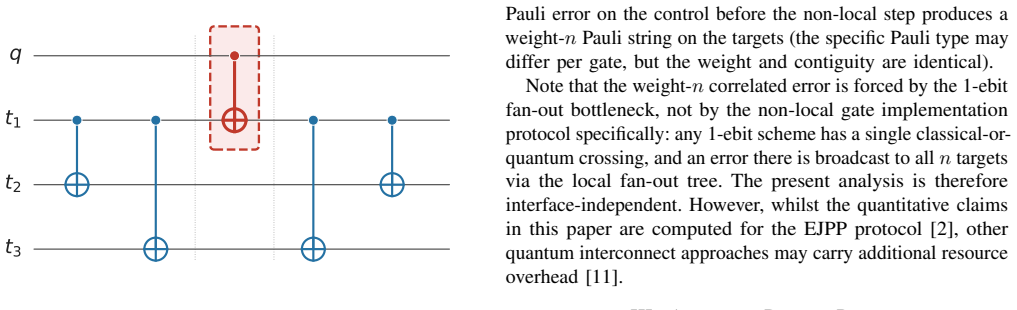
Multi-gate teleportation saves n-1 ebits by routing n gates through a single 1-ebit fan-out circuit, at the cost of one network fault injecting a weight-n Pauli error. For rotated surface codes of distance d the design rule nmax_corr(d) = ceil(d/2) keeps the logical error rate fault-tolerant under a correlation-aware decoder, while the naive bound is floor(d/2). The standard MWPM decoder constructed from the packet circuit's noise model corrects the correlated errors as effectively as independent ones; at network-to-local ratios gamma up to 100 the packet matches or surpasses sequential per-link logical error rates, with the gain growing in gamma and d, while entanglement cost drops from n t
What carries the argument
The multi-gate teleportation fan-out circuit whose circuit-level noise model is supplied directly to a minimum-weight perfect matching decoder.
If this is right
- Packetisation reduces entanglement use from n ebits to 1 while keeping or lowering logical error rates when network noise dominates.
- The bound ceil(d/2) permits larger safe packets than the naive floor(d/2) limit.
- Performance gains increase with both the network-to-local noise ratio gamma and the code distance d.
- No custom decoder is needed; the circuit noise model already captures the correlation.
- Packetisation is advantageous only when the network is the bottleneck; at gamma near 1 the extra local fan-out gates offset the savings.
Where Pith is reading between the lines
- Noise-aware distributed compilers can now default to fan-out packetisation for remote gates without extra decoder engineering.
- The same noise-model approach may yield analogous packet-size rules for other codes once their circuit noise is modeled.
- Hybrid strategies that switch between packet and sequential modes depending on measured gamma could further reduce overhead.
- Verification on non-rotated surface codes or with alternative decoders would test whether the ceil(d/2) bound generalizes.
- keywords:[
Load-bearing premise
The standard MWPM decoder built from the packet circuit's noise model will correct the weight-n correlated errors produced by the fan-out.
What would settle it
A simulation in which the logical error rate for packets of size ceil(d/2) exceeds the sequential baseline at moderate-to-high gamma would falsify that the standard decoder suffices.
Figures
read the original abstract
Multi-gate teleportation (MGT) packages $n$ remote gates into a single ebit via a 1-ebit fan-out quantum circuit, saving $n{-}1$ entangled pairs relative to sequential gate teleportation. The cost is a correlated failure mode: a single network fault propagates through the fan-out tree, injecting a weight-$n$ Pauli error. We derive a design rule for fault-tolerant packet sizes, $\nmax^{\text{corr}}(d) = \lceil d/2 \rceil$ for rotated surface codes of distance~$d$ with a correlation-aware decoder ($\nmax^{\text{naive}} = \lfloor d/2 \rfloor$ without), bounding how many gates can be packaged whilst preserving fault tolerance. Simulation with PyMatching shows that the standard MWPM decoder built from the packet circuit's noise model naturally corrects the correlated error: at network-to-local noise ratios $\gamma = \pnet/\pgate$ up to $100$, the packet matches or surpasses the per-link sequential LER at moderate-to-high $\gamma$, with the advantage growing with both $\gamma$ and $d$, whilst reducing the entanglement cost from $n$ ebits to~$1$. Packetisation wins when the network is the bottleneck ($\gamma \gg 1$); at $\gamma \approx 1$ the $n{-}1$ extra local fan-out gates offset the network savings. No custom decoder is required: the circuit-level noise model already encodes the correlation. These results enable noise-aware distributed circuit compilers to favour fan-out packetisation without sacrificing fault tolerance.
Editorial analysis
A structured set of objections, weighed in public.
Referee Report
Summary. The manuscript derives a design rule n_max^cor(d) = ceil(d/2) for the maximum packet size in multi-gate teleportation (packaging n remote gates into one ebit via 1-ebit fan-out) for rotated surface codes of distance d, contrasting it with the naive bound floor(d/2). It reports PyMatching simulations showing that the standard MWPM decoder, when constructed from the packet circuit's noise model, corrects the weight-n correlated Pauli errors induced by network faults in the fan-out without requiring a custom decoder, yielding entanglement savings and logical error rate advantages that grow with network-to-local noise ratio gamma and with d.
Significance. If the central claims hold, the work supplies a concrete, noise-aware design rule for distributed quantum compilers that reduces entanglement overhead from n ebits to 1 while preserving fault tolerance. The explicit demonstration that circuit-level modeling suffices for standard MWPM (no custom decoder) and the quantitative simulation results across gamma up to 100 and multiple d values are practical strengths that could directly inform resource estimation in networked architectures.
major comments (2)
- [Abstract and simulation results paragraph] Abstract and simulation results paragraph: the claim that 'the standard MWPM decoder built from the packet circuit's noise model naturally corrects the correlated error' (no custom decoder required) is load-bearing for the no-custom-decoder conclusion and the n_max^cor bound. A single network fault through the fan-out produces a weight-n Pauli (hyperedge of degree n=ceil(d/2) in the detector graph). Standard PyMatching MWPM operates on pairwise graphs and cannot natively represent such hyperedges without decomposition or approximation; the manuscript must specify the exact detector-graph construction used and confirm that the effective distance remains d rather than dropping for n>2.
- [Derivation of the design rule] Derivation of the design rule: n_max^cor(d) = ceil(d/2) is stated to follow from code distance and decoder properties, yet the manuscript provides no explicit equation or step showing why the correlation-aware modeling increases the allowable packet size by one relative to the naive floor(d/2) bound. Without this derivation or a table confirming that logical error rate remains below threshold exactly up to ceil(d/2) (and exceeds it beyond), the bound cannot be verified as parameter-free or generally applicable to rotated surface codes.
minor comments (2)
- Notation: symbols such as n_max^cor(d), gamma = p_net / p_gate, and the rotated surface code distance d are introduced without a consolidated notation table; adding one would improve readability.
- [simulation results paragraph] Simulation details: the abstract reports outcomes at gamma up to 100 but does not list the exact number of shots, the precise surface-code lattice sizes simulated, or the exclusion criteria for failed decodings; these should be added to the methods or results section for reproducibility.
Simulated Author's Rebuttal
We thank the referee for their careful reading and constructive comments, which help strengthen the presentation of our results on multi-gate teleportation. We address each major comment below and will incorporate clarifications in the revised manuscript.
read point-by-point responses
-
Referee: [Abstract and simulation results paragraph] the claim that 'the standard MWPM decoder built from the packet circuit's noise model naturally corrects the correlated error' (no custom decoder required) is load-bearing... Standard PyMatching MWPM operates on pairwise graphs and cannot natively represent such hyperedges without decomposition or approximation; the manuscript must specify the exact detector-graph construction used and confirm that the effective distance remains d rather than dropping for n>2.
Authors: We agree that explicit details on the detector-graph construction are needed for clarity. In the manuscript, the circuit-level noise model is generated from the full packet circuit (including the 1-ebit fan-out) using Stim, and PyMatching is applied to the resulting detector graph with edge weights derived from the probabilities of all error mechanisms, including the network fault that induces the weight-n correlated Pauli. Although MWPM uses a pairwise graph, the correlations are encoded via the joint error probabilities in the model; simulations across d=3,5,7 and gamma up to 100 show the logical error rate scaling consistent with preserved distance d (no degradation for n=ceil(d/2)). We will revise to add a dedicated paragraph detailing the Stim-to-PyMatching pipeline and an explicit check that the effective distance remains d. revision: yes
-
Referee: [Derivation of the design rule] n_max^cor(d) = ceil(d/2) is stated to follow from code distance and decoder properties, yet the manuscript provides no explicit equation or step showing why the correlation-aware modeling increases the allowable packet size by one relative to the naive floor(d/2) bound. Without this derivation or a table confirming that logical error rate remains below threshold exactly up to ceil(d/2) (and exceeds it beyond), the bound cannot be verified as parameter-free or generally applicable to rotated surface codes.
Authors: The bound follows from the rotated surface code's ability to correct up to floor((d-1)/2) errors in the uncorrelated case (yielding the naive floor(d/2) packet limit to avoid logical operators), while the correlation-aware model treats the specific weight-n Pauli pattern from a single network fault as a single high-probability mechanism whose likelihood is captured in the detector graph; this permits one additional gate (to ceil(d/2)) before the pattern becomes indistinguishable from a logical error under the joint probabilities. We will add an explicit derivation with the relevant equations in the main text (near the definition of n_max^cor) and a supplementary table/figure of LER vs. n for multiple d values confirming the threshold behavior holds exactly up to ceil(d/2). revision: yes
Circularity Check
No circularity: bound follows from standard distance properties; simulations use external decoder on explicit model
full rationale
The paper states it derives nmax_corr(d) = ceil(d/2) from the rotated surface code distance d and the properties of a correlation-aware decoder, with the naive bound floor(d/2) without. This is a direct consequence of the code's ability to correct floor((d-1)/2) errors (standard threshold) versus handling a single weight-n correlated error when the decoder accounts for the circuit-level noise model. No equations reduce the bound to a fitted parameter or prior self-citation by construction. Simulations invoke PyMatching (external standard tool) on an explicitly constructed noise model from the packet circuit; the claim that this model 'naturally corrects' the correlation is presented as a simulation outcome rather than an input assumption. No self-citation load-bearing steps, ansatz smuggling, or renaming of known results appear in the provided text. The derivation chain is self-contained against external benchmarks.
Axiom & Free-Parameter Ledger
axioms (2)
- domain assumption Rotated surface codes of distance d tolerate weight-n Pauli errors for n up to ceil(d/2) under a correlation-aware decoder.
- domain assumption The circuit-level noise model constructed from the multi-gate teleportation packet accurately encodes the propagation of a single network fault into a weight-n correlated Pauli error.
Reference graph
Works this paper leans on
-
[1]
Demonstrating the viability of universal quantum computation using teleportation and single-qubit operations,
D. Gottesman and I. L. Chuang, “Demonstrating the viability of universal quantum computation using teleportation and single-qubit operations,” Nature, vol. 402, pp. 390–393, 1999
1999
-
[2]
Optimal local implementation of nonlocal quantum gates,
J. Eisert, K. Jacobs, P. Papadopoulos, and M. B. Plenio, “Optimal local implementation of nonlocal quantum gates,”Phys. Rev. A, vol. 62, p. 052317, 2000
2000
-
[3]
Automated distribution of quantum circuits via hypergraph partitioning,
P. Andrés-Martínez and C. Heunen, “Automated distribution of quantum circuits via hypergraph partitioning,”Physical Review A, vol. 100, no. 3, 2019. [Online]. Available: http://dx.doi.org/10.1103/PhysRevA. 100.032308
-
[4]
Networked realization of quantum ldpc codes,
S. Shaw and N. Rengaswamy, “Networked realization of quantum ldpc codes,” 2026
2026
-
[5]
Transversal fault tolerant distributed quantum computing operations,
J. Stack, M. Wang, and F. Mueller, “Transversal fault tolerant distributed quantum computing operations,” 2025
2025
-
[6]
Distributed Quantum Error Correction with Bivariate Bicycle Codes in a Modular Architecture
N. K. Chandra, E. Kaur, R. Nejabati, and K. P. Seshadreesan, “Distributed quantum error correction with bivariate bicycle codes in a modular architecture,” 2026. [Online]. Available: https://arxiv.org/abs/2605.04663
work page internal anchor Pith review Pith/arXiv arXiv 2026
-
[7]
Space-time tradeoffs of pauli-based computation in distributed qldpc architectures,
N. Benchasattabuse, M. Hajdušek, and R. V . Meter, “Space-time tradeoffs of pauli-based computation in distributed qldpc architectures,”
-
[8]
Space-Time Tradeoffs of Pauli-Based Computation in Distributed qLDPC Architectures
[Online]. Available: https://arxiv.org/abs/2605.03854
work page internal anchor Pith review Pith/arXiv arXiv
-
[9]
Impact of network constraints on fault- tolerant distributed quantum computing,
E. Kaur, S. Pouryousef, N. K. Chandra, H. Shapourian, J. Zhao, R. Kompella, and R. Nejabati, “Impact of network constraints on fault- tolerant distributed quantum computing,” 2026
2026
-
[10]
Lattice surgery- based logical state teleportation via noisy links,
D. Márton, P. Colmenarez, M. Bödeker, and M. Müller, “Lattice surgery- based logical state teleportation via noisy links,” 2025
2025
-
[11]
Network requirements for distributed quantum computation,
H. Jacinto, E. Gouzien, and N. Sangouard, “Network requirements for distributed quantum computation,”Phys. Rev. Res., vol. 8, p. 013205, Feb 2026. [Online]. Available: https://link.aps.org/doi/10.1103/v9ln-c4v2
-
[12]
Optimized noise-resilient surface code teleportation interfaces,
M. A. Shalby, R. Wang, and D. Sedov, “Optimized noise-resilient surface code teleportation interfaces,” 2025
2025
-
[13]
On distributed quantum computing with distributed fan-out operations,
S. W. Loke, “On distributed quantum computing with distributed fan-out operations,” 2026
2026
-
[14]
Distributed quantum circuit optimisation: Evaluating global and local encodings,
M. Gragera Garces and M. Haghparast, “Distributed quantum circuit optimisation: Evaluating global and local encodings,” 2026
2026
-
[15]
Optimal complexity correction of correlated errors in the surface code,
A. G. Fowler, “Optimal complexity correction of correlated errors in the surface code,” 2013
2013
-
[16]
Simulation of rare events in quantum error correction,
S. Bravyi and A. Vargo, “Simulation of rare events in quantum error correction,”Phys. Rev. A, vol. 88, p. 062308, 2013
2013
-
[17]
Sparse Blossom: correcting a million errors per core second with minimum-weight matching,
O. Higgott and C. Gidney, “Sparse Blossom: correcting a million errors per core second with minimum-weight matching,”Quantum, vol. 9, p. 1600, Jan. 2025. [Online]. Available: https://doi.org/10.22331/ q-2025-01-20-1600
2025
-
[18]
Theory of quantum error-correcting codes,
E. Knill and R. Laflamme, “Theory of quantum error-correcting codes,” Phys. Rev. A, vol. 55, pp. 900–911, 1997
1997
-
[19]
Quantum teleportation of an elemental silicon nanophotonic CNOT gate,
K.-C. Chang, X. Cheng, F. Ribuot-Hirsch, M. C. Sarihan, Y . Chen, J. G. F. Flores, M. Yu, P. G.-Q. Loet al., “Quantum teleportation of an elemental silicon nanophotonic CNOT gate,”Optica Quantum, vol. 3, p. 381, 2025
2025
-
[20]
Distributed quantum computation based on small quantum registers,
L. Jiang, J. M. Taylor, A. S. Sørensen, and M. D. Lukin, “Distributed quantum computation based on small quantum registers,”Phys. Rev. A, vol. 76, p. 062323, 2007
2007
-
[21]
Tour de gross: A modular quantum computer based on bivariate bicycle codes
T. J. Yoder, E. Schoute, P. Rall, E. Pritchett, J. M. Gambetta, A. W. Cross, M. Carroll, and M. E. Beverland, “Tour de gross: A modular quantum computer based on bivariate bicycle codes,” 2025. [Online]. Available: https://arxiv.org/abs/2506.03094
work page internal anchor Pith review Pith/arXiv arXiv 2025
-
[22]
Optimized compilation for distributed quantum computing,
M. Bandini, D. Ferrari, S. Carretta, and M. Amoretti, “Optimized compilation for distributed quantum computing,” 2026. [Online]. Available: https://arxiv.org/abs/2602.24062
-
[23]
Efficient gate reordering for distributed quantum compiling in data centers,
R. Mengoni, W. Nadalin, M. Rennela, J. Rotureau, T. Darras, J. Laurat, E. Diamanti, and I. Lavdas, “Efficient gate reordering for distributed quantum compiling in data centers,” 2025. [Online]. Available: https://arxiv.org/abs/2507.01090
-
[24]
Assessing System Capabilities and Bottlenecks of an Early Fault-Tolerant Bicycle Architecture
K. Liu, B. Foxman, G.-L. R. Anselmetti, and Y . Ding, “Assessing system capabilities and bottlenecks of an early fault-tolerant bicycle architecture,” 2026. [Online]. Available: https://arxiv.org/abs/2604.20013
work page internal anchor Pith review Pith/arXiv arXiv 2026
-
[25]
Entanglement-efficient distribu- tion of quantum circuits over large-scale quantum networks,
F. Burt, K.-C. Chen, and K. K. Leung, “Entanglement-efficient distribu- tion of quantum circuits over large-scale quantum networks,” in2025 IEEE International Conference on Quantum Computing and Engineering (QCE), vol. 01, 2025, pp. 1111–1122
2025
discussion (0)
Sign in with ORCID, Apple, or X to comment. Anyone can read and Pith papers without signing in.