Token Geometry
Pith reviewed 2026-07-03 21:06 UTC · model grok-4.3
The pith
The embedding and LM-head interface in language models has distinct gradient geometry that a lightweight optimizer can exploit to reduce memory use while matching or exceeding standard performance.
A machine-rendered reading of the paper's core claim, the machinery that carries it, and where it could break.
Core claim
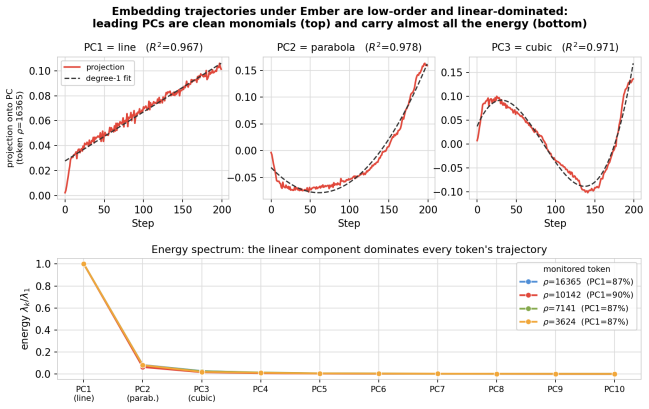
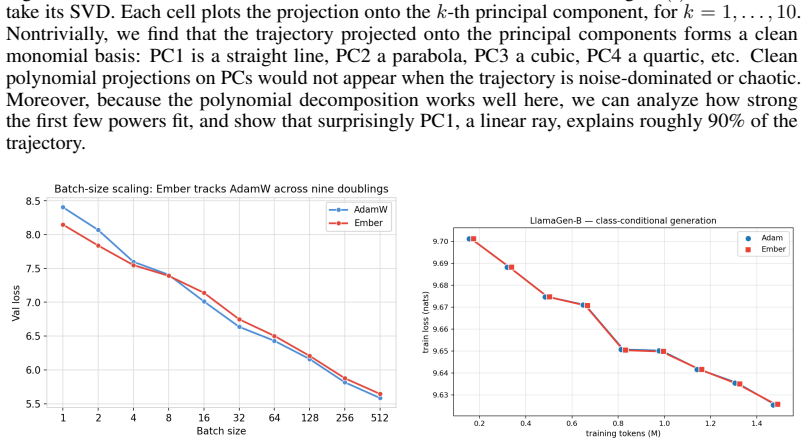
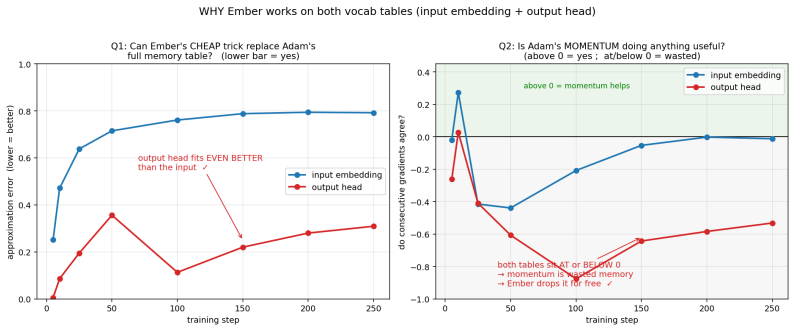
The embedding table and LM-head exhibit gradient geometry distinct from hidden weights; this geometry can be exploited by an optimizer that stores only O(V + D) VRAM and still improves the Pareto frontier across supervised finetuning, RL, and pretraining. Token trajectories are well described by a one-dimensional ray, and the same geometry explains why a small set of optimizer designs suffices for Transformer training.
What carries the argument
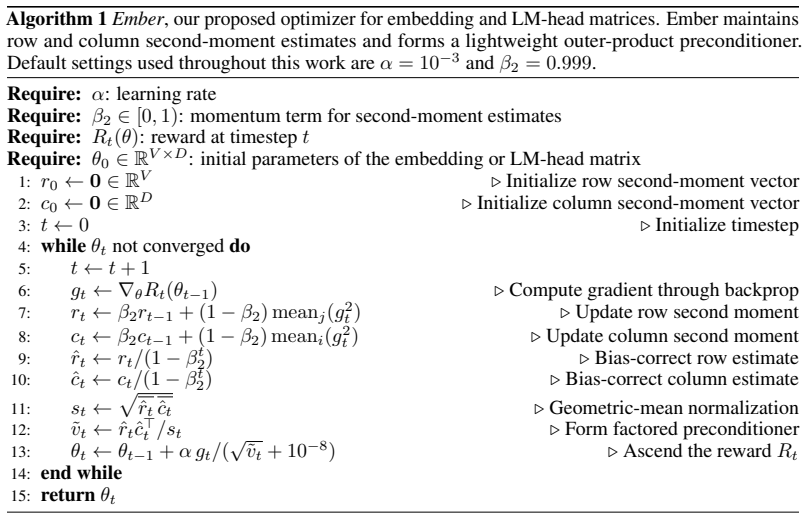
Ember, a lightweight optimizer for embedding and LM-head matrices that treats each token's update as motion along a one-dimensional ray and requires only O(V + D) optimizer state.
If this is right
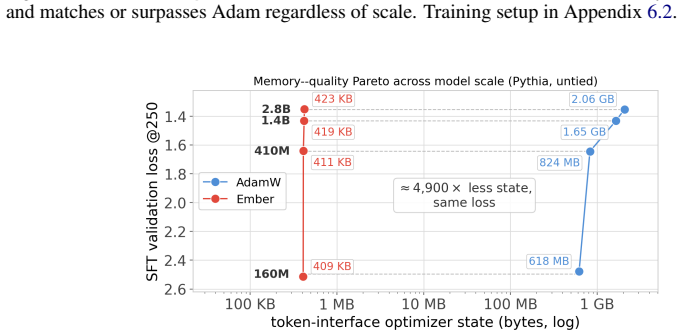
- Ember reduces total optimizer state for the vocabulary matrices from O(2VD) to O(V + D), eliminating the need to shard both embedding and head optimizer states.
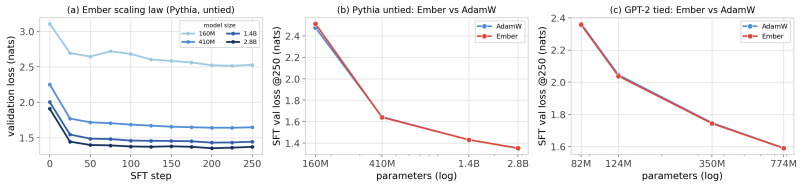
- The same optimizer works across supervised finetuning, reinforcement learning from human feedback, and pretraining without architecture changes.
- Token-level updates follow a one-dimensional trajectory, which accounts for why only a narrow class of optimizers performs well on Transformer models.
- The implementation merges directly with ZeRO and FSDP, allowing immediate use in existing large-scale training stacks.
Where Pith is reading between the lines
- If the one-dimensional ray description holds at larger scales, then token-level learning rates or momentum could be set independently of the rest of the network without destabilizing training.
- The geometry distinction may explain why vocabulary size often becomes a memory bottleneck even when hidden-layer optimizers are heavily sharded.
- Similar interface-specific optimizers might be worth testing on other discrete-to-continuous mappings, such as code tokenizers or multimodal projection layers.
Load-bearing premise
The observed difference in gradient geometry between token tables and hidden weights is large enough that a specialized optimizer can improve efficiency without hidden costs to convergence speed or training stability.
What would settle it
Running Ember on a standard pretraining run and finding that final loss or downstream accuracy falls behind an otherwise identical Adam baseline by more than a small constant margin.
Figures


read the original abstract
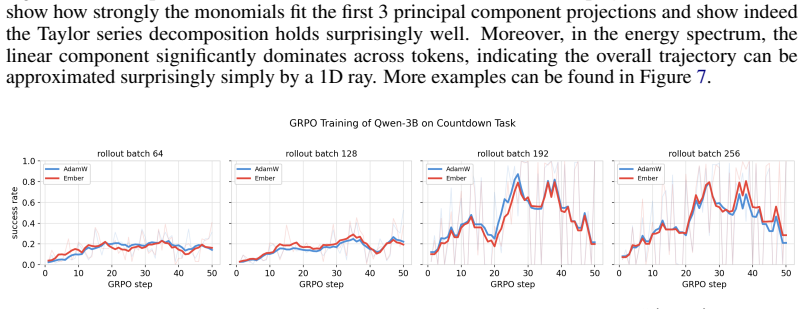
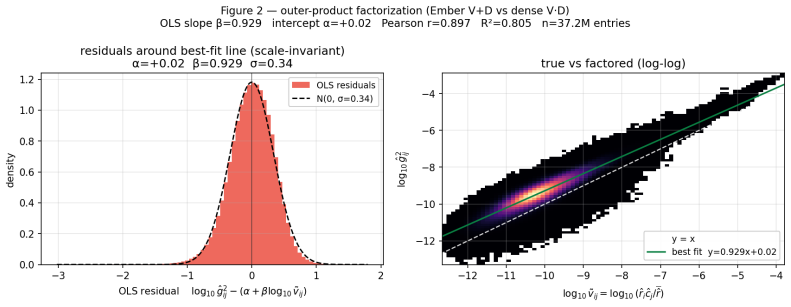
Language models learn continuous programs over discrete symbols, with the embedding table and LM-head acting as the read/write interface between them. We show that this interface has gradient geometry distinct from dense hidden weights which can be exploited to improve the Pareto frontier across supervised finetuning, RL, and pretraining, while only utilizing kilobytes of optimizer state. We introduce Ember, a lightweight optimizer for embedding and LM-head matrices that utilizes O(V + D) VRAM, instead of Adam's O(2VD), and forgoes the need to shard both token table optimizer states. We provide empirical evidence that Ember scales effectively across batch size and parameter count. We show that the optimization trajectory of tokens can be well described by a simple 1D ray, counter to the popular belief that neural net parameters navigate a heavily nonconvex landscape. We provide a principled view on the surprisingly narrow space of optimizers that suffice for Transformer training. Finally, we open-source our distributed Ember implementation that merges cleanly with existing ZeRO/FSDP setups to support further research at https://github.com/katop1234/ember
Editorial analysis
A structured set of objections, weighed in public.
Referee Report
Summary. The paper claims that the embedding table and LM-head in language models exhibit gradient geometry distinct from dense hidden weights. This geometry is exploited by a new lightweight optimizer, Ember, which uses O(V + D) VRAM (versus Adam's O(2VD)) and only kilobytes of optimizer state to improve the Pareto frontier across supervised finetuning, RL, and pretraining. The manuscript further claims that token optimization trajectories are well-described by a simple 1D ray (contrary to typical nonconvex landscape views), provides a principled perspective on sufficient optimizers for Transformer training, demonstrates scaling across batch size and parameter count, and releases a distributed implementation compatible with ZeRO/FSDP.
Significance. If the empirical claims hold, the work could meaningfully reduce optimizer memory overhead for large-vocabulary models, enabling larger scales or training on constrained hardware without sharding both token-table optimizer states. The open-sourced implementation and explicit scaling tests across batch sizes and parameter counts are concrete strengths. The 1D-ray trajectory description, if supported by the full derivations and ablations, offers a falsifiable perspective that could influence optimizer design. The stress-test concern (whether distinct geometry yields Pareto gains without hidden convergence or stability costs) does not land as a load-bearing issue on the basis of the scaling evidence presented.
minor comments (2)
- The abstract states that Ember 'scales effectively across batch size and parameter count' and that the 1D ray description is 'well' supported; the main text should include explicit quantitative metrics (e.g., trajectory fit error, stability metrics, or Pareto deltas) with error bars or multiple seeds to allow readers to assess robustness.
- Notation for the memory complexity O(V + D) versus O(2VD) is clear in the abstract but would benefit from an explicit comparison table (e.g., Table X) showing actual VRAM usage and wall-clock overhead for representative V and D values.
Simulated Author's Rebuttal
We thank the referee for their supportive summary, significance assessment, and recommendation of minor revision. The report contains no major comments requiring point-by-point rebuttal.
Circularity Check
No significant circularity detected
full rationale
The provided abstract and context describe empirical observations on gradient geometry for embeddings/LM-heads, a 1D ray trajectory description, and an optimizer Ember with O(V+D) state. No load-bearing derivation step is shown to reduce by construction to its own inputs via self-definition, fitted parameters renamed as predictions, or self-citation chains. The 1D ray claim is presented as an empirical finding rather than a fitted input called prediction, and the central claims rest on scaling tests and implementation details without internal reduction to tautology. The derivation chain is self-contained against external benchmarks.
Axiom & Free-Parameter Ledger
Reference graph
Works this paper leans on
-
[1]
Diederik P. Kingma and Jimmy Ba. Adam: A method for stochastic optimization. InInternational Conference on Learning Representations (ICLR), 2015
work page 2015
-
[2]
Sham M. Kakade. A natural policy gradient. InAdvances in Neural Information Processing Systems 14, pages 1531–1538. MIT Press, 2001
work page 2001
-
[3]
Heavy-tailed class imbalance and why Adam outperforms gradient descent on language models
Frederik Kunstner, Robin Yadav, Alan Milligan, Mark Schmidt, and Alberto Bietti. Heavy-tailed class imbalance and why Adam outperforms gradient descent on language models. InAdvances in Neural Information Processing Systems, 2024
work page 2024
-
[4]
Modular duality in deep learning.arXiv preprint arXiv:2410.21265, 2024
Jeremy Bernstein and Laker Newhouse. Modular duality in deep learning. InarXiv preprint arXiv:2410.21265, 2024
-
[5]
Zhihong Shao, Peiyi Wang, Qihao Zhu, Runxin Xu, Junxiao Song, Xiao Bi, Haowei Zhang, Mingchuan Zhang, Y . K. Li, Y . Wu, and Daya Guo. DeepSeekMath: Pushing the limits of mathematical reasoning in open language models.arXiv preprint arXiv:2402.03300, 2024
work page internal anchor Pith review Pith/arXiv arXiv 2024
-
[6]
N. N. Chentsov.Statistical Decision Rules and Optimal Inference. Translations of Mathematical Monographs, V ol. 53. American Mathematical Society, Providence, RI, 1982
work page 1982
-
[7]
Natural gradient works efficiently in learning.Neural Computation, 10(2):251– 276, 1998
Shun-ichi Amari. Natural gradient works efficiently in learning.Neural Computation, 10(2):251– 276, 1998
work page 1998
-
[8]
Applied Mathematical Sciences, V ol
Shun-ichi Amari.Information Geometry and Its Applications. Applied Mathematical Sciences, V ol. 194. Springer Japan, Tokyo, 2016
work page 2016
-
[9]
Alexander Ly, Maarten Marsman, Josine Verhagen, Raoul P. P. P. Grasman, and Eric-Jan Wa- genmakers. A tutorial on Fisher information.Journal of Mathematical Psychology, 80:40–55, 2017
work page 2017
-
[10]
An elementary introduction to information geometry.Entropy, 22(10):1100, 2020
Frank Nielsen. An elementary introduction to information geometry.Entropy, 22(10):1100, 2020
work page 2020
-
[11]
Revisiting natural gradient for deep networks
Razvan Pascanu and Yoshua Bengio. Revisiting natural gradient for deep networks. In International Conference on Learning Representations (ICLR), 2014
work page 2014
-
[12]
Guillaume Desjardins, Karen Simonyan, Razvan Pascanu, and Koray Kavukcuoglu. Natural neural networks. InAdvances in Neural Information Processing Systems, 2015
work page 2015
-
[13]
Modular manifolds.Thinking Machines Lab: Connectionism, 2025
Jeremy Bernstein. Modular manifolds.Thinking Machines Lab: Connectionism, 2025. https: //thinkingmachines.ai/blog/modular-manifolds/, doi:10.64434/tml.20250926
-
[14]
DeepSeek-V4: Towards highly efficient million-token context intelligence
DeepSeek-AI. DeepSeek-V4: Towards highly efficient million-token context intelligence. Technical Report, 2026
work page 2026
-
[15]
Muon: An optimizer for LLMs.Keller Jordan’s Blog, 2024
Keller Jordan. Muon: An optimizer for LLMs.Keller Jordan’s Blog, 2024. URL: https: //kellerjordan.github.io/posts/muon/
work page 2024
-
[16]
David E. Rumelhart, Geoffrey E. Hinton, and Ronald J. Williams. Learning representations by back-propagating errors.Nature, 323(6088):533–536, 1986
work page 1986
- [17]
-
[18]
Adafactor: Adaptive learning rates with sublinear memory cost
Noam Shazeer and Mitchell Stern. Adafactor: Adaptive learning rates with sublinear memory cost. InInternational Conference on Machine Learning (ICML), 2018
work page 2018
-
[19]
Tim Tsz-Kit Lau and Weijie Su. Symmetry-compatible principle for optimizer design: Em- beddings, LM heads, SwiGLU MLPs, and MoE routers.arXiv preprint arXiv:2605.18106, 2026. 9
work page internal anchor Pith review Pith/arXiv arXiv 2026
-
[20]
signSGD: Compressed optimisation for non-convex problems
Jeremy Bernstein, Yu-Xiang Wang, Kamyar Azizzadenesheli, and Anima Anandkumar. signSGD: Compressed optimisation for non-convex problems. InInternational Conference on Machine Learning (ICML), 2018
work page 2018
-
[21]
Jorge Nocedal and Stephen J. Wright. Numerical optimization. Springer, 2nd edition, 2006
work page 2006
-
[22]
ZeRO: Memory op- timizations toward training trillion parameter models
Samyam Rajbhandari, Jeff Rasley, Olatunji Ruwase, and Yuxiong He. ZeRO: Memory op- timizations toward training trillion parameter models. InInternational Conference for High Performance Computing, Networking, Storage and Analysis (SC20), 2020
work page 2020
-
[23]
M. S. Bartlett. Approximate confidence intervals. InBiometrika, 1953
work page 1953
-
[24]
Francis Ysidro Edgeworth. The law of error. InTransactions of the Cambridge Philosophical Society, 20:33–66, 1905
work page 1905
-
[25]
Lecture Notes in Statistics, V olume 28
Shun-ichi Amari.Differential-Geometrical Methods in Statistics. Lecture Notes in Statistics, V olume 28. Springer, 1985
work page 1985
-
[26]
Chentsov.Statistical Decision Rules and Optimal Inference
Nikolai N. Chentsov.Statistical Decision Rules and Optimal Inference. American Mathematical Society, 1982
work page 1982
-
[27]
Google AI.Gemma 3n model overview. 2025. https://ai.google.dev/gemma/docs/ gemma-3n. Accessed: 2026-06-17. 10 6 Appendix 6.1 Further work Parameter class-awareness.In general, a principled method of coming up with optimizers for different transformer parameter classes can likely save memory state and improve performance. Comfortingly, the search space of ...
work page 2025
discussion (0)
Sign in with ORCID, Apple, or X to comment. Anyone can read and Pith papers without signing in.