DiPS: Dialogue Policy Selection for High-Stakes Persuasion Agents
Pith reviewed 2026-07-03 00:45 UTC · model grok-4.3
The pith
DiPS uses Q-learning to select persuasion strategies dynamically based on resident utterances, raising evacuation success over zero-shot LLMs.
A machine-rendered reading of the paper's core claim, the machinery that carries it, and where it could break.
Core claim
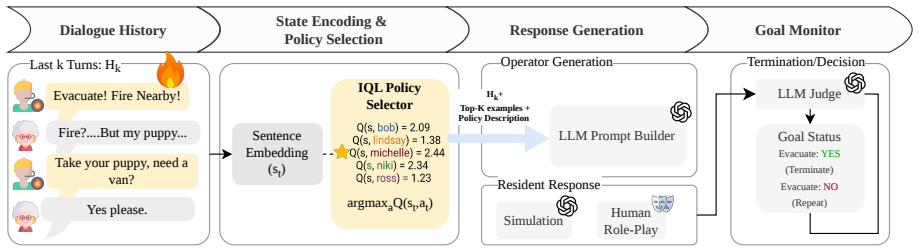
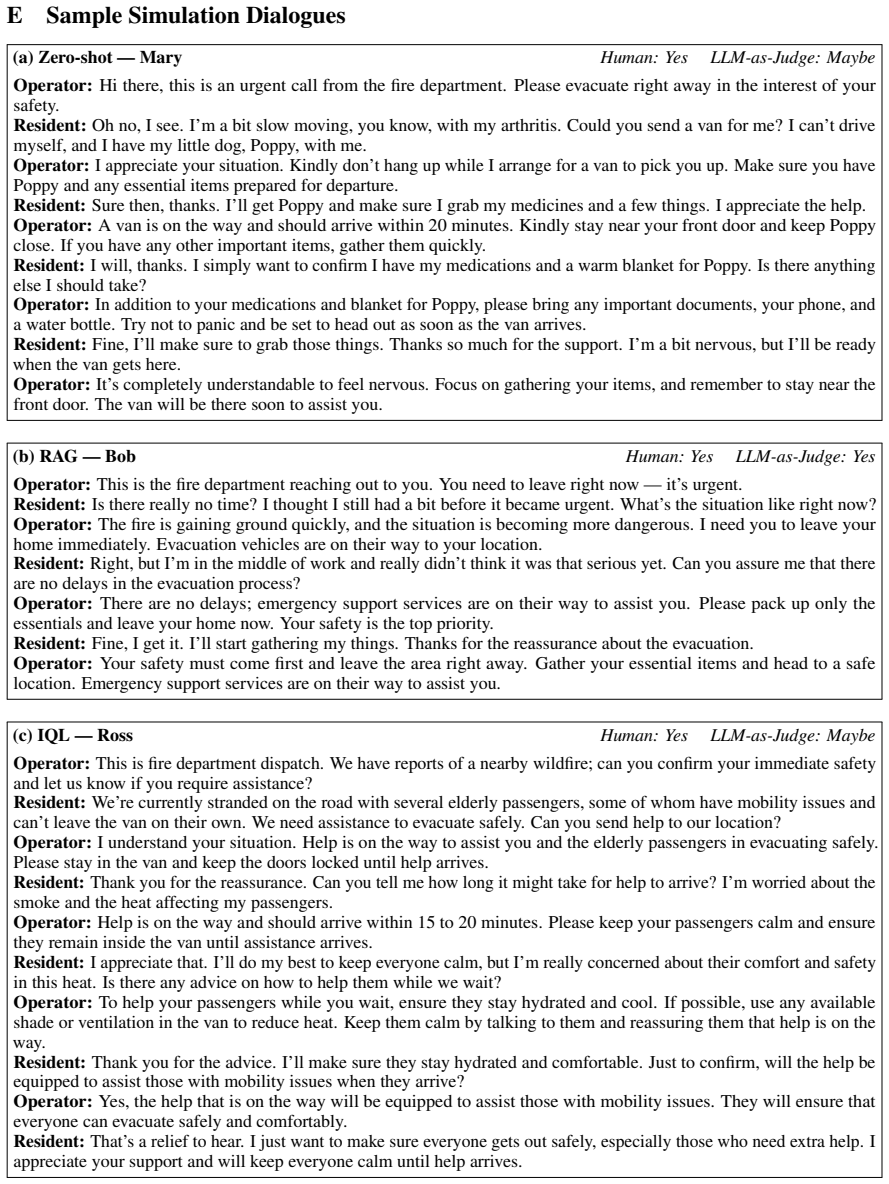
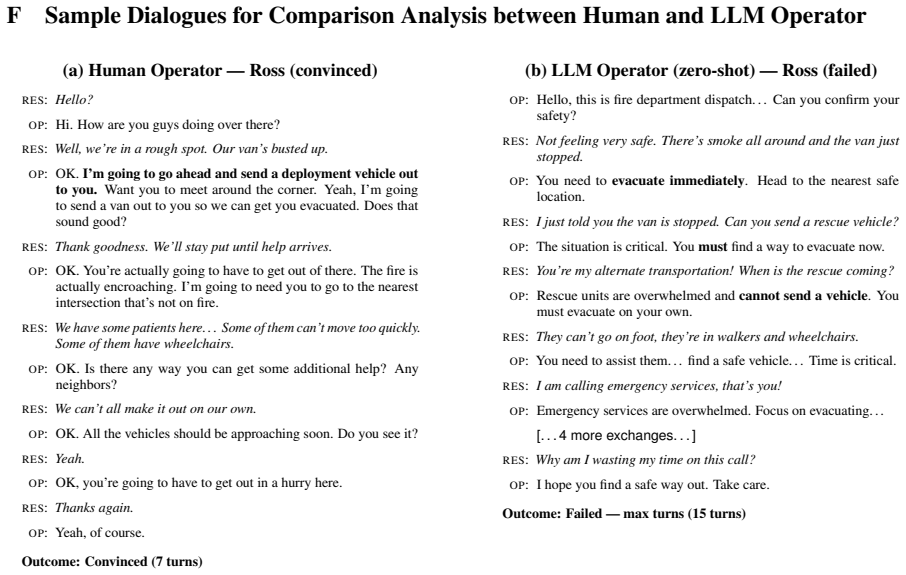
DiPS is a Q-learning framework to dynamically select persuasion strategies adapted to the evolving conversational context. A critic trained to maximize the chance of evacuation success selects a persuasion policy at each turn based on the resident's recent utterances. DiPS achieves higher evacuation success than a zero-shot LLM and generic RAG-augmented approach in both simulated and real human interactions.
What carries the argument
The critic model inside the Q-learning framework, which scores and selects among persuasion policies at each turn using resident utterances and dialogue state.
If this is right
- Higher evacuation success rates compared with zero-shot LLMs and RAG baselines in the same fire-rescue dialogues.
- Dynamic selection adapts persuasion tactics to changes in the resident's recent statements.
- The same critic-based selection can be applied to other high-stakes persuasion tasks beyond evacuation.
- Training the critic on success labels produces measurable gains in both simulation and live interactions.
Where Pith is reading between the lines
- The method could be tested on longer dialogues that include more resident history or personality cues.
- Success might improve further if the critic receives explicit feedback from failed prior turns.
- Deployment in real emergencies would need safeguards against the critic selecting manipulative or unsafe tactics.
Load-bearing premise
The critic model can reliably predict which persuasion strategy will work given only the resident's recent utterances and the current dialogue state.
What would settle it
Run new human trials in which the critic's policy selections are replaced by random or fixed selections and measure whether evacuation success rates drop measurably below the DiPS condition.
Figures

read the original abstract
Large Language Models (LLMs) often struggle with persuasion in high-stakes scenarios. People's individual personalities and concerns require tailored strategies rather than a one-size-fits-all approach. To address this challenge, we focus on a fire-rescue scenario in which an operator must persuade a resident to evacuate as a high-stakes persuasion domain and propose Dialogue Policy Selection (DiPS), a Q-learning framework to dynamically select persuasion strategies adapted to the evolving conversational context. Specifically, we train a critic, trained to maximize the chance of evacuation success, to select a persuasion policy at each turn based on the resident's recent utterances.We then evaluate DiPS against multiple baselines in both simulated and real human interactions. We find that DiPS achieves higher evacuation success than a zero-shot LLM and generic RAG-augmented approach.
Editorial analysis
A structured set of objections, weighed in public.
Referee Report
Summary. The paper proposes DiPS, a Q-learning framework for selecting among persuasion policies in a fire-rescue evacuation domain. A critic is trained to maximize evacuation success and selects a policy at each turn based on the resident's recent utterances and current dialogue state. The central empirical claim is that DiPS yields higher evacuation success rates than a zero-shot LLM baseline and a generic RAG-augmented approach, demonstrated in both simulated environments and real human interactions.
Significance. If the reported gains prove robust under proper statistical controls and state representations that capture resident traits, the work would offer a concrete, learnable alternative to static prompting for high-stakes persuasion. The Q-learning critic formulation is standard, but its application to LLM strategy selection in safety-critical dialogue is a timely contribution; reproducible code or parameter-free derivations are not mentioned.
major comments (2)
- [Abstract] Abstract and Experiments section: the claim that DiPS 'achieves higher evacuation success' supplies no quantitative results, error bars, dataset sizes, training corpus details, or statistical tests. Without these, the central empirical comparison cannot be evaluated and the outperformance claim remains unsupported.
- [Method] Method / Critic description: the state representation is described only as 'resident's recent utterances' plus 'current dialogue state.' No information is given on whether stable resident traits (personality, prior concerns) are included or how the reward signal for evacuation success was obtained. This directly affects the load-bearing assumption that the critic can reliably value policies for unseen real-human responses.
Simulated Author's Rebuttal
We thank the referee for the constructive feedback and the recommendation for major revision. We address each major comment below and will incorporate clarifications and additions to strengthen the empirical presentation and methodological details.
read point-by-point responses
-
Referee: [Abstract] Abstract and Experiments section: the claim that DiPS 'achieves higher evacuation success' supplies no quantitative results, error bars, dataset sizes, training corpus details, or statistical tests. Without these, the central empirical comparison cannot be evaluated and the outperformance claim remains unsupported.
Authors: We agree that the abstract lacks specific quantitative support for the central claim, which limits immediate evaluability. The Experiments section reports success rates from simulation and human trials with baseline comparisons, but we will revise both the abstract and Experiments section to explicitly include key quantitative results (evacuation success percentages for DiPS versus baselines), error bars or variance measures, dataset sizes (simulation runs and human participants), training corpus details for the critic, and references to the statistical tests performed. These additions will make the outperformance claim fully supported and transparent. revision: yes
-
Referee: [Method] Method / Critic description: the state representation is described only as 'resident's recent utterances' plus 'current dialogue state.' No information is given on whether stable resident traits (personality, prior concerns) are included or how the reward signal for evacuation success was obtained. This directly affects the load-bearing assumption that the critic can reliably value policies for unseen real-human responses.
Authors: We acknowledge the need for greater precision here. In the revised Method section we will clarify that the state representation consists of the resident's recent utterances and current dialogue state to capture dynamic context and evolving concerns; stable resident traits such as personality or prior concerns are not explicitly modeled, as the approach relies on real-time adaptation rather than pre-specified profiles. The reward signal is the binary outcome of evacuation success (or failure) obtained from the simulation environment, which is used to train the critic via Q-learning to maximize expected success. We will also discuss how this formulation supports application to unseen human responses in the trials. revision: yes
Circularity Check
No circularity: empirical Q-learning framework evaluated on held-out interactions
full rationale
The paper presents DiPS as a trained critic using Q-learning on dialogue state to select policies, then reports success rates versus baselines in simulation and real-human trials. No equations, derivations, or first-principles claims appear; the result is an empirical comparison whose validity rests on data collection and training details rather than any self-referential reduction. No self-citation load-bearing steps, fitted inputs renamed as predictions, or ansatzes are present in the provided text.
Axiom & Free-Parameter Ledger
Reference graph
Works this paper leans on
-
[1]
Conservative Q-Learning for Offline Reinforcement Learning , url =
Kumar, Aviral and Zhou, Aurick and Tucker, George and Levine, Sergey , booktitle =. Conservative Q-Learning for Offline Reinforcement Learning , url =
-
[2]
Advances in neural information processing systems , volume=
Conservative q-learning for offline reinforcement learning , author=. Advances in neural information processing systems , volume=
-
[3]
International conference on machine learning , pages=
Off-policy deep reinforcement learning without exploration , author=. International conference on machine learning , pages=. 2019 , organization=
work page 2019
-
[4]
Offline Reinforcement Learning with Implicit Q-Learning
Offline reinforcement learning with implicit q-learning , author=. arXiv preprint arXiv:2110.06169 , year=
work page internal anchor Pith review Pith/arXiv arXiv
-
[5]
Computer Speech & Language , volume=
Partially observable Markov decision processes for spoken dialog systems , author=. Computer Speech & Language , volume=. 2007 , publisher=
work page 2007
-
[6]
Proceedings of the 2016 conference on empirical methods in natural language processing , pages=
Deep reinforcement learning for dialogue generation , author=. Proceedings of the 2016 conference on empirical methods in natural language processing , pages=
work page 2016
-
[7]
Proceedings of the 2017 conference on empirical methods in natural language processing , pages=
Composite task-completion dialogue policy learning via hierarchical deep reinforcement learning , author=. Proceedings of the 2017 conference on empirical methods in natural language processing , pages=
work page 2017
-
[8]
Advances in neural information processing systems , volume=
Training language models to follow instructions with human feedback , author=. Advances in neural information processing systems , volume=
-
[9]
Training a Helpful and Harmless Assistant with Reinforcement Learning from Human Feedback
Training a helpful and harmless assistant with reinforcement learning from human feedback , author=. arXiv preprint arXiv:2204.05862 , year=
work page internal anchor Pith review Pith/arXiv arXiv
-
[10]
Chai: A chatbot ai for task-oriented dialogue with offline reinforcement learning , author=. Proceedings of the 2022 Conference of the North American Chapter of the Association for Computational Linguistics: Human Language Technologies , pages=
work page 2022
-
[11]
arXiv preprint arXiv:2206.11871 , year=
Offline rl for natural language generation with implicit language q learning , author=. arXiv preprint arXiv:2206.11871 , year=
-
[12]
Role play with large language models , author=. Nature , volume=. 2023 , publisher=
work page 2023
-
[13]
Proceedings of the 36th annual acm symposium on user interface software and technology , pages=
Generative agents: Interactive simulacra of human behavior , author=. Proceedings of the 36th annual acm symposium on user interface software and technology , pages=
-
[14]
arXiv preprint arXiv:2309.13233 , year=
User simulation with large language models for evaluating task-oriented dialogue , author=. arXiv preprint arXiv:2309.13233 , year=
-
[15]
Proceedings of the 57th annual meeting of the association for computational linguistics , pages=
Persuasion for good: Towards a personalized persuasive dialogue system for social good , author=. Proceedings of the 57th annual meeting of the association for computational linguistics , pages=
-
[16]
Proceedings of the 2017 Conference on Empirical Methods in Natural Language Processing , pages=
Deal or no deal? end-to-end learning of negotiation dialogues , author=. Proceedings of the 2017 Conference on Empirical Methods in Natural Language Processing , pages=
work page 2017
-
[17]
The role of pragmatic and discourse context in determining argument impact , author=. Proceedings of the 2019 Conference on Empirical Methods in Natural Language Processing and the 9th International Joint Conference on Natural Language Processing (EMNLP-IJCNLP) , pages=
work page 2019
-
[18]
On the conversational persuasiveness of large language models: A randomized controlled trial , author=. 2024 , publisher=
work page 2024
-
[19]
Proceedings of the 2018 Conference on Empirical Methods in Natural Language Processing , pages=
Decoupling strategy and generation in negotiation dialogues , author=. Proceedings of the 2018 Conference on Empirical Methods in Natural Language Processing , pages=
work page 2018
-
[20]
The measurement of observer agreement for categorical data , author=. Biometrics , volume=
-
[21]
Artificial Intelligence and Machine Learning for Multi-Domain Operations Applications II , volume=
Human swarm interaction using plays, audibles, and a virtual spokesperson , author=. Artificial Intelligence and Machine Learning for Multi-Domain Operations Applications II , volume=. 2020 , organization=
work page 2020
-
[22]
Companion Publication of the 25th International Conference on Multimodal Interaction , pages=
Multimodal Prediction of User's Performance in High-Stress Dialogue Interactions , author=. Companion Publication of the 25th International Conference on Multimodal Interaction , pages=
-
[23]
Common Strategy Patterns of Persuasion in a Mission Critical and Time Sensitive Task
To, Claire and Gilani, Setareh Nasihati and Traum, David. Common Strategy Patterns of Persuasion in a Mission Critical and Time Sensitive Task. Proceedings of the 27th Workshop on the Semantics and Pragmatics of Dialogue - Poster Abstracts. 2023
work page 2023
- [24]
discussion (0)
Sign in with ORCID, Apple, or X to comment. Anyone can read and Pith papers without signing in.