REVIEW 2 minor 64 references
Nonreciprocity coupled to inertia or pre-stress in filaments amplifies and advects curvature variations to produce unidirectional shape waves.
Reviewed by Pith at T0; open to challenge. T0 means a machine referee read the full paper against a public rubric. the ladder, T0–T4 →
T0 review · grok-4.3
2026-07-03 05:28 UTC pith:LJUHEMKF
load-bearing objection The paper gives a geometrically exact continuum model showing nonreciprocity plus inertia or pre-stress produces unidirectional curvature advection in filaments, with dissipation selecting the patterns.
Tuning nonlinear waves in nonreciprocal active filaments
The pith
A machine-rendered reading of the paper's core claim, the machinery that carries it, and where it could break.
Core claim
Nonreciprocity, when coupled to inertia or pre-stress, amplifies and advects curvature variations. The resulting one-way patterns of shape morphing can then be selected via dissipative interactions with the environment. Our work offers a continuum-based strategy for how internal stresses can drive active unidirectional waves without need for additional degrees of freedom.
What carries the argument
Geometrically exact theory of nonreciprocal filaments whose central mechanism is the coupling of nonreciprocity to inertia or pre-stress that amplifies and advects curvature variations.
Load-bearing premise
The geometrically exact theory developed in the paper accurately captures the post-instability nonlinear dynamics of nonreciprocal filaments under the stated conditions.
What would settle it
An experiment or simulation in which curvature variations on nonreciprocal filaments with added inertia or pre-stress propagate equally in both directions or show no net advection.
Editorial analysis
A structured set of objections, weighed in public.
Referee Report
Summary. The paper develops a geometrically exact continuum theory for nonreciprocal active filaments together with numerical simulations of their post-instability nonlinear dynamics. It reports that nonreciprocity, when coupled to inertia or pre-stress, produces unidirectional amplification and advection of curvature variations; dissipative interactions with the environment then select the resulting one-way shape-morphing patterns. The central claim is that this mechanism supplies a continuum strategy for active unidirectional waves without additional degrees of freedom.
Significance. If the derivation and simulations hold, the work supplies a parameter-free, continuum-level design principle for tuning and stabilizing nonreciprocal flexural waves in slender active structures. This is relevant to biological locomotion and soft-robot actuation. The geometrically exact formulation, the demonstration of post-instability dynamics, and the absence of extra degrees of freedom or fitted parameters constitute clear strengths.
minor comments (2)
- [Abstract] The abstract states that the theory and simulations 'capture' post-instability dynamics; a brief statement in §2 or §3 on the numerical scheme (time-stepping method, spatial discretization, convergence checks) would strengthen this claim.
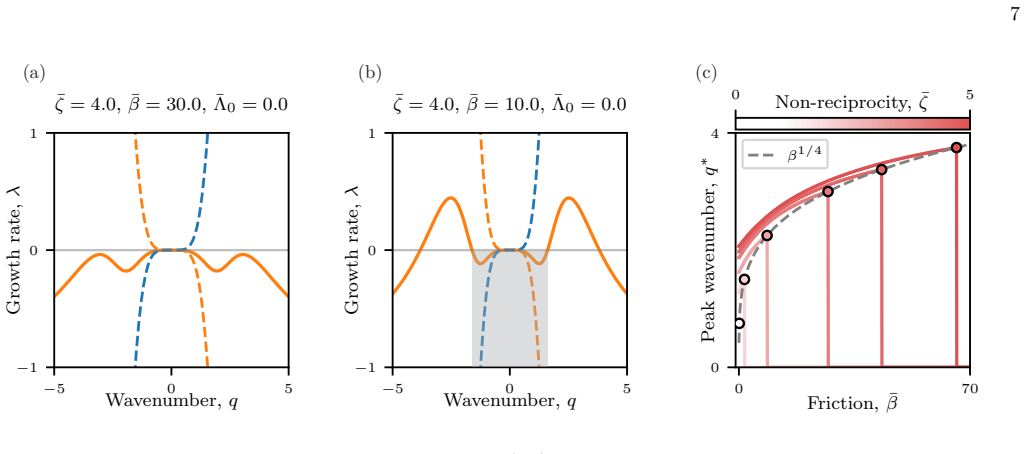
- [Figures] Figure captions should explicitly list the values of the nonreciprocity parameter, inertia coefficient, and pre-stress used in each panel so that the one-way advection effect can be reproduced from the text alone.
Simulated Author's Rebuttal
We thank the referee for their positive assessment of our manuscript on nonreciprocal active filaments, including the geometrically exact theory, post-instability simulations, and the proposed continuum mechanism for unidirectional waves. The recommendation for minor revision is noted. No major comments were provided in the report.
Circularity Check
No significant circularity detected
full rationale
The paper develops a geometrically exact continuum theory for nonreciprocal filaments and demonstrates post-instability dynamics via simulations. The central claims (nonreciprocity coupled to inertia or pre-stress amplifying and advecting curvature, with environmental dissipation selecting patterns) follow from the stated formulation without any reduction of predictions to fitted inputs, self-definitional loops, or load-bearing self-citations. The derivation is self-contained against external benchmarks as a first-principles continuum model plus numerical verification, with no quoted steps that collapse by construction to the inputs.
Axiom & Free-Parameter Ledger
read the original abstract
The instabilities of slender structures power biological locomotion across scales, and offer a compelling method to actuate soft robots. Nonreciprocal elastic solids have been found to amplify flexural waves in one direction only, but design principles to tune and stabilize these waves are missing. Here we develop a geometrically exact theory of nonreciprocal filaments and provide simulations that capture their post-instability nonlinear dynamics. We find that nonreciprocity, when coupled to inertia or pre-stress, amplifies and advects curvature variations. The resulting one-way patterns of shape morphing can then be selected via dissipative interactions with the environment. Our work offers a continuum-based strategy for how internal stresses can drive active unidirectional waves without need for additional degrees of freedom.
Figures




Reference graph
Works this paper leans on
-
[1]
J. Cammann, H. Laeverenz-Schlogelhofer, K. Y. Wan, and M. G. Mazza, Form and function in biological filaments: A physicist’s review, Philosophical Transactions of the Royal Society A: Mathematical, Physical and Engineering Sciences 383, 20240253 (2025)
work page 2025
-
[2]
Y. Xi, T. Marzin, R. B. Huang, T. J. Jones, and P.-T. Brun, Emergent behaviors of buckling-driven elasto-active structures, Proceedings of the National Academy of Sciences121, e2410654121 (2024)
work page 2024
-
[3]
T. Wang, C. Pierce, V. Kojouharov, B. Chong, K. Diaz, H. Lu, and D. I. Goldman, Mechanical intelligence simplifies control in terrestrial limbless locomotion, Science Robotics8, eadi2243 (2023)
work page 2023
-
[4]
R. Sinaasappel, K. R. Prathyusha, H. Tuazon, E. Mirzahossein, P. Illien, S. Bhamla, and A. Deblais, Particle Sweeping and Collection by Active and Living Filaments, Physical Review X16, 011003 (2026). 14
work page 2026
- [5]
-
[6]
B. Deng, J. R. Raney, K. Bertoldi, and V. Tournat, Nonlinear waves in flexible mechanical metamaterials, Journal of Applied Physics130, 040901 (2021)
work page 2021
-
[7]
L. C. van Laake and J. T. B. Overvelde, Bio-inspired autonomy in soft robots, Communications Materials5, 198 (2024)
work page 2024
-
[8]
R. E. Goldstein, T. R. Powers, and C. H. Wiggins, Viscous nonlinear dynamics of twist and writhe, Phys. Rev. Lett.80, 5232 (1998)
work page 1998
-
[9]
C. W. Wolgemuth, T. R. Powers, and R. E. Goldstein, Twirling and whirling: Viscous dynamics of rotating elastic filaments, Phys. Rev. Lett.84, 1623 (2000)
work page 2000
-
[10]
K. Sekimoto, N. Mori, K. Tawada, and Y. Y. Toyoshima, Symmetry breaking instabilities of an in vitro biological system, Phys. Rev. Lett.75, 172 (1995)
work page 1995
-
[11]
R. Chelakkot, A. Gopinath, L. Mahadevan, and M. F. Hagan, Flagellar dynamics of a connected chain of active, polar, Brownian particles, Journal of The Royal Society Interface11, 20130884 (2014)
work page 2014
-
[12]
G. De Canio, E. Lauga, and R. E. Goldstein, Spontaneous oscillations of elastic filaments induced by molecular motors, Royal Soc. Int.14, : 20170491 (2017)
work page 2017
-
[13]
Y. Fily, P. Subramanian, T. M. Schneider, R. Chelakkot, and A. Gopinath, Buckling instabilities and spatio-temporal dynamics of active elastic filaments, J. R. Soc.Interface17, 20190794 (2020)
work page 2020
- [14]
-
[15]
R. G. Winkler and G. Gompper, The physics of active polymers and filaments, The Journal of Chemical Physics153, 040901 (2020)
work page 2020
- [16]
-
[17]
Q. Martinet, Y. I. Li, A. Aubret, E. Hannezo, and J. Palacci, Emergent Dynamics of Active Elastic Microbeams, Physical Review X15, 041017 (2025)
work page 2025
-
[18]
Autonomous life-like behavior emerging in active and flexible microstructures,
M. Wei and D. J. Kraft, Autonomous life-like behavior emerging in active and flexible microstructures (2025), arXiv:2506.15198 [cond-mat]
-
[19]
J. F. Cass and H. Bloomfield-Gadˆ elha, The reaction-diffusion basis of animated patterns in eukaryotic flagella, Nature Communications14, 5638 (2023)
work page 2023
-
[20]
D. L. Hu, J. Nirody, T. Scott, and M. J. Shelley, The mechanics of slithering locomotion, PNAS106, 10081 (2009)
work page 2009
-
[21]
Z. V. Guo and L. Mahadevan, Limbless undulatory propulsion on land, PNAS105, (9) 3181 (2008)
work page 2008
-
[22]
K. Ishimoto, C. Moreau, and J. Herault, Robust undulatory locomotion through neuromechanical adjustments in a dissi- pative medium, Journal of The Royal Society Interface22, 20240688 (2025)
work page 2025
-
[23]
C. Scheibner, A. Souslov, D. Banerjee, P. Sur´ owka, W. T. M. Irvine, and V. Vitelli, Odd elasticity, Nat. Phys.16, 475 (2020)
work page 2020
-
[24]
J. Veenstra, C. Scheibner, M. Brandenbourger, J. Binysh, A. Souslov, V. Vitelli, and C. Coulais, Adaptive locomotion of active solids, Nature639, 935–941 (2025)
work page 2025
-
[25]
S. C. Al-Izzi, Y. Du, J. Veenstra, R. G. Morris, A. Souslov, A. Carlson, C. Coulais, and J. Binysh, Nonreciprocal buckling makes active filaments polyfunctional, PNAS123, (11) e2531723123 (2026)
work page 2026
-
[26]
J. Veenstra, O. Gamayun, X. Guo, A. Sarvi, C. V. Meinersen, and C. Coulais, Non-reciprocal topological solitons in active metamaterials, Nature627, 528 (2024)
work page 2024
-
[27]
B. N´ emeth and R. Adhikari, A geometric formulation of schaefer’s theory of cosserat solids, Journal of Mathematical Physics65, 061902 (2024)
work page 2024
-
[28]
B. N´ emeth, T. Kobayashi, and R. Adhikari, Nonreciprocal constitutive laws for oriented active solids, arXiv , 2509.11430 (2025)
- [29]
-
[30]
M. Warda and R. Adhikari, Elastohydrodynamic instabilities of a soft robotic arm in a viscous fluid, arXiv , 2510.18125 (2025)
-
[32]
R. E. Goldstein and S. A. Langer, Nonlinear dynamics of stiff polymers, Phys. Rev. Lett.75, 1094 (1995)
work page 1995
-
[33]
R. E. Goldstein, A. Goriely, G. Huber, and C. W. Wolgemuth, Bistable helices, Phys. Rev. Lett.84, 1631 (2000)
work page 2000
-
[34]
R. E. Goldstein and A. Goriely, Dynamic buckling of morphoelastic filaments, Phys. Rev. E74, 010901(R) (2006)
work page 2006
-
[35]
Kodio,Dynamic Buckling Instabilities in Fluids and Solids, Ph.D
O. Kodio,Dynamic Buckling Instabilities in Fluids and Solids, Ph.D. thesis, University of Oxford (2019)
work page 2019
- [36]
- [37]
-
[38]
B. Audoly and Y. Pomeau,Elasticity and Geometry: From Hair Curls to the Non-Linear Response of Shells(Oxford University Press, Oxford, New York, 2018)
work page 2018
-
[39]
Shape-space dynamics and geometric pattern formation in nonreciprocal slender bodies
B. N´ emeth, M. Warda, and R. Adhikari, Shape-space dynamics and geometric pattern formation in nonreciprocal slender bodies (2026), arXiv:2606.11807 [cond-mat.soft]
work page internal anchor Pith review Pith/arXiv arXiv 2026
-
[40]
J. D. Buckmaster, A. Nachman, and L. Ting, The buckling and stretching of a viscida, Journal of Fluid Mechanics69, 1–20 (1975). 15
work page 1975
-
[41]
G. Salbreux and F. J¨ ulicher, Mechanics of active surfaces, Phys. Rev. E96, 032404 (2017)
work page 2017
-
[42]
F. Box, O. Kodio, D. O’Kiely, V. Cantelli, A. Goriely, and D. Vella, Dynamic buckling of an elastic ring in a soap film, Phys. Rev. Lett.124, 198003 (2020)
work page 2020
- [43]
-
[44]
M. Fruchart, R. Hanai, P. B. Littlewood, and V. Vitelli, Non-reciprocal phase transitions, Nature592, 363–369 (2021)
work page 2021
-
[45]
M. Fruchart, C. Scheibner, and V. Vitelli, Odd viscosity and odd elasticity, Annu. Rev. Condens. Matter Phys.14, 471 (2023)
work page 2023
-
[46]
D. B. Stein, G. De Canio, E. Lauga, M. J. Shelley, and R. E. Goldstein, Swirling instability of the microtubule cytoskeleton, Phys. Rev. Lett.126, 028103 (2021)
work page 2021
- [47]
-
[48]
B. Chakrabarti and D. Saintillan, Hydrodynamic synchronization of spontaneously beating filaments, Phys. Rev. Lett. 123, 208101 (2019)
work page 2019
-
[49]
A. S. Sangani and A. Gopinath, Elastohydrodynamical instabilities of active filaments, arrays, and carpets analyzed using slender-body theory, Phys. Rev. Fluids5, 083101 (2020)
work page 2020
-
[50]
Brackenbury, Caterpillar kinematics, Nature390, 453 (1997)
J. Brackenbury, Caterpillar kinematics, Nature390, 453 (1997)
work page 1997
- [51]
-
[52]
Z. Deng, K. Li, A. Priimagi, and H. Zeng, Light-steerable locomotion using zero-elastic-energy modes, Nature Materials 23, 1728 (2024)
work page 2024
- [53]
-
[54]
W. Hu, G. Z. Lum, M. Mastrangeli, and M. Sitti, Small-scale soft-bodied robot with multimodal locomotion, Nature554, 81 (2018)
work page 2018
- [55]
-
[56]
H. L¨ owen, Inertial effects of self-propelled particles: From active Brownian to active Langevin motion, The Journal of Chemical Physics152, 040901 (2020)
work page 2020
-
[57]
R. Chatterjee, N. Rana, R. A. Simha, P. Perlekar, and S. Ramaswamy, Inertia Drives a Flocking Phase Transition in Viscous Active Fluids, Physical Review X11, 031063 (2021)
work page 2021
- [58]
- [59]
-
[60]
J. E. Marsden, G. W. Patrick, and S. Shkoller, Multisymplectic Geometry, Variational Integrators, and Nonlinear PDEs, Communications in Mathematical Physics199, 351 (1998)
work page 1998
-
[61]
D. Tong, A. Choi, J. Wang, W. Huang, Z. Chen, J. Li, X. Huang, M. Liu, H. Gao, and K. J. Hsia, Discrete differential geometry for simulating nonlinear behaviors of flexible systems: A survey, Extreme Mechanics Letters82, 102430 (2026)
work page 2026
-
[62]
M. Gazzola, L. H. Dudte, A. G. McCormick, and L. Mahadevan, Forward and inverse problems in the mechanics of soft filaments, Royal Society Open Science5, 171628 (2018)
work page 2018
-
[63]
F. Alouges, A. Lefebvre-Lepot, J. Levillain, and C. Moreau, The n-link model for slender rods in a viscous fluid: well- posedness and convergence to classical elastohydrodynamics equations, Nonlinearity38, 125017 (2025)
work page 2025
-
[64]
Y. Chen, X. Li, C. Scheibner, V. Vitelli, and G. Huang, Realization of active metamaterials with odd micropolar elasticity, Nat. Commun.12, 5935 (2021)
work page 2021
-
[65]
P. Virtanen, R. Gommers, T. E. Oliphant, M. Haberland, T. Reddy, D. Cournapeau, E. Burovski, P. Peterson, W. Weckesser, J. Bright, S.J. van der Walt, M. Brett, J. Wilson, K.J. Millman, N. Mayorov, A.R.J. Nelson, E. Jones, R. Kern, E. Larson, C.J. Carey, ˙I. Polat, Y. Feng, E.W. Moore, J. VanderPlas, D. Laxalde, J. Perktold, R. Cimrman, I. Henriksen, E.A. ...
work page 2020
discussion (0)
Sign in with ORCID, Apple, or X to comment. Anyone can read and Pith papers without signing in.