Structured Factorization Approaches for Quantum State Tomography
Pith reviewed 2026-07-03 13:08 UTC · model grok-4.3
The pith
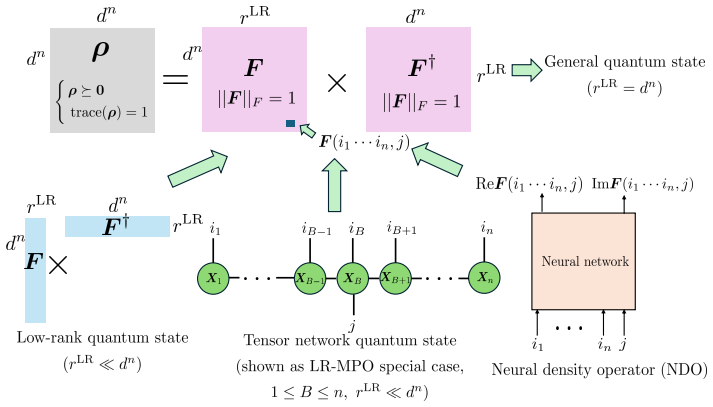
Quantum state tomography is formulated as optimization over a structured factor F in the parametrization of the density matrix as FF^dagger.
A machine-rendered reading of the paper's core claim, the machinery that carries it, and where it could break.
Core claim
By building on Burer-Monteiro-type factorization and constraining the factor F to a structured model class, the density matrix is parametrized as FF^dagger. This guarantees physical validity by construction and incorporates structural priors directly through the choice of the factor space, enabling formulation of QST as an optimization problem over the factor space from measurement data.
What carries the argument
Structured factorization of the density matrix as FF^dagger with F belonging to a structured model class, which carries the argument by allowing priors to be incorporated while ensuring positivity and normalization.
If this is right
- Unified statistical analysis shows sample complexity for least-squares estimation over a broad class of structured quantum states.
- Projected gradient descent operates on the factor space for various structural parametrizations.
- A power method yields a step-size-free algorithm with fast convergence, recovering Cover's method as a special case when the factor is unconstrained.
Where Pith is reading between the lines
- Similar factorization could apply to quantum process tomography or other quantum information tasks.
- Choosing neural architectures for F might enable tomography of states with complex correlations not captured by traditional structures.
- The approach could lead to hybrid methods combining different structures for even better efficiency in large systems.
Load-bearing premise
The true quantum state belongs to or is well approximated by one of the structured model classes imposed on the factor F.
What would settle it
If the optimization over the factor space fails to recover accurate density matrices for states that do belong to the assumed structured classes, even with increasing numbers of measurements, that would falsify the claims.
Figures


read the original abstract
Since the complexity of quantum state tomography (QST) scales exponentially with system size, exploiting priors such as low-rankness, tensor-network structures, and neural-network representations is essential for scalable QST in terms of sample complexity and parameter complexity. In this paper, we introduce a unified framework, termed structured factorization, that builds on BurerMonteiro-type factorization by parametrizing the density matrix as $FF^\dagger$, where the factor $F$ is constrained to belong to a structured model class. This factorization guarantees physical validity by construction while allowing a broad range of structural priors to be incorporated directly through the choice of the factor space, ranging from the generic Cholesky decomposition to low-rank matrices, matrix product operators, and neural density operators based on multilayer perceptron and transformer architectures. Building on this structured factorization framework, we formulate QST as an optimization problem over the factor space from measurement data. We first develop a unified statistical analysis of the sample complexity of least-squares estimation for a broad class of structured quantum states. We then propose a projected gradient descent method that operates directly on the factor space and accommodates a wide range of structural parametrizations and reconstruction objectives. To further exploit the geometry of the maximum-likelihood estimation formulation and the constraints on the factors, we derive a power method that yields a step-size-free algorithm with fast convergence, recovering Covers method as a special case when the factor is unconstrained.
Editorial analysis
A structured set of objections, weighed in public.
Referee Report
Summary. The manuscript introduces a unified structured factorization framework for quantum state tomography (QST). The density matrix is parametrized as FF^dagger where the factor F is constrained to a structured model class (ranging from Cholesky factors to low-rank matrices, matrix product operators, and neural density operators). This guarantees physical validity by construction. QST is reduced to optimization over the factor space; the paper provides a unified statistical analysis of sample complexity for least-squares estimation over a broad class of structured states, proposes a projected gradient descent algorithm on the factor space, and derives a power method for the maximum-likelihood formulation that is step-size-free and recovers Cover's method as a special case when F is unconstrained.
Significance. If the statistical analysis and convergence claims hold, the framework unifies a wide range of structural priors under a single parametrization that automatically enforces positivity and unit trace, offering a flexible route to scalable QST. The explicit recovery of Cover's method as a special case and the geometry-aware power method are concrete strengths. The modeling approach is standard in spirit but the breadth of structures covered (including neural architectures) could facilitate reproducible implementations across different priors.
major comments (2)
- [Statistical analysis section] The unified statistical analysis of sample complexity for least-squares estimation (described after the framework introduction) is stated at high level with no explicit error bounds, concentration inequalities, or derivations visible; this is load-bearing for the claim that the framework yields improved sample complexity for a broad class of structured states.
- [Power method derivation] The derivation of the power method (in the section proposing the algorithm) is presented without convergence rates, iteration complexity, or comparison to projected gradient descent; the claim of 'fast convergence' therefore lacks the quantitative support needed to evaluate its advantage over existing methods.
minor comments (2)
- [Introduction] The notation for the structured model class and the precise definition of the factor space F could be introduced with a short table or diagram in the introduction to improve readability for readers unfamiliar with Burer-Monteiro factorization.
- [Abstract and Introduction] Several sentences in the abstract and introduction repeat the same high-level description of the framework; condensing these would improve conciseness without loss of content.
Simulated Author's Rebuttal
We thank the referee for the careful review and constructive comments on our manuscript. The two major comments identify areas where additional detail would strengthen the presentation of the statistical analysis and the power method. We address each point below and will revise the manuscript to incorporate explicit derivations and quantitative comparisons.
read point-by-point responses
-
Referee: [Statistical analysis section] The unified statistical analysis of sample complexity for least-squares estimation (described after the framework introduction) is stated at high level with no explicit error bounds, concentration inequalities, or derivations visible; this is load-bearing for the claim that the framework yields improved sample complexity for a broad class of structured states.
Authors: We agree that the current presentation of the unified statistical analysis remains at a high level and does not display the explicit error bounds or concentration inequalities. In the revised manuscript we will expand this section to include the key concentration inequalities (e.g., matrix Bernstein or covering-number arguments adapted to the factor space) and the resulting sample-complexity bounds expressed in terms of the structured model class. These additions will make the load-bearing claims fully explicit while preserving the unified character of the analysis. revision: yes
-
Referee: [Power method derivation] The derivation of the power method (in the section proposing the algorithm) is presented without convergence rates, iteration complexity, or comparison to projected gradient descent; the claim of 'fast convergence' therefore lacks the quantitative support needed to evaluate its advantage over existing methods.
Authors: We acknowledge that the power-method section currently lacks explicit convergence rates, iteration complexity, and a direct comparison with projected gradient descent. In the revision we will add a convergence analysis that exploits the geometry of the maximum-likelihood objective on the factor manifold, derive iteration-complexity bounds, and include a side-by-side comparison (both theoretical and numerical) with the projected-gradient method. This will provide the quantitative support required to substantiate the claim of fast convergence. revision: yes
Circularity Check
No significant circularity
full rationale
The paper presents a modeling framework that parametrizes density matrices as FF^dagger with F drawn from a chosen structured class (low-rank, MPO, neural nets, etc.). This is an explicit modeling choice that enforces positivity by construction, followed by standard least-squares analysis and projected gradient / power-method optimization over the factor space. No step equates a claimed prediction or uniqueness result to a fitted parameter or self-citation chain; the statistical sample-complexity bounds and algorithmic derivations are independent of the target state once the structural class is fixed. The framework therefore remains self-contained against external benchmarks.
Axiom & Free-Parameter Ledger
axioms (1)
- domain assumption The density matrix of the quantum state can be written as FF^dagger for some factor F belonging to a structured model class that encodes the desired prior.
Reference graph
Works this paper leans on
-
[1]
A tomographic approach to Wigner’s function.Found
Jacqueline Bertrand and Pierre Bertrand. A tomographic approach to Wigner’s function.Found. Phys., 17(4):397– 405, 1987
work page 1987
-
[2]
K V ogel and H Risken. Determination of quasiprobability distributions in terms of probability distributions for the rotated quadrature phase.Phys. Rev. A, 40(5):2847, 1989
work page 1989
-
[3]
Quantum-state tomography and discrete wigner function.Phys
Ulf Leonhardt. Quantum-state tomography and discrete wigner function.Phys. Rev. Lett., 74(21):4101, 1995
work page 1995
-
[4]
Zdenek Hradil. Quantum-state estimation.Phys. Rev. A, 55(3):R1561, 1997
work page 1997
-
[5]
Daniel F. V . James, Paul G. Kwiat, William J. Munro, and Andrew G. White. Measurement of qubits.Phys. Rev. A, 64:052312, Oct 2001
work page 2001
-
[6]
J Haah, AW Harrow, Z Ji, X Wu, and N Yu. Sample-optimal tomography of quantum states.IEEE Transactions on Information Theory, 63(9):5628–5641, 2017
work page 2017
-
[7]
Quantum computing in the nisq era and beyond.Quantum, 2:79, 2018
John Preskill. Quantum computing in the nisq era and beyond.Quantum, 2:79, 2018. 25
work page 2018
-
[8]
Quantum supremacy using a programmable superconduct- ing processor.Nature, 574(7779):505–510, 2019
Frank Arute, Kunal Arya, Ryan Babbush, Dave Bacon, Joseph C Bardin, Rami Barends, Rupak Biswas, Sergio Boixo, Fernando GSL Brandao, David A Buell, et al. Quantum supremacy using a programmable superconduct- ing processor.Nature, 574(7779):505–510, 2019
work page 2019
-
[9]
Ibm quantum breaks the 100-qubit processor barrier.IBM Research Blog, 2021
Jerry Chow, Oliver Dial, and Jay Gambetta. Ibm quantum breaks the 100-qubit processor barrier.IBM Research Blog, 2021
work page 2021
-
[10]
Steven T Flammia, David Gross, Yi-Kai Liu, and Jens Eisert. Quantum tomography via compressed sensing: error bounds, sample complexity and efficient estimators.New Journal of Physics, 14(9):095022, 2012
work page 2012
-
[11]
Quantum Tomography From Few Full-Rank Observables
Vladislav V oroninski. Quantum tomography from few full-rank observables.arXiv preprint arXiv:1309.7669, 2013
work page internal anchor Pith review Pith/arXiv arXiv 2013
-
[12]
Low rank matrix recovery from rank one measurements
Richard Kueng, Holger Rauhut, and Ulrich Terstiege. Low rank matrix recovery from rank one measurements. Applied and Computational Harmonic Analysis, 42(1):88–116, 2017
work page 2017
-
[13]
Fast state tomography with optimal error bounds
Madalin Gut ¸˘a, Jonas Kahn, Richard Kueng, and Joel A Tropp. Fast state tomography with optimal error bounds. Journal of Physics A: Mathematical and Theoretical, 53(20):204001, 2020
work page 2020
-
[14]
Fast and robust quantum state tomography from few basis measurements
Daniel Stilck Franc ¸a, Fernando GS Brand ˜ao, and Richard Kueng. Fast and robust quantum state tomography from few basis measurements. In16th Conference on the Theory of Quantum Computation, Communication and Cryptography (TQC 2021). Schloss Dagstuhl-Leibniz-Zentrum f¨ur Informatik, 2021
work page 2021
-
[15]
Zhen Qin, Casey Jameson, Zhexuan Gong, Michael B Wakin, and Zhihui Zhu. Optimal allocation of pauli measurements for low-rank quantum state tomography.IEEE Transactions on Quantum Engineering, 7:1–16, 2026
work page 2026
-
[16]
Existence of temperature on the nanoscale.Physical review letters, 93(8):080402, 2004
Michael Hartmann, G ¨unter Mahler, and Ortwin Hess. Existence of temperature on the nanoscale.Physical review letters, 93(8):080402, 2004
work page 2004
- [17]
-
[18]
Matrix product operator representations
Bogdan Pirvu, Valentin Murg, J Ignacio Cirac, and Frank Verstraete. Matrix product operator representations. New Journal of Physics, 12(2):025012, 2010
work page 2010
-
[19]
Kyungjoo Noh, Liang Jiang, and Bill Fefferman. Efficient classical simulation of noisy random quantum circuits in one dimension.Quantum, 4:318, 2020
work page 2020
-
[20]
Zhen Qin, Casey Jameson, Zhexuan Gong, Michael B Wakin, and Zhihui Zhu. Quantum state tomography for matrix product density operators.IEEE Transactions on Information Theory, 70(7):5030–5056, 2024
work page 2024
-
[21]
Zhen Qin, Casey Jameson, Alireza Goldar, Michael B Wakin, Zhexuan Gong, and Zhihui Zhu. Sample-efficient quantum state tomography for structured quantum states in one dimension.arXiv preprint arXiv:2410.02583, 2024
-
[22]
Zhen Qin, Joseph M Lukens, Brian T Kirby, and Zhihui Zhu. Enhancing quantum state reconstruction with structured classical shadows.npj Quantum Information, 11(1):147, 2025
work page 2025
-
[23]
Sketch Tomography: Hybridizing Classical Shadow and Matrix Product State
Xun Tang, Haoxuan Chen, Yuehaw Khoo, and Lexing Ying. Sketch tomography: Hybridizing classical shadow and matrix product state.arXiv preprint arXiv:2512.03333, 2025
work page internal anchor Pith review Pith/arXiv arXiv 2025
-
[24]
Learning mixed quantum states in large-scale experiments.arXiv preprint arXiv:2507.12550, 2025
Matteo V otto, Marko Ljubotina, C ´ecilia Lancien, J Ignacio Cirac, Peter Zoller, Maksym Serbyn, Lorenzo Piroli, and Beno ˆıt Vermersch. Learning mixed quantum states in large-scale experiments.arXiv preprint arXiv:2507.12550, 2025
-
[25]
Zhen Qin and Zhihui Zhu. Quantum state tomography for tensor networks in two dimensions.Physical Review A, 113(2):022414, 2026. 26
work page 2026
-
[26]
Zhen Qin, Michael B Wakin, and Zhihui Zhu. Statistical and algorithmic foundations of probing quantum systems with compressive measurements: A review.arXiv preprint arXiv:2605.27191, 2026
work page internal anchor Pith review Pith/arXiv arXiv 2026
-
[27]
Neural-network quantum state tomography.Nature Physics, 14(5):447–450, 2018
Giacomo Torlai, Guglielmo Mazzola, Juan Carrasquilla, Matthias Troyer, Roger Melko, and Giuseppe Carleo. Neural-network quantum state tomography.Nature Physics, 14(5):447–450, 2018
work page 2018
-
[28]
Giacomo Torlai, Brian Timar, Evert PL Van Nieuwenburg, Harry Levine, Ahmed Omran, Alexander Keesling, Hannes Bernien, Markus Greiner, Vladan Vuleti ´c, Mikhail D Lukin, et al. Integrating neural networks with a quantum simulator for state reconstruction.Physical review letters, 123(23):230504, 2019
work page 2019
-
[29]
Approximating quantum many-body wave functions using artificial neural networks.Phys
Zi Cai and Jinguo Liu. Approximating quantum many-body wave functions using artificial neural networks.Phys. Rev. B, 97(3):035116, 2018
work page 2018
-
[30]
Stewart Morawetz, Isaac JS De Vlugt, Juan Carrasquilla, and Roger G Melko. U (1)-symmetric recurrent neural networks for quantum state reconstruction.Physical Review A, 104(1):012401, 2021
work page 2021
-
[31]
Dmitri Iouchtchenko, J ´erˆome F Gonthier, Alejandro Perdomo-Ortiz, and Roger G Melko. Neural network enhanced measurement efficiency for molecular groundstates.Machine Learning: Science and Technology, 4(1):015016, 2023
work page 2023
-
[32]
Attention-based quantum tomography.Machine Learning: Science and Technology, 3(1):01LT01, 2021
Peter Cha, Paul Ginsparg, Felix Wu, Juan Carrasquilla, Peter L McMahon, and Eun-Ah Kim. Attention-based quantum tomography.Machine Learning: Science and Technology, 3(1):01LT01, 2021
work page 2021
-
[33]
Hailan Ma, Zhenhong Sun, Daoyi Dong, Chunlin Chen, and Herschel Rabitz. Tomography of quantum states from structured measurements via quantum-aware transformer.arXiv preprint arXiv:2305.05433, 2023
-
[34]
Lattice convolutional net- works for learning ground states of quantum many-body systems
Cong Fu, Xuan Zhang, Huixin Zhang, Hongyi Ling, Shenglong Xu, and Shuiwang Ji. Lattice convolutional net- works for learning ground states of quantum many-body systems. InProceedings of the 2024 SIAM International Conference on Data Mining (SDM), pages 490–498. SIAM, 2024
work page 2024
-
[35]
Andrea Rocchetto, Edward Grant, Sergii Strelchuk, Giuseppe Carleo, and Simone Severini. Learning hard quan- tum distributions with variational autoencoders.npj Quantum Information, 4(1):28, 2018
work page 2018
-
[36]
Description of states in quantum mechanics by density matrix and operator techniques.Rev
Ugo Fano. Description of states in quantum mechanics by density matrix and operator techniques.Rev. Mod. Phys., 29(1):74, 1957
work page 1957
-
[37]
Iterative algorithm for reconstruction of entangled states.Phys
J ˇReh´aˇcek, Z Hradil, and M Je ˇzek. Iterative algorithm for reconstruction of entangled states.Phys. Rev. A, 63(4):040303, 2001
work page 2001
-
[38]
Approxi- mate message passing for quantum state tomography.arXiv preprint arXiv:2511.12857, 2025
Noah Siekierski, Kausthubh Chandramouli, Christian K ¨ummerle, Bojko N Bakalov, and Dror Baron. Approxi- mate message passing for quantum state tomography.arXiv preprint arXiv:2511.12857, 2025
-
[39]
Quantum state tomography with tensor train cross approximation.arXiv preprint arXiv:2207.06397, 2022
Alexander Lidiak, Casey Jameson, Zhen Qin, Gongguo Tang, Michael B Wakin, Zhihui Zhu, and Zhexuan Gong. Quantum state tomography with tensor train cross approximation.arXiv preprint arXiv:2207.06397, 2022
-
[40]
Optimal, reliable estimation of quantum states.New Journal of Physics, 12(4):043034, 2010
Robin Blume-Kohout. Optimal, reliable estimation of quantum states.New Journal of Physics, 12(4):043034, 2010
work page 2010
-
[41]
Practical bayesian tomography.new Journal of Physics, 18(3):033024, 2016
Christopher Granade, Joshua Combes, and DG Cory. Practical bayesian tomography.new Journal of Physics, 18(3):033024, 2016
work page 2016
-
[42]
A practical and efficient approach for Bayesian quantum state estimation.New J
Joseph M Lukens, Kody J H Law, Ajay Jasra, and Pavel Lougovski. A practical and efficient approach for Bayesian quantum state estimation.New J. Phys., 22(6):063038, 2020
work page 2020
-
[43]
Robust error bars for quantum tomography
Robin Blume-Kohout. Robust error bars for quantum tomography.arXiv preprint arXiv:1202.5270, 2012
work page internal anchor Pith review Pith/arXiv arXiv 2012
-
[44]
Practical and reliable error bars in quantum tomography.Physical review letters, 117(1):010404, 2016
Philippe Faist and Renato Renner. Practical and reliable error bars in quantum tomography.Physical review letters, 117(1):010404, 2016. 27
work page 2016
-
[45]
Sanjaya Lohani, Brian T Kirby, Michael Brodsky, Onur Danaci, and Ryan T Glasser. Machine learning assisted quantum state estimation.Machine Learning: Science and Technology, 1(3):035007, 2020
work page 2020
-
[46]
Fernando GSL Brand ˜ao, Richard Kueng, and Daniel Stilck Franc ¸a. Fast and robust quantum state tomography from few basis measurements.arXiv preprint arXiv:2009.08216, 2020
-
[47]
On the connection between least squares, regularization, and classical shadows.Quantum, 8:1455, 2024
Zhihui Zhu, Joseph M Lukens, and Brian T Kirby. On the connection between least squares, regularization, and classical shadows.Quantum, 8:1455, 2024
work page 2024
-
[48]
Frank Verstraete, Juan J Garcia-Ripoll, and Juan Ignacio Cirac. Matrix product density operators: Simulation of finite-temperature and dissipative systems.Physical review letters, 93(20):207204, 2004
work page 2004
-
[49]
Empirical sample complexity of neural network mixed state reconstruction.Quantum, 8:1358, 2024
Haimeng Zhao, Giuseppe Carleo, and Filippo Vicentini. Empirical sample complexity of neural network mixed state reconstruction.Quantum, 8:1358, 2024
work page 2024
-
[50]
Samuel Burer and Renato DC Monteiro. A nonlinear programming algorithm for solving semidefinite programs via low-rank factorization.Mathematical programming, 95(2):329–357, 2003
work page 2003
-
[51]
Local minima and convergence in low-rank semidefinite programming
Samuel Burer and Renato DC Monteiro. Local minima and convergence in low-rank semidefinite programming. Mathematical programming, 103(3):427–444, 2005
work page 2005
-
[52]
David S Watkins.Fundamentals of matrix computations. John Wiley & Sons, 2004
work page 2004
-
[53]
Global optimality in low-rank matrix optimization
Zhihui Zhu, Qiuwei Li, Gongguo Tang, and Michael B Wakin. Global optimality in low-rank matrix optimization. IEEE Transactions on Signal Processing, 66(13):3614–3628, 2018
work page 2018
-
[54]
Yuejie Chi, Yue M Lu, and Yuxin Chen. Nonconvex optimization meets low-rank matrix factorization: An overview.IEEE Transactions on Signal Processing, 67(20):5239–5269, 2019
work page 2019
-
[55]
Yong Wang, Lijun Liu, Shuming Cheng, Li Li, and Jie Chen. Efficient factored gradient descent algorithm for quantum state tomography.Physical Review Research, 6(3):033034, 2024
work page 2024
-
[56]
Ming-Chien Hsu, En-Jui Kuo, Wei-Hsuan Yu, Jian-Feng Cai, and Min-Hsiu Hsieh. Quantum state tomography via nonconvex riemannian gradient descent.Physical Review Letters, 132(24):240804, 2024
work page 2024
-
[57]
Jian-Feng Cai, Yuling Jiao, Yinan Li, Xiliang Lu, Jerry Zhijian Yang, and Juntao You. Online quantum state tomography via stochastic gradient descent.arXiv preprint arXiv:2507.07601, 2025
-
[58]
Rigorous maximum-likelihood estimation for quantum states.Physical Review A, 112(5):052436, 2025
Kuchibhotla Aditi and Stephen Becker. Rigorous maximum-likelihood estimation for quantum states.Physical Review A, 112(5):052436, 2025
work page 2025
-
[59]
GI Struchalin, Ya A Zagorovskii, EV Kovlakov, SS Straupe, and SP Kulik. Experimental estimation of quantum state properties from classical shadows.PRX Quantum, 2(1):010307, 2021
work page 2021
-
[60]
Bootstrapping classical shadows for neural quantum state tomography.arXiv:2405.06864, 2024
Wirawat Kokaew, Bohdan Kulchytskyy, Shunji Matsuura, and Pooya Ronagh. Bootstrapping classical shadows for neural quantum state tomography.arXiv:2405.06864, 2024
-
[61]
M ˘ad˘alin Gut ¸˘a, Theodore Kypraios, and Ian Dryden. Rank-based model selection for multiple ions quantum tomography.New Journal of Physics, 14(10):105002, 2012
work page 2012
-
[62]
Artur Czerwinski. Quantum tomography of entangled qubits by time-resolved single-photon counting with time- continuous measurements: A. czerwinski.Quantum Information Processing, 21(9):332, 2022
work page 2022
-
[63]
Neural-network quantum state tomography.Physical Review A, 106(1):012409, 2022
Dominik Koutn `y, Libor Motka, Zden ˇek Hradil, Jaroslav ˇReh´aˇcek, and Luis L S ´anchez-Soto. Neural-network quantum state tomography.Physical Review A, 106(1):012409, 2022
work page 2022
-
[64]
Mohammadhossein Mohammadisiahroudi, Zeguan Wu, Brandon Augustino, Arielle Carr, and Tam ´as Terlaky. Improvements to quantum interior point method for linear optimization.ACM Transactions on Quantum Com- puting, 6(1):1–24, 2025. 28
work page 2025
-
[65]
Zhengfeng Ji, Yi-Kai Liu, and Fang Song. Pseudorandom quantum states. InAdvances in Cryptology–CRYPTO 2018: 38th Annual International Cryptology Conference, Santa Barbara, CA, USA, August 19–23, 2018, Pro- ceedings, Part III 38, pages 126–152. Springer, 2018
work page 2018
- [66]
-
[67]
Yunmei Chen and Xiaojing Ye. Projection onto a simplex.arXiv:1101.6081, 2011
work page internal anchor Pith review Pith/arXiv arXiv 2011
-
[68]
Hannah Lange, Anka Van de Walle, Atiye Abedinnia, and Annabelle Bohrdt. From architectures to applications: A review of neural quantum states.Quantum Science and Technology, 2024
work page 2024
-
[69]
Simon Kothe and Peter Kirton. Liouville-space neural network representation of density matrices.Physical Review A, 109(6):062215, 2024
work page 2024
-
[70]
Latent space purification via neural density operators.Physical review letters, 120(24):240503, 2018
Giacomo Torlai and Roger G Melko. Latent space purification via neural density operators.Physical review letters, 120(24):240503, 2018
work page 2018
-
[71]
Yusuke Nomura, Nobuyuki Yoshioka, and Franco Nori. Purifying deep boltzmann machines for thermal quantum states.Physical review letters, 127(6):060601, 2021
work page 2021
-
[72]
Johannes Mellak, Enrico Arrigoni, and Wolfgang von der Linden. Deep neural networks as variational solutions for correlated open quantum systems.Communications Physics, 7(1):268, 2024
work page 2024
-
[73]
George Cybenko. Approximation by superpositions of a sigmoidal function.Mathematics of control, signals and systems, 2(4):303–314, 1989
work page 1989
-
[74]
Attention is all you need.Advances in neural information processing systems, 30, 2017
Ashish Vaswani, Noam Shazeer, Niki Parmar, Jakob Uszkoreit, Llion Jones, Aidan N Gomez, Łukasz Kaiser, and Illia Polosukhin. Attention is all you need.Advances in neural information processing systems, 30, 2017
work page 2017
-
[75]
A Self-Attention Ansatz for Ab-initio Quantum Chemistry
Ingrid von Glehn, James S Spencer, and David Pfau. A self-attention ansatz for ab-initio quantum chemistry. arXiv preprint arXiv:2211.13672, 2022
-
[76]
Solving schr\” odinger equation with a language model.arXiv preprint arXiv:2307.09343, 2023
Honghui Shang, Chu Guo, Yangjun Wu, Zhenyu Li, and Jinlong Yang. Solving schr\” odinger equation with a language model.arXiv preprint arXiv:2307.09343, 2023
-
[77]
Yangjun Wu, Chu Guo, Yi Fan, Pengyu Zhou, and Honghui Shang. Nnqs-transformer: an efficient and scalable neural network quantum states approach for ab initio quantum chemistry. InProceedings of the International Conference for High Performance Computing, Networking, Storage and Analysis, pages 1–13, 2023
work page 2023
-
[78]
Di Luo, Zhuo Chen, Juan Carrasquilla, and Bryan K Clark. Autoregressive neural network for simulating open quantum systems via a probabilistic formulation.Physical review letters, 128(9):090501, 2022
work page 2022
-
[79]
Quantum computation and quantum information, 2002
Michael A Nielsen and Isaac Chuang. Quantum computation and quantum information, 2002
work page 2002
-
[80]
Anastasios Kyrillidis, Amir Kalev, Dohyung Park, Srinadh Bhojanapalli, Constantine Caramanis, and Sujay Sang- havi. Provable compressed sensing quantum state tomography via non-convex methods.npj Quantum Inf., 4(1):36, 2018
work page 2018
discussion (0)
Sign in with ORCID, Apple, or X to comment. Anyone can read and Pith papers without signing in.