meer21cm: an Analysis Pipeline and Comprehensive Toolkit for HI Intensity Mapping
Pith reviewed 2026-07-03 06:52 UTC · model grok-4.3
The pith
The meer21cm Python package supplies a modular pipeline for HI intensity mapping data analysis that recovers power spectra to per-cent accuracy on simulated survey patches.
A machine-rendered reading of the paper's core claim, the machinery that carries it, and where it could break.
Core claim
meer21cm is a survey-oriented Python package that performs the full sequence of intensity mapping analysis steps after calibration, including data ingestion, foreground removal, power spectrum computation, mock simulation and inference, while maintaining consistent treatment of observational effects; when applied to simulated MeerKLASS UHF-band patches the pipeline recovers the input power spectrum to per-cent level for k between 0.02 and 0.2 h Mpc inverse, with mock-to-model deviations no larger than 0.5 sigma.
What carries the argument
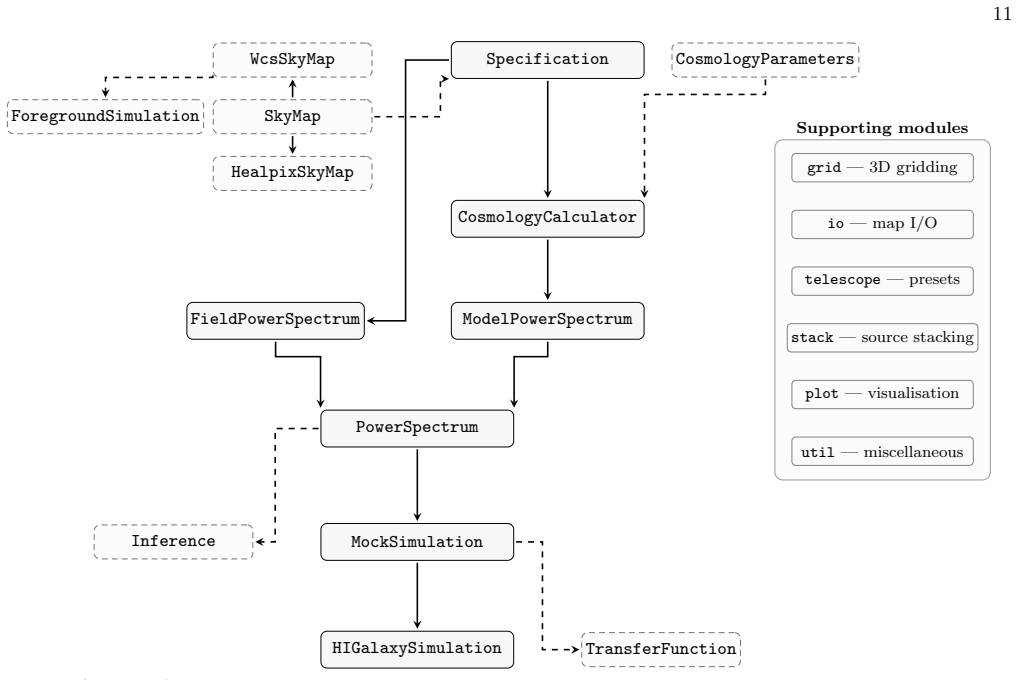
The meer21cm package, a modular Python code base that enforces survey-specific modelling of observational effects throughout foreground cleaning, power spectrum estimation and transfer function corrections.
If this is right
- The pipeline produces power spectra whose modelling remains consistent with the exact survey geometry and analysis choices.
- The same code base can analyse both auto-power spectra of intensity maps and cross-power spectra with galaxy catalogues.
- Mock simulations generated inside the package can be used directly for covariance estimation and parameter inference.
- Transfer function corrections are applied in a manner tied to the specific foreground cleaning and map-making steps.
Where Pith is reading between the lines
- The modular structure could allow users to swap in alternative foreground cleaning algorithms while preserving the rest of the pipeline.
- Public release of the code lowers the barrier for groups without large simulation teams to perform intensity mapping analyses.
- If the package were run on real data the same accuracy metric would provide a direct test of whether unmodelled systematics remain below the one-percent threshold.
Load-bearing premise
The mock simulations used for testing accurately represent the real observational effects, foregrounds, and data analysis choices specific to the survey.
What would settle it
Apply the pipeline to actual observed intensity maps from the survey and check whether the recovered power spectrum matches independent measurements or more complete end-to-end simulations at the same one-percent level.
Figures
read the original abstract
We present meer21cm, a comprehensive python package for cosmological data analysis of single-dish HI intensity mapping surveys. This package is simple to use, with a modularised code structure designed for interactive usage. meer21cm is designed for data analysis, with particular focus on the UHF-band observation of MeerKAT Large Area Synoptic Survey (MeerKLASS). We explicitly impose meer21cm to be survey-oriented, ensuring consistent modelling of observational effects in the clustering power spectrum with the survey specifications and data analysis choices. meer21cm covers a large range of data analysis procedures post calibration, including data read-in, foreground cleaning, power spectrum estimation, mock simulation, transfer function corrections and parameter inference. It handles both meer21cm intensity maps and overlapping galaxy catalogues, allowing for multi-tracer and cross-correlation analysis between MeerKLASS and optical galaxy surveys. Tested with a simulated survey of ten $750\,$deg$^2$ sky patches in the redshift sub-band $0.6\,{<}\,z\,{<}\,0.8$, the meer21cm pipeline achieves per-cent accuracy in the power spectrum estimation for $k \in [0.02, 0.2]\,{h{\rm Mpc}^{-1}}$, with deviations $\lesssim 0.5\sigma$ between the mock and the model power spectra, where $\sigma$ is the signal variance. The meer21cm package is publicly available and easy to install, with a comprehensive documentation website at https://meer21cm.readthedocs.io
Editorial analysis
A structured set of objections, weighed in public.
Referee Report
Summary. The manuscript presents meer21cm, a modular Python package for post-calibration analysis of single-dish HI intensity mapping surveys, focused on MeerKLASS UHF-band data. It implements data ingestion, foreground cleaning, power spectrum estimation, mock generation, transfer function corrections, and parameter inference, with support for cross-correlations against galaxy catalogs. The central claim is that tests on ten simulated 750 deg² patches at 0.6 < z < 0.8 recover the input power spectrum to per-cent accuracy for k ∈ [0.02, 0.2] h Mpc^{-1}, with mock-model deviations ≲ 0.5σ.
Significance. If the reported accuracy is robust, the package supplies a publicly documented, survey-specific toolkit that could standardize analysis choices for MeerKLASS and comparable HI IM experiments, reducing inconsistencies in foreground treatment and transfer-function modeling while enabling multi-tracer work. The open-source release and documentation website constitute concrete contributions to the field.
major comments (2)
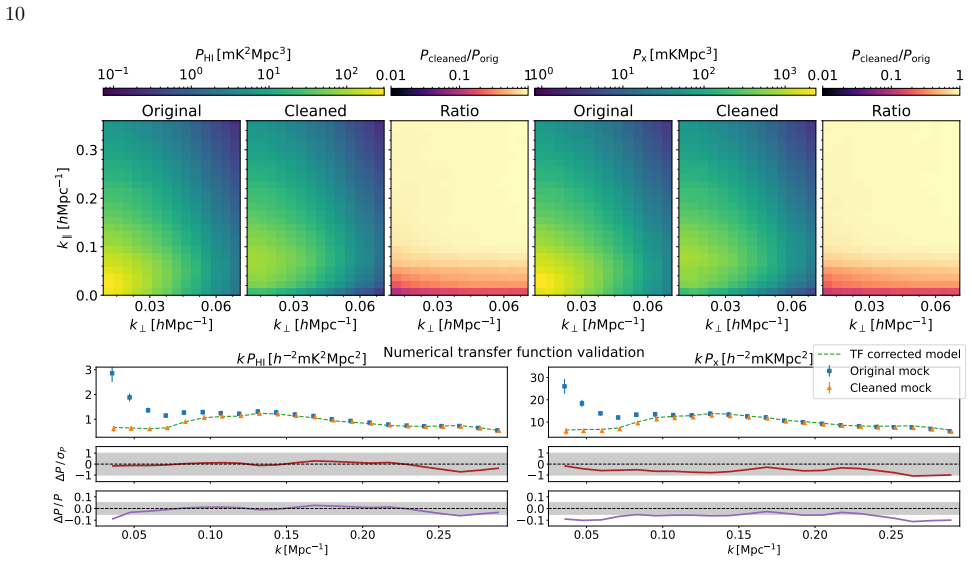
- [Abstract] Abstract and validation section: the per-cent accuracy claim for k ∈ [0.02, 0.2] h Mpc^{-1} is demonstrated exclusively on the described mock survey; the manuscript must explicitly document how UHF-band beam convolution, residual foregrounds after cleaning, RFI flagging, and calibration transfer functions are realized in the mocks, because these choices directly determine whether the reported ≲ 0.5σ deviations are representative of real MeerKLASS data.
- [Validation] Validation tests: the manuscript should report at least one cross-check of the pipeline against an independent code or against a second, independently generated mock suite that uses different foreground or beam models, to quantify the sensitivity of the accuracy result to simulation assumptions.
minor comments (2)
- [Abstract] The abstract states 'per-cent accuracy' without quoting the precise metric (e.g., fractional bias or χ² per degree of freedom); a quantitative definition should appear in the abstract or first paragraph of the validation section.
- [Figures] Figure captions for the power-spectrum comparison plots should state the exact number of modes per k-bin and the precise definition of σ used in the deviation metric.
Simulated Author's Rebuttal
We thank the referee for their positive evaluation and constructive suggestions. We address the two major comments below and will revise the manuscript to improve clarity on the mock generation and validation approach.
read point-by-point responses
-
Referee: [Abstract] Abstract and validation section: the per-cent accuracy claim for k ∈ [0.02, 0.2] h Mpc^{-1} is demonstrated exclusively on the described mock survey; the manuscript must explicitly document how UHF-band beam convolution, residual foregrounds after cleaning, RFI flagging, and calibration transfer functions are realized in the mocks, because these choices directly determine whether the reported ≲ 0.5σ deviations are representative of real MeerKLASS data.
Authors: We agree that explicit documentation of these mock ingredients is necessary for readers to judge how representative the reported accuracy is. Section 4 of the manuscript already outlines the mock generation procedure, but we will expand it with a dedicated subsection that details the precise implementation of UHF-band beam convolution (including the model and frequency dependence), the residual foreground levels after cleaning, the RFI flagging mask application, and the calibration transfer function. These additions will be accompanied by references to the specific simulation parameters used, allowing direct assessment against real MeerKLASS data characteristics. revision: yes
-
Referee: [Validation] Validation tests: the manuscript should report at least one cross-check of the pipeline against an independent code or against a second, independently generated mock suite that uses different foreground or beam models, to quantify the sensitivity of the accuracy result to simulation assumptions.
Authors: We recognize the benefit of an independent cross-validation to test sensitivity to simulation assumptions. The current validation uses a single, internally consistent mock suite that matches the survey specifications and analysis choices described in the paper. Generating a fully independent second mock suite with alternate foreground or beam models would require substantial new simulation effort beyond the scope of the present work. In the revision we will add a limited cross-check by comparing the power-spectrum estimation module against an alternative public estimator on a subset of the existing mocks, and we will explicitly state the limitations of the validation with respect to model variations. revision: partial
Circularity Check
No circularity: validation uses independent mocks on a software toolkit
full rationale
The paper presents meer21cm as a modular Python pipeline for post-calibration analysis of MeerKLASS HI intensity maps, including foreground cleaning, power spectrum estimation, transfer functions, and multi-tracer cross-correlations. Its central claim of per-cent accuracy (deviations ≲0.5σ for k ∈ [0.02, 0.2] h Mpc^{-1}) is obtained by applying the pipeline to independently generated mock surveys of ten 750 deg² patches at 0.6 < z < 0.8; the reported match is between the pipeline output on those mocks and the input model power spectra, with no equations or parameters defined in terms of the target accuracy metric itself. No self-definitional loops, fitted inputs renamed as predictions, or load-bearing self-citations appear in the derivation chain. The package is self-contained against external benchmarks once the mocks are accepted as given, satisfying the default expectation of no significant circularity.
Axiom & Free-Parameter Ledger
Reference graph
Works this paper leans on
-
[1]
H I intensity mapping with MeerKAT: power spectrum detection in cross-correlation with WiggleZ galaxies. , keywords =. doi:10.1093/mnras/stac3060 , archivePrefix =. 2206.01579 , primaryClass =
-
[2]
21-cm Tomography of the Intergalactic Medium at High Redshift
21 Centimeter Tomography of the Intergalactic Medium at High Redshift. , keywords =. doi:10.1086/303549 , archivePrefix =. astro-ph/9608010 , primaryClass =
work page internal anchor Pith review Pith/arXiv arXiv doi:10.1086/303549
-
[3]
Using HI to probe large scale structures at z ~ 3
Using HI to probe large scale structures at z 3. Journal of Astrophysics and Astronomy , keywords =. doi:10.1007/BF02933588 , archivePrefix =. astro-ph/0003200 , primaryClass =
work page internal anchor Pith review Pith/arXiv arXiv doi:10.1007/bf02933588
-
[4]
Neutral hydrogen surveys for high-redshift galaxy clusters and protoclusters. , keywords =. doi:10.1111/j.1365-2966.2004.08416.x , archivePrefix =. astro-ph/0401340 , primaryClass =
-
[5]
Baryon Acoustic Oscillation Intensity Mapping as a Test of Dark Energy
Baryon Acoustic Oscillation Intensity Mapping of Dark Energy. , keywords =. doi:10.1103/PhysRevLett.100.091303 , archivePrefix =. 0709.3672 , primaryClass =
work page internal anchor Pith review Pith/arXiv arXiv doi:10.1103/physrevlett.100.091303
-
[6]
The 21-cm power spectrum after reionization. , keywords =. doi:10.1111/j.1365-2966.2009.15019.x , archivePrefix =. 0808.2323 , primaryClass =
-
[7]
, year = 2010, month = jul, volume =
An intensity map of hydrogen 21-cm emission at redshift z -0.5ex 0.8. , year = 2010, month = jul, volume =. doi:10.1038/nature09187 , adsurl =
-
[8]
HI intensity mapping : a single dish approach
H I intensity mapping: a single dish approach. , keywords =. doi:10.1093/mnras/stt1082 , archivePrefix =. 1209.0343 , primaryClass =
work page internal anchor Pith review Pith/arXiv arXiv doi:10.1093/mnras/stt1082
-
[9]
Cosmology with Phase 1 of the Square Kilometre Array Red Book 2018: Technical specifications and performance forecasts. , keywords =. doi:10.1017/pasa.2019.51 , archivePrefix =. 1811.02743 , primaryClass =
-
[10]
Measurement of 21 cm brightness fluctuations at z ~ 0.8 in cross-correlation
Measurement of 21 cm Brightness Fluctuations at z -0.5ex 0.8 in Cross-correlation. , keywords =. doi:10.1088/2041-8205/763/1/L20 , archivePrefix =. 1208.0331 , primaryClass =
work page internal anchor Pith review Pith/arXiv arXiv doi:10.1088/2041-8205/763/1/l20 2041
-
[11]
Determination of z -0.5ex 0.8 neutral hydrogen fluctuations using the 21cm intensity mapping autocorrelation. , keywords =. doi:10.1093/mnrasl/slt074 , archivePrefix =. 1304.3712 , primaryClass =
work page internal anchor Pith review Pith/arXiv arXiv doi:10.1093/mnrasl/slt074
-
[12]
Lack of clustering in low-redshift 21-cm intensity maps cross-correlated with 2dF galaxy densities
Low-amplitude clustering in low-redshift 21-cm intensity maps cross-correlated with 2dF galaxy densities. , keywords =. doi:10.1093/mnras/sty346 , archivePrefix =. 1710.00424 , primaryClass =
work page internal anchor Pith review Pith/arXiv arXiv doi:10.1093/mnras/sty346
-
[13]
H I constraints from the cross-correlation of eBOSS galaxies and Green Bank Telescope intensity maps. , keywords =. doi:10.1093/mnras/stab3621 , archivePrefix =. 2102.04946 , primaryClass =
-
[14]
Detection of Cosmological 21 cm Emission with the Canadian Hydrogen Intensity Mapping Experiment. , keywords =. doi:10.3847/1538-4357/acb13f , archivePrefix =. 2202.01242 , primaryClass =
-
[15]
Hydrogen intensity mapping with MeerKAT: Preserving cosmological signal by optimising contaminant separation. , keywords =. doi:10.1051/0004-6361/202453461 , archivePrefix =. 2412.06750 , primaryClass =
-
[16]
MeerKLASS L-band deep-field intensity maps: entering the H I dominated regime. , keywords =. doi:10.1093/mnras/staf195 , archivePrefix =. 2407.21626 , primaryClass =
-
[17]
MeerKLASS: MeerKAT Large Area Synoptic Survey
A Large Sky Survey with MeerKAT. MeerKAT Science: On the Pathway to the SKA , year = 2016, month = jan, eid =. doi:10.22323/1.277.0032 , archivePrefix =. 1709.06099 , primaryClass =
work page internal anchor Pith review Pith/arXiv arXiv doi:10.22323/1.277.0032 2016
-
[18]
The effect of foreground subtraction on cosmological measurements from Intensity Mapping
The effect of foreground subtraction on cosmological measurements from intensity mapping. , keywords =. doi:10.1093/mnras/stu792 , archivePrefix =. 1310.8144 , primaryClass =
work page internal anchor Pith review Pith/arXiv arXiv doi:10.1093/mnras/stu792
-
[19]
Bayesian Semi-blind Component Separation for Foreground Removal in Interferometric 21 cm Observations. , keywords =. doi:10.3847/0067-0049/222/1/3 , archivePrefix =. 1505.04146 , primaryClass =
work page internal anchor Pith review Pith/arXiv arXiv doi:10.3847/0067-0049/222/1/3
-
[20]
Extracting HI cosmological signal with Generalized Needlet Internal Linear Combination
Extracting H I cosmological signal with generalized needlet internal linear combination. , keywords =. doi:10.1093/mnras/stv2884 , archivePrefix =. 1509.00742 , primaryClass =
work page internal anchor Pith review Pith/arXiv arXiv doi:10.1093/mnras/stv2884
-
[21]
21cm Signal Recovery via the Robust Principle Component Analysis
21 cm Signal Recovery via Robust Principal Component Analysis. , keywords =. doi:10.3847/1538-3881/aaef3b , archivePrefix =. 1801.04082 , primaryClass =
work page internal anchor Pith review Pith/arXiv arXiv doi:10.3847/1538-3881/aaef3b
-
[22]
Cleaning foregrounds from single-dish 21 cm intensity maps with Kernel principal component analysis. , keywords =. doi:10.1093/mnras/stab2855 , archivePrefix =. 2107.02267 , primaryClass =
-
[23]
Recovery of 21-cm intensity maps with sparse component separation. , keywords =. doi:10.1093/mnras/staa2854 , archivePrefix =. 2006.05996 , primaryClass =
-
[24]
Calibration requirements for detecting the 21 cm epoch of reionization power spectrum and implications for the SKA. , keywords =. doi:10.1093/mnras/stw1380 , archivePrefix =. 1603.00607 , primaryClass =
work page internal anchor Pith review Pith/arXiv arXiv doi:10.1093/mnras/stw1380
-
[25]
Field sources near the southern-sky calibrator PKS B1934-638: effect on spectral line observations with SKA-MID and its precursors. , keywords =. doi:10.1093/mnras/staa941 , archivePrefix =. 2004.00454 , primaryClass =
-
[26]
Fast simulations for intensity mapping experiments
Fast simulations for intensity mapping experiments. , keywords =. doi:10.1093/mnras/stu1666 , archivePrefix =. 1405.1751 , primaryClass =
work page internal anchor Pith review Pith/arXiv arXiv doi:10.1093/mnras/stu1666
-
[27]
21-cm foregrounds and polarization leakage: cleaning and mitigation strategies. , keywords =. doi:10.1093/mnras/stab856 , archivePrefix =. 2010.02907 , primaryClass =
-
[28]
H I intensity mapping with MeerKAT: primary beam effects on foreground cleaning. , keywords =. doi:10.1093/mnras/stab1688 , archivePrefix =. 2011.10815 , primaryClass =
-
[29]
Characterization from Simulations and Power Spectrum Implications
Primary Beam Chromaticity in HIRAX: I. Characterization from Simulations and Power Spectrum Implications. arXiv e-prints , keywords =. doi:10.48550/arXiv.2412.09527 , archivePrefix =. 2412.09527 , primaryClass =
-
[30]
Emission-line Stacking of 21 cm Intensity Maps with MeerKLASS: Inference Pipeline and Application to the L-band Deep-field Data. , keywords =. doi:10.3847/1538-4365/add897 , archivePrefix =. 2504.03908 , primaryClass =
-
[31]
Interpreting the unresolved intensity of cosmologically redshifted line radiation
Interpreting the Unresolved Intensity of Cosmologically Redshifted Line Radiation. , keywords =. doi:10.1088/0004-637X/815/1/51 , archivePrefix =. 1504.07527 , primaryClass =
work page internal anchor Pith review Pith/arXiv arXiv doi:10.1088/0004-637x/815/1/51
-
[32]
Late-time cosmology with 21cm intensity mapping experiments
Late-time Cosmology with 21 cm Intensity Mapping Experiments. , keywords =. doi:10.1088/0004-637X/803/1/21 , archivePrefix =. 1405.1452 , primaryClass =
work page internal anchor Pith review Pith/arXiv arXiv doi:10.1088/0004-637x/803/1/21
-
[33]
Multipole expansion for H I intensity mapping experiments: simulations and modelling. , keywords =. doi:10.1093/mnras/staa1524 , archivePrefix =. 2002.05626 , primaryClass =
-
[34]
A quadratic estimator view of the transfer function correction in intensity mapping surveys. , keywords =. doi:10.1093/mnrasl/slaf058 , archivePrefix =. 2504.13070 , primaryClass =
-
[35]
Accurate Fourier-space statistics for line intensity mapping: Cartesian grid sampling without aliased power. , keywords =. doi:10.1093/mnras/stae333 , archivePrefix =. 2312.07289 , primaryClass =
-
[36]
Clustering in real space and in redshift space. , keywords =. doi:10.1093/mnras/227.1.1 , adsurl =
-
[37]
Cosmology at Low Frequencies: The 21 cm Transition and the High-Redshift Universe
Cosmology at low frequencies: The 21 cm transition and the high-redshift Universe. , keywords =. doi:10.1016/j.physrep.2006.08.002 , archivePrefix =. astro-ph/0608032 , primaryClass =
work page internal anchor Pith review Pith/arXiv arXiv doi:10.1016/j.physrep.2006.08.002 2006
-
[38]
Hellwig, Helmut and Vessot, Robert F. C. and Levine, Martin W. and Zitzewitz, Paul W. and Allan, David W. and Glaze, David J. , journal=. Measurement of the Unperturbed Hydrogen Hyperfine Transition Frequency , year=
-
[39]
Power spectrum modelling of galaxy and radio intensity maps including observational effects. , keywords =. doi:10.1093/mnras/stz2145 , archivePrefix =. 1902.07439 , primaryClass =
-
[40]
The foreground transfer function for H I intensity mapping signal reconstruction: MeerKLASS and precision cosmology applications. , keywords =. doi:10.1093/mnras/stad1567 , archivePrefix =. 2302.07034 , primaryClass =
-
[41]
DESI 2024 III: Baryon Acoustic Oscillations from Galaxies and Quasars
DESI 2024 III: baryon acoustic oscillations from galaxies and quasars. , keywords =. doi:10.1088/1475-7516/2025/04/012 , archivePrefix =. 2404.03000 , primaryClass =
work page internal anchor Pith review Pith/arXiv arXiv doi:10.1088/1475-7516/2025/04/012 2024
-
[42]
Planck 2018 results. VI. Cosmological parameters. , keywords =. doi:10.1051/0004-6361/201833910 , archivePrefix =. 1807.06209 , primaryClass =
work page internal anchor Pith review Pith/arXiv arXiv doi:10.1051/0004-6361/201833910 2018
-
[43]
I., Schawinski, K., Kaviraj, S., et al
The 6dF Galaxy Survey: baryon acoustic oscillations and the local Hubble constant. , keywords =. doi:10.1111/j.1365-2966.2011.19250.x , archivePrefix =. 1106.3366 , primaryClass =
-
[44]
The Python Sky Model: software for simulating the Galactic microwave sky
The Python Sky Model: software for simulating the Galactic microwave sky. , keywords =. doi:10.1093/mnras/stx949 , archivePrefix =. 1608.02841 , primaryClass =
work page internal anchor Pith review Pith/arXiv arXiv doi:10.1093/mnras/stx949
-
[45]
The Journal of Open Source Software , keywords =
The Python Sky Model 3 software. The Journal of Open Source Software , keywords =. doi:10.21105/joss.03783 , archivePrefix =. 2108.01444 , primaryClass =
-
[46]
Full-sky Models of Galactic Microwave Emission and Polarization at Subarcminute Scales for the Python Sky Model. , keywords =. doi:10.3847/1538-4357/adf212 , archivePrefix =. 2502.20452 , primaryClass =
-
[47]
An evolution free test for non-zero cosmological constant. , keywords =. doi:10.1038/281358a0 , adsurl =
-
[48]
HI intensity mapping with the MIGHTEE Survey: first results of the HI power spectrum. , keywords =. doi:10.1093/mnras/staf975 , archivePrefix =. 2501.17564 , primaryClass =
-
[49]
Why your model parameter confidences might be too optimistic. Unbiased estimation of the inverse covariance matrix. , keywords =. doi:10.1051/0004-6361:20066170 , archivePrefix =. astro-ph/0608064 , primaryClass =
work page internal anchor Pith review Pith/arXiv arXiv doi:10.1051/0004-6361:20066170
-
[50]
The clustering of Galaxies in the SDSS-III Baryon Oscillation Spectroscopic Survey: including covariance matrix errors. , keywords =. doi:10.1093/mnras/stu112 , archivePrefix =. 1312.4841 , primaryClass =
work page internal anchor Pith review Pith/arXiv arXiv doi:10.1093/mnras/stu112
-
[51]
Analytical and EZmock covariance validation for the DESI 2024 results. , keywords =. doi:10.1088/1475-7516/2025/04/055 , archivePrefix =. 2411.12027 , primaryClass =
-
[52]
Generating Log-normal Mock Catalog of Galaxies in Redshift Space
Generating log-normal mock catalog of galaxies in redshift space. , keywords =. doi:10.1088/1475-7516/2017/10/003 , archivePrefix =. 1706.09195 , primaryClass =
work page internal anchor Pith review Pith/arXiv arXiv doi:10.1088/1475-7516/2017/10/003 2017
-
[53]
An accurate low-redshift measurement of the cosmic neutral hydrogen density
An accurate low-redshift measurement of the cosmic neutral hydrogen density. , keywords =. doi:10.1093/mnras/stz2038 , archivePrefix =. 1907.10375 , primaryClass =
work page internal anchor Pith review Pith/arXiv arXiv doi:10.1093/mnras/stz2038 1907
-
[54]
The simple way to measure evolving dark energy without prior-volume effects. , keywords =. doi:10.1088/1475-7516/2026/04/030 , archivePrefix =. 2509.09562 , primaryClass =
-
[55]
The Effective Field Theory of Cosmological Large Scale Structures
The effective field theory of cosmological large scale structures. Journal of High Energy Physics , keywords =. doi:10.1007/JHEP09(2012)082 , archivePrefix =. 1206.2926 , primaryClass =
work page internal anchor Pith review Pith/arXiv arXiv doi:10.1007/jhep09(2012)082 2012
-
[56]
The Effective Field Theory of Dark Matter and Structure Formation: Semi-Analytical Results
Effective field theory of dark matter and structure formation: Semianalytical results. , keywords =. doi:10.1103/PhysRevD.89.043521 , archivePrefix =. 1208.0839 , primaryClass =
work page internal anchor Pith review Pith/arXiv arXiv doi:10.1103/physrevd.89.043521
-
[57]
Modified gravity and massive neutrinos: constraints from the full shape analysis of BOSS galaxies and forecasts for Stage IV surveys. , keywords =. doi:10.1088/1475-7516/2023/12/025 , archivePrefix =. 2306.09275 , primaryClass =
-
[58]
Cosmology with the EFTofLSS and BOSS: dark energy constraints and a note on priors. , keywords =. doi:10.1088/1475-7516/2023/01/028 , archivePrefix =. 2207.14784 , primaryClass =
-
[59]
Detecting redshift space distortions and probing the growth rate of cosmic structure with 21cm intensity maps from MeerKLASS
Tassie, Daniel and others. Detecting redshift space distortions and probing the growth rate of cosmic structure with 21cm intensity maps from MeerKLASS. -. in prep
-
[60]
NAUTILUS: boosting Bayesian importance nested sampling with deep learning. , keywords =. doi:10.1093/mnras/stad2441 , archivePrefix =. 2306.16923 , primaryClass =
-
[61]
Correcting for the alias effect when measuring the power spectrum using FFT
Correcting for the Alias Effect When Measuring the Power Spectrum Using a Fast Fourier Transform. , keywords =. doi:10.1086/427087 , archivePrefix =. astro-ph/0409240 , primaryClass =
work page internal anchor Pith review Pith/arXiv arXiv doi:10.1086/427087
-
[62]
An improved source-subtracted and destriped 408 MHz all-sky map
An improved source-subtracted and destriped 408-MHz all-sky map. , keywords =. doi:10.1093/mnras/stv1274 , archivePrefix =. 1411.3628 , primaryClass =
work page internal anchor Pith review Pith/arXiv arXiv doi:10.1093/mnras/stv1274
-
[63]
An Improved Model of Diffuse Galactic Radio Emission from 10 MHz to 5 THz
An improved model of diffuse galactic radio emission from 10 MHz to 5 THz. , keywords =. doi:10.1093/mnras/stw2525 , archivePrefix =. 1605.04920 , primaryClass =
work page internal anchor Pith review Pith/arXiv arXiv doi:10.1093/mnras/stw2525
-
[64]
H I intensity mapping with MeerKAT: calibration pipeline for multidish autocorrelation observations. , keywords =. doi:10.1093/mnras/stab1365 , archivePrefix =. 2011.13789 , primaryClass =
-
[65]
Efficient Computation of CMB anisotropies in closed FRW models
Efficient Computation of Cosmic Microwave Background Anisotropies in Closed Friedmann-Robertson-Walker Models. , keywords =. doi:10.1086/309179 , archivePrefix =. astro-ph/9911177 , primaryClass =
work page internal anchor Pith review Pith/arXiv arXiv doi:10.1086/309179
-
[66]
The Astropy Project: Sustaining and Growing a Community-oriented Open-source Project and the Latest Major Release (v5.0) of the Core Package. , keywords =. doi:10.3847/1538-4357/ac7c74 , archivePrefix =. 2206.14220 , primaryClass =
work page internal anchor Pith review Pith/arXiv arXiv doi:10.3847/1538-4357/ac7c74
-
[67]
The bacco simulation project: bacco hybrid Lagrangian bias expansion model in redshift space. , keywords =. doi:10.1093/mnras/stad368 , archivePrefix =. 2207.06437 , primaryClass =
-
[68]
A first detection of neutral hydrogen intensity mapping on Mpc scales at z 0.32 and z 0.44. arXiv e-prints , keywords =. doi:10.48550/arXiv.2301.11943 , archivePrefix =. 2301.11943 , primaryClass =
work page internal anchor Pith review Pith/arXiv arXiv doi:10.48550/arxiv.2301.11943
-
[69]
Detection of the Cosmological 21 cm Signal in Auto-correlation at z -0.5ex 1 with the Canadian Hydrogen Intensity Mapping Experiment. arXiv e-prints , keywords =. doi:10.48550/arXiv.2511.19620 , archivePrefix =. 2511.19620 , primaryClass =
-
[70]
Revealing cosmological fluctuations in 21 cm intensity maps with MeerKLASS: from maps to power spectra. , keywords =. doi:10.1007/s10509-026-04547-7 , archivePrefix =. 2510.27549 , primaryClass =
-
[71]
A multitracer analysis for the eBOSS galaxy sample based on the effective field theory of large-scale structure. , keywords =. doi:10.1093/mnras/stae1452 , archivePrefix =. 2308.06206 , primaryClass =
work page internal anchor Pith review Pith/arXiv arXiv doi:10.1093/mnras/stae1452
-
[72]
The effective field theory of large-scale structure and multi-tracer. , keywords =. doi:10.1088/1475-7516/2022/04/021 , archivePrefix =. 2108.11363 , primaryClass =
-
[73]
A Measurement of the Quadrupole Power Spectrum in the Clustering of the 2dF QSO Survey
A Measurement of the Quadrupole Power Spectrum in the Clustering of the 2dF QSO Survey. , keywords =. doi:10.1093/pasj/58.1.93 , archivePrefix =. astro-ph/0505115 , primaryClass =
work page internal anchor Pith review Pith/arXiv arXiv doi:10.1093/pasj/58.1.93
-
[74]
Semi-analytical covariance matrices for two-point correlation function for DESI 2024 data. , keywords =. doi:10.1088/1475-7516/2025/01/145 , archivePrefix =. 2404.03007 , primaryClass =
-
[75]
Cobaya: Code for Bayesian Analysis of hierarchical physical models
Cobaya: code for Bayesian analysis of hierarchical physical models. , keywords =. doi:10.1088/1475-7516/2021/05/057 , archivePrefix =. 2005.05290 , primaryClass =
work page internal anchor Pith review Pith/arXiv arXiv doi:10.1088/1475-7516/2021/05/057 2021
-
[76]
2010, MNRAS, 405, 933, doi: 10.1111/j.1365-2966.2010.16536.x
The WiggleZ Dark Energy Survey: the selection function and z = 0.6 galaxy power spectrum. , keywords =. doi:10.1111/j.1365-2966.2010.16747.x , archivePrefix =. 1003.5721 , primaryClass =
-
[77]
H I intensity mapping with MeerKAT: 1/f noise analysis. , keywords =. doi:10.1093/mnras/staa3856 , archivePrefix =. 2007.01767 , primaryClass =
-
[78]
Mitigating the effect of 1/f noise on the detection of the H I intensity mapping power spectrum from single-dish measurements. , keywords =. doi:10.1093/mnras/stad3457 , archivePrefix =. 2302.02683 , primaryClass =
-
[79]
Measurements of the HI intensity mapping power spectrum at low redshifts with MIGHTEE data: comparison with detected HI galaxies. arXiv e-prints , keywords =. doi:10.48550/arXiv.2602.23055 , archivePrefix =. 2602.23055 , primaryClass =
-
[80]
A critique of Rees's theory of primordial gravitational radiation. , keywords =. doi:10.1093/mnras/156.1.1P , archivePrefix =. 0810.3908 , primaryClass =
work page internal anchor Pith review Pith/arXiv arXiv doi:10.1093/mnras/156.1.1p
discussion (0)
Sign in with ORCID, Apple, or X to comment. Anyone can read and Pith papers without signing in.