NGTS-39 b: A 58 d transiting warm Jupiter in an eccentric orbit
Pith reviewed 2026-07-03 05:07 UTC · model grok-4.3
The pith
A Jupiter-sized gas giant transits a Sun-like star every 58 days on an eccentric orbit with eccentricity 0.39.
A machine-rendered reading of the paper's core claim, the machinery that carries it, and where it could break.
Core claim
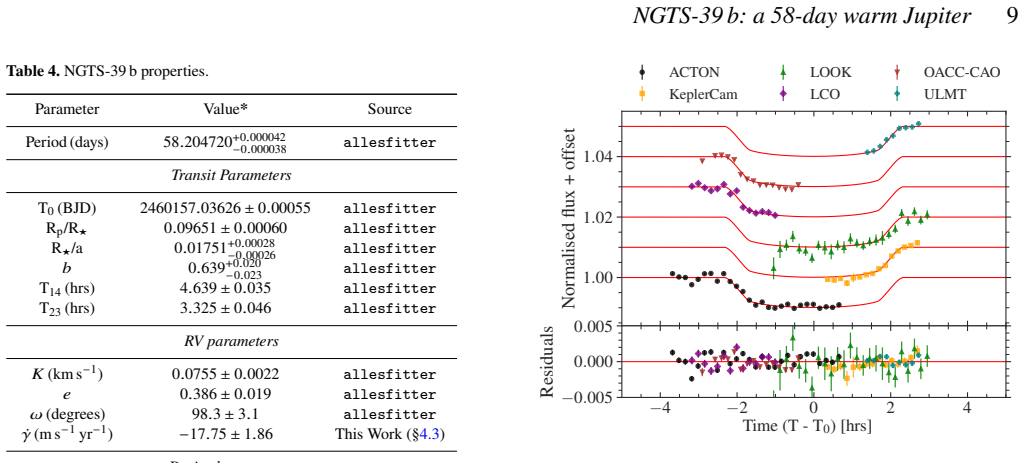
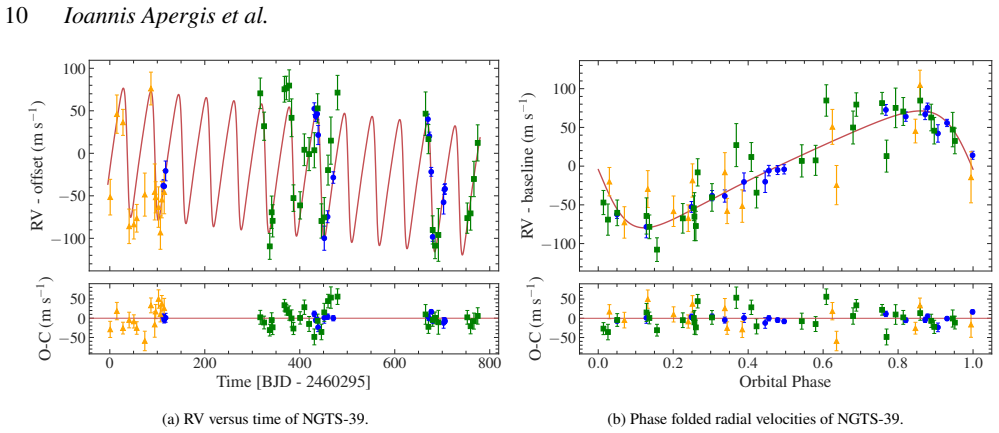
NGTS-39 b is a Jupiter-sized gas giant with a radius of 1.088 RJ and a mass of 1.467 MJ that transits a Sun-like star on a 58.2 day eccentric orbit with eccentricity 0.386. Its equilibrium temperature is 519 K. The radial velocity data show a linear trend of -17.75 m s^-1 yr^-1, which indicates the presence of an outer companion.
What carries the argument
The transiting gas giant planet with measured mass, radius, and orbital elements, which serves as the central object for studying warm Jupiters in the long-period regime.
If this is right
- It provides a test case for formation and migration models of gas giants at intermediate orbital periods.
- The measured eccentricity constrains possible dynamical histories or interactions with other bodies.
- The linear trend in radial velocities indicates at least one additional outer companion in the system.
- The bright host star allows further atmospheric or dynamical follow-up observations.
Where Pith is reading between the lines
- Similar single-transit events in survey data may be prioritized for radial velocity follow-up to find more such planets.
- The system could be used to test predictions about how eccentricity correlates with orbital period in gas giants.
- Detection of the outer companion would create a laboratory for studying planet-planet interactions over long timescales.
Load-bearing premise
The single transit signal, additional photometry, and radial velocity variations all come from the same planetary companion rather than stellar activity or a false positive.
What would settle it
A mismatch between the predicted transit timing from the radial velocity orbit and new photometric observations, or radial velocity data that cannot be fit by the derived orbital parameters.
Figures
read the original abstract
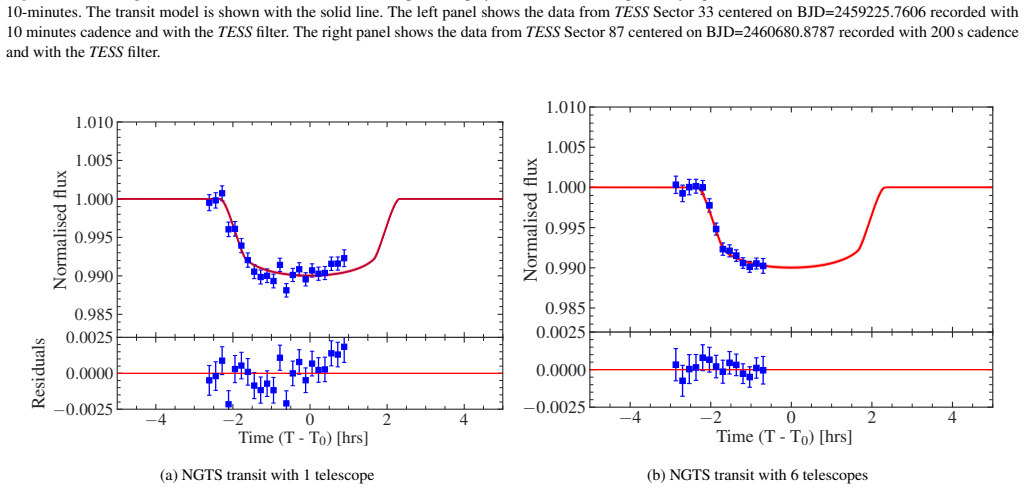
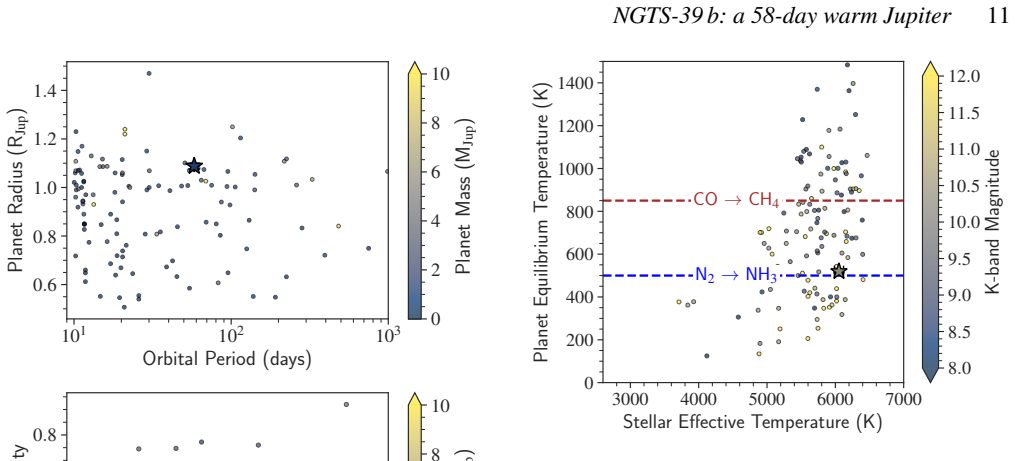
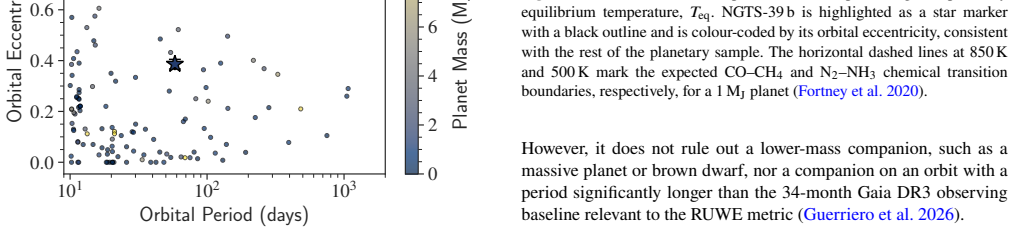
We report the discovery and characterisation of NGTS-39 b (TIC 453147896 b), a warm Jupiter transiting a Sun-like star on a 58.2 day, eccentric (e = 0.386 +/- 0.019) orbit. NGTS-39 b was first identified from a TESS single-transit event, and subsequently confirmed with NGTS photometry and radial-velocity measurements from CORALIE and HARPS. The host star is a bright (Tmag = 11.02) F9 dwarf with an effective temperature of Teff = 6053 +67/-30 K. NGTS-39 b is a Jupiter-sized gas giant with a radius of 1.088 +/- 0.012 RJ and a mass of 1.467 +/- 0.081 MJ. Its equilibrium temperature is 519 +6/-5 K, placing it between short-period hot Jupiters and cold, Jupiter-like giants. The high orbital eccentricity and intermediate equilibrium temperature of NGTS-39 b make it a valuable test case for formation and migration models, particularly in the poorly sampled regime of long-period gas giants. The RV data show a linear trend of gamma dot = -17.75 m s^-1 yr^-1, which indicates the presence of an outer companion. The discovery of NGTS-39 b contributes to the small but growing population of transiting warm Jupiters with P > 50 days orbiting bright stars.
Editorial analysis
A structured set of objections, weighed in public.
Referee Report
Summary. The manuscript reports the discovery and characterization of NGTS-39 b, a warm Jupiter transiting a bright F9 dwarf (Tmag=11.02, Teff=6053+67/-30 K) on a 58.2-day eccentric (e=0.386±0.019) orbit. The planet was identified from a single TESS transit and confirmed with NGTS photometry plus CORALIE and HARPS radial velocities, yielding Rp=1.088±0.012 RJ, Mp=1.467±0.081 MJ, and Teq=519+6/-5 K. The RV data also show a linear trend (γ̇=-17.75 m s⁻¹ yr⁻¹) indicating an outer companion. The result is presented as adding to the population of long-period transiting gas giants around bright stars.
Significance. If robust, the detection supplies a rare, precisely characterized warm Jupiter in the P>50 d regime around a bright star, offering a test case for formation and migration models in a sparsely sampled period range. The combination of measured eccentricity and outer-companion trend adds dynamical interest beyond a simple period-radius-mass addition to the census.
major comments (2)
- [Analysis / confirmation section (likely §3–4)] The central claim that the TESS transit, NGTS photometry, and CORALIE/HARPS RVs arise from the same planetary companion requires explicit false-positive vetting (e.g., centroid motion, blend scenarios, activity indicators). No such section or quantitative assessment is described in the provided material, leaving the weakest assumption unaddressed and preventing full evaluation of the discovery.
- [§3 (Transit and RV analysis)] Transit and RV modeling details are absent: the abstract quotes final parameters and uncertainties but provides no information on data reduction pipelines, choice of transit model (e.g., Mandel–Agol vs. others, limb-darkening treatment), eccentricity priors, or joint fitting procedure. These choices directly affect the quoted Rp, Mp, and e values and must be documented for reproducibility.
minor comments (1)
- [Abstract / planet properties paragraph] The equilibrium temperature is reported with asymmetric uncertainties but the assumed Bond albedo and heat redistribution factor are not stated; this should be added for clarity even if standard values are used.
Simulated Author's Rebuttal
We thank the referee for their constructive report and positive assessment of the scientific value of NGTS-39 b. We agree that the two major comments identify areas where the manuscript can be strengthened for clarity and reproducibility. We address each point below and will revise the manuscript accordingly.
read point-by-point responses
-
Referee: The central claim that the TESS transit, NGTS photometry, and CORALIE/HARPS RVs arise from the same planetary companion requires explicit false-positive vetting (e.g., centroid motion, blend scenarios, activity indicators). No such section or quantitative assessment is described in the provided material, leaving the weakest assumption unaddressed and preventing full evaluation of the discovery.
Authors: We acknowledge that a dedicated false-positive vetting section was not present in the submitted manuscript. In the revised version we will add a new subsection (likely in §3 or §4) that quantitatively addresses this. It will include: (i) TESS centroid motion analysis to check for shifts during transit; (ii) assessment of possible blend scenarios using available high-resolution imaging or archival data; and (iii) checks on activity indicators (e.g., BIS, FWHM, log R'HK from CORALIE/HARPS and photometric variability from NGTS/TESS) to rule out stellar activity or false positives. These additions will directly support the planetary interpretation. revision: yes
-
Referee: Transit and RV modeling details are absent: the abstract quotes final parameters and uncertainties but provides no information on data reduction pipelines, choice of transit model (e.g., Mandel–Agol vs. others, limb-darkening treatment), eccentricity priors, or joint fitting procedure. These choices directly affect the quoted Rp, Mp, and e values and must be documented for reproducibility.
Authors: We agree that the modeling and data-reduction procedures require explicit documentation. The revised manuscript will expand the relevant analysis section to describe: the TESS, NGTS, CORALIE and HARPS data-reduction pipelines; the transit model (Mandel–Agol with quadratic limb darkening, specifying how coefficients were handled); the eccentricity priors and other parameter priors; and the joint transit+RV fitting procedure (including the software package and any additional constraints such as the linear trend). This will allow full reproduction of the reported Rp, Mp and e values. revision: yes
Circularity Check
No significant circularity identified
full rationale
The paper is a standard observational discovery and characterization of an exoplanet. Orbital elements, mass, and radius are obtained by direct fitting of transit photometry (TESS + NGTS) and radial-velocity data (CORALIE + HARPS) to a Keplerian model; no derivation chain reduces any claimed result to its own inputs by construction, no self-citation is load-bearing for the existence or parameters of the planet, and no ansatz or uniqueness theorem is invoked. The central claim therefore remains self-contained against the external data.
Axiom & Free-Parameter Ledger
axioms (2)
- domain assumption The photometric and spectroscopic signals are produced by a single transiting planet on a Keplerian orbit
- domain assumption Stellar parameters derived from spectroscopy accurately reflect the host star's mass and radius
Reference graph
Works this paper leans on
-
[1]
Nominal thresholds for good astrometric fits, and prospects for binary detectability, for the full extended Gaia mission. , keywords =. doi:10.1093/mnras/stag654 , archivePrefix =. 2511.02476 , primaryClass =
work page internal anchor Pith review Pith/arXiv arXiv doi:10.1093/mnras/stag654
-
[2]
Gaia DR3 detectability of unresolved binary systems. , keywords =. doi:10.1051/0004-6361/202450172 , archivePrefix =. 2404.14127 , primaryClass =
-
[3]
A comprehensive study on radial velocity signals using ESPRESSO: Pushing precision to the 10 cm/s level. , keywords =. doi:10.1051/0004-6361/202553869 , archivePrefix =. 2507.07514 , primaryClass =
-
[5]
New planetary systems around HD 87816, HD 94890, and HD 102888 and an update on HD 121056
CORALIE radial-velocity search for companions around evolved stars (CASCADES): IV. New planetary systems around HD 87816, HD 94890, and HD 102888 and an update on HD 121056. , keywords =. doi:10.1051/0004-6361/202554137 , archivePrefix =. 2505.14317 , primaryClass =
-
[6]
The CORALIE survey for southern extrasolar planets. XVI. Discovery of a planetary system around HD 147018 and of two long period and massive planets orbiting HD 171238 and HD 204313. , keywords =. doi:10.1051/0004-6361/200912136 , archivePrefix =. 0908.1479 , primaryClass =
work page internal anchor Pith review Pith/arXiv arXiv doi:10.1051/0004-6361/200912136
-
[7]
MNRAS , month = nov, number =
Parviainen, Hannu and Aigrain, Suzanne , doi =. MNRAS , month = nov, number =
-
[8]
Analytical Chemistry , year = 1964, month = jan, volume =
Smoothing and differentiation of data by simplified least squares procedures. Analytical Chemistry , year = 1964, month = jan, volume =. doi:10.1021/ac60214a047 , adsurl =
-
[9]
Research Notes of the American Astronomical Society , keywords =
TESS Science Processing Operations Center FFI Target List Products. Research Notes of the American Astronomical Society , keywords =. doi:10.3847/2515-5172/abc9b3 , archivePrefix =. 2011.05495 , primaryClass =
-
[10]
The CORALIE survey for southern extrasolar planets. XVIII. Three new massive planets and two low-mass brown dwarfs at greater than 5 AU separation. , keywords =. doi:10.1051/0004-6361/201935356 , archivePrefix =. 1904.01573 , primaryClass =
work page internal anchor Pith review Pith/arXiv arXiv doi:10.1051/0004-6361/201935356 1904
-
[11]
Lightkurve: Kepler and TESS time series analysis in Python
-
[12]
, volume = 167, number = 5, pages = 238, doi =
-
[13]
doi:10.1093/mnras/stx2836 , keywords =
, volume = 475, number = 4, pages =. doi:10.1093/mnras/stx2836 , keywords =
-
[14]
doi:10.1038/378355a0 , adsurl =
, volume = 378, number = 6555, pages =. doi:10.1038/378355a0 , adsurl =
-
[15]
Exoplanets , publisher =
-
[16]
doi:10.1051/0004-6361:20020802 , keywords =
, volume = 391, pages =. doi:10.1051/0004-6361:20020802 , keywords =
-
[17]
, volume = 210, number = 2, pages = 19, doi =
-
[18]
, volume = 254, number = 2, pages = 39, doi =
-
[19]
arXiv e-prints , pages =
-
[20]
, volume = 754, number = 2, pages = 129, doi =
-
[21]
, volume = 155, number = 2, pages = 57, doi =
-
[22]
The NASA Exoplanet Archive and Exoplanet Follow-up Observing Program: Data, Tools, and Usage. , keywords =. doi:10.3847/PSJ/ade3c2 , archivePrefix =. 2506.03299 , primaryClass =
-
[23]
An upgraded 0.4-meter telescope fleet for Las Cumbres Observatory's Educational and Science Programs. arXiv e-prints , keywords =. doi:10.48550/arXiv.2405.10408 , archivePrefix =. 2405.10408 , primaryClass =
-
[24]
Real-time processing of the imaging data from the network of Las Cumbres Observatory Telescopes using BANZAI. Software and Cyberinfrastructure for Astronomy V , year = 2018, editor =. doi:10.1117/12.2314340 , archivePrefix =. 1811.04163 , primaryClass =
work page internal anchor Pith review Pith/arXiv arXiv doi:10.1117/12.2314340 2018
-
[25]
doi:10.1111/j.1365-2966.2008.13689.x , keywords =
, volume = 389, number = 3, pages =. doi:10.1111/j.1365-2966.2008.13689.x , keywords =
-
[26]
doi:10.1093/mnras/staa3739 , keywords =
, volume = 501, number = 4, pages =. doi:10.1093/mnras/staa3739 , keywords =
-
[27]
, volume = 419, number = 4, pages =. doi:10.1111/j.1365-2966.2011.19932.x , keywords =
-
[28]
Scientific Data , volume = 5, pages = 180124, doi =
Time-lapse imagery and volunteer classifications from the Zooniverse Penguin Watch project , author =. Scientific Data , volume = 5, pages = 180124, doi =
-
[29]
doi:10.3847/2041-8213/aa7200 , keywords =
, volume = 841, number = 2, pages =. doi:10.3847/2041-8213/aa7200 , keywords =
-
[30]
doi:10.1016/j.icarus.2018.08.018 , keywords =
, volume = 319, pages =. doi:10.1016/j.icarus.2018.08.018 , keywords =
-
[31]
doi:10.31219/osf.io/z6exv , url =
Describing vocalizations in young children: A big data approach through citizen science annotation , author =. doi:10.31219/osf.io/z6exv , url =
-
[32]
Deep learning for automatic segmentation of the nuclear envelope in electron microscopy data, trained with volunteer segmentations , author =. Traffic , publisher =. doi:10.1111/tra.12789 , issn =
-
[33]
doi:10.46298/jdmdh.5759 , url =
Blickhan, Samantha and Krawczyk, Coleman and Hanson, Daniel and Boyer, Amy and Simenstad, Andrea and Hyning, Victoria Van and Van Hyning, Victoria , year = 2019, month = Dec, journal =. doi:10.46298/jdmdh.5759 , url =
-
[34]
, volume = 125, number = 930, pages = 989, doi =
-
[35]
Nature Astronomy , doi =
-
[36]
, volume = 410, number = 1, pages =. doi:10.1111/j.1365-2966.2010.17432.x , keywords =
-
[37]
Advances in Machine Learning and Data Mining for Astronomy , publisher =
-
[38]
, volume = 399, number = 1, pages =. doi:10.1111/j.1365-2966.2009.15299.x , keywords =
-
[39]
, volume = 399, number = 3, pages =. doi:10.1111/j.1365-2966.2009.15383.x , keywords =
-
[40]
doi:10.1038/s41586-020-2421-7 , keywords =
, volume = 583, number = 7814, pages =. doi:10.1038/s41586-020-2421-7 , keywords =
-
[41]
doi:10.1051/0004-6361/201527329 , keywords =
, volume = 587, pages =. doi:10.1051/0004-6361/201527329 , keywords =
-
[42]
doi:10.1111/j.1365-2966.2006.11074.x , keywords =
, volume = 373, number = 2, pages =. doi:10.1111/j.1365-2966.2006.11074.x , keywords =
-
[43]
Science , volume = 327, number = 5968, pages = 977, doi =
-
[44]
doi:10.1117/1.JATIS.1.1.014003 , eid =
Journal of Astronomical Telescopes, Instruments, and Systems , volume = 1, pages =. doi:10.1117/1.JATIS.1.1.014003 , eid =
work page internal anchor Pith review doi:10.1117/1.jatis.1.1.014003
-
[45]
doi:10.1086/521346 , keywords =
, volume = 669, number = 2, pages =. doi:10.1086/521346 , keywords =
-
[46]
, volume = 819, number = 2, pages = 127, doi =
-
[47]
The Deuterium-Burning Mass Limit for Brown Dwarfs and Giant Planets
The Deuterium-burning Mass Limit for Brown Dwarfs and Giant Planets. , keywords =. doi:10.1088/0004-637X/727/1/57 , archivePrefix =. 1008.5150 , primaryClass =
work page internal anchor Pith review Pith/arXiv arXiv doi:10.1088/0004-637x/727/1/57
-
[48]
doi:10.1073/pnas.1304206111 , keywords =
Proceedings of the National Academy of Science , volume = 111, number = 35, pages =. doi:10.1073/pnas.1304206111 , keywords =
-
[49]
, volume = 59, doi =
-
[50]
, volume = 52, pages =. doi:10.48550/arXiv.astro-ph/0202320 , keywords =
work page internal anchor Pith review Pith/arXiv arXiv doi:10.48550/arxiv.astro-ph/0202320
-
[51]
doi:10.1086/429127 , keywords =
, volume = 624, number = 1, pages =. doi:10.1086/429127 , keywords =
-
[52]
doi:10.1086/509874 , keywords =
, volume = 656, number = 1, pages =. doi:10.1086/509874 , keywords =
-
[53]
doi:10.1051/0004-6361/201834853 , keywords =
, volume = 623, pages =. doi:10.1051/0004-6361/201834853 , keywords =
-
[54]
doi:10.1086/508556 , keywords =
, volume = 118, number = 848, pages =. doi:10.1086/508556 , keywords =
-
[55]
Transiting Extrapolar Planets Workshop , series =
-
[56]
, volume = 356, number = 4, pages =. doi:10.1111/j.1365-2966.2004.08585.x , keywords =
-
[57]
doi:10.1016/0019-1035(84)90102-7 , keywords =
, volume = 58, number = 1, pages =. doi:10.1016/0019-1035(84)90102-7 , keywords =
-
[58]
doi:10.1086/382735 , keywords =
, volume = 116, number = 817, pages =. doi:10.1086/382735 , keywords =
-
[59]
, volume = 222, number = 1, pages = 14, doi =
-
[60]
, volume = 126, number = 938, pages = 398, doi =
-
[61]
Next Generation Transit Survey Data Release Document , author =
-
[62]
Next Generation Transit Survey Second Data Release Document , author =
-
[63]
doi:10.1093/mnras/stz2064 , keywords =
, volume = 488, number = 4, pages =. doi:10.1093/mnras/stz2064 , keywords =
-
[64]
, volume = 156, number = 5, pages = 234, doi =
-
[65]
, volume = 155, number = 3, pages = 136, doi =
-
[66]
doi:10.1146/annurev-astro-081811-125523 , keywords =
, volume = 50, pages =. doi:10.1146/annurev-astro-081811-125523 , keywords =
-
[67]
, volume = 822, number = 2, pages = 86, doi =
-
[68]
, volume = 158, number = 4, pages = 138, doi =
-
[69]
doi:10.48550/arXiv.2108.04778 , keywords =
arXiv e-prints , pages =. doi:10.48550/arXiv.2108.04778 , keywords =
-
[70]
doi:10.17909/FWDT-2X66 , url =
TESS Input Catalog and Candidate Target List , author =. doi:10.17909/FWDT-2X66 , url =
-
[71]
, volume = 809, number = 1, pages = 25, doi =
-
[72]
, volume = 162, number = 2, pages = 75, doi =
-
[73]
, volume = 805, number = 1, pages = 16, doi =
-
[74]
doi:10.1086/309530 , keywords =
, volume = 542, number = 1, pages =. doi:10.1086/309530 , keywords =
-
[75]
J. Sci. Commun. , volume = 18, number = 1, pages =. doi:10.22323/2.18010204 , url =
-
[76]
doi:10.1093/mnras/stx2778 , keywords =
, volume = 475, number = 4, pages =. doi:10.1093/mnras/stx2778 , keywords =
-
[77]
doi:10.1093/mnras/sty2581 , keywords =
, volume = 481, number = 4, pages =. doi:10.1093/mnras/sty2581 , keywords =
-
[78]
doi:10.1093/mnras/sty1193 , keywords =
, volume = 478, number = 4, pages =. doi:10.1093/mnras/sty1193 , keywords =
-
[79]
doi:10.1093/mnras/stz1084 , keywords =
, volume = 486, number = 4, pages =. doi:10.1093/mnras/stz1084 , keywords =
-
[80]
doi:10.1051/0004-6361/201935206 , keywords =
, volume = 625, pages =. doi:10.1051/0004-6361/201935206 , keywords =
-
[81]
doi:10.1093/mnras/stz2349 , keywords =
, volume = 489, number = 3, pages =. doi:10.1093/mnras/stz2349 , keywords =
discussion (0)
Sign in with ORCID, Apple, or X to comment. Anyone can read and Pith papers without signing in.