Electrical transport in ultra-thin films: from Fuchs-Sondheimer to quantum-confinement
Pith reviewed 2026-07-03 06:50 UTC · model grok-4.3
The pith
Reciprocal-space confinement theory predicts exponential resistivity increase in ultra-thin films at the nanoscale.
A machine-rendered reading of the paper's core claim, the machinery that carries it, and where it could break.
Core claim
The paper establishes that under extreme spatial confinement in ultra-thin films, the electronic states available for transport are fundamentally restructured by finite size, leading to predictions from the reciprocal-space confinement theory of an exponential increase of resistivity with decreasing thickness, which can be unified with classical surface-scattering models for metallic and semiconducting films.
What carries the argument
Reciprocal-space confinement theory, which restructures the electronic states available for transport due to finite film thickness and predicts exponential resistivity growth.
Load-bearing premise
Growing experimental evidence shows that classical models become insufficient under extreme confinement.
What would settle it
Measurements on ultra-thin films showing resistivity that does not rise exponentially as thickness decreases below the mean free path would challenge the quantum-confinement prediction.
Figures


read the original abstract
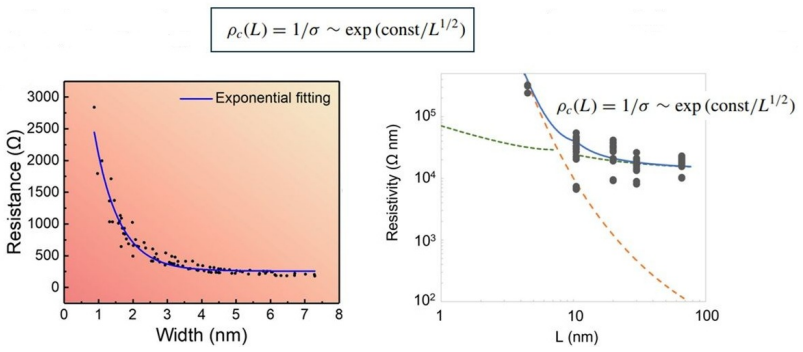
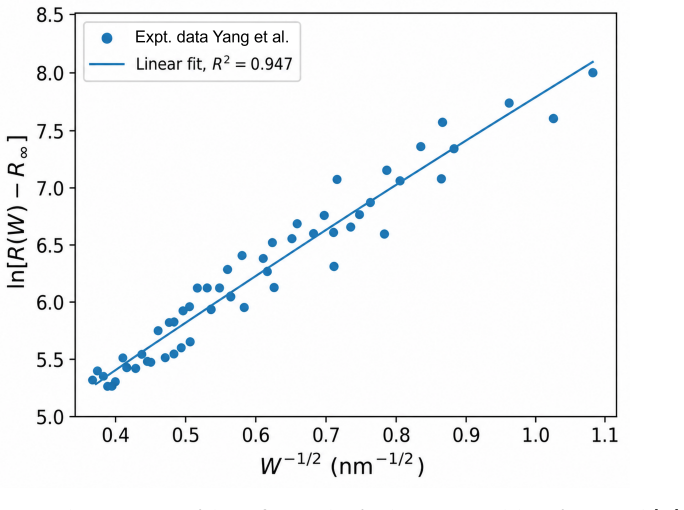
Ultra-thin films are fundamental components of modern nanoelectronics, where reducing thickness to the few-nanometer scale leads to a dramatic increase in electrical resistivity. For decades, this behavior has been interpreted in terms of classical size effects, primarily surface scattering within the Fuchs--Sondheimer theory and grain-boundary scattering in the Mayadas--Shatzkes model. While these approaches successfully describe transport when the film thickness is comparable to the electronic mean free path, growing experimental evidence indicates that they become insufficient under extreme confinement. This review discusses the crossover from classical scattering to a quantum-confinement regime in which the electronic states available for transport are fundamentally restructured by finite size. We review the recently proposed reciprocal-space confinement theory, which predicts an exponential increase of resistivity with decreasing thickness at the nanoscale, and discuss how it can be combined with classical surface-scattering models to provide a unified description of ultra-thin metallic and semiconducting films. Finally, we summarize recent experimental evidence supporting this picture and discuss its implications for future nanoelectronic devices, nanoscale interconnects, and quantum transport under extreme spatial confinement.
Editorial analysis
A structured set of objections, weighed in public.
Referee Report
Summary. The manuscript is a review article discussing electrical transport in ultra-thin metallic and semiconducting films. It reviews the classical Fuchs-Sondheimer surface-scattering and Mayadas-Shatzkes grain-boundary models, notes their limitations under extreme confinement based on cited experimental evidence, and summarizes the recently proposed reciprocal-space confinement theory, which predicts an exponential resistivity increase with decreasing thickness. The review proposes combining this quantum-confinement approach with classical models for a unified description and discusses implications for nanoelectronics.
Significance. If the reciprocal-space confinement predictions are independently validated, the review offers a useful synthesis of classical and quantum regimes for transport under nanoscale confinement, with direct relevance to interconnect scaling and device performance. The explicit unification framework is a constructive element, though the manuscript's value as a review hinges on balanced coverage of supporting and competing literature.
minor comments (2)
- [Abstract] The abstract states that classical models 'become insufficient under extreme confinement' but does not quantify the thickness scale (e.g., relative to mean free path or Fermi wavelength) at which the crossover is expected; adding this would improve clarity for readers.
- Figure captions and axis labels should explicitly distinguish resistivity data from different materials or models to avoid ambiguity when comparing classical and quantum-confinement regimes.
Simulated Author's Rebuttal
We thank the referee for their constructive summary of the manuscript and for recommending minor revision. No major comments are listed in the report.
Circularity Check
Review summarizes prior theory; no load-bearing derivation reduces to self-inputs
full rationale
The manuscript is a review paper that summarizes the reciprocal-space confinement theory (labeled 'recently proposed') and its combination with classical models, without performing or claiming a new derivation of the exponential resistivity prediction within this document. No equations or steps in the provided text reduce a claimed prediction to a fitted parameter or self-citation by construction; the central claims rest on referenced prior literature and experimental summaries rather than internal re-derivation. Self-citation of the author's own prior work is present but does not function as the sole justification for a new result here, satisfying the criteria for an independent review summary.
Axiom & Free-Parameter Ledger
Reference graph
Works this paper leans on
-
[1]
Cramming more components onto integrated circuits
Moore GE. Cramming more components onto integrated circuits. Electronics. 1965; 38(8):114–117
work page 1965
-
[2]
The future of computing beyond moore’s law
Shalf J. The future of computing beyond moore’s law. Philosophical Transactions of the Royal Society A. 2020;378(2166):20190061
work page 2020
-
[3]
Design of ion-implanted mosfet’s with very small physical dimensions
Dennard RH, Gaensslen FH, Yu HN, et al. Design of ion-implanted mosfet’s with very small physical dimensions. IEEE Journal of Solid-State Circuits. 1974; 9(5):256–268
work page 1974
-
[4]
A new golden age for computer architecture
Hennessy JL, Patterson DA. A new golden age for computer architecture. Com- munications of the ACM. 2019;62(2):48–60
work page 2019
-
[5]
Envisioning the economics of a semiconductor revolution
Davies M. Envisioning the economics of a semiconductor revolution. Communica- tions of the ACM. 2025;68(5):44–49
work page 2025
-
[6]
The conductivity of thin metallic films according to the electron theory of metals
Fuchs K. The conductivity of thin metallic films according to the electron theory of metals. Mathematical Proceedings of the Cambridge Philosophical Society. 1938; 34(1):100–108
work page 1938
-
[7]
The mean free path of electrons in metals
Sondheimer EH. The mean free path of electrons in metals. Advances in Physics. 1952;1(1):1–42
work page 1952
-
[8]
Mayadas AF, Shatzkes M. Electrical-resistivity model for polycrystalline films: the case of arbitrary reflection at external surfaces. Physical Review B. 1970;1(4):1382– 1389
work page 1970
-
[9]
Electron-surface scattering from first-principles
Zhang C, Liu Y. Electron-surface scattering from first-principles. ACS Nano. 2024;18(40):27433–27439. PMID: 39325662; Available from:https://doi.org/10. 1021/acsnano.4c07698
work page 2024
-
[10]
Exploring conductivity in ex-situ doped si thin films as thickness approaches 5 nm
MacHale J, Meaney F, Kennedy N, et al. Exploring conductivity in ex-situ doped si thin films as thickness approaches 5 nm. Journal of Applied Physics. 2019; 125(22):225709
work page 2019
-
[11]
Thickness-dependent conductivity of nanometric semiconductor thin films
Zaccone A. Thickness-dependent conductivity of nanometric semiconductor thin films. Physical Review Materials. 2025;9:046001
work page 2025
-
[12]
Approaching the ballistic transport limit in single crystalline Au
Yang X, Zhang J, Li W, et al. Approaching the ballistic transport limit in single crystalline Au. Physical Review Letters. 2025;135:216302
work page 2025
-
[13]
The theory of the properties of metals and alloys
Mott NF, Jones H. The theory of the properties of metals and alloys. Oxford: Oxford University Press; 1936
work page 1936
-
[14]
Introduction to solid state physics
Kittel C. Introduction to solid state physics. John Wiley and Sons; 2005
work page 2005
-
[15]
Ashcroft NW, Mermin ND. Solid state physics. New York: Holt, Rinehart and Winston; 1976
work page 1976
-
[16]
Electrons and phonons: The theory of transport phenomena in solids
Ziman JM. Electrons and phonons: The theory of transport phenomena in solids. Oxford: Oxford University Press; 1960
work page 1960
-
[17]
Influence of the electron mean free path on the resistivity of thin metal films
Zhang W, Brongersma SH, Richard O, et al. Influence of the electron mean free path on the resistivity of thin metal films. Microelectronic Engineering. 2004;76(1– 4):146–152
work page 2004
-
[18]
Resistivity scaling due to electron surface scattering in thin metal layers
Zhou T, Gall D. Resistivity scaling due to electron surface scattering in thin metal layers. Physical Review B. 2018;97:165406
work page 2018
-
[19]
Carrier density and dc conductivity of ultrathin aluminum films
Du H, Gong J, Sun C, et al. Carrier density and dc conductivity of ultrathin aluminum films. Journal of Materials Science. 2004;39:2865–2867
work page 2004
-
[20]
Extended analytical BCS theory of superconductivity in thin films
Travaglino R, Zaccone A. Extended analytical BCS theory of superconductivity in thin films. Journal of Applied Physics. 2023 01;133(3):033901. Available from: https://doi.org/10.1063/5.0132820
-
[21]
Analytical theory of enhanced bose–einstein con- densation in thin films
Travaglino R, Zaccone A. Analytical theory of enhanced bose–einstein con- densation in thin films. Journal of Physics B: Atomic, Molecular and Optical 21 Physics. 2022 mar;55(5):055301. Available from:https://dx.doi.org/10.1088/ 1361-6455/ac5583
work page 2022
-
[22]
Quantum confinement theory of the heat capacity of thin films
Zaccone A. Quantum confinement theory of the heat capacity of thin films. Phys Rev Mater. 2024 May;8:056001. Available from:https://link.aps.org/doi/10. 1103/PhysRevMaterials.8.056001
work page 2024
-
[23]
Phonon-confinement theory of thermal conductivity in ultrathin silicon films
Zaccone A. Phonon-confinement theory of thermal conductivity in ultrathin silicon films. Journal of Applied Physics. 2025 12;138(22):225305. Available from:https: //doi.org/10.1063/5.0304896
-
[24]
Electrical conduction in nanogranular cluster-assembled metallic films
Mirigliano M, Milani P. Electrical conduction in nanogranular cluster-assembled metallic films. Advances in Physics: X. 2021;6(1):1908847
work page 2021
-
[25]
Mirigliano M, Radice S, Falqui A, et al. Anomalous electrical conduction and nega- tive temperature coefficient of resistance in nanostructured gold resistive switching films. Scientific Reports. 2020;10:20482
work page 2020
-
[26]
Understanding the resistivity and absolute thermoelectric power of disordered metals and alloys
Gasser JG. Understanding the resistivity and absolute thermoelectric power of disordered metals and alloys. Journal of Physics: Condensed Matter. 2008; 20(11):114230
work page 2008
-
[27]
Quantitative Eliashberg theory of the superconductiv- ity of thin films
Ummarino GA, Zaccone A. Quantitative Eliashberg theory of the superconductiv- ity of thin films. Journal of Physics: Condensed Matter. 2024 nov;37(6):065703. Available from:https://doi.org/10.1088/1361-648X/ad92ed
-
[28]
Can the noble metals (au, ag, and cu) be superconduc- tors? Phys Rev Mater
Ummarino GA, Zaccone A. Can the noble metals (au, ag, and cu) be superconduc- tors? Phys Rev Mater. 2024 Oct;8:L101801. Available from:https://link.aps. org/doi/10.1103/PhysRevMaterials.8.L101801
-
[29]
Zhang CJ, Zhang B, Wu Y, et al. Enhanced superconductivity in atomically thin noble metals: From quantum confinement to interface-induced lifshitz transition
-
[30]
Available from:https://arxiv.org/abs/2606.03663
work page internal anchor Pith review Pith/arXiv arXiv
-
[31]
Addressing interconnect challenges for enhanced micro- electronics
Kim JS, Gall D, Pop E. Addressing interconnect challenges for enhanced micro- electronics. Science. 2024;386(6725):eadk6189
work page 2024
-
[32]
Surface conduction and reduced electrical resistivity in ultrathin noncrystalline nbp semimetal
Khan AI, Ramdas A, Lindgren E, et al. Surface conduction and reduced electrical resistivity in ultrathin noncrystalline nbp semimetal. Science. 2025;387(6729):62– 67
work page 2025
-
[33]
Quantum properties of atomic-sized conductors
Agra¨ ıt N, Yeyati AL, van Ruitenbeek JM. Quantum properties of atomic-sized conductors. Physics Reports. 2003;377(2–3):81–279
work page 2003
-
[34]
Quantum conductance in memristive de- vices: Fundamentals, developments, and applications
Milano G, Pedretti G, Montesi L, et al. Quantum conductance in memristive de- vices: Fundamentals, developments, and applications. Advanced Materials. 2022; 34(32):2201248
work page 2022
-
[35]
Recent advances and future prospects for memristive devices
Xia Q, Yang JJ. Recent advances and future prospects for memristive devices. ACS Nano. 2023;17(14):13254–13286
work page 2023
-
[36]
Recent contact strategies for two-dimensional electronics
Zhang Y, Liu Y. Recent contact strategies for two-dimensional electronics. ACS Nano. 2025;19(1)
work page 2025
-
[37]
Rise and fall of shape resonances in thin films of bcs superconductors
Valentinis D, van der Marel D, Berthod C. Rise and fall of shape resonances in thin films of bcs superconductors. Physical Review B. 2016;94(5):054516
work page 2016
-
[38]
Empante TA, Martinez A, Wurch M, et al. Low resistivity and high breakdown current density of 10-nm diameter van der waals tase3 nanowires by chemical vapor deposition. Nano Letters. 2019;19(7):4355–4361
work page 2019
-
[39]
Quantized conductance of point contacts in a two-dimensional electron gas
van Wees BJ, van Houten H, Beenakker CWJ, et al. Quantized conductance of point contacts in a two-dimensional electron gas. Physical Review Letters. 1988; 60(9):848–850
work page 1988
-
[40]
Facile fabrication of complex networks of memristive devices
Minnai C, Bellacicca A, Brown SA, et al. Facile fabrication of complex networks of memristive devices. Scientific Reports. 2017;7:7955
work page 2017
-
[41]
Minnai C, Mirigliano M, Brown SA, et al. The nanocoherer: An electrically and 22 mechanically resettable resistive switching device based on gold clusters assembled on paper. Nano Futures. 2018;2(1):011002. 23
work page 2018
discussion (0)
Sign in with ORCID, Apple, or X to comment. Anyone can read and Pith papers without signing in.