Spherically Symmetric Fluid Simulations of Black Hole Accretion in Self-Interacting Dark Matter Halos
Pith reviewed 2026-07-03 06:46 UTC · model grok-4.3
The pith
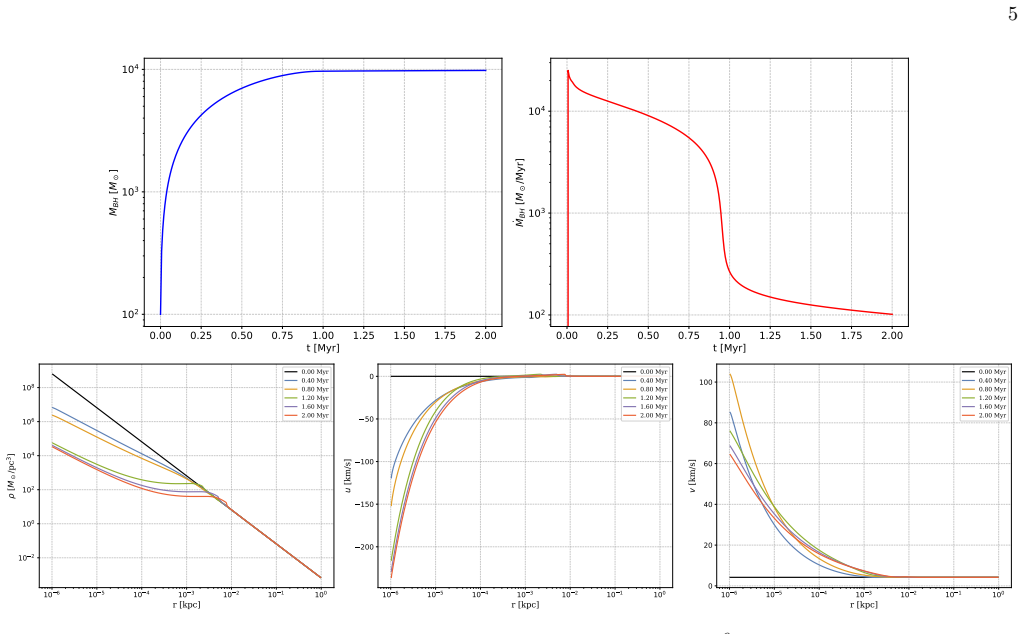
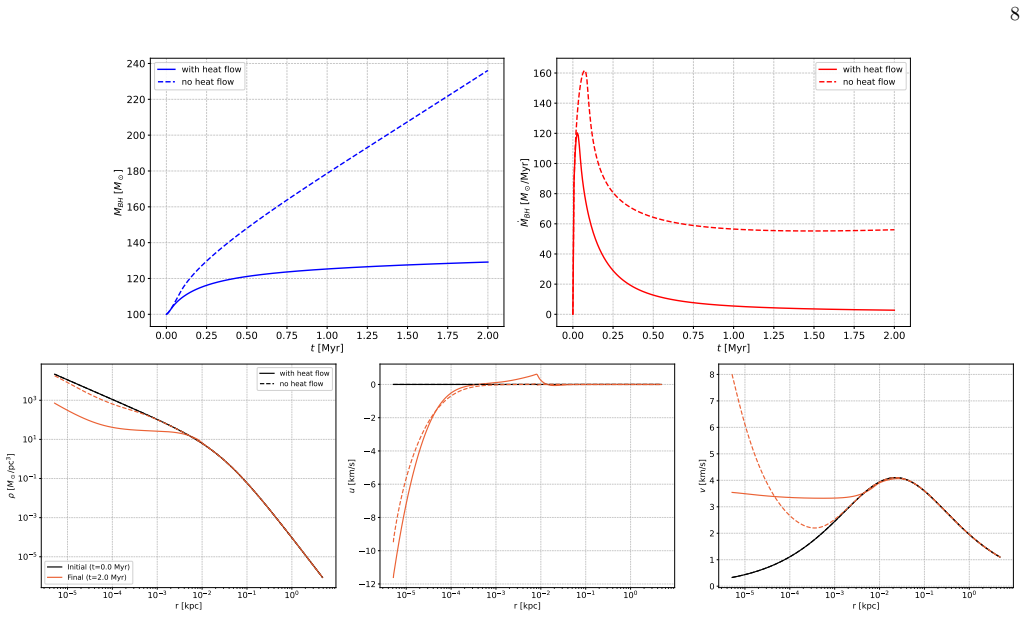
Black holes in SIS-like self-interacting dark matter halos grow from 100 to 10,000 solar masses in 2 million years.
A machine-rendered reading of the paper's core claim, the machinery that carries it, and where it could break.
Core claim
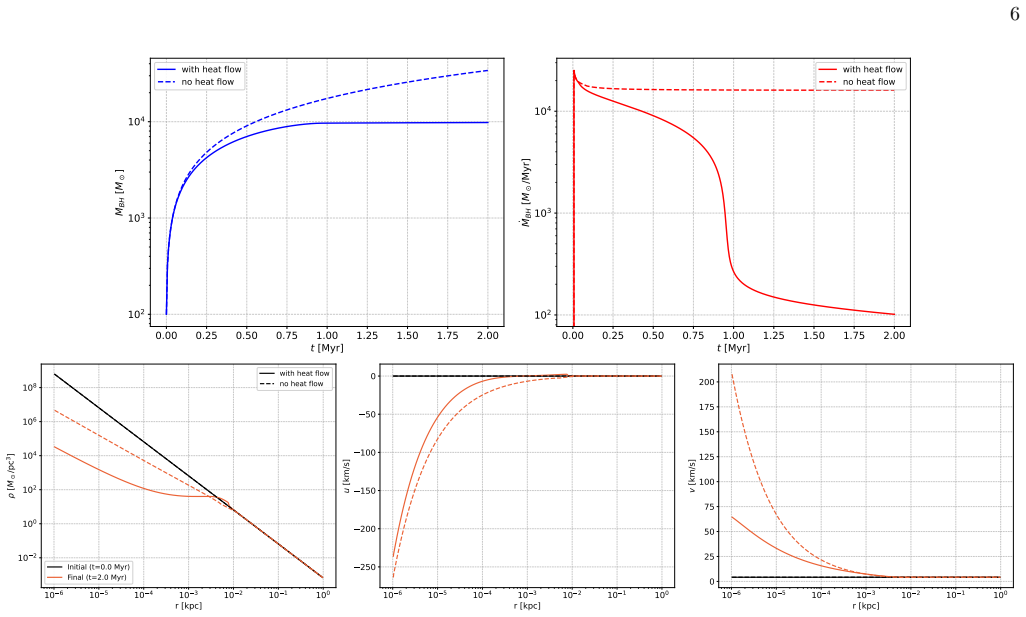
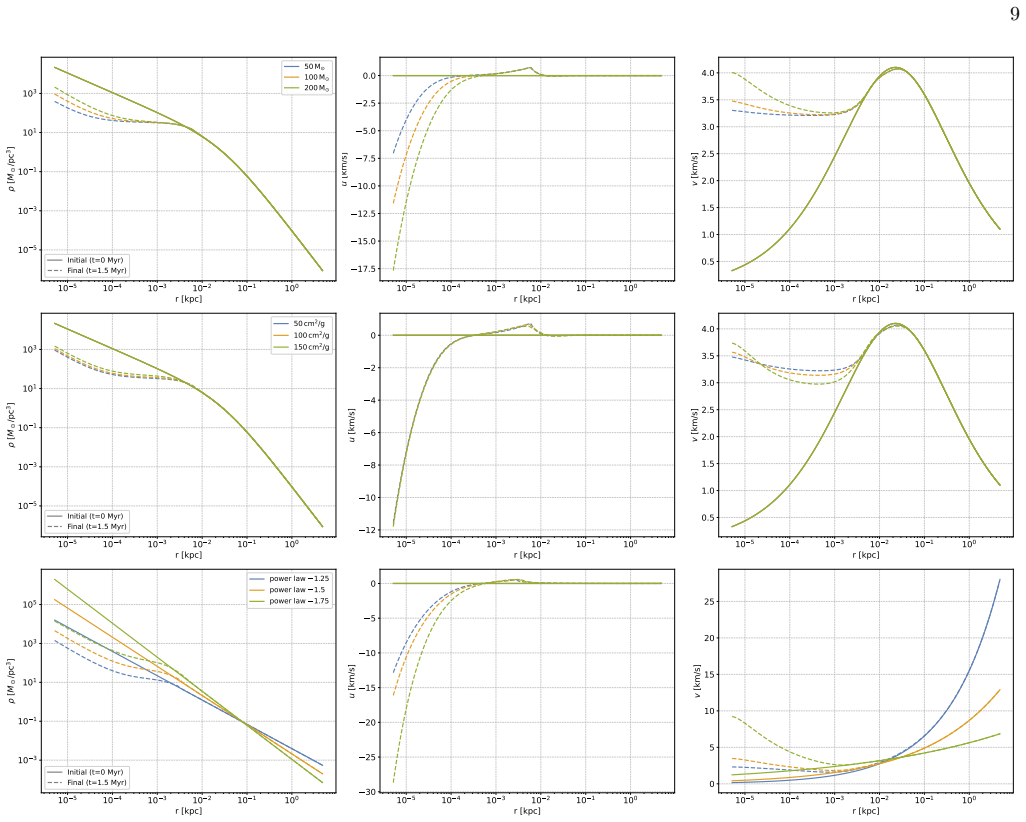
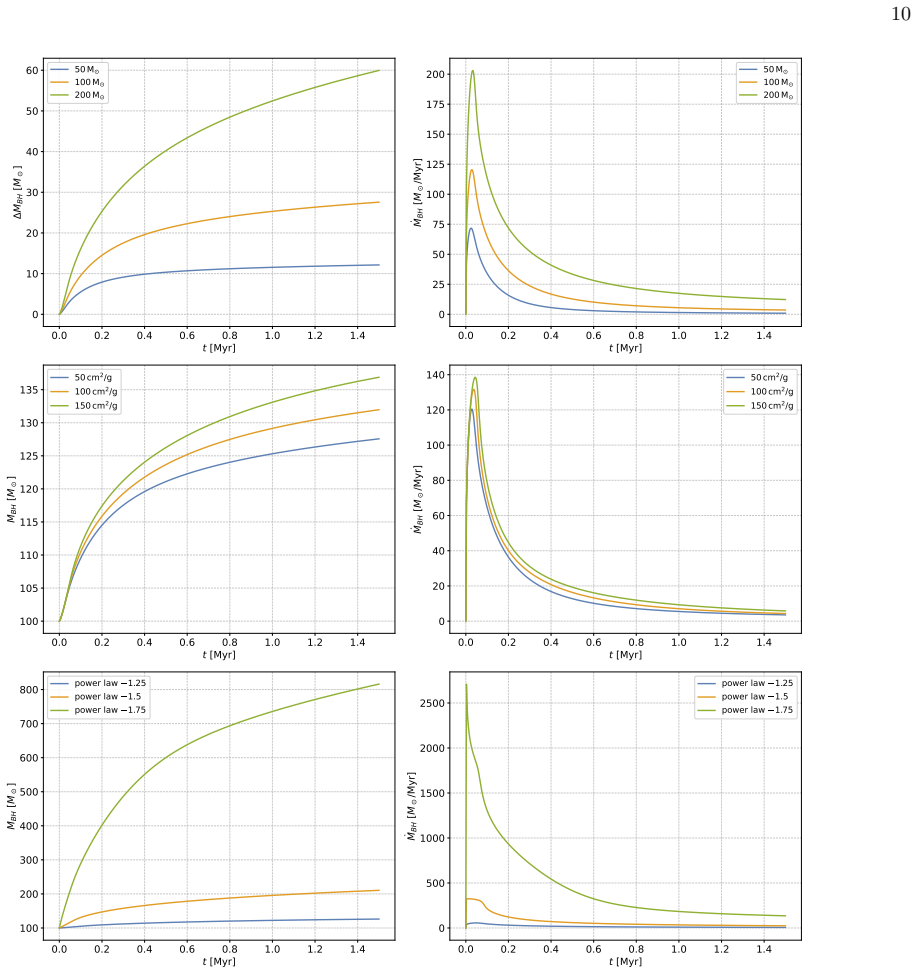
Black hole growth in SIDM halos is regulated by the competition between gravity-driven inflow and SIDM heat transport. An SIS-like environment facilitates rapid accretion, allowing a 100 M⊙ seed to grow to 10^4 M⊙ within 2 Myr. Larger initial black hole masses, steeper density profiles, and higher scattering cross sections significantly enhance the accretion rate.
What carries the argument
The self-gravitating fluid model with thermal conduction simulated by a one-dimensional spherically symmetric hydrodynamic code that uses operator-splitting finite-volume methods to track the balance between inflow and heat transport.
If this is right
- Larger initial black hole masses produce higher accretion rates.
- Steeper initial density profiles increase the growth rate.
- Higher SIDM scattering cross sections accelerate black hole growth.
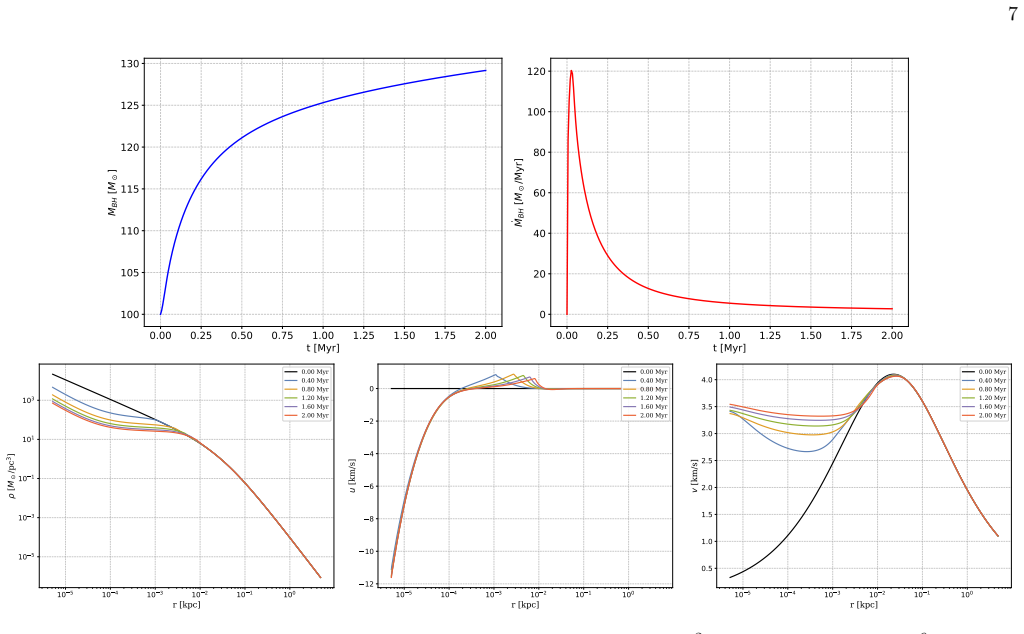
- The SIS profile yields faster growth than the NFW profile under otherwise identical conditions.
Where Pith is reading between the lines
- If SIDM halos with SIS-like cores are common at high redshift, the mechanism could help explain the existence of massive black holes observed at early cosmic times.
- Direct comparison of the predicted accretion rates against future 3D SIDM simulations would test the spherical-symmetry assumption.
- Observational upper limits on early black hole masses could be used to place bounds on the SIDM cross section once the model is extended to cosmological volumes.
Load-bearing premise
The self-gravitating fluid model with thermal conduction and the assumption of perfect spherical symmetry accurately capture the accretion dynamics in SIDM halos.
What would settle it
A three-dimensional simulation of the identical initial conditions that produces accretion rates differing by more than a factor of a few due to non-spherical flows or non-fluid particle behavior would falsify the central result.
Figures
read the original abstract
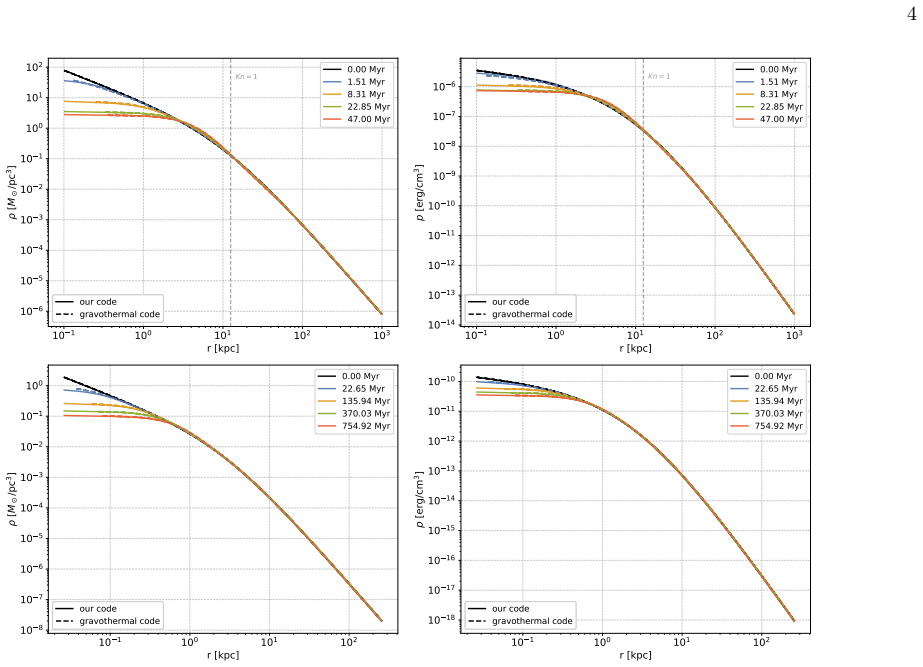
We investigate black hole accretion in self-interacting dark matter (SIDM) halos using a self-gravitating fluid model with thermal conduction. We develop a robust one-dimensional spherically symmetric hydrodynamic code based on an operator-splitting finite-volume method. Simulating both Singular Isothermal Sphere (SIS) and Navarro-Frenk-White (NFW) profiles, we find that black hole growth is regulated by the competition between gravity-driven inflow and SIDM heat transport. Our results demonstrate that an SIS-like environment facilitates rapid accretion, allowing a $100\,\mathrm{M_{\odot}}$ seed to grow to $10^4\,\mathrm{M_{\odot}}$ within $2\,\mathrm{Myr}$. Furthermore, we show that larger initial black hole masses, steeper density profiles, and higher scattering cross sections significantly enhance the accretion rate. This study provides a comprehensive fluid-dynamical picture of black hole growth in SIDM halos.
Editorial analysis
A structured set of objections, weighed in public.
Referee Report
Summary. The paper develops a one-dimensional spherically symmetric hydrodynamic code based on an operator-splitting finite-volume method to simulate black hole accretion in self-interacting dark matter (SIDM) halos, modeled as self-gravitating fluids with thermal conduction. It compares Singular Isothermal Sphere (SIS) and Navarro-Frenk-White (NFW) profiles and reports that an SIS-like environment enables rapid accretion, allowing a 100 M⊙ seed to reach 10^4 M⊙ within 2 Myr, with accretion rates enhanced by larger initial black hole masses, steeper density profiles, and higher scattering cross sections.
Significance. If the numerical results are robust, the work supplies a fluid-dynamical picture of how SIDM heat transport competes with gravity-driven inflow to regulate black hole growth, potentially informing seed black hole evolution in alternative dark matter models. The explicit demonstration of profile-dependent growth rates is a concrete contribution, though its weight depends on validation of the 1D setup.
major comments (3)
- [Abstract] Abstract: the headline result (100 M⊙ seed growing to 10^4 M⊙ in 2 Myr under SIS-like conditions) is stated without any reported validation tests, convergence checks, error bars, or comparison to analytic limits, leaving the numerical support for the central claim unassessable from the provided information.
- [model development paragraph] Model development paragraph: the self-gravitating fluid model with thermal conduction is implemented under the assumption of perfect spherical symmetry, yet no justification or test is supplied for why net angular momentum or non-radial motions can be neglected in SIDM halos; a run with even a modest specific angular momentum floor would be required to show that centrifugal support does not throttle the reported inflow.
- [Abstract] Abstract and results description: the claim that larger initial masses, steeper profiles, and higher cross sections enhance accretion is presented as a simulation outcome, but without quantitative sensitivity analysis or resolution studies it is unclear whether the reported factor-of-100 growth is converged or sensitive to the operator-splitting treatment of conduction and self-gravity.
minor comments (1)
- Notation for the scattering cross section and conduction coefficient should be defined explicitly at first use to avoid ambiguity between particle-physics and fluid parameters.
Simulated Author's Rebuttal
We thank the referee for their constructive feedback, which highlights areas where the presentation of our numerical results can be strengthened. We address each major comment below and indicate the revisions we will make.
read point-by-point responses
-
Referee: [Abstract] Abstract: the headline result (100 M⊙ seed growing to 10^4 M⊙ in 2 Myr under SIS-like conditions) is stated without any reported validation tests, convergence checks, error bars, or comparison to analytic limits, leaving the numerical support for the central claim unassessable from the provided information.
Authors: We agree that the abstract and main text would benefit from explicit references to validation. In the revised manuscript we will add a dedicated methods subsection summarizing grid-convergence tests (doubling and halving the radial resolution), direct comparisons of the conduction-free limit to the analytic Bondi accretion rate, and quantitative error estimates on the integrated mass growth. These additions will make the numerical support for the reported growth rates assessable. revision: yes
-
Referee: [model development paragraph] Model development paragraph: the self-gravitating fluid model with thermal conduction is implemented under the assumption of perfect spherical symmetry, yet no justification or test is supplied for why net angular momentum or non-radial motions can be neglected in SIDM halos; a run with even a modest specific angular momentum floor would be required to show that centrifugal support does not throttle the reported inflow.
Authors: The one-dimensional formulation is adopted to isolate the radial competition between gravity-driven inflow and SIDM heat transport that constitutes the central physical question of the study. We will expand the model section with a brief justification referencing the rapid velocity isotropization expected in SIDM halos on timescales shorter than the accretion window considered. We nevertheless recognize that a quantitative test with a specific-angular-momentum floor lies outside the present scope; we will explicitly list this as a limitation and defer such explorations to future multidimensional work. revision: partial
-
Referee: [Abstract] Abstract and results description: the claim that larger initial masses, steeper profiles, and higher cross sections enhance accretion is presented as a simulation outcome, but without quantitative sensitivity analysis or resolution studies it is unclear whether the reported factor-of-100 growth is converged or sensitive to the operator-splitting treatment of conduction and self-gravity.
Authors: The manuscript already contains a parameter survey (varying seed mass, initial density slope, and scattering cross-section) whose outcomes are shown in the figures and text. To address the concern directly we will insert a new table in the results section that tabulates accretion rates at multiple resolutions together with the corresponding operator-split time-step errors, thereby demonstrating convergence of the reported growth factor within the 1D framework. revision: yes
Circularity Check
No circularity: results obtained via direct numerical integration of fluid equations
full rationale
The paper reports outcomes from a custom 1D spherically symmetric finite-volume hydrodynamic code applied to self-gravitating fluid equations with thermal conduction. No analytic derivation chain exists whose steps could reduce to fitted parameters, self-definitions, or self-citations. The reported accretion rates (e.g., 100 M⊙ seed to 10^4 M⊙ in 2 Myr under SIS conditions) are generated outputs of the numerical integration under stated initial profiles and boundary conditions, not predictions obtained by renaming or fitting subsets of the same data. The spherical-symmetry assumption is an explicit modeling choice whose validity is external to any internal reduction; it does not create a self-referential loop within the derivation.
Axiom & Free-Parameter Ledger
Reference graph
Works this paper leans on
-
[1]
The MC slope limiter In computational fluid dynamics (CFD), slope lim- iters are used to reconstruct interfacial values from cell- averaged quantities [52]. Given the cell-averaged state vectorU i, the left and right reconstructed states at the interfacei+ 1/2, denoted byU L i+1/2 andU R i+1/2, can be obtained through linear reconstruction as follows: UL ...
-
[2]
The Roe Riemann solver In computational fluid dynamics, a Riemann problem is an initial-value problem for a hyperbolic system of conservation laws with piecewise-constant initial data. When the computational domain is discretized into cells, a local Riemann problem is defined at each interface i+ 1/2 by the reconstructed left and right states,U L i+1/2 12...
-
[3]
The Waning of the WIMP? A Review of Models, Searches, and Constraints
G. Arcadi, M. Dutra, P. Ghosh, M. Lindner, Y. Mam- brini, M. Pierre, S. Profumo, and F. S. Queiroz, The waning of the WIMP? A review of models, searches, and constraints, Eur. Phys. J. C78, 203 (2018), arXiv:1703.07364 [hep-ph]
work page internal anchor Pith review Pith/arXiv arXiv 2018
-
[4]
Dark Matter Search Results from 4.2 Tonne-Years of Exposure of the LUX-ZEPLIN (LZ) Experiment
J. Aalberset al.(LZ), Dark Matter Search Results from 4.2 Tonne-Years of Exposure of the LUX-ZEPLIN (LZ) Experiment, Phys. Rev. Lett.135, 011802 (2025), arXiv:2410.17036 [hep-ex]
work page internal anchor Pith review Pith/arXiv arXiv 2025
-
[5]
Aprileet al.(XENON), First Search for Light Dark Matter in the Neutrino Fog with XENONnT, Phys
E. Aprileet al.(XENON), First Search for Light Dark Matter in the Neutrino Fog with XENONnT, Phys. Rev. Lett.134, 111802 (2025), arXiv:2409.17868 [hep-ex]
-
[6]
D. N. Spergel and P. J. Steinhardt, Observational ev- idence for selfinteracting cold dark matter, Phys. Rev. Lett.84, 3760 (2000), arXiv:astro-ph/9909386
work page internal anchor Pith review Pith/arXiv arXiv 2000
-
[7]
Subhaloes in Self-Interacting Galactic Dark Matter Haloes
M. Vogelsberger, J. Zavala, and A. Loeb, Subhaloes in Self-Interacting Galactic Dark Matter Haloes, Mon. Not. Roy. Astron. Soc.423, 3740 (2012), arXiv:1201.5892 [astro-ph.CO]
work page internal anchor Pith review Pith/arXiv arXiv 2012
-
[8]
Dark Matter Self-interactions and Small Scale Structure
S. Tulin and H.-B. Yu, Dark Matter Self-interactions and Small Scale Structure, Phys. Rept.730, 1 (2018), arXiv:1705.02358 [hep-ph]
work page internal anchor Pith review Pith/arXiv arXiv 2018
-
[9]
Jianget al., A semi-analytic study of self-interacting dark-matter haloes with baryons, Mon
F. Jianget al., A semi-analytic study of self-interacting dark-matter haloes with baryons, Mon. Not. Roy. Astron. Soc.521, 4630 (2023), arXiv:2206.12425 [astro-ph.CO]
- [10]
- [11]
- [12]
-
[13]
Z. Jia, F. Jiang, S. Li, R. Li, J. Wang, and L. Zhu, An Enhanced Isothermal Jeans Approach to Constraining Dark Matter Self-Interactions from Galactic Kinematics (2026), arXiv:2601.17118 [astro-ph.GA]
work page internal anchor Pith review Pith/arXiv arXiv 2026
- [14]
-
[15]
M. Kaplinghat, S. Tulin, and H.-B. Yu, Dark Matter Halos as Particle Colliders: Unified Solution to Small- Scale Structure Puzzles from Dwarfs to Clusters, Phys. Rev. Lett.116, 041302 (2016), arXiv:1508.03339 [astro- ph.CO]
work page internal anchor Pith review Pith/arXiv arXiv 2016
- [16]
-
[17]
W. J. G. de Blok, The Core-Cusp Problem, Advances in 14 Astronomy2010, 789293 (2010), arXiv:0910.3538 [astro- ph.CO]
work page internal anchor Pith review Pith/arXiv arXiv 2010
-
[18]
D. Yang, Y.-Z. Fan, S. Hou, and Y.-L. S. Tsai, Self- interacting dark matter with mass segregation: a unified explanation of dwarf cores and small-scale lenses, Sci. Bull.71, 1349 (2026), arXiv:2506.14898 [astro-ph.CO]
work page internal anchor Pith review Pith/arXiv arXiv 2026
-
[19]
Too big to fail? The puzzling darkness of massive Milky Way subhaloes
M. Boylan-Kolchin, J. S. Bullock, and M. Kaplinghat, Too big to fail? The puzzling darkness of massive Milky Way subhaloes, Mon. Not. Roy. Astron. Soc.415, L40 (2011), arXiv:1103.0007 [astro-ph.CO]
work page internal anchor Pith review Pith/arXiv arXiv 2011
-
[20]
Constraining Self-Interacting Dark Matter with the Milky Way's dwarf spheroidals
J. Zavala, M. Vogelsberger, and M. G. Walker, Constrain- ing Self-Interacting Dark Matter with the Milky Way’s dwarf spheroidals, Mon. Not. Roy. Astron. Soc.431, L20 (2013), arXiv:1211.6426 [astro-ph.CO]
work page internal anchor Pith review Pith/arXiv arXiv 2013
-
[21]
K. A. Omanet al., The unexpected diversity of dwarf galaxy rotation curves, Mon. Not. Roy. Astron. Soc.452, 3650 (2015), arXiv:1504.01437 [astro-ph.GA]
work page internal anchor Pith review Pith/arXiv arXiv 2015
-
[22]
How the Self-Interacting Dark Matter Model Explains the Diverse Galactic Rotation Curves
A. Kamada, M. Kaplinghat, A. B. Pace, and H.-B. Yu, How the Self-Interacting Dark Matter Model Explains the Diverse Galactic Rotation Curves, Phys. Rev. Lett. 119, 111102 (2017), arXiv:1611.02716 [astro-ph.GA]
work page internal anchor Pith review Pith/arXiv arXiv 2017
-
[23]
M. Kaplinghat, T. Ren, and H.-B. Yu, Dark Matter Cores and Cusps in Spiral Galaxies and their Explanations, JCAP06(2020), 027, arXiv:1911.00544 [astro-ph.GA]
- [24]
-
[25]
D. Yang and H.-B. Yu, Self-interacting dark matter and small-scale gravitational lenses in galaxy clusters, Phys. Rev. D104, 103031 (2021), arXiv:2102.02375 [astro- ph.GA]
-
[26]
D. Yang and H.-B. Yu, Gravothermal evolution of dark matter halos with differential elastic scattering, JCAP09 (2022), 077, arXiv:2205.03392 [astro-ph.CO]
-
[27]
D. Gilman, Y.-M. Zhong, and J. Bovy, Constrain- ing resonant dark matter self-interactions with strong gravitational lenses, Phys. Rev. D107, 103008 (2023), arXiv:2207.13111 [astro-ph.CO]
- [28]
-
[29]
S. Liet al., The “Little Dark Dot”: Evidence for Self-interacting Dark Matter in the Strong Lens SDSS J0946+1006?, Astrophys. J.994, 201 (2025), arXiv:2504.11800 [astro-ph.GA]
- [30]
- [31]
-
[32]
H.-B. Yu, Three Birds with One Stone: Core-Collapsed SIDM Halos as the Common Origin of Dense Per- turbers in Lenses, Streams, and Satellites (2025), arXiv:2510.11006 [astro-ph.GA]
-
[33]
J. Mattheeet al., Little Red Dots: An Abundant Popu- lation of Faint Active Galactic Nuclei at z∼5 Revealed by the EIGER and FRESCO JWST Surveys, Astrophys. J.963, 129 (2024), arXiv:2306.05448 [astro-ph.GA]
-
[34]
Z. Li, K. Inayoshi, K. Chen, K. Ichikawa, and L. C. Ho, Little Red Dots: Rapidly Growing Black Holes Reddened by Extended Dusty Flows, Astrophys. J.980, 36 (2025)
2025
-
[35]
W.-X. Feng, H.-B. Yu, and Y.-M. Zhong, Dark Bondi Accretion Aided by Baryons and the Origin of JWST Little Red Dots (2025), arXiv:2506.17641 [astro-ph.GA]
-
[36]
Inayoshi, Little Red Dots as the Very First Activity of Black Hole Growth, Astrophys
K. Inayoshi, Little Red Dots as the Very First Activity of Black Hole Growth, Astrophys. J. Lett.988, L22 (2025)
2025
- [37]
- [38]
- [39]
-
[40]
Self-Interacting Dark Matter Halos and the Gravothermal Catastrophe
S. Balberg, S. L. Shapiro, and S. Inagaki, Self-interacting dark matter halos and the gravothermal catastrophe, As- trophys. J.568, 475 (2002), arXiv:astro-ph/0110561
work page internal anchor Pith review Pith/arXiv arXiv 2002
-
[41]
W.-X. Feng, H.-B. Yu, and Y.-M. Zhong, Dynamical in- stability of collapsed dark matter halos, JCAP05(2022), 036, arXiv:2108.11967 [astro-ph.CO]
-
[42]
W.-X. Feng, H.-B. Yu, and Y.-M. Zhong, Seeding Su- permassive Black Holes with Self-interacting Dark Mat- ter: A Unified Scenario with Baryons, Astrophys. J. Lett. 914, L26 (2021), arXiv:2010.15132 [astro-ph.CO]
-
[43]
H.-P. Gu, F. Jiang, X. Chen, and R. Li, Non-Equilibrium Relativistic Core Collapse of Self-Interacting Dark Mat- ter Halos – Limits On Seed Black Hole Mass (2026), arXiv:2601.17117 [astro-ph.CO]
work page internal anchor Pith review Pith/arXiv arXiv 2026
-
[44]
J. P. Ostriker, Collisional dark matter and the origin of massive black holes, Phys. Rev. Lett.84, 5258 (2000), arXiv:astro-ph/9912548
work page internal anchor Pith review Pith/arXiv arXiv 2000
-
[45]
J. F. Hennawi and J. P. Ostriker, Observational con- straints on the self interacting dark matter scenario and the growth of supermassive black holes, Astrophys. J. 572, 41 (2002), arXiv:astro-ph/0108203
work page internal anchor Pith review Pith/arXiv arXiv 2002
-
[46]
J. Hu, Y. Shen, Y.-Q. Lou, and S. Zhang, Forming su- permassive black holes by accreting dark and baryon matter, Mon. Not. Roy. Astron. Soc.365, 345 (2006), arXiv:astro-ph/0510222
work page internal anchor Pith review Pith/arXiv arXiv 2006
- [47]
-
[48]
S. L. Shapiro and V. Paschalidis, Self-interacting dark matter cusps around massive black holes, Phys. Rev. D 89, 023506 (2014), arXiv:1402.0005 [astro-ph.CO]
work page internal anchor Pith review Pith/arXiv arXiv 2014
-
[49]
J. F. Navarro, C. S. Frenk, and S. D. M. White, The Structure of cold dark matter halos, Astrophys. J.462, 563 (1996), arXiv:astro-ph/9508025
work page internal anchor Pith review Pith/arXiv arXiv 1996
-
[50]
Formation and Evolution of the Self-Interacting Dark Matter Halos
K.-J. Ahn and P. R. Shapiro, Formation and evolution of the self-interacting dark matter halos, Mon. Not. Roy. Astron. Soc.363, 1092 (2005), arXiv:astro-ph/0412169
work page internal anchor Pith review Pith/arXiv arXiv 2005
-
[51]
J. Koda and P. R. Shapiro, Gravothermal collapse of iso- lated self-interacting dark matter haloes: N-body simula- tion versus the fluid model, Mon. Not. Roy. Astron. Soc. 415, 1125 (2011), arXiv:1101.3097 [astro-ph.CO]
work page internal anchor Pith review Pith/arXiv arXiv 2011
-
[52]
H. Nishikawa, K. K. Boddy, and M. Kaplinghat, Accel- erated core collapse in tidally stripped self-interacting dark matter halos, Phys. Rev. D101, 063009 (2020), 15 arXiv:1901.00499 [astro-ph.GA]
-
[53]
Blazek,Computational fluid dynamics: principles and applications(Butterworth-Heinemann, 2015)
J. Blazek,Computational fluid dynamics: principles and applications(Butterworth-Heinemann, 2015)
2015
-
[54]
R. J. LeVeque,Finite volume methods for hyperbolic problems, Vol. 31 (Cambridge university press, 2002)
2002
-
[55]
P. L. Roe, Approximate Riemann Solvers, Parameter Vectors, and Difference Schemes, Journal of Computa- tional Physics43, 357 (1981)
1981
-
[56]
E. F. Toro,Riemann solvers and numerical methods for fluid dynamics: a practical introduction(Springer Sci- ence & Business Media, 2013)
2013
-
[57]
van Leer, Towards the Ultimate Conservative Differ- ence Scheme
B. van Leer, Towards the Ultimate Conservative Differ- ence Scheme. IV. A New Approach to Numerical Convec- tion, Journal of Computational Physics23, 276 (1977)
1977
- [58]
-
[59]
S. Gad-Nasr, K. K. Boddy, M. Kaplinghat, N. J. Out- mezguine, and L. Sagunski, On the late-time evolution of velocity-dependent self-interacting dark matter halos, JCAP05(2024), 131, arXiv:2312.09296 [astro-ph.GA]
- [60]
-
[61]
Godunov, Finite difference methods for the computa- tion of discontinuous solutions of the equations of fluid dynamics, Mat
S. Godunov, Finite difference methods for the computa- tion of discontinuous solutions of the equations of fluid dynamics, Mat. Sb.47, 271 (1959)
1959
-
[62]
Harten, P
A. Harten, P. D. Lax, and B. van Leer, On Upstream Differencing and Godunov-Type Schemes for Hyperbolic Conservation Laws, SIAM Rev.25, 35 (1983)
1983
-
[63]
E. F. Toro, M. Spruce, and W. Speares, Restoration of the contact surface in the HLL-Riemann solver, Shock Waves4, 25 (1994)
1994
discussion (0)
Sign in with ORCID, Apple, or X to comment. Anyone can read and Pith papers without signing in.