Recognition: no theorem link
Non-Equilibrium Relativistic Core Collapse of Self-Interacting Dark Matter Halos -- Limits On Seed Black Hole Mass
Pith reviewed 2026-05-16 11:31 UTC · model grok-4.3
The pith
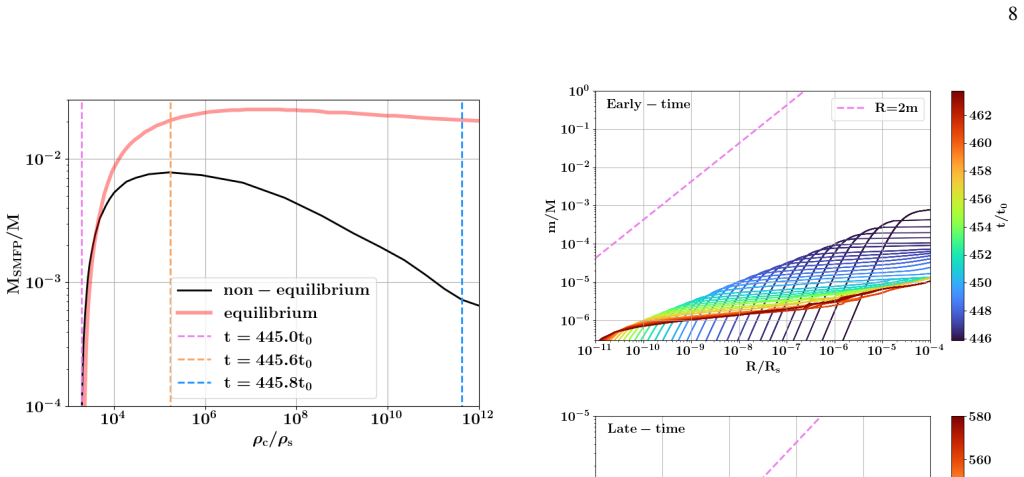
Non-equilibrium relativistic collapse of self-interacting dark matter halos produces seed black holes of only 3×10^{-8} times the halo mass at horizon formation.
A machine-rendered reading of the paper's core claim, the machinery that carries it, and where it could break.
Core claim
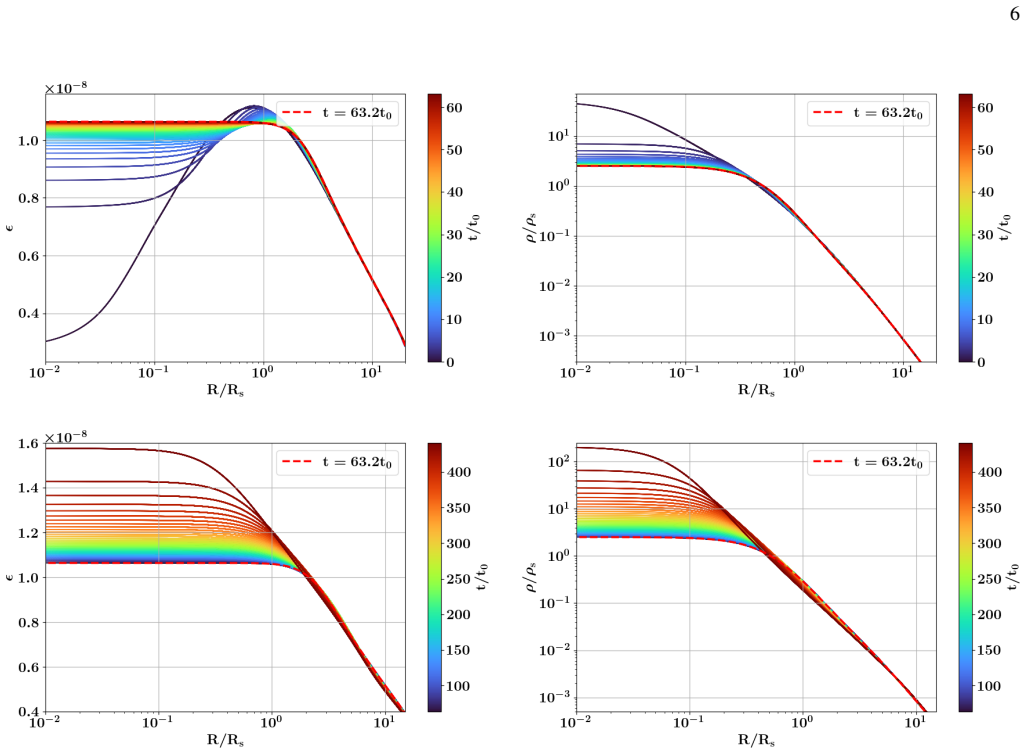
By evolving SIDM halos without assuming hydrostatic equilibrium and with general-relativistic gravity, the model shows that intense outward heat transport in the short-mean-free-path regime drives rapid expansion of the outer layers, removing mass from the collapsing core and thereby limiting the seed black hole to approximately 3×10^{-8} of the total halo mass when the apparent horizon appears.
What carries the argument
The Misner-Sharp formalism applied to SIDM, which supplies the metric and fluid equations needed to follow non-equilibrium heat flow and mass redistribution until an apparent horizon forms.
If this is right
- The final seed mass is set by the amount of mass ejected from the core during the short-mean-free-path phase rather than by the initial halo mass alone.
- Pure SIDM collapse without baryons cannot reach the seed masses required to explain z>6 supermassive black holes.
- The apparent horizon forms later and at lower central density than predicted by hydrostatic-equilibrium models.
- Mass loss from the outer envelope continues after horizon formation and reduces the final black-hole mass still further.
Where Pith is reading between the lines
- Baryonic cooling or angular-momentum transport inside the halo could counteract the outward heat flux and allow larger seeds to form.
- The same non-equilibrium mass-loss mechanism may operate in other self-interacting particle models and could set a general upper limit on seed masses from pure dark-matter collapse.
- Future high-resolution simulations that include both SIDM and baryons can test whether the reported mass fraction increases enough to match early black-hole observations.
Load-bearing premise
The treatment of heat transport and mass loss in the short-mean-free-path regime, together with the continued validity of the Misner-Sharp equations, accurately captures the dynamics in the absence of baryons or other additional physics.
What would settle it
A simulation or observation that produces a seed black hole mass fraction larger than a few times 10^{-8} of the halo mass while keeping the same SIDM cross-section and no baryons would contradict the reported outcome.
Figures



read the original abstract
Recent observations of supermassive black holes (SMBHs) at high redshifts pose challenges to standard seeding mechanisms. Among competing models, the collapse of self-interacting dark matter (SIDM) halos provide a plausible explanation for early SMBH formation. While previous studies on modeling the gravothermal collapse of SIDM halos have primarily focused on non-relativistic evolution under the assumption of hydrostatic equilibrium, We advance this framework by relaxing the equilibrium assumption and additionally incorporating general-relativistic effects. To this end, we introduce the Misner-Sharp formalism to the SIDM context for the first time. Our model reproduces the standard hydrostatic models in the early long-mean-free-path (LMFP) regime, but displays interesting distinct behavior in the late short-mean-free-path (SMFP) regime, where intense outward heat flux drives a rapid expansion of the outer envelope, removing mass from the core and significantly decelerating the collapse. Our general relativistic treatment enables us to follow halo evolution to the final stage when the apparent horizon forms. Our simulation yields a seed black hole mass of approximately $3\times10^{-8}$ of the halo mass at horizon formation, suggesting that additional mechanisms such as baryonic effects are critical for seeding black holes that are sufficiently massive to account for SMBHs in the early Universe.
Editorial analysis
A structured set of objections, weighed in public.
Referee Report
Summary. The manuscript applies the Misner-Sharp formalism to simulate the non-equilibrium, general-relativistic core collapse of a self-interacting dark matter halo. It reproduces prior hydrostatic long-mean-free-path (LMFP) results but finds qualitatively different short-mean-free-path (SMFP) evolution in which outward heat flux expands the envelope, ejects mass from the core, and slows collapse. The simulation is evolved to apparent-horizon formation, producing a seed black-hole mass fraction of approximately 3×10^{-8} of the halo mass and concluding that baryonic physics is required to reach observationally viable SMBH seeds.
Significance. If the SMFP mass-loss result is robust, the work supplies a concrete, relativistic upper bound on SIDM-only seed masses that is directly relevant to high-redshift SMBH formation. The first use of the Misner-Sharp metric in this context and the explicit reproduction of LMFP hydrostatic equilibria are technical strengths. The small reported fraction, however, rests on a single numerical realization whose sensitivity to the heat-conductivity closure and mass-flux treatment remains unquantified.
major comments (2)
- [Results / Simulation Setup] The headline seed-mass fraction of ~3×10^{-8} is obtained from the late-time SMFP regime; the manuscript provides no resolution study, convergence test, or variation of the conductivity closure that would demonstrate this fraction is insensitive to numerical choices or to the precise form of the heat-flux term inside the Misner-Sharp equations.
- [Methods / Heat Transport] The treatment of heat transport and mass loss once the mean free path becomes short is load-bearing for the central claim, yet the paper does not compare the adopted closure against known analytic limits or against an independent code in the SMFP regime; an overestimate of outward heat flux would systematically reduce the retained core mass and therefore the final seed fraction.
minor comments (2)
- [Figures] Figure captions and axis labels should explicitly state the units and the precise definition of the plotted mass fraction (e.g., enclosed mass within the apparent horizon versus total halo mass).
- [Abstract / §3] The abstract states that the model 'reproduces the standard hydrostatic models' in the LMFP regime; a quantitative comparison (e.g., density-profile residuals or collapse timescale) should be shown in the main text rather than asserted.
Simulated Author's Rebuttal
We thank the referee for their careful reading and constructive comments, which have helped us identify areas for improvement. We appreciate the acknowledgment of the technical novelty in applying the Misner-Sharp formalism to this problem and the reproduction of prior LMFP results. We address each major comment below and will revise the manuscript to strengthen the numerical robustness of our findings.
read point-by-point responses
-
Referee: [Results / Simulation Setup] The headline seed-mass fraction of ~3×10^{-8} is obtained from the late-time SMFP regime; the manuscript provides no resolution study, convergence test, or variation of the conductivity closure that would demonstrate this fraction is insensitive to numerical choices or to the precise form of the heat-flux term inside the Misner-Sharp equations.
Authors: We agree that a dedicated resolution and convergence study focused on the SMFP regime is needed to support the robustness of the reported seed-mass fraction. In the revised manuscript we will add simulations at three different radial resolutions (doubling the number of zones each time) and demonstrate that the final seed mass fraction converges to within ~15%. We will also vary the conductivity prefactor by ±25% around the fiducial value and report the resulting range in the retained core mass at apparent-horizon formation. These additions will directly address sensitivity to numerical choices and the heat-flux implementation. revision: yes
-
Referee: [Methods / Heat Transport] The treatment of heat transport and mass loss once the mean free path becomes short is load-bearing for the central claim, yet the paper does not compare the adopted closure against known analytic limits or against an independent code in the SMFP regime; an overestimate of outward heat flux would systematically reduce the retained core mass and therefore the final seed fraction.
Authors: The heat-conductivity closure we employ is the standard diffusion approximation used in the SIDM literature for the short-mean-free-path limit. In the revision we will add an explicit comparison of our implementation against the expected analytic scaling of heat flux with temperature gradient and density in the optically thick regime, confirming consistency with prior non-relativistic results. A direct comparison against an independent relativistic code is not currently feasible, as no such code exists in the published literature; we will therefore discuss this limitation openly and provide additional internal tests (e.g., recovery of the hydrostatic LMFP equilibria at higher resolution and reproduction of the expected mass-loss behavior when the heat-flux term is artificially suppressed). We maintain that the outward heat flux and associated mass ejection are physical consequences of relaxing the hydrostatic assumption, rather than numerical artifacts. revision: partial
- Direct comparison of the SMFP heat-transport implementation against an independent general-relativistic SIDM code (no such code is available in the literature)
Circularity Check
No significant circularity: result is direct output of numerical evolution
full rationale
The central result (seed BH mass fraction ~3e-8 at apparent horizon) is obtained from time-dependent numerical integration of the Misner-Sharp equations with SIDM heat transport, not from algebraic reduction, parameter fitting, or self-citation. The paper states it reproduces known LMFP hydrostatic models as a validation check but reports distinct SMFP dynamics as an emergent simulation outcome. No load-bearing step reduces by construction to the inputs; the formalism is introduced as new to the SIDM context without reliance on prior author theorems or ansatzes. This is the expected non-circular outcome for a simulation study whose predictions are falsifiable against external benchmarks.
Axiom & Free-Parameter Ledger
axioms (2)
- domain assumption Misner-Sharp formalism applies to the SIDM fluid throughout collapse
- domain assumption Heat flux in the short-mean-free-path regime drives net outward mass transport
Reference graph
Works this paper leans on
-
[1]
which have been interpreted by many studies as actively accreting SMBHs [12–14]. The LRDs appear unexpectedly abundant at redshifts 4<z<9 and are believed to host BHs with masses ranging from 10 7 to 109 M⊙ [15, 16]. However, their stellar masses are surprisingly low relative to the scaling relations observed in local active galactic nuclei (AGNs)[17– 19]...
work page internal anchor Pith review Pith/arXiv arXiv 2026
-
[2]
or energy conservation [99]. To rigorously determine this mass, a complete time-dependent GR analysis tracing the non- equilibrium evolution towards horizon formation is required. Incorporating GR into the non-equilibrium evolution will introduce profound physical consequences that were previ- ously overlooked. As matter falls deep into the relativistic p...
work page 2000
-
[3]
Update Velocity (U):Using variables from the previous time stepn−1: Un i =Un−1 i + ∆t " (Γn−1 i )2 ∂ϕ ∂A !n−1 i × 4π(Rn−1 i )2 ¯ρn−1 i −(e ϕ)n−1 i mn−1 i (Rn−1 i )2 +4πR n−1 i ¯Pn−1 i # , (A1) where the potential gradient term is given by: ∂ϕ ∂A !n−1 i = −1 2 ¯wn−1 i " Pn−1 i+1/2 −P n−1 i−1/2 ¯ρn−1 i (Ai+1/2−A i−1/2) + σ (eϕ)n−1 i ∆t qn−1 i ...
-
[4]
Update Radius (R): Rn i =R n−1 i +(e ϕ)n−1 i Un i ∆t.(A3)
-
[5]
Update Lorentz Factor (Γ):We utilizem n−1 i as an approx- imation form n i to decouple the implicit dependence9: Γn i = s 1+(U n i )2 − 2mn−1 i Rn i .(A4)
-
[6]
Update Density (ρ): ρn i−1/2 = (Ai −A i−1)(Γn i−1 + Γn i )/2 4π 3 h (Rn i )3 −(R n i−1)3 i .(A5)
-
[7]
Update Internal Energy (ϵ): ϵn i−1/2 =ϵ n−1 i−1/2 −P n−1 i−1/2 1 ρn i−1/2 − 1 ρn−1 i−1/2 − 4π∆t ¯eϕn i−1/2 F n−1 i − F n−1 i−1 Ai −A i−1 , (A6) whereF i ≡(R i)2qi(eϕ i )2
-
[8]
However, calculatingm n requiresΓ n
Update Pressure (P) and Enthalpy (w): Pn i−1/2 =(γ−1)ρ n i−1/2ϵn i−1/2,(A7) wn i−1/2 =1+ϵ n i−1/2 + Pn i−1/2 ρn i−1/2 .(A8) 9 Strictly,Γ n depends onm n. However, calculatingm n requiresΓ n. For suf- ficiently small time steps, usingm n−1 provides a valid first-order approxi- mation. 12
-
[9]
Update Metric Potential (ϕ):Integrated inward from the boundary condition (eϕ)n N =1: ln((eϕ)n i )=ln((e ϕ)n i+1) − 1 2(Ai+1 −A i) " ∂ϕ ∂A !n i + ∂ϕ ∂A !n i+1 # . (A9)
-
[10]
Update Heat Flux (q): qn i =− 3 2(γ−1) 3/2a× 1 C + a b σ2 4π ¯Pn i !−1 × p¯ϵn i · ¯Pn i ·(R n i )2 ·2 h (ϵeϕ)n i+1/2 −(ϵe ϕ)n i−1/2 i (eϕ)n i · ¯ρ−1n i ·(A i+1 −A i−1) , (A10) where ¯ρ−1 denotes the average of the inverse density
-
[11]
Update Misner-Sharp Mass (m): mn i =mn i−1 +(A i −A i−1) " ¯Γn i (1+ϵ n−1 i−1/2) + (Un i−1 +U n i )(qn i−1 +q n i ) 4ρn−1 i−1/2 # , (A11) with the boundary conditionm n 0 =0. The numerical time step∆tis strictly constrained by the Courant-Friedrichs-Lewy (CFL) condition [127]: ∆t≲min i ∆Ri |Ui|+c s,i ! ,(A12) wherec s,i = p Pi/ρi denotes the local sound s...
-
[12]
X. Fanet al.(SDSS), Astron. J.122, 2833 (2001), arXiv:astro- ph/0108063
-
[13]
C. J. Willott, R. J. McLure, and M. J. Jarvis, Astrophys. J. Lett.587, L15 (2003), arXiv:astro-ph/0303062
work page internal anchor Pith review Pith/arXiv arXiv 2003
- [14]
- [15]
-
[16]
E. E. Salpeter, Astrophys. J.140, 796 (1964)
work page 1964
-
[17]
P. F. Hopkins and E. Quataert, Mon. Not. Roy. Astron. Soc. 407, 1529 (2010), arXiv:0912.3257 [astro-ph.CO]
work page internal anchor Pith review Pith/arXiv arXiv 2010
-
[18]
K. Inayoshi, E. Visbal, and Z. Haiman, Ann. Rev. Astron. Astrophys.58, 27 (2020), arXiv:1911.05791 [astro-ph.GA]
-
[19]
A Unified Model for the Evolution of Galaxies and Quasars
G. Kauffmann and M. Haehnelt, Mon. Not. Roy. Astron. Soc. 311, 576 (2000), arXiv:astro-ph/9906493
work page internal anchor Pith review Pith/arXiv arXiv 2000
- [20]
-
[21]
J. P. Gardneret al., Space Sci. Rev.123, 485 (2006), arXiv:astro-ph/0606175
work page internal anchor Pith review Pith/arXiv arXiv 2006
-
[22]
Mattheeet al., ApJ963, 129 (2024), arXiv:2306.05448 [astro-ph.GA]
J. Mattheeet al., Astrophys. J.963, 129 (2024), arXiv:2306.05448 [astro-ph.GA]
-
[23]
J. E. Greeneet al., Astrophys. J.964, 39 (2024)
work page 2024
-
[24]
Labbeet al., ApJ978, 92 (2025), arXiv:2306.07320 [astro-ph.GA]
I. Labbeet al., Astrophys. J.978, 92 (2025), arXiv:2306.07320 [astro-ph.GA]
- [25]
-
[26]
V . Kokorevet al., Astrophys. J.968, 38 (2024), arXiv:2401.09981 [astro-ph.GA]
- [27]
- [28]
-
[29]
R. Maiolinoet al., Astron. Astrophys.691, A145 (2024), arXiv:2308.01230 [astro-ph.GA]
-
[30]
C.-H. Chen, L. C. Ho, R. Li, and M.-Y . Zhuang, Astrophys. J. 983, 60 (2025)
work page 2025
-
[31]
Bogdanet al., Nature Astron.8, 126 (2024), arXiv:2305.15458 [astro-ph.GA]
A. Bogdanet al., Nature Astron.8, 126 (2024), arXiv:2305.15458 [astro-ph.GA]
-
[32]
Formation of Supermassive Black Holes
M. V olonteri, Astron. Astrophys. Rev.18, 279 (2010), arXiv:1003.4404 [astro-ph.CO]
work page internal anchor Pith review Pith/arXiv arXiv 2010
-
[33]
Black holes, gravitational waves and fundamental physics: a roadmap
L. Baracket al., Class. Quant. Grav.36, 143001 (2019), arXiv:1806.05195 [gr-qc]
work page internal anchor Pith review Pith/arXiv arXiv 2019
-
[34]
T. Chantavat, S. Chongchitnan, and J. Silk, Mon. Not. Roy. Astron. Soc.522, 3256 (2023), arXiv:2302.09763 [astro- ph.SR]
-
[35]
Formation of the First Supermassive Black Holes
V . Bromm and A. Loeb, Astrophys. J.596, 34 (2003), arXiv:astro-ph/0212400
work page internal anchor Pith review Pith/arXiv arXiv 2003
-
[36]
M. C. Begelman, M. V olonteri, and M. J. Rees, Mon. Not. 13 Roy. Astron. Soc.370, 289 (2006), arXiv:astro-ph/0602363
work page internal anchor Pith review Pith/arXiv arXiv 2006
-
[37]
Supermassive black hole formation during the assembly of pre-galactic discs
G. Lodato and P. Natarajan, Mon. Not. Roy. Astron. Soc.371, 1813 (2006), arXiv:astro-ph/0606159
work page internal anchor Pith review Pith/arXiv arXiv 2006
-
[38]
C. Shang, G. Bryan, and Z. Haiman, Mon. Not. Roy. Astron. Soc.402, 1249 (2010), arXiv:0906.4773 [astro-ph.CO]
work page internal anchor Pith review Pith/arXiv arXiv 2010
-
[39]
M. A. Latif, D. R. G. Schleicher, W. Schmidt, and J. Niemeyer, Mon. Not. Roy. Astron. Soc.433, 1607 (2013), arXiv:1304.0962 [astro-ph.CO]
work page internal anchor Pith review Pith/arXiv arXiv 2013
-
[40]
S. C. O. Glover and P. W. J. L. Brand, Mon. Not. Roy. Astron. Soc.321, 385 (2001), arXiv:astro-ph/0005576
work page internal anchor Pith review Pith/arXiv arXiv 2001
-
[41]
High-redshift formation and evolution of central massive objects II: The census of BH seeds
B. Devecchi, M. V olonteri, E. M. Rossi, M. Colpi, and S. Portegies Zwart, Mon. Not. Roy. Astron. Soc.421, 1465 (2012), arXiv:1201.3761 [astro-ph.CO]
work page internal anchor Pith review Pith/arXiv arXiv 2012
- [42]
-
[43]
M. A. Latif and A. Ferrara, Publ. Astron. Soc. Austral.33, e051 (2016), arXiv:1605.07391 [astro-ph.GA]
work page internal anchor Pith review Pith/arXiv arXiv 2016
- [44]
-
[45]
Critical Metallicity and Fine-Structure Emission of Primordial Gas Enriched by the First Stars
F. Santoro and J. M. Shull, Astrophys. J.643, 26 (2006), arXiv:astro-ph/0509101
work page internal anchor Pith review Pith/arXiv arXiv 2006
-
[46]
Hyper-Eddington accretion flows onto massive black holes
K. Inayoshi, Z. Haiman, and J. P. Ostriker, Mon. Not. Roy. As- tron. Soc.459, 3738 (2016), arXiv:1511.02116 [astro-ph.HE]
work page internal anchor Pith review Pith/arXiv arXiv 2016
-
[47]
J. L. Johnson, D. J. Whalen, H. Li, and D. E. Holz, Astrophys. J.771, 116 (2013), arXiv:1211.0548 [astro-ph.CO]
work page internal anchor Pith review Pith/arXiv arXiv 2013
- [48]
-
[49]
Z. Haiman, Astrophys. J.613, 36 (2004), arXiv:astro- ph/0404196
-
[50]
Formation of the Black Holes in the Highest Redshift Quasars
J. Yoo and J. Miralda-Escude, Astrophys. J. Lett.614, L25 (2004), arXiv:astro-ph/0406217
work page internal anchor Pith review Pith/arXiv arXiv 2004
-
[51]
M. Y . Khlopov, Res. Astron. Astrophys.10, 495 (2010), arXiv:0801.0116 [astro-ph]
work page internal anchor Pith review Pith/arXiv arXiv 2010
-
[52]
Escriv `a, Universe8, 66 (2022), arXiv:2111.12693 [gr-qc]
A. Escriv `a, Universe8, 66 (2022), arXiv:2111.12693 [gr-qc]
-
[53]
A. Escriv `a, F. Kuhnel, and Y . Tada, (2022), 10.1016/B978-0- 32-395636-9.00012-8, arXiv:2211.05767 [astro-ph.CO]
-
[54]
Y . B. Zel’dovich and I. D. Novikov, Sov. Astron.10, 602 (1967)
work page 1967
- [55]
-
[56]
B. J. Carr and S. W. Hawking, Mon. Not. Roy. Astron. Soc. 168, 399 (1974)
work page 1974
-
[57]
Primordial Black Holes as Generators of Cosmic Structures
B. Carr and J. Silk, Mon. Not. Roy. Astron. Soc.478, 3756 (2018), arXiv:1801.00672 [astro-ph.CO]
work page internal anchor Pith review Pith/arXiv arXiv 2018
-
[58]
Revisiting constraints on small scale perturbations from big-bang nucleosynthesis
K. Inomata, M. Kawasaki, and Y . Tada, Phys. Rev. D94, 043527 (2016), arXiv:1605.04646 [astro-ph.CO]
work page internal anchor Pith review Pith/arXiv arXiv 2016
-
[59]
K. C. Freeman, Astrophys. J.160, 811 (1970)
work page 1970
-
[60]
T. G. Brainerd, R. D. Blandford, and I. Smail, Astrophys. J. 466, 623 (1996), arXiv:astro-ph/9503073
work page internal anchor Pith review Pith/arXiv arXiv 1996
-
[61]
Seven-Year Wilkinson Microwave Anisotropy Probe (WMAP) Observations: Cosmological Interpretation
E. Komatsuet al.(WMAP), Astrophys. J. Suppl.192, 18 (2011), arXiv:1001.4538 [astro-ph.CO]
work page internal anchor Pith review Pith/arXiv arXiv 2011
-
[62]
Planck 2018 results. VI. Cosmological parameters
N. Aghanimet al.(Planck), Astron. Astrophys.641, A6 (2020), [Erratum: Astron.Astrophys. 652, C4 (2021)], arXiv:1807.06209 [astro-ph.CO]
work page internal anchor Pith review Pith/arXiv arXiv 2020
-
[63]
P. J. E. Peebles,The large-scale structure of the universe (1980)
work page 1980
- [64]
-
[65]
H. Mo, F. C. van den Bosch, and S. White,Galaxy F ormation and Evolution(2010)
work page 2010
-
[66]
M. V ogelsberger, F. Marinacci, P. Torrey, and E. Puchwein, Nature Rev. Phys.2, 42 (2020), arXiv:1909.07976 [astro- ph.GA]
- [67]
- [68]
-
[69]
M. Cirelli, A. Strumia, and J. Zupan, (2024), arXiv:2406.01705 [hep-ph]
work page internal anchor Pith review Pith/arXiv arXiv 2024
- [70]
- [71]
-
[72]
D. N. Spergel and P. J. Steinhardt, Phys. Rev. Lett.84, 3760 (2000), arXiv:astro-ph/9909386
work page internal anchor Pith review Pith/arXiv arXiv 2000
-
[73]
Dark Matter Self-interactions and Small Scale Structure
S. Tulin and H.-B. Yu, Phys. Rept.730, 1 (2018), arXiv:1705.02358 [hep-ph]
work page internal anchor Pith review Pith/arXiv arXiv 2018
- [74]
-
[75]
Subhaloes in Self-Interacting Galactic Dark Matter Haloes
M. V ogelsberger, J. Zavala, and A. Loeb, Mon. Not. Roy. As- tron. Soc.423, 3740 (2012), arXiv:1201.5892 [astro-ph.CO]
work page internal anchor Pith review Pith/arXiv arXiv 2012
-
[76]
M. Rocha, A. H. G. Peter, J. S. Bullock, M. Kaplinghat, S. Garrison-Kimmel, J. Onorbe, and L. A. Moustakas, Mon. Not. Roy. Astron. Soc.430, 81 (2013), arXiv:1208.3025 [astro-ph.CO]
work page internal anchor Pith review Pith/arXiv arXiv 2013
-
[77]
A. H. G. Peter, M. Rocha, J. S. Bullock, and M. Kapling- hat, Mon. Not. Roy. Astron. Soc.430, 105 (2013), arXiv:1208.3026 [astro-ph.CO]
work page internal anchor Pith review Pith/arXiv arXiv 2013
-
[78]
Constraining Self-Interacting Dark Matter with the Milky Way's dwarf spheroidals
J. Zavala, M. V ogelsberger, and M. G. Walker, Mon. Not. Roy. Astron. Soc.431, L20 (2013), arXiv:1211.6426 [astro- ph.CO]
work page internal anchor Pith review Pith/arXiv arXiv 2013
-
[79]
K. A. Omanet al., Mon. Not. Roy. Astron. Soc.452, 3650 (2015), arXiv:1504.01437 [astro-ph.GA]
work page internal anchor Pith review Pith/arXiv arXiv 2015
-
[80]
D. Yang and H.-B. Yu, Phys. Rev. D104, 103031 (2021), arXiv:2102.02375 [astro-ph.GA]
discussion (0)
Sign in with ORCID, Apple, or X to comment. Anyone can read and Pith papers without signing in.