Resolved HI and Environmental Dynamics
Pith reviewed 2026-07-03 09:47 UTC · model grok-4.3
The pith
SKA-mid AA4 will enable deep spatially resolved HI imaging over hundreds of square degrees across galaxy environments from isolated systems to filaments.
A machine-rendered reading of the paper's core claim, the machinery that carries it, and where it could break.
Core claim
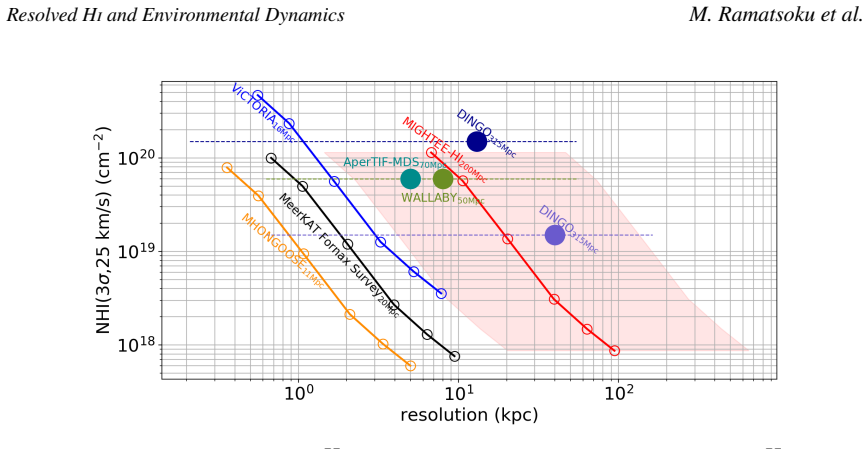
With SKA-mid AA4 it becomes possible to carry out deep, spatially resolved HI imaging over hundreds of square degrees, covering environments from isolated galaxies to filaments, reaching column-density sensitivities between 1.0 × 10^18 and ~1.0 × 10^19 cm^{-2} at physical resolutions of ~10 and ~1-2 kpc respectively, and thereby constructing large, statistically representative samples while studying environmental mechanisms at resolved scales.
What carries the argument
SKA-mid AA4 wide-area contiguous HI imaging that achieves the stated column-density and resolution performance in short integrations.
If this is right
- Large statistically representative samples of galaxies become available for environmental studies.
- Resolved HI maps extend to previously under-observed filaments and groups where ram pressure is weak.
- Multi-resolution data reveal cold-gas accretion and tidal replenishment across many systems simultaneously.
- The relative roles of hydrodynamical and gravitational processes can be compared across the full density range.
Where Pith is reading between the lines
- Such surveys would supply direct observational constraints for simulations that currently lack statistics on low-density environments.
- Combined with optical and UV data the maps could test whether HI replenishment correlates with star-formation rates on kiloparsec scales.
- The same observing mode would incidentally produce a legacy HI catalogue usable for cosmology and dark-matter studies.
Load-bearing premise
The deployed SKA-mid AA4 array will actually deliver the quoted column-density sensitivities and physical resolutions within the stated integration times.
What would settle it
On-sky tests with the completed SKA-mid AA4 array showing that the column-density sensitivity at 1-10 kpc resolution falls short of 10^18-10^19 cm^{-2} in the integration times required for hundred-square-degree surveys.
Figures
read the original abstract
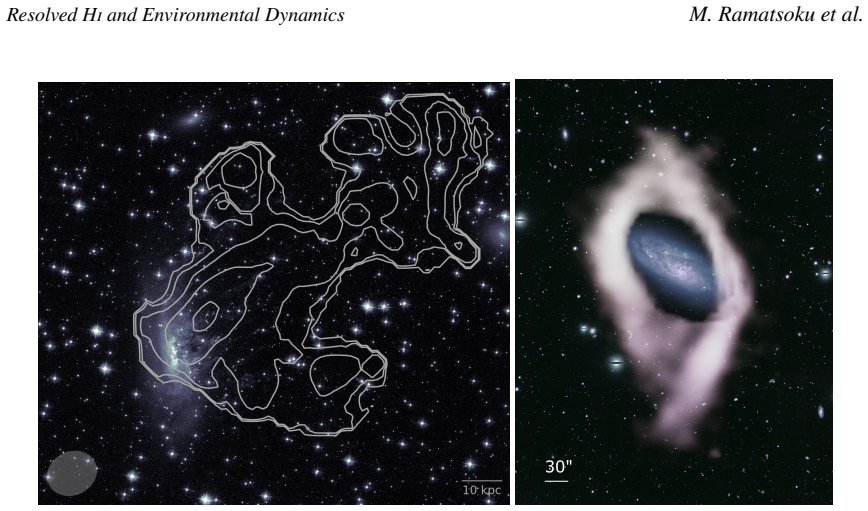
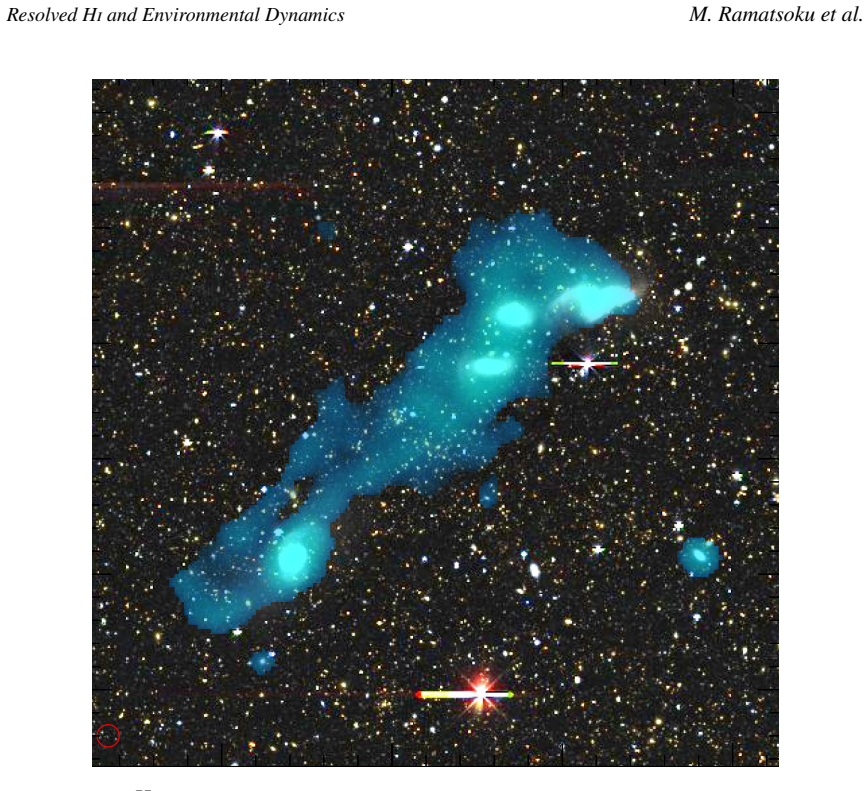
Spatially resolved, deep HI observations from SKA precursors and pathfinders such as MeerKAT, FAST, and ASKAP have demonstrated their ability to reveal the complex interactions between galaxies and their environments. These include, but are not limited to, recent observations of the Virgo cluster showing that the hydrodynamical effects of ram pressure stripping can operate effectively at unexpectedly large cluster-centric distances. In the Fornax cluster, the discovery of long HI tails with mixed tidal-ram-pressure origins indicates the interplay between gravitational and hydrodynamical mechanisms. Similar HI features in nearby filaments and galaxy groups, where ram pressure is expected to be weak, highlight the influence of hydrodynamical processes even in low-density environments. Multi-resolution studies have further revealed signs of cold gas accretion and HI replenishment driven by tidal interactions. While highly informative, these studies remain limited to small, specific regions of the sky. With SKA-mid AA4, it will become possible to carry out deep, spatially resolved HI imaging over hundreds of square degrees, covering environments from isolated galaxies to filaments. By reaching column-density sensitivities between $1.0 \times 10^{18}$ and $\sim 1.0 \times 10^{19}~\mathrm{cm^{-2}}$ at physical resolutions of $\sim$10 and $\sim$1 - 2 kpc, respectively, and by enabling sensitive, contiguous observations of wide areas within short integrations, SKA-mid AA4 will allow the construction of large, statistically representative samples of galaxies and detailed studies of environmental mechanisms operating across the full range of these less-studied environments at resolved scales.
Editorial analysis
A structured set of objections, weighed in public.
Referee Report
Summary. The manuscript reviews recent resolved HI observations from SKA precursors (MeerKAT, FAST, ASKAP) in the Virgo and Fornax clusters and nearby filaments, highlighting ram-pressure stripping, tidal interactions, and hydrodynamical effects at large radii and in low-density environments. It argues that SKA-mid AA4 will enable contiguous, deep HI imaging over hundreds of square degrees with column-density sensitivities of 1.0×10^18 to ~1.0×10^19 cm^{-2} at physical resolutions of ~10 kpc and ~1-2 kpc, respectively, allowing statistically representative samples across isolated galaxies to filaments.
Significance. The descriptive summary of precursor results is consistent with published literature and correctly identifies the scientific motivation for wide-field resolved HI studies. If the SKA-mid AA4 performance projections hold, the work would usefully frame the transition from targeted precursor observations to large statistical samples; however, the absence of traceable calculations for the quoted sensitivities reduces the immediate impact of the forward-looking claims.
major comments (2)
- [Abstract / main projections] Abstract and main text: the quoted SKA-mid AA4 column-density sensitivities (1.0×10^18 to ~1.0×10^19 cm^{-2}) and resolutions (~10 kpc and ~1-2 kpc) over hundreds of square degrees are stated without derivation, explicit array parameters (antenna count, baseline distribution, T_sys, integration time, bandwidth), or citation to an SKA sensitivity model or simulation. This is the load-bearing element of the central claim.
- [Abstract / main projections] The manuscript asserts that these figures will be reached 'within short integrations' but supplies no quantitative link between the stated performance and the SKA-mid AA4 configuration, leaving the extrapolation from precursor instruments unexamined.
minor comments (1)
- The text would benefit from a short table or paragraph summarizing the key precursor survey parameters (area, sensitivity, resolution) for direct comparison with the SKA-mid AA4 projections.
Simulated Author's Rebuttal
We thank the referee for their review and for recognizing the scientific motivation of the work. We agree that the SKA-mid AA4 performance projections require clearer traceability and will revise the manuscript to address this.
read point-by-point responses
-
Referee: [Abstract / main projections] Abstract and main text: the quoted SKA-mid AA4 column-density sensitivities (1.0×10^18 to ~1.0×10^19 cm^{-2}) and resolutions (~10 kpc and ~1-2 kpc) over hundreds of square degrees are stated without derivation, explicit array parameters (antenna count, baseline distribution, T_sys, integration time, bandwidth), or citation to an SKA sensitivity model or simulation. This is the load-bearing element of the central claim.
Authors: We accept this point. The quoted figures are drawn from published SKA-mid technical specifications and sensitivity models, but the manuscript does not make this explicit. In revision we will add a concise paragraph (or short appendix) that states the key array parameters, integration times, and references to the SKA sensitivity calculator or relevant SKA memos used to derive the column-density limits and resolutions at the quoted physical scales. revision: yes
-
Referee: [Abstract / main projections] The manuscript asserts that these figures will be reached 'within short integrations' but supplies no quantitative link between the stated performance and the SKA-mid AA4 configuration, leaving the extrapolation from precursor instruments unexamined.
Authors: We agree that the phrase 'within short integrations' needs quantitative support. The revised manuscript will include a brief statement linking the expected survey speed of AA4 to the quoted sensitivities, again referencing the appropriate SKA documentation. This will make the transition from precursor capabilities to the anticipated SKA-mid performance more transparent without altering the scientific narrative. revision: yes
Circularity Check
No circularity: purely descriptive statements of SKA capabilities with no derivations or self-referential predictions
full rationale
The manuscript contains no equations, fitted parameters, or claimed derivations. The central statements about SKA-mid AA4 sensitivities and resolutions are presented as design goals without any internal calculation, ansatz, or reduction to paper-defined quantities. No self-citations are used to justify uniqueness or load-bearing premises. The text is observational context and forward-looking description, fully self-contained against external benchmarks such as instrument specifications.
Axiom & Free-Parameter Ledger
Reference graph
Works this paper leans on
-
[1]
2019 , eprint=
Anticipated Performance of the Square Kilometre Array -- Phase 1 (SKA1) , author=. 2019 , eprint=
2019
-
[2]
2015 , publisher=
Advancing Astrophysics with the Square Kilometre Array (AASKA14) , author=. 2015 , publisher=
2015
-
[3]
From Clusters to Proto-Clusters: The Infrared Perspective on Environmental Galaxy Evolution. Universe , keywords =. doi:10.3390/universe8110554 , archivePrefix =. 2209.02781 , primaryClass =
-
[4]
Why does the environmental influence on group and cluster galaxies extend beyond the virial radius?
Why does the environmental influence on group and cluster galaxies extend beyond the virial radius?. , keywords =. doi:10.1093/mnras/stt109 , archivePrefix =. 1210.8407 , primaryClass =
work page internal anchor Pith review Pith/arXiv arXiv doi:10.1093/mnras/stt109
-
[5]
The Hydrangea simulations: galaxy formation in and around massive clusters
The Hydrangea simulations: galaxy formation in and around massive clusters. , keywords =. doi:10.1093/mnras/stx1403 , archivePrefix =. 1703.10610 , primaryClass =
work page internal anchor Pith review Pith/arXiv arXiv doi:10.1093/mnras/stx1403
-
[6]
Differential Galaxy Evolution in Cluster and Field Galaxies at z=0.3
Differential Galaxy Evolution in Cluster and Field Galaxies at z -0.5ex 0.3. , keywords =. doi:10.1086/308056 , archivePrefix =. astro-ph/9906470 , primaryClass =
work page internal anchor Pith review Pith/arXiv arXiv doi:10.1086/308056
-
[7]
The Origin of Star Formation Gradients in Rich Galaxy Clusters
The Origin of Star Formation Gradients in Rich Galaxy Clusters. , keywords =. doi:10.1086/309323 , archivePrefix =. astro-ph/0004078 , primaryClass =
work page internal anchor Pith review Pith/arXiv arXiv doi:10.1086/309323
-
[8]
Evidence for a change in the dominant satellite galaxy quenching mechanism at z=1
Evidence for a change in the dominant satellite galaxy quenching mechanism at z = 1. , keywords =. doi:10.1093/mnras/stv2949 , archivePrefix =. 1511.07344 , primaryClass =
work page internal anchor Pith review Pith/arXiv arXiv doi:10.1093/mnras/stv2949
-
[9]
Improved background subtraction for the Sloan Digital Sky Survey images
Improved Background Subtraction for the Sloan Digital Sky Survey Images. , keywords =. doi:10.1088/0004-6256/142/1/31 , archivePrefix =. 1105.1960 , primaryClass =
work page internal anchor Pith review Pith/arXiv arXiv doi:10.1088/0004-6256/142/1/31 1960
-
[10]
How do central and satellite galaxies quench? - Insights from spatially resolved spectroscopy in the MaNGA survey. , keywords =. doi:10.1093/mnras/staa2806 , archivePrefix =. 2009.05341 , primaryClass =
-
[12]
On the origin of the faint-end of the red sequence in high density environments
On the origin of the faint-end of the red sequence in high-density environments. , keywords =. doi:10.1007/s00159-014-0074-y , archivePrefix =. 1411.5513 , primaryClass =
work page internal anchor Pith review Pith/arXiv arXiv doi:10.1007/s00159-014-0074-y
-
[13]
H imaging of the Herschel Reference Survey. The star formation properties of a volume-limited, K-band-selected sample of nearby late-type galaxies. , keywords =. doi:10.1051/0004-6361/201525712 , archivePrefix =. 1504.01876 , primaryClass =
work page internal anchor Pith review Pith/arXiv arXiv doi:10.1051/0004-6361/201525712
-
[14]
A Virgo Environmental Survey Tracing Ionised Gas Emission (VESTIGE). VI. Environmental quenching on HII-region scales. , keywords =. doi:10.1051/0004-6361/201937310 , archivePrefix =. 2001.06379 , primaryClass =
-
[15]
The Difference Between Clusters and Groups: A Journey from Cluster Cores to Their Outskirts and Beyond. Clusters of Galaxies: Probes of Cosmological Structure and Galaxy Evolution , year = 2004, editor =. doi:10.48550/arXiv.astro-ph/0306342 , archivePrefix =. astro-ph/0306342 , primaryClass =
work page internal anchor Pith review Pith/arXiv arXiv doi:10.48550/arxiv.astro-ph/0306342 2004
-
[16]
astropy/photutils: 1.8.0 , month = may, year = 2023, publisher =
Larry Bradley and Brigitta Sip. astropy/photutils: 1.8.0 , month = may, year = 2023, publisher =. doi:10.5281/zenodo.7946442 , url =
-
[17]
Virgo filaments. I. Processing of gas in cosmological filaments around the Virgo cluster. , keywords =. doi:10.1051/0004-6361/202040141 , archivePrefix =. 2101.04389 , primaryClass =
-
[18]
Virgo Filaments. II. Catalog and First Results on the Effect of Filaments on Galaxy Properties. , keywords =. doi:10.3847/1538-4365/ac45f7 , archivePrefix =. 2110.13797 , primaryClass =
-
[19]
Virgo Filaments. V. Disrupting the Baryon Cycle in the NGC 5364 Galaxy Group. , keywords =. doi:10.3847/1538-4357/adc566 , archivePrefix =. 2505.09782 , primaryClass =
-
[20]
Virgo Galaxies with Long One-Sided HI Tails
Virgo Galaxies with Long One-sided H I Tails. , keywords =. doi:10.1086/518034 , archivePrefix =. astro-ph/0703338 , primaryClass =
work page internal anchor Pith review Pith/arXiv arXiv doi:10.1086/518034
-
[22]
Cosmography of the Local Universe
Cosmography of the Local Universe. , keywords =. doi:10.1088/0004-6256/146/3/69 , archivePrefix =. 1306.0091 , primaryClass =
work page internal anchor Pith review Pith/arXiv arXiv doi:10.1088/0004-6256/146/3/69
-
[23]
Thermal evaporation of gas within galaxies by a hot intergalactic medium. , keywords =. doi:10.1038/266501a0 , adsurl =
-
[24]
2005, MNRAS, 360, 587, doi: 10.1111/j.1365-2966.2005.09047.x
The many lives of active galactic nuclei: cooling flows, black holes and the luminosities and colours of galaxies. , keywords =. doi:10.1111/j.1365-2966.2005.09675.x , archivePrefix =. astro-ph/0508046 , primaryClass =
-
[25]
Dense Cloud Ablation and Ram Pressure Stripping of the Virgo Spiral NGC 4402
Dense Cloud Ablation and Ram Pressure Stripping of the Virgo Spiral NGC 4402. , keywords =. doi:10.1086/430526 , archivePrefix =. astro-ph/0503422 , primaryClass =
work page internal anchor Pith review Pith/arXiv arXiv doi:10.1086/430526
-
[26]
From Voids to Coma: the prevalence of pre-processing in the local Universe
From voids to Coma: the prevalence of pre-processing in the local Universe. , keywords =. doi:10.1093/mnras/stu200 , archivePrefix =. 1401.7328 , primaryClass =
work page internal anchor Pith review Pith/arXiv arXiv doi:10.1093/mnras/stu200
-
[27]
, archivePrefix = "arXiv", eprint =
A simple model to interpret the ultraviolet, optical and infrared emission from galaxies. , keywords =. doi:10.1111/j.1365-2966.2008.13535.x , archivePrefix =. 0806.1020 , primaryClass =
-
[28]
Cosmic Web and Star Formation Activity in Galaxies at z~1
Cosmic Web and Star Formation Activity in Galaxies at z -0.5ex 1. , keywords =. doi:10.1088/0004-637X/796/1/51 , archivePrefix =. 1409.7695 , primaryClass =
work page internal anchor Pith review Pith/arXiv arXiv doi:10.1088/0004-637x/796/1/51
-
[30]
Cold streams in early massive hot haloes as the main mode of galaxy formation
Cold streams in early massive hot haloes as the main mode of galaxy formation. , keywords =. doi:10.1038/nature07648 , archivePrefix =. 0808.0553 , primaryClass =
work page internal anchor Pith review Pith/arXiv arXiv doi:10.1038/nature07648
-
[31]
Formation of Massive Galaxies at High Redshift: Cold Streams, Clumpy Disks and Compact Spheroids
Formation of Massive Galaxies at High Redshift: Cold Streams, Clumpy Disks, and Compact Spheroids. , keywords =. doi:10.1088/0004-637X/703/1/785 , archivePrefix =. 0901.2458 , primaryClass =
work page internal anchor Pith review Pith/arXiv arXiv doi:10.1088/0004-637x/703/1/785
-
[32]
Overview of the DESI Legacy Imaging Surveys
Overview of the DESI Legacy Imaging Surveys. , keywords =. doi:10.3847/1538-3881/ab089d , archivePrefix =. 1804.08657 , primaryClass =
work page internal anchor Pith review Pith/arXiv arXiv doi:10.3847/1538-3881/ab089d
-
[33]
Galaxy morphology in rich clusters: implications for the formation and evolution of galaxies. , keywords =. doi:10.1086/157753 , adsurl =
-
[34]
, year = 1984, month = jan, volume =
The Evolution of Galaxies in Clusters. , year = 1984, month = jan, volume =. doi:10.1146/annurev.astro.22.1.185 , adsurl =
-
[35]
Evolution since z = 0.5 of the Morphology-Density relation for Clusters of Galaxies
Evolution since z = 0.5 of the Morphology-Density Relation for Clusters of Galaxies. , keywords =. doi:10.1086/304890 , archivePrefix =. astro-ph/9707232 , primaryClass =
work page internal anchor Pith review Pith/arXiv arXiv doi:10.1086/304890
-
[36]
Clusters of Galaxies: Probes of Cosmological Structure and Galaxy Evolution , year = 2004, editor =
Star-forming Galaxies in Clusters. Clusters of Galaxies: Probes of Cosmological Structure and Galaxy Evolution , year = 2004, editor =
2004
-
[37]
Resolved Galaxies in the Hubble Ultra Deep Field: Star Formation in Disks at High Redshift
Resolved Galaxies in the Hubble Ultra Deep Field: Star Formation in Disks at High Redshift. , keywords =. doi:10.1086/511667 , archivePrefix =. astro-ph/0701121 , primaryClass =
work page internal anchor Pith review Pith/arXiv arXiv doi:10.1086/511667
-
[38]
Clumpy Galaxies in GOODS and GEMS: Massive Analogs of Local Dwarf Irregulars
Clumpy Galaxies in Goods and Gems: Massive Analogs of Local Dwarf Irregulars. , keywords =. doi:10.1088/0004-637X/701/1/306 , archivePrefix =. 0906.2660 , primaryClass =
work page internal anchor Pith review Pith/arXiv arXiv doi:10.1088/0004-637x/701/1/306
-
[39]
Constraints on the Assembly and Dynamics of Galaxies. II. Properties of Kiloparsec-scale Clumps in Rest-frame Optical Emission of z -0.5ex 2 Star-forming Galaxies. , keywords =. doi:10.1088/0004-637X/739/1/45 , archivePrefix =. 1104.0248 , primaryClass =
work page internal anchor Pith review Pith/arXiv arXiv doi:10.1088/0004-637x/739/1/45
-
[40]
A Virgo Environmental Survey Tracing Ionised Gas Emission (VESTIGE). II. Constraining the quenching time in the stripped galaxy NGC 4330. , keywords =. doi:10.1051/0004-6361/201732373 , archivePrefix =. 1801.09685 , primaryClass =
work page internal anchor Pith review Pith/arXiv arXiv doi:10.1051/0004-6361/201732373
-
[41]
H 3: an H imaging survey of HI selected galaxies from ALFALFA. I. Catalogue in the Local Supercluster. , keywords =. doi:10.1051/0004-6361/201218788 , archivePrefix =. 1206.0061 , primaryClass =
work page internal anchor Pith review Pith/arXiv arXiv doi:10.1051/0004-6361/201218788
-
[42]
CANDELS: The Cosmic Assembly Near-infrared Deep Extragalactic Legacy Survey
CANDELS: The Cosmic Assembly Near-infrared Deep Extragalactic Legacy Survey. , keywords =. doi:10.1088/0067-0049/197/2/35 , archivePrefix =. 1105.3753 , primaryClass =
work page internal anchor Pith review Pith/arXiv arXiv doi:10.1088/0067-0049/197/2/35
-
[44]
The Arecibo Legacy Fast ALFA Survey: The ALFALFA Extragalactic HI Source Catalog
The Arecibo Legacy Fast ALFA Survey: The ALFALFA Extragalactic H I Source Catalog. , keywords =. doi:10.3847/1538-4357/aac956 , archivePrefix =. 1805.11499 , primaryClass =
work page internal anchor Pith review Pith/arXiv arXiv doi:10.3847/1538-4357/aac956
-
[45]
The radial distribution of H II regions in spiral galaxies. , keywords =. doi:10.1086/160893 , adsurl =
-
[46]
But what about...: cosmic rays, magnetic fields, conduction, and viscosity in galaxy formation. , keywords =. doi:10.1093/mnras/stz3321 , archivePrefix =. 1905.04321 , primaryClass =
-
[47]
A Cosmological Framework for the Co-Evolution of Quasars, Supermassive Black Holes, and Elliptical Galaxies. II. Formation of Red Ellipticals. , keywords =. doi:10.1086/524363 , archivePrefix =. 0706.1246 , primaryClass =
work page internal anchor Pith review Pith/arXiv arXiv doi:10.1086/524363
-
[49]
Preprocessing among the Infalling Galaxy Population of EDisCS Clusters. , keywords =. doi:10.3847/1538-4357/ab44a0 , archivePrefix =. 1506.02051 , primaryClass =
-
[50]
The environmental dependence of the relations between stellar mass, structure, star formation and nuclear activity in galaxies. , keywords =. doi:10.1111/j.1365-2966.2004.08117.x , archivePrefix =. astro-ph/0402030 , primaryClass =
-
[51]
Strangulation in Galaxy Groups
Strangulation in Galaxy Groups. , keywords =. doi:10.1086/526544 , archivePrefix =. 0707.3814 , primaryClass =
work page internal anchor Pith review Pith/arXiv arXiv doi:10.1086/526544
-
[52]
The Global Schmidt Law in Star Forming Galaxies
The Global Schmidt Law in Star-forming Galaxies. , keywords =. doi:10.1086/305588 , archivePrefix =. astro-ph/9712213 , primaryClass =
work page internal anchor Pith review Pith/arXiv arXiv doi:10.1086/305588
-
[53]
Star Formation in the Milky Way and Nearby Galaxies
Star Formation in the Milky Way and Nearby Galaxies. , keywords =. doi:10.1146/annurev-astro-081811-125610 , archivePrefix =. 1204.3552 , primaryClass =
work page internal anchor Pith review Pith/arXiv arXiv doi:10.1146/annurev-astro-081811-125610
-
[54]
2005, MNRAS, 360, 587, doi: 10.1111/j.1365-2966.2005.09047.x
How do galaxies get their gas?. , keywords =. doi:10.1111/j.1365-2966.2005.09451.x , archivePrefix =. astro-ph/0407095 , primaryClass =
-
[55]
Large-scale filamentary structures around the Virgo cluster revisited
Large-scale Filamentary Structures around the Virgo Cluster Revisited. , keywords =. doi:10.3847/1538-4357/833/2/207 , archivePrefix =. 1611.00437 , primaryClass =
work page internal anchor Pith review Pith/arXiv arXiv doi:10.3847/1538-4357/833/2/207
-
[56]
Cosmic cartography of the large-scale structure with Sloan Digital Sky Survey data release 6. , keywords =. doi:10.1111/j.1365-2966.2009.15470.x , archivePrefix =. 0906.3978 , primaryClass =
-
[57]
CANDELS: Constraining the AGN-Merger Connection with Host Morphologies at z~2
CANDELS: Constraining the AGN-Merger Connection with Host Morphologies at z -0.5ex 2. , keywords =. doi:10.1088/0004-637X/744/2/148 , archivePrefix =. 1109.2588 , primaryClass =
work page internal anchor Pith review Pith/arXiv arXiv doi:10.1088/0004-637x/744/2/148
-
[58]
Halpha Morphologies and Environmental Effects in Virgo Cluster Spiral Galaxies
H Morphologies and Environmental Effects in Virgo Cluster Spiral Galaxies. , keywords =. doi:10.1086/423191 , archivePrefix =. astro-ph/0406243 , primaryClass =
work page internal anchor Pith review Pith/arXiv arXiv doi:10.1086/423191
-
[59]
Galaxy Groups within 3500 km s$^{-1}$
Galaxy Groups Within 3500 km s ^ -1. , keywords =. doi:10.3847/1538-4357/aa76db , archivePrefix =. 1705.08068 , primaryClass =
work page internal anchor Pith review Pith/arXiv arXiv doi:10.3847/1538-4357/aa76db
-
[60]
The evolution of disk galaxies and the origin of S0 galaxies. , keywords =. doi:10.1086/157917 , adsurl =
-
[61]
The 2dF Galaxy Redshift Survey: the environmental dependence of galaxy star formation rates near clusters. , keywords =. doi:10.1046/j.1365-8711.2002.05558.x , archivePrefix =. astro-ph/0203336 , primaryClass =
-
[62]
Major mergers are not significant drivers of star formation or morphological transformation around the epoch of peak cosmic star formation. , keywords =. doi:10.1093/mnras/stw2895 , archivePrefix =. 1608.03892 , primaryClass =
work page internal anchor Pith review Pith/arXiv arXiv doi:10.1093/mnras/stw2895
-
[63]
HyperLEDA. III. The catalogue of extragalactic distances. , keywords =. doi:10.1051/0004-6361/201423496 , archivePrefix =. 1408.3476 , primaryClass =
work page internal anchor Pith review Pith/arXiv arXiv doi:10.1051/0004-6361/201423496
-
[64]
The accretion of galaxies into groups and clusters. , keywords =. doi:10.1111/j.1365-2966.2009.15507.x , archivePrefix =. 0908.0750 , primaryClass =
-
[65]
SCARLET: Source separation in multi-band images by Constrained Matrix Factorization
SCARLET: Source separation in multi-band images by Constrained Matrix Factorization. Astronomy and Computing , keywords =. doi:10.1016/j.ascom.2018.07.001 , archivePrefix =. 1802.10157 , primaryClass =
work page internal anchor Pith review Pith/arXiv arXiv doi:10.1016/j.ascom.2018.07.001 2018
-
[66]
Relaxation and tidal stripping in rich clusters of galaxies. I. Evolution of the mass distribution. , keywords =. doi:10.1086/160571 , adsurl =
-
[68]
Morphological Transformation from Galaxy Harassment
Morphological Transformation from Galaxy Harassment. , keywords =. doi:10.1086/305264 , archivePrefix =. astro-ph/9701211 , primaryClass =
work page internal anchor Pith review Pith/arXiv arXiv doi:10.1086/305264
-
[69]
The Hubble Space Telescope Key Project on the Extragalactic Distance Scale. XXVIII. Combining the Constraints on the Hubble Constant. , keywords =. doi:10.1086/308304 , archivePrefix =. astro-ph/9909260 , primaryClass =
work page internal anchor Pith review Pith/arXiv arXiv doi:10.1086/308304
-
[70]
Transport processes and the stripping of cluster galaxies. , keywords =. doi:10.1093/mnras/198.4.1007 , adsurl =
-
[71]
Clusters of Galaxies: Probes of Cosmological Structure and Galaxy Evolution , year = 2004, editor =
Clusters of Galaxies in the Sloan Digital Sky Survey. Clusters of Galaxies: Probes of Cosmological Structure and Galaxy Evolution , year = 2004, editor =
2004
-
[72]
The HI Content of Galaxies in Groups and Clusters as Measured by ALFALFA
The HI Content of Galaxies in Groups and Clusters as Measured by ALFALFA. , keywords =. doi:10.3847/0004-637X/824/2/110 , archivePrefix =. 1604.08862 , primaryClass =
work page internal anchor Pith review Pith/arXiv arXiv doi:10.3847/0004-637x/824/2/110
-
[73]
The Effects of Environment on the Evolution of the Galaxy Stellar Mass Function
The Effects of Environment on the Evolution of the Galaxy Stellar Mass Function. , keywords =. doi:10.3847/1538-4357/aaa766 , archivePrefix =. 1801.04934 , primaryClass =
work page internal anchor Pith review Pith/arXiv arXiv doi:10.3847/1538-4357/aaa766
-
[74]
HYPERLEDA. I. Identification and designation of galaxies. , keywords =. doi:10.1051/0004-6361:20031411 , adsurl =
-
[75]
The Deep Swire Field. III. Wiyn Spectroscopy. , keywords =. doi:10.1088/0067-0049/182/2/625 , archivePrefix =. 0904.4651 , primaryClass =
work page internal anchor Pith review Pith/arXiv arXiv doi:10.1088/0067-0049/182/2/625
-
[76]
The flickering nuclear activity of Fornax A. , keywords =. doi:10.1051/0004-6361/201936867 , archivePrefix =. 1911.09424 , primaryClass =
-
[77]
Mass and Environment as Drivers of Galaxy Evolution in SDSS and zCOSMOS and the Origin of the Schechter Function. , keywords =. doi:10.1088/0004-637X/721/1/193 , archivePrefix =. 1003.4747 , primaryClass =
work page internal anchor Pith review Pith/arXiv arXiv doi:10.1088/0004-637x/721/1/193
-
[79]
The Star Formation Histories of Galaxies in Distant Clusters
The Star Formation Histories of Galaxies in Distant Clusters. , keywords =. doi:10.1086/307322 , archivePrefix =. astro-ph/9901264 , primaryClass =
work page internal anchor Pith review Pith/arXiv arXiv doi:10.1086/307322
-
[80]
A Comparison of the Galaxy Populations in the Coma and Distant Clusters: The Evolution of k+a Galaxies and the Role of the Intracluster Medium. , keywords =. doi:10.1086/380195 , archivePrefix =. astro-ph/0309449 , primaryClass =
work page internal anchor Pith review Pith/arXiv arXiv doi:10.1086/380195
-
[81]
GASP XXIII: A Jellyfish Galaxy as an Astrophysical Laboratory of the Baryonic Cycle. , keywords =. doi:10.3847/1538-4357/ab5224 , archivePrefix =. 1910.11622 , primaryClass =
-
[82]
The morphology-density relation - The group connection. , keywords =. doi:10.1086/162078 , adsurl =
-
[84]
Reviews of Modern Physics , year = 1986, month = jan, volume =
X-ray emission from clusters of galaxies. Reviews of Modern Physics , year = 1986, month = jan, volume =. doi:10.1103/RevModPhys.58.1 , adsurl =
-
[85]
The SAMI Galaxy Survey: spatially resolving the environmental quenching of star formation in GAMA galaxies. , keywords =. doi:10.1093/mnras/stw2289 , archivePrefix =. 1609.02635 , primaryClass =
work page internal anchor Pith review Pith/arXiv arXiv doi:10.1093/mnras/stw2289
-
[86]
Finite-resolution Deconvolution of Multiwavelength Imaging of 20,000 Galaxies in the COSMOS Field: The Evolution of Clumpy Galaxies over Cosmic Time. , keywords =. doi:10.3847/1538-4357/ac2f40 , archivePrefix =. 2110.07612 , primaryClass =
-
[87]
2005, MNRAS, 360, 587, doi: 10.1111/j.1365-2966.2005.09047.x
Modelling feedback from stars and black holes in galaxy mergers. , keywords =. doi:10.1111/j.1365-2966.2005.09238.x , archivePrefix =. astro-ph/0411108 , primaryClass =
-
[88]
Redshift-independent Distances in the NASA/IPAC Extragalactic Database: Methodology, Content, and Use of NED-D. , keywords =. doi:10.3847/1538-3881/153/1/37 , archivePrefix =. 1612.09263 , primaryClass =
work page internal anchor Pith review Pith/arXiv arXiv doi:10.3847/1538-3881/153/1/37
discussion (0)
Sign in with ORCID, Apple, or X to comment. Anyone can read and Pith papers without signing in.