Molecular interpretability of the bulk electrochemical impedance of concentrated electrolytes
Pith reviewed 2026-07-03 03:42 UTC · model grok-4.3
The pith
The itinerant oscillator model interprets the bulk electrolyte contribution to EIS spectra at the molecular level without assuming any particular concentration.
A machine-rendered reading of the paper's core claim, the machinery that carries it, and where it could break.
Core claim
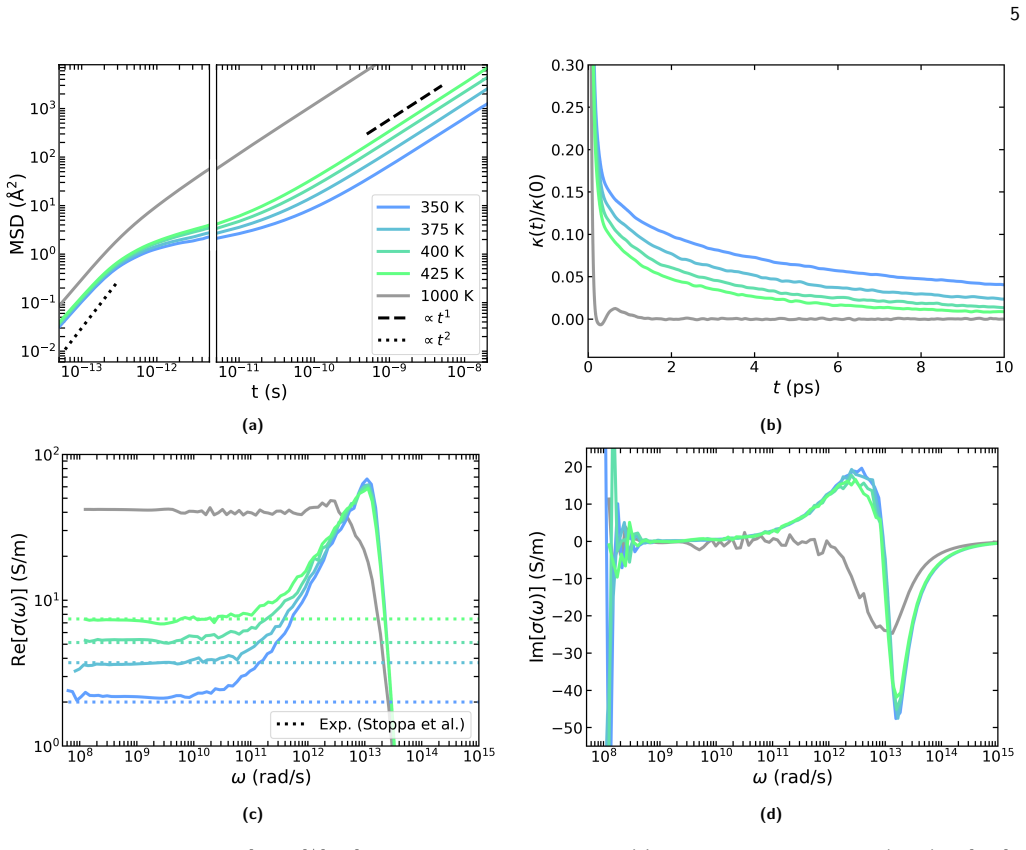
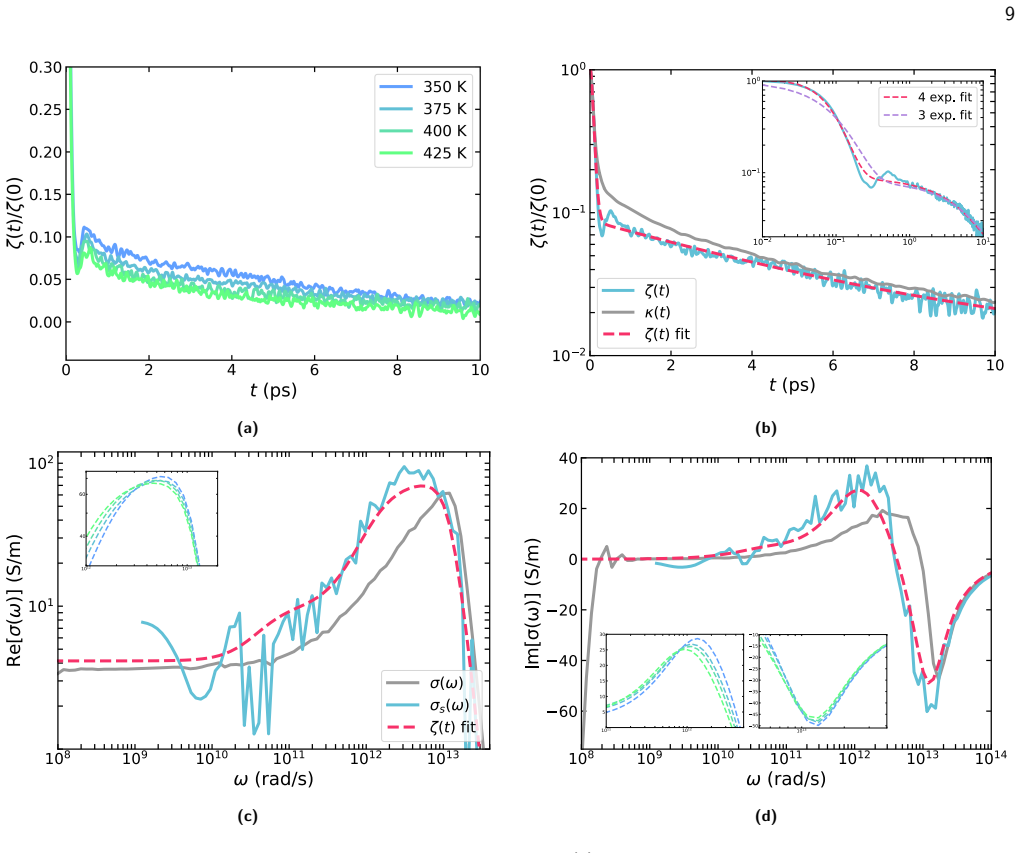
By determining the moments of the frequency-dependent conductivity within the itinerant oscillator model from a generalized Langevin equation, the bulk electrolyte contribution to the EIS spectrum can be given molecular interpretability, and this holds without assumptions on concentration as verified through molecular dynamics simulations of a room-temperature ionic liquid that link the memory function's timescale separation to the beta-relaxation.
What carries the argument
The itinerant oscillator model, which describes effective single-particle dynamics via a generalized Langevin equation and interprets the memory function's timescales for impedance spectra.
If this is right
- The model applies directly to concentrated electrolytes like ionic liquids without modification for concentration.
- It shows how the distribution of timescales in the memory function controls the beta-relaxation process.
- Impedance spectra can report on this timescale distribution while using familiar calculation workflows.
- Molecular dynamics data can be used to validate and extract parameters for the model.
Where Pith is reading between the lines
- Experimental EIS measurements might be analyzed with this model to infer molecular dynamics without running simulations for every case.
- The framework could help design electrolytes by linking ion interactions to relaxation behaviors observed in impedance.
- Similar approaches might apply to other spectroscopic techniques that probe relaxation in condensed matter.
Load-bearing premise
The memory function extracted from the molecular dynamics of the ionic liquid fits the itinerant oscillator model in a way that directly connects its timescale separation to the beta-relaxation in the impedance data.
What would settle it
Performing the impedance calculation from the itinerant oscillator model on the simulated conductivity of the ionic liquid and finding that it does not match the temperature dependence of the beta-relaxation feature in the spectra.
Figures
read the original abstract
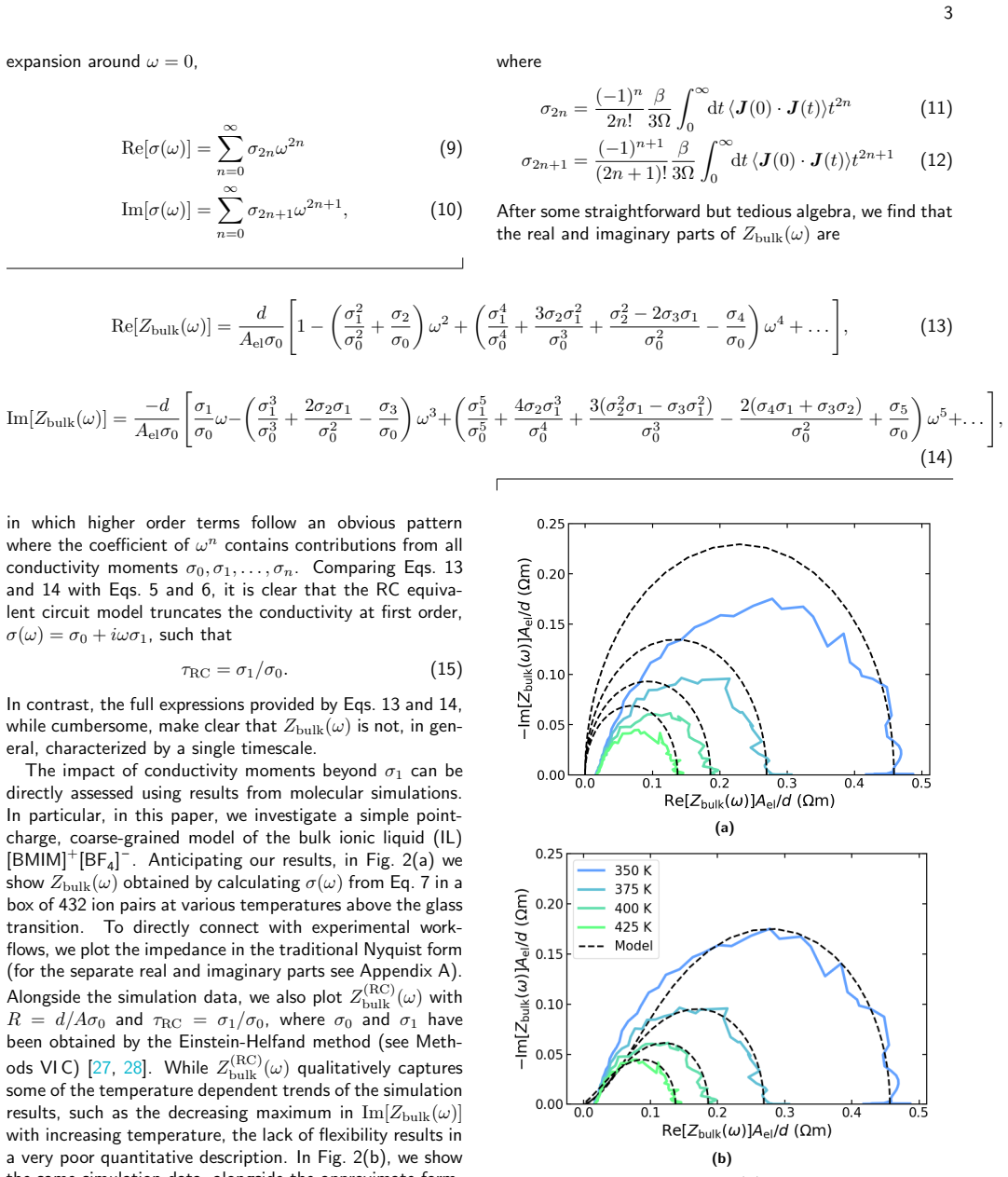
Electrochemical impedance spectroscopy (EIS) is a widely used technique to understand time-dependent response and relaxation under applied voltage. While these spectra contain a wealth of information, major gaps in our understanding can hinder our ability to interpret EIS spectra in terms of microscopic chemical mechanisms. We propose an alternative approach to common empirical fitting procedures for describing the contribution of the bulk electrolyte to the EIS spectrum. This new approach is rooted in determining the moments of the frequency-dependent conductivity, with molecular interpretability provided by a generalized Langevin equation description of an effective single particle dynamics; the `itinerant oscillator' (IO) model. In contrast to a Debye--Falkenhagen description, the IO model makes no assumptions regarding the concentration of the electrolyte, a fact we demonstrate by analysing molecular dynamics simulations of a room-temperature ionic liquid. By analysing the memory function from simulation within the framework provided by the IO model, we reveal the importance of capturing the separation of timescales within the memory function for describing the temperature dependent $\beta$-relaxation process. We go on to show how our impedance model directly reports on this distribution of timescales while retaining the simplicity of commonly employed workflows.
Editorial analysis
A structured set of objections, weighed in public.
Referee Report
Summary. The paper proposes using the itinerant oscillator (IO) model, derived from a generalized Langevin equation for effective single-particle dynamics, to interpret the bulk electrolyte contribution to electrochemical impedance spectroscopy (EIS) spectra in a molecularly grounded way. Unlike Debye-Falkenhagen approaches, the IO framework makes no explicit concentration assumptions; this is illustrated by extracting the memory function from molecular dynamics trajectories of a room-temperature ionic liquid, parametrizing it within the IO form, and linking the resulting timescale separation to the temperature-dependent β-relaxation feature in the conductivity spectrum.
Significance. If the IO parametrization of the MD memory function is shown to quantitatively recover the frequency-dependent conductivity (including the β-relaxation peak position, width, and amplitude) without additional ad-hoc adjustments, the work would supply a concrete route to molecular interpretability of bulk EIS data for highly concentrated electrolytes. The absence of concentration-dependent assumptions and the direct use of simulation-derived memory functions are strengths that could bridge microscopic dynamics and macroscopic spectra.
major comments (3)
- [Results section] Results section (analysis of MD memory function): The manuscript states that the IO representation captures the separation of timescales relevant to the β-relaxation, yet provides no quantitative metric (e.g., integrated squared error, peak-frequency deviation, or R² on the real/imaginary conductivity) comparing the IO-derived spectrum to the conductivity obtained directly from the current autocorrelation function in the same trajectories. Without this comparison, the central claim that the IO form supplies faithful molecular interpretability remains unverified.
- [Methods / IO framework subsection] Methods / IO framework subsection: The memory function is extracted from MD and then represented within the IO model; the text must clarify whether the IO functional form is constrained to be parameter-free (as suggested by the axiom ledger) or whether any fitting parameters are determined from the identical trajectories used to compute the target conductivity. If the latter, an explicit test for circularity or overfitting is required to support the interpretability claim.
- [Discussion of temperature dependence] Discussion of temperature dependence: The mapping from IO timescale separation to the observed temperature-dependent β-relaxation is presented as direct, but the manuscript does not report how uncertainties in the memory-function extraction (finite trajectory length, statistical error in the VACF) propagate into the predicted impedance features. This propagation is load-bearing for the claim that the model “directly reports on this distribution of timescales.”
minor comments (2)
- [Figure captions] Figure captions should explicitly state whether the plotted conductivity spectra are obtained from the full MD current autocorrelation or from the IO-reconstructed memory function.
- [Notation] Notation: the symbol used for the memory kernel should be defined once at first use and kept consistent between the generalized Langevin equation and the subsequent IO parametrization.
Simulated Author's Rebuttal
We thank the referee for their constructive and detailed comments, which highlight important aspects for strengthening the quantitative validation and clarity of our approach. We address each major comment below and outline the revisions we will make.
read point-by-point responses
-
Referee: [Results section] Results section (analysis of MD memory function): The manuscript states that the IO representation captures the separation of timescales relevant to the β-relaxation, yet provides no quantitative metric (e.g., integrated squared error, peak-frequency deviation, or R² on the real/imaginary conductivity) comparing the IO-derived spectrum to the conductivity obtained directly from the current autocorrelation function in the same trajectories. Without this comparison, the central claim that the IO form supplies faithful molecular interpretability remains unverified.
Authors: We agree that a quantitative comparison is required to substantiate the claim of faithful reproduction. In the revised manuscript we will add direct metrics, including R² values for the real and imaginary conductivity, integrated squared error, and deviations in β-relaxation peak position, width, and amplitude between the IO-derived spectrum and the spectrum computed from the current autocorrelation function. These will be presented in the Results section alongside the existing figures. revision: yes
-
Referee: [Methods / IO framework subsection] Methods / IO framework subsection: The memory function is extracted from MD and then represented within the IO model; the text must clarify whether the IO functional form is constrained to be parameter-free (as suggested by the axiom ledger) or whether any fitting parameters are determined from the identical trajectories used to compute the target conductivity. If the latter, an explicit test for circularity or overfitting is required to support the interpretability claim.
Authors: The IO parameters are obtained by fitting the functional form to the memory function extracted from the MD trajectories. The conductivity spectrum used for comparison is computed independently from the current autocorrelation function, which encodes collective charge correlations rather than the single-particle velocity autocorrelation underlying the memory function. We will revise the Methods / IO framework subsection to state this explicitly and to describe the fitting procedure. We will also add a short discussion of potential circularity, noting that the reduced single-particle model is not expected to reproduce the full many-body conductivity exactly but to furnish interpretable timescales; a sensitivity test on parameter variation will be included to address overfitting concerns. revision: yes
-
Referee: [Discussion of temperature dependence] Discussion of temperature dependence: The mapping from IO timescale separation to the observed temperature-dependent β-relaxation is presented as direct, but the manuscript does not report how uncertainties in the memory-function extraction (finite trajectory length, statistical error in the VACF) propagate into the predicted impedance features. This propagation is load-bearing for the claim that the model “directly reports on this distribution of timescales.”
Authors: We acknowledge that explicit propagation of statistical uncertainties from finite-length trajectories and VACF noise is needed to support the robustness of the timescale mapping. In the revised Discussion we will report error estimates on the extracted memory-function parameters (via block averaging across independent trajectory segments) and will discuss, at least qualitatively, how these uncertainties affect the predicted β-relaxation position and amplitude. A full quantitative propagation (e.g., Monte-Carlo sampling of the memory function) will be noted as computationally demanding but feasible in follow-up work; the current revision will therefore contain the error estimates and a limitations paragraph. revision: partial
Circularity Check
No significant circularity detected in derivation chain
full rationale
The paper extracts the memory function directly from MD trajectories of the ionic liquid and analyzes its timescale separation within the itinerant oscillator framework to interpret the beta-relaxation feature in the conductivity spectrum computed from the same trajectories. This constitutes an application of an existing GLE-based model to simulation data rather than a closed loop in which a fitted parameter is relabeled as an independent prediction or in which the target observable is defined in terms of itself. No equations are shown reducing the impedance expression to the fit by construction, no self-citation chains bear the central claim, and the absence of concentration assumptions is demonstrated by direct application to a concentrated system rather than by redefinition. The derivation therefore remains self-contained against the external benchmark of the raw MD current autocorrelation.
Axiom & Free-Parameter Ledger
axioms (1)
- domain assumption The generalized Langevin equation provides an accurate effective description of single-particle dynamics in the ionic liquid.
Reference graph
Works this paper leans on
-
[1]
Perkin, M
S. Perkin, M. Salanne, P. Madden, and R. Lynden-Bell, Proceedings of the National Academy of Sciences 110, 4121 (2013)
2013
-
[2]
M. A. Gebbie, M. Valtiner, X. Banquy, E. T. Fox, W. A. Henderson, and J. N. Israelachvili, Proceedings of the Na- tional Academy of Sciences 110, 9674 (2013)
2013
-
[3]
A. A. Lee, D. Vella, S. Perkin, and A. Goriely, The Journal of Physical Chemistry Letters 6, 159 (2015)
2015
-
[4]
Weing¨ artner, Angewandte Chemie International Edition 47, 654 (2008)
H. Weing¨ artner, Angewandte Chemie International Edition 47, 654 (2008)
2008
-
[5]
Nordness and J
O. Nordness and J. Brennecke, Chemical Reviews 120, 12873 (2020)
2020
-
[6]
M. A. Gebbie, A. M. Smith, H. A. Dobbs, A. A. Lee, G. G. Warr, X. Banquy, M. Valtiner, M. W. Rutland, J. N. Israelachvili, S. Perkin, and R. Atkin, Chemical Communi- cations 53, 1214 (2017)
2017
-
[7]
A. A. Kornyshev, The Journal of Physical Chemistry B 111, 5545 (2007)
2007
-
[8]
M. Z. Bazant, B. D. Storey, and A. A. Kornyshev, Physical Review Letters 106, 046102 (2011)
2011
-
[9]
S. Wang, J. Zhang, O. Gharbi, V. Vivier, M. Gao, and M. E. Orazem, Nature Reviews Methods Primers 1, 1 (2021)
2021
-
[10]
A. L. Usler, D. Fertig, and M. Janssen, arXiv:2606.21980 [physics.chem-ph] (2026)
work page internal anchor Pith review Pith/arXiv arXiv 2026
-
[11]
K. S. Cole and R. H. Cole, The Journal of Chemical Physics 9, 341 (1941)
1941
-
[12]
D. W. Davidson and R. H. Cole, The Journal of Chemical Physics 18, 1417 (1950)
1950
-
[13]
D. W. Davidson and R. H. Cole, The Journal of Chemical Physics 19, 1484 (1951)
1951
-
[14]
S. R. Tee and D. J. Searles, The Journal of Chemical Physics 156, 184101 (2022)
2022
-
[15]
Dufils, G
T. Dufils, G. Jeanmairet, B. Rotenberg, M. Sprik, and M. Salanne, Physical Review Letters 123, 195501 (2019)
2019
-
[16]
Pireddu and B
G. Pireddu and B. Rotenberg, Phys. Rev. Lett. 130 (2023)
2023
-
[17]
Pireddu, C
G. Pireddu, C. J. Fairchild, S. P. Niblett, S. J. Cox, and B. Rotenberg, Proceedings of the National Academy of Sciences 121, e2318157121 (2024)
2024
-
[18]
As determined from the covariance of the local polarization with the total dipole of the fluid
-
[19]
S. J. Cox and P. L. Geissler, Chemical Science 13, 9102 (2022)
2022
-
[20]
A. P. dos Santos and R. R. Netz, The Journal of Chemical Physics 148, 164103 (2018)
2018
-
[21]
Fletcher, V
S. Fletcher, V. J. Black, and I. Kirkpatrick, Journal of Solid State Electrochemistry 18, 1377 (2014)
2014
-
[22]
S. S. Zhang, K. Xu, and T. R. Jow, Electrochimica Acta 49, 1057 (2004)
2004
-
[23]
J. T. S. Irvine, D. C. Sinclair, and A. R. West, Advanced Materials 2, 132 (1990)
1990
-
[24]
M. A. Hern´ andez, N. Mas´ o, and A. R. West, Applied Physics Letters 108, 152901 (2016)
2016
-
[25]
H. P. Schwan, Annals of Biomedical Engineering 20, 269 (1992)
1992
-
[26]
C. Chassagne, E. Dubois, M. L. Jim´ enez, J. P. M. van der Ploeg, and J. van Turnhout, Frontiers in Chemistry 4, 10.3389/fchem.2016.00030 (2016)
-
[27]
Schr¨ oder, M
C. Schr¨ oder, M. Haberler, and O. Steinhauser, The Journal of Chemical Physics 128, 134501 (2008)
2008
-
[28]
Pic´ alek and J
J. Pic´ alek and J. Kolafa, Journal of Molecular Liquids EMLG/JMLG 2005 Special Issue, 134, 29 (2007)
2005
-
[29]
Friesen, M
G. Friesen, M. E. ¨Ozsar, and E. D. Dunlop, Thin Solid Films 361-362, 303 (2000)
2000
-
[30]
Stoppa, J
A. Stoppa, J. Hunger, R. Buchner, G. Hefter, A. Thoman, and H. Helm, The Journal of Physical Chemistry B 112, 4854 (2008)
2008
-
[31]
Williams and D
G. Williams and D. C. Watts, Transactions of the Faraday Society 66, 80 (1970)
1970
-
[32]
A. C. Lazanas and M. I. Prodromidis, ACS Measurement Science Au 3, 162 (2023)
2023
-
[33]
P. A. Beckmann, Physics Reports 171, 85 (1988)
1988
-
[34]
T. P. Iglesias, G. Vil˜ ao, and J. C. R. Reis, Journal of Ap- plied Physics 122, 074102 (2017)
2017
-
[35]
J. G. Powles, Proceedings of the Physical Society. Section B 64, 81 (1951)
1951
-
[36]
M. R. Shoar Abouzari, F. Berkemeier, G. Schmitz, and D. Wilmer, Solid State Ionics 180, 922 (2009)
2009
-
[37]
S. M. Rezaei Niya and M. Hoorfar, Electrochimica Acta 188, 98 (2016)
2016
-
[38]
C´ ordoba-Torres, T
P. C´ ordoba-Torres, T. J. Mesquita, and R. P. Nogueira, 17 The Journal of Physical Chemistry C 119, 4136 (2015)
2015
-
[39]
Wei and G
D. Wei and G. N. Patey, The Journal of Chemical Physics 94, 6795 (1991)
1991
-
[40]
Chandra, D
A. Chandra, D. Wei, and G. N. Patey, The Journal of Chemical Physics 99, 2083 (1993)
2083
-
[41]
Chandra and B
A. Chandra and B. Bagchi, The Journal of Chemical Physics 112, 1876 (2000)
2000
-
[42]
Chandra and B
A. Chandra and B. Bagchi, The Journal of Physical Chem- istry B 104, 9067 (2000)
2000
-
[43]
Dufrˆ eche, O
J.-F. Dufrˆ eche, O. Bernard, P. Turq, A. Mukherjee, and B. Bagchi, Physical Review Letters 88, 095902 (2002)
2002
-
[44]
Zwanzig, The Journal of Chemical Physics 33, 1338 (1960)
R. Zwanzig, The Journal of Chemical Physics 33, 1338 (1960)
1960
-
[45]
Fujisaka and M
H. Fujisaka and M. Inoue, Progress of Theoretical Physics 78, 1203 (1987)
1987
-
[46]
J. P. Boon and S. Yip, Molecular Hydrodynamics (Courier Corporation, 1991)
1991
-
[47]
Stoppa, O
A. Stoppa, O. Zech, W. Kunz, and R. Buchner, Journal of Chemical & Engineering Data 55, 1768 (2010)
2010
-
[48]
Hayes, G
R. Hayes, G. G. Warr, and R. Atkin, Chemical Reviews 115, 6357 (2015)
2015
-
[49]
Y. Pei, Y. Zhang, J. Ma, M. Fan, S. Zhang, and J. Wang, Materials Today Nano 17, 100159 (2022)
2022
-
[50]
H. L. Ngo, K. LeCompte, L. Hargens, and A. B. McEwen, Thermochimica Acta 357-358, 97 (2000)
2000
-
[51]
Eftekhari, Energy Storage Materials 9, 47 (2017)
A. Eftekhari, Energy Storage Materials 9, 47 (2017)
2017
-
[52]
L. Miao, Z. Song, D. Zhu, L. Li, L. Gan, and M. Liu, Energy & Fuels 35, 8443 (2021)
2021
-
[53]
Salanne, in Ionic Liquids II , edited by B
M. Salanne, in Ionic Liquids II , edited by B. Kirchner and E. Perlt (Springer International Publishing, Cham, 2018) pp. 29–53
2018
-
[54]
Ray and B
A. Ray and B. Saruhan, Materials 14, 2942 (2021)
2021
-
[55]
Merlet, M
C. Merlet, M. Salanne, and B. Rotenberg, The Journal of Physical Chemistry C 116, 7687 (2012)
2012
-
[56]
Shamim and G
N. Shamim and G. B. McKenna, The Journal of Physical Chemistry B 114, 15742 (2010)
2010
-
[57]
Cerrillo and J
J. Cerrillo and J. Cao, Physical Review Letters 112, 110401 (2014)
2014
-
[58]
K. D. Fong, J. Self, B. D. McCloskey, and K. A. Persson, Macromolecules 53, 9503 (2020)
2020
-
[59]
Rusciano, R
F. Rusciano, R. Pastore, and F. Greco, Physical Review Letters 128, 168001 (2022)
2022
-
[60]
V. K. de Souza and D. J. Wales, The Journal of Chemical Physics 129, 164507 (2008)
2008
-
[61]
D. Roy, N. Patel, S. Conte, and M. Maroncelli, The Journal of Physical Chemistry B 114, 8410 (2010)
2010
-
[62]
Knorr, P
A. Knorr, P. Stange, K. Fumino, F. Weinhold, and R. Lud- wig, ChemPhysChem 17, 458 (2016)
2016
-
[63]
Shiraishi, H
K. Shiraishi, H. Mizuno, and A. Ikeda, Proceedings of the National Academy of Sciences 120, e2215153120 (2023)
2023
-
[64]
Karmakar, Journal of Physics: Conference Series 759, 012008 (2016)
S. Karmakar, Journal of Physics: Conference Series 759, 012008 (2016)
2016
-
[65]
M. Sha, X. Ma, N. Li, F. Luo, G. Zhu, and M. D. Fayer, The Journal of Chemical Physics 151, 154502 (2019)
2019
-
[66]
Debye and H
P. Debye and H. Falkenhagen, Phys. Z 29, 121 (1928)
1928
-
[67]
A. V. Lesikar, C. J. Simmons, and C. T. Moynihan, Journal of Non-Crystalline Solids Proceedings of the Fifth Univer- sity Conference on Glass Science, 40, 171 (1980)
1980
-
[68]
J. E. Anderson, Journal of Non-Crystalline Solids Proceed- ings of the Second Internatinal Discussion Meeting on Re- laxations in Complex Systems, 172-174, 1190 (1994)
1994
-
[69]
Ibuki and M
K. Ibuki and M. Nakahara, The Journal of Chemical Physics 92, 7323 (1990)
1990
-
[70]
Bonneau, Y
H. Bonneau, Y. Avni, D. Andelman, and H. Orland, The Journal of Chemical Physics 161, 244501 (2024)
2024
-
[71]
L. M. C. Janssen, Frontiers in Physics 6, 10.3389/fphy.2018.00097 (2018)
-
[72]
Canales and G
M. Canales and G. Ses´ e, The Journal of Chemical Physics 109, 6004 (1998)
1998
-
[73]
This is because the random force remains in the comple- mentary subspace of v i at all times, while the velocities of all the other ions v j start in the complementary sub- space and only partial enter the projected space under time evolution
-
[74]
Carof, R
A. Carof, R. Vuilleumier, and B. Rotenberg, The Journal of Chemical Physics 140, 124103 (2014)
2014
-
[75]
G. Jung, M. Hanke, and F. Schmid, Journal of Chemical Theory and Computation 13, 2481 (2017)
2017
-
[76]
J. O. Daldrop, J. Kappler, F. N. Br¨ unig, and R. R. Netz, Proceedings of the National Academy of Sciences 115, 5169 (2018)
2018
-
[77]
V. F. Sears, Proceedings of the Physical Society 86, 953 (1965)
1965
-
[78]
P. S. Damle, A. Sj¨ olander, and K. S. Singwi, Physical Re- view 165, 277 (1968)
1968
- [79]
-
[80]
Kudlik, S
A. Kudlik, S. Benkhof, T. Blochowicz, C. Tschirwitz, and E. R¨ ossler, Journal of Molecular Structure 479, 201 (1999)
1999
discussion (0)
Sign in with ORCID, Apple, or X to comment. Anyone can read and Pith papers without signing in.