Distributed, Parallel, and Cluster Computing · arXiv:2607.02525 v2 · submitted 10 May 2026
PEEK: Predictive Queue-Informed KV Cache Management for LLM Serving
The paper says
“We present PEEK, a lightweight scheduling and eviction framework for both online (streaming) and offline (batch) LLM serving; this paper focuses on the online regime.”
more of the abstract
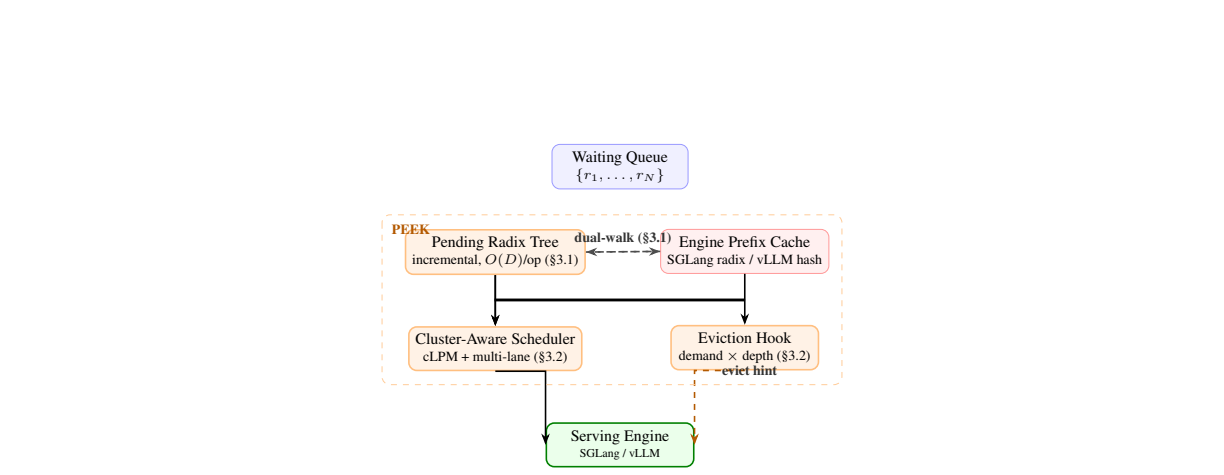
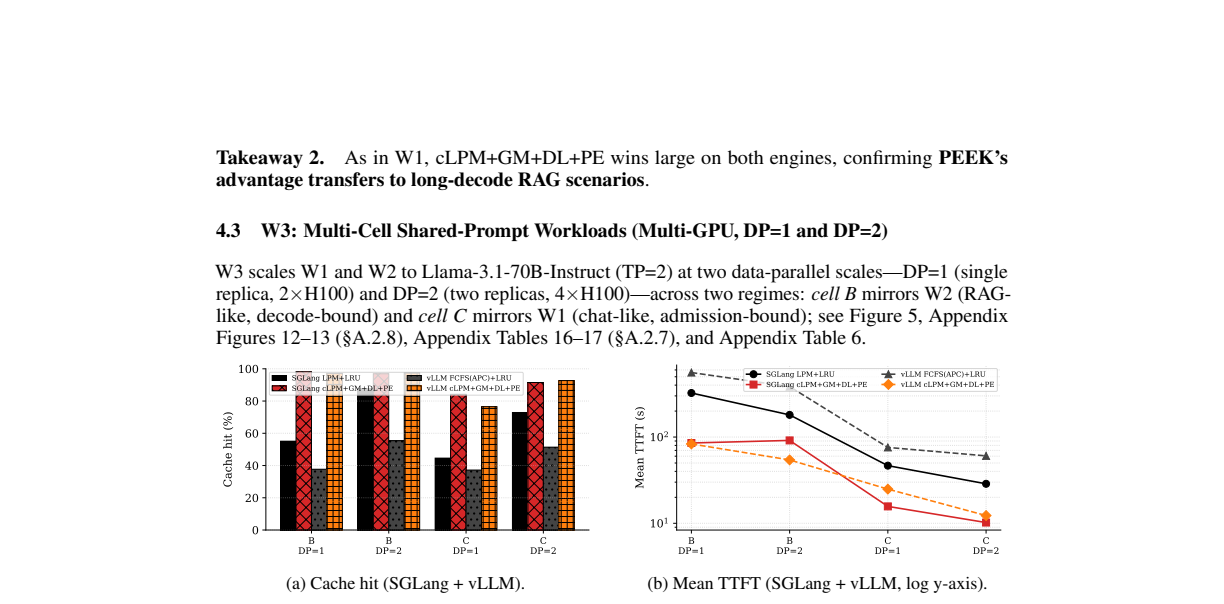
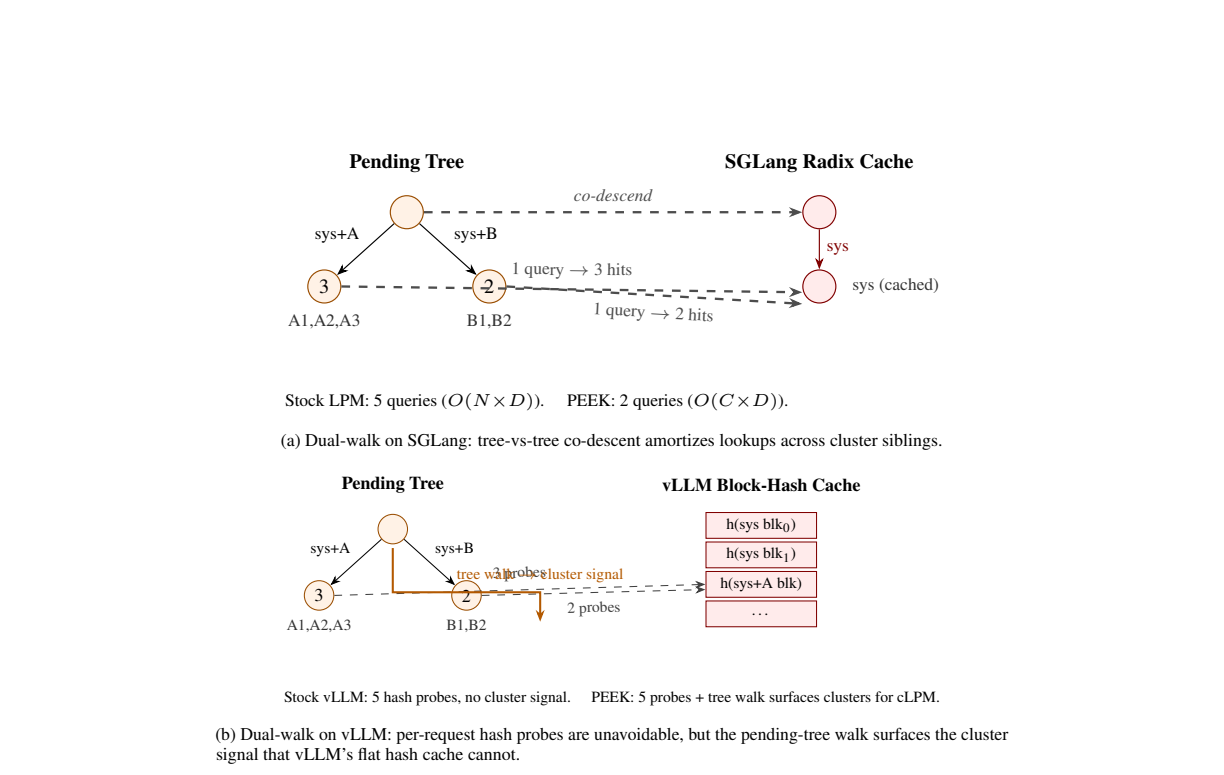
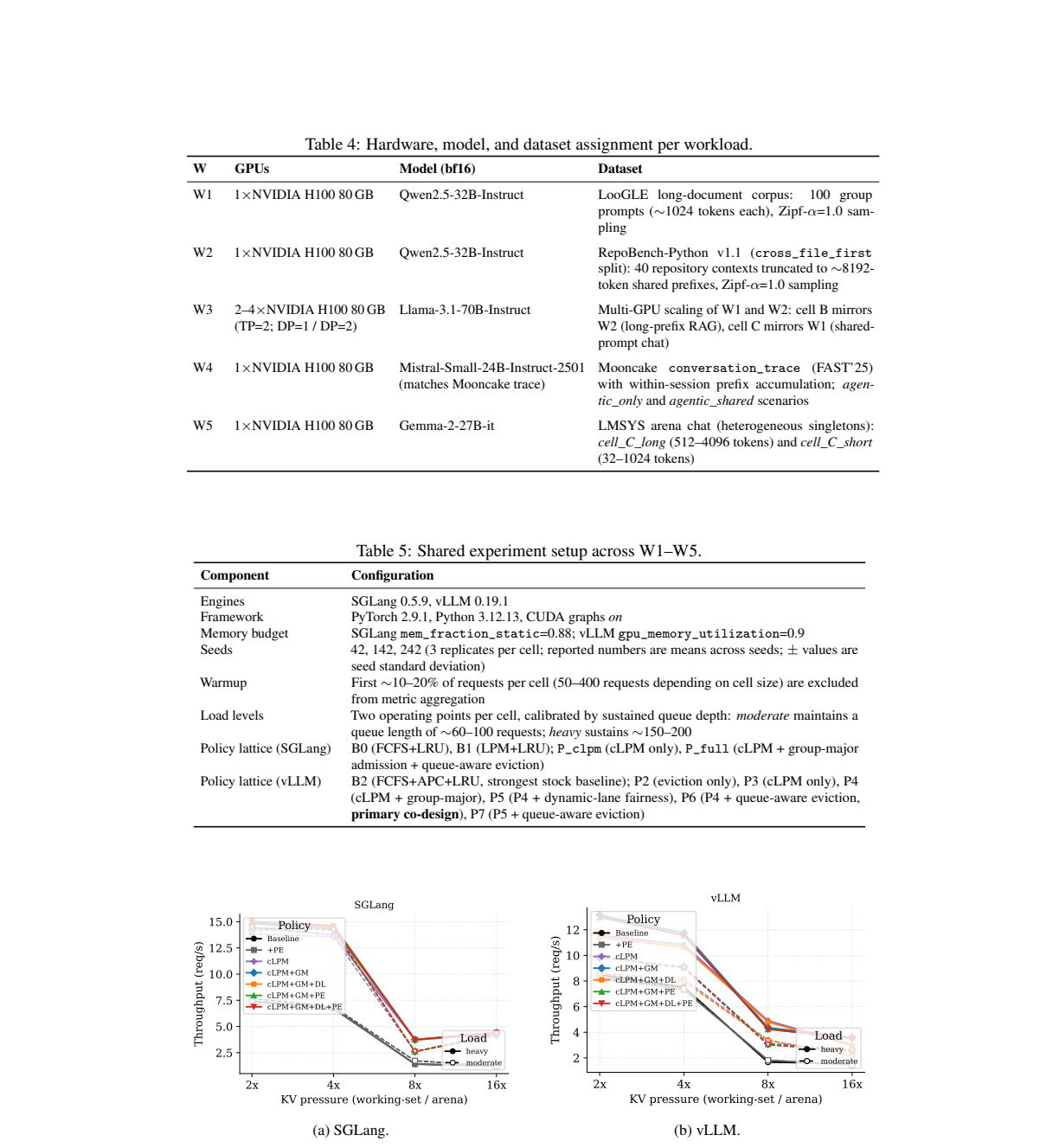
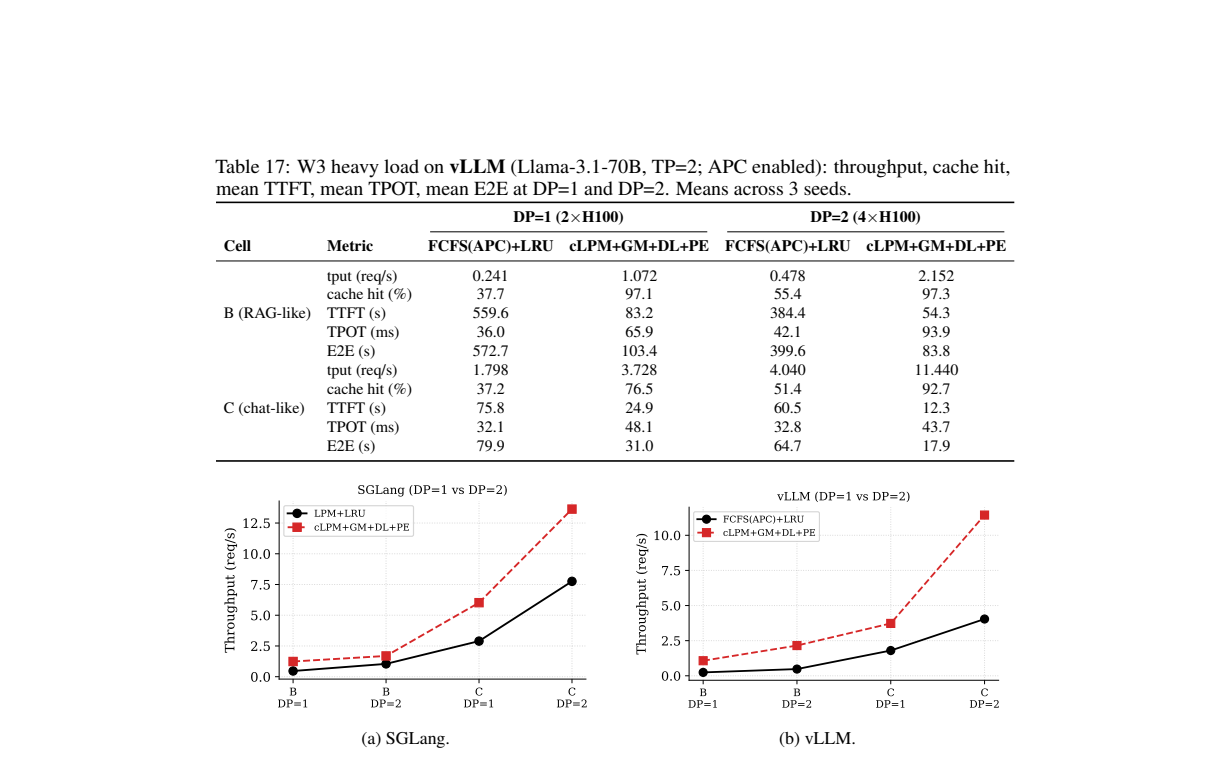
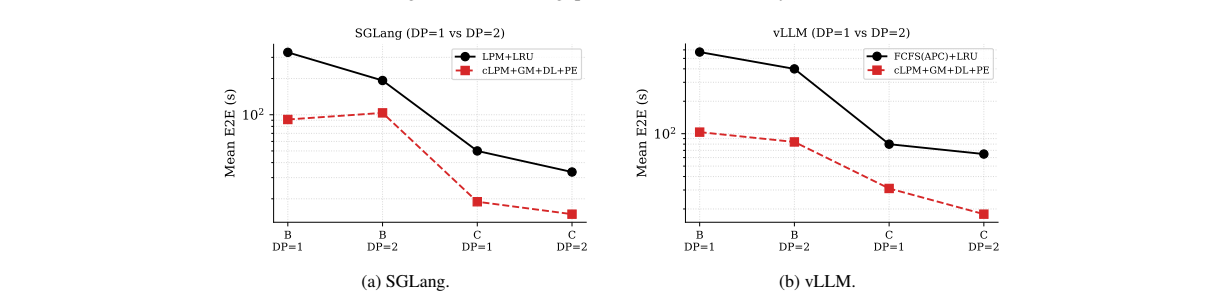
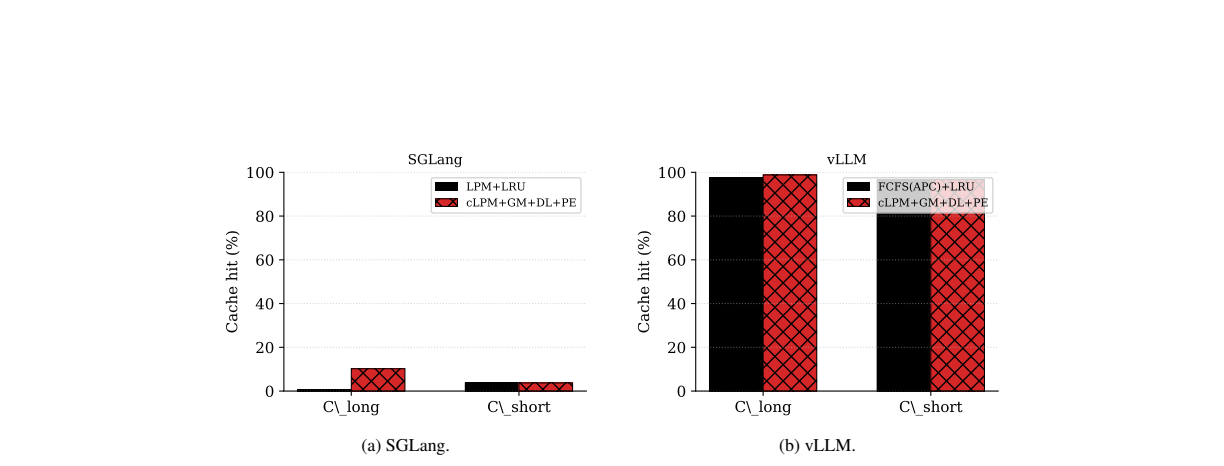
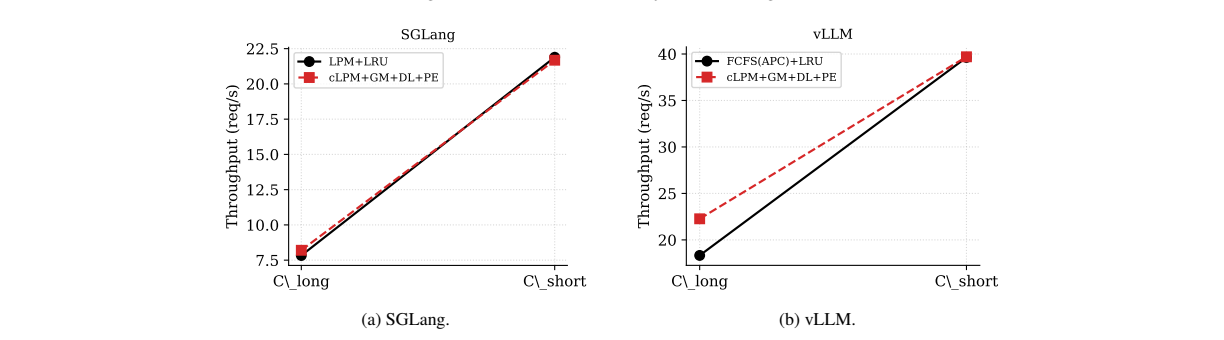
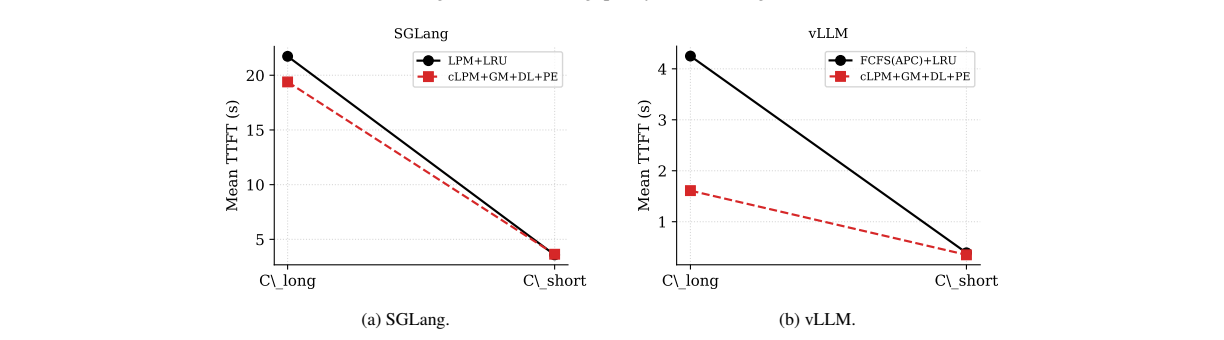
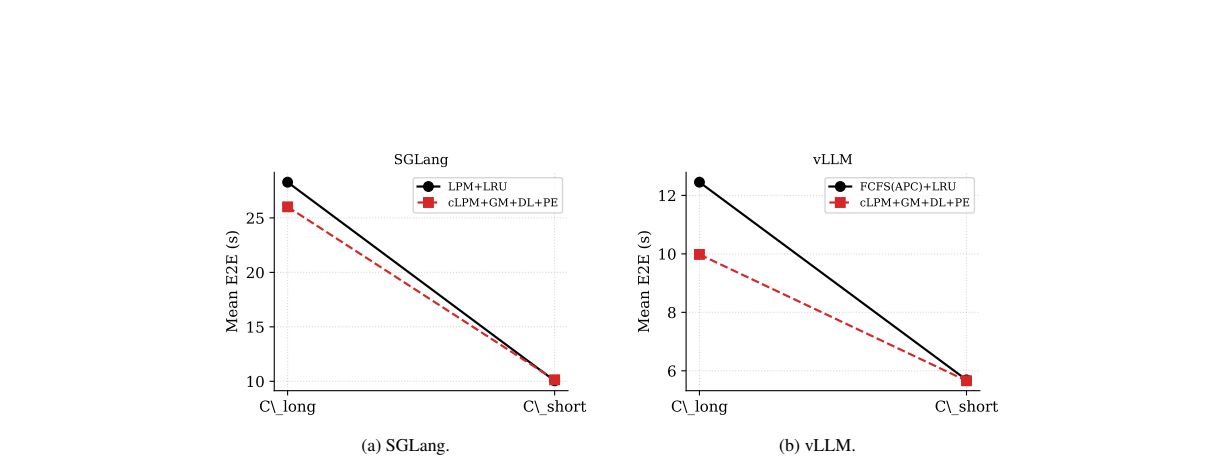
PEEK maintains an incremental radix tree over the pending queue, exposing prefix-sharing clusters no existing engine surfaces. A low-overhead dual-walk matches the tree against the engine's prefix cache to yield longest-prefix-match for every waiting request; PEEK then admits cluster pioneers first so siblings inherit the freshly cached prefix, a co-designed eviction hook protects blocks ancestral to queued demand, and a multi-lane stride scheduler bounds starvation. On SGLang and vLLM across five workloads up to 4×H100 (DP=2 over TP=2), PEEK delivers up to 3.0×/2.6× cache hit, 7.9×/7.1× TTFT, 6.7×/5.5× E2E, and 3.6×/4.5× throughput gains over each engine's strongest stock baseline (SGLang/vLLM), while matching baselines within noise on workloads with no exploitable prefix structure. Wins hold as KV-cache pressure and inference parallelism scale.
from the abstract
Pith says
Machine review · grok-4.5 · 12 Jul 2026 · of version 1 of the paper; version 2 is newer · what was read was not recorded · not checked by a person
It can be wrong. Challenge this review or reply to it.
Holds up, with conditions. Solid systems paper: pending-queue radix tree + cluster-first admit/evict is a real, measurable lever on SGLang/vLLM under KV pressure, with honest no-regress cells. This line is wrong
3 major objections · 6 minor
How often objections from reviews like this one are right: not yet measured
Not checked: figures, code, what the references say.
The paper says, at §2, §4.1–§4.3, Tables 6–9
The review did not quote this passage.
Pith says: Objection 1 of 3 · major
§2 thrashing example and §4.1–§4.3 / Tables 6–9: The multi-fold gains rest on concurrent multi-group prefix structure (Zipf-α=1.0 over shared-prompt groups on LooGLE/RepoBench, production-class mapping in Tables 7–9). W4/W5 correctly show no-regress when that structure is missing or already arrival-coherent, but the high-gain cells are still synthetic multi-tenant constructions rather than production online traces (Mooncake is used only for W4).
more of objection 1
The central predictive claim—that live pending-queue prefix relationships are a reliable high-signal driver of future KV demand—is demonstrated under the conditions where it can matter, but transfer of the reported 3–8× TTFT/E2E factors outside these cells is not yet established. Please either evaluate at least one high-gain cell on a real multi-tenant production or gateway trace with concurrent shared prefixes, or substantially strengthen the di
The paper says, at §3.2, Eqs. (1)–(2), §4.1
The review did not quote this passage.
Pith says: Objection 2 of 3 · major
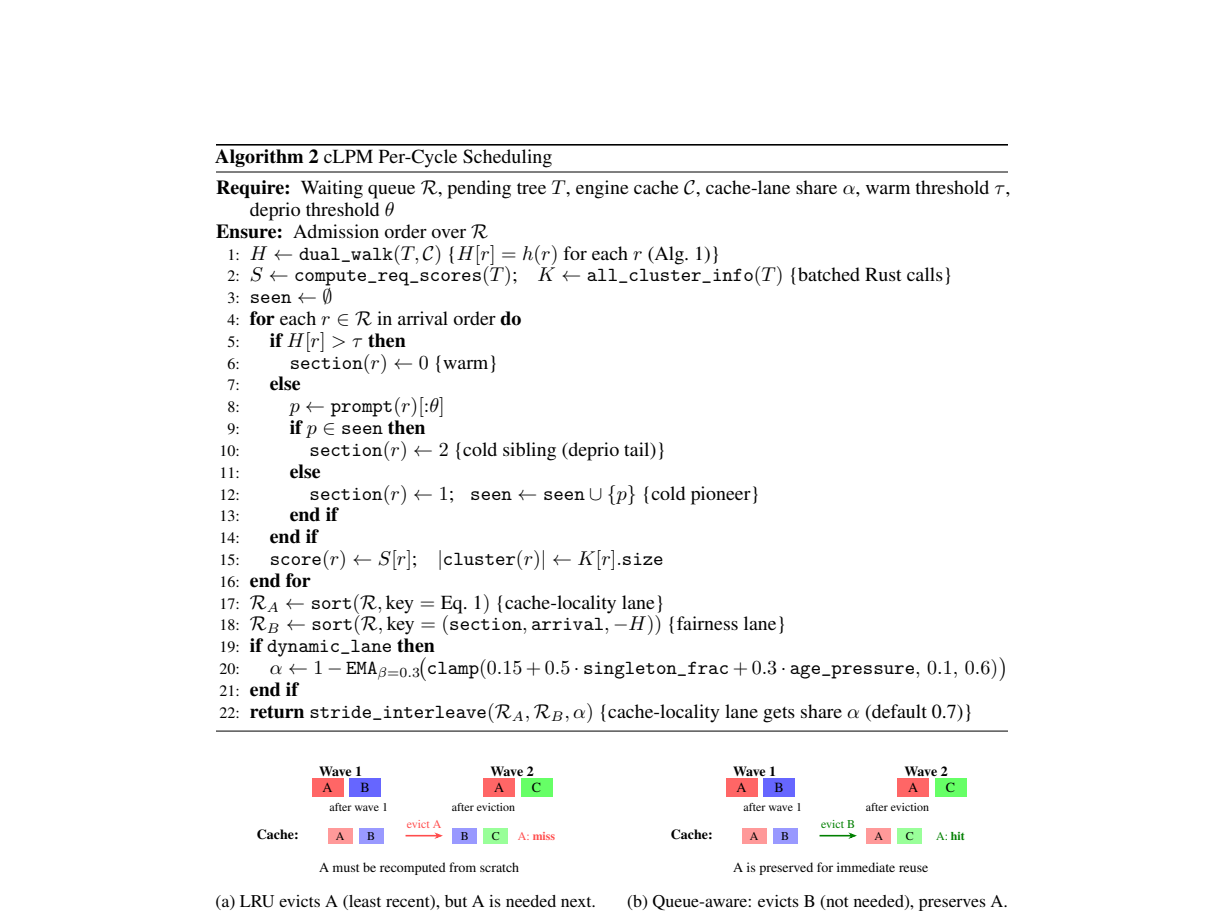
§3.2 Eqs. (1)–(2) and free parameters (α default 0.7, θ=32, warm τ, DL coefficients 0.15/0.5/0.3 with EMA β=0.3 and clamp [0.10,0.60], vLLM victim scan cap 4N, eviction mode=cluster): Component ablations (cLPM vs GM vs DL vs PE) are thorough and correctly identify cLPM as dominant, but continuous sensitivity of the free knobs is largely unreported.
more of objection 2
Because DL and GM can trade TTFT/E2E for fairness (up to 10–29% TTFT cost from GM; 2.4–15.1% recovery from DL), a short sensitivity sweep on α, θ, and the DL clamp/coefficients—at least on W1 cell C—would show that the headline policy is not a fragile sweet spot and would make the defaults reproducible as design choices rather than tuned constants.
The paper says, at Abstract, §3.1, Algorithm 1
The review did not quote this passage.
Pith says: Objection 3 of 3 · major
§3.1 / Algorithm 1 and abstract claim of dual-walk amortization: The O(C×D) vs O(N×D) amortization is SGLang-specific; on vLLM the paper correctly falls back to O(N×b) per-request probes and only extracts cluster signals from the tree. The abstract and intro headline the dual-walk as a general mechanism without always making this engine asymmetry salient.
more of objection 3
Please state clearly in the abstract/§3.1 that LPM amortization is SGLang-only and that vLLM gains come from cluster-aware ordering (and PE) rather than cheaper LPM, so readers do not over-attribute the vLLM speedups to dual-walk cost reduction.
6 minor objections
The paper says, at Table 1, §1
Pith says: minor objection 1 of 6
Table 1 and §1: “Queue trie” / “Pending trie” vs “pending radix tree” are used interchangeably; pick one term and stick to it for the structure over waiting requests.
The paper says, at §4.1, Figures 2–3
Pith says: minor objection 2 of 6
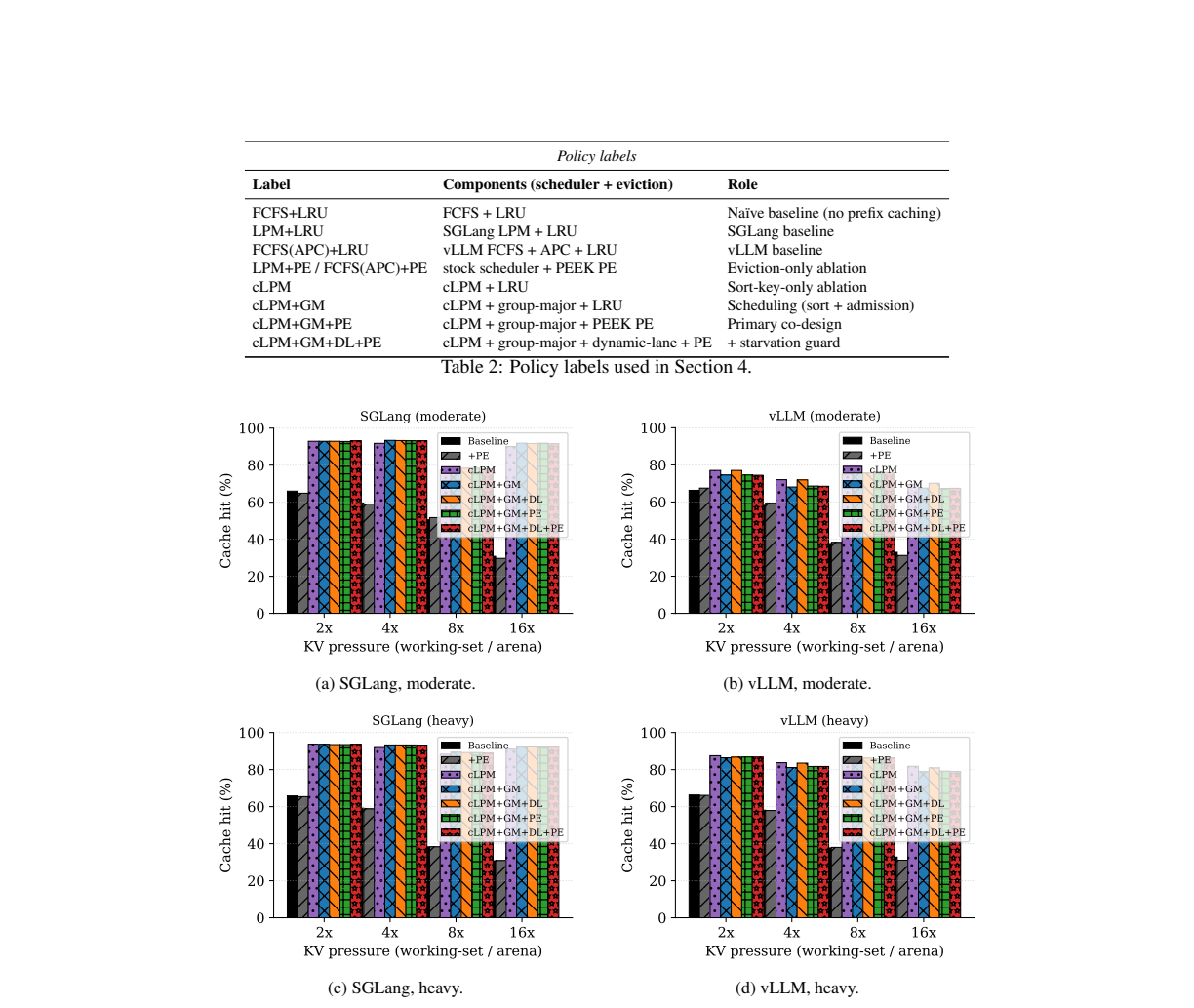
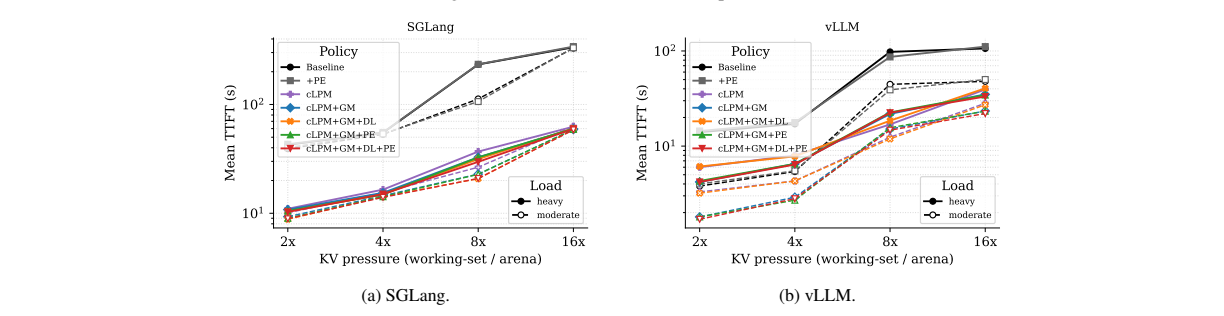
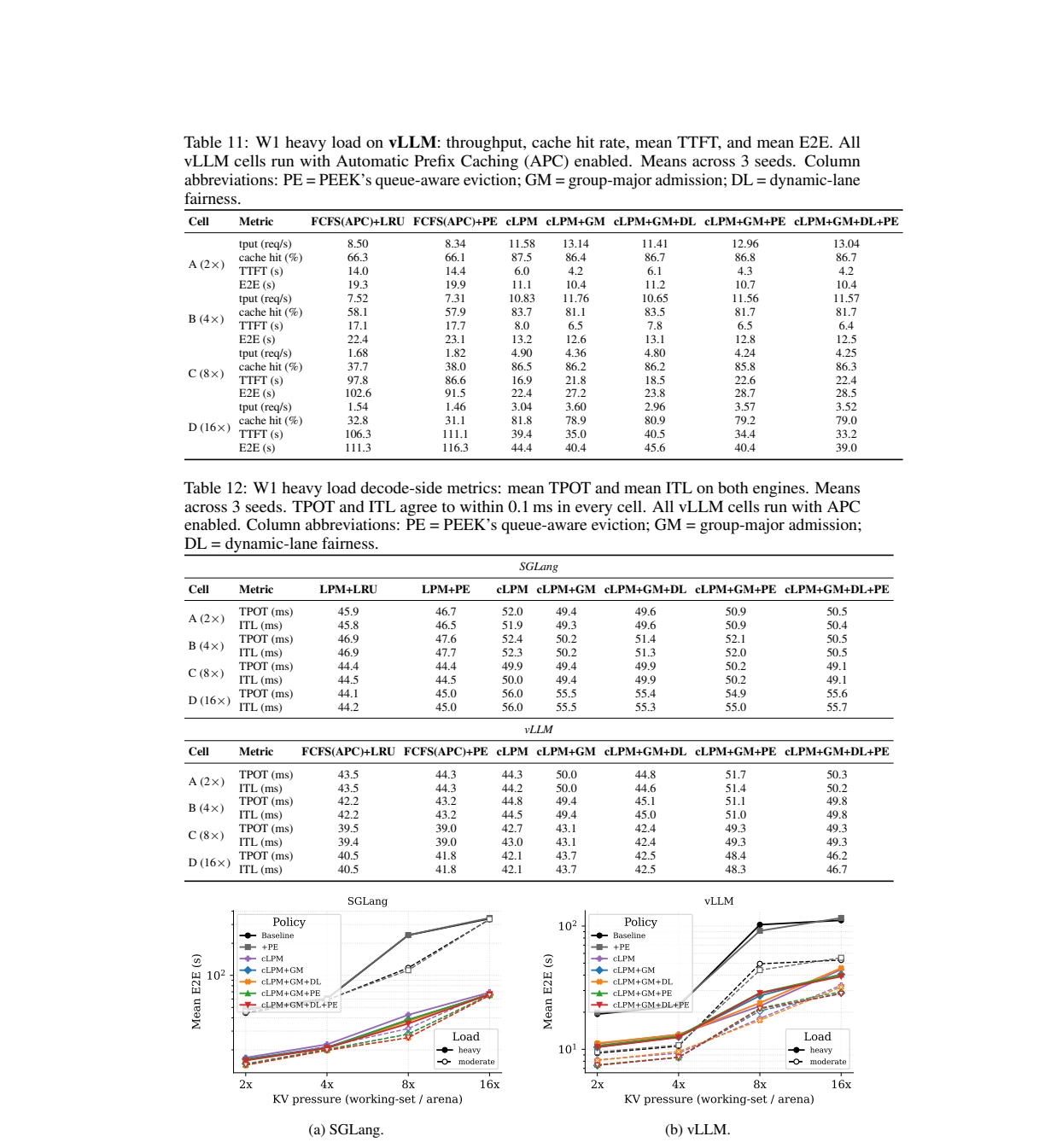
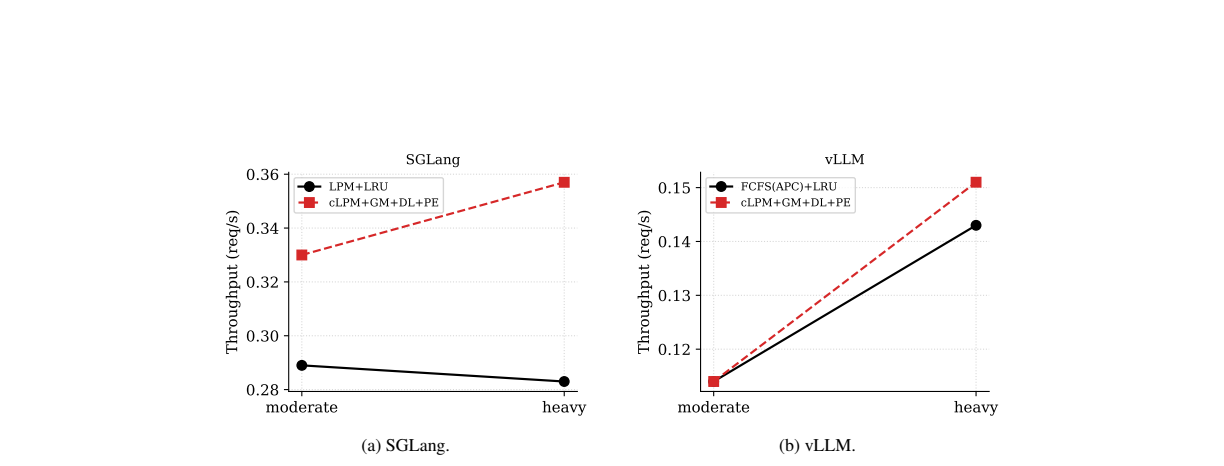
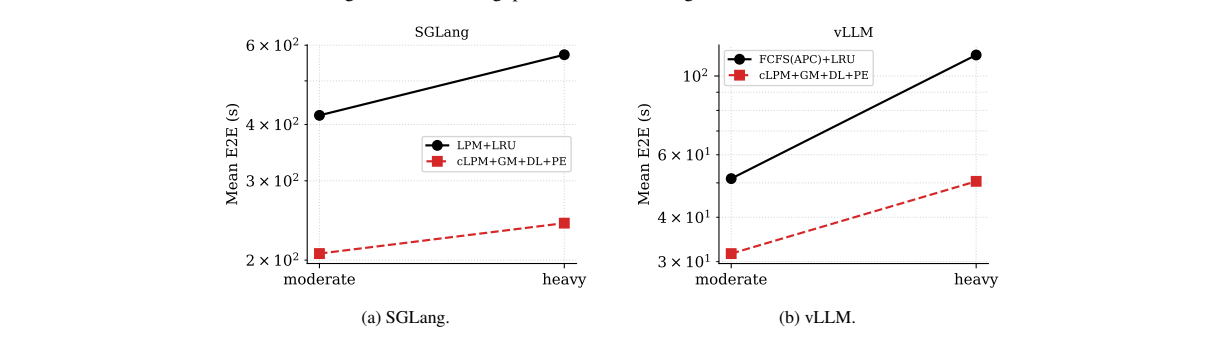
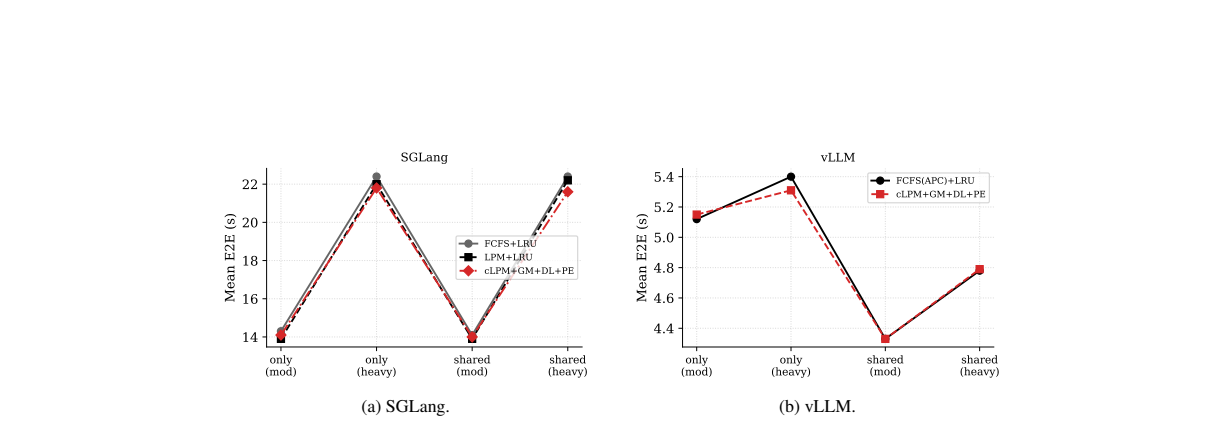
Figures 2–3 and 8–9: Log y-axes and overlaid moderate/heavy lines are dense; consider separating moderate and heavy into panels or adding a small table of peak ratios next to the figures for the primary cell C.
show 4 more
The paper says, at §4.1, Appendix Table 12
Pith says: minor objection 3 of 6
§4.1 decode-side note: TPOT rises 8–26% (4–12 ms/token) on SGLang under PEEK while E2E still drops sharply. A one-sentence explanation that larger decode batches under higher throughput inflate per-token time would help readers who fixate on TPOT.
The paper says, at §5
Pith says: minor objection 4 of 6
§5 Related Work: Preble, HotPrefix, SOLA, BatchLLM, and BlendServe are cited appropriately; a short explicit sentence on why pending-queue structure is complementary to cache-hotness (HotPrefix) and workflow-graph forecasts (KVFlow) would sharpen the positioning.
The paper says, at Abstract, Appendix A.3
Pith says: minor objection 5 of 6
Appendix A.3 offline results are substantial (up to 2.4×/8.0×) but the paper title and abstract focus on online. Either demote offline claims in the abstract to a single clause or move a compact offline summary into the main body so the appendix does not carry unadvertised primary results.
The paper says, at Abstract, §3.2
Pith says: minor objection 6 of 6
Typos / polish: “amulti-lanestride”, “incrementalradix”, “low-overheaddual-walk” and similar missing spaces appear in the abstract/intro; “is_depr” in §3.2 should be defined once in prose; arXiv id 2607.02525 dating looks future-dated—confirm metadata.
What would settle it
Replay one production-derived online trace (e.g., a public Mooncake or LMSYS multi-tenant slice with natural rather than Zipf-injected sharing) under identical SGLang/vLLM configs and the same cLPM+GM+DL+PE policy; if cache-hit / TTFT gains fall below ~1.2× relative to the stock baseline while W4/W5-style no-regress still holds, the transfer claim weakens. Otherwise the reader's CONDITIONAL stance is confirmed as appropriately cautious rather than under-supported.
from the skeptic's reading
How the review went
4 readings by grok-4.5 · 12 Jul 2026
- Reader holds up, with conditions
- Skeptic agrees
- Editor wrote the verdict above
- Referee minor revision: 3 major objections, 6 minor
Not run on this paper: the simulated authors' defence.
Pith did not check this review's objections against the paper.
The review in full
The review in brief, machine-written
The thing worth knowing is that PEEK closes a real gap stock engines leave open: they only see the current cache, not prefix sharing among waiting requests. The incremental pending radix tree, dual-walk LPM, cLPM sort, and queue-demand eviction are concrete and co-designed; the ablations show cLPM alone gets within ~3 pp cache hit of the full stack. That is the actual contribution.
What they do well: multi-engine integration (monkey-patch, no fork), full W1 lattice, multi-GPU 70B (DP=1/2), and explicit no-regress on W4/W5 with a has_sharing short-circuit. Gains scale with KV pressure where thrashing is real (W1–W3), and they match baselines within noise when structure is absent or already arrival-coherent. Algorithms and sort keys are specified; free knobs (α, θ, EMA) are policy hyperparameters, not circular. Offline appendix is consistent with the same idea. Code promise is there.
Soft spots are real but scoped. Workloads deliberately inject concurrent Zipf shared-prompt groups so stock LPM/FCFS thrash; that is the regime the paper claims, not a hidden universal. H100-only, Python sort, and a few hand-tuned fairness/eviction constants are ordinary systems caveats, not load-bearing flaws. Related work is covered fairly (Preble, BatchLLM, HotPrefix, etc.); they correctly position as intra-replica and complementary.
This is for people who ship or research LLM serving under multi-tenant/RAG KV pressure. The central empirical claim holds under the conditions they measure. I would send it to peer review; it deserves referee time, not a desk reject. Worth reading and, if the numbers hold on your traffic, citing.
The strongest objection
The reader's weakest assumption (that Zipf-α=1.0 shared-prompt groups on LooGLE/RepoBench plus constructed agentic/LMSYS cells are representative enough for multi-fold gains to transfer) is the correct soft spot, but it is already scoped carefully by the paper itself. W1–W3 deliberately inject concurrent multi-tenant prefix structure that stock LPM/FCFS thrash under (explicit thrashing example in §2; production-class mapping in Tables 7–9); W4–W5 then show no-regress when that structure is absent or already arrival-coherent. The core predictive claim—that live pending-queue prefix relationships drive future KV demand—is therefore demonstrated under the conditions where it can matter, not asserted as universal. Ablations further isolate cLPM as the dominant lever (within ~3 pp cache hit of the full stack), so the headline numbers are not an artifact of the fairness/eviction knobs. No internal inconsistency, circular evaluation, or hidden assumption in the dual-walk / cLPM sort key (Eq. 1) / PE score (Eq. 2) undermines the reported measurements.
The paper's strongest claim is an engineering measurement: large, multi-metric gains on named engines and hardware when concurrent prefix structure exists, with explicit no-regress on structure-poor traffic, and ablations showing cLPM dominates. That claim is internally consistent and well-instrumented (dual-walk amortization, pending-tree signals, PE demand score, multi-lane fairness). The only load-bearing external risk is workload representativeness—the same risk the reader already flags. Because the paper already includes both high-structure (W1–W3) and low-structure (W4–W5) cells, maps cells to production classes, and shows the has_sharing guard short-circuits cleanly, that risk does not rise to a reason to move the verdict. H100-only hardware and a few hand-tuned knobs (α, θ, EMA) remain secondary caveats already covered by CONDITIONAL. No stronger technical objection (e.g., dual-walk correctness, sort-key inversion under realistic arrival, or PE undoing cLPM locality) is supported by the manuscript. Hence the reader's CONDITIONAL / HIGH-confidence stance stands; agreement is full on the weakest assumption.
The referee's report
If the results hold under realistic production queues, this is a meaningful systems contribution: existing engines (SGLang LPM/DFS_WEIGHT, vLLM FCFS+APC) bind scheduling and eviction to current cache state and ignore inter-request sharing in the waiting queue, which the paper shows can induce thrashing under multi-tenant prefix pressure. Jointly driving admission and eviction from one pending-tree signal, with a low-overhead dual-walk and an adaptive fairness lane, is a clean co-design. Strengths include multi-engine integration without upstream forks, a full W1 ablation lattice that correctly attributes most of the gain to cLPM, explicit no-regress cells, multi-GPU 70B scaling, and open code. The work composes under cross-replica routers and atop existing prefix-cache mechanisms, so the practical impact path is clear.
Pith's reading of the paper (a machine's summary, not the authors')
Current LLM servers reuse cached key-value blocks when prompts share a prefix, but they only look at what is already in cache. They ignore the fact that the requests still waiting in the queue also share prefixes with one another. PEEK builds a live radix tree over that waiting queue, exposes the resulting prefix-sharing clusters, and uses them both to decide which request to admit next and which cache blocks to protect from eviction. By admitting a cluster’s first request (the pioneer) and then its siblings, one expensive prefill can be reused by many later requests before an unrelated arrival can thrash the cache. Across five production-style workloads on two major engines and up to four H100 GPUs, the paper reports large gains in cache hit rate, time-to-first-token, end-to-end latency, and throughput whenever exploitable prefix structure exists, and no regression when it does not.
What carries the argument. An incremental pending radix tree over the waiting queue, plus a dual-walk that co-descends it against the engine’s prefix cache to obtain longest-prefix matches for every waiting request; those signals drive Cluster-LPM admission (pioneers first so siblings inherit the fresh prefix), a demand-weighted eviction hook, and a multi-lane stride scheduler that bounds singleton starvation.
Core claim. The waiting queue is itself a structured workload whose live prefix-sharing relationships are a high-signal predictor of future KV-cache demand. An incremental radix tree over that queue, together with a dual-walk that matches it against the engine cache, supplies cluster-aware admission and co-designed eviction that jointly raise cache hit rate and cut latency far beyond what stock longest-prefix-match or FCFS policies achieve.
The premise it rests on. The concurrent multi-request prefix structure present in the paper’s evaluation workloads is representative enough of real online production queues that the reported multi-fold gains will transfer outside those cells.
Check this review
Pith stored no record of this review's passes and took no fingerprint of it. Reviews made by code from 13 Nov 2026 on carry both.
How often reviews like this one are right
Reviews like this one: written by grok-4.5, where what was read was not recorded.
How often objections from reviews like this one are right: not yet measured
Reviews by people
This review was written by a machine. No person has reviewed this paper on Pith yet. A scientist listed on Pith can review it for a fee, and their review is published here whatever it concludes.
The paper
Abstract
We present PEEK, a lightweight scheduling and eviction framework for both online (streaming) and offline (batch) LLM serving; this paper focuses on the online regime. PEEK maintains an incremental radix tree over the pending queue, exposing prefix-sharing clusters no existing engine surfaces. A low-overhead dual-walk matches the tree against the engine's prefix cache to yield longest-prefix-match for every waiting request; PEEK then admits cluster pioneers first so siblings inherit the freshly cached prefix, a co-designed eviction hook protects blocks ancestral to queued demand, and a multi-lane stride scheduler bounds starvation. On SGLang and vLLM across five workloads up to 4×H100 (DP=2 over TP=2), PEEK delivers up to 3.0×/2.6× cache hit, 7.9×/7.1× TTFT, 6.7×/5.5× E2E, and 3.6×/4.5× throughput gains over each engine's strongest stock baseline (SGLang/vLLM), while matching baselines within noise on workloads with no exploitable prefix structure. Wins hold as KV-cache pressure and inference parallelism scale.
The paper's own sentences, arranged, kept beside the review and separate from it. Each label is drawn from a closed vocabulary; the number beside it is the probability the classifier gave that label. No sentence in this record was written by a model.
abstract compiled · 2026-09-23
The authors' main claim, as the classifier picked it out 1.00
“On SGLang and vLLM across five workloads up to 4$\times$H100 (DP=2 over TP=2), PEEK delivers up to 3.0$\times$/2.6$\times$ cache hit, 7.9$\times$/7.1$\times$ TTFT, 6.7$\times$/5.5$\times$ E2E, and 3.6$\times$/4.5$\times$ throughput gains over each engine's strongest stock baseline (SGLang/vLLM), while matching baselines within noise on workloads with no exploitable prefix structure.”
How the main claim is stated: asserted 1.00
What the abstract itself states, as probabilities: claims first 0.12 · states limitation 0.82 · human participants 0.02 · controlled comparison 0.97 · randomized assignment 0.02 · states quantitative result 0.99 · compares with prior results 0.98 · mentions code or data availability 0.03
The abstract, sentence by sentence
This table labels the abstract only (arXiv listing abstract v2). The number is the probability the classifier gave the label.
| Sentence | Role | The authors' own work | States the main conclusion | Strength |
|---|---|---|---|---|
| We present PEEK, a lightweight scheduling and eviction framework for both online (streaming) and offline (batch) LLM serving; this paper focuses on the online regime. | contribution 0.99 | 0.82 | 0.04 | asserted 0.99 |
| PEEK maintains an incremental radix tree over the pending queue, exposing prefix-sharing clusters no existing engine surfaces. | method 0.83 | 0.87 | 0.03 | asserted 1.00 |
| A low-overhead dual-walk matches the tree against the engine's prefix cache to yield longest-prefix-match for every waiting request; PEEK then admits cluster pioneers first so siblings inherit the freshly cached prefix, a co-designed eviction hook protects blocks ancestral to queued demand, and a multi-lane stride scheduler bounds starvation. | method 0.99 | 0.88 | 0.05 | asserted 1.00 |
| On SGLang and vLLM across five workloads up to 4$\times$H100 (DP=2 over TP=2), PEEK delivers up to 3.0$\times$/2.6$\times$ cache hit, 7.9$\times$/7.1$\times$ TTFT, 6.7$\times$/5.5$\times$ E2E, and 3.6$\times$/4.5$\times$ throughput gains over each engine's strongest stock baseline (SGLang/vLLM), while matching baselines within noise on workloads with no exploitable prefix structure. | result 1.00 | 0.96 | 0.81 | asserted 1.00 |
| Wins hold as KV-cache pressure and inference parallelism scale. | result 0.91 | 0.88 | 0.10 | asserted 1.00 |
What kind of paper the classifier reports this is: method or tool 1.00 · evidence from observation or experiment 0.99
What was examined, and what was not
Sources read
- arXiv listing abstract v2
Not examined
- full text
- figures and tables
- references and citing sentences
- relations to other papers
Levels run
- P abstract
Not run
- S sections
- T body sentences
- C citations
- R cross-paper relations
How the labels were made
Compiled by classifier-1.13.0 via TypeSafe API, question bank abstract-p1-20260923, 2026-09-23: 1 request, 4,570 input tokens.
Every quoted sentence on this record is the authors'. Every label is from Pith's closed vocabulary, with the probability shown beside it. This record as JSON
Figures (21)


Figures are the authors', reproduced from the paper.
Cited by 4 Pith papers
Reviewed papers on Pith that cite this one. The full citation record
- Gandalf: Flash Shall Not Die! Increasing Flash Storage Lifetime for KV Cache Offloading in LLM Serving cs.LG · Oct 2026
- Inside the Trap: A Renewal Law for Prefix-Cache Collapse in LLM Agent Serving cs.DC · Nov 2026
- Reducing Batch Makespan for LLM Agent Workloads through Inference-Environment Coordination cs.DC · Nov 2026
- Fairway: Load-Aware KV Cache Reuse for LLM Prefill Scheduling cs.DC · Nov 2026
Challenges and discussion
Disagree with the review, or know something it missed? Leave a comment, or challenge this review formally: a challenge becomes a permanent entry in this paper's record, and its decision is published here.
Come back by email
A short list of the week's newly reviewed papers. Nothing is sent until you confirm from your inbox, and every email has a link that stops it. No account.
No comments yet.
Sign in to comment