Distributed, Parallel, and Cluster Computing · arXiv:2611.08902 v1 · submitted 6 Nov 2026 · 106 references
Inside the Trap: A Renewal Law for Prefix-Cache Collapse in LLM Agent Serving
The paper says
“Prefix caching lets an LLM agent's follow-up turns reuse cached KV, but a burst can tip an engine into a trap in which every turn misses and the backlog does not drain, at a load it served before.”
more of the abstract
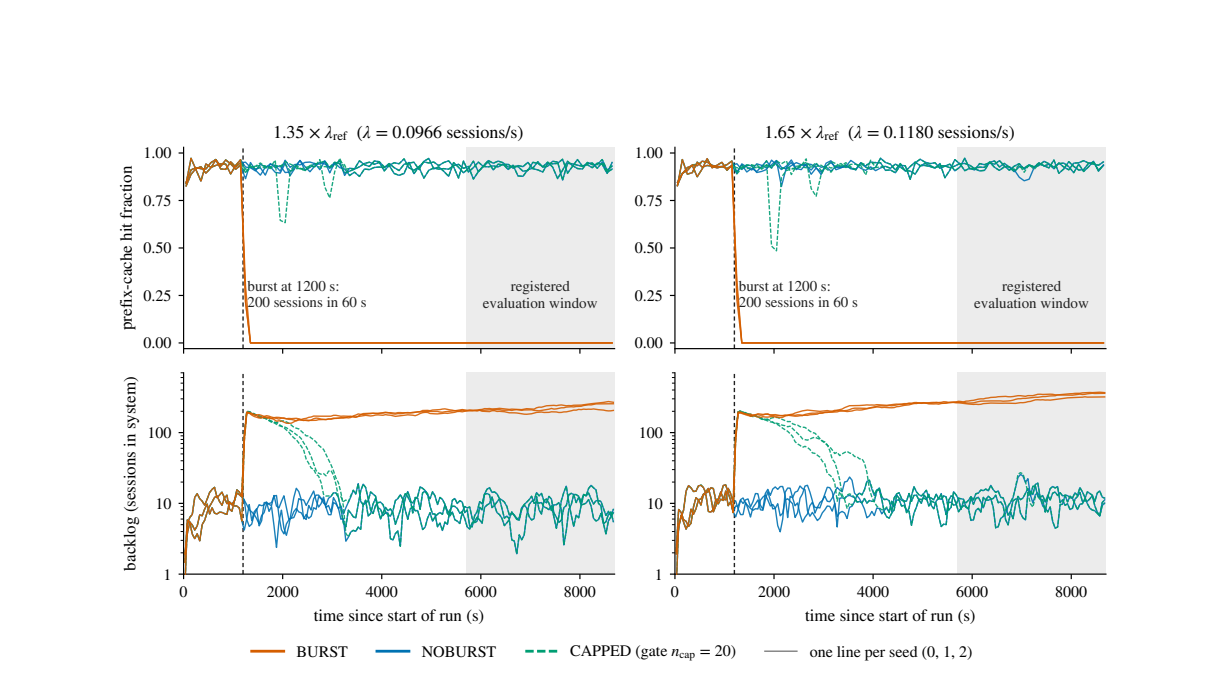
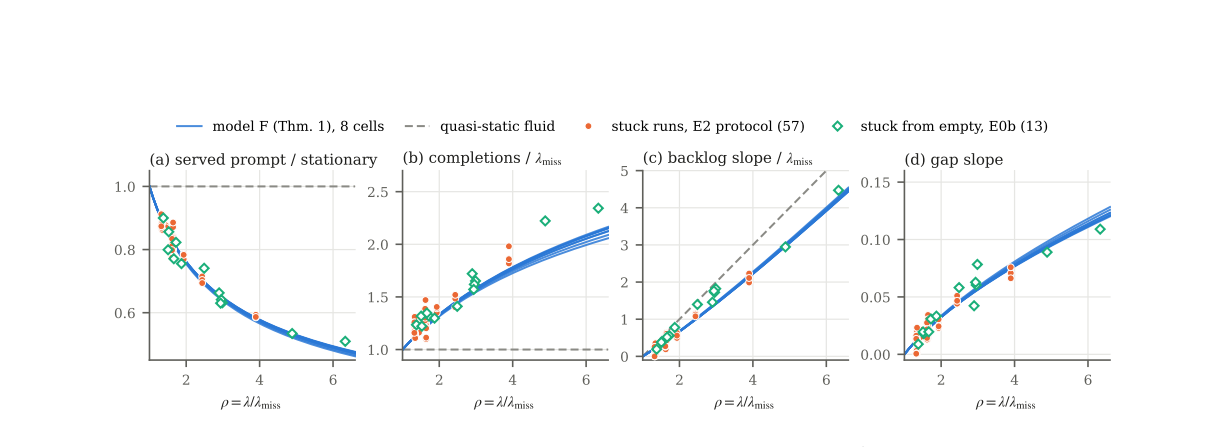
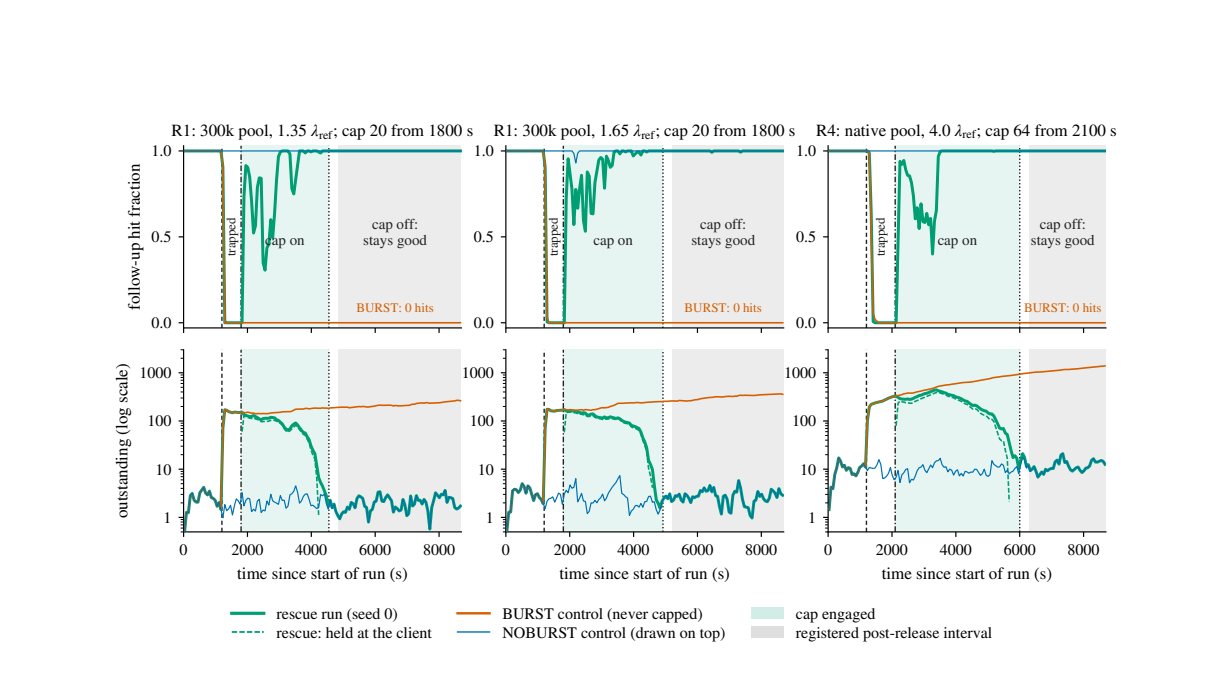
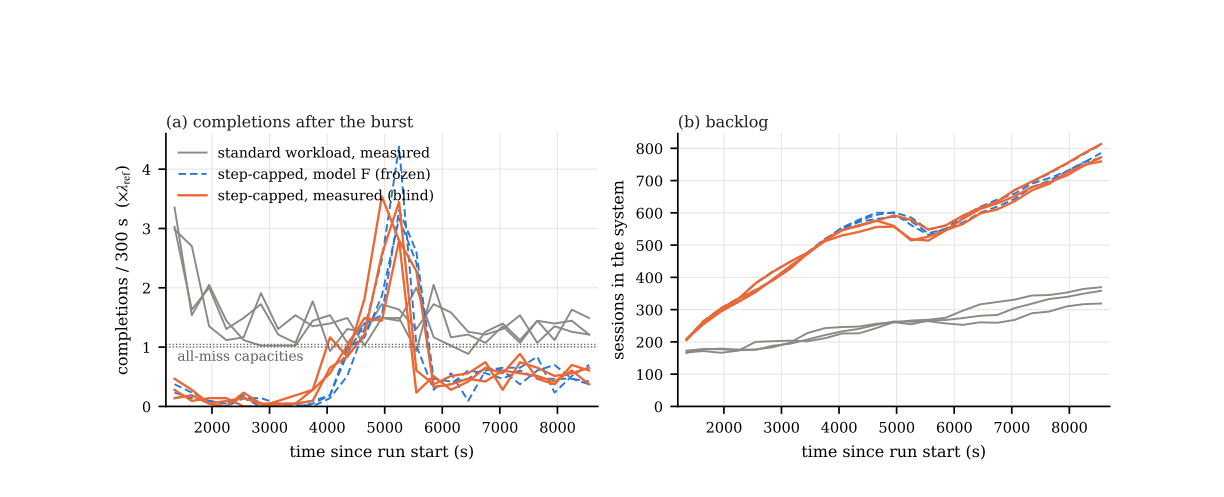
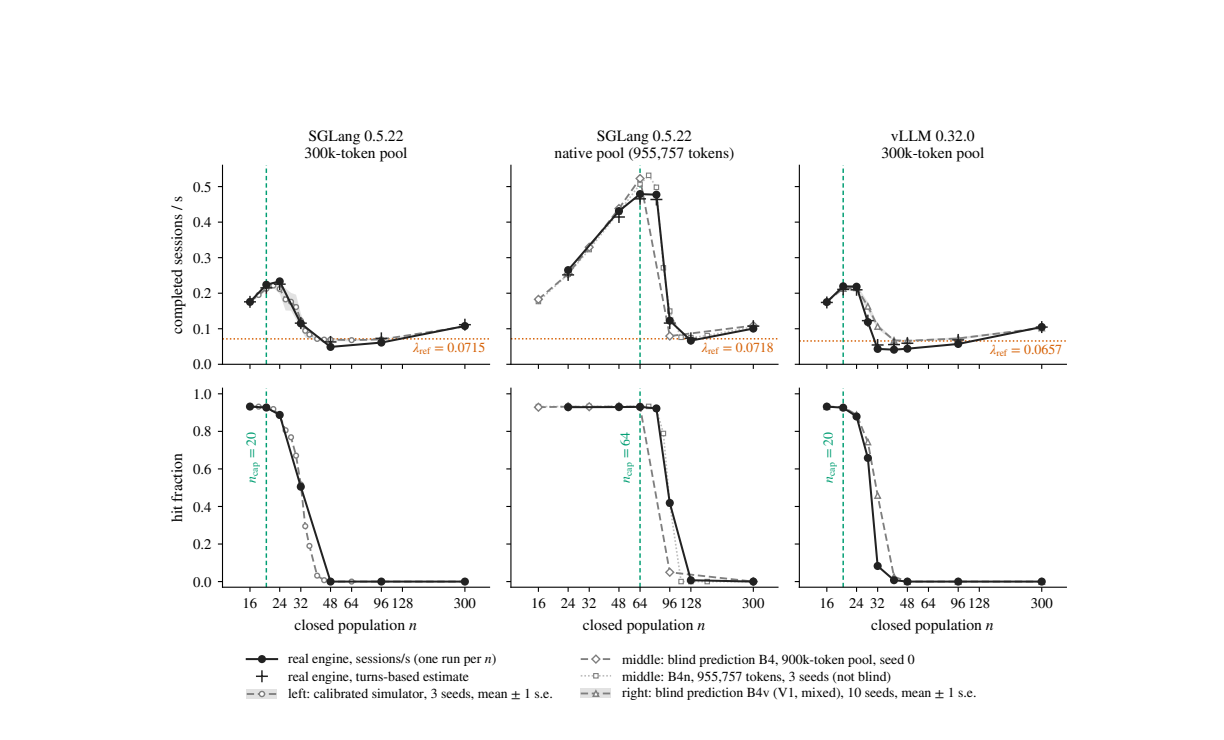
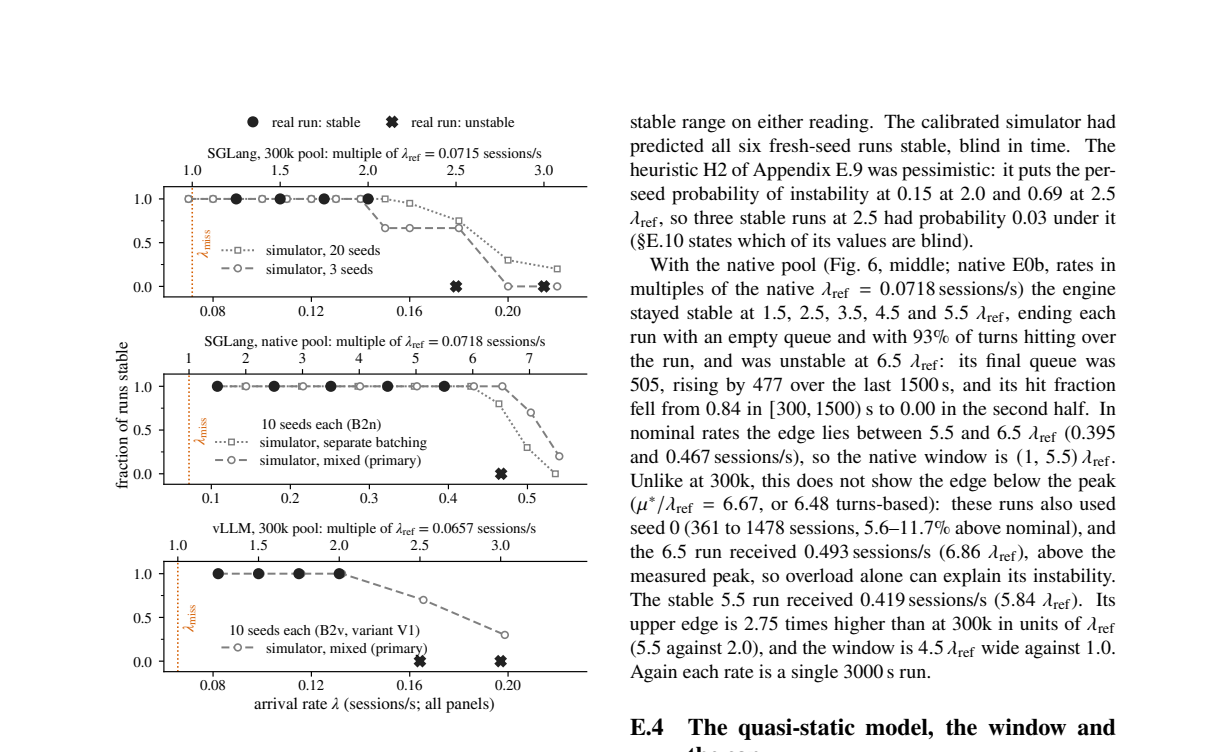
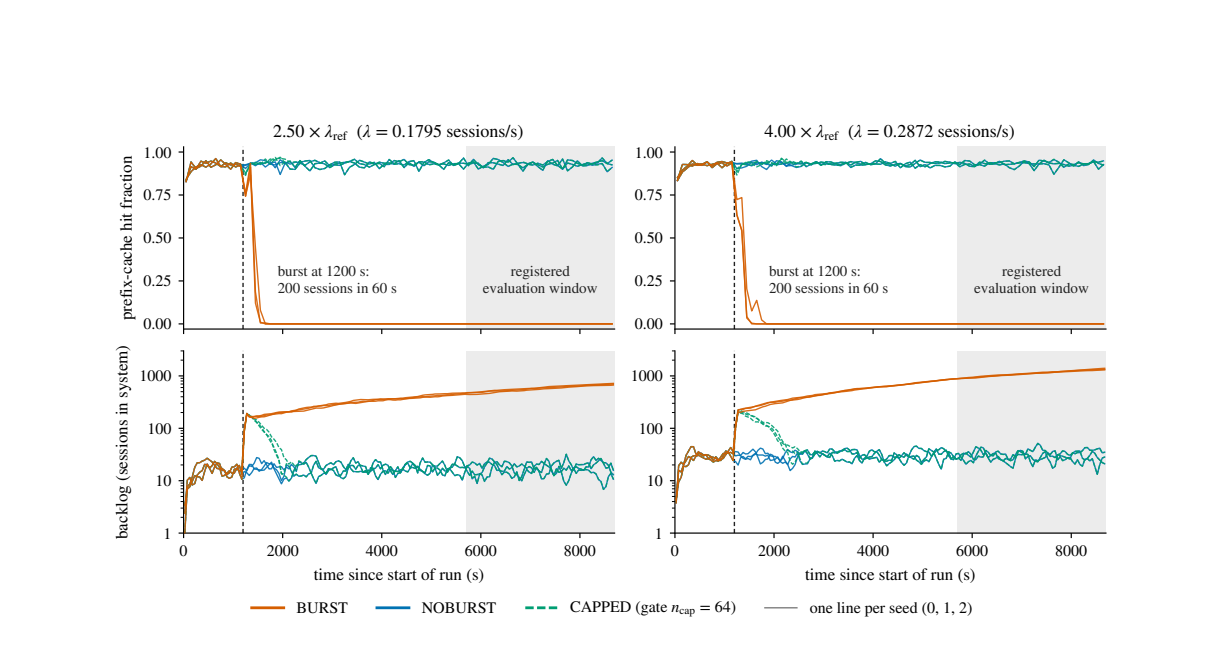
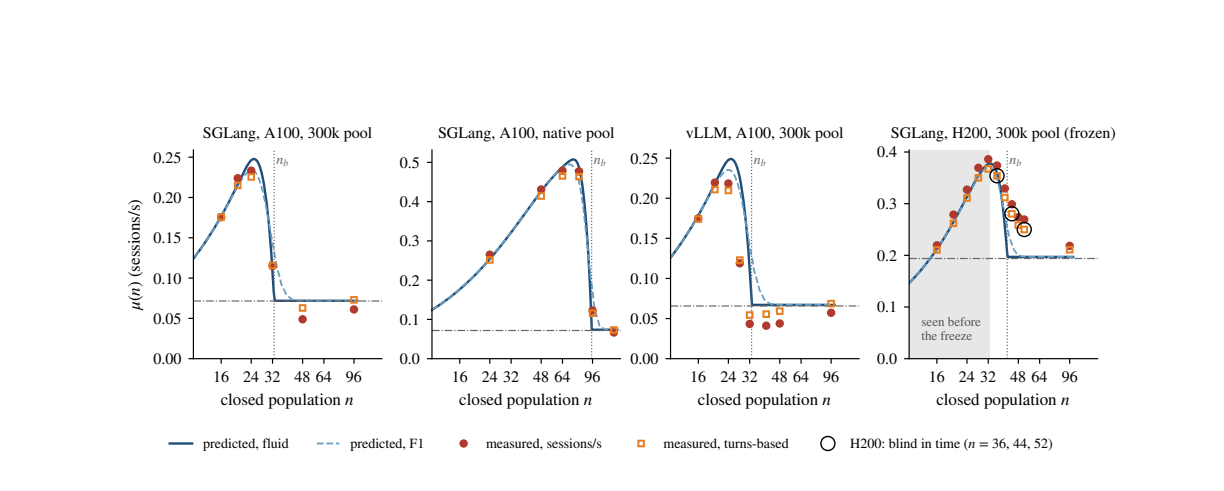
In registered paired tests on two engines, two GPUs and two models (passed at 9 of 10 rates), a 200-session burst left the engine at zero hits to the end in all 30 runs, while every matched no-burst run stayed good and a session cap prevented the trap in all 30 capped runs. We analyse an idealization of the trapped state exactly: for a fluid FIFO server on which every turn misses, we prove that along FIFO orbits its cycles obey a linear renewal recursion. As is classical, the trap drains if and only if arrivals are below the all-miss capacity; above it, a Perron root fixes the dynamics: every trapped state converges to a known self-similar regime in which the gap between turns grows linearly and the turns served are young and short. For our workload the backlog grows at 0.6 to 0.8 of the excess load and sessions complete faster than the all-miss capacity, a youth premium with turn-count and cost-growth factors, so in the model a trap's measured throughput overstates the recovery threshold. Retrospectively, with nothing fitted to trap data, the theory matches 57 stuck runs: the mean served prompt within 3% in 50 runs, completions above the all-miss capacity in every run, and the pooled gap growth. Blind in outcome, 4 runs trapped by a tool slowdown met 4 of 5 pre-set scores, cut traps persisted, and with a 20-step budget, trapped runs completed below the all-miss capacity, as predicted. Of two exits, refusing arrivals sheds sessions; a session cap restores reuse: in registered tests it rescued 9 of 9 established traps at the same load without shedding, and the engine stayed good after release. We do not prove that the engine converges to the model.
from the abstract
Pith says
Machine review · deepseek-v4-flash · 9 Nov 2026 · what was read was not recorded · not checked by a person
It can be wrong. Challenge this review or reply to it.
Holds up, with conditions.
3 major objections · 4 minor
How often objections from reviews like this one are right: not yet measured
Not checked: figures, code, what the 106 references say.
The paper says, at §3, Model F assumptions
The review did not quote this passage.
Pith says: Objection 1 of 3 · major
The FIFO assumption (F3) is load-bearing for the orbit recursion (Lemma 1) and the resulting Perron root analysis. The engine, however, runs about 28 concurrent requests (at 300k pool) and vLLM uses preemption, which deviate from strict FIFO ordering. The authors acknowledge this idealization and state they do not prove convergence to Model F.
more of objection 1
The empirical validation shows that the model's aggregate predictions (mean served prompt, gap slope, completion rate, backlog slope) match the engine, but the recursion itself is not verified. As the skeptic notes, a violation of strict FIFO could still produce similar aggregate statistics under the all-miss regime, but the quantitative predictions (exact growth rates, D/λ_miss values) depend on the precise Perron root. The paper would be strengthened by a more detailed analysis of how concurrency and preemption could modify the recursion, or by providing bounds on the deviation from the FIFO predictions. Without such analysis, the transfer of the exact theoretical guarantees to the engine rests on empirical coincidence, which weakens the claim of a "renewal law" for the engine.
The paper says, at §4, Retrospective checks
The review did not quote this passage.
A classifier read this sentence of the paper as acknowledging the concern (probability 0.95):
“The validation.The check on the 57 stuck runs is retro- spective: the theory was derived after they were read, and its scoringtolerancesweresetonthem.”
Pith says: Objection 2 of 3 · major
The main validation of Model F is performed on 57 previously collected stuck runs. The authors correctly state that this is retrospective and that the theory was derived after the runs were read. While the match is impressive, the retrospective nature limits the strength of the evidence.
more of objection 2
The blind tests (TOOLSLOW-W, TOOLSLOW-D15, CUT, MIRROR) are a step forward, but they are blind in outcome only: the tolerances were set on the committed runs and the workload for MIRROR was chosen after computing model predictions. The paper should more clearly separate the retrospective from the prospective evidence and state that the primary confirmation of the model is retrospective, with the blind tests providing additional but limited support.
The paper says, at §4.1, MIRROR test
The review did not quote this passage.
A classifier read this sentence of the paper as acknowledging the concern (probability 0.80):
“The test has limits: the cut comes 1200s after the burst, so it probes the young trap’s transient and the start of its re- growth, not the asymptotic rate, and CUT-B cannot show recovery within the run.”
Pith says: Objection 3 of 3 · major
The MIRROR test is a clever design to check the predicted reversal of the youth premium. However, the test measures only the transient lull after the burst (completions over [6600,8700)s are 0.50–0.845 λ_ref), not the asymptotic D/λ_miss (0.771 at 1.65 λ_ref). The paper should clarify that MIRROR does not confirm the asymptotic premium reversal, only the transient behavior. This is already partially stated, but the title "A predicted reversal of the youth premium" may overstate what is tested.
4 minor objections
The paper says, at §4, Figure 2 caption
Pith says: minor objection 1 of 4
The caption states "No parameter is fitted to any trap measurement." However, the speed factor for vLLM, the H200, and Llama is fitted to each engine's all-miss token rate, which is measured in a calibration run that is essentially the same all-miss state as the trap. While this is not a trap measurement per se, it is a measurement of the all-miss regime that the model describes. The wording could be clarified to avoid confusion.
The paper says, at Throughout
Pith says: minor objection 2 of 4
The notation λ_miss and λ_ref is used extensively and can be confusing. λ_miss is the model's all-miss capacity from the cost model, while λ_ref is the measured all-miss session rate with caching disabled. They are close (within 4%) but distinct. The paper would benefit from a table or a sentence early on that restates the relationship for each cell.
show 2 more
The paper says, at §5, CUT tests
Pith says: minor objection 3 of 4
The registered rule for CUT was fixed after the predictions were read. The authors note this and describe the differences from the draft rule. This is transparent, but the rule's complexity and the fact that it was adjusted post-prediction should be highlighted in the main text, not only in the appendix.
The paper says, at §7, Limitations
Pith says: minor objection 4 of 4
The limitations section is thorough. A minor point: the statement "The premium is proved positive for our workload at ρ≥1.04; below that it rests on a floating-point bracket and a first-order expansion" is accurate and commendably honest. This should perhaps be repeated in the main body where the premium is discussed.
What would settle it
Directly verify the FIFO orbit recursion on a trapped engine run: record the arrival time u of each first turn and its completion time f(u). For each FIFO orbit (sequentially completed requests that arrived consecutively), compute the cycle duration Δ_n = u_{n+1} - u_n. Check whether Δ_n = sum_{k=1}^{min(n,K)} λ c_k G_k Δ_{n-k} + h_n (Eq. 1) within measurement error. If the residuals exceed, say, 10% of the mean Δ_n, the recursion fails and the FIFO assumption is violated. Because the engine mixes requests, extract orbits by sorting completed requests by their completion time and then by their join time within the same completion batch; use the exact arrival plan to compute the terms. A single run at 1.65λ_ref (300k pool) with and without the waiting-prefix refresh would suffice.
from the skeptic's reading
How the review went
3 readings by deepseek-v4-flash · 9 Nov 2026
- Reader holds up, with conditions
- Skeptic partly agrees
- Referee major revision: 3 major objections, 4 minor
Not run on this paper: the editor, the simulated authors' defence.
Pith did not check this review's objections against the paper.
The review in full
The strongest objection
Model F's central renewal recursion (Lemma 1, Eq. 1) and the convergence to the self-similar regime (Theorem 1) rely on strict request-level FIFO ordering (F3) to map work across cycles: a request that joins at time u completes at u + V(u). On the engine, concurrency (M/E_S ≈ 28 simultaneous requests) and preemption (vLLM) mix the order of completions: a request can start before an earlier one if the earlier one is waiting for a concurrent slot, and completions need not follow the join order exactly. The authors acknowledge this idealization and test only the model's aggregate predictions—mean prompt, gap slope, completion rate, backlog slope—not the orbit recursion itself. While the aggregate tests are strong (57 retrospective runs, 4 blind runs pass), they do not directly confirm that the work in each cycle obeys the linear recurrence. A violation of strict FIFO could still produce similar aggregate statistics under the high-load, all-miss regime, e.g., if the serving order is approximately FIFO on the timescale of cycles. The key concern is that the theoretical guarantee of the youth premium and the drain threshold (Corollary 3) hinges on the precise Perron root derived from the recursion; if the recursion does not hold on the engine, the model's quantitative predictions (e.g., the exact growth rates and D/λ_miss values) could be off by more than the reported margins, especially outside the tested load range. The paper's own limitation statement (§7) and the empirical success mitigate this, but the gap remains the most load-bearing assumption because the entire edifice of Theorem 1 and its corollaries rests on it.
The reader correctly identifies FIFO (F3) as a load-bearing assumption. I refine this: the paper tests only the model's consequences, not the recursion itself. The empirical match is strong and partly blind, so the concern does not overturn the verdict. However, a direct test of the recursion would close the remaining gap between idealization and engine. The paper already acknowledges that it does not prove convergence, so the concern is not new; but it is the most vulnerable point. I recommend UNCHANGED because the empirical support is substantial and the authors are transparent about the limitation. The reader's CONDITIONAL verdict stands, with the condition that future work should validate the recursion directly or on a wider range of scheduling policies.
The referee's report
If the results hold, this paper makes a significant contribution by providing a rigorous mathematical characterization of an important practical failure mode in LLM serving. The derivation of the renewal recursion and the youth premium is novel, and the connection to existing results on overloaded FIFO re-entrant lines is clearly drawn. The empirical validation is unusually thorough, with registered tests, blind predictions, and no parameters fitted to trap data. The operational implications (Corollary 3) are directly actionable. The work is likely to influence both the theory and practice of LLM serving systems.
Pith's reading of the paper (a machine's summary, not the authors')
When a burst of new sessions overwhelms an LLM agent server with prefix caching, the cache can collapse, causing every follow-up turn to miss. The authors model this trapped state as a fluid FIFO server (model F) and prove that, above the all-miss capacity, the backlog grows linearly and sessions complete faster than the all-miss rate—a 'youth premium.' This means the throughput measured in a trap overstates how low arrivals must drop to recover. The model matches real-engine data on two GPUs and two models without any parameter fitted to trap measurements, and a session cap reliably rescues the system.
What carries the argument. The key machinery is a discrete renewal equation (Lotka–Leslie type) that arises from the FIFO orbit: the time between a session's turns follows a linear recurrence whose coefficients are the all-miss work of each turn. The Perron root z>1 of this equation sets the asymptotic gap growth γ=z−1, the backlog growth α=λ(1−E[$z^{{-T}}$]), and the tilted turn mix proportional to G_k $z^{{-k}}$. This gives closed-form expressions for the youth premium and the recovery condition.
Core claim. Under the idealization that every turn misses and the server is a fluid FIFO queue, the trapped state obeys a linear renewal recursion. The Perron root of this recursion determines the asymptotic growth rate of the backlog, the linear increase in the gap between a session's turns, and the tilted mix of young, cheap turns that produces the youth premium. Consequently, a cut to just below the trapped throughput does not clear the trap; only a cut below the all-miss capacity works, and even then slowly. The engine experiments confirm these predictions, with the mean served prompt within 3% in 50 of 57 retrospective runs and all blind tests passing.
The premise it rests on. Model F assumes that the engine behaves as a fluid FIFO server in which every turn misses, requests complete in strict order of arrival, and finished turns rejoin the queue instantly. The real engine runs about 28 requests concurrently, uses preemption, and does not strictly enforce FIFO once a request is running; hits return as the backlog falls, which the model does not capture.
If the paper is right (Pith's inferences, not the authors')
Operators should not use the trapped throughput to estimate the recovery threshold; cutting to that rate does not clear the trap. Only a cut below the all-miss capacity works.
A client-side session cap that limits concurrent sessions to a value within the good-state basin can prevent the trap from forming or rescue an established trap without shedding sessions.
The youth premium implies that a trapped engine's completion rate overstates its true capacity under good conditions, masking the severity of the cache collapse.
The renewal law provides a benchmark for designing admission control and eviction policies for LLM agent serving.
The youth premium may be weaker for workloads with near-deterministic turn counts or slowly growing context costs, where the factor H in the premium falls significantly below 1.
The model's FIFO assumption is critical; engines that reorder requests (e.g., longest-prefix match) may escape the trap more easily, as the paper notes.
The linear renewal structure could generalize to other caching systems where miss costs depend on request generation under FIFO scheduling.
Check this review
Pith stored no record of this review's passes and took no fingerprint of it. Reviews made by code from 13 Nov 2026 on carry both.
How often reviews like this one are right
Reviews like this one: written by deepseek-v4-flash, where what was read was not recorded.
How often objections from reviews like this one are right: not yet measured
Reviews by people
This review was written by a machine. No person has reviewed this paper on Pith yet. A scientist listed on Pith can review it for a fee, and their review is published here whatever it concludes.
The paper
Abstract
Prefix caching lets an LLM agent's follow-up turns reuse cached KV, but a burst can tip an engine into a trap in which every turn misses and the backlog does not drain, at a load it served before. In registered paired tests on two engines, two GPUs and two models (passed at 9 of 10 rates), a 200-session burst left the engine at zero hits to the end in all 30 runs, while every matched no-burst run stayed good and a session cap prevented the trap in all 30 capped runs. We analyse an idealization of the trapped state exactly: for a fluid FIFO server on which every turn misses, we prove that along FIFO orbits its cycles obey a linear renewal recursion. As is classical, the trap drains if and only if arrivals are below the all-miss capacity; above it, a Perron root fixes the dynamics: every trapped state converges to a known self-similar regime in which the gap between turns grows linearly and the turns served are young and short. For our workload the backlog grows at 0.6 to 0.8 of the excess load and sessions complete faster than the all-miss capacity, a youth premium with turn-count and cost-growth factors, so in the model a trap's measured throughput overstates the recovery threshold. Retrospectively, with nothing fitted to trap data, the theory matches 57 stuck runs: the mean served prompt within 3% in 50 runs, completions above the all-miss capacity in every run, and the pooled gap growth. Blind in outcome, 4 runs trapped by a tool slowdown met 4 of 5 pre-set scores, cut traps persisted, and with a 20-step budget, trapped runs completed below the all-miss capacity, as predicted. Of two exits, refusing arrivals sheds sessions; a session cap restores reuse: in registered tests it rescued 9 of 9 established traps at the same load without shedding, and the engine stayed good after release. We do not prove that the engine converges to the model.
The paper's own sentences, arranged, kept beside the review and separate from it. Each label is drawn from a closed vocabulary; the number beside it is the probability the classifier gave that label. No sentence in this record was written by a model.
abstract compiled · 2026-11-09
The authors' main claim, as the classifier picked it out 0.44
“Of two exits, refusing arrivals sheds sessions; a session cap restores reuse: in registered tests it rescued 9 of 9 established traps at the same load without shedding, and the engine stayed good after release.”
How the main claim is stated: asserted 1.00
What the abstract itself states, as probabilities: claims first 0.05 · states limitation 0.97 · human participants 0.04 · controlled comparison 0.93 · randomized assignment 0.05 · states quantitative result 0.98 · compares with prior results 0.58 · mentions code or data availability 0.03
The abstract, sentence by sentence
This table labels the abstract only (arXiv listing abstract v1). The number is the probability the classifier gave the label.
| Sentence | Role | The authors' own work | States the main conclusion | Strength |
|---|---|---|---|---|
| Prefix caching lets an LLM agent's follow-up turns reuse cached KV, but a burst can tip an engine into a trap in which every turn misses and the backlog does not drain, at a load it served before. | background 0.85 | 0.32 | 0.33 | asserted 0.80 |
| In registered paired tests on two engines, two GPUs and two models (passed at 9 of 10 rates), a 200-session burst left the engine at zero hits to the end in all 30 runs, while every matched no-burst run stayed good and a session cap prevented the trap in all 30 capped runs. | result 0.97 | 0.96 | 0.19 | asserted 1.00 |
| We analyse an idealization of the trapped state exactly: for a fluid FIFO server on which every turn misses, we prove that along FIFO orbits its cycles obey a linear renewal recursion. | contribution 0.69 | 0.93 | 0.11 | asserted 1.00 |
| As is classical, the trap drains if and only if arrivals are below the all-miss capacity; above it, a Perron root fixes the dynamics: every trapped state converges to a known self-similar regime in which the gap between turns grows linearly and the turns served are young and short. | result 0.86 | 0.77 | 0.28 | asserted 1.00 |
| For our workload the backlog grows at 0.6 to 0.8 of the excess load and sessions complete faster than the all-miss capacity, a youth premium with turn-count and cost-growth factors, so in the model a trap's measured throughput overstates the recovery threshold. | interpretation 0.59 | 0.91 | 0.16 | asserted 0.98 |
| Retrospectively, with nothing fitted to trap data, the theory matches 57 stuck runs: the mean served prompt within 3% in 50 runs, completions above the all-miss capacity in every run, and the pooled gap growth. | result 1.00 | 0.94 | 0.15 | asserted 0.99 |
| Blind in outcome, 4 runs trapped by a tool slowdown met 4 of 5 pre-set scores, cut traps persisted, and with a 20-step budget, trapped runs completed below the all-miss capacity, as predicted. | result 0.99 | 0.93 | 0.06 | asserted 1.00 |
| Of two exits, refusing arrivals sheds sessions; a session cap restores reuse: in registered tests it rescued 9 of 9 established traps at the same load without shedding, and the engine stayed good after release. | result 0.97 | 0.95 | 0.27 | asserted 1.00 |
| We do not prove that the engine converges to the model. | limitation 1.00 | 0.69 | 0.04 | asserted 0.83 |
What kind of paper the classifier reports this is: theoretical result 0.91 · evidence from observation or experiment 0.93
What was examined, and what was not
Sources read
- arXiv listing abstract v1
Not examined
- full text
- figures and tables
- references and citing sentences
- relations to other papers
Levels run
- P abstract
Not run
- S sections
- T body sentences
- C citations
- R cross-paper relations
How the labels were made
Compiled by classifier-1.13.0 via TypeSafe API, question bank abstract-p1-20260923, 2026-11-09: 1 request, 7,402 input tokens.
Every quoted sentence on this record is the authors'. Every label is from Pith's closed vocabulary, with the probability shown beside it. This record as JSON
Figures (8)
Figures are the authors', reproduced from the paper.
References (106)
- [1] Reyna Abhyankar, Zijian He, Vikranth Srivatsa, Hao Zhang, and Yiying Zhang. InferCept: Efficient intercept support for augmented large language model inference. InProceedings of the 41st International Conference on Machine Learning, volume 235 of Proceedings of Machine Learnin... on Pith
- [2] Peter Alvaro, Rebecca Isaacs, Rupak Majumdar, Kiran-Kumar Muniswamy-Reddy, Mahmoud Salamati, and Sadegh Soudjani. Formal analysis of metastable failures in software systems. arXiv:2510.03551, 2025 on PitharXiv
- [3] Anonymous. AgentKV: Predictive admission prevents KV-cache collapse in agentic LLM serving. ICLR 2027 submission,https: //openreview.net/forum?id=zLtopd1ATE, 2026 on Pith
- [4] Ruicheng Ao, Gan Luo, David Simchi-Levi, and Xinshang Wang. Optimizing LLM inference: Fluid-guided online scheduling with memory constraints. arXiv:2504.11320 (v4, 13 June 2026), 2025 on PithPith's reviewarXiv
- [5] Ruicheng Ao, Jing Dong, Gan Luo, and David Simchi-Levi. Service-induced congestion in 12 memory-constrained LLM serving. arXiv:2606.15555 (v3, 20 October 2026), 2026 on PithPith's reviewarXiv
- [6] Mayank Arya, Agrim Bari, Anjaly Parayil, Yogesh Simmhan, Renee St. Amant, Victor Rühle, and Saravan Rajmohan. Understanding KV residency in production-scale agentic LLM workloads. arXiv:2610.22863 (v1, 16 October 2026), 2026 on PithPith's reviewarXiv
- [7] L. A. Belady. A study of replacement algorithms for a virtual-storage computer.IBM Systems Journal, 5(2): 78–101, 1966 on Pith
- [8] Zhuohang Bian, Feiyang Wu, Zhuoran Li, Teng Ma, and Youwei Zhuo. TokenCake: A KV-cache-centric serving framework for LLM-based multi-agent applications. arXiv:2510.18586; to appear at EuroSys ’27, 2025 on PithPith's reviewarXiv
- [9] Anish Biswas, Kanishk Goel, Srivarshinee S, Jayashree Mohan, Alind Khare, Anjaly Parayil, Ramachandran Ramjee, and Chetan Bansal. Sutradhara: An intelligent orchestrator-engine co-design for tool-based agentic inference. arXiv:2601.12967(v3,22April2026),2026 on PithPith's reviewarXiv
- [10] Maury Bramson. Convergence to equilibria for fluid models of FIFO queueing networks.Queueing Systems, 22(1–2):5–45, 1996. doi: 10.1007/BF01159391 on Pithdoi:10.1007/bf01159391
- [11] Nathan Bronson, Abutalib Aghayev, Aleksey Charapko, and Timothy Zhu. Metastable failures in distributed systems. InProceedingsoftheWorkshop onHotTopics in Operating Systems (HotOS ’21), Ann Arbor, MI, on Pith
- [12] Shelby L. Brumelle. On the relation between customer and time averages in queues.Journal of Applied Probability, 8(3):508–520, 1971. doi: 10.2307/3212174 on Pithdoi:10.2307/3212174
- [13] Shiyi Cao, Yichuan Wang, Ziming Mao, Pin-Lun Hsu, Liangsheng Yin, Tian Xia, Dacheng Li, Shu Liu, Yineng Zhang, Yang Zhou, Ying Sheng, Joseph Gonzalez, and Ion Stoica. Locality-aware fair scheduling in LLM serving. arXiv:2501.14312, 2025 on PithPith's reviewarXiv
- [14] A. Carleial and M. Hellman. Bistable behavior of ALOHA-type systems.IEEE Transactions on Communications, 23(4):401–410, 1975. doi: 10.1109/TCOM.1975.1092823 on Pithdoi:10.1109/tcom.1975.1092823
- [15] Carri W. Chan, Galit Yom-Tov, and Gabriel Escobar. When to use speedup: An examination of service systems with returns.Operations Research, 62(2): 462–482, 2014. doi: 10.1287/opre.2014.1258 on Pithdoi:10.1287/opre.2014.1258
- [16] Hao Che, Ye Tung, and Zhijun Wang. Hierarchical Web caching systems: Modeling, design and experimental results.IEEE Journal on Selected Areas in Communications, 20(7):1305–1314, 2002. doi: 10.1109/JSAC.2002.801752 on Pithdoi:10.1109/jsac.2002.801752
- [17] Hong Chen and Avi Mandelbaum. Discrete flow networks: bottleneck analysis and fluid approximations.Mathematics of Operations Research, 16(2):408–446, 1991. doi: 10.1287/moor.16.2.408 on Pithdoi:10.1287/moor.16.2.408
- [18] Qiaoling Chen, Zhisheng Ye, Tian Tang, Peng Sun, Boyu Tian, Guoteng Wang, Shenggui Li, Yonggang Wen, Zhenhua Han, and Tianwei Zhang. CONCUR: High-throughput agentic batch inference of LLM via congestion-based concurrency control. InProceedings of the 43rd International Confere... on PitharXiv
- [19] L. Cherkasova and P. Phaal. Session-based admission control: A mechanism for peak load management of commercial web sites.IEEE Transactions on Computers, 51(6):669–685, 2002. doi: 10.1109/TC.2002.1009151 on Pithdoi:10.1109/tc.2002.1009151
- [20] Neil Chowdhury, James Aung, Jun Shern Chan, Oliver Jaffe, Dane Sherburn, Giulio Starace, Evan Mays, Rachel Dias, Marwan Aljubeh, Mia Glaese, Carlos E. Jimenez, John Yang, Leyton Ho, Tejal Patwardhan, Kevin Liu, and Aleksander Madry. Introducing SWE-bench Verified. OpenAI blog ... on Pith
show 80 more
- [21] Edward G. Coffman and Leonard Kleinrock. Feedback queueing models for time-shared systems.Journal of the ACM, 15(4):549–576, 1968. doi: 10.1145/321479.321483 on Pithdoi:10.1145/321479.321483
- [22] P. J. Courtois. Decomposability, instabilities, and saturation in multiprogramming systems. Communications of the ACM, 18(7):371–377, 1975. doi: 10.1145/360881.360887 on Pithdoi:10.1145/360881.360887
- [23] J. G. Dai and Thomas G. Kurtz. A multiclass station with Markovian feedback in heavy traffic.Mathematics of Operations Research, 20(3):721–742, 1995. doi: 10.1287/moor.20.3.721 on Pithdoi:10.1287/moor.20.3.721
- [24] J. G. Dai and G. Weiss. Stability and instability of fluid models for reentrant lines.Mathematics of Operations Research, 21(1):115–134, 1996. doi: 10.1287/moor.21.1.115 on Pithdoi:10.1287/moor.21.1.115
- [25] J. G. Dai, Tianze Deng, Yueying Li, and Tianyi Peng. Throughput-optimal scheduling algorithms for LLM inference and AI agents. arXiv:2504.07347 (v3, 18 May 2026), 2025 on PithPith's reviewarXiv
- [26] Peter J. Denning. Thrashing: Its causes and prevention. InProceedings of the AFIPS Fall Joint Computer Conference, pages 915–922, 1968. doi: 10.1145/1476589.1476705. 13 on Pithdoi:10.1145/1476589.1476705
- [27] Peter J. Denning. The working set model for program behavior.CommunicationsoftheACM,11(5):323–333, on Pith
- [28] Peter J. Denning, Kevin C. Kahn, Jacques Leroudier, Dominique Potier, and Rajan Suri. Optimal multiprogramming.Acta Informatica, 7(2):197–216, on Pith
- [29] Gregory Dexter, Shao Tang, Ata Fatahi Baarzi, Qingquan Song, Tejas Dharamsi, and Aman Gupta. LLM query scheduling with prefix reuse and latency constraints. arXiv:2502.04677 (v3; v1 7 February 2025), 2025 on PitharXiv
- [30] Ishan Dhanani, Jamie Li, and Karen Chung. Session-aware agentic inference with NVIDIA Dynamo. PyTorch Blog, 8 October 2026; https://pytorch.org/blog/session-aware- agentic-inference-with-nvidia-dynamo/, 2026 on Pith
- [31] Jing Dong. Metastability in queues.Queueing Systems, 100(3–4):413–415, 2022. doi: 10.1007/s11134-022-09795-2 on Pithdoi:10.1007/s11134-022-09795-2
- [32] Jing Dong, Pnina Feldman, and Galit B. Yom-Tov. Service systems with slowdowns: Potential failures and proposed solutions.Operations Research, 63(2): 305–324, 2015. doi: 10.1287/opre.2015.1346 on Pithdoi:10.1287/opre.2015.1346
- [33] William Feller.An Introduction to Probability Theory and Its Applications, Volume I. Wiley, third edition, 1968 on Pith
- [34] Christine Fricker, Philippe Robert, and James Roberts. A versatile and accurate approximation for LRU cache performance. 24th International Teletraffic Congress (ITC 24); arXiv:1202.3974 (v1, 17 February 2012), 2012 on PithPith's reviewarXiv
- [35] Bin Gao, Zhuomin He, Puru Sharma, Qingxuan Kang, Djordje Jevdjic, Junbo Deng, Xingkun Yang, Zhou Yu, and Pengfei Zuo. Cost-efficient large language model serving for multi-turn conversations with CachedAttention. In2024 USENIX Annual Technical Conference (USENIX ATC 24), pages... on PithPith's reviewarXiv
- [36] Aaron Grattafiori, Abhimanyu Dubey, Abhinav Jauhri, et al. The Llama 3 herd of models. arXiv:2407.21783, 2024 on PithPith's reviewarXiv
- [37] Sergei Grishechkin. On a relationship between processor-sharing queues and Crump–Mode–Jagers branching processes.Advances in Applied Probability, 24(3):653–698, 1992. doi: 10.2307/1427484 on Pithdoi:10.2307/1427484
- [38] Farzad Habibi, Tania Lorido-Botran, Ahmad Showail, Daniel C. Sturman, and Faisal Nawab. MSF-Model: Queuing-based analysis and prediction of metastable failures in replicated storage systems. InProceedings of the 43rd International Symposium on Reliable Distributed Systems (SRD... on Pithdoi:10.1109/srds64841.2024.00013
- [39] Daniel P. Heyman and Shaler Stidham, Jr. The relation between customer and time averages in queues. Operations Research, 28(4):983–994, 1980. doi: 10.1287/opre.28.4.983 on Pithdoi:10.1287/opre.28.4.983
- [40] Zetao Hong, Song Yuan, Yuanhao Ding, Yibo Zhu, Daxin Jiang, Zhibin Wang, and Chen Tian. Scheduling mixed RL rollouts beyond prefix locality. arXiv:2608.11152 (v1, 11 August 2026), 2026 on PithPith's reviewarXiv
- [41] Lexiang Huang, Matthew Magnusson, Abishek Bangalore Muralikrishna, Salman Estyak, Rebecca Isaacs, Abutalib Aghayev, Timothy Zhu, and Aleksey Charapko. Metastable failures in the wild. In 16thUSENIXSymposiumonOperatingSystemsDesign and Implementation (OSDI 22), pages 73–90, 202... on Pith
- [42] Rebecca Isaacs, Peter Alvaro, Rupak Majumdar, Kiran-Kumar Muniswamy-Reddy, Mahmoud Salamati, and Sadegh Soudjani. Analyzing metastable failures. InProceedings of the Workshop on Hot Topics in Operating Systems (HotOS ’25), pages 172–178, Banff, AB, Canada, 2025. ACM. doi: 10.1... on Pithdoi:10.1145/3713082.3730380
- [43] Alain Jean-Marie and Philippe Robert. On the transient behavior of the processor sharing queue.Queueing Systems, 17(1–2):129–136, 1994. doi: 10.1007/BF01158692 on Pithdoi:10.1007/bf01158692
- [44] Otis B. Jennings and Amber L. Puha. Fluid limits for overloaded multiclass FIFO single-server queues with general abandonment.Stochastic Systems, 3(1): 262–321, 2013. doi: 10.1214/12-SSY085 on Pithdoi:10.1214/12-ssy085
- [45] Youhe Jiang, Fangcheng Fu, Binhang Yuan, Krishna Malladi, Ehsan K. Ardestani, Zhan Shu, Adnan Aziz, and Yi Xu. Coda: Exploiting admission flexibility for coding-agent serving. arXiv:2610.03088 (v1, 2 October 2026), 2026 on PithPith's reviewarXiv
- [46] Carlos E. Jimenez, John Yang, Alexander Wettig, Shunyu Yao, Kexin Pei, Ofir Press, and Karthik Narasimhan. SWE-bench: Can language models resolve real-world GitHub issues? InInternational Conference on Learning Representations (ICLR 2024), 2024 on Pith
- [47] Hao Kang, Ziyang Li, Weili Xu, Xinyu Yang, Yinfang Chen, Junxiong Wang, Beidi Chen, Tushar Krishna, Chenfeng Xu, and Simran Arora. ThunderAgent: A 14 fast, simple, and program-aware agentic inference system. InProceedings of the 43rd International Conference on Machine Learnin... on PithPith's reviewarXiv
- [48] David G. Kendall. Some problems in the theory of queues.Journal of the Royal Statistical Society: Series B, 13(2):151–173, 1951. doi: 10.1111/j.2517-6161.1951.tb00080.x on Pithdoi:10.1111/j.2517-6161.1951.tb00080.x
- [49] K. Khanin, D. Khmelev, A. Rybko, and A. Vladimirov. Steady solutions for FIFO networks.Moscow Mathematical Journal, 1(3):407–419, 2001. doi: 10.17323/1609-4514-2001-1-3-407-419 on Pithdoi:10.17323/1609-4514-2001-1-3-407-419
- [50] Jinpyo Kim, Mingi Kwon, Younghoon Min, Jongryool Kim, and Jishen Zhao. Dynamic HBM repartitioning for multi-turn MoE serving. arXiv:2609.13537 (v1, 11 September 2026), 2026 on PithPith's reviewarXiv
- [51] Leonard Kleinrock. Time-shared systems: a theoretical treatment.Journal of the ACM, 14(2):242–261, 1967. doi: 10.1145/321386.321388 on Pithdoi:10.1145/321386.321388
- [52] Leonard Kleinrock and Simon S. Lam. Packet switching in a multiaccess broadcast channel: Performance evaluation.IEEE Transactions on Communications, 23(4):410–423, 1975. doi: 10.1109/TCOM.1975.1092814 on Pithdoi:10.1109/tcom.1975.1092814
- [53] P. R. Kumar. Re-entrant lines.Queueing Systems, 13 (1–3):87–110, 1993. doi: 10.1007/BF01158930 on Pithdoi:10.1007/bf01158930
- [54] Woosuk Kwon, Zhuohan Li, Siyuan Zhuang, Ying Sheng, Lianmin Zheng, Cody Hao Yu, Joseph E. Gonzalez, Hao Zhang, and Ion Stoica. Efficient memory management for large language model serving with PagedAttention. InProceedings of the 29th Symposium on Operating Systems Principles ... on Pithdoi:10.1145/3600006.3613165
- [55] Hanchen Li, Runyuan He, Qiuyang Mang, Qizheng Zhang, Huanzhi Mao, Xiaokun Chen, Hangrui Zhou, Huanchen Zhang, Alvin Cheung, Joseph Gonzalez, and Ion Stoica. Continuum: Efficient and robust multi-turn LLM agent scheduling with KV cache time-to-live. arXiv:2511.02230 (v7, 8 Sept... on PithPith's reviewarXiv
- [56] Shuhuai Li, Shengdong Ye, Dongdong Ge, Yinyu Ye, and Jianghao Lin. TAO: Tool-aware joint scheduling for LLM-based agentic serving. arXiv:2610.37230 (v1, 27 October 2026), 2026 on PithPith's reviewarXiv
- [57] Chaofan Lin, Zhenhua Han, Chengruidong Zhang, Yuqing Yang, Fan Yang, Chen Chen, and Lili Qiu. Parrot: Efficient serving of LLM-based applications with semantic variable. In18th USENIX Symposium on Operating Systems Design and Implementation (OSDI 24), pages 929–945, Santa Clar... on PithPith's reviewarXiv
- [58] Yipeng Liu, Yingqiang Zhang, Feifei Li, and Huanchen Zhang. Ask the tool, don’t guess: Agent tool calls hold their progress, and the serving system should read it. arXiv:2609.18849, 2026 on PithPith's reviewarXiv
- [59] Yiyu Liu, Minlan Yu, and Juncheng Yang. When fancy eviction fails: Rethinking cache replacement for LLM prefix reuse. arXiv:2609.28870 (v2, 1 October 2026), 2026 on PithPith's reviewarXiv
- [60] Chengzhi Lu, Boxi Zhou, Yanying Lin, and Dmitrii Ustiugov. When cache pressure becomes a trap: Metastability in agent serving. arXiv:2611.02543, on PithPith's reviewarXiv
- [61] Michael Luo, Xiaoxiang Shi, Colin Cai, Tianjun Zhang, Justin Wong, Yichuan Wang, Chi Wang, Yanping Huang, Zhifeng Chen, Joseph E. Gonzalez, and Ion Stoica. Agentix: An efficient serving engine for LLM agents as general programs. In23rd USENIX Symposium on Networked Systems Des... on PithPith's reviewarXiv
- [62] Jiaying Meng and Bojie Li. Metronome: Bound the cache, keep the beat for real-time interaction model serving. arXiv:2607.02640 (v1, 2 July 2026), 2026 on PithPith's reviewarXiv
- [63] Utopia Meng, Unicornt Zhao, Derek Li, Goalen Gao, and Frank Du. Talaria: Session-aware serverless serving of hundred-billion-parameter LLMs. arXiv:2607.17181 (v1, 19 July 2026), 2026 on PithPith's reviewarXiv
- [64] Randolph Nelson. Stochastic catastrophe theory in computer performance modeling.Journal of the ACM, 34(3):661–685, 1987. doi: 10.1145/28869.28878 on Pithdoi:10.1145/28869.28878
- [65] Chengyi Nie, Nian Si, and Zijie Zhou. A queueing-theoretic framework for stability analysis of LLM inference with KV cache memory constraints. In Proceedings of the 43rd International Conference on Machine Learning, volume 306 ofProceedings of Machine Learning Research, pages ... on Pith
- [66] Zaifeng Pan, Ajjkumar Dahyalal Patel, Yipeng Shen, Zhengding Hu, Yue Guan, Wan-Lu Li, Lianhui Qin, Yida Wang, and Yufei Ding. KVFlow: Efficient prefix caching for accelerating LLM-based multi-agent workflows. InAdvances in Neural Information Processing Systems 38 (NeurIPS 2025... on PithPith's reviewarXiv
- [67] Zaifeng Pan, Yipeng Shen, Zhengding Hu, Zhuang Wang, Aninda Manocha, Zheng Wang, Zhongkai Yu, Yue Guan, and Yufei Ding. ScaleSim: Serving large-scale multi-agent simulation with invocation distance-based memory management. InProceedings 15 of the 43rd International Conference ... on PitharXiv
- [68] Zaifeng Pan, Chris Wu, Zhengding Hu, Xinwei Qiang, Zhongkai Yu, and Yufei Ding. RR-Evict: Fine-grained prefix cache eviction beyond LRU for agentic LLM serving. arXiv:2609.32278 (v2, 2 October 2026; under review), 2026 on PithPith's reviewarXiv
- [69] Sungjoon Park, Changue Jung, Kyungno Joo, Mincheol Kang, Jaehyung Ahn, Sehwan Lee, and Sangjoon Kim. ServeTwin: A benchmark-validated simulator for distributed LLM architecture exploration. arXiv:2610.02732 (v1, 2 October 2026), 2026 on PithPith's reviewarXiv
- [70] Amber L. Puha, Alexander L. Stolyar, and Ruth J. Williams. The fluid limit of an overloaded processor sharing queue.Mathematics of Operations Research, 31(2):316–350, 2006. doi: 10.1287/moor.1050.0181 on Pithdoi:10.1287/moor.1050.0181
- [71] Ruoyu Qin, Zheming Li, Weiran He, Jialei Cui, Feng Ren, Mingxing Zhang, Yongwei Wu, Weimin Zheng, and Xinran Xu. Mooncake: Trading more storage for less computation — A KVCache-centric architecture for serving LLM chatbot. In23rd USENIX Conference on File and Storage Technolog... on PithPith's reviewarXiv
- [72] Qwen Team. Qwen2.5 technical report. arXiv:2412.15115, 2024 on PithPith's reviewarXiv
- [73] Rakibul Hasan Rajib, Mengxin Zheng, and Qian Lou. AgentServeSim: Serving-system simulation and policy search for LLM agent programs. arXiv:2606.09613 (v3, 5 September 2026), 2026 on PithPith's reviewarXiv
- [74] Martin I. Reiman. A multiclass feedback queue in heavy traffic.Advances in Applied Probability, 20(1): 179–207, 1988. doi: 10.2307/1427275 on Pithdoi:10.2307/1427275
- [75] Maria Remerova, Sergey Foss, and Bert Zwart. Random fluid limit of an overloaded polling model. Advances in Applied Probability, 46(1):76–101, 2014. doi: 10.1239/aap/1396360104 on Pithdoi:10.1239/aap/1396360104
- [76] Jay Shah, Ganesh Bikshandi, Ying Zhang, Vijay Thakkar, Pradeep Ramani, and Tri Dao. FlashAttention-3: Fast and accurate attention with asynchrony and low-precision. InAdvances in Neural Information Processing Systems 37 (NeurIPS 2024), pages 68658–68685, 2024. doi: 10.52202/07... on Pithdoi:10.52202/079017-2193
- [77] Kunming Shao, Jierun Chen, Jiangnan Yu, Xiao-Hui Li, Chaofan Tao, Yanli Wang, Huanxin Lin, Kwang-Ting Cheng, Chi Ying Tsui, and Haoli Bai. EfficientAgent: What makes KV cache offloading work for concurrent agents? arXiv:2609.33762 (v1, 27 September 2026), 2026 on PithPith's reviewarXiv
- [78] Shriniwas Ramesh Suram. Cacheable by design? Training mixture-of-experts routers for locality against the edge memory-bandwidth wall: A pre-registered negative result with a systems measurement study. arXiv:2608.18261 (v1, 18 August 2026), 2026 on PithPith's reviewarXiv
- [79] SWE-agent. mini-SWE-agent. GitHub repository, release v2.0.0 (11 February 2026);https: //github.com/SWE-agent/mini-swe-agent, 2026 on Pith
- [80] Lajos Takács. A single-server queue with feedback. Bell System Technical Journal, 42(2):505–519, 1963. doi: 10.1002/j.1538-7305.1963.tb00510.x on Pithdoi:10.1002/j.1538-7305.1963.tb00510.x
- [81] Shubham Tiwari, Tapan Chugh, Nash Rickert, Simon Peter, Ratul Mahajan, and Haiying Shen. CacheWise: Understanding workloads and optimizing KVCache management for efficiently serving LLM coding agents. arXiv:2606.16824, 2026 on PitharXiv
- [82] J. L. van den Berg, O. J. Boxma, and W. P. Groenendijk. Sojourn times in the M/G/1 queue with deterministic feedback.Communications in Statistics. Stochastic Models, 5(1):115–129, 1989. doi: 10.1080/15326348908807101 on Pithdoi:10.1080/15326348908807101
- [83] Michael Wang, Yikang Yue, Shaobo Li, Yirui Eric Zhou, Chen Wang, and Jian Huang. Benchmarking LLM serving systems for agentic AI workloads with XPerf. arXiv:2608.20370, 2026 on PithPith's reviewarXiv
- [84] Yifei Wang, Hancheng Ye, Yechen Xu, Cong Guo, Chiyue Wei, Qinsi Wang, Dongting Li, Tingjun Chen, Hai “Helen” Li, Danyang Zhuo, and Yiran Chen. MARS: Efficient, adaptive co-scheduling for heterogeneous agentic systems. arXiv:2604.26963 (v2, 15 June 2026), 2026 on PithPith's reviewarXiv
- [85] Fangzhou Wu, Sandeep Silwal, and Qiuyi (Richard) Zhang. Randomization boosts KV caching, learning balances query load: A joint perspective. In International Conference on Learning Representations (ICLR 2026), 2026. arXiv:2601.18999 on PitharXiv
- [86] Tian Xia, Hanchen Li, Zhifei Li, Xiaokun Chen, Hao Kang, Yifan Qiao, Yi Xu, and Ion Stoica. Idleness is relative: Exploiting tool-call idle windows for offloading in agentic systems with MORI. arXiv:2606.00866, 2026 on PithPith's reviewarXiv
- [87] Bing Xie, Zhipeng Wang, Masahiro Tanaka, and Zhen Zheng. PEEK: Predictive queue-informed KV cache management for LLM serving. arXiv:2607.02525 (v2, 12 September 2026; under review), 2026. 16 on PithPith's reviewarXiv
- [88] John Yang, Carlos E. Jimenez, Alexander Wettig, Kilian Lieret, Shunyu Yao, Karthik Narasimhan, and Ofir Press. SWE-agent: Agent-computer interfaces enable automated software engineering. InAdvances in Neural Information Processing Systems 37 (NeurIPS 2024), pages 50528–50652, ... on PithPith's reviewarXiv
- [89] HeyuanYao,ChutongGao,YuanLyu,IzzyGrosof,and David Simchi-Levi. Multi-turn LLM conversations under the least-recently-used policy: Mean-field asymptotics and hit ratio approximation. arXiv:2609.02027, 2026 on PithPith's reviewarXiv
- [90] Zihao Ye, Lequn Chen, Ruihang Lai, Wuwei Lin, Yineng Zhang, Stephanie Wang, Tianqi Chen, Baris Kasikci, Vinod Grover, Arvind Krishnamurthy, and Luis Ceze. FlashInfer: Efficient and customizable attention engine for LLM inference serving. In Proceedings of Machine Learning and ... on Pith
- [91] Gyeong-In Yu, Joo Seong Jeong, Geon-Woo Kim, Soojeong Kim, and Byung-Gon Chun. Orca: A distributed serving system for Transformer-based generative models. In16th USENIX Symposium on Operating Systems Design and Implementation (OSDI 22), pages 521–538, Carlsbad, CA, 2022. USENI... on Pith
- [92] Lingfan Yu, Jinkun Lin, and Jinyang Li. Stateful large language model serving with Pensieve. InProceedings of the Twentieth European Conference on Computer Systems (EuroSys ’25), pages 144–158. ACM, 2025. doi: 10.1145/3689031.3696086. arXiv:2312.05516 on PithPith's reviewarXiv
- [93] Yichao Yuan, Mosharaf Chowdhury, and Nishil Talati. KAIROS: Stateful, context-aware power-efficient agentic inference serving. arXiv:2604.16682 (v1, 17 April 2026), 2026 on PithPith's reviewarXiv
- [94] Yichao Yuan, Ankita Nayak, Souvik Kundu, and Nishil Talati. Agentic AI workload characterization. In Proceedings of the 2026 IEEE International Symposium on Workload Characterization (IISWC), on Pith
- [95] Rui Zhang, Chaeeun Kim, Shaoting Feng, Kuntai Du, Yuhan Liu, Yi Zhong, Cheng-Wei Ching, Junchen Jiang, and Liting Hu. Learning agent execution for KV-cache management in agentic serving. arXiv:2608.14624, 2026 on PithPith's reviewarXiv
- [96] Lianmin Zheng, Liangsheng Yin, Zhiqiang Xie, Chuyue Sun, Jeff Huang, Cody Hao Yu, Shiyi Cao, Christos Kozyrakis, Ion Stoica, Joseph E. Gonzalez, Clark Barrett, and Ying Sheng. SGLang: Efficient execution of structured language model programs. In Advances in Neural Information ... on Pithdoi:10.52202/079017-2000
- [97] Kan Zhu, Mathew Jacob, Chenxi Ma, Yi Pan, Stephanie Wang, Arvind Krishnamurthy, and Baris Kasikci. TraceLab: Characterizing coding agent workloads for LLM serving. arXiv:2606.30560 (v2, 30 June 2026), 2026. Trace release v0.0.2, 24 July 2026: https://github.com/uw-syfi/TraceLa... on PithPith's reviewarXiv
- [99] arXiv:2605.26297 (v2, 21 September 2026), listed there as “Agentic AI Workload Characteristics” on PithPith's reviewarXiv
- [103] and|𝜖𝑛|≤𝐶𝜗 𝑛 uniformly. At𝑡=𝑢 𝑛(𝑢0), 𝑡=𝑢 0+ ˝𝑗<𝑛Δ𝑗 = 𝐿𝑧𝑛𝑧−1 1+𝑜(1) , 𝑉(𝑡)=Δ 𝑛=𝐿𝑧 𝑛1+𝑜(1) , so𝑉(𝑡)/𝑡→𝑧−1uniformly. The relative error is 𝑂(𝑛max(𝜗,1/𝑧) 𝑛). As𝑡→∞, the generation index𝑛of 𝑡tends to infinity because every𝑏𝑛 is finite. By Lemma 3(v), 𝑁(𝑡)=𝜆 ˝𝑘𝐺𝑘Δ𝑛−𝑘, and the identi... on Pith
- [104] Of the frozen exploratory measures, the sessions alive at 2100s were off by 4 in seed 1 (reference accuracy 1), the outstanding requests at 3300s by 7 in seed 0 (reference 5), and seed 0’s first 150s window below a follow-up hit of 0.5 came one bin early; pred2’s plan walk mis... on Pith
The first 100 of 106 references are listed here. All of them are in this paper's citation record.
Challenges and discussion
Disagree with the review, or know something it missed? Leave a comment, or challenge this review formally: a challenge becomes a permanent entry in this paper's record, and its decision is published here.
Come back by email
A short list of the week's newly reviewed papers. Nothing is sent until you confirm from your inbox, and every email has a link that stops it. No account.
No comments yet.
Sign in to comment