Distributed, Parallel, and Cluster Computing · arXiv:2610.22863 v1 · submitted 16 Oct 2026 · 66 references
Understanding KV Residency in Production-Scale Agentic LLM Workloads
The paper says
“Agentic large language model (LLM) applications turn one user request into a sequence of model and tool calls over a growing context.”
more of the abstract
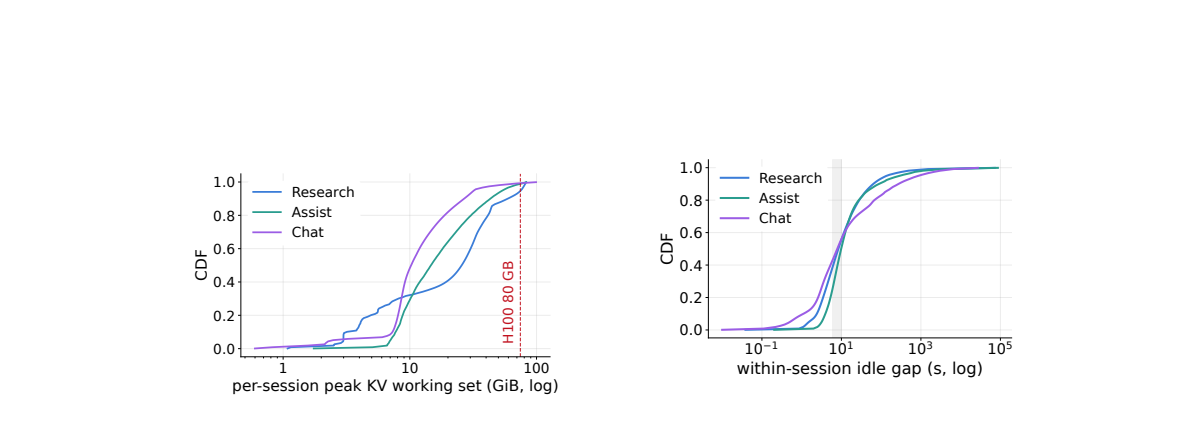
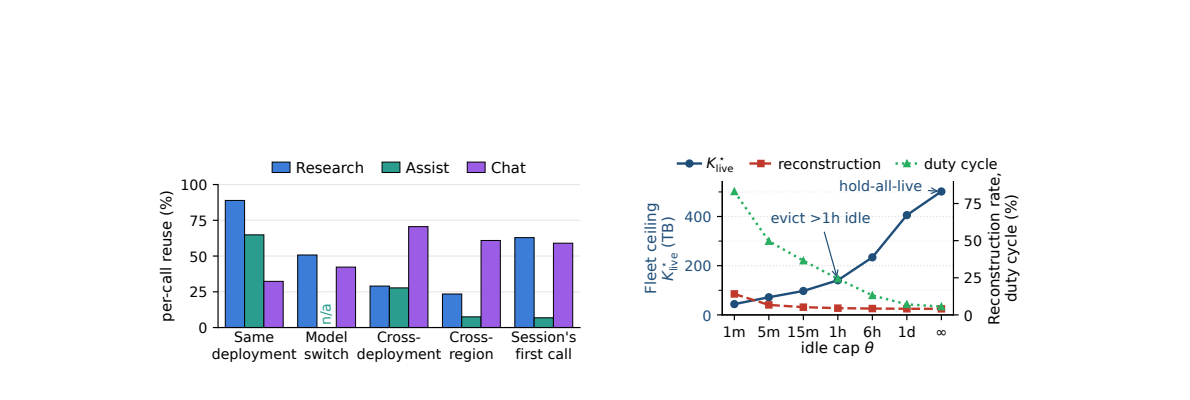
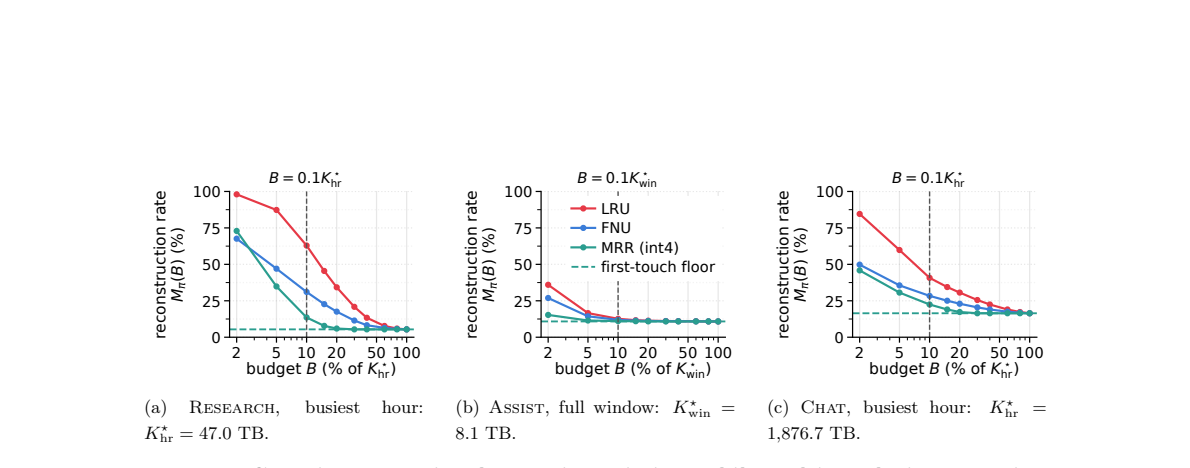
Retaining this context's key-value (KV) state in GPU memory lets later calls reuse it instead of recomputing it, but at fleet scale this needs substantial memory. We characterize four production Microsoft M365 workload traces (Deep Research, Enterprise Assistant, Coding Agent and Enterprise Chat) spanning more than 121 million model calls. In Deep Research, the application issues 89% of model calls and the median context grows from about 10K to 68K tokens by the 30th call. About 80% of context tokens are served from the prefix cache. With the public Llama-2-70B KV layout standing in for confidential models, one 99th-percentile Deep Research session exceeds the 80 GB HBM of an NVIDIA H100, and holding all live sessions at their peak needs an estimated 501.8 TB of HBM, although inference occupies only 5.6% of that retention time. Trace-driven replay shows that a one-hour idle cap cuts this ceiling by 3.6x while raising the share of calls that recompute context only from 4.07% to 4.53%. Under tighter budgets, eviction alone is insufficient: at one tenth of the busiest hour's demand, LRU eviction makes 63% of Deep Research calls recompute and clairvoyant furthest-next-use 31%, whereas multi-resolution retention (MRR), which demotes the LRU session's KV state to int4, lowers this to 13.6%. Placement imposes a separate limit: when the next call reaches a different deployment, cached-context reuse drops from 89% to 29%, and treating KV state as deployment-local raises the recompute floor under unlimited memory from 5.4% to 20.2%. These findings motivate retention that changes the representation of KV state, together with deployment-aware routing or migration. We plan to release AgenticTraceSim, a parametric trace generator, and a residency replay framework.
from the abstract
Pith says
Machine review · deepseek-v4-flash · 19 Oct 2026 · what was read was not recorded · not checked by a person
It can be wrong. Challenge this review or reply to it.
Holds up. Solid production characterization of KV residency in agentic LLM workloads, with honest limitations and useful counterfactual analysis. Worth reading and citing. This line is wrong
6 minor
How often objections from reviews like this one are right: not yet measured
Not checked: figures, code, what the 66 references say.
6 minor objections
The paper says, at Abstract / Section 2.2
Pith says: minor objection 1 of 6
The paper uses 'Deployment' to refer to a specific endpoint instance. The manuscript would benefit from an early, explicit definition that distinguishes a deployment from a model or a GPU worker, especially since readers may be unfamiliar with the internal naming. The current definition in Section 2.2 ('we call this endpoint instance a deployment') is clear but could be highlighted earlier.
The paper says, at Figure 11 caption
Pith says: minor objection 2 of 6
The caption states 'The legend in (b) applies to all panels', but panel (c) for Chat uses the same legend. This is fine, but the text might be clearer if the legend were repeated or if the sentence read 'The legend in (b) applies to (a) and (c) as well'.
show 4 more
The paper says, at Section 3.2, line 'context reduction'
Pith says: minor objection 3 of 6
The term 'context reduction' is used for calls with less context than the predecessor. The paper notes that the telemetry does not record the cause (compaction, summarization, truncation). It would be helpful to add a brief note that the replay in Section 5 respects these reductions (the session's current KV size is updated at each call), as the authors implicitly do.
The paper says, at Section 5.7, first paragraph of Open Problems
Pith says: minor objection 4 of 6
The sentence 'Residency mechanisms leave the context unchanged and decide only whether, where, and at what precision its KV is kept' could be misinterpreted: context reduction (Section 3.2) does change the context. The paragraph later correctly separates context reduction from KV residency, but the initial phrasing might confuse. Consider rewording for clarity.
The paper says, at Section 6, AgenticTraceSim validation
Pith says: minor objection 5 of 6
The generator validation compares synthetic traces against the matched measured Research sample, but not against the Assist or Chat workloads. While the paper states the generator is calibrated to Research, noting whether the generator can reproduce other workloads at a coarse level (e.g., depth distributions) would strengthen the claim of generality. If not possible, a brief justification of why only Research is used would be helpful.
The paper says, at General
Pith says: minor objection 6 of 6
The paper uses multiple abbreviations (MRR, FNU, SR, SD) that are defined early but not always restated. Consider including a table of acronyms, or at least redefining them in figure captions where they first appear.
What would settle it
For additional confidence, reproduce the policy ordering result (LRU ≥ FNU ≥ MRR) on a different one-hour window within the Research trace (e.g., the second busiest hour) to verify that the policy separation at 10% budget is not an artifact of the specific interval chosen. The paper already validates the trace generator against this ordering; a cross-window check would strengthen generality.
from the skeptic's reading
How the review went
4 readings by deepseek-v4-flash · 19 Oct 2026
- Reader holds up
- Skeptic partly agrees
- Editor wrote the verdict above
- Referee minor revision: 6 minor
Not run on this paper: the simulated authors' defence.
Pith did not check this review's objections against the paper.
The review in full
The review in brief, machine-written
This is a well-executed operational study that answers a concrete question: how much GPU memory does KV state actually need in production agentic workloads, and what can be done about it? The paper has real evidence: four traces from Microsoft M365, 121M model calls, clear definitions, and careful separation of measured, estimated, and replayed quantities. The central finding – that efficient agentic serving needs both recoverable KV retention (like MRR) and deployment-aware routing – is well supported by the data. The discovery that a one-hour idle cap cuts the hold-all-live ceiling by 3.6× while barely increasing reconstruction is practically useful, and the demonstration that even clairvoyant eviction leaves 31% reconstruction under tight budgets is a strong motivator for MRR and similar approaches.
The paper does several things particularly well. It distinguishes between two distinct sources of recomputation (eviction under memory pressure vs. unavailability due to deployment changes) and quantifies the independent floor from placement. It provides a clear decomposition of model-class structure (Spine, Mid, etc.) and shows how reuse degrades after excursions. The authors are unusually transparent about their assumptions: the Llama-2-70B stand-in KV layout, the pooled budget in replay, the lack of int4 quality measurement – all are stated plainly.
Soft spots are minor and mostly acknowledged. The KV byte conversion is a stand-in; the absolute byte numbers scale linearly with that choice, though relative results are robust. The deployment identifier may not capture cache sharing at the worker level. The generality is limited to these four M365 workloads, and the int4 MRR results depend on published open-model quality numbers rather than production quality data. None of these undermine the central conclusions.
This paper is for the systems community: anyone building LLM serving infrastructure, designing KV-cache eviction policies, or planning fleet capacity for agentic workloads. It deserves a serious referee. I would cite it in my own work and bring it to a reading group.
Recommendation: accept for peer review. The paper is methodologically sound and the contributions are clearly scoped.
The strongest objection
The paper's central claim – that efficient agentic serving requires both memory mechanisms that preserve recoverable KV under capacity pressure and placement mechanisms that maintain or move reusable state across deployments – is well supported by the evidence. The weakest point that could be raised is the reliance on int4 KV retention (MRR) without measuring its impact on response quality in agentic settings, but this is fully acknowledged by the authors (Section 5.7: 'The replay does not measure how int4 KV changes responses'). The paper correctly frames MRR as an illustrative mechanism, not a definitive solution, and the central claim does not depend on int4 being lossless. The KV-byte conversion assumption, noted by the reader, is carefully bounded: absolute values scale linearly and are presented alongside scaling-invariant relative results. All major limitations are stated (trace confidentiality, deployment granularity, replay assumptions), and the conclusions are tempered to match the scope. No internal inconsistency or unacknowledged vulnerability undermines the argument.
The reader correctly identifies the KV byte conversion as a sensitivity, but the paper handles it explicitly: absolute estimates are linearly rescalable, and all non-dimensional results (reuse rates, reconstruction fractions at budget fractions) are independent of β. I found no additional load-bearing concern that would change the verdict. The paper is thorough in characterizing production traces, clean in separating measured/estimated/replayed quantities, and transparent about limitations. The trace generator and replay framework, once released, will support independent verification. The central claim is well evidenced by the capacity-constrained replay (MRR vs LRU/FNU) and the deployment-local floor analysis. The verdict ACCEPT with HIGH confidence remains appropriate.
The referee's report
The paper provides rare, large-scale production measurements of agentic LLM workloads, covering KV reuse, idle gaps, and deployment locality. These measurements are directly relevant to the design of LLM serving systems, memory management policies, and routing strategies. The trace-driven replay separates the effects of capacity and placement, and the int4 MRR results, while acknowledged as illustrative, highlight a promising direction. The planned release of AgenticTraceSim and a replay framework will support reproducible research. If the results hold, the paper's findings will influence how cloud providers provision GPU memory and design scheduling policies for agentic applications.
Pith's reading of the paper (a machine's summary, not the authors')
This paper characterizes KV cache residency in four production Microsoft M365 agentic workloads totaling over 121 million model calls. It finds that agentic sessions accumulate large, reusable KV state that sits idle for long intervals. Under tight memory budgets, even clairvoyant eviction forces 31% of calls to recompute context, while multi-resolution retention (demoting KV to int4) cuts this to 13.6%. Deployment changes cause reuse to drop from 89% to 29%, creating a routing floor that more memory cannot fix. The authors conclude that efficient agentic serving requires both recoverable KV representations and deployment-aware routing.
What carries the argument. The analysis uses trace-driven replay that models each session's current KV context as a variable-sized object. Multi-resolution retention (MRR) demotes the LRU session's KV to int4 representation (quarter the fp16 size) within the same memory budget, instead of discarding it entirely. The methodology separates memory-induced recomputation from routing-induced recomputation by comparing session-keyed versus session-and-deployment-keyed cache objects. The replay uses Belady's furthest-next-use (FNU) as a clairvoyant destructive-eviction reference, and MRR as a recoverable alternative.
Core claim. The paper establishes that agentic LLM workloads exhibit a unique KV residency problem: sessions are deep (median 13 calls), context grows from ~10K to 68K tokens by call 30, reuse is high (80% of tokens from prefix cache), but idle gaps are heavy-tailed. Two distinct sources of recomputation arise: insufficient GPU memory (even clairvoyant eviction at 10% budget leaves 31.1% miss rate) and deployment-local placement (routing floor of 20.2% with unlimited memory). The key intervention is multi-resolution retention, which keeps displaced KV as int4 copies, reducing miss rate 2.3× below clairvoyant eviction. The paper argues that serving systems must combine memory mechanisms that preserve recoverable KV under capacity pressure and placement mechanisms that maintain or move reusable state across deployments.
The premise it rests on. The paper assumes that all models use the same per-token KV size as Llama-2-70B (327,680 bytes per token in fp16); all absolute byte estimates scale linearly with this assumed size, and if the actual production models differ, the absolute memory requirements could be substantially different.
If the paper is right (Pith's inferences, not the authors')
Serving systems should implement multi-tier KV retention where displaced state is quantized rather than discarded, reducing recomputation under memory pressure.
Routing policies should prefer maintaining deployment continuity to maximize KV reuse; a same-model deployment change drops reuse from 89% to 29%.
Idle caps of about one hour can reduce fleet KV memory requirements by 3.6× with only a 0.46 percentage point increase in recomputation rate.
Capacity planning must account for both session working-set distribution and concurrent session count; deep agentic sessions create large individual working sets while chat creates large aggregate footprint via concurrency.
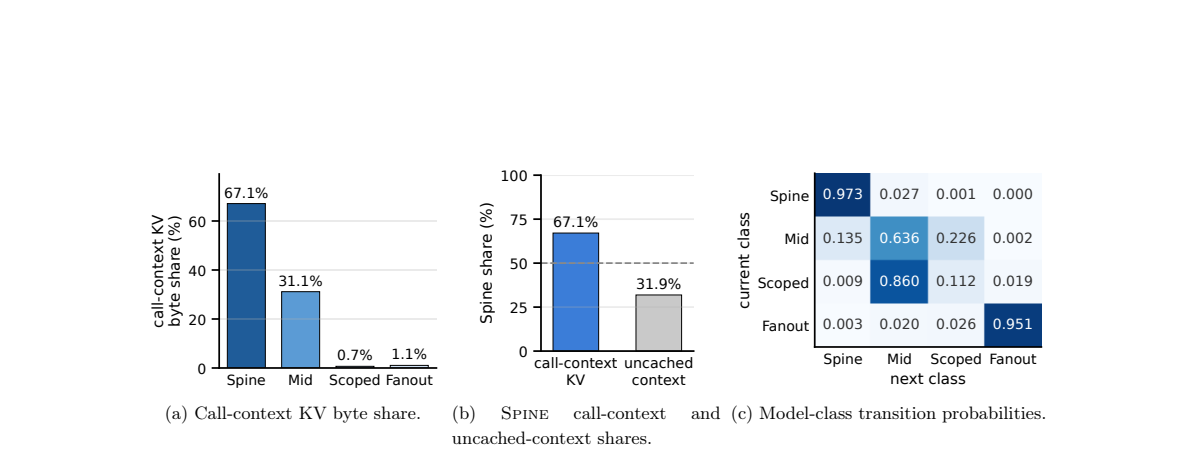
Model-class transition predictability (88% accuracy on next class) offers a low-cost signal for prefetching or preemptively migrating KV state across deployments.
The results suggest that existing serving systems designed for single-turn requests will underperform on agentic workloads without explicit session-level KV management that accounts for idle gaps and deployment continuity.
Multi-resolution retention could be combined with host-memory offload to approach the first-touch floor, but at the cost of increased data transfer bandwidth; the paper estimates 285 GB/s average for int4 transfer over the busiest hour.
The heavy-tailed idle gap distribution implies that a single fixed timeout cannot be optimal; adaptive policies that estimate resumption probability from session history may further reduce memory pressure without increasing recomputation.
Check this review
Pith stored no record of this review's passes and took no fingerprint of it. Reviews made by code from 13 Nov 2026 on carry both.
How often reviews like this one are right
Reviews like this one: written by deepseek-v4-flash, where what was read was not recorded.
How often objections from reviews like this one are right: not yet measured
Reviews by people
This review was written by a machine. No person has reviewed this paper on Pith yet. A scientist listed on Pith can review it for a fee, and their review is published here whatever it concludes.
The paper
Abstract
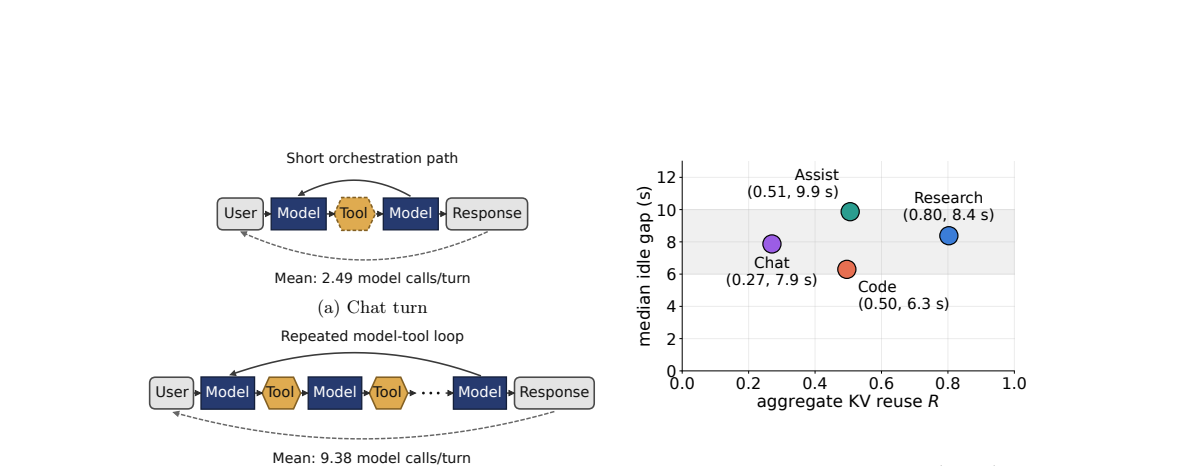
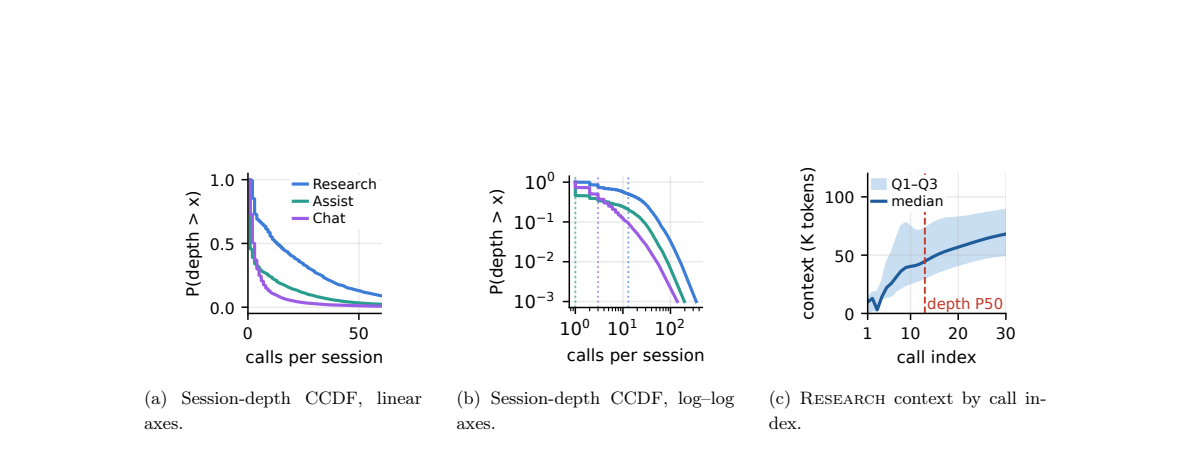
Agentic large language model (LLM) applications turn one user request into a sequence of model and tool calls over a growing context. Retaining this context's key-value (KV) state in GPU memory lets later calls reuse it instead of recomputing it, but at fleet scale this needs substantial memory. We characterize four production Microsoft M365 workload traces (Deep Research, Enterprise Assistant, Coding Agent and Enterprise Chat) spanning more than 121 million model calls. In Deep Research, the application issues 89% of model calls and the median context grows from about 10K to 68K tokens by the 30th call. About 80% of context tokens are served from the prefix cache. With the public Llama-2-70B KV layout standing in for confidential models, one 99th-percentile Deep Research session exceeds the 80 GB HBM of an NVIDIA H100, and holding all live sessions at their peak needs an estimated 501.8 TB of HBM, although inference occupies only 5.6% of that retention time. Trace-driven replay shows that a one-hour idle cap cuts this ceiling by 3.6x while raising the share of calls that recompute context only from 4.07% to 4.53%. Under tighter budgets, eviction alone is insufficient: at one tenth of the busiest hour's demand, LRU eviction makes 63% of Deep Research calls recompute and clairvoyant furthest-next-use 31%, whereas multi-resolution retention (MRR), which demotes the LRU session's KV state to int4, lowers this to 13.6%. Placement imposes a separate limit: when the next call reaches a different deployment, cached-context reuse drops from 89% to 29%, and treating KV state as deployment-local raises the recompute floor under unlimited memory from 5.4% to 20.2%. These findings motivate retention that changes the representation of KV state, together with deployment-aware routing or migration. We plan to release AgenticTraceSim, a parametric trace generator, and a residency replay framework.
The paper's own sentences, arranged, kept beside the review and separate from it. Each label is drawn from a closed vocabulary; the number beside it is the probability the classifier gave that label. No sentence in this record was written by a model.
abstract compiled · 2026-10-20
The authors' main claim, as the classifier picked it out 1.00
“These findings motivate retention that changes the representation of KV state, together with deployment-aware routing or migration.”
How the main claim is stated: asserted 0.62
What the abstract itself states, as probabilities: claims first 0.04 · states limitation 0.69 · human participants 0.04 · controlled comparison 0.48 · randomized assignment 0.01 · states quantitative result 0.99 · compares with prior results 0.82 · mentions code or data availability 0.17
The abstract, sentence by sentence
This table labels the abstract only (arXiv listing abstract v1). The number is the probability the classifier gave the label.
| Sentence | Role | The authors' own work | States the main conclusion | Strength |
|---|---|---|---|---|
| Agentic large language model (LLM) applications turn one user request into a sequence of model and tool calls over a growing context. | background 1.00 | 0.07 | 0.02 | asserted 1.00 |
| Retaining this context's key-value (KV) state in GPU memory lets later calls reuse it instead of recomputing it, but at fleet scale this needs substantial memory. | background 1.00 | 0.08 | 0.04 | asserted 1.00 |
| We characterize four production Microsoft M365 workload traces (Deep Research, Enterprise Assistant, Coding Agent and Enterprise Chat) spanning more than 121 million model calls. | method 0.73 | 0.96 | 0.03 | asserted 1.00 |
| In Deep Research, the application issues 89% of model calls and the median context grows from about 10K to 68K tokens by the 30th call. | result 0.99 | 0.91 | 0.03 | asserted 1.00 |
| About 80% of context tokens are served from the prefix cache. | result 1.00 | 0.87 | 0.04 | asserted 1.00 |
| With the public Llama-2-70B KV layout standing in for confidential models, one 99th-percentile Deep Research session exceeds the 80 GB HBM of an NVIDIA H100, and holding all live sessions at their peak needs an estimated 501.8 TB of HBM, although inference occupies only 5.6% of that retention time. | result 1.00 | 0.88 | 0.16 | asserted 0.98 |
| Trace-driven replay shows that a one-hour idle cap cuts this ceiling by 3.6x while raising the share of calls that recompute context only from 4.07% to 4.53%. | result 1.00 | 0.95 | 0.09 | asserted 1.00 |
| Under tighter budgets, eviction alone is insufficient: at one tenth of the busiest hour's demand, LRU eviction makes 63% of Deep Research calls recompute and clairvoyant furthest-next-use 31%, whereas multi-resolution retention (MRR), which demotes the LRU session's KV state to int4, lowers this to 13.6%. | result 1.00 | 0.93 | 0.16 | asserted 1.00 |
| Placement imposes a separate limit: when the next call reaches a different deployment, cached-context reuse drops from 89% to 29%, and treating KV state as deployment-local raises the recompute floor under unlimited memory from 5.4% to 20.2%. | result 1.00 | 0.86 | 0.09 | asserted 1.00 |
| These findings motivate retention that changes the representation of KV state, together with deployment-aware routing or migration. | interpretation 0.94 | 0.49 | 0.74 | asserted 0.62 |
| We plan to release AgenticTraceSim, a parametric trace generator, and a residency replay framework. | future work 0.99 | 0.43 | 0.05 | asserted 0.57 |
What kind of paper the classifier reports this is: empirical study 1.00 · evidence from analysis of existing data 0.75
What was examined, and what was not
Sources read
- arXiv listing abstract v1
Not examined
- full text
- figures and tables
- references and citing sentences
- relations to other papers
Levels run
- P abstract
Not run
- S sections
- T body sentences
- C citations
- R cross-paper relations
How the labels were made
Compiled by classifier-1.13.0 via TypeSafe API, question bank abstract-p1-20260923, 2026-10-20: 1 request, 8,620 input tokens.
Every quoted sentence on this record is the authors'. Every label is from Pith's closed vocabulary, with the probability shown beside it. This record as JSON
Figures (12)

Showing 8 of the paper's 12 figures. Figures are the authors', reproduced from the paper.
References (66)
- [1] Reyna Abhyankar, Zijian He, Vikranth Srivatsa, Hao Zhang, and Yiying Zhang. InferCept: Efficient intercept support for augmented large language model inference. InProceedings of the 41st International Conference on Machine Learning, volume 235 ofProceedings of Machine Learning... on Pith
- [2] Saurabh Agarwal, Marco Laju, Jayanth Srinivasa, Myungjin Lee, and Aditya Akella. Software-defined agentic serving.arXiv preprint arXiv:2601.03197, 2026 on PitharXiv
- [3] Amey Agrawal, Nitin Kedia, Ashish Panwar, Jayashree Mohan, Nipun Kwatra, Bhargav Gulavani, AlexeyTumanov, andRamachandranRamjee. Tamingthroughput-latencytrade- off in LLM inference with Sarathi-Serve. InProc. USENIX OSDI, 2024 on Pith
- [4] Joshua Ainslie, James Lee-Thorp, Michiel de Jong, Yury Zemlyanskiy, Federico Lebron, and Sumit Sanghai. GQA: Training generalized multi-query transformer models from multi- head checkpoints. InProceedings of the 2023 Conference on Empirical Methods in Natural Language Processi... on Pith
- [5] L. A. Belady. A study of replacement algorithms for a virtual-storage computer.IBM Systems Journal, 5(2):78–101, 1966 on Pith
- [6] Daniel S. Berger, Nathan Beckmann, and Mor Harchol-Balter. Practical bounds on optimal caching with variable object sizes.Proceedings of the ACM on Measurement and Analysis of Computing Systems, 2(2):1–38, June 2018 on Pith
- [7] AnishBiswas, KanishkGoel, SrivarshineeS,JayashreeMohan, AlindKhare, AnjalyParayil, Ramachandran Ramjee, and Chetan Bansal. Sutradhara: An intelligent orchestrator-engine co-design for tool-based agentic inference.arXiv preprint arXiv:2601.12967, 2026 on PithPith's reviewarXiv
- [8] Qiaoling Chen, Zhisheng Ye, Tian Tang, Peng Sun, Boyu Tian, Guoteng Wang, Sheng- gui Li, Yonggang Wen, Zhenhua Han, and Tianwei Zhang. CONCUR: high-throughput agentic batch inference of llm via congestion-based concurrency control.arXiv preprint arXiv:2601.22705, 2026 on PitharXiv
- [9] Prateek Chhikara, Dev Khant, Saket Aryan, Taranjeet Singh, and Deshraj Yadav. Mem0: Building production-ready AI agents with scalable long-term memory. InECAI 2025: 28th European Conference on Artificial Intelligence, volume 413 ofFrontiers in Artificial Intelligence and Appli... on Pith
- [10] Yinwei Dai, Zhuofu Chen, Anand Iyer, and Ravi Netravali. Aragog: Just-in-time model routing for scalable serving of agentic workflows.arXiv preprint arXiv:2511.20975, 2025 on PitharXiv
- [11] Adam Fourney, Gagan Bansal, Hussein Mozannar, Cheng Tan, Eduardo Salinas, Erkang Zhu, Friederike Niedtner, Grace Proebsting, Griffin Bassman, Jack Gerrits, Jacob Alber, Peter Chang, Ricky Loynd, Robert West, Victor Dibia, Ahmed Awadallah, Ece Kamar, Rafah Hosn, and Saleema Ame... on PithPith's reviewarXiv
- [12] Bin Gao, Zhuomin He, Puru Sharma, Qingxuan Kang, Djordje Jevdjic, Junbo Deng, Xingkun Yang, Zhou Yu, and Pengfei Zuo. Cost-efficient large language model serving for multi-turn conversations with cachedattention. InProceedings of the 2024 USENIX Annual Technical Conference (US... on Pith
- [13] Shiwei Gao, Youmin Chen, and Jiwu Shu. Fast state restoration in LLM serving with HCache. InProceedings of the Twentieth European Conference on Computer Systems (Eu- roSys 2025), pages 128–143, New York, NY, USA, 2025. Association for Computing Ma- chinery on Pith
- [14] Suyu Ge, Yunan Zhang, Liyuan Liu, Minjia Zhang, Jiawei Han, and Jianfeng Gao. Model tells you what to discard: Adaptive KV cache compression for LLMs. InInternational Conference on Learning Representations, 2024 on Pith
- [15] In Gim, Guojun Chen, Seung-seob Lee, Nikhil Sarda, Anurag Khandelwal, and Lin Zhong. Prompt cache: Modular attention reuse for low-latency inference. InProceedings of Machine Learning and Systems, volume 6, 2024 on Pith
- [16] In Gim, Zhiyao Ma, Seung-seob Lee, and Lin Zhong. Pie: A programmable serving system for emerging LLM applications. InProceedings of the 31st ACM Symposium on Operating Systems Principles (SOSP), pages 415–430. Association for Computing Machinery, 2025 on Pith
- [17] ColemanHooper, SehoonKim, HivaMohammadzadeh, MichaelW.Mahoney, YakunSophia Shao, Kurt Keutzer, and Amir Gholami. KVQuant: Towards 10 million context length LLM inference with KV cache quantization. InProc. NeurIPS, 2024 on Pith
- [18] Hao Kang, Ziyang Li, Weili Xu, Xinyu Yang, Yinfang Chen, Junxiong Wang, Beidi Chen, Tushar Krishna, Chenfeng Xu, and Simran Arora. ThunderAgent: A simple, fast and program-aware agentic inference system.arXiv preprint arXiv:2602.13692, 2026 on PithPith's reviewarXiv
- [19] Minki Kang, Wei-Ning Chen, Dongge Han, Huseyin A. Inan, Lukas Wutschitz, Yanzhi Chen, Robert Sim, and Saravan Rajmohan. ACON: Optimizing context compression for long-horizon LLM agents. InProceedings of the 43rd International Conference on Machine Learning, volume 306 ofProcee... on Pith
- [20] Woosuk Kwon, Zhuohan Li, Siyuan Zhuang, Ying Sheng, Lianmin Zheng, Cody Hao Yu, Joseph E. Gonzalez, Hao Zhang, and Ion Stoica. Efficient memory management for large language model serving with PagedAttention. InProceedings of the 29th ACM Sympo- sium on Operating Systems Princ... on Pith
show 46 more
- [21] WonbeomLee, JungiLee, JunghwanSeo, andJaewoongSim. InfiniGen: Efficientgenerative inference of large language models with dynamic KV cache management. InProc. USENIX OSDI, 2024. arXiv:2406.19707 on PithPith's reviewarXiv
- [22] Hanchen Li, Qiuyang Mang, Runyuan He, Qizheng Zhang, Huanzhi Mao, Xiaokun Chen, Hangrui Zhou, Alvin Cheung, Joseph E. Gonzalez, and Ion Stoica. Continuum: Efficient 25 and robust multi-turn LLM agent scheduling with KV cache time-to-live. InICLR 2026 Workshop on Lifelong Agent... on Pith
- [23] Junjie Li, Jiong Lou, and Jie Li. IntentKV: Cross-turn intent-aware KV cache pruning for agent inference.arXiv preprint arXiv:2606.09916, 2026 on PithPith's reviewarXiv
- [24] Yuhong Li, Yingbing Huang, Bowen Yang, Bharat Venkitesh, Acyr Locatelli, Hanchen Ye, Tianle Cai, Patrick Lewis, and Deming Chen. SnapKV: LLM knows what you are looking for before generation. InProc. NeurIPS, 2024. arXiv:2404.14469 on PithPith's reviewarXiv
- [25] Zhiyu Li, Shichao Song, Hanyu Wang, Simin Niu, Ding Chen, Jiawei Yang, Chenyang Xi, Huayi Lai, Jihao Zhao, Yezhaohui Wang, Junpeng Ren, Zehao Lin, Jiahao Huo, Tianyi Chen, Kai Chen, Kehang Li, Zhiqiang Yin, Qingchen Yu, Bo Tang, Hongkang Yang, Zhi- Qin John Xu, and Feiyu Xiong... on PithPith's reviewarXiv
- [26] Chaofan Lin, Zhenhua Han, Chengruidong Zhang, Yuqing Yang, Fan Yang, Chen Chen, and Lili Qiu. Parrot: Efficient serving of LLM-based applications with semantic variable. InProc. USENIX OSDI, 2024 on Pith
- [27] Yujun Lin, Haotian Tang, Shang Yang, Zhekai Zhang, Guangxuan Xiao, Chuang Gan, and Song Han. QServe: W4A8KV4 quantization and system co-design for efficient LLM serving. InProceedings of Machine Learning and Systems (MLSys), 2025 on Pith
- [28] Banruo Liu, Haoran Qiu, Íñigo Goiri, Rodrigo Fonseca, Ricardo Bianchini, and Esha Choukse. Agentic coding in the wild: Characterizing GitHub Copilot traces at produc- tion scale.arXiv preprint arXiv:2608.00101, 2026 on PithPith's reviewarXiv
- [29] Yuhan Liu, Yihua Cheng, Jiayi Yao, Yuwei An, Xiaokun Chen, Shaoting Feng, Yuyang Huang, Samuel Shen, Rui Zhang, Kuntai Du, and Junchen Jiang. LMCache: An efficient KV cache layer for enterprise-scale LLM inference.arXiv preprint arXiv:2510.09665, 2025 on PitharXiv
- [30] Yuhan Liu, Hanchen Li, Yihua Cheng, Siddhant Ray, Yuyang Huang, Qizheng Zhang, Kun- tai Du, Jiayi Yao, Shan Lu, Ganesh Ananthanarayanan, Michael Maire, Henry Hoffmann, Ari Holtzman, and Junchen Jiang. CacheGen: KV cache compression and streaming for fast large language model s... on Pith
- [31] Zichang Liu, Aditya Desai, Fangshuo Liao, Weitao Wang, Victor Xie, Zhaozhuo Xu, Anas- tasios Kyrillidis, and Anshumali Shrivastava. Scissorhands: Exploiting the persistence of importance hypothesis for LLM KV cache compression at test time. InProc. NeurIPS, on Pith
- [32] Zirui Liu, Jiayi Yuan, Hongye Jin, Shaochen Zhong, Zhaozhuo Xu, Vladimir Braverman, Beidi Chen, and Xia Hu. KIVI: A tuning-free asymmetric 2bit quantization for KV cache. InProceedings of the 41st International Conference on Machine Learning, volume 235 of Proceedings of Machi... on Pith
- [33] Michael Luo, Xiaoxiang Shi, Colin Cai, Tianjun Zhang, Justin Wong, Yichuan Wang, Chi Wang, Yanping Huang, Zhifeng Chen, Joseph E. Gonzalez, and Ion Stoica. Autellix: An ef- ficient serving engine for LLM agents as general programs.arXiv preprint arXiv:2502.13965, 2025 on PithPith's reviewarXiv
- [34] Jesse Mu, Xiang Lisa Li, and Noah Goodman. Learning to compress prompts with gist tokens. InProc. NeurIPS, 2023 on Pith
- [35] Isaac Ong, Amjad Almahairi, Vincent Wu, Wei-Lin Chiang, Tianhao Wu, Joseph E. Gonza- lez, M Waleed Kadous, and Ion Stoica. RouteLLM: Learning to route LLMs from preference data. InProc. ICLR, 2025 on Pith
- [36] OpenAI. Prompt caching.https://developers.openai.com/api/docs/guides/ prompt-caching, 2025. OpenAI API documentation, accessed October 2026 on Pith
- [37] Charles Packer, Sarah Wooders, Kevin Lin, Vivian Fang, Shishir G. Patil, Ion Stoica, and Joseph E. Gonzalez. MemGPT: Towards LLMs as operating systems.arXiv preprint arXiv:2310.08560, 2023 on PithPith's reviewarXiv
- [38] Zaifeng Pan, Ajjkumar Patel, Yipeng Shen, Zhengding Hu, Yue Guan, Wan-Lu Li, Lianhui Qin, Yida Wang, and Yufei Ding. KVFlow: Efficient prefix caching for accelerating LLM- based multi-agent workflows. InProc. NeurIPS, 2025 on Pith
- [39] Zhuoshi Pan, Qianhui Wu, Huiqiang Jiang, Menglin Xia, Xufang Luo, Jue Zhang, Qingwei Lin, Victor Ruhle, Yuqing Yang, Chin-Yew Lin, H. Vicky Zhao, Lili Qiu, and Dongmei Zhang. LLMLingua-2: Data distillation for efficient and faithful task-agnostic prompt compression. InFindings... on Pith
- [40] Pratyush Patel, Esha Choukse, Chaojie Zhang, Aashaka Shah, Inigo Goiri, Saeed Maleki, and Ricardo Bianchini. Splitwise: Efficient generative LLM inference using phase split- ting. InProceedings of the 51st Annual International Symposium on Computer Architecture, pages 118–132.... on Pith
- [41] Ruoyu Qin, Zheming Li, Weiran He, Jialei Cui, Feng Ren, Mingxing Zhang, Yongwei Wu, Weimin Zheng, and Xinran Xu. Mooncake: Trading more storage for less computation — a KVCache-centric architecture for serving LLM chatbot. In23rd USENIX Conference on File and Storage Technolog... on Pith
- [42] Preston Rasmussen, Pavlo Paliychuk, Travis Beauvais, Jack Ryan, and Daniel Chalef. Zep: A temporal knowledge graph architecture for agent memory.arXiv preprint arXiv:2501.13956, 2025 on PithPith's reviewarXiv
- [43] Keshav Santhanam, Deepti Raghavan, Muhammad Shahir Rahman, Thejas Venkatesh, Neha Kunjal, Pratiksha Thaker, Philip Levis, and Matei Zaharia. ALTO: An efficient network orchestrator for compound AI systems. InProceedings of the 4th Workshop on Machine Learning and Systems (Euro... on Pith
- [44] Ying Sheng, Lianmin Zheng, Binhang Yuan, Zhuohan Li, Max Ryabinin, Beidi Chen, Percy Liang, Christopher Re, Ion Stoica, and Ce Zhang. FlexGen: High-throughput generative inference of large language models with a single GPU. InProceedings of the 40th Inter- national Conference ... on Pith
- [45] Vikranth Srivatsa, Zijian He, Reyna Abhyankar, Dongming Li, and Yiying Zhang. Pre- ble: Efficient distributed prompt scheduling for LLM serving. InProc. ICLR, 2025. arXiv:2407.00023 on PithPith's reviewarXiv
- [46] Biao Sun, Ziming Huang, Hanyu Zhao, Wencong Xiao, Xinyi Zhang, Yong Li, and Wei Lin. Llumnix: Dynamic scheduling for large language model serving. In18th USENIX Symposium on Operating Systems Design and Implementation (OSDI 24), pages 173–191, Santa Clara, CA, July 2024. USENI... on Pith
- [47] Zuhair Ahmed Khan Taha, Mohammed Mudassir Uddin, and Shahnawaz Alam. AgentCom- press: Task-aware compression for affordable large language model agents.arXiv preprint arXiv:2601.05191, 2026 on PitharXiv
- [48] Xin Tan, Yimin Jiang, Yitao Yang, and Hong Xu. Teola: Towards end-to-end optimization of LLM-based applications. InProceedings of the 30th ACM International Conference on Architectural Support for Programming Languages and Operating Systems, Volume 2, pages 1302–1316. Associat... on Pith
- [49] Hugo Touvron, Louis Martin, Kevin Stone, Peter Albert, Amjad Almahairi, Yasmine Babaei, Nikolay Bashlykov, Soumya Batra, Prajjwal Bhargava, Shruti Bhosale, Dan Bikel, Lukas Blecher, Cristian Canton Ferrer, Moya Chen, Guillem Cucurull, David Esiobu, Jude Fernandes, Jeremy Fu, W... on PithPith's reviewarXiv
- [50] vLLM Project. Automatic prefix caching.https://docs.vllm.ai/en/stable/ design/prefix_caching/, 2026. vLLM documentation, accessed October 2026 on Pith
- [51] Chen Wang, Xunzhuo Liu, Yuhan Liu, Yue Zhu, Xiangxi Mo, Junchen Jiang, and Huamin Chen. When to reason: Semantic router for vLLM. InNeurIPS ML for Systems Workshop, 2025 on Pith
- [52] Jiahao Wang, Jinbo Han, Xingda Wei, Sijie Shen, Dingyan Zhang, Chenguang Fang, Rong Chen, Wenyuan Yu, and Haibo Chen. KVCache cache in the wild: Characterizing and 28 optimizing KVCache cache at a large cloud provider. In2025 USENIX Annual Technical Conference (USENIX ATC 25), 2025 on Pith
- [53] Otto White, Marcel Wagenländer, Britannio Jarrett, Xijin Zhou, Yanda Tao, Pedro Sil- vestre, Guo Li, Huanzhou Zhu, Lluís Vilanova, and Peter Pietzuch. Scepsy: Serving agentic workflows using aggregate LLM pipelines.arXiv preprint arXiv:2604.15186, 2026 on PithPith's reviewarXiv
- [54] Guangxuan Xiao, Yuandong Tian, Beidi Chen, Song Han, and Mike Lewis. Efficient stream- ing language models with attention sinks. InProc. ICLR, 2024 on Pith
- [55] Fangyuan Xu, Weijia Shi, and Eunsol Choi. RECOMP: Improving retrieval-augmented LMs with compression and selective augmentation. InProc. ICLR, 2024. arXiv:2310.04408 on PithPith's reviewarXiv
- [56] Wujiang Xu, Zujie Liang, Kai Mei, Hang Gao, Juntao Tan, and Yongfeng Zhang. A-Mem: Agentic memory for LLM agents. InAdvances in Neural Information Processing Systems, volume 38, 2025 on Pith
- [57] Jiayi Yao, Samuel Shen, Kuntai Du, Shaoting Feng, Dongjoo Seo, Rui Zhang, Yuyang Huang, Yuhan Liu, Shan Lu, and Junchen Jiang. VeriCache: Turning lossy KV cache into lossless LLM inference.arXiv preprint arXiv:2605.17613, 2026 on PithPith's reviewarXiv
- [58] Shunyu Yao, Jeffrey Zhao, Dian Yu, Nan Du, Izhak Shafran, Karthik Narasimhan, and Yuan Cao. ReAct: Synergizing reasoning and acting in language models. InInternational Conference on Learning Representations (ICLR), 2023 on Pith
- [59] Lingfan Yu, Jinkun Lin, and Jinyang Li. Stateful large language model serving with pen- sieve. InProceedings of the Twentieth European Conference on Computer Systems (EuroSys 2025), pages 144–158, New York, NY, USA, 2025. Association for Computing Machinery on Pith
- [60] Yichao Yuan, Ankita Nayak, Souvik Kundu, and Nishil Talati. Agentic AI workload charac- teristics. In2026 IEEE International Symposium on Workload Characterization (IISWC), on Pith
- [61] Yuxuan Yue, Zhihang Yuan, Haojie Duanmu, Sifan Zhou, Jianlong Wu, and Liqiang Nie. WKVQuant: Quantizing weight and key/value cache for large language models gains more. arXiv preprint arXiv:2402.12065, 2024 on PithPith's reviewarXiv
- [62] Zhenyu Zhang, Ying Sheng, Tianyi Zhou, Tianlong Chen, Lianmin Zheng, Ruisi Cai, Zhao Song, Yuandong Tian, Christopher Ré, Clark Barrett, Zhangyang Wang, and Beidi Chen. H2O: Heavy-hitter oracle for efficient generative inference of large language models. In Proc. NeurIPS, 2023 on Pith
- [63] Yilong Zhao, Chien-Yu Lin, Kan Zhu, Zihao Ye, Lequn Chen, Size Zheng, Luis Ceze, Arvind Krishnamurthy, Tianqi Chen, and Baris Kasikci. Atom: Low-bit quantization for efficient and accurate LLM serving. InProceedings of Machine Learning and Systems (MLSys), 2024 on Pith
- [64] Lianmin Zheng, Liangsheng Yin, Zhiqiang Xie, Chuyue Sun, Jeff Huang, Cody Hao Yu, Shiyi Cao, Christos Kozyrakis, Ion Stoica, Joseph E. Gonzalez, Clark Barrett, and Ying Sheng. SGLang: Efficient execution of structured language model programs. InProc. NeurIPS, 2024. 29 on Pith
- [65] Yinmin Zhong, Shengyu Liu, Junda Chen, Jianbo Hu, Yibo Zhu, Xuanzhe Liu, Xin Jin, and Hao Zhang. DistServe: Disaggregating prefill and decoding for goodput-optimized large language model serving. InProc. USENIX OSDI, 2024 on Pith
- [66] Kan Zhu, Mathew Jacob, Chenxi Ma, Yi Pan, Stephanie Wang, Arvind Krishnamurthy, and Baris Kasikci. TraceLab: Characterizing coding agent workloads for LLM serving. arXiv preprint arXiv:2606.30560, 2026. 30 on PithPith's reviewarXiv
Cited by 2 Pith papers
Reviewed papers on Pith that cite this one. The full citation record
Challenges and discussion
Disagree with the review, or know something it missed? Leave a comment, or challenge this review formally: a challenge becomes a permanent entry in this paper's record, and its decision is published here.
Come back by email
A short list of the week's newly reviewed papers. Nothing is sent until you confirm from your inbox, and every email has a link that stops it. No account.
No comments yet.
Sign in to comment