Distributed, Parallel, and Cluster Computing · arXiv:2611.13412 v1 · submitted 10 Nov 2026 · 19 references
Bursts That Outlast Themselves: Persistent Degradation in Prefix-Cached Agent Serving
The paper says
“LLM agents drive inference engines with closed-loop sessions whose context grows every turn, and serving them economically depends on prefix caching: a hit costs an incremental prefill of about a thousand tokens, a miss recomputes a 10–40K-token context.”
more of the abstract
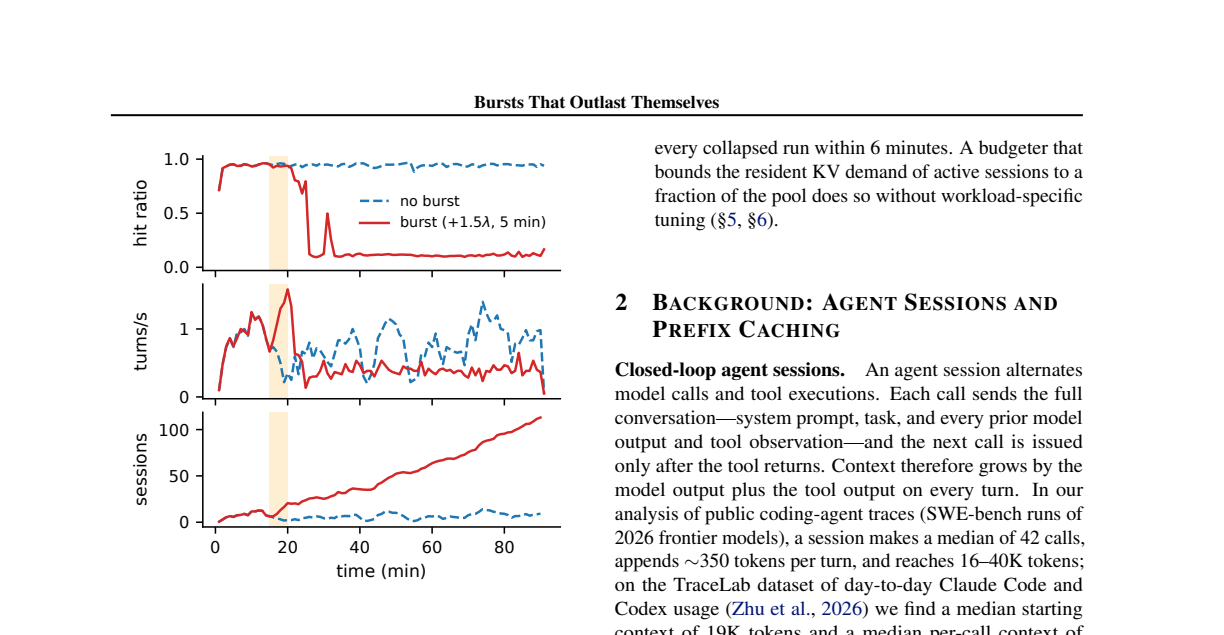
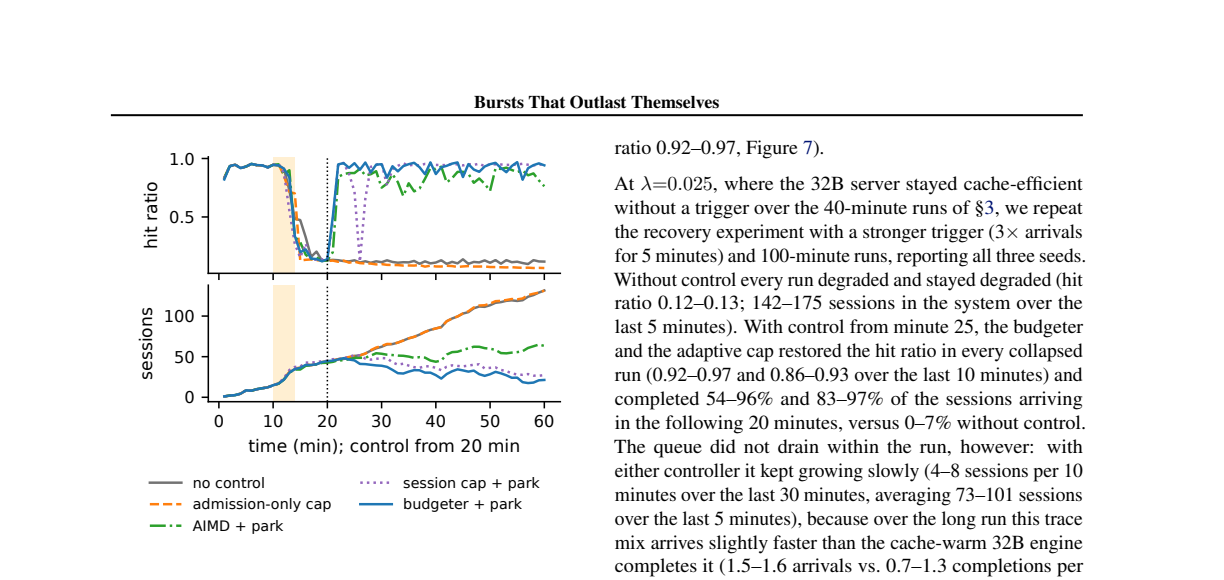
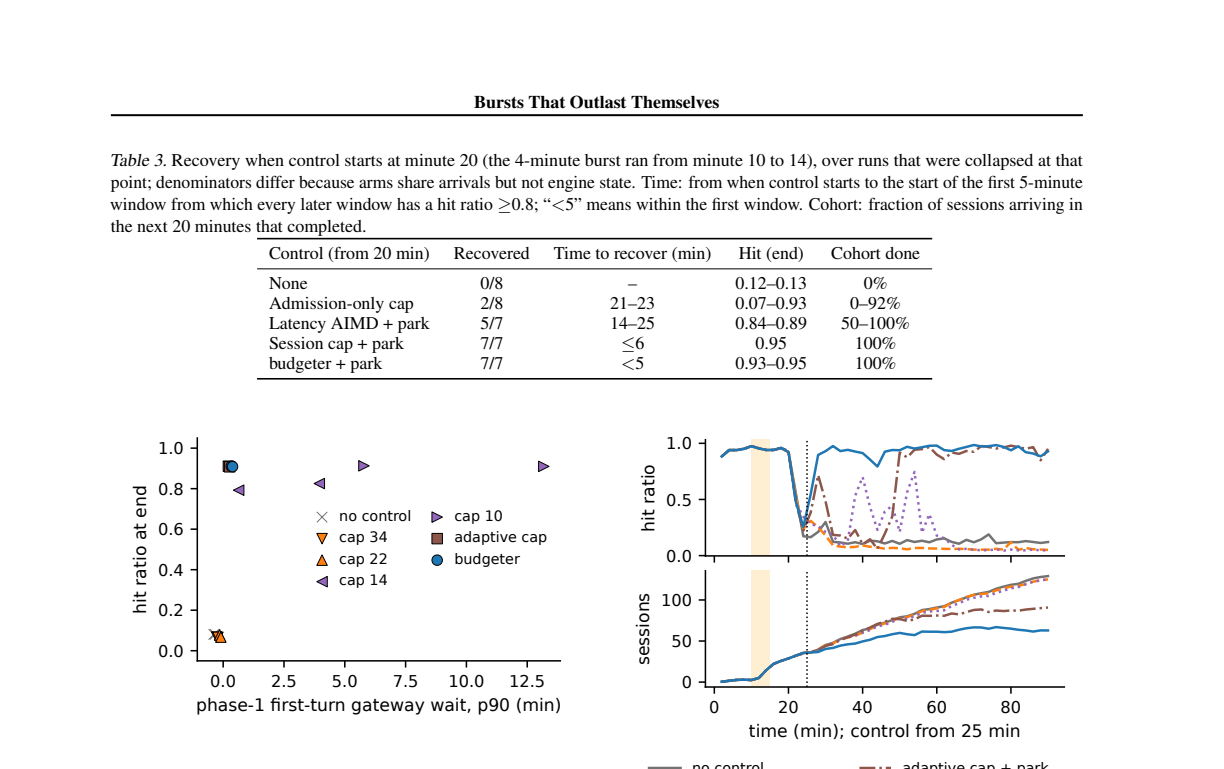
We show that this makes prefix-cached agent serving metastable. With an identical base workload, a few minutes of extra arrivals leaves a vLLM server in a degraded regime–a 10% hit ratio, about half the throughput, and a backlog that grows for the remaining 70 minutes–while its no-burst twin stays healthy (9 of 12 pairs; none in the reverse direction). The regime appears at loads the cache-warm server sustains, is absent without prefix caching, and also appears with Qwen3-32B on SWE-bench agent trace shapes and on SGLang, which tolerates larger triggers. Slower service keeps more sessions in the system, their working set outgrows the KV pool, and every turn becomes a recomputation; a first-order workload-balance condition, calibrated independently, brackets when the regime can drain. Getting out is the harder problem: throttling new admissions recovered 1 of 7 matched collapsed runs, while suspending admitted sessions against a capacity-based limit recovered all of them within minutes. A CPU offload tier delays the collapse but does not prevent it. A budgeter that bounds the resident KV demand of active sessions to the pool, with thresholds that need no per-workload tuning, prevented the failure in every run we tested.
from the abstract
Pith says
Machine review · deepseek-v4-flash · 11 Nov 2026 · what was read was not recorded · not checked by a person
It can be wrong. Challenge this review or reply to it.
Holds up. The paper convincingly demonstrates that prefix-cached agent serving is metastable under transient bursts, and the main soft spot is its disclosed but unverified eviction mechanism, not the persistence result itself. This line is wrong
3 minor
How often objections from reviews like this one are right: not yet measured
Not checked: figures, code, what the 19 references say.
3 minor objections
The paper says, at §4 (b94)
Pith says: minor objection 1 of 3
The paper explicitly acknowledges that the eviction mechanism is inferred rather than measured, but the surrounding prose and the conclusion present the population-cache feedback loop as established. I suggest adding one sentence in §4 or §8 that names the alternative mechanisms the current telemetry cannot fully exclude—for example scheduler behavior, prefix-hash or radix fragmentation, and pool fragmentation—and states that the recovery and prevention results are empirical regardless of which mechanism dominates.
more of objection 1
This would make the paper's epistemic claims match exactly what is measured.
The paper says, at §4
Pith says: minor objection 2 of 3
The description of the cost calibration is ambiguous: "we regress window length on the number of completed turns and their total prompt tokens" cannot refer to the fixed two-minute windows described in the preceding sentence. Please specify the actual dependent variable, such as busy engine-seconds per window, and describe how the 48 windows were selected, so that the independent calibration of c(L) is reproducible.
show 1 more
The paper says, at §3, Table 1
Pith says: minor objection 3 of 3
The no-cache control runs at a much lower base arrival rate (0.0086 sessions/s versus 0.035 in the cached paired design). The text explains that this is about 80% of no-cache capacity, but stating the corresponding cache-warm capacity fraction in Table 1 would make the "not just overload" control easier to follow.
What would settle it
Patch vLLM's block manager (and SGLang's radix tree) to log each eviction with the owner session and the evicted block's token range, then rerun the paired 8B experiment (λ=0.035, +1.5λ for 5 min at minute 15, seeds 501–512). For every completed turn in the degraded phase, classify misses into: (a) the previous turn's prefix blocks were evicted between turns; (b) blocks were resident but unmatched because of scheduler routing, hash/radix fragmentation, or pool fragmentation; (c) blocks were evicted by preemption or a flush. If (a) accounts for essentially all misses (the >99% of turns with less than half their prompt cached), the §4 population-cache feedback is confirmed. If (b) or (c) dominate, the mechanism and the capacity-based parking rationale need revision, while the persistence observation itself would remain valid.
from the skeptic's reading
How the review went
4 readings by deepseek-v4-flash · 11 Nov 2026
- Reader holds up
- Skeptic agrees
- Editor wrote the verdict above
- Referee minor revision: 3 minor
Not run on this paper: the simulated authors' defence.
Pith did not check this review's objections against the paper.
The review in full
The review in brief, machine-written
The raw phenomenon is solid. Paired runs sharing one base arrival stream, a two-sided sign test over discordant pairs (9/12, p=0.00391), a cache-disabled control, a completed-injected-sessions control, and reproduction on SGLang and Qwen3-32B add up to a credible claim: an identical base workload can end healthy or persistently degraded depending on a short past burst. The paper is also honest about what it does not show, especially at b94, where it states the eviction mechanism is inferred, not measured. That is the real soft spot. The persistence result does not depend on the mechanism, but the §4 feedback-loop explanation and the capacity-based parking remedy do. If the misses were caused by scheduler behavior, prefix-hash or radix fragmentation, or pool fragmentation rather than between-turn LRU eviction, the empirical degradation would stand but the proposed causal story and remedy would be on shakier ground. One targeted measurement—per-block eviction events, or a scheduler-level probe—would materially raise confidence. The paper also acknowledges the other limits: synthetic and content-free traces, truncated replay, unmeasured production contexts, and no 32B queue-stability evidence. Those are real but disclosed and appropriately scoped. Two smaller issues. First, the abstract says admission throttling recovered 1 of 7 collapsed runs while the introduction and §6 say 2 of 8; that should be reconciled. Second, no code or data is released, which makes independent verification harder, though the controls and reported numbers are detailed enough that this is a reproducibility concern rather than a correctness one. The contribution is genuinely new relative to the cited prior work: same-load history dependence, persistence after trigger removal, and measured recovery of already-admitted sessions are not demonstrated in CONCUR, MISA-T, VAMP, or KAIROS. The budgeter is simple and its thresholds seem robust across the reported variations. This paper deserves a serious referee and likely acceptance after revision. I would push for code release and the eviction-mechanism measurement, and I would ask the authors to fix the admission-cap recovery count. My own verdict is accept with those revisions.
The strongest objection
The paired design, sign test (9/12 discordant pairs, p=0.0039), no-cache control, completed-burst-sessions control, and SGLang/32B reproductions make the raw phenomenon—persistent degradation after a removed trigger—well supported. The least secure condition for the paper's central mechanistic claim is the identity of the sustaining effect. The paper states at b94: "We infer, rather than measure, that the misses come from prefixes evicted between turns; the engine does not export per-block eviction events." The evidence offered for the population-cache loop is consistent with eviction: hit ratio collapses to only the shared system prompt, KV usage is 83–100%, preemptions are rare (23–37 per run), and the no-cache control shows no second regime. But it is also consistent with a different self-sustaining cause, e.g., FCFS/chunked-prefill scheduling that persistently starves incremental prefills, prefix-hash or radix fragmentation that prevents reuse even when blocks are resident, or pool fragmentation caused by running requests. If such a mechanism dominated, the raw persistence would stand, but the §4 feedback loop, the "working-set thrashing" explanation, and the interpretation of the budgeter's success as validating a capacity bound would all rest on an unverified cause. The authors disclose this limitation clearly, so this is not a hidden flaw; it is the point where the central argument is least secure and where one targeted measurement would materially raise confidence.
Reader's weakest_assumption and my concern coincide: b94's inferred eviction is the least secure load-bearing point. The reader's ACCEPT is appropriate because the central empirical claims are supported and the mechanism is explicitly labeled as inferred; however the mechanism-level framing (abstract "every turn becomes a recomputation", §4's working-set feedback, and the capacity-based budgeter's interpretation) would be strengthened by direct eviction evidence. I additionally checked for internal inconsistencies: the abstract's "1 of 7 matched" matches §6's restriction to seven seeds collapsed in every arm, while Table 3 reports 2/8 across all collapsed runs; the sign test p=0.0039 is exact for 9 discordant pairs; and the 32B queue-stability caveat (b202) is stated. I did not find a defect that would change the verdict: raw persistence is not threatened by the eviction uncertainty because the cache-disabled control, the completed-burst-sessions control, and the paired design already rule out the main alternatives (ordinary overload, residual burst sessions). The concrete eviction-logging experiment would settle the residual question and should be run before the mechanism is cited as established; if it failed, I would move to CONDITIONAL for the mechanism claim, not for the phenomenon.
The referee's report
If correct, this is an important and actionable finding for stateful LLM serving: the failure mode is not ordinary overload, entering and leaving it require different control actions, and a simple gateway-level budgeter appears to both prevent and reverse it. The paper's strengths are the controlled paired design, the sign test over discordant pairs, the no-cache control, the check that injected sessions had finished in degraded runs, the independent calibration of the drain condition, and the reproduction on a second engine and a larger model. The authors also state their limitations clearly, especially in b94, where the between-turn LRU-eviction mechanism is inferred because the engine does not export per-block eviction events. The raw persistence result and the recovery/prevention results are well supported; the exact identity of the sustaining mechanism is the least directly verified element of the causal story.
Pith's reading of the paper (a machine's summary, not the authors')
The paper claims that serving LLM agents with prefix caching is metastable: a short burst of extra arrivals can push a server into a degraded regime that persists long after the burst ends, even though the load that remains is one the server was handling comfortably. In paired runs that share every base session, 9 of 12 burst runs degraded persistently — token-weighted hit ratio near 10 percent, about half the throughput, backlog growing past 100 sessions — while in no pair did the no-burst twin degrade alone (two-sided sign test over discordant pairs, $p = 0.00391$). The sustaining mechanism is a feedback loop: slower turns mean more concurrent sessions, their combined context outgrows the shared KV pool, prefixes are evicted between turns, every turn becomes a full recomputation, and service slows further. The paper further claims that the degraded state is hard to leave — refusing new arrivals recovered only 1 of 7 matched collapsed runs — while suspending already-admitted sessions at turn boundaries against a capacity-based limit recovered every collapsed run within minutes, and a budgeter bounding resident KV demand to the pool prevented collapse in every tested run. The claim matters because agent traffic is a large and growing share of inference workloads, and it identifies a failure mode that looks like ordinary overload but is history-dependent, self-sustaining, and invisible to the usual health signals.
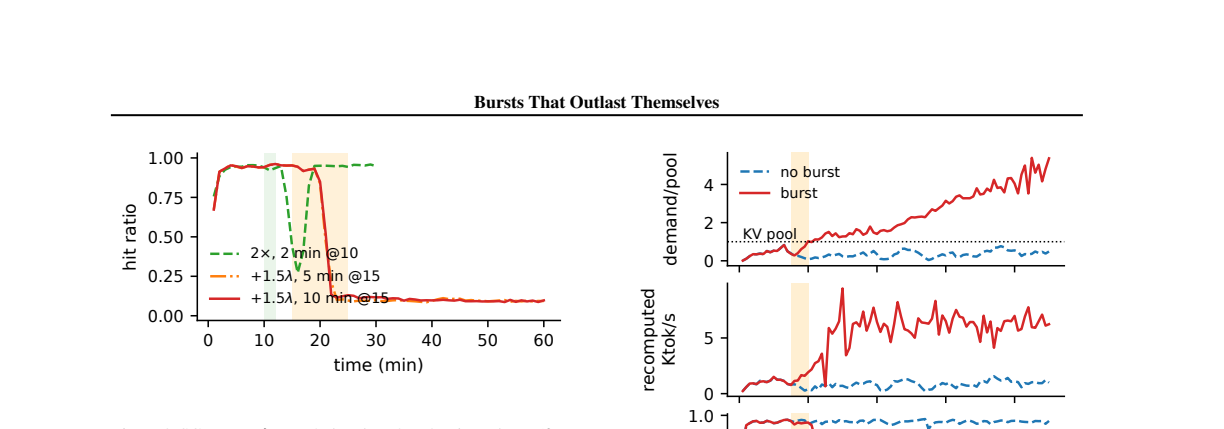
What carries the argument. The load-bearing mechanism is the population-cache feedback loop, an application of the working-set model of thrashing to closed-loop agent sessions. Because a session's next turn cannot be issued until the previous turn is served, the number of sessions concurrently in the system grows with response time (Little's law, $N = \lambda T(Z+R)$), and every active session needs its prefix resident to hit. Running requests and cached prefixes share one KV pool, so when service slows, more sessions overlap, their combined resident demand $D = \sum_s (L_s + o_s)$ outgrows the pool $C$, LRU evicts each session's prefix before its next turn, every turn becomes a full recomputation of a 10–40K-token context, and service slows further — the loop that holds the degraded regime in place. The quantitative anchor is the drain condition: if every turn misses, a session costs $S = \sum_k c(L_k)$ engine-seconds, and the regime can drain only if arrivals bring less work than the engine completes, $\lambda < 1/S$; with the per-miss cost $c(L)$ calibrated on cache-disabled runs, $1/S \approx 0.013$ sessions/s for the synthetic workload, bracketed by the drain experiments at 0.010–0.014. The proposed control object is the budgeter, a gateway-side controller that holds the resident KV demand of admitted sessions in a hysteresis band — admit while $D \le 0.75C$, park sessions at turn boundaries when $D > 0.95C$ — using the engine-reported pool size $C$ and two thresholds that needed no per-workload tuning.
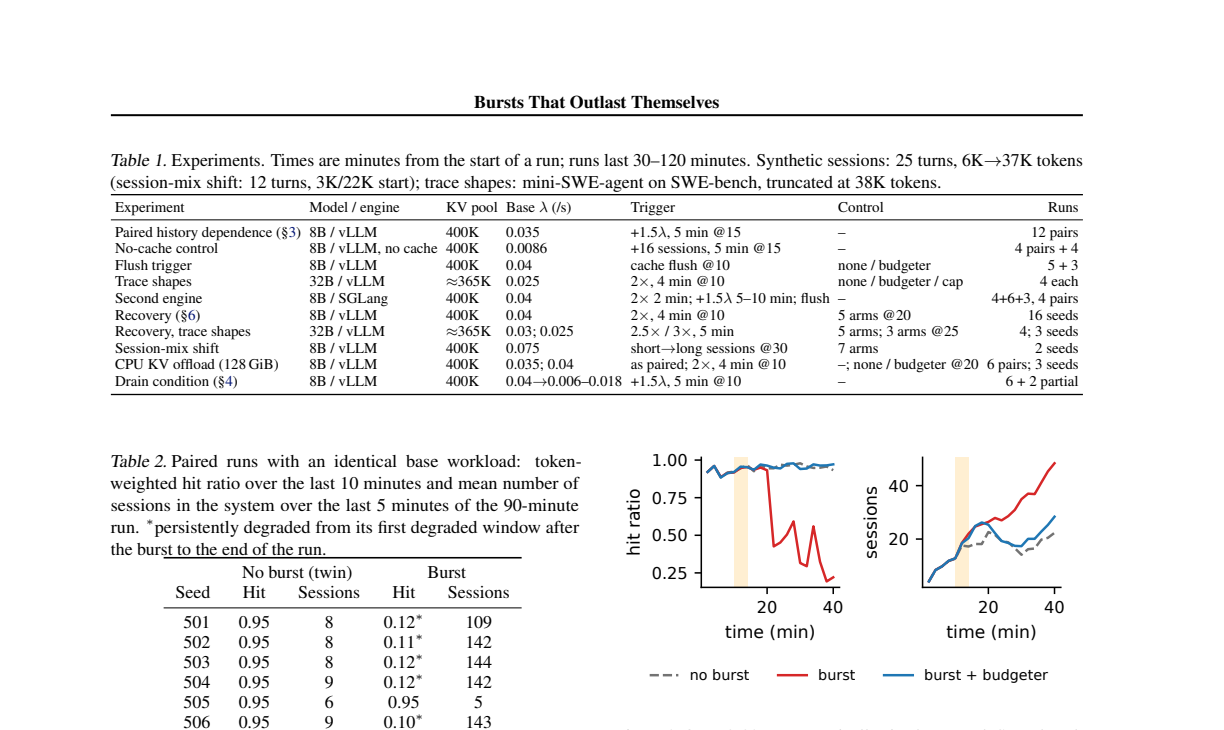
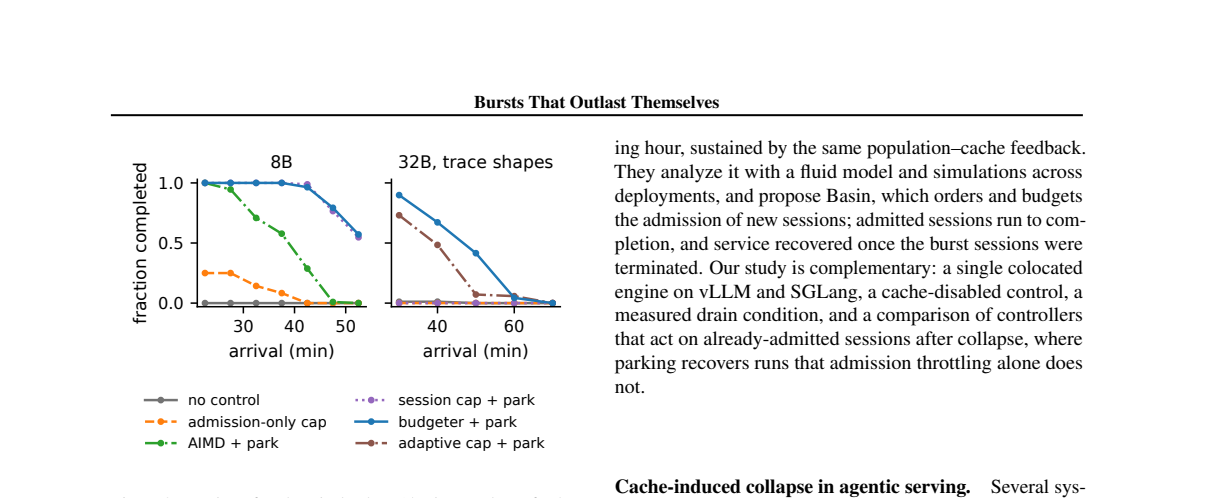
Core claim. The paper's central claim is that prefix-cached agent serving exhibits metastable failure: a trigger pushes the system into a degraded state, and a sustaining effect keeps it there after the trigger is gone. Controlled paired runs establish the phenomenon: with identical base arrivals, a five-minute injected burst (an extra $1.5\lambda$ of arrivals at minute 15) left the vLLM burst runs at a token-weighted hit ratio of 0.10–0.12, about 0.4 turns/s, and a backlog growing past 100 sessions for the remaining 70 minutes, while the no-burst twins stayed healthy at a 0.94–0.95 hit ratio with about 10 sessions (9 of 12 pairs only the burst arm degraded, none only the twin, 2 both, 1 neither). The paper shows the regime is not ordinary overload: it appears at roughly 70 percent of cache-warm capacity, is absent with prefix caching disabled at matched sub-capacity load, and is not caused by the burst's own sessions still being served (in 7 of 11 degraded runs every injected session had finished). It reproduces on a second engine, SGLang, which tolerates larger triggers before collapsing, and on Qwen3-32B replaying SWE-bench agent trace shapes against the model's full auto-sized KV pool — with the caveat, stated by the authors, that at $\lambda = 0.03$ the 32B configuration degraded even without a burst, so history dependence for that model rests on the $\lambda = 0.025$ runs. The paper also argues why the state persists and when it can drain: in the degraded regime essentially all turns miss and the engine runs at its no-cache capacity, and a workload-balance condition with per-miss cost measured independently on cache-disabled runs brackets the drain threshold at about 0.010–0.014 sessions/s, matching the model's $1/S \approx 0.013$, far below the loads at which collapse was observed. Its final claim is asymmetric control: admission throttling alone recovered 1 of 7 matched collapsed runs, while parking admitted sessions at turn boundaries against a limit derived from the KV pool restored a 0.93–0.95 hit ratio in every collapsed run within minutes.
The premise it rests on. The load-bearing assumption is that the misses in the degraded regime are caused by prefixes evicted from the shared KV pool between turns: the paper infers this rather than measuring it, because the engine exports no per-block eviction events, so if the misses actually came from scheduler behavior, pool fragmentation, or another mechanism, the persistence would remain but the feedback-loop explanation and the capacity-based parking remedy would rest on an unverified cause.
If the paper is right (Pith's inferences, not the authors')
Operators cannot judge health by load: a server can be persistently degraded at an arrival rate its no-burst twin sustains, with GPU utilization high and latency alarms firing, while the real signals are the agent-traffic prefix hit ratio and the number of sessions in the system relative to what the KV pool holds.
Once a server has collapsed, refusing new arrivals is the wrong actuator: it recovered only 1 of 7 matched runs, whereas parking admitted sessions at turn boundaries against a capacity-based limit recovered every collapsed run within minutes, so exiting the regime needs a different control action than staying out of it.
Restarts, weight updates, and cache flushes are triggers in their own right — a flush with preemption of running requests left 1 of 5 runs persistently degraded — so admission should be ramped while the cache rebuilds.
Enlarging the KV pool or adding a CPU offload tier raises the trigger size but does not remove the regime: offloading delayed collapse from minute 20–25 to minute 40–60, but 4 of 6 burst runs still ended persistently degraded because the growing population eventually outgrows any pool.
A budgeter that bounds the resident KV demand of active sessions to a fraction of the pool prevented collapse in every tested trigger (bursts, cache flushes, and 32B trace shapes), using thresholds of 0.75/0.95 of the pool with no per-workload tuning and throughput within run-to-run variation of the uncontrolled server.
An implication the paper does not develop: because the collapse threshold is set by $N^* = C/\bar{L}$, the pool size divided by mean session context, and because the paper reports production agent contexts are far longer (median per-call above 100K tokens), production deployments may sit much closer to the cliff than the synthetic 6K–37K contexts suggest — a testable prediction is that bursts harm
The drain condition $\lambda < 1/S$ suggests a triage rule for operators that the paper leaves implicit: measure the collapsed server's cold-turn cost and arrival rate, and treat $1/S$ as the break-even below which the backlog may drain on its own but above which waiting will not help; the paper's own data show the wait can be long, since no cache re-formed in up to two hours of observation.
The paired runs show the healthy regime is not absorbing — 2 of 12 no-burst twins degraded spontaneously after 25–30 minutes — and the paper reports its Poisson fluctuation model was an order of magnitude too pessimistic at predicting this, so estimating spontaneous collapse rates remains an open problem that operators would need answered for capacity planning.
An engine-builder's extension: the paper notes SGLang refuses to flush its cache while requests run and recovered from a flush in 3 of 3 runs, while vLLM's flush-with-preemption collapsed 1 of 5, so a fair comparison of eviction or scheduling policies that favor sessions with a resident prefix — which the paper did not test — could move the trigger threshold enough to matter at production context
Check this review
Pith stored no record of this review's passes and took no fingerprint of it. Reviews made by code from 13 Nov 2026 on carry both.
How often reviews like this one are right
Reviews like this one: written by deepseek-v4-flash, where what was read was not recorded.
How often objections from reviews like this one are right: not yet measured
Reviews by people
This review was written by a machine. No person has reviewed this paper on Pith yet. A scientist listed on Pith can review it for a fee, and their review is published here whatever it concludes.
The paper
Abstract
LLM agents drive inference engines with closed-loop sessions whose context grows every turn, and serving them economically depends on prefix caching: a hit costs an incremental prefill of about a thousand tokens, a miss recomputes a 10–40K-token context. We show that this makes prefix-cached agent serving metastable. With an identical base workload, a few minutes of extra arrivals leaves a vLLM server in a degraded regime–a 10% hit ratio, about half the throughput, and a backlog that grows for the remaining 70 minutes–while its no-burst twin stays healthy (9 of 12 pairs; none in the reverse direction). The regime appears at loads the cache-warm server sustains, is absent without prefix caching, and also appears with Qwen3-32B on SWE-bench agent trace shapes and on SGLang, which tolerates larger triggers. Slower service keeps more sessions in the system, their working set outgrows the KV pool, and every turn becomes a recomputation; a first-order workload-balance condition, calibrated independently, brackets when the regime can drain. Getting out is the harder problem: throttling new admissions recovered 1 of 7 matched collapsed runs, while suspending admitted sessions against a capacity-based limit recovered all of them within minutes. A CPU offload tier delays the collapse but does not prevent it. A budgeter that bounds the resident KV demand of active sessions to the pool, with thresholds that need no per-workload tuning, prevented the failure in every run we tested.
The paper's own sentences, arranged, kept beside the review and separate from it. Each label is drawn from a closed vocabulary; the number beside it is the probability the classifier gave that label. No sentence in this record was written by a model.
abstract compiled · 2026-11-11
The authors' main claim, as the classifier picked it out 0.98
“We show that this makes prefix-cached agent serving metastable.”
How the main claim is stated: asserted 1.00
What the abstract itself states, as probabilities: claims first 0.06 · states limitation 0.47 · human participants 0.03 · controlled comparison 0.96 · randomized assignment 0.03 · states quantitative result 0.98 · compares with prior results 0.87 · mentions code or data availability 0.03
The abstract, sentence by sentence
This table labels the abstract only (arXiv listing abstract v1). The number is the probability the classifier gave the label.
| Sentence | Role | The authors' own work | States the main conclusion | Strength |
|---|---|---|---|---|
| LLM agents drive inference engines with closed-loop sessions whose context grows every turn, and serving them economically depends on prefix caching: a hit costs an incremental prefill of about a thousand tokens, a miss recomputes a 10--40K-token context. | background 1.00 | 0.09 | 0.03 | asserted 1.00 |
| We show that this makes prefix-cached agent serving metastable. | result 0.53 | 0.78 | 0.63 | asserted 1.00 |
| With an identical base workload, a few minutes of extra arrivals leaves a vLLM server in a degraded regime--a ~10% hit ratio, about half the throughput, and a backlog that grows for the remaining 70 minutes--while its no-burst twin stays healthy (9 of 12 pairs; none in the reverse direction). | result 1.00 | 0.96 | 0.29 | asserted 1.00 |
| The regime appears at loads the cache-warm server sustains, is absent without prefix caching, and also appears with Qwen3-32B on SWE-bench agent trace shapes and on SGLang, which tolerates larger triggers. | result 0.99 | 0.91 | 0.10 | asserted 0.91 |
| Slower service keeps more sessions in the system, their working set outgrows the KV pool, and every turn becomes a recomputation; a first-order workload-balance condition, calibrated independently, brackets when the regime can drain. | interpretation 0.86 | 0.88 | 0.12 | asserted 0.95 |
| Getting out is the harder problem: throttling new admissions recovered 1 of 7 matched collapsed runs, while suspending admitted sessions against a capacity-based limit recovered all of them within minutes. | result 0.96 | 0.95 | 0.12 | asserted 1.00 |
| A CPU offload tier delays the collapse but does not prevent it. | result 0.99 | 0.89 | 0.03 | asserted 1.00 |
| A budgeter that bounds the resident KV demand of active sessions to the pool, with thresholds that need no per-workload tuning, prevented the failure in every run we tested. | result 0.49 | 0.93 | 0.35 | asserted 1.00 |
What kind of paper the classifier reports this is: empirical study 0.98 · evidence from observation or experiment 0.99
What was examined, and what was not
Sources read
- arXiv listing abstract v1
Not examined
- full text
- figures and tables
- references and citing sentences
- relations to other papers
Levels run
- P abstract
Not run
- S sections
- T body sentences
- C citations
- R cross-paper relations
How the labels were made
Compiled by classifier-1.13.0 via TypeSafe API, question bank abstract-p1-20260923, 2026-11-11: 1 request, 6,524 input tokens.
Every quoted sentence on this record is the authors'. Every label is from Pith's closed vocabulary, with the probability shown beside it. This record as JSON
Figures (8)

Showing 7 of the paper's 8 figures. Figures are the authors', reproduced from the paper.
References (19)
- [1] Alvaro, P., Isaacs, R., Majumdar, R., Muniswamy- Reddy, K.-K., Salamati, M., and Soudjani, S. For- mal analysis of metastable failures in software systems. arXiv:2510.03551, on PitharXiv
- [6] Denning, P. J. Thrashing: Its causes and prevention. InPro- ceedings of the AFIPS Fall Joint Computer Conference, Part I, pp. 915–922. ACM, 1968a. doi: 10.1145/1476589. 1476705. Bursts That Outlast Themselves Denning, P. J. The working set model for program behavior. Communica... on PithPith's reviewarXiv
- [7] Farahbakhsh, A., Lu, Q., Alvisi, L., Haeberlen, A., and van Renesse, R. Characterizing metastable faults and failures. arXiv:2606.00942, on PithPith's reviewarXiv
- [9] doi: 10.1145/3713082.3730380. Kim, J., Kwon, M., Min, Y ., Kim, J., and Zhao, J. Dy- namic HBM repartitioning for multi-turn MoE serving. arXiv:2609.13537, on PithPith's reviewarXiv
- [11] Liu, B., Qiu, H., Goiri, Í., Fonseca, R., Bianchini, R., and Choukse, E. Agentic coding in the wild: Char- acterizing GitHub Copilot traces at production scale. arXiv:2608.00101, 2026a. Liu, Y ., Yu, M., and Yang, J. When fancy eviction fails: Rethinking cache replacement for ... on PithPith's reviewarXiv
- [12] Meng, J. and Li, B. Metronome: Bound the cache, keep the beat for real-time interaction model serving. arXiv:2607.02640, on PithPith's reviewarXiv
- [13] Pan, Z., Wu, C., Hu, Z., Qiang, X., Yu, Z., and Ding, Y . RR- Evict: Fine-grained prefix cache eviction beyond LRU for agentic LLM serving. arXiv:2609.32278, on PithPith's reviewarXiv
- [14] USENIX Association. Shao, K., Chen, J., Yu, J., Li, X.-H., Tao, C., Wang, Y ., Lin, H., Cheng, K.-T., Tsui, C. Y ., and Bai, H. EfficientAgent: What makes KV cache offloading work for concurrent agents? arXiv:2609.33762, on PithPith's reviewarXiv
- [16] Yuan, Y ., Chowdhury, M., and Talati, N. KAIROS: Stateful, context-aware power-efficient agentic inference serving. arXiv:2604.16682, on PithPith's reviewarXiv
- [17] Zheng, L., Yin, L., Xie, Z., Sun, C., Huang, J., Yu, C. H., Cao, S., Kozyrakis, C., Stoica, I., Gonzalez, J. E., Barrett, C., and Sheng, Y . SGLang: Efficient execution of struc- tured language model programs. InAdvances in Neural Information Processing Systems 37 (NeurIPS 202... on Pith
- [18] doi: 10.52202/079017-2000. Zhu, K., Jacob, M., Ma, C., Pan, Y ., Wang, S., Kr- ishnamurthy, A., and Kasikci, B. TraceLab: Char- acterizing coding agent workloads for LLM serving. arXiv:2606.30560, on PithPith's reviewarXiv
- [19] Bursts That Outlast Themselves Zou, L., Li, B., Mao, W., Ye, W., Li, L., Liu, K., Deng, C., Zhu, J., and Yu, B. Vesta: Queueing-aware LLM scheduling for real-world workloads. arXiv:2610.14686, on PithPith's reviewarXiv
- [27] Yao, H., Gao, C., Lyu, Y ., Grosof, I., and Simchi-Levi, D. Multi-turn LLM conversations under the least-recently- used policy: Mean-field asymptotics and hit ratio approx- imation. arXiv:2609.02027, on PithPith's reviewarXiv
- [2002] doi: 10.1109/JSAC.2002.801752. Chen, Q., Ye, Z., Tang, T., Sun, P., Tian, B., Wang, G., Li, S., Wen, Y ., Han, Z., and Zhang, T. CONCUR: High-throughput agentic batch inference of LLM via congestion-based concurrency control. arXiv:2601.22705, on PitharXiv
- [2021] doi: 10.1145/3458336.3465286. Che, H., Tung, Y ., and Wang, Z. Hierarchical web caching systems: Modeling, design and experimental results. IEEE Journal on Selected Areas in Communications, 20 (7):1305–1314, on Pithdoi:10.1145/3458336.3465286
- [2023] doi: 10.1145/3600006.3613165. Li, L., Wang, S., Ruan, Z., Li, D., and Gong, B. The KV cache working set: Online capacity planning for LLM inference systems. arXiv:2609.27746, on PithPith's reviewarXiv
- [2024] doi: 10.1109/SRDS64841.2024.00013. Hong, Z., Yuan, S., Ding, Y ., Zhu, Y ., Jiang, D., Wang, Z., and Tian, C. Scheduling mixed RL rollouts beyond prefix locality. arXiv:2608.11152, on PithPith's reviewarXiv
- [2025] Ao, R., Dong, J., Luo, G., and Simchi-Levi, D. Service- induced congestion in memory-constrained LLM serving. arXiv:2606.15555, on PithPith's reviewarXiv
- [2026] Arya, M., Bari, A., Parayil, A., Simmhan, Y ., St. Amant, R., Rühle, V ., and Rajmohan, S. Understanding KV residency in production-scale agentic LLM workloads. arXiv:2610.22863, on PithPith's reviewarXiv
Challenges and discussion
Disagree with the review, or know something it missed? Leave a comment, or challenge this review formally: a challenge becomes a permanent entry in this paper's record, and its decision is published here.
Come back by email
A short list of the week's newly reviewed papers. Nothing is sent until you confirm from your inbox, and every email has a link that stops it. No account.
No comments yet.
Sign in to comment