Distributed, Parallel, and Cluster Computing · arXiv:2607.17181 v1 · submitted 19 Jul 2026 · 54 references
Talaria: Session-Aware Serverless Serving of Hundred-Billion-Parameter LLMs
The paper says
“Serverless multi-model LLM systems multiplex popularity-skewed model catalogs over shared GPU pools, yet typically schedule each request independently.”
more of the abstract
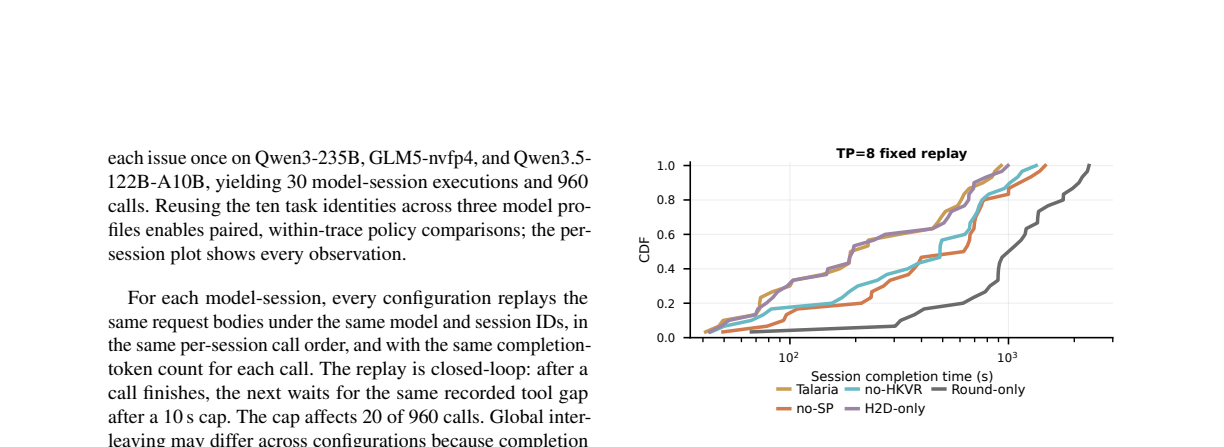
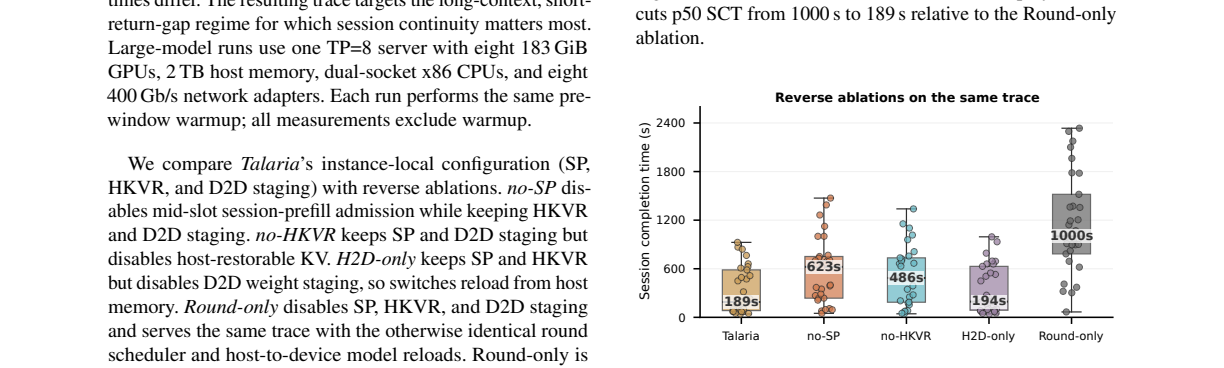
Tool-using agents break this abstraction: a session repeatedly calls an LLM across short tool gaps, carries a long reusable KV prefix, and is judged by session completion time (SCT). Load-only routing can separate a continuation from both its model and KV state, while round-based model multiplexing can delay even a correctly placed continuation until the target model's next slot. Both failures are especially costly for hundred-billion-parameter models: their weights constrain residency, while long-context KV is expensive to reconstruct or move. We present Talaria, a session-aware serverless multi-model serving system that makes session continuity a joint placement-and-admission decision. Its router ranks placements by model residency, KV locality, and instance pressure, while soft reservations account for likely returns in the last serving instance's admission budget. Session-prefill (SP) admits budget-eligible continuations before the active model slot closes. An instance-local substrate keeps HBM addresses stable, preserves host-restorable KV, and stages weights across model switches. On a single TP=8 server, we replay 30 SWE-Bench model-sessions (960 calls) over three models, each with more than 100B total parameters. Against an otherwise identical round scheduler with SP, host-KV restoration, and D2D staging disabled, Talaria cuts p50 SCT from 1000 s to 189 s and p95 from 2296 s to 867 s, speedups of 5.3x and 2.6x.
from the abstract
Pith says
Machine review · deepseek-v4-flash · 1 Aug 2026 · what was read was not recorded · not checked by a person
It can be wrong. Challenge this review or reply to it.
Holds up, with conditions. Serious and coherent systems paper on session-aware serving, but the headline speedups rest on a single low-concurrency replay and an internal baseline, so treat the magnitudes as provisional. This line is wrong
3 major objections · 5 minor
How often objections from reviews like this one are right: not yet measured
Not checked: figures, code, what the 54 references say.
The paper says, at §5.1–§5.2, Figs. 6–7
The review did not quote this passage.
Pith says: Objection 1 of 3 · major
The 5.3x/2.6x speedup may be inflated by phase-locking in the closed-loop replay. The paper itself states in §5.1 that 'global interleaving may differ across configurations because completion times differ.' With only 30 sessions, a Round-only session that misses its model slot is delayed, which delays its next release and can cause it to miss subsequent slots repeatedly.
more of objection 1
This is a property of low concurrency and the replay harness, not necessarily of realistic multi-model serving, where many interleaved sessions would keep slots busier and reduce expected wait toward half a round. The paper should either provide evidence that Round-only's 1000 s p50 is ordinary round-waiting (e.g., slot-occupancy or wait-time breakdowns), add an open-loop or arrival-fixed sensitivity run, or scale the session count to show the effect is not an artifact. Without this, the headline magnitudes are not robus
The paper says, at §5.2, p95 claim
The review did not quote this passage.
Pith says: Objection 2 of 3 · major
With N=30, the nearest-rank empirical p95 is the rank-29 observation (ceil(0.95*30)=29). The p95 SCT gap (2296 s vs 867 s) is therefore determined by the second-highest session in each configuration, so the 2.6x p95 claim is statistically very unstable. The per-session points in Fig. 7 help, but the abstract reports the p95 as if it were a stable population quantile.
more of objection 2
Please add bootstrap confidence intervals or a sensitivity analysis (e.g., jackknife), and soften the p95 claim in the abstract if the uncertainty cannot be quantified.
The paper says, at §5.1, §5.3
The review did not quote this passage.
Pith says: Objection 3 of 3 · major
The end-to-end TP=8 comparison is against an internal Round-only ablation only; no published multi-model scheduler (e.g., Aegaeon, MuxServe) is run on the same trace. The reverse ablations show that the mechanisms help within this engine, but they do not establish a system-level advantage over existing work, and the abstract's 'cuts p50 SCT' phrasing could be read as a general speedup over prior systems.
more of objection 3
Additionally, the router/soft-reservation component is evaluated only on a separate 120-call TP=4 testbed with smaller models, and at low load the full router's SCT is worse than least-pressure (p50/p95 7.39/15.81 s vs 6.82/11.31 s, §5.3). The 'joint placement-and-admission' claim is thus supported only partially: the large-model speedup comes from the instance-local mechanisms, and the router's benefit is mixed and measured under different conditions. The authors should either add an ex
5 minor objections
The paper says, at Abstract / §5.2
Pith says: minor objection 1 of 5
The abstract's 'cuts p50 SCT from 1000 s to 189 s' is precise about the baseline only later in the sentence ('otherwise identical round scheduler... disabled'). Consider adding 'relative to our all-off ablation' to avoid implying a comparison with prior systems.
The paper says, at §5.4
Pith says: minor objection 2 of 5
The reservation timeout τ is selected from the same trace family (the TP=4 120-call subset), and the unused-lease proxy is 50% at the chosen τ=1 s. This is acceptable as a sensitivity sweep, but please report whether the TP=8 headline results are sensitive to τ in that setting, not just the TP=4 TTFT numbers.
show 3 more
The paper says, at §5.6 / Table 2
Pith says: minor objection 3 of 5
Table 2 reports a separate component stress run with D2D-full p95 = 298.9 ms, while Figure 12 shows Talaria's logical-switch p95 = 2679 ms. The paper notes these are different runs, but the discrepancy is large; a brief sentence explaining why (e.g., dirty-chunk fallbacks in the replay) would help readers avoid confusion.
The paper says, at General
Pith says: minor objection 4 of 5
The author contact email addresses in the header appear to be placeholders; please provide institutional addresses for the camera-ready version.
The paper says, at §5.1
Pith says: minor objection 5 of 5
The methodology says the replay is 'closed-loop: after a call finishes, the next waits for the same recorded tool gap after a 10 s cap.' Please state explicitly how many sessions/tasks are run concurrently, since the phase-locking concern depends on the number of active sessions in the replay. The current text says 30 model-sessions over the whole run, but not the concurrency level at any given time.
What would settle it
Replay the same 10-issue, three-model trace with K replicated session sets (e.g., K=1, 5, 10, 30) on the same TP=8 hardware, keeping per-session call order/bodies/gaps unchanged, and measure Round-only vs Talaria p50/p95 SCT. If Round-only's per-continuation wait falls below ~2s and the p50 speedup drops below ~2x as K grows, the headline magnitudes are a low-concurrency artifact; if the wait stays near the round bound and the speedup holds at K=30, the concern is resolved.
from the skeptic's reading
How the review went
4 readings by deepseek-v4-flash · 1 Aug 2026
- Reader holds up, with conditions
- Skeptic partly agrees
- Editor wrote the verdict above
- Referee major revision: 3 major objections, 5 minor
Not run on this paper: the simulated authors' defence.
Pith did not check this review's objections against the paper.
The review in full
The review in brief, machine-written
Quick take: Talaria is a real idea — session-scoped soft reservations plus mid-slot session-prefill admission — and the paper is honestly engineered. The reverse ablations are the right way to isolate mechanisms. But the 5.3x/2.6x headline is measured against an internal all-off baseline on one TP=8 server with 30 replayed sessions, no code/data, and the stress-test's phase-locking worry is real. I'd send it to review, expecting the magnitude claims to be softened and a broader-scale evaluation added.
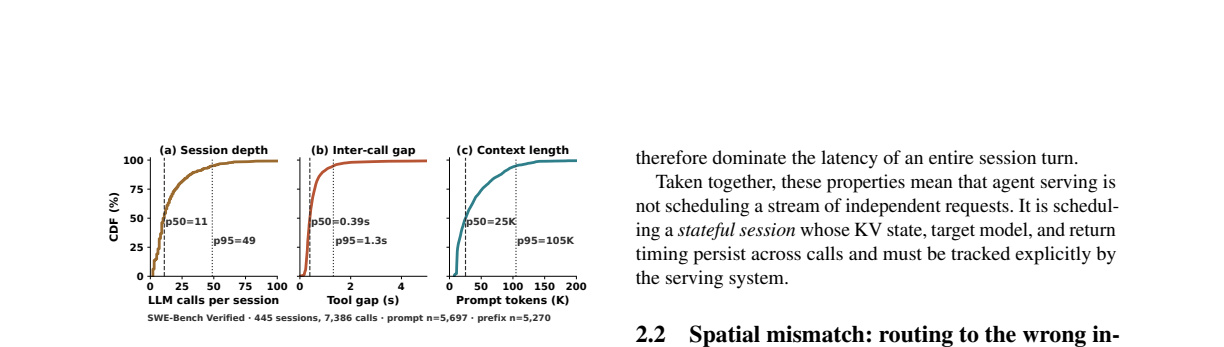
What's actually new: the system treats a session as a first-class scheduling object across placement and admission. That is genuinely absent from Aegaeon, Preble, Mooncake, ServerlessLLM, Llumnix, and Continuum. The router's soft reservation is a lease, not a pin; SP admission within a slot is a neat way to exploit short tool gaps. The memory substrate (stable HBM layout, host KV registry with TP-consistency guard, D2D staging) is sensible, and the switch-phase instrumentation is careful. The trace characterization (median 0.39s gap, 25K prompt, 96.8% prefix reuse) supports the motivation.
Soft spots, in proportion. The headline comparison is against an internal Round-only baseline, not a published system run on the same trace. No code or data are released. One TP=8 server, 30 sessions, and N=30 makes the p95 a rank-29 observation. The phase-locking concern is legitimate: in a closed-loop replay with only 30 sessions, a delayed session's next call is released a full round later and can repeatedly miss its slot. That can inflate Round-only's wait beyond what realistic concurrency would produce. The paper acknowledges global interleaving may differ, but doesn't test with more sessions or a synthetic arrival process. So 5.3x is likely an upper bound; the direction is solid — the no-SP (623s vs 189s) and no-HKVR (486s vs 189s) ablations show the mechanisms help even without the all-off baseline. Minor circularity: the reservation timeout tau and admission margin gamma are tuned on the same trace family, though the sensitivity sweep makes that transparent.
Who this is for: systems folks working on multi-model serving or agentic workload infrastructure. Worth discussing at reading group for the admission abstraction, but the numbers shouldn't be quoted as settled. Deserves a serious referee — I'd accept it — and a strong revision would add more sessions or a second workload, compare against at least one prior system on the same trace, and soften the p95 precision.
The strongest objection
The central comparison is Talaria vs Round-only on a closed-loop replay of 30 model-sessions on one TP=8 server. The reported 5.3x/2.6x SCT speedup requires that Round-only's ~800s extra p50 SCT is ordinary round-waiting plus prefix recomputation. But in a closed-loop replay with only 30 sessions, the arrival process is not fixed: §5.1 states 'global interleaving may differ across configurations because completion times differ.' A session whose continuation is deferred by one round is itself delayed, so its next call is released a full round later, which can repeatedly land just after its model's slot closes. This phase-locking is a property of the low session count and replay harness, not necessarily of multi-model round serving under realistic load. With more interleaved sessions, slots would stay busy and expected wait would be closer to half a round, so the 1000s vs 189s gap could shrink substantially. The no-SP ablation (623s vs 189s) shows SP's benefit is not an artifact of the all-off baseline, but the abstract's headline comparison still rests on this single low-concurrency, closed-loop trace. Additionally, N=30 makes the reported p95 a rank-29 observation, so the 2.6x p95 claim is not statistically stable.
The paper is a coherent systems contribution with careful reverse ablations: the 29/30 paired-session improvement, the no-SP/no-HKVR/H2D-only ablations, and the separate TP=4 router experiments provide real internal evidence that the session-continuity mechanisms work. I did not find an internal inconsistency or a fatal flaw. However, the headline quantitative claim rests on a single closed-loop replay with only 30 sessions and one TP=8 server. The reader's weakest assumption captured representativeness and baseline fairness; my stress-test sharpens this into a specific mechanism: closed-loop phase-locking at low concurrency can inflate Round-only's SCT, because a deferred continuation shifts all subsequent calls for that session, potentially locking the session into a pattern of just missing its model slot. This is not addressed by the paper's own limitation paragraph, which only mentions workload and cluster-scale evaluation. The proposed K-replication test would directly quantify whether the speedup magnitude depends on session count, and a bootstrap on the 30 paired differences would address p95 instability. Since the reader already assigned CONDITIONAL and my concern falls within that condition, I recommend no change to the verdict.
The referee's report
If the reported speedups are robust, the paper makes a meaningful contribution: it quantifies agent-session properties (depth, 0.39 s median tool gap, 25K-token median prompt, 96.8% prefix reuse) and proposes concrete mechanisms that jointly address placement and admission. The experimental design has real strengths: fixed replay avoids agent-path divergence, reverse ablations isolate each mechanism, and Figure 7 shows all 30 per-session observations rather than only aggregates. The validation protocol in Appendix B is careful about TP-consistency and DMA safety. However, the evidence base is narrow: the headline speedup rests on a single 30-session, one-server, closed-loop replay, and the baseline is internal. The magnitudes in the abstract, especially the p95, are not established with statistical confidence. The paper is honest about these limitations, but the central quantitative claim is less robust than the abstract's framing suggests.
Pith's reading of the paper (a machine's summary, not the authors')
The paper tries to establish that agent sessions—sequences of LLM calls separated by short tool executions—are the right scheduling unit for serverless multi-model serving, not individual requests. It argues that treating each return as a fresh request causes two coupled failures: routing to an instance that lacks the model or the KV prefix, and deferring a correctly placed continuation until the model's next round slot. Talaria addresses both with a session-aware router using soft reservations and a session-prefill admission step in each model slot, supported by an instance-local memory substrate that keeps KV restorable across switches. If correct, this would cut the median session completion time of hundred-billion-parameter agent workloads from 1000 to 189 seconds on a single server, and most of the gain comes from admitting returning calls mid-slot rather than waiting for the next round.
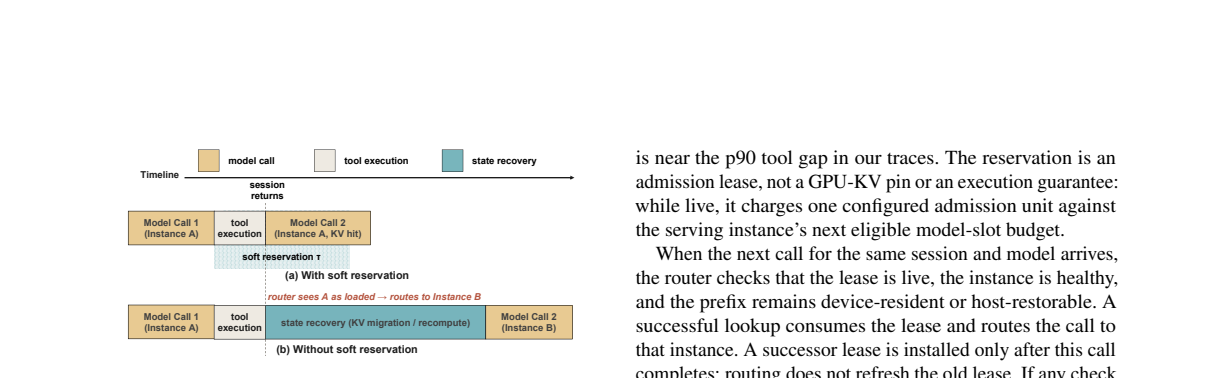
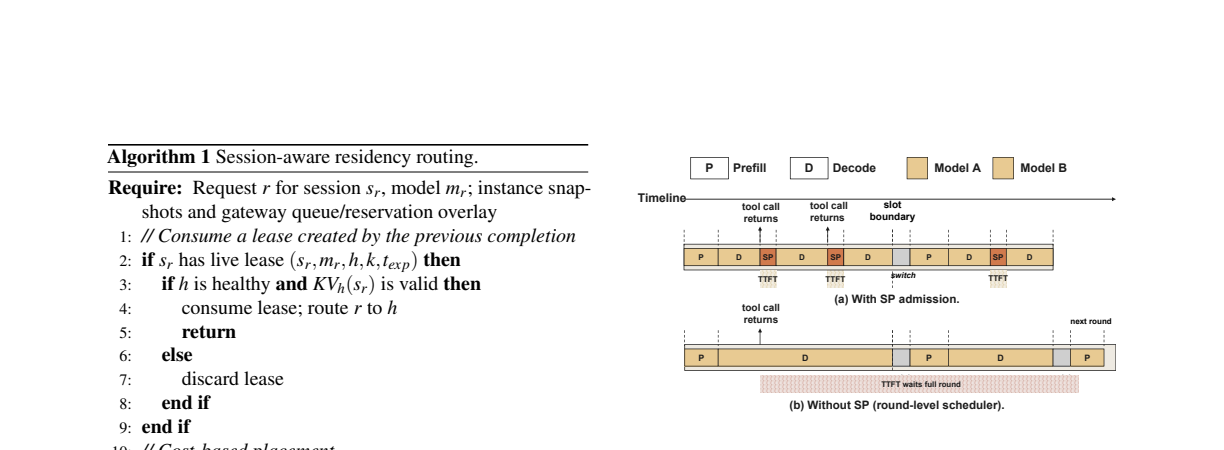
What carries the argument. The central mechanisms are the soft reservation lease and the session-prefill (SP) admission step. The lease is a short-lived admission charge on the last serving instance, created when a call completes and expiring at a chosen timeout (1s in the evaluation), so a likely return is steered back to the instance that holds its reusable KV prefix. SP is a mid-slot prefill window inside each cold-pool model slot—slot structure P → D1 → (SP→D)* → Dfin—that batch-admits budget-eligible continuations before the slot closes. Around these, a memory substrate gives stable HBM addresses, a host-side KV registry for restorable prefixes, and D2D-staged weight switching so the admission windows are not con
Core claim. On the paper's own terms, the discovery is that session continuity can be made a scheduling abstraction: a soft reservation placed when a call completes preserves affinity to the instance holding the model and KV state, and a session-prefill admission step lets eligible returns enter the active model slot before it closes. On a fixed replay of 30 sessions (960 calls) across three models larger than 100B parameters on one TP=8 server, the full system cuts p50 session completion time from 1000s to 189s (5.3x) and p95 from 2296s to 867s (2.6x) against an otherwise identical round scheduler; SP alone accounts for the largest marginal p50 gain, HKVR reduces tail latency, and D2D staging reduces p
The premise it rests on. The load-bearing premise is that the single-server replay of 30 sessions with tool gaps capped at 10s captures how real hundred-billion-parameter agent workloads behave; if that replay skews the baseline or the gap distribution, the claimed speedups could be smaller in practice.
If the paper is right (Pith's inferences, not the authors')
If correct, request-level scheduling for agent workloads should be considered a mismatch: systems that route on load alone will keep paying prefix-recomputation and next-slot-waiting costs that session-aware placement avoids.
The 47.8% mid-slot admission rate suggests that a substantial fraction of returning calls can be served inside the active model window, which changes the round-budget equation: prefill/decode protection can coexist with frequent short returns.
Host-restorable KV plus stable HBM addresses means a cold-pool model can leave the GPU without abandoning session state; this makes time-sharing of long-tail models viable for sessions whose prefixes would otherwise be too expensive to rebuild.
The router's soft reservation trades some model-residency hits for return locality; at the evaluated 1s lease, returning-call TTFT p95 improves, but longer leases degrade residency, so the lease timeout is a tunable knob rather than a fixed setting.
In the two-worker test, residency-aware routing cut avoidable model opens from 37 to 1 at high load, suggesting placement, not admission, dominates when model opens are expensive.
Editorial inference: the measured 5.3x/2.6x speedup likely shrinks as tool gaps grow beyond the 0.39s median and 10s cap; the continuity window is defined by the gap being shorter than prefix-recompute time, so workloads with long tool executions would see less benefit.
Editorial inference: the soft-reservation timeout could be made adaptive per session (based on observed gap distribution or tool type) instead of a fixed 1s, which might preserve the return-locality gain without sacrificing model residency.
Editorial inference: the same session-continuity abstraction should extend to prefill/decode-disaggregated deployments, where returning sessions enter through a prefill tier but their KV lives on the decode side; the paper notes this as future work, and a cross-tier KV-ownership protocol would be the natural test.
Editorial inference: a testable extension is to run the same fixed replay on a multi-server cluster with remote KV migration, to see whether the instance-local gains survive when a return could alternatively be served from a remote copy.
Check this review
Pith stored no record of this review's passes and took no fingerprint of it. Reviews made by code from 13 Nov 2026 on carry both.
How often reviews like this one are right
Reviews like this one: written by deepseek-v4-flash, where what was read was not recorded.
How often objections from reviews like this one are right: not yet measured
Reviews by people
This review was written by a machine. No person has reviewed this paper on Pith yet. A scientist listed on Pith can review it for a fee, and their review is published here whatever it concludes.
The paper
Abstract
Serverless multi-model LLM systems multiplex popularity-skewed model catalogs over shared GPU pools, yet typically schedule each request independently. Tool-using agents break this abstraction: a session repeatedly calls an LLM across short tool gaps, carries a long reusable KV prefix, and is judged by session completion time (SCT). Load-only routing can separate a continuation from both its model and KV state, while round-based model multiplexing can delay even a correctly placed continuation until the target model's next slot. Both failures are especially costly for hundred-billion-parameter models: their weights constrain residency, while long-context KV is expensive to reconstruct or move. We present Talaria, a session-aware serverless multi-model serving system that makes session continuity a joint placement-and-admission decision. Its router ranks placements by model residency, KV locality, and instance pressure, while soft reservations account for likely returns in the last serving instance's admission budget. Session-prefill (SP) admits budget-eligible continuations before the active model slot closes. An instance-local substrate keeps HBM addresses stable, preserves host-restorable KV, and stages weights across model switches. On a single TP=8 server, we replay 30 SWE-Bench model-sessions (960 calls) over three models, each with more than 100B total parameters. Against an otherwise identical round scheduler with SP, host-KV restoration, and D2D staging disabled, Talaria cuts p50 SCT from 1000 s to 189 s and p95 from 2296 s to 867 s, speedups of 5.3x and 2.6x.
The paper's own sentences, arranged, kept beside the review and separate from it. Each label is drawn from a closed vocabulary; the number beside it is the probability the classifier gave that label. No sentence in this record was written by a model.
abstract compiled · 2026-09-23
The authors' main claim, as the classifier picked it out 0.94
“Against an otherwise identical round scheduler with SP, host-KV restoration, and D2D staging disabled, Talaria cuts p50 SCT from 1000 s to 189 s and p95 from 2296 s to 867 s, speedups of 5.3x and 2.6x.”
How the main claim is stated: asserted 1.00
What the abstract itself states, as probabilities: claims first 0.08 · states limitation 0.22 · human participants 0.04 · controlled comparison 0.97 · randomized assignment 0.02 · states quantitative result 0.99 · compares with prior results 0.96 · mentions code or data availability 0.03
The abstract, sentence by sentence
This table labels the abstract only (arXiv listing abstract v1). The number is the probability the classifier gave the label.
| Sentence | Role | The authors' own work | States the main conclusion | Strength |
|---|---|---|---|---|
| Serverless multi-model LLM systems multiplex popularity-skewed model catalogs over shared GPU pools, yet typically schedule each request independently. | background 0.97 | 0.06 | 0.02 | asserted 0.99 |
| Tool-using agents break this abstraction: a session repeatedly calls an LLM across short tool gaps, carries a long reusable KV prefix, and is judged by session completion time (SCT). | background 0.96 | 0.08 | 0.03 | asserted 1.00 |
| Load-only routing can separate a continuation from both its model and KV state, while round-based model multiplexing can delay even a correctly placed continuation until the target model's next slot. | gap 0.52 | 0.09 | 0.03 | asserted 0.94 |
| Both failures are especially costly for hundred-billion-parameter models: their weights constrain residency, while long-context KV is expensive to reconstruct or move. | background 0.93 | 0.09 | 0.03 | asserted 0.98 |
| We present Talaria, a session-aware serverless multi-model serving system that makes session continuity a joint placement-and-admission decision. | contribution 1.00 | 0.90 | 0.34 | asserted 1.00 |
| Its router ranks placements by model residency, KV locality, and instance pressure, while soft reservations account for likely returns in the last serving instance's admission budget. | method 0.95 | 0.83 | 0.09 | asserted 1.00 |
| Session-prefill (SP) admits budget-eligible continuations before the active model slot closes. | method 0.96 | 0.73 | 0.06 | asserted 0.99 |
| An instance-local substrate keeps HBM addresses stable, preserves host-restorable KV, and stages weights across model switches. | method 0.94 | 0.74 | 0.04 | asserted 1.00 |
| On a single TP=8 server, we replay 30 SWE-Bench model-sessions (960 calls) over three models, each with more than 100B total parameters. | method 0.96 | 0.96 | 0.03 | asserted 0.99 |
| Against an otherwise identical round scheduler with SP, host-KV restoration, and D2D staging disabled, Talaria cuts p50 SCT from 1000 s to 189 s and p95 from 2296 s to 867 s, speedups of 5.3x and 2.6x. | result 1.00 | 0.97 | 0.61 | asserted 1.00 |
What kind of paper the classifier reports this is: method or tool 1.00 · evidence from observation or experiment 0.96
What was examined, and what was not
Sources read
- arXiv listing abstract v1
Not examined
- full text
- figures and tables
- references and citing sentences
- relations to other papers
Levels run
- P abstract
Not run
- S sections
- T body sentences
- C citations
- R cross-paper relations
How the labels were made
Compiled by classifier-1.13.0 via TypeSafe API, question bank abstract-p1-20260923, 2026-09-23: 1 request, 7,740 input tokens.
Every quoted sentence on this record is the authors'. Every label is from Pith's closed vocabulary, with the probability shown beside it. This record as JSON
Figures (15)




Showing 12 of the paper's 15 figures. Figures are the authors', reproduced from the paper.
References (54)
- [1] Stanford Institute for Human-Centered Artificial Intel- ligence. The 2025 ai index report. Technical report, Stanford University, 2025 on Pith
- [2] Avijit Ghosh, Lucie-Aimée Kaffee, Yacine Jernite, and Irene Solaiman. State of open source on hugging face: Spring 2026. Hugging Face Blog, 2026 on Pith
- [3] Ying Sheng, Shiyi Cao, Dacheng Li, Coleman Hooper, Nicholas Lee, Shuo Yang, Christopher Chou, Banghua Zhu, Lianmin Zheng, Kurt Keutzer, Joseph E. Gonza- lez, and Ion Stoica. S-LoRA: Serving thousands of concurrent LoRA adapters. InProceedings of Machine Learning and Systems (M... on Pith
- [4] Bingyang Wu, Ruidong Zhu, Zili Zhang, Peng Sun, Xu- anzhe Liu, and Xin Jin. dLoRA: Dynamically orches- trating requests and adapters for LoRA LLM serving. In Proceedings of the 18th USENIX Symposium on Operat- ing Systems Design and Implementation (OSDI), pages 911–927, 2024 on Pith
- [5] Yuxing Xiang, Xue Li, Kun Qian, Yufan Yang, Diwen Zhu, Wenyuan Yu, Ennan Zhai, Xuanzhe Liu, Xin Jin, and Jingren Zhou. Aegaeon: Effective gpu pooling for concurrent llm serving on the market. InProceedings 14 of the ACM SIGOPS 31st Symposium on Operating Sys- tems Principles (... on Pith
- [6] Yao Fu, Leyang Xue, Yeqi Huang, Andrei-Octavian Brabete, Dmitrii Ustiugov, Yuvraj Patel, and Luo Mai. ServerlessLLM: Low-latency serverless inference for large language models. InProceedings of the 18th USENIX Symposium on Operating Systems Design and Implementation (OSDI), 2024 on Pith
- [7] Zhuohan Li, Lianmin Zheng, Yinmin Zhong, Vincent Liu, Ying Sheng, Xin Jin, Yanping Huang, Zhifeng Chen, Hao Zhang, Joseph E. Gonzalez, and Ion Stoica. Al- paServe: Statistical multiplexing with model parallelism for deep learning serving. InProceedings of the 17th USENIX Sympo... on Pith
- [8] Jiangfei Duan, Runyu Lu, Haojie Duanmu, Xiuhong Li, Xingcheng Zhang, Dahua Lin, Ion Stoica, and Hao Zhang. MuxServe: Flexible spatial-temporal multiplex- ing for multiple LLM serving, 2024 on Pith
- [9] Shunyu Yao, Jeffrey Zhao, Dian Yu, Nan Du, Izhak Shafran, Karthik Narasimhan, and Yuan Cao. ReAct: Synergizing reasoning and acting in language models. InProceedings of the 11th International Conference on Learning Representations (ICLR), 2023 on Pith
- [10] Timo Schick, Jane Dwivedi-Yu, Roberto Dessì, Roberta Raileanu, Maria Lomeli, Luke Zettlemoyer, Nicola Can- cedda, and Thomas Scialom. Toolformer: Language models can teach themselves to use tools. InAdvances in Neural Information Processing Systems (NeurIPS), 2023 on Pith
- [11] John Yang, Carlos E. Jimenez, Alexander Wettig, Kil- ian Lieret, Shunyu Yao, Karthik Narasimhan, and Ofir Press. SWE-agent: Agent-computer interfaces enable automated software engineering. InAdvances in Neural Information Processing Systems (NeurIPS), 2024 on Pith
- [12] Michael Luo, Xiaoxiang Shi, Colin Cai, Tianjun Zhang, Justin Wong, Yichuan Wang, Chi Wang, Yanping Huang, Zhifeng Chen, Joseph E. Gonzalez, and Ion Stoica. Autellix: An efficient serving engine for llm agents as general programs, 2025 on Pith
- [13] Carlos E. Jimenez, John Yang, Alexander Wettig, Shunyu Yao, Kexin Pei, Ofir Press, and Karthik R. Narasimhan. SWE-bench: Can language models resolve real-world GitHub issues? InProceedings of the 12th International Conference on Learning Representations (ICLR), 2024 on Pith
- [14] Bin Gao, Zhuomin He, Puru Sharma, Qingxuan Kang, Djordje Jevdjic, Junbo Deng, Xingkun Yang, Zhou Yu, and Pengfei Zuo. Cost-efficient large language model serving for multi-turn conversations with CachedAtten- tion. InProceedings of the 2024 USENIX Annual Tech- nical Conference... on Pith
- [15] Ruoyu Qin, Zheming Li, Weiran He, Jialei Cui, Heyi Tang, Feng Ren, Teng Ma, Shangming Cai, Yineng Zhang, Mingxing Zhang, Yongwei Wu, Weimin Zheng, and Xinran Xu. Mooncake: Trading more storage for less computation – a KVCache-centric architecture for serving LLM chatbot. InPro... on Pith
- [16] Vikranth Srivatsa, Zijian He, Reyna Abhyankar, Dong- ming Li, and Yiying Zhang. Preble: Efficient distributed prompt scheduling for LLM serving, 2024 on Pith
- [17] Pratyush Patel, Esha Choukse, Chaojie Zhang, Aashaka Shah, Iñigo Goiri, Saeed Maleki, and Ricardo Bianchini. Splitwise: Efficient generative LLM inference using phase splitting. InProceedings of the 51st Annual Inter- national Symposium on Computer Architecture (ISCA), 2024 on Pith
- [18] Yinmin Zhong, Shengyu Liu, Junda Chen, Jianbo Hu, Yibo Zhu, Xuanzhe Liu, Xin Jin, and Hao Zhang. Dist- Serve: Disaggregating prefill and decoding for goodput- optimized large language model serving. InProceedings of the 18th USENIX Symposium on Operating Systems Design and Imp... on Pith
- [19] Cunchen Hu, Heyang Huang, Liangliang Xu, Xusheng Chen, Jiang Xu, Shuang Chen, Hao Feng, Chenxi Wang, Sa Wang, Yungang Bao, Ninghui Sun, and Yizhou Shan. Inference without interference: Disaggregate LLM in- ference for mixed downstream workloads, 2024 on Pith
- [20] Woosuk Kwon, Zhuohan Li, Siyuan Zhuang, Ying Sheng, Lianmin Zheng, Cody Hao Yu, Joseph E. Gonza- lez, Hao Zhang, and Ion Stoica. Efficient memory man- agement for large language model serving with page- dattention. InProceedings of the ACM SIGOPS 29th Symposium on Operating Sy... on Pith
show 34 more
- [21] Ramya Prabhu, Ajay Nayak, Jayashree Mohan, Ra- machandran Ramjee, and Ashish Panwar. vAttention: Dynamic memory management for serving LLMs with- out PagedAttention, 2024 on Pith
- [22] Ying Sheng, Lianmin Zheng, Binhang Yuan, Zhuohan Li, Max Ryabinin, Daniel Y . Fu, Zhiqiang Xie, Beidi Chen, Clark Barrett, Joseph E. Gonzalez, Percy Liang, Christopher Ré, Ion Stoica, and Ce Zhang. FlexGen: High-throughput generative inference of large language models with a s... on Pith
- [23] Lianmin Zheng, Liangsheng Yin, Zhiqiang Xie, Chuyue Sun, Jeff Huang, Cody Hao Yu, Shiyi Cao, Christos Kozyrakis, Ion Stoica, Joseph E. Gonzalez, Clark Bar- rett, and Ying Sheng. SGLang: Efficient execution of structured language model programs. InAdvances in Neural Information... on Pith
- [24] Christopher Olston, Noah Fiedel, Kiril Gorovoy, Jeremiah Harmsen, Li Lao, Fangwei Li, Vinu Rajashekhar, Sukriti Ramesh, and Jordan Soyke. TensorFlow-Serving: Flexible, high-performance ML serving, 2017 on Pith
- [25] Daniel Crankshaw, Xin Wang, Guilio Zhou, Michael J. Franklin, Joseph E. Gonzalez, and Ion Stoica. Clipper: A low-latency online prediction serving system. InPro- ceedings of the 14th USENIX Symposium on Networked Systems Design and Implementation (NSDI), 2017 on Pith
- [26] Haichen Shen, Lequn Chen, Yuchen Jin, Liangyu Zhao, Bingyu Kong, Matthai Philipose, Arvind Krishnamurthy, and Ravi Sundaram. Nexus: A GPU cluster engine for accelerating DNN-based video analysis. InProceed- ings of the 27th ACM Symposium on Operating Systems Principles (SOSP),... on Pith
- [27] Daniel Crankshaw, Gur-Eyal Sela, Corey Zumar, Xi- angxi Mo, Joseph E. Gonzalez, Ion Stoica, and Alexey Tumanov. InferLine: Latency-aware provisioning and scaling for prediction serving pipelines. InProceed- ings of the 11th ACM Symposium on Cloud Computing (SoCC), 2020 on Pith
- [28] Francisco Romero, Qian Li, Neeraja J. Yadwadkar, and Christos Kozyrakis. INFaaS: Automated model-less inference serving. InProceedings of the 2021 USENIX Annual Technical Conference (USENIX ATC), pages 397–411, 2021 on Pith
- [29] Arpan Gujarati, Reza Karimi, Safya Alzayat, Wei Hao, Antoine Kaufmann, Ymir Vigfusson, and Jonathan Mace. Serving DNNs like clockwork: Performance predictability from the bottom up. InProceedings of the 14th USENIX Symposium on Operating Systems Design and Implementation (OSDI), 2020 on Pith
- [30] Mohammad Shahrad, Rodrigo Fonseca, Inigo Goiri, Go- har Chaudhry, Paul Batum, Jason Cooke, Eduardo Lau- reano, Colby Tresness, Mark Russinovich, and Ricardo Bianchini. Serverless in the wild: Characterizing and optimizing the serverless workload at a large cloud provider. InPr... on Pith
- [31] Xupeng Miao, Chunan Shi, Jiangfei Duan, Xiaoli Xi, Dahua Lin, Bin Cui, and Zhihao Jia. SpotServe: Serv- ing generative large language models on preemptible instances. InProceedings of the ACM International Conference on Architectural Support for Programming Languages and Opera... on Pith
- [32] Lequn Chen, Zhiqiang Ye, Yilong Wu, Danyang Zhuo, Luis Ceze, Arvind Krishnamurthy, and Tianqi Zhang. Punica: Multi-tenant LoRA serving. InProceedings of Machine Learning and Systems (MLSys), 2024 on Pith
- [33] Bingyang Wu, Shengyu Liu, Yinmin Zhong, Peng Sun, Xuanzhe Liu, and Xin Jin. LoongServe: Efficiently serving long-context large language models with elastic sequence parallelism, 2024 on Pith
- [34] Wonbeom Lee, Jungi Lee, Junghwan Seo, and Jaewoong Sim. InfiniGen: Efficient generative inference of large language models with dynamic KV cache management. InProceedings of the 18th USENIX Symposium on Op- erating Systems Design and Implementation (OSDI), 2024 on Pith
- [35] Bin Lin, Chen Zhang, Tao Peng, Hanyu Zhao, Wen- cong Xiao, Minmin Sun, Anmin Liu, Zhipeng Zhang, Lanbo Li, Xiafei Qiu, Shen Li, Zhigang Ji, Tao Xie, Yong Li, and Wei Lin. Infinite-LLM: Efficient LLM ser- vice for long context with DistAttention and distributed KVCache, 2024 on Pith
- [36] Gyeong-In Yu, Joo Seong Jeong, Geon-Woo Kim, Soo- jeong Kim, and Byung-Gon Chun. Orca: A distributed serving system for transformer-based generative mod- els. InProceedings of the 16th USENIX Symposium on Operating Systems Design and Implementation (OSDI), 2022 on Pith
- [37] Amey Agrawal, Nitin Kedia, Ashish Panwar, Jayashree Mohan, Nipun Kwatra, Bhargav S. Gulavani, Alexey Tumanov, and Ramachandran Ramjee. Taming Throughput-Latency tradeoff in LLM inference with Sarathi-Serve. InProceedings of the 18th USENIX Sym- posium on Operating Systems Desi... on Pith
- [38] Bingyang Wu, Yinmin Zhong, Zili Zhang, Gang Huang, Xuanzhe Liu, and Xin Jin. FastServe: Fast distributed inference serving for large language models. InPro- ceedings of the 17th USENIX Symposium on Operating Systems Design and Implementation (OSDI), 2023 on Pith
- [39] Connor Holmes, Masahiro Tanaka, Michael Wyatt, Am- mar Ahmad Awan, Jeff Rasley, Samyam Rajbhandari, Reza Yazdani Aminabadi, Heyang Qin, Arash Bakhtiari, Lev Kurilenko, and Yuxiong He. DeepSpeed-FastGen: High-throughput text generation for LLMs via dynamic splitfuse, 2024. 16 on Pith
- [40] Kan Zhu, Yilong Zhao, Liang Zhao, Gan Zuo, Yile Gu, Dedong Xie, Yufei Gao, Qinyu Xu, Tian Tang, Zihao Ye, Keisuke Kamahori, Chien-Yu Lin, Stephanie Wang, Arvind Krishnamurthy, and Baris Kasikci. NanoFlow: Towards optimal large language model serving through- put, 2024 on Pith
- [41] Ruiqi Lai, Hongrui Liu, Chengzhi Lu, Zonghao Liu, Siyu Cao, Siyang Shao, Yixin Zhang, Luo Mai, and Dmitrii Ustiugov. TokenScale: Timely and accurate autoscaling for disaggregated LLM serving with token velocity, 2025 on Pith
- [42] Jordan Juravsky, Bradley Brown, Ryan Ehrlich, Daniel Y . Fu, Christopher Ré, and Azalia Mirhoseini. Hydragen: High-throughput LLM inference with shared prefixes, 2024 on Pith
- [43] Yuhan Liu, Hanchen Li, Yihua Cheng, Siddhant Ray, Yuyang Huang, Qizheng Zhang, Kuntai Du, Jiayi Yao, Shan Lu, Ganesh Ananthanarayanan, Michael Maire, Henry Hoffmann, Ari Holtzman, and Junchen Jiang. CacheGen: KV cache compression and streaming for fast large language model ser... on Pith
- [44] Jiayi Yao, Hanchen Li, Yuhan Liu, Siddhant Ray, Yi- hua Cheng, Qizheng Zhang, Kuntai Du, Shan Lu, and Junchen Jiang. CacheBlend: Fast large language model serving for RAG with cached knowledge fusion, 2024 on Pith
- [45] Yihua Cheng, Yuhan Liu, Jiayi Yao, Yuwei An, Xi- aokun Chen, Shaoting Feng, Yuyang Huang, Samuel Shen, Kuntai Du, and Junchen Jiang. LMCache: An efficient KV cache layer for enterprise-scale LLM infer- ence, 2025 on Pith
- [46] Cunchen Hu, Heyang Huang, Junhao Hu, Jiang Xu, Xusheng Chen, Tao Xie, Chenxi Wang, Sa Wang, Yun- gang Bao, Ninghui Sun, and Yizhou Shan. MemServe: Context caching for disaggregated LLM serving with elastic memory pool, 2024 on Pith
- [47] Ying Yuan, Pengfei Zuo, Bo Wang, Zhangyu Chen, Zhipeng Tan, and Zhou Yu. DualMap: Enabling both cache affinity and load balancing for distributed LLM serving, 2026 on Pith
- [48] Biao Sun, Ziming Huang, Hanyu Zhao, Wencong Xiao, Xinyi Zhang, Yong Li, and Wei Lin. Llumnix: Dynamic scheduling for large language model serving. InPro- ceedings of the 18th USENIX Symposium on Operating Systems Design and Implementation (OSDI), 2024 on Pith
- [49] Binfeng Xu, Zhendong Peng, Bowen Lei, Subhabrata Mukherjee, Yu Liu, and Dongkuan Xu. ReWOO: De- coupling reasoning from observations for efficient aug- mented language models, 2023 on Pith
- [50] Noah Shinn, Federico Cassano, Ashwin Gopinath, Karthik Narasimhan, and Shunyu Yao. Reflexion: Lan- guage agents with verbal reinforcement learning. In Advances in Neural Information Processing Systems (NeurIPS), 2023 on Pith
- [51] Qingyun Wu, Gagan Bansal, Jieyu Zhang, Yiran Wu, Beibin Li, Erkang Zhu, Li Jiang, Xiaoyun Zhang, Shaokun Zhang, Jiale Liu, Ahmed Hassan Awadallah, Ryen W. White, Doug Burger, and Chi Wang. AutoGen: Enabling next-gen LLM applications via multi-agent conversation, 2023 on Pith
- [52] Chaofan Lin, Zhenhua Han, Chengruidong Zhang, Yuqing Yang, Fan Yang, Chen Chen, and Lili Qiu. Par- rot: Efficient serving of LLM-based applications with semantic variable. InProceedings of the 18th USENIX Symposium on Operating Systems Design and Imple- mentation (OSDI), pages... on Pith
- [53] In Gim, Zhiyao Ma, Seung-seob Lee, and Lin Zhong. Pie: A programmable serving system for emerging LLM applications. InProceedings of the ACM SIGOPS 31st Symposium on Operating Systems Principles (SOSP), 2025 on Pith
- [54] Hanchen Li, Runyuan He, Qiuyang Mang, Qizheng Zhang, Huanzhi Mao, Xiaokun Chen, Hangrui Zhou, Alvin Cheung, Joseph E. Gonzalez, and Ion Stoica. Continuum: Efficient and robust multi-turn llm agent scheduling with kv cache time-to-live, 2025. A Trace and Replay Details Session ... on Pith
Cited by 2 Pith papers
Reviewed papers on Pith that cite this one. The full citation record
How the literature uses it
What this paper does with the arXiv papers it cites
What it cites · 12 sentences without a confident label
Cites as background 12 papers
-
Memory management for LLM serving PagedAttention, vAttention, FlexGen, LoongServe, InfiniGen, and Infinite-LLM improve LLM serving by reducing KV fragmentation, exploiting virtual memory, offloading cache state, or distributing long-context KV across memory tiers [ref] .
LoongServe: Efficiently Serving Long-Context Large Language Models with Elastic Sequence Parallelism · Related Work · 0.97
-
Memory management for LLM serving PagedAttention, vAttention, FlexGen, LoongServe, InfiniGen, and Infinite-LLM improve LLM serving by reducing KV fragmentation, exploiting virtual memory, offloading cache state, or distributing long-context KV across memory tiers [ref] .
vAttention: Dynamic Memory Management for Serving LLMs without PagedAttention · Related Work · 0.97
-
Memory management for LLM serving PagedAttention, vAttention, FlexGen, LoongServe, InfiniGen, and Infinite-LLM improve LLM serving by reducing KV fragmentation, exploiting virtual memory, offloading cache state, or distributing long-context KV across memory tiers [ref] .
Infinite-LLM: Efficient LLM Service for Long Context with DistAttention and Distributed KVCache · Related Work · 0.97
Challenges and discussion
Disagree with the review, or know something it missed? Leave a comment, or challenge this review formally: a challenge becomes a permanent entry in this paper's record, and its decision is published here.
Come back by email
A short list of the week's newly reviewed papers. Nothing is sent until you confirm from your inbox, and every email has a link that stops it. No account.
No comments yet.
Sign in to comment