Distributed, Parallel, and Cluster Computing · arXiv:2610.03088 v1 · submitted 2 Oct 2026 · 30 references
Coda: Exploiting Admission Flexibility for Coding-Agent Serving
The paper says
“Coding agents powered by large language models (LLMs) repeatedly alternate between model inference and tool calls, creating long-lived sessions with reusable key-value (KV) states and asynchronous request resumptions.”
more of the abstract
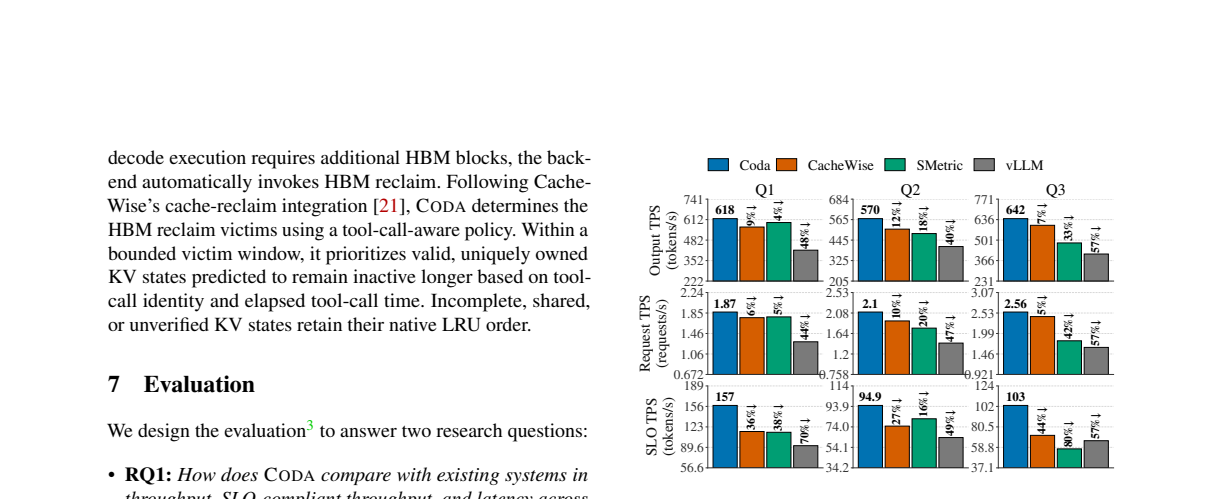
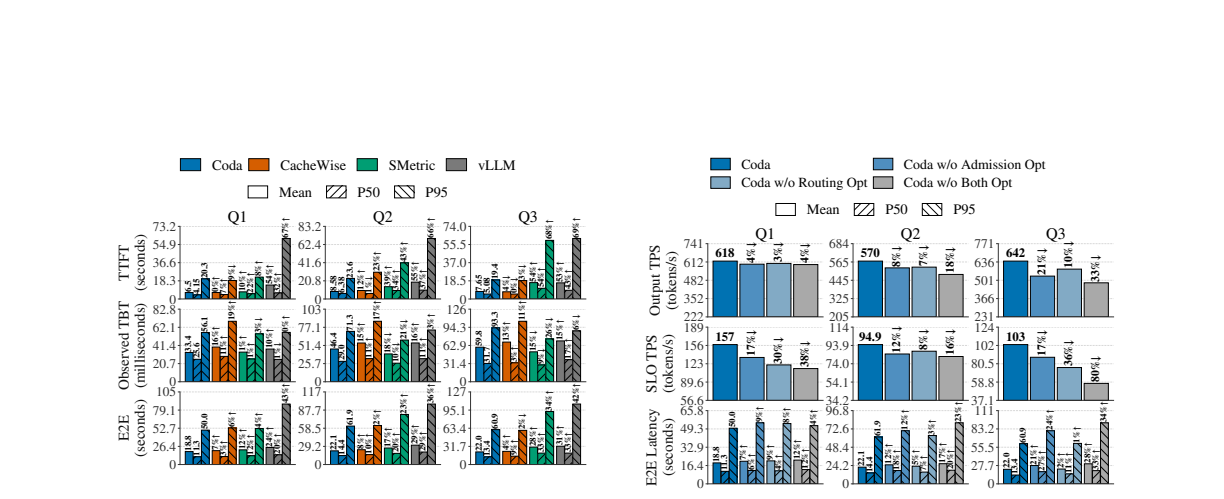
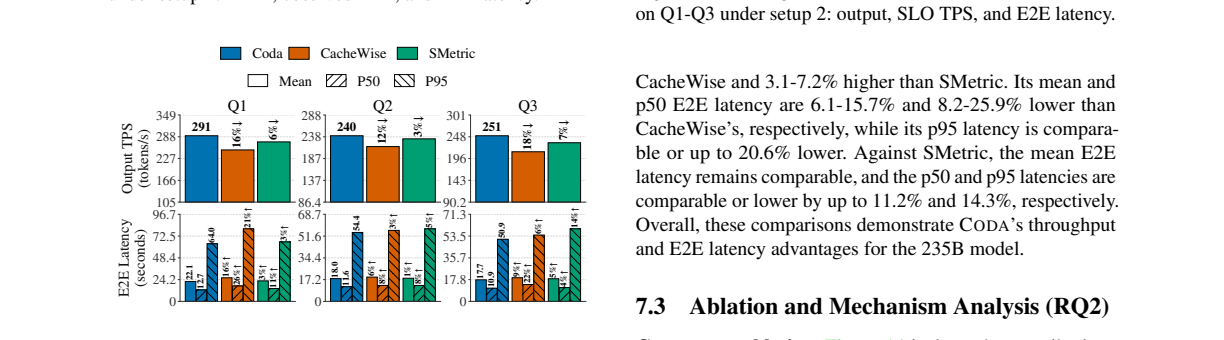
Logical readiness, however, does not ensure efficient admission in a shared serving system. Through direct trace analysis and trace-driven replay, we identify two mismatches: reusable KV states reside across storage tiers and incur unequal computational costs for state preparation, while requests with heterogeneous context lengths can decode inefficiently together. Our central insight is that exploiting admission flexibility can improve serving performance while preserving request progress. We present Coda, a coding-agent serving system that realizes this insight through a readiness-informed admission layer incorporating two mechanisms. Tiered-Aging state admission exploits bounded flexibility in admission order to improve admission efficiency and preserve request progress. Compatibility-Aware execution admission exploits flexibility in attention grouping within each model iteration to reduce mixed-context interference and improve shared decoding efficiency. For multi-worker configurations, Coda introduces a separate routing layer that considers KV-state residency, worker load, and request-to-worker context-length compatibility to guide efficient request placement. We evaluate Coda across different models and workloads against state-of-the-art coding-agent serving systems and vLLM. Across the single-worker and multi-worker experiments, Coda improves output-token and SLO-compliant throughput by 20.3% and 70.5% on average, with peak gains of 29.3% and 140.2%.
from the abstract
Pith says
Machine review · deepseek-v4-flash · 5 Oct 2026 · what was read was not recorded · not checked by a person
It can be wrong. Challenge this review or reply to it.
Holds up, with conditions. A genuine systems paper: the joint admission layer is new, the ablations are clean, and the disclosed parameters and honest limitations make it worth a real referee — but the abstract's headline numbers overstate the strongest-baseline gains, and the Γ=0.05 decision boundary is never swept. This line is wrong
4 major objections · 4 minor
How often objections from reviews like this one are right: not yet measured
Not checked: figures, code, what the 30 references say.
The paper says, at §7.2, Table 1, Appendix A
The review did not quote this passage.
Pith says: Objection 1 of 4 · major
Both admission mechanisms actuate only through offline-calibrated thresholds (τ=5000 ms and Wmax=20,000 ms in Eq. (4); Γ=0.05, Mmin=2, ρ=0.35 in Eq. (7)), yet no sensitivity is reported near any operating point. Table 1 shows the benefit is workload-dependent: on M1, adding Tiered-Aging alone reduces SLO-compliant throughput from 12.788 to 12.370 (−3.3%) while output tokens stay flat (+0.1%), whereas on M2/M3 the same policy gains 8.2–11.8% output and 42.9–86.1% SLO.
more of objection 1
Because the central claim is that admission flexibility 'can improve serving performance,' the paper should report a sweep of Γ, τ, and ideally Wmax on at least one or two traces (or per-trace optimal values) to show the operating point is not on a knife edge. The conservative-gain construction in Appendix A protects against over-selection at the boundary only if the in-profile residual bound is honest, and that regime is exactly what the fixed-threshold reporting leaves uncertified.
The paper says, at §7.1 metrics; Figures 11, 14, 15; Table 1
The review did not quote this passage.
Pith says: Objection 2 of 4 · major
SLO-compliant throughput is one of the two headline metrics (abstract: +70.5% on average, up to +140.2%), but the paper never defines the SLO target. The reader cannot reproduce 'SLO-compliant' without knowing the latency metric and threshold (TBT, E2E, or TTFT; which percentile; what value) against which a request or token is judged compliant, nor how violations are attributed across multi-round sessions. This definition should be stated once in §7.1 and is load-bearing for interpreting the headline gains.
The paper says, at Appendix A, §7
The review did not quote this passage.
A classifier read this sentence of the paper as acknowledging the concern (probability 0.94):
“The current pro- totype and reported experiments do not configure an SSD tier, so Tload i (t) =0 ; an SSD-enabled configuration requires a sep- arately measured loading curve.”
Pith says: Objection 3 of 4 · major
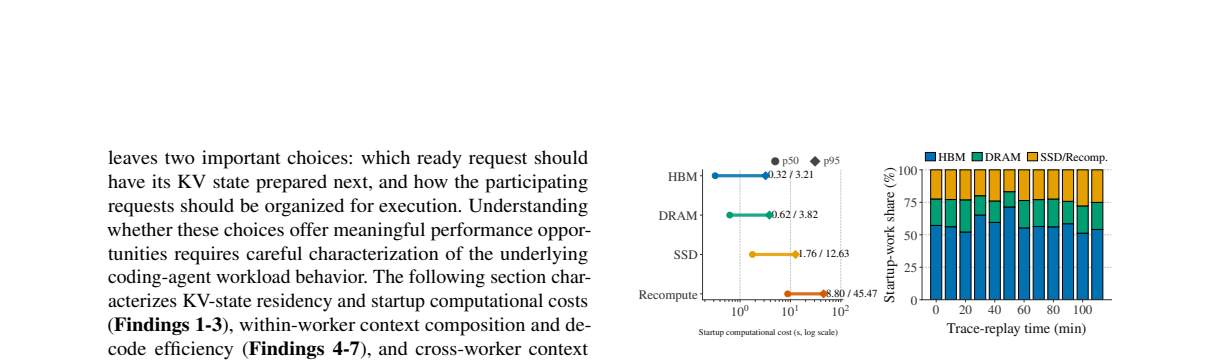
As acknowledged in Appendix A, the current prototype and reported experiments do not configure an SSD tier, so Tload_i(t)=0 and Tiered-Aging is exercised only over the HBM-versus-DRAM restoration differential. The SSD-loading path that motivates state admission — 23.03% of total startup computational cost and p95 12.633 s (Finding 3) — is validated only in the policy-neutral replay with profiled loading curves, not end-to-end.
more of objection 3
The abstract's framing that 'reusable KV states reside across storage tiers' is supported by trace analysis, but the measured end-to-end benefit covers only two of the three tiers; the claims should be scoped, or an SSD-enabled configuration added, so the reader can tell how much of the 20.3%/70.5% headline rests on the unmeasured third tier.
The paper says, at Appendix A, gain-model fitting
The review did not quote this passage.
Pith says: Objection 4 of 4 · major
The paired gain model behind Eq. (7) is fit to measured attention shapes on batch size, log total context, maximum context, and context CV, with shapes partitioned across fitting, calibration, and validation sets. The paper does not report the size of these sets, the residual magnitudes, or the distribution of predicted gains near the Γ=0.05 decision boundary.
more of objection 4
A line stating median/max residual error on the validation set, and ideally the fraction of runtime decisions whose predicted gain falls within one residual bound of Γ, would directly address the miscalibration risk at the boundary.
4 minor objections
The paper says, at Abstract, §7.2
Pith says: minor objection 1 of 4
The abstract and introduction headline the 20.3%/70.5% averages, which mix the unoptimized vLLM baseline into the comparison; the honestly reported strongest-baseline numbers (4.2–12.1% output TPS, 15.9–44.3% SLO TPS) appear only in §7.2. Reporting at least one strongest-baseline figure in the abstract would prevent over-reading of the headline.
The paper says, at Figure 15, §7.1
Pith says: minor objection 2 of 4
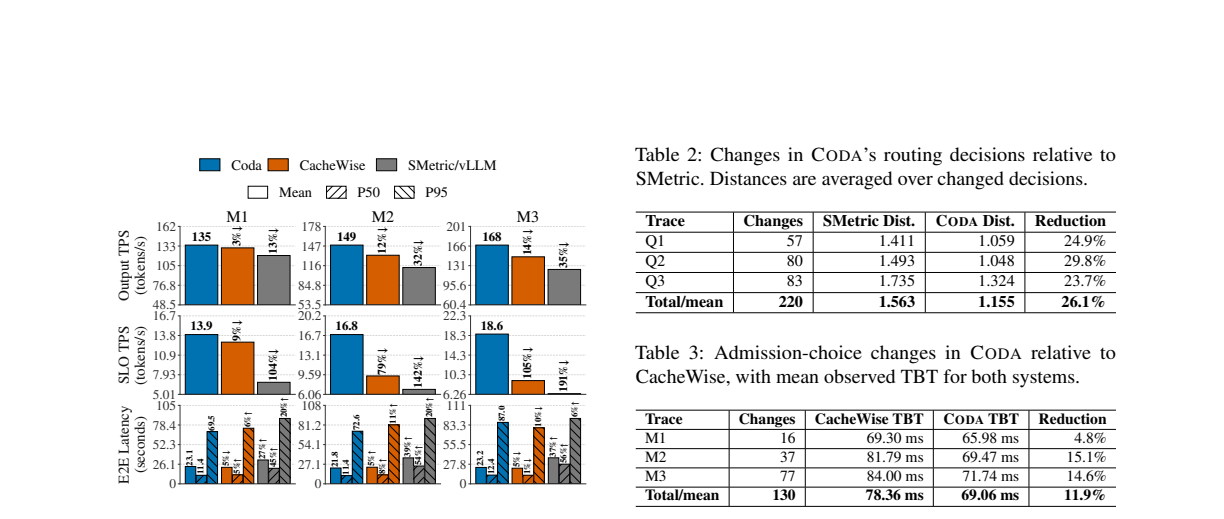
The single-GPU comparison labels the third bar 'SMetric/vLLM' as a shared FIFO baseline; please clarify whether this is a separate variant or a single configuration, and why one baseline serves for both.
show 2 more
The paper says, at Table 3
Pith says: minor objection 3 of 4
Table 3 counts changed admission choices over 'five-minute decision windows' but reports mean TBT over '10-minute measurement windows'; the mismatch in window lengths makes the association between decision changes and TBT improvement unclear and should be explained.
The paper says, at Table 2
Pith says: minor objection 4 of 4
Table 2's context-length distance reduction is shown for changed decisions only; reporting the pooled distance over all decisions (changed and unchanged) would clarify the end-to-end effect of the routing signal rather than only its effect conditional on a change.
What would settle it
Re-run the single-GPU admission ablation on M2 and M3 with the cohorting threshold Γ swept over {0.02, 0.03, 0.05, 0.08, 0.10} at fixed Mmin=2, ρ=0.35, and, in a second family, perturb the Tiered-Aging parameters to (τ, Wmax) ∈ {(3000,15000),(5000,20000),(8000,30000)}. Record SLO-compliant throughput, output throughput, and p95 E2E latency. The concern lands if SLO TPS falls by more than ~5% as Γ drops below the calibrated 0.05 — indicating the fitted gain model over-selects cohorting at the boundary — or if p95 E2E degrades when Wmax is reduced. Flat results across the sweep would show the calibration is robust and the concern does not land.
from the skeptic's reading
How the review went
4 readings by deepseek-v4-flash · 5 Oct 2026
- Reader holds up, with conditions
- Skeptic agrees
- Editor wrote the verdict above
- Referee major revision: 4 major objections, 4 minor
Not run on this paper: the simulated authors' defence.
Pith did not check this review's objections against the paper.
The review in full
The review in brief, machine-written
This is a real systems paper and it deserves a serious referee. The core claim — that you can improve coding-agent serving throughput by treating admission order and attention grouping as controllable rather than fixed by logical readiness — is supported by a genuine end-to-end evaluation with clean ablations and honestly disclosed parameters. The conservative-gain construction for cohort selection (lower bound on full-execution cost, upper bounds on cohort costs, plus a launch allowance, so uncertainty makes cohorting harder to select) is the best part of the engineering. That is what separates a design decision from a tuning knob.
What is actually new: the joint admission layer. CacheWise does eviction, SMetric and ThunderAgent do routing or residency, AlignedServe does prefix batching; none combine bounded preparation-aware ordering with within-iteration attention cohorting. The single-GPU ablation (Table 1) is the strongest evidence: Tiered-Aging alone moves SLO-TPS on M2/M3, and Compatibility-Aware execution adds another 10-26% on top. The routing mechanism check in Table 2 (26.1% distance reduction) is decent supporting evidence.
The stress-test concern about unswept thresholds is fair but somewhat over-stated. The authors disclose τ, Wmax, Γ, Mmin, and ρ in Appendix A and never sweep them — that is true, and Table 1 does show Tiered-Aging is near-neutral or slightly negative on M1 (−3.3% SLO). But the conservative construction genuinely biases selection against cohorting, and the out-of-domain fallback absorbs part of the residual-model risk. The real weakness is the missing sensitivity analysis right at Γ=0.05, where an over-fitted gain model could flip a split. That is a round of experiments, not a rejection.
Two reporting issues. First, the abstract's 20.3%/70.5% headline blends in the unoptimized vLLM baseline; against the strongest competing baseline per trace it is 4.2-12.1% output-TPS and 15.9-44.3% SLO-TPS. The body reports these honestly; the abstract should lead with the strongest-baseline numbers.
Second, the SSD tier is never configured — the authors say so explicitly (Appendix A, Tload=0) — so restoration-cost heterogeneity is only exercised as HBM-versus-DRAM, and the SSD-driven 23% of startup cost is replay-inferred. Acknowledged limitation, but it means one motivation for Tiered-Aging is only partially demonstrated.
For anyone building agentic-serving infrastructure, and for the systems community more broadly: referee it. In my view the paper is CONDITIONAL, not accept-as-is, but the conditions are addressable and the core claim holds up.
The strongest objection
Both admission mechanisms actuate only through offline-calibrated models with fixed thresholds: Eq. 4's Tiered-Aging uses τ=5000 ms and Wmax=20000 ms; Eq. 7's cohorting selects a cut only when the fitted duration/gain model predicts at least Γ=0.05 relative gain, with Mmin=2 and ρ=0.35 (Appendix A). The load-bearing premise is that this fitted gain model correctly ranks one-cohort vs. two-cohort attention cost at runtime, and that the residual bound applied to paired in-profile shapes is honest. The paper's conservative construction — lower bound of C_full, upper bounds of cohorts, plus a profiled launch allowance — genuinely biases against cohorting, and out-of-domain shapes fall back to full execution; I credit that. But the residual risk concentrates exactly where it is least certified: an in-profile shape whose predicted gain sits just above Γ=0.05 with a small residual bound. A validation-set residual bound does not certify that boundary regime. Table 1 is direct evidence that the benefit is workload-dependent and can sit near zero: on M1, Tiered-Aging alone slightly reduces SLO-compliant throughput (12.788 to 12.370, −3.3%) while output tokens are flat (+0.1%), yet on M2/M3 it gains 8.2–11.8% output and 42.9–86.1% SLO. No sensitivity data are reported near any operating threshold. If the gain model over-selects cohorting at the boundary, the measured SLO gains (up to 140.2% vs. vLLM; 15.9–44.3% vs. the strongest baseline) shrink toward the lower end and the headline loses support; if it under-selects, gains hold. The SSD tier is acknowledged as unconfigured (b399, Tload=0), so I do not attack that replay-only inference here, but it means state-preparation heterogeneity is exercised only as HBM-versus-DRAM in the measured system.
This is a well-executed systems paper with unusually complete parameter disclosure (Appendix A states every control: τ, Wmax, Mmin, ρ, Γ, launch allowance, and the profiling protocol) and an honest limitation statement about the SSD tier (b399). The end-to-end ablations (Table 1, Figures 14–15) are real measurements that support the central claim within the measured configuration, and the routing/state/execution mechanisms are cleanly separated. My stress-test converges on the reader's weakest assumption: the correctness of the offline-calibrated decision models at their operating thresholds. I sharpened it in two ways. First, the conservative-gain construction the paper uses is genuinely conservative, so the residual risk is not that CODA is aggressive; it is that for in-profile shapes the held-out residual bound may not certify the just-above-Γ regime, and no sensitivity sweep exists. Second, Table 1 provides in-paper evidence that the mechanism's benefit is workload-dependent and can be slightly negative (M1 Tiered-Aging SLO −3.3%), which is precisely the boundary-fragility regime the paper does not characterize. This does not refute the central claim — the measured gains on M2/M3 and Q1–Q3 are real — but it supports keeping the verdict CONDITIONAL pending a sensitivity analysis. The SSD concern is real but acknowledged by the authors and secondary: it affects generalization of the state-admission motivation, not the measured results. There is no ad hominem and no manufactured concern; the request is for a threshold-sensitivity experiment the paper omits. Since the reader already issued CONDITIONAL for the same core reason, my read does not change the verdict.
The referee's report
The paper's strengths are real: an end-to-end evaluation against genuine baselines (CacheWise, SMetric, vLLM) on A100 clusters; component ablations in Table 1 and Figure 14 that isolate Tiered-Aging, Compatibility-Aware execution admission, and routing; and an intentionally conservative design in which Eq. (7)'s cohort selection uses a lower bound on full-batch cost, upper bounds on cohort costs, and a 0.3 ms launch allowance, so uncertainty makes cohort execution harder to select, with out-of-domain shapes falling back to full execution. The per-trace comparison against the strongest competing baseline is reported honestly in §7.2 (4.2–12.1% output TPS, 15.9–44.3% SLO TPS). If the calibrated gates are robust, the contribution is a useful, well-ablated demonstration that admission-order and attention-grouping flexibility yield measurable serving gains without changing the participating request set. The residual risk is that the entire benefit is mediated by offline-calibrated thresholds whose operating regime is never stress-tested, and that the SSD motivation is never exercised end-to-end.
Pith's reading of the paper (a machine's summary, not the authors')
The paper tries to establish that admission control—deciding which ready request gets its KV state prepared next, and how ready requests are grouped for attention execution—is a first-class performance lever that coding-agent workloads make especially valuable. Through direct analysis of a large coding-agent trace corpus and trace-driven replay, it shows two mismatches: reusable key-value (KV) cache state (the saved attention history that lets a session resume without recomputing its prefix) sits across HBM, DRAM, and SSD and costs very different amounts of work to restore, while requests with very different context lengths decode inefficiently when batched together. On that evidence it builds CODA, whose admission layer reorders state preparation by a tier-aware cost with an aging and progress guard, and reorganizes heterogeneous decode batches into context-compatible attention cohorts only when a calibrated cost model predicts the regrouping pays. Evaluated against two state-of-the-art coding-agent serving systems and vLLM, CODA reports average output-token and SLO-compliant throughput gains of 20.3% and 70.5%, with peak gains of 29.3% and 140.2%, while leaving the participating request set within each model iteration unchanged. If correct, this shows a serving system can meet more latency budgets without starving or delaying anyone, purely by choosing order and grouping more cleverly.
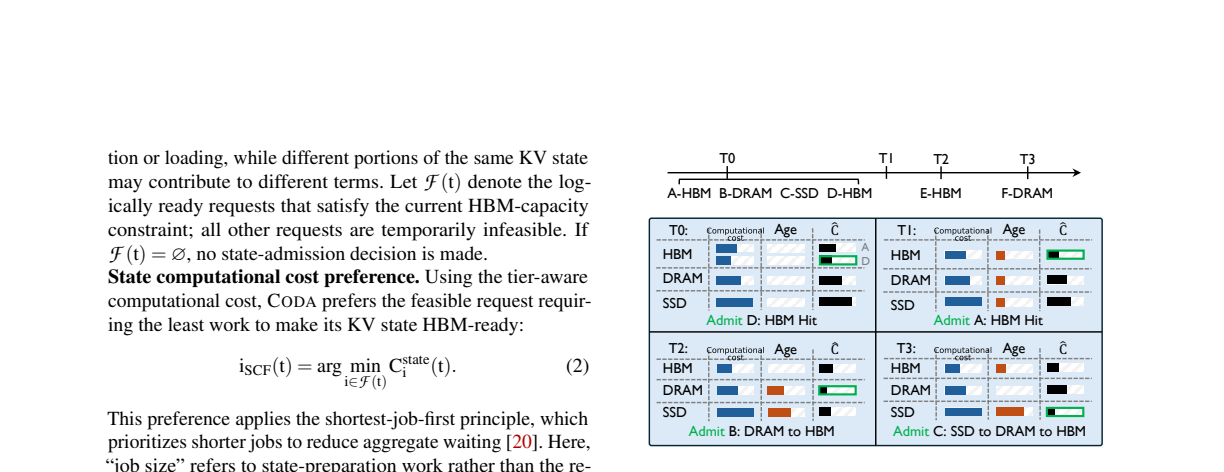
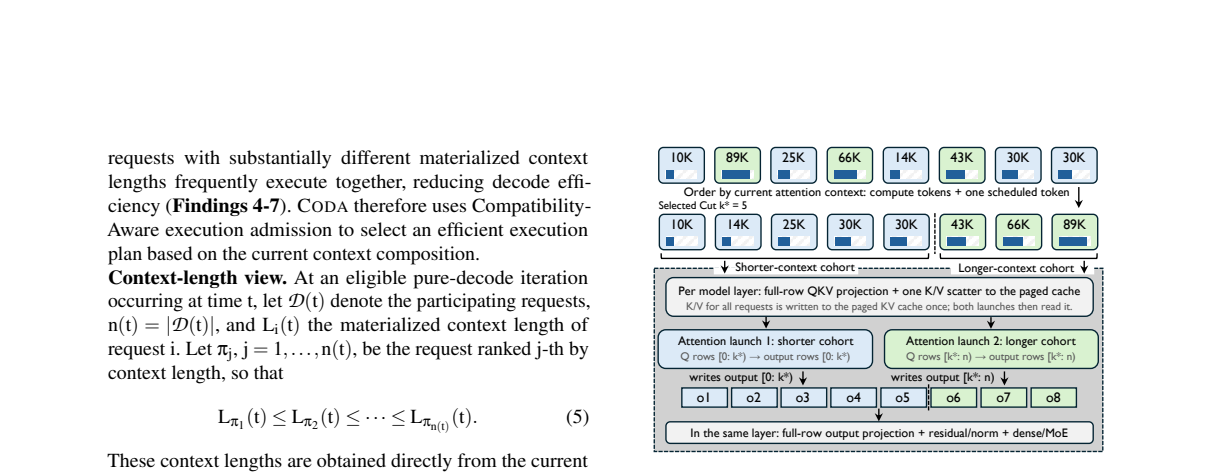
What carries the argument. Two decision rules and one routing score carry the argument. The Tiered-Aging state-admission rule (Eq. 4) selects the feasible request \(i^* = o(t)\) if the oldest ready request's wait \(w_{o(t)}(t) \ge W_{\max}\), otherwise the request minimizing the age-adjusted state cost \(\hat{C}_i(t) = $C^{{\text{state}}$}_i(t)/(1 + w_i(t)/\tau)\), where \($C^{{\text{state}}$}_i\) is the sum of CPU-to-GPU restoration, SSD-to-HBM loading, and prefill work (Eq. 1). The Compatibility-Aware execution-admission rule (Eq. 7) chooses the context-length cut \(k^*\) maximizing the predicted relative attention-cost gain of two-cohort over full-batch execution, applying the split only when the conservative predicted gain exceeds \(\Gamma = 0.05\) and each cohort holds at least \(\max(M_{\min}, \rho n)\) requests (Eq. 6). The routing distance (Eq. 8) measures a request's log-ratio context mismatch to each load-eligible worker's active decode population. The load-bearing machinery is the offline-calibrated cost model (Appendix A) that turns shape features—batch size, log total context, maximum context, context CV—into duration predictions whose lower and upper bounds are used conservatively, so uncertainty makes cohort selection harder rather than easier.
Core claim. The paper's central claim is that a coding-agent serving system can raise output-token and SLO-compliant throughput without changing which requests join a model iteration, by exploiting the bounded flexibility that exists between a request becoming logically ready and its physical GPU execution. CODA realizes this with two admission mechanisms. Tiered-Aging state admission selects which ready request has its KV state prepared next, using an estimated tier-aware preparation cost modified by waiting age (Eq. 3) and a hard progress guard (Eq. 4) that forces the oldest feasible request to be admitted once its wait exceeds \(W_{\max}\). Compatibility-Aware execution admission keeps the complete batch but partitions it into a shorter- and longer-context cohort (Eq. 6) whenever a fitted gain model (Eq. 7) predicts at least 5% conservative relative gain, otherwise retaining full-batch execution. For multi-worker serving, a routing layer adds context-length compatibility to a reuse- and load-aware placement policy, selecting among load-eligible workers the one whose active decode population is contextually closest (Eq. 8). Across the Qwen3-30B and Qwen3-235B models and three TraceLab-derived workloads, the method reports average output-token and SLO-compliant throughput gains of 20.3% and 70.5% over the strongest baseline for each metric.
The premise it rests on. The paper's results stand on the assumption that its offline-calibrated cost models—particularly the execution-gain model of Eq. (7), which must predict at least a 5% relative gain before cohorts are used—correctly forecast when reordering state preparation and regrouping decode batches actually saves computation, and the paper itself acknowledges that the SSD tier is never configured in the prototype, so the loading term \($T^{{\text{load}}$}_i(t)\) is zero and the SSD-driven benefit is inferred from replay rather than measured end to end.
If the paper is right (Pith's inferences, not the authors')
If the claim holds, serving systems gain a new optimization axis without changing their fairness contract: a readiness-informed admission layer that bounds reordering with a progress guard preserves request progress while raising efficiency, because the participating set within each model iteration never changes.
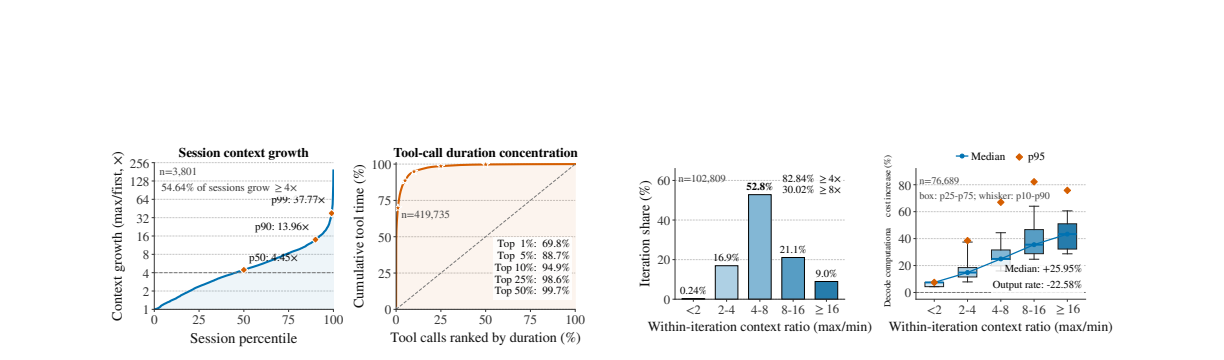
The decode-dominance finding—that 79.34% of model-execution time sits in pure-decode iterations and mixed-context compositions incur 25.95% higher median cost at fixed token volume—implies attention grouping, not just scheduling or eviction, is a productive lever for agentic workloads.
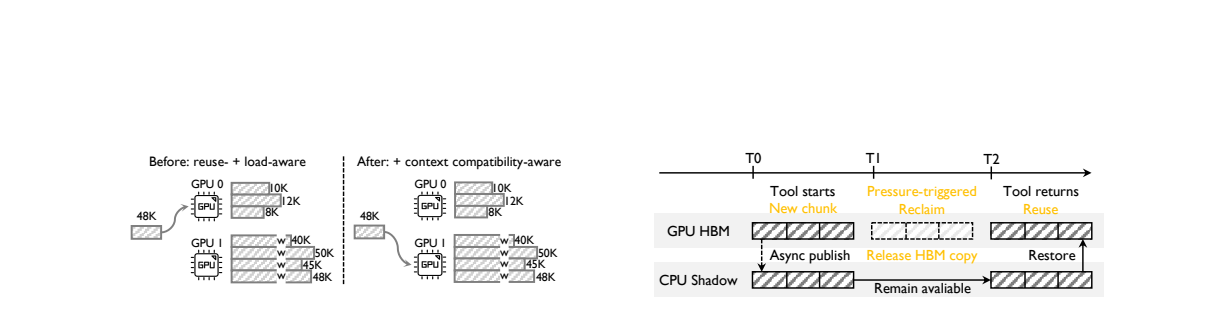
The multi-worker results tie context-length compatibility to routing without sacrificing KV affinity or load balance, predicting that cueing placement by decode-context shape raises cluster-wide SLO-compliant throughput.
Because runtime decisions use only current KV-residency, missing-prefix work, waiting age, and materialized context lengths—never future output lengths or tool-return times—the mechanisms can generalize to workloads whose tool-call dynamics differ from the measured traces, as long as the offline profiles match the hardware.
The admission-policy ablation (Tiered-Aging then Compatibility-Aware on top of CacheWise) indicates the two mechanisms have complementary, additive effects, so systems adopting only one of them should expect partial rather than full gains.
Editorial extension: because the two decisions act on different axes—preparation order across the storage hierarchy and attention grouping within an iteration—the same admission-layer pattern could transfer to other context-carrying application workloads (multi-turn assistants with long tool echoes, retrieval-augmented pipelines) where ready requests differ in restoration cost and context length.
Editorial extension: a testable interaction is that the gain threshold \(\Gamma\) and aging timescale \(\tau\) trade off against each other—loosening the 0.05 gain gate should pay off more as attention kernels become more length-sensitive, and tightening the progress guard \(W_{\max}\) should exchange a bounded amount of SLO throughput for strictly lower admission waiting.
Editorial extension: the reported gains come from NVLink-attached A100s; an unmeasured stress is disaggregated or heterogeneous-GPU pools where restoration and prefill bandwidths vary per worker, where the routing distance of Eq. (8) may need a bandwidth-weighted variant.
Editorial extension: the findings rest on a single public trace corpus, so the cleanest external check is to replay the two mechanisms on an independent coding-agent trace with different tool-call duration distributions and confirm that the 20-29% output-throughput and 70-140% SLO-throughput gains persist.
Check this review
Pith stored no record of this review's passes and took no fingerprint of it. Reviews made by code from 13 Nov 2026 on carry both.
How often reviews like this one are right
Reviews like this one: written by deepseek-v4-flash, where what was read was not recorded.
How often objections from reviews like this one are right: not yet measured
Reviews by people
This review was written by a machine. No person has reviewed this paper on Pith yet. A scientist listed on Pith can review it for a fee, and their review is published here whatever it concludes.
The paper
Abstract
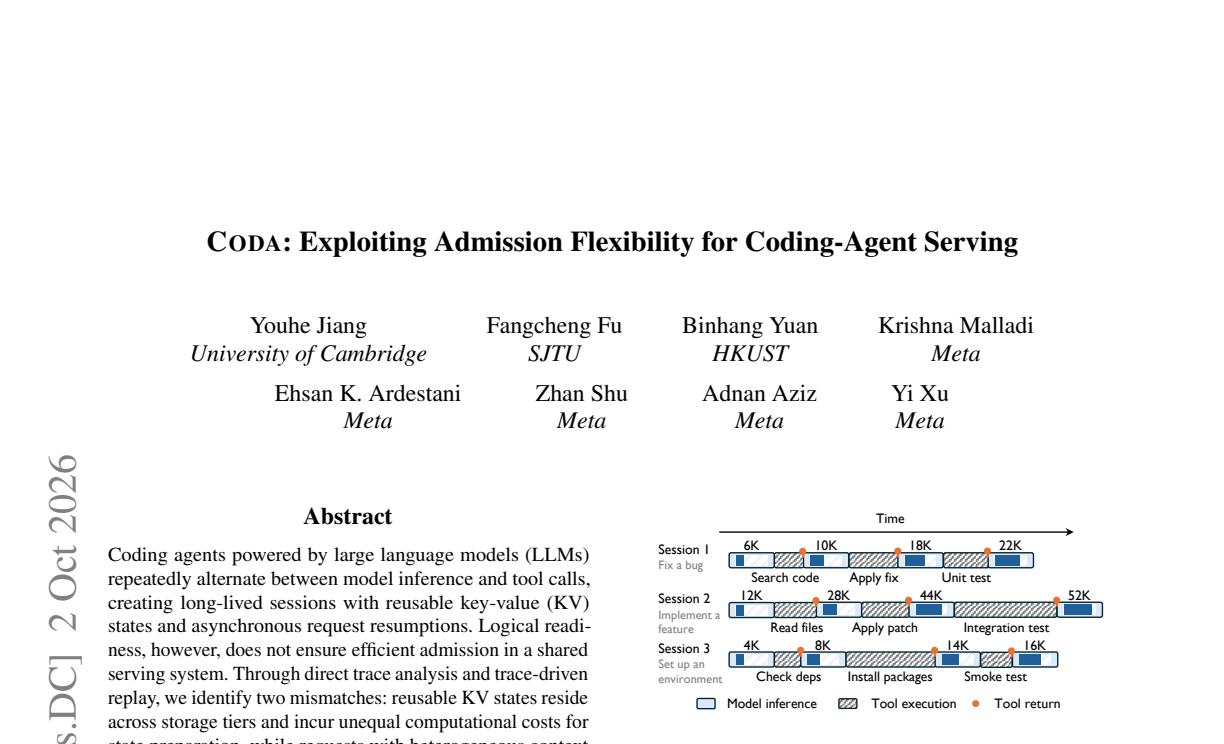
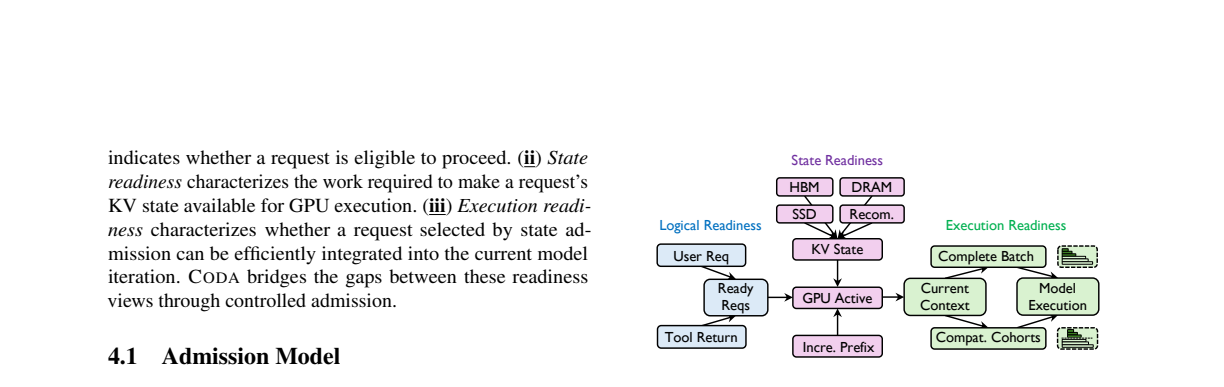
Coding agents powered by large language models (LLMs) repeatedly alternate between model inference and tool calls, creating long-lived sessions with reusable key-value (KV) states and asynchronous request resumptions. Logical readiness, however, does not ensure efficient admission in a shared serving system. Through direct trace analysis and trace-driven replay, we identify two mismatches: reusable KV states reside across storage tiers and incur unequal computational costs for state preparation, while requests with heterogeneous context lengths can decode inefficiently together. Our central insight is that exploiting admission flexibility can improve serving performance while preserving request progress. We present Coda, a coding-agent serving system that realizes this insight through a readiness-informed admission layer incorporating two mechanisms. Tiered-Aging state admission exploits bounded flexibility in admission order to improve admission efficiency and preserve request progress. Compatibility-Aware execution admission exploits flexibility in attention grouping within each model iteration to reduce mixed-context interference and improve shared decoding efficiency. For multi-worker configurations, Coda introduces a separate routing layer that considers KV-state residency, worker load, and request-to-worker context-length compatibility to guide efficient request placement. We evaluate Coda across different models and workloads against state-of-the-art coding-agent serving systems and vLLM. Across the single-worker and multi-worker experiments, Coda improves output-token and SLO-compliant throughput by 20.3% and 70.5% on average, with peak gains of 29.3% and 140.2%.
The paper's own sentences, arranged, kept beside the review and separate from it. Each label is drawn from a closed vocabulary; the number beside it is the probability the classifier gave that label. No sentence in this record was written by a model.
abstract compiled · 2026-10-05
The authors' main claim, as the classifier picked it out 0.74
“Our central insight is that exploiting admission flexibility can improve serving performance while preserving request progress.”
How the main claim is stated: asserted 0.82
What the abstract itself states, as probabilities: claims first 0.05 · states limitation 0.11 · human participants 0.02 · controlled comparison 0.93 · randomized assignment 0.02 · states quantitative result 0.99 · compares with prior results 0.98 · mentions code or data availability 0.03
The abstract, sentence by sentence
This table labels the abstract only (arXiv listing abstract v1). The number is the probability the classifier gave the label.
| Sentence | Role | The authors' own work | States the main conclusion | Strength |
|---|---|---|---|---|
| Coding agents powered by large language models (LLMs) repeatedly alternate between model inference and tool calls, creating long-lived sessions with reusable key-value (KV) states and asynchronous request resumptions. | background 1.00 | 0.12 | 0.02 | asserted 1.00 |
| Logical readiness, however, does not ensure efficient admission in a shared serving system. | gap 0.65 | 0.10 | 0.03 | asserted 1.00 |
| Through direct trace analysis and trace-driven replay, we identify two mismatches: reusable KV states reside across storage tiers and incur unequal computational costs for state preparation, while requests with heterogeneous context lengths can decode inefficiently together. | result 0.48 | 0.95 | 0.04 | asserted 1.00 |
| Our central insight is that exploiting admission flexibility can improve serving performance while preserving request progress. | interpretation 0.75 | 0.56 | 0.75 | asserted 0.82 |
| We present Coda, a coding-agent serving system that realizes this insight through a readiness-informed admission layer incorporating two mechanisms. | contribution 0.97 | 0.89 | 0.10 | asserted 0.99 |
| Tiered-Aging state admission exploits bounded flexibility in admission order to improve admission efficiency and preserve request progress. | method 0.80 | 0.84 | 0.10 | asserted 1.00 |
| Compatibility-Aware execution admission exploits flexibility in attention grouping within each model iteration to reduce mixed-context interference and improve shared decoding efficiency. | method 0.82 | 0.83 | 0.05 | asserted 1.00 |
| For multi-worker configurations, Coda introduces a separate routing layer that considers KV-state residency, worker load, and request-to-worker context-length compatibility to guide efficient request placement. | method 0.85 | 0.91 | 0.04 | asserted 1.00 |
| We evaluate Coda across different models and workloads against state-of-the-art coding-agent serving systems and vLLM. | method 0.79 | 0.93 | 0.03 | asserted 0.88 |
| Across the single-worker and multi-worker experiments, Coda improves output-token and SLO-compliant throughput by 20.3% and 70.5% on average, with peak gains of 29.3% and 140.2%. | result 1.00 | 0.97 | 0.47 | asserted 1.00 |
What kind of paper the classifier reports this is: method or tool 1.00 · evidence from observation or experiment 1.00
What was examined, and what was not
Sources read
- arXiv listing abstract v1
Not examined
- full text
- figures and tables
- references and citing sentences
- relations to other papers
Levels run
- P abstract
Not run
- S sections
- T body sentences
- C citations
- R cross-paper relations
How the labels were made
Compiled by classifier-1.13.0 via TypeSafe API, question bank abstract-p1-20260923, 2026-10-05: 1 request, 7,593 input tokens.
Every quoted sentence on this record is the authors'. Every label is from Pith's closed vocabulary, with the probability shown beside it. This record as JSON
Figures (16)
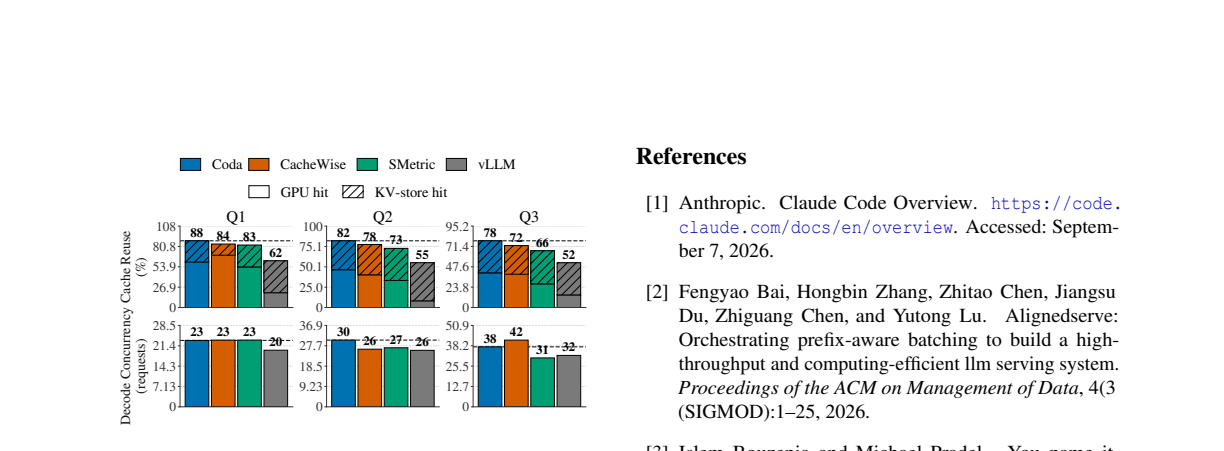
Showing 13 of the paper's 16 figures. Figures are the authors', reproduced from the paper.
References (30)
- [1] Anthropic. Claude Code Overview. https://code. claude.com/docs/en/overview. Accessed: Septem- ber 7, 2026 on Pith
- [2] Fengyao Bai, Hongbin Zhang, Zhitao Chen, Jiangsu Du, Zhiguang Chen, and Yutong Lu. Alignedserve: Orchestrating prefix-aware batching to build a high- throughput and computing-efficient llm serving system. Proceedings of the ACM on Management of Data, 4(3 (SIGMOD):1–25, 2026 on Pith
- [3] Islem Bouzenia and Michael Pradel. You name it, i run it: An llm agent to execute tests of arbitrary projects.Proceedings of the ACM on Software Engi- neering, 2(ISSTA):1054–1076, 2025 on Pith
- [4] Chaokun Chang, Yukun Zhou, Kaihua Fu, Dakai An, Tianyu Feng, Hanfeng Lu, Sheng Yao, Pu Guo, Yinghao Yu, Yizhou Shan, et al. From llm inference to agentic workloads: Characterization and implications for serv- ing systems.arXiv preprint arXiv:2608.15127, 2026 on PithPith's reviewarXiv
- [5] Cursor. Cursor Agent. https://cursor.com/docs/ agent/overview. Accessed: September 7, 2026 on Pith
- [6] Bin Gao, Zhuomin He, Puru Sharma, Qingxuan Kang, Djordje Jevdjic, Junbo Deng, Xingkun Yang, Zhou Yu, and Pengfei Zuo. {Cost-Efficient} large lan- guage model serving for multi-turn conversations with {CachedAttention}. In2024 USENIX annual technical conference (USENIX ATC 24),... on Pith
- [7] Shipeng Hu, Guangyan Zhang, Yuqi Zhou, Yaya Wei, Ziyan Zhong, and Jike Chen. Bidaw: Enhancing{Key- Value} caching for interactive{LLM} serving via bidi- rectional{Computation–Storage} awareness. In24th USENIX Conference on File and Storage Technologies (FAST 26), pages 101–116, 2026 on Pith
- [8] Youhe Jiang, Fangcheng Fu, Xiaozhe Yao, Guoliang He, Xupeng Miao, Ana Klimovic, Bin Cui, Binhang Yuan, and Eiko Yoneki. Demystifying cost-efficiency in llm serving over heterogeneous gpus.arXiv preprint arXiv:2502.00722, 2025 on PithPith's reviewarXiv
- [9] Youhe Jiang, Fangcheng Fu, Xiaozhe Yao, Taiyi Wang, Bin Cui, Ana Klimovic, and Eiko Yoneki. Thunder- serve: High-performance and cost-efficient llm serving in cloud environments.Proceedings of Machine Learn- ing and Systems, 7, 2025 on Pith
- [10] Youhe Jiang, Ran Yan, Xiaozhe Yao, Yang Zhou, Beidi Chen, and Binhang Yuan. Hexgen: Generative inference of large language model over heterogeneous environ- ment.arXiv preprint arXiv:2311.11514, 2023. 13 on PithPith's reviewarXiv
- [11] Youhe Jiang, Ran Yan, and Binhang Yuan. Hexgen-2: Disaggregated generative inference of llms in hetero- geneous environment. InInternational Conference on Learning Representations, volume 2025, pages 3985– 4002, 2025 on Pith
- [12] Hao Kang, Ziyang Li, Weili Xu, Xinyu Yang, Yinfang Chen, Junxiong Wang, Beidi Chen, Tushar Krishna, Chenfeng Xu, and Simran Arora. Thunderagent: A sim- ple, fast and program-aware agentic inference system. arXiv preprint arXiv:2602.13692, 2026 on PithPith's reviewarXiv
- [13] Woosuk Kwon, Zhuohan Li, Siyuan Zhuang, Ying Sheng, Lianmin Zheng, Cody Hao Yu, Joseph Gonzalez, Hao Zhang, and Ion Stoica. Efficient memory manage- ment for large language model serving with pagedatten- tion. InProceedings of the 29th symposium on operating systems principles... on Pith
- [14] Banruo Liu, Haoran Qiu, Íñigo Goiri, Rodrigo Fonseca, Ricardo Bianchini, and Esha Choukse. Agentic coding in the wild: Characterizing github copilot traces at pro- duction scale.arXiv preprint arXiv:2608.00101, 2026 on PithPith's reviewarXiv
- [15] Yuhan Liu, Yihua Cheng, Jiayi Yao, Yuwei An, Xiaokun Chen, Shaoting Feng, Yuyang Huang, Samuel Shen, Rui Zhang, Kuntai Du, et al. Lmcache: An efficient kv cache layer for enterprise-scale llm inference.arXiv preprint arXiv:2510.09665, 2025 on PitharXiv
- [16] LMCache Project. GDS Backend. https: //docs.lmcache.ai/kv_cache/storage_ backends/gds.html. Accessed September 2026 on Pith
- [17] OpenAI. Codex CLI. https://learn.chatgpt.com/ docs/codex/cli. Accessed: September 7, 2026 on Pith
- [18] Ruoyu Qin, Zheming Li, Weiran He, Jialei Cui, Heyi Tang, Feng Ren, Teng Ma, Shangming Cai, Yineng Zhang, Mingxing Zhang, et al. Mooncake: A kvcache- centric disaggregated architecture for llm serving.ACM Transactions on Storage, 22(4):1–38, 2026 on Pith
- [19] Ying Sheng, Lianmin Zheng, Binhang Yuan, Zhuohan Li, Max Ryabinin, Beidi Chen, Percy Liang, Christopher Ré, Ion Stoica, and Ce Zhang. Flexgen: High-throughput generative inference of large language models with a single gpu. InInternational Conference on Machine Learning, pages... on Pith
- [20] Wayne E Smith. Various optimizers for single-stage production.Naval Research Logistics Quarterly, 3(1- 2):59–66, 1956 on Pith
show 10 more
- [21] Shubham Tiwari, Tapan Chugh, Nash Rickert, Simon Peter, Ratul Mahajan, and Haiying Shen. Cachewise: Understanding workloads and optimizing kvcache man- agement for efficiently serving llm coding agents.arXiv preprint arXiv:2606.16824, 2026 on PitharXiv
- [22] Jiahao Wang, Kaizhan Lin, Kaixi Zhang, Jinbo Han, Xingda Wei, Sijie Shen, Chenguang Fang, Wenyuan Yu, Rong Chen, and Haibo Chen. Smetric: Rethink llm scheduling for serving agents with balanced session- centric scheduling.arXiv preprint arXiv:2607.08565, 2026 on PithPith's reviewarXiv
- [23] Xingyao Wang, Boxuan Li, Yufan Song, Frank F Xu, Xiangru Tang, Mingchen Zhuge, Jiayi Pan, Yueqi Song, Bowen Li, Jaskirat Singh, et al. Openhands: An open platform for ai software developers as generalist agents. InInternational Conference on Learning Representa- tions, volume ... on Pith
- [24] Tian Xia, Hanchen Li, Zhifei Li, Xiaokun Chen, Hao Kang, Yifan Qiao, Yi Xu, and Ion Stoica. Idleness is relative: Exploiting tool-call idle windows for of- floading in agentic systems with mori.arXiv preprint arXiv:2606.00866, 2026 on PithPith's reviewarXiv
- [25] An Yang, Anfeng Li, Baosong Yang, Beichen Zhang, Binyuan Hui, Bo Zheng, Bowen Yu, Chang Gao, Chen- gen Huang, Chenxu Lv, et al. Qwen3 technical report. arXiv preprint arXiv:2505.09388, 2025 on PithPith's reviewarXiv
- [26] John Yang, Carlos Jimenez, Alexander Wettig, Kilian Lieret, Shunyu Yao, Karthik Narasimhan, and Ofir Press. Swe-agent: Agent-computer interfaces enable auto- mated software engineering.Advances in Neural In- formation Processing Systems, 37:50528–50652, 2024 on Pith
- [27] Shunyu Yao, Jeffrey Zhao, Dian Yu, Nan Du, Izhak Shafran, Karthik Narasimhan, and Yuan Cao. React: Synergizing reasoning and acting in language models. arXiv preprint arXiv:2210.03629, 2022 on PithPith's reviewarXiv
- [28] Gyeong-In Yu, Joo Seong Jeong, Geon-Woo Kim, Soo- jeong Kim, and Byung-Gon Chun. Orca: A distributed serving system for {Transformer-Based} generative models. In16th USENIX symposium on operating sys- tems design and implementation (OSDI 22), pages 521– 538, 2022 on Pith
- [29] Li Zhang, Youhe Jiang, Guoliang He, Xin Chen, Han Lv, Qian Yao, Ningsheng Ma, Fangcheng Fu, and Kai Chen. Lmdeploy accelerates mixed-precision llm infer- ence with turbomind.arXiv preprint arXiv:2508.15601, 2025 on PithPith's reviewarXiv
- [30] Kan Zhu, Mathew Jacob, Chenxi Ma, Yi Pan, Stephanie Wang, Arvind Krishnamurthy, and Baris Kasikci. Trace- lab: Characterizing coding agent workloads for llm serv- ing.arXiv preprint arXiv:2606.30560, 2026. 14 A Profiling Details Profile scope.CODAprofiles each model–hardware–s... on PithPith's reviewarXiv
Cited by 2 Pith papers
Reviewed papers on Pith that cite this one. The full citation record
Challenges and discussion
Disagree with the review, or know something it missed? Leave a comment, or challenge this review formally: a challenge becomes a permanent entry in this paper's record, and its decision is published here.
Come back by email
A short list of the week's newly reviewed papers. Nothing is sent until you confirm from your inbox, and every email has a link that stops it. No account.
No comments yet.
Sign in to comment