Distributed, Parallel, and Cluster Computing · arXiv:2611.02543 v1 · submitted 2 Nov 2026 · 96 references
When Cache Pressure Becomes a Trap: Metastability in Agent Serving
The paper says
“LLM agents repeatedly send a growing conversation to a model, making prefix reuse central to efficient serving.”
more of the abstract
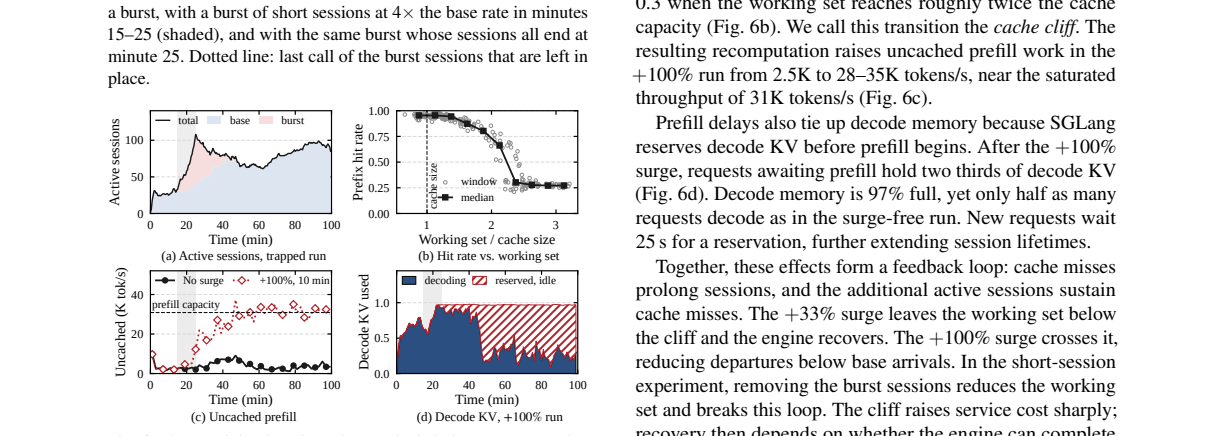
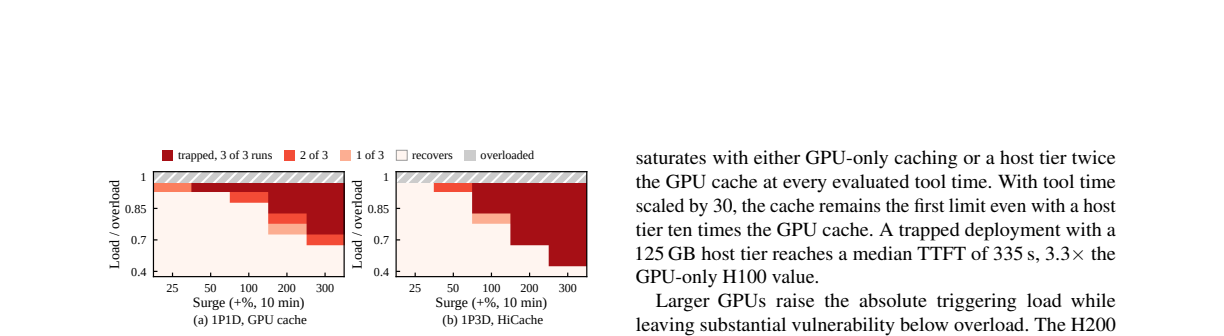
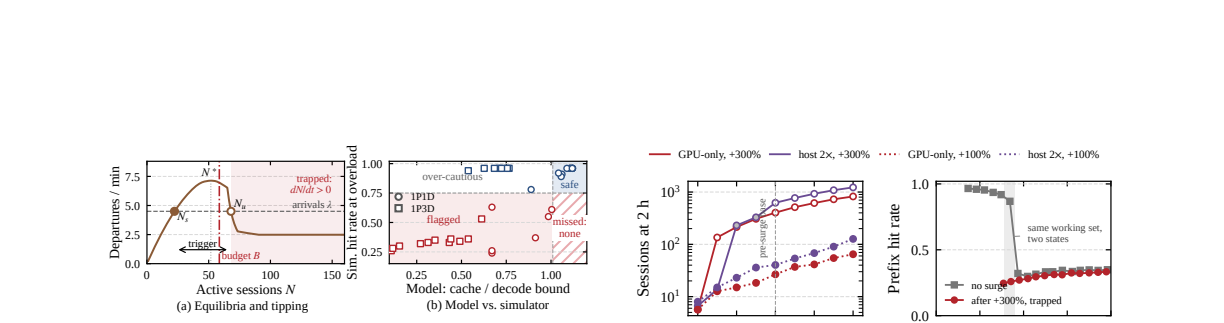
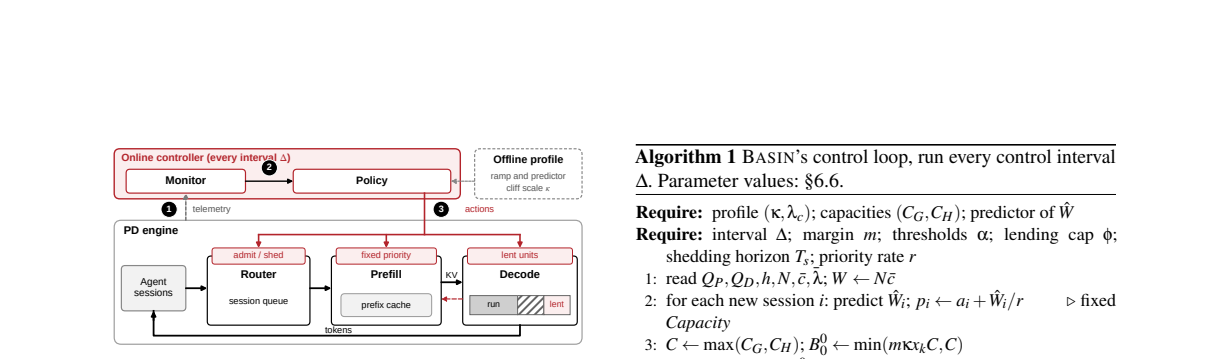
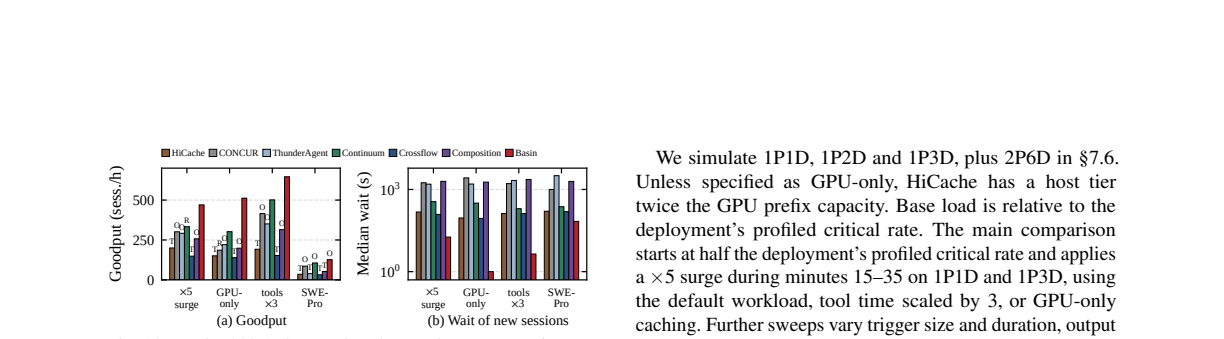
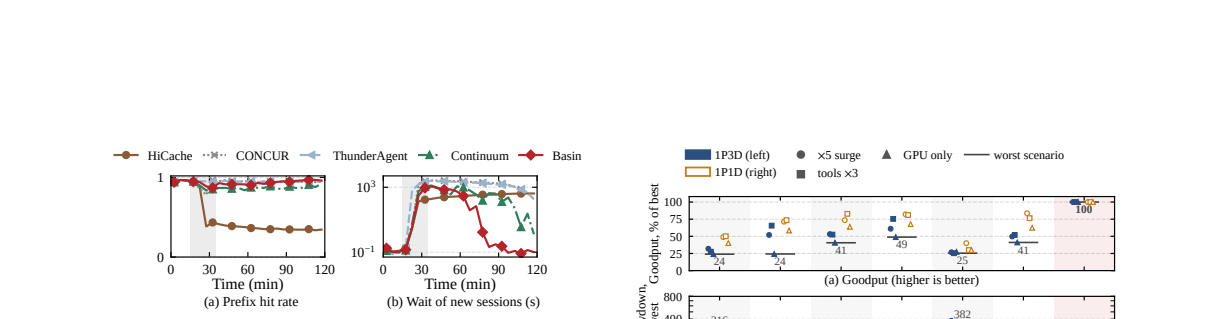
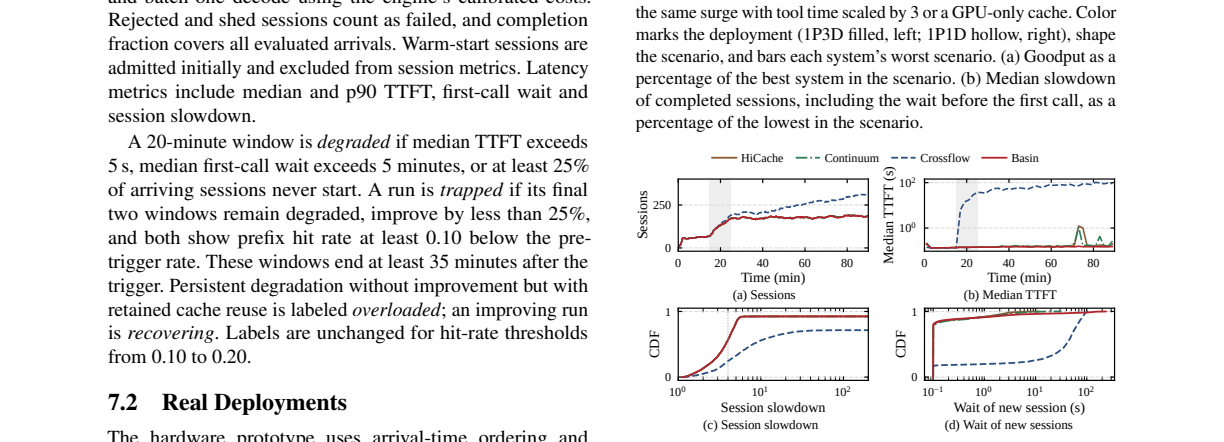
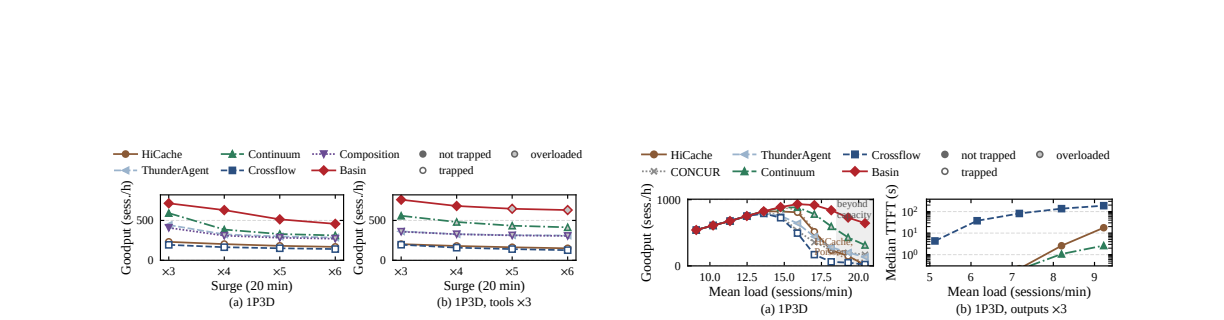
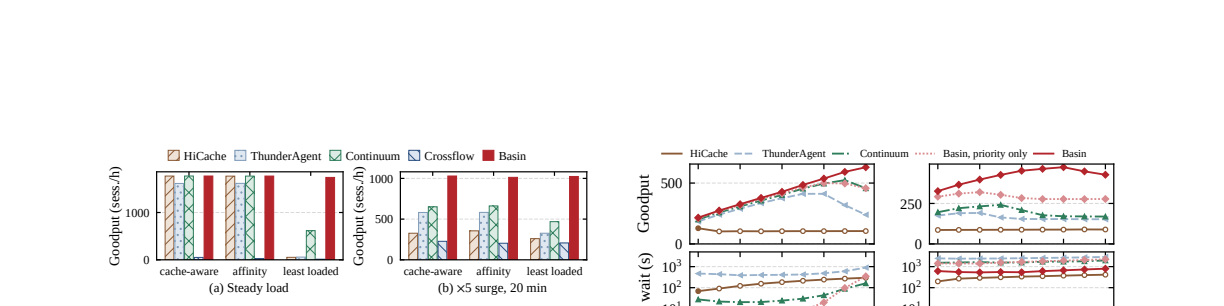
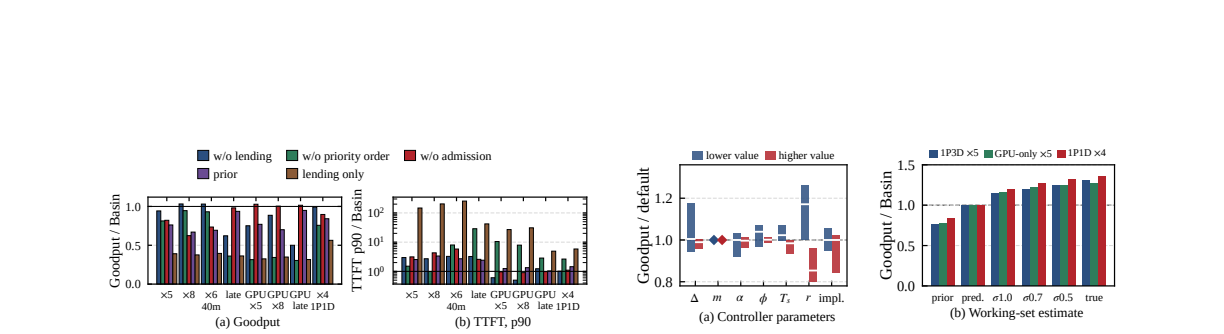
We show that a brief surge can disrupt this reuse and trigger metastable failure in prefill–decode (PD) disaggregated engines: service remains degraded after arrivals return to a load the engine previously sustained. On SGLang, a ten-minute surge reduced goodput by about 88% over the following hour. Removing the residual burst sessions restored service within minutes. The sustaining mechanism is population-cache feedback. Slower calls prolong sessions and enlarge their aggregate context, or working set; the resulting cache misses increase recomputation and further delay departures. A fluid model identifies the resource conditions for this feedback and explains how cache capacity, tool time and base load affect vulnerability. Across 36 simulated deployments, it flags all 17 cache-first cases. Controlled simulations hold the post-surge state fixed and show that changing subsequent arrivals alone reverses the recovery outcome. Once the cache collapses, low-reuse departure capacity sets the scale of the load reduction needed for recovery. Guided by these dynamics, we build Basin, which gives each session a fixed priority, reserves their predicted peak contexts against an adaptive admission budget, extends the cache with idle decode memory, and sheds excess demand. On real H200 1P3D deployments under surges, including long-context SWE-bench Pro sessions, an arrival-time prototype achieves 1.20–1.70x the goodput of Continuum and 2.35–3.59x that of HiCache alone. In simulation, the predictor-driven policy delivers 1.20–2.05x the strongest baseline's goodput across six surge scenarios.
from the abstract
Pith says
Machine review · deepseek-v4-flash · 3 Nov 2026 · what was read was not recorded · not checked by a person
It can be wrong. Challenge this review or reply to it.
Holds up, with conditions. A real metastability claim backed by a well-designed causal intervention, but the 88% headline rests on single unreplicated runs and the simulator cannot independently validate it; referee-worthy, with replication and artifacts the conditions for trusting the number. This line is wrong
3 major objections · 5 minor
How often objections from reviews like this one are right: not yet measured
Not checked: figures, code, what the 96 references say.
The paper says, at Sections 3.2-3.3, Figs. 4-5
The review did not quote this passage.
Pith says: Objection 1 of 3 · major
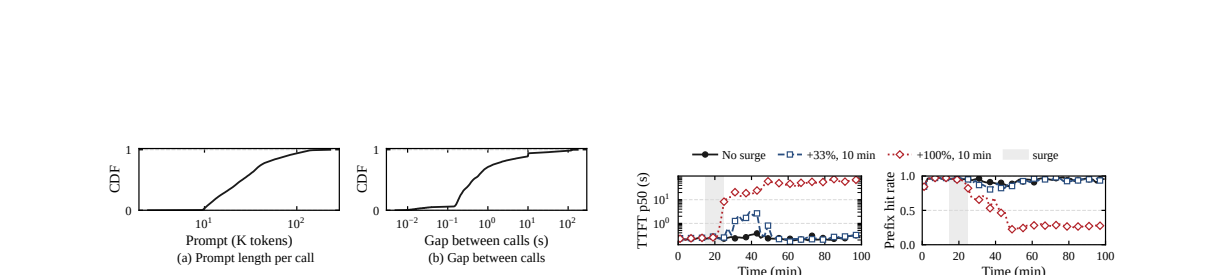
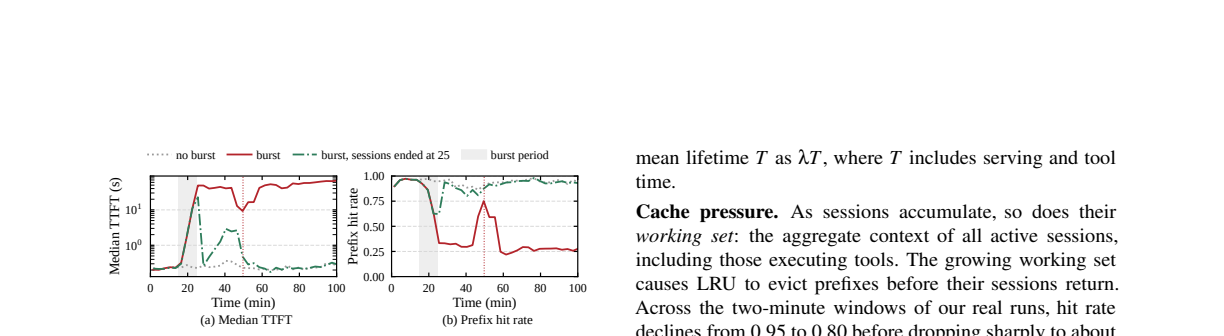
The defining observation of the paper - that a finite surge leaves the engine persistently degraded at a base rate it previously sustained - is presented without replication counts, variance, or per-run values for any of the arms of Fig. 4 (no surge, +33%, +100%) and Fig. 5 (no burst, burst left in place, burst terminated), even though Section 7.10 reports at least fifteen real 1P3D main-trace runs in the calibration set, so the authors have the capacity to replicate.
more of objection 1
Because the claim is precisely that identical arrival streams can yield two different outcomes depending on cache history, a single comparison per arm cannot exclude an environmental, replay-client, or configuration confound that coincides with the surge. The +33% control partially mitigates this by showing dose-dependence in the same environment, and the termination intervention is well designed, but the headline quantitative claims (about 88% goodput reduction, persistence for the full hour, recovery within minutes) should be secured by at least three to five repetitions of each arm with per-run trajectories, and the text should state explicitly which of the Section 7.10 calibration runs are the Fig. 4 and Fig. 5 runs. The hardware system comparisons of Fig. 12 should carry the same replication statement.
The paper says, at Section 5.1, Eq. 2; Section 4, Figs. 7-9
The review did not quote this passage.
Pith says: Objection 2 of 3 · major
The quantitative generalization layer is anchored to a single measurement basis: the hit-rate cliff h(W/C) of Fig. 6b, measured on one engine, one model, one workload, and LRU, which the fluid model consumes directly ('The model uses the real-system hit-rate curve in Fig. 6b'), together with engine costs calibrated on the same hardware runs (Section 7.10).
more of objection 2
The 36-deployment classification in Fig. 9b is therefore a consistency check between two extrapolations from that one basis (a fluid model and a calibrated simulator); it confirms internal coherence but does not independently validate the vulnerability boundaries in Figs. 7-8, the cliff knee xk about 1.9, or the factor 2 in Eq. 2 for other models, workloads, or eviction policies. The qualitative metastability claim does not depend on this curve, and the paper's Section 9 scope statement is candid about the single-engine evaluation, but Observation 2, Eq. 2, and the abstract's formulation that the model identifies resource conditions are stated without that caveat. A proportionate fix is to measure the cliff on a second model or workload, or to perturb the curve within the simulator and report how the Fig. 7-8 boundaries move; alternatively, the generalization claims should be explicitly restricted to the profiled workload and engine.
The paper says, at Sections 7.10 and 7.3-7.4
The review did not quote this passage.
Pith says: Objection 3 of 3 · major
The simulator's fidelity disclosure in Section 7.10, while welcome, is not consistently carried into the simulation claims in the main text. The simulator underestimates BASIN's ITL-violating session share by more than an order of magnitude (0.5% simulated versus 13.6% measured), and since the goodput definition of Section 7.1 requires at least 95% of decode steps to meet the ITL SLO, …
more of objection 3
… the simulated goodput claims - including 'completes at least 95% of sessions while shedding at most 2.2%' (Section 7.4) and the 1.20-2.05x ratios of Section 7.3 - inherit an optimistic bias whose size is not quantified. The held-out H200 comparisons also show errors of 33% and 37% for ThunderAgent and Crossflow and 2.6x for the composition, so the statement that the simulator ranks systems as measured holds only for the subset listed in Section 7.10. The hardware results of Section 7.2 are direct measurements and are not affected, but the paper should add the caveat at the point of the simulation claims rather than only in Section 7.10, and should quantify the effect of the ITL under-count on the reported goodput margins.
5 minor objections
The paper says, at Fig. 1
Pith says: minor objection 1 of 5
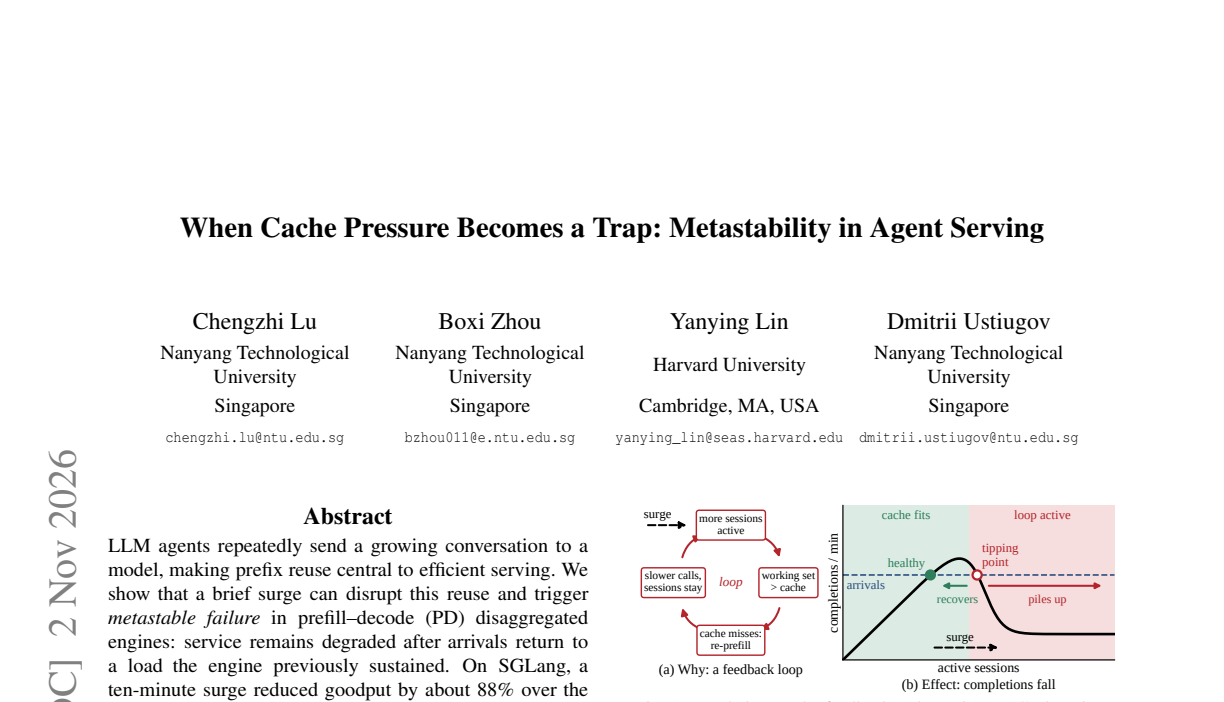
The labels in the Fig. 1 schematic ('healthy tipping point recovers piles up'; 'active sessions completions / min cache fits loop active arrivals') are garbled and make the otherwise helpful intuition figure hard to parse; please redraw it with clean axis labels and a coherent caption.
The paper says, at Section 3.2
Pith says: minor objection 2 of 5
The headline 'about 88%' refers to the post-surge hour (17 versus 138 sessions/h), while the same paragraph reports whole-run goodput falling from 123 to 43 sessions/h (about 65%); please state explicitly in Section 3.2 and the abstract which window the headline figure uses, so the two numbers do not appear inconsistent.
show 3 more
The paper says, at Section 7.10
Pith says: minor objection 3 of 5
The calibration numbers would be much easier to interpret as a small table listing each hardware condition, its repetition count, and the per-run simulated-versus-measured goodput, rather than averaged deviations (8.8% mean, 32% maximum); this would also resolve the ambiguity about how many of the fifteen main-trace 1P3D runs correspond to the comparisons in Figs. 4 and 5.
The paper says, at Reproducibility
Pith says: minor objection 4 of 5
The paper gives no statement on the availability of the simulator, the replay client, the Terminal-Bench and Bailian trace artifacts, or the configuration files; a release statement (or a clear commitment to release on acceptance) would substantially aid independent verification of Observation 1.
The paper says, at References
Pith says: minor objection 5 of 5
Reference [51] is cited as a GitHub issue; if an archival or peer-reviewed version exists, it should be cited alongside or instead, and the model and benchmark card entries ([54], [68]) should carry stable identifiers rather than plain project names.
What would settle it
Re-run the Fig. 4 comparison on the same H100 SGLang deployment with at least five independent Poisson seeds for the no-surge, +33%, and +100% conditions, plus five repetitions of each arm of the Fig. 5 termination experiment, applying the Section 7.1 'trapped' definition and reporting per-seed time series. If every +100% seed remains trapped through minute 85 and every termination arm restores service while every leave-in-place arm keeps base sessions accumulating, the concern is resolved; if any seed recovers within 60 minutes, the persistence claim is not robust.
from the skeptic's reading
How the review went
4 readings by deepseek-v4-flash · 3 Nov 2026
- Reader holds up, with conditions
- Skeptic partly agrees
- Editor wrote the verdict above
- Referee major revision: 3 major objections, 5 minor
Not run on this paper: the simulated authors' defence.
Pith did not check this review's objections against the paper.
The review in full
The review in brief, machine-written
The thing to know: the central phenomenon is probably real, the causal experiment is well designed, and the headline number is under-secured. The 88% goodput reduction over the following hour is one +100% surge run against one no-surge run, with no seeds or error bars, and the persistence evidence is likewise one termination arm against one leave-in-place arm. Since the claim is exactly that the same base load has two outcomes depending on history, a single unreplicated trajectory is a thin base for the number everyone will quote. That concern holds up on reading; it is a verification gap, not a design flaw.
What is new: prior work covered collapse under sustained load, KV-growth instability, and hit-rate collapse with re-prefill feedback. This paper contributes the finite-surge version in open-arrival PD-disaggregated serving: a short burst pushes the active-session population past an unstable equilibrium, and after arrivals return to a rate the engine previously sustained, departures stay below arrivals. The state variable is the session population, not utilization, queue length, or KV occupancy, which is why standard scaling signals show headroom while the engine is trapped (b22). That reframing is useful for anyone running agentic workloads on disaggregated engines.
The strongest evidence is Fig. 5: terminating the burst sessions restores service within minutes; leaving them in place sustains degradation. That is a clean intervention and it directly supports the population-cache feedback story. The fluid model is a reasonable container for the mechanism, Eq. 2's cache-first condition is checkable, and it flags all 17 cache-first deployments. The authors disclose scope honestly: dependent sessions are out (b529), fixed capacity is assumed (b526), and the simulator overestimates ThunderAgent and Crossflow by 33-37% and the composition by 2.6x on held-out runs. That last point matters more than they let on, since several BASIN-vs-baseline simulation claims lean on those systems. Also, the hardware wins for BASIN come from the arrival-time prototype; the full predictor-driven controller appears only in simulation.
The soft spots, in proportion: the single-run headline; the simulator sharing the measured hit-rate cliff with the hardware runs, so the quantitative layer is self-consistent rather than independently validated; no artifacts; one engine, one model, LRU. None of this kills the qualitative claim, which rests on the intervention rather than the curve fits. But the abstract's 88% sentence is the least-secured sentence in the paper, and it is the one people will repeat.
This deserves a serious referee. The phenomenon is important if real, the mechanism is coherent, and the intervention is the right way to test it. The referee should push for replication runs, confidence intervals on the headline, and artifacts. I would cite the metastability observation and bring the paper to a reading group; I would not repeat the 88% figure without seeing replications.
The strongest objection
The load-bearing result is Observation 1: a finite surge changes the engine's trajectory at a base rate it previously sustained (Sections 3.2–3.3, Figs. 4–5). The causal intervention (terminating burst sessions) is well designed, and the mechanism is internally consistent. What is not secured is the empirical basis: the headline 88% figure and the persistence at 3.3 sessions/min come from one +100% surge run against one no-surge run, and the sustaining-loop evidence comes from one termination arm and one leave-in-place arm, all on a single H100 SGLang deployment, with no seeds, confidence intervals, or artifacts. The simulator (§7.10) is calibrated to the same hardware runs and shares the same hit-rate curve, so it cannot independently validate the central observation. Since the claim is exactly that the same base load has two outcomes depending on history, a single unreplicated run cannot rule out an unobserved environmental, replay-client, or configuration condition producing the apparent metastability. This is a verification gap, not an accusation: the experiment is appropriately designed, and the result is plausible, but the defining observation is not yet empirically secured.
I focused on the reader's stated central claim, Observation 1 plus the measured 88% goodput reduction, rather than on the fluid model or BASIN's quantitative predictions. The model and simulator layers have known weaknesses: the hit-rate curve is empirical input, the model is matched to the simulator, and the simulator overestimates some baselines on held-out runs. Those weaknesses affect the quantitative boundaries and the simulator-evaluated policies, but they do not affect the defining metastability signature because the hardware intervention in Section 3.3 establishes the sustaining mechanism directly. The same cannot be said for the hardware evidence itself: the no-surge, +33%, and +100% comparison and the two-arm termination study appear to be single runs, with no reported randomness or confidence intervals. The paper honestly discloses its scope and limitations, including dependent-session coverage and fixed-capacity assumptions, and there is no reason to suspect misconduct. But a claim that the same arrival rate yields healthy or trapped outcomes depending on history is exactly the kind of claim that needs repeated independent trials before the headline number can be treated as established. The reader's rationale already lists missing error bars and artifacts as reasons for CONDITIONAL; my concern is the same gap, elevated to the central observation rather than the quantitative layer. A five-seed replication test would settle it directly. If the replication passes, I see no remaining objection to the qualitative central claim; if it fails, the paper's main contribution would need reinterpretation.
The referee's report
If the result holds, the significance is high: the paper demonstrates a cleanly explained, history-dependent failure at a previously sustained load in a production-relevant serving architecture, with a well-designed causal intervention and a falsifiable fluid model. The strengths are genuine: the termination experiment of Fig. 5 is a direct causal test; the +33% versus +100% contrast shows dose-dependence in the same environment; the post-surge arrival intervention of Fig. 10a holds the triggering history fixed across seeds; and the evaluation is unusually broad, with two hardware platforms, a second workload, seeded ablations, and a calibration section that honestly discloses discrepancies (for example, a simulated ITL-violation share of 0.5% versus 13.6% measured). The principal weaknesses are that the headline hardware results are presented without replication counts or error bars, which is load-bearing for Observation 1, and that the quantitative generalization layer (Eq. 2, Figs. 7-9, the 17/17 classification) is anchored to a single measured hit-rate cliff, so it is internally consistent but not independently validated across models or workloads.
Pith's reading of the paper (a machine's summary, not the authors')
This paper claims that LLM agent serving engines that reuse cached conversation prefixes can suffer a metastable failure: a brief surge in arrivals leaves service degraded long after traffic returns to a rate the engine previously handled. The sustaining mechanism is population-cache feedback — cache misses slow calls, slow calls keep sessions alive longer, and the enlarged working set of active sessions causes more cache misses, so the degradation outlasts its trigger. On SGLang, a ten-minute surge reduced goodput by about 88% over the following hour, with median time to first token rising from about 0.2 s to about 60 s; terminating the burst's residual sessions restored service within minutes. A fluid model of the active-session population shows why this happens: the same base load admits two outcomes, healthy or trapped, depending on cache history, which the authors give as the defining signature of metastability. Guided by the model, the paper builds BASIN, a controller that orders sessions by fixed priority, admits them against predicted peak contexts, lends idle decode memory as a cache tier, and sheds excess demand, achieving 1.20–1.70× the goodput of the strongest baseline on real hardware.
What carries the argument. The load-bearing object is the population-cache feedback loop, formalized as a fluid balance over the active session population $N$: $dN/dt = \lambda(t) - X(N)/K$, where $\lambda(t)$ is the arrival rate, $K$ the average calls per session, and $X(N)$ the call throughput set by a smooth minimum of a closed-loop bound, a prefill bound that falls as cache reuse collapses, and a decode-memory bound. The resulting departure curve $D(N)=X(N)/K$ is non-monotonic: it rises toward a peak $N^*$ while reuse holds, then falls toward a low-reuse rate $D_{\mathrm{low}}$ once the working set $W=N\bar{c}$ crosses the cache cliff, the measured drop of prefix hit rate from about 0.95 to about 0.3 at a working set near $1.9\times$ cache capacity. A base arrival rate between $D_{\mathrm{low}}$ and $D(N^*)$ intersects the curve twice, at a stable equilibrium $N_s$ and an unstable equilibrium $N_u$, so crossing $N_u$ is the trap condition and the same load supports two outcomes. The vulnerability condition $C \lesssim D_{KV}/(2f)$ — cache capacity small relative to decode KV capacity divided by the fraction of sessions in service — states when the cache cliff precedes decode saturation. BASIN acts on each term of this balance: a fixed session priority packs smaller predicted footprints first, admission against predicted peak contexts under the working-set principle bounds entry into the working set, decode-memory lending raises effective cache capacity, and shedding removes demand above the profiled peak departure rate.
Core claim. The paper's central claim is that prefix-cache reuse makes prefill–decode-disaggregated agent serving metastable: a finite surge can drive the active session population past an unstable equilibrium, after which the same base arrival rate the engine previously sustained leaves departures below arrivals, so degradation persists until the working set drains or arrivals are cut. The sustaining mechanism, stated as Observation 1, is that a transient surge sustains prefix-cache thrashing by extending session lifetimes and enlarging the working set; cache misses force recomputation, slower calls keep sessions active longer, and continuing arrivals enlarge the aggregate context further. On SGLang the paper measures a ten-minute +100% surge dropping prefix hit rate from 0.95 to 0.27 and median time to first token from about 0.2 s to about 60 s, with sessions completed per hour over the following hour at about an eighth of the surge-free rate. Two interventions establish causation: removing the residual burst sessions restores service within minutes, and controlled simulations that fix the post-surge state show that changing only the subsequent arrival rate reverses the recovery outcome. The paper concludes that recovery depends jointly on the state left by the surge and the load that follows it, with the low-reuse departure capacity setting the scale of the arrival reduction needed to drain the system.
The premise it rests on. The quantitative trap boundaries inherit one empirical input, the measured hit-rate cliff — reuse falling from about 0.95 to about 0.3 at a working set near 1.9 times cache capacity — taken from a single engine, model, workload, and eviction policy, so the predicted vulnerability thresholds shift if that cliff's location or shape changes under other conditions, even though the qualitative metastable behavior itself is established directly by the hardware interventions.
If the paper is right (Pith's inferences, not the authors')
Conventional monitoring gives no warning: utilization, queue length, and KV usage all show ample headroom while the engine is tipping, so overload control in these systems must track the working-set-to-cache balance and the departures-versus-arrivals balance instead.
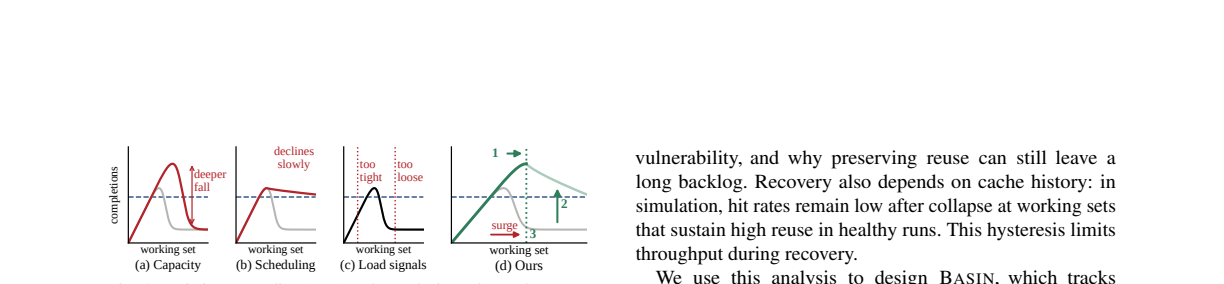
Adding cache capacity does not remove the vulnerability: it moves the cliff to a larger population, and any deployment where cache pressure limits service before decode saturates remains trap-prone below steady-state overload; added decode instances and longer tool execution shift the first limit toward the cache.
Smarter eviction is not the lever: next-call-oracle eviction, which knows each session's future use, reaches only 1.08–1.18× LRU's goodput and 0.28–0.41× BASIN's under surges, because the feedback is sustained by session-population growth rather than by eviction quality.
Recovery planning must use the collapsed-state numbers: after collapse the hit rate stays at 0.26–0.37 even at working sets where healthy runs keep 0.81–0.93, so the arrival reduction needed to drain a trapped engine is set by the low-reuse departure capacity, not by the healthy throughput.
A controller that combines fixed session priority, admission against predicted peak contexts, decode-memory lending, and shedding keeps engines out of the trap in the evaluated settings: 1.20–1.70× the goodput of the strongest baseline on real H200 1P3D hardware, the highest goodput in all six simulated surge scenarios, and at least 95% of sessions completed with at most 2.2% shed in the surge-siz
The bistable population-cache balance should generalize beyond LLM serving: any partly-open system that keeps session state in a shared cache with context-dependent miss cost — conversational database buffer pools, retry-heavy RPC front ends with response caches, or object stores under burst arrivals — should exhibit the same trap, and the paper's fluid model transfers once that system's hit-rate
Because the collapse occurs below saturation with headroom in every conventional signal, demand-proportional autoscaling and rate limiting keyed to utilization will systematically react too late; a deployment-internal monitor of the working-set-to-cache ratio, with the cliff near 1.9×, plus the departures-versus-arrivals balance, could warn any PD engine of an impending trap without adopting BASIN
The cliff's location in working-set units yields a directly testable prediction: at fixed cache capacity, a workload with longer average context should trap under smaller surges, because the same working-set cliff is reached by fewer sessions; re-running the surge protocol at varying cache sizes and context lengths would quantify that trade-off.
The paper's evidence that the hit-rate cliff is an empirical property of the engine–workload pair suggests deployments should re-profile after model, routing, or eviction-policy changes rather than treating the boundaries as fixed; the 2P6D results, where least-loaded routing yields a profiled cliff scale of 0.55 against 1.38 for affinity routing, show how much routing alone shifts the map.
Check this review
Pith stored no record of this review's passes and took no fingerprint of it. Reviews made by code from 13 Nov 2026 on carry both.
How often reviews like this one are right
Reviews like this one: written by deepseek-v4-flash, where what was read was not recorded.
How often objections from reviews like this one are right: not yet measured
Reviews by people
This review was written by a machine. No person has reviewed this paper on Pith yet. A scientist listed on Pith can review it for a fee, and their review is published here whatever it concludes.
The paper
Abstract
LLM agents repeatedly send a growing conversation to a model, making prefix reuse central to efficient serving. We show that a brief surge can disrupt this reuse and trigger metastable failure in prefill–decode (PD) disaggregated engines: service remains degraded after arrivals return to a load the engine previously sustained. On SGLang, a ten-minute surge reduced goodput by about 88% over the following hour. Removing the residual burst sessions restored service within minutes. The sustaining mechanism is population-cache feedback. Slower calls prolong sessions and enlarge their aggregate context, or working set; the resulting cache misses increase recomputation and further delay departures. A fluid model identifies the resource conditions for this feedback and explains how cache capacity, tool time and base load affect vulnerability. Across 36 simulated deployments, it flags all 17 cache-first cases. Controlled simulations hold the post-surge state fixed and show that changing subsequent arrivals alone reverses the recovery outcome. Once the cache collapses, low-reuse departure capacity sets the scale of the load reduction needed for recovery. Guided by these dynamics, we build Basin, which gives each session a fixed priority, reserves their predicted peak contexts against an adaptive admission budget, extends the cache with idle decode memory, and sheds excess demand. On real H200 1P3D deployments under surges, including long-context SWE-bench Pro sessions, an arrival-time prototype achieves 1.20–1.70x the goodput of Continuum and 2.35–3.59x that of HiCache alone. In simulation, the predictor-driven policy delivers 1.20–2.05x the strongest baseline's goodput across six surge scenarios.
The paper's own sentences, arranged, kept beside the review and separate from it. Each label is drawn from a closed vocabulary; the number beside it is the probability the classifier gave that label. No sentence in this record was written by a model.
abstract compiled · 2026-11-03
The authors' main claim, as the classifier picked it out 0.96
“We show that a brief surge can disrupt this reuse and trigger metastable failure in prefill--decode (PD) disaggregated engines: service remains degraded after arrivals return to a load the engine previously sustained.”
How the main claim is stated: asserted 1.00
What the abstract itself states, as probabilities: claims first 0.05 · states limitation 0.20 · human participants 0.03 · controlled comparison 0.93 · randomized assignment 0.02 · states quantitative result 0.99 · compares with prior results 0.97 · mentions code or data availability 0.05
The abstract, sentence by sentence
This table labels the abstract only (arXiv listing abstract v1). The number is the probability the classifier gave the label.
| Sentence | Role | The authors' own work | States the main conclusion | Strength |
|---|---|---|---|---|
| LLM agents repeatedly send a growing conversation to a model, making prefix reuse central to efficient serving. | background 1.00 | 0.06 | 0.03 | asserted 1.00 |
| We show that a brief surge can disrupt this reuse and trigger metastable failure in prefill--decode (PD) disaggregated engines: service remains degraded after arrivals return to a load the engine previously sustained. | result 0.60 | 0.94 | 0.77 | asserted 1.00 |
| On SGLang, a ten-minute surge reduced goodput by about 88% over the following hour. | result 1.00 | 0.93 | 0.12 | asserted 1.00 |
| Removing the residual burst sessions restored service within minutes. | result 0.99 | 0.90 | 0.08 | asserted 1.00 |
| The sustaining mechanism is population-cache feedback. | interpretation 0.68 | 0.84 | 0.16 | asserted 1.00 |
| Slower calls prolong sessions and enlarge their aggregate context, or working set; the resulting cache misses increase recomputation and further delay departures. | interpretation 0.97 | 0.75 | 0.11 | asserted 1.00 |
| A fluid model identifies the resource conditions for this feedback and explains how cache capacity, tool time and base load affect vulnerability. | method 0.74 | 0.90 | 0.08 | asserted 1.00 |
| Across 36 simulated deployments, it flags all 17 cache-first cases. | result 0.95 | 0.93 | 0.06 | asserted 1.00 |
| Controlled simulations hold the post-surge state fixed and show that changing subsequent arrivals alone reverses the recovery outcome. | result 0.71 | 0.96 | 0.08 | asserted 1.00 |
| Once the cache collapses, low-reuse departure capacity sets the scale of the load reduction needed for recovery. | interpretation 0.80 | 0.84 | 0.13 | asserted 1.00 |
| Guided by these dynamics, we build Basin, which gives each session a fixed priority, reserves their predicted peak contexts against an adaptive admission budget, extends the cache with idle decode memory, and sheds excess demand. | method 0.63 | 0.95 | 0.22 | asserted 0.99 |
| On real H200 1P3D deployments under surges, including long-context SWE-bench Pro sessions, an arrival-time prototype achieves 1.20--1.70x the goodput of Continuum and 2.35--3.59x that of HiCache alone. | result 1.00 | 0.95 | 0.22 | asserted 1.00 |
| In simulation, the predictor-driven policy delivers 1.20--2.05x the strongest baseline's goodput across six surge scenarios. | result 1.00 | 0.94 | 0.17 | asserted 1.00 |
What kind of paper the classifier reports this is: method or tool 0.93 · evidence from observation or experiment 0.63
What was examined, and what was not
Sources read
- arXiv listing abstract v1
Not examined
- full text
- figures and tables
- references and citing sentences
- relations to other papers
Levels run
- P abstract
Not run
- S sections
- T body sentences
- C citations
- R cross-paper relations
How the labels were made
Compiled by classifier-1.13.0 via TypeSafe API, question bank abstract-p1-20260923, 2026-11-03: 1 request, 9,501 input tokens.
Every quoted sentence on this record is the authors'. Every label is from Pith's closed vocabulary, with the probability shown beside it. This record as JSON
Figures (24)


Showing 16 of the paper's 24 figures. Figures are the authors', reproduced from the paper.
References (96)
- [1] ABHYANKAR, R., HE, Z., SRIVATSA, V., ZHANG, H.,ANDZHANG, Y. InferCept: Efficient intercept support for augmented large language model inference. InProceedings of the 41st International Conference on Machine Learning (ICML)(2024), vol. 235 ofProceedings of Machine Learning Rese... on Pith
- [2] AGARWAL, S., HU, B., MAO, A., AKELLA, A.,ANDVENKATARA- MAN, S. SYMPHONY: Enabling compute-memory disaggregation in LLM serving systems. In23rd USENIX Symposium on Networked Systems Design and Implementation (NSDI 26)(2026) on Pith
- [3] AGRAWAL, A., KEDIA, N., PANWAR, A., MOHAN, J., KWATRA, N., GULAVANI, B. S., TUMANOV, A.,ANDRAMJEE, R. Taming throughput-latency tradeoff in LLM inference with Sarathi-Serve. In18th USENIX Symposium on Operating Systems Design and Implementation (OSDI 24)(2024), pp. 117–134 on Pith
- [4] AO, R., DONG, J., LUO, G.,ANDSIMCHI-LEVI, D. Service- induced congestion in memory-constrained LLM serving, 2026. arXiv:2606.15555 on PithPith's reviewarXiv
- [5] AO, R., LUO, G., SIMCHI-LEVI, D.,ANDWANG, X. Optimizing LLM inference: Fluid-guided online scheduling with memory con- straints, 2025 on Pith
- [6] ARUN, S., PARAYIL, A., BHARADWAJ, S., ST. AMANT, R.,AND RÜHLE, V. Towards load-aware prefill deflection for disaggregated LLM serving, 2026. arXiv:2607.02043 on PithPith's reviewarXiv
- [7] BRONSON, N., AGHAYEV, A., CHARAPKO, A.,ANDZHU, T. Metastable failures in distributed systems. InProceedings of the Workshop on Hot Topics in Operating Systems (HotOS)(2021), pp. 221–227 on Pith
- [8] CARLEIAL, A. B.,ANDHELLMAN, M. E. Bistable behavior of ALOHA-type systems.IEEE Transactions on Communications 23, 4 (1975), 401–410 on Pith
- [9] CHEN, Q., YE, Z., TANG, T., SUN, P., TIAN, B., WANG, G., LI, S., WEN, Y., HAN, Z.,ANDZHANG, T. Concur: Proactive agent-level admission control for efficient agentic batch inference, 2026. arXiv:2601.22705. 16 on PitharXiv
- [10] CHO, I., SAEED, A., FRIED, J., PARK, S. J., ALIZADEH, M.,AND BELAY, A. Overload control for µs-scale RPCs with Breakwater. In14th USENIX Symposium on Operating Systems Design and Implementation (OSDI 20)(2020), pp. 299–314 on Pith
- [11] CHO, I., SAEED, A., PARK, S. J., ALIZADEH, M.,ANDBELAY, A. Protego: Overload control for applications with unpredictable lock contention. In20th USENIX Symposium on Networked Systems Design and Implementation (NSDI 23)(2023), pp. 725–738 on Pith
- [12] CHU, W. W.,ANDOPDERBECK, H. The page fault frequency replacement algorithm. InProceedings of the AFIPS Fall Joint Computer Conference, Part I(1972), pp. 597–609 on Pith
- [13] DAI, J. G. On positive Harris recurrence of multiclass queueing networks: A unified approach via fluid limit models.The Annals of Applied Probability 5, 1 (1995), 49–77 on Pith
- [14] DEEPSEEK-AI. DeepSeek-V3 technical report, 2024. arXiv:2412.19437 on PithPith's reviewarXiv
- [15] DENG, X., DA, J., PAN, E., HE, Y. Y., IDE, C., GARG, K., LAUFFER, N., PARK, A., PASARI, N., RANE, C., SAMPATH, K., KRISHNAN, M., KUNDURTHY, S., HENDRYX, S., WANG, Z., BHARADWAJ, V., HOLM, J., ALURI, R., ZHANG, C. B. C., JACOBSON, N., LIU, B., ANDKENSTLER, B. SWE-Bench Pro: Can... on PithPith's reviewarXiv
- [16] DENNING, P. J. Thrashing: Its causes and prevention. InProceedings of the AFIPS Fall Joint Computer Conference, Part I(1968), pp. 915– 922 on Pith
- [17] DENNING, P. J. The working set model for program behavior. Communications of the ACM 11, 5 (1968), 323–333 on Pith
- [18] DING, J., HOSSEINI, R., GHOLAMI, P. M., XIANG, M.,AND HOFFMANN, H. Observation, not prediction: Conversation-level disaggregated scheduling for agentic serving, 2026 on Pith
- [19] DONG, J. Metastability in queues.Queueing Systems 100, 3 (2022), 413–415 on Pith
- [20] ELNIKETY, S., NAHUM, E., TRACEY, J.,ANDZWAENEPOEL, W. A method for transparent admission control and request scheduling in e-commerce web sites. InProceedings of the 13th International Conference on World Wide Web (WWW)(2004), pp. 276–286 on Pith
show 76 more
- [21] FU, Y., XUE, L., HUANG, Y., BRABETE, A.-O., USTIUGOV, D., PATEL, Y.,ANDMAI, L. ServerlessLLM: Low-latency serverless inference for large language models. In18th USENIX Symposium on Operating Systems Design and Implementation (OSDI 24)(2024), pp. 135–153 on Pith
- [22] FU, Y., ZHU, S., SU, R., QIAO, A., STOICA, I.,ANDZHANG, H. Efficient LLM scheduling by learning to rank. InAdvances in Neural Information Processing Systems (NeurIPS)(2024) on Pith
- [23] GAO, B., HE, Z., SHARMA, P., KANG, Q., JEVDJIC, D., DENG, J., YANG, X., YU, Z.,ANDZUO, P. Cost-efficient large language model serving for multi-turn conversations with CachedAttention. In2024 USENIX Annual Technical Conference (USENIX ATC 24)(2024), pp. 111–126 on Pith
- [24] GIBBENS, R. J., HUNT, P. J.,ANDKELLY, F. P. Bistability in communication networks. InDisorder in Physical Systems, G. R. Grimmett and D. J. A. Welsh, Eds. Oxford University Press, 1990, pp. 113–128 on Pith
- [25] GIM, I., MA, Z., LEE, S.-S.,ANDZHONG, L. Pie: A programmable serving system for emerging LLM applications. InProceedings of the ACM SIGOPS 31st Symposium on Operating Systems Principles (SOSP)(2025) on Pith
- [26] HABIBI, F., LORIDO-BOTRAN, T., SHOWAIL, A., STURMAN, D. C., ANDNAWAB, F. MSF-Model: Queuing-based analysis and prediction of metastable failures in replicated storage systems. In43rd International Symposium on Reliable Distributed Systems (SRDS) (2024). arXiv:2309.16181 on PithPith's reviewarXiv
- [27] HE, W., JIANG, Y., ZHAO, P., XU, Q., YONEKI, E., CUI, B.,ANDFU, F. Efficient multi-round LLM inference over disaggregated serving. In Proceedings of the 43rd International Conference on Machine Learning (ICML)(2026) on Pith
- [28] HOERL, A. E.,ANDKENNARD, R. W. Ridge regression: Biased estimation for nonorthogonal problems.Technometrics 12, 1 (1970), 55–67 on Pith
- [29] HU, C., HUANG, H., HU, J., XU, J., CHEN, X., XIE, T., WANG, C., WANG, S., BAO, Y., SUN, N.,ANDSHAN, Y. MemServe: Context caching for disaggregated LLM serving with elastic memory pool, 2024. arXiv:2406.17565 on PithPith's reviewarXiv
- [30] HU, Y., ZHANG, Z., LIU, Y., GU, Y., LEI, S., KASIKCI, B.,AND HUANG, P. Mitigating application resource overload with targeted task cancellation. InProceedings of the ACM SIGOPS 31st Symposium on Operating Systems Principles (SOSP)(2025) on Pith
- [31] HUANG, L., MAGNUSSON, M., MURALIKRISHNA, A. B., ESTYAK, S., ISAACS, R., AGHAYEV, A., ZHU, T.,ANDCHARAPKO, A. Metastable failures in the wild. In16th USENIX Symposium on Operating Systems Design and Implementation (OSDI 22)(2022), pp. 73–90 on Pith
- [32] ISAACS, R., ALVARO, P., MAJUMDAR, R., MUNISWAMY-REDDY, K.-K., SALAMATI, M.,ANDSOUDJANI, S. Analyzing metastable failures. InProceedings of the Workshop on Hot Topics in Operating Systems (HotOS)(2025), pp. 172–178 on Pith
- [33] JACOBSON, V. Congestion avoidance and control. InProceedings of the ACM SIGCOMM Symposium on Communications Architectures and Protocols(1988), pp. 314–329 on Pith
- [34] JIANG, Y., FU, F., YUAN, B., MALLADI, K., ARDESTANI, E. K., SHU, Z., AZIZ, A.,ANDXU, Y. Coda: Exploiting admission flexibility for coding-agent serving, 2026. arXiv:2610.03088 on PithPith's reviewarXiv
- [35] JIMENEZ, C. E., YANG, J., WETTIG, A., YAO, S., PEI, K., PRESS, O., ANDNARASIMHAN, K. SWE-bench: Can language models resolve real-world GitHub issues? InInternational Conference on Learning Representations (ICLR)(2024) on Pith
- [36] JIN, Y., WU, C.-F., BROOKS, D.,ANDWEI, G.-Y. S3: Increasing GPU utilization during generative inference for higher throughput. In Advances in Neural Information Processing Systems (NeurIPS)(2023) on Pith
- [37] KANG, H., LI, Z., XU, W., YANG, X., CHEN, Y., WANG, J., CHEN, B., KRISHNA, T., XU, C.,ANDARORA, S. ThunderAgent: A simple, fast and program-aware agentic inference system, 2026. arXiv:2602.13692 on PithPith's reviewarXiv
- [38] KIM, J., KWON, M., MIN, Y., KIM, J.,ANDZHAO, J. Dynamic HBM repartitioning for multi-turn MoE serving, 2026. arXiv:2609.13537 on PithPith's reviewarXiv
- [39] KONDRASHOV, L., LIU, H., PARK, J., ZHOU, B., LIU, Z., LU, C., MANCINI, R., CHOUKSE, E., JAVAID, H., SVIRIDOV, G., PENG, T., ZHAO, C., AVDEEVA, A., GUSEV, A., KOGIAS, M., MAI, L., ANDUSTIUGOV, D. Rethinking AI cloud infrastructure for agentic serving systems with the Aries expe... on PithPith's reviewarXiv
- [40] KURTZ, T. G. Solutions of ordinary differential equations as limits of pure jump Markov processes.Journal of Applied Probability 7, 1 (1970), 49–58 on Pith
- [41] KWON, W., LI, Z., ZHUANG, S., SHENG, Y., ZHENG, L., YU, C. H., GONZALEZ, J. E., ZHANG, H.,ANDSTOICA, I. Efficient memory management for large language model serving with PagedAttention. In Proceedings of the 29th Symposium on Operating Systems Principles (SOSP)(2023), pp. 611–626 on Pith
- [42] LAI, R., LIU, H., LU, C., LIU, Z., CAO, S., SHAO, S., ZHANG, Y., MAI, L.,ANDUSTIUGOV, D. TokenScale: Timely and accurate autoscaling for disaggregated LLM serving with token velocity, 2025. arXiv:2512.03416. 17 on PithPith's reviewarXiv
- [43] LI, H., HE, R., MANG, Q., ZHANG, Q., MAO, H., CHEN, X., ZHOU, H., ZHANG, H., CHEUNG, A., GONZALEZ, J.,ANDSTOICA, I. Continuum: Efficient and robust multi-turn LLM agent scheduling with KV cache time-to-live, 2025. arXiv:2511.02230 on PithPith's reviewarXiv
- [44] LI, L., WANG, S., RUAN, Z., LI, D.,ANDGONG, B. The KV cache working set: Online capacity planning for LLM inference systems, on Pith
- [45] LIEBER, O.,ET AL. Jamba: A hybrid Transformer-Mamba language model, 2024. arXiv:2403.19887 on PithPith's reviewarXiv
- [46] LIN, C., HAN, Z., ZHANG, C., YANG, Y., YANG, F., CHEN, C.,AND QIU, L. Parrot: Efficient serving of LLM-based applications with semantic variable. In18th USENIX Symposium on Operating Systems Design and Implementation (OSDI 24)(2024), pp. 929–945 on Pith
- [47] LIU, B., QIU, H., GOIRI, Í., FONSECA, R., BIANCHINI, R.,AND CHOUKSE, E. Agentic coding in the wild: Characterizing GitHub Copilot traces at production scale, 2026. arXiv:2608.00101 on PithPith's reviewarXiv
- [48] LIU, Y., CHENG, Y., YAO, J., AN, Y., CHEN, X., FENG, S., HUANG, Y., SHEN, S., ZHANG, R., DU, K.,ET AL. LMCache: An efficient KV cache layer for enterprise-scale LLM inference, 2025 on Pith
- [49] LIU, Y., LI, H., CHENG, Y., RAY, S., HUANG, Y., ZHANG, Q., DU, K., YAO, J., LU, S., ANANTHANARAYANAN, G.,ET AL. CacheGen: KV cache compression and streaming for fast large language model serving. InProceedings of the ACM SIGCOMM 2024 Conference (2024), pp. 38–56 on Pith
- [50] LIU, Y., YU, M.,ANDYANG, J. When fancy eviction fails: Rethinking cache replacement for LLM prefix reuse, 2026. arXiv:2609.28870 on PithPith's reviewarXiv
- [51] LLM-D CONTRIBUTORS. Session-level admission control for agentic workloads (thunderagent plugin). llm-d router issue #2964, https: //github.com/llm-d/llm-d-router/issues/2964, Sept. 2026 on Pith
- [52] LUO, M., SHI, X., CAI, C., ZHANG, T., WONG, J., WANG, Y., WANG, C., HUANG, Y., CHEN, Z., GONZALEZ, J. E.,ANDSTOICA, I. Agentix: An efficient serving engine for LLM agents as general programs. In23rd USENIX Symposium on Networked Systems Design and Implementation (NSDI 26)(2026... on PithPith's reviewarXiv
- [53] MENG, J.,ANDLI, B. Metronome: Bound the cache, keep the beat for real-time interaction model serving, 2026. arXiv:2607.02640 on PithPith's reviewarXiv
- [54] MERRILL, M. A., SHAW, A. G., CARLINI, N., LI, B., RAJ, H., BERCOVICH, I., SHI, L., SHIN, J. Y., WALSHE, T., BUCHANAN, E. K.,ET AL. Terminal-bench: Benchmarking agents on hard, realistic tasks in command line interfaces, 2026 on Pith
- [55] MEZA, J. J., GOWDA, T., EID, A., IJAWARE, T., CHERNYSHEV, D., YU, Y., UDDIN, M. N., DAS, R., NACHIAPPAN, C., TRAN, S.,ET AL. Defcon: Preventing overload with graceful feature degradation. In17th USENIX Symposium on Operating Systems Design and Implementation (OSDI 23)(2023) on Pith
- [56] MINIMAX. MiniMax-01: Scaling foundation models with lightning attention, 2025. arXiv:2501.08313 on PithPith's reviewarXiv
- [57] MOGUL, J. C.,ANDRAMAKRISHNAN, K. K. Eliminating receive livelock in an interrupt-driven kernel.ACM Transactions on Computer Systems 15, 3 (1997), 217–252 on Pith
- [58] NI, H., TIAN, H., ZHANG, C., LI, G.,ANDTAN, H. TOPAS: Workflow-aware prefix-state scheduling for multi-agent LLM serving, 2026 on Pith
- [59] NISHTALA, R., FUGAL, H., GRIMM, S., KWIATKOWSKI, M., LEE, H., LI, H. C., MCELROY, R., PALECZNY, M., PEEK, D., SAAB, P., ET AL. Scaling memcache at Facebook. In10th USENIX Symposium on Networked Systems Design and Implementation (NSDI 13)(2013), pp. 385–398 on Pith
- [60] NVIDIA. NVIDIA Dynamo: A datacenter-scale distributed inference serving framework. https://github.com/ai- dynamo/dynamo , 2025 on Pith
- [61] NVIDIA. Full-stack optimizations for agentic inference with NVIDIA Dynamo. NVIDIA Technical Blog, https://developer.nvidia.c om/blog/full-stack-optimizations-for-agentic-inferen ce-with-nvidia-dynamo/, Apr. 2026 on Pith
- [62] PAN, R., WANG, Z., JIA, Z., KARAKUS, C., ZANCATO, L., DAO, T., WANG, Y.,ANDNETRAVALI, R. Marconi: Prefix caching for the era of hybrid LLMs. InProceedings of Machine Learning and Systems (MLSys)(2025) on Pith
- [63] PAN, Z., PATEL, A., SHEN, Y., HU, Z., GUAN, Y., LI, W.-L., QIN, L., WANG, Y.,ANDDING, Y. KVFlow: Efficient prefix caching for accelerating LLM-based multi-agent workflows. InAdvances in Neural Information Processing Systems 38 (NeurIPS)(2025), pp. 139912– 139931. arXiv:2507.07400 on PithPith's reviewarXiv
- [64] PARK, J., PARK, J., JUNG, Y., LIM, H., YEO, H.,ANDHAN, D. TopFull: An adaptive top-down overload control for SLO-oriented microservices. InProceedings of the ACM SIGCOMM 2024 Conference(2024) on Pith
- [65] PATEL, P., CHOUKSE, E., ZHANG, C., SHAH, A., GOIRI, Í., MALEKI, S.,ANDBIANCHINI, R. Splitwise: Efficient generative LLM inference using phase splitting. InProceedings of the 51st ACM/IEEE Annual International Symposium on Computer Architecture (ISCA)(2024), pp. 118–132 on Pith
- [66] PATKE, A., REDDY, D., JHA, S., QIU, H., PINTO, C., NARAYANASWAMI, C., KALBARCZYK, Z.,ANDIYER, R. Queue management for SLO-oriented large language model serving. In Proceedings of the ACM Symposium on Cloud Computing (SoCC) (2024), pp. 18–35 on Pith
- [67] QIN, R., LI, Z., HE, W., CUI, J., REN, F., ZHANG, M., WU, Y., ZHENG, W.,ANDXU, X. Mooncake: Trading more storage for less computation — a KVCache-centric architecture for serving LLM chatbot. In23rd USENIX Conference on File and Storage Technologies (FAST 25)(2025), pp. 155–17... on PithPith's reviewarXiv
- [68] QWENTEAM. Qwen3.6-35B-A3B. Hugging Face model card, https: //huggingface.co/Qwen/Qwen3.6-35B-A3B, 2026 on Pith
- [69] SALTON, G.,ANDBUCKLEY, C. Term-weighting approaches in automatic text retrieval.Information Processing & Management 24, 5 (1988), 513–523 on Pith
- [70] SCHROEDER, B., WIERMAN, A.,ANDHARCHOL-BALTER, M. Open versus closed: A cautionary tale. In3rd USENIX Symposium on Networked Systems Design and Implementation (NSDI 06)(2006), pp. 239–252 on Pith
- [71] SHAO, K., CHEN, J., YU, J., LI, X.-H., TAO, C., WANG, Y., LIN, H., CHENG, K.-T., TSUI, C. Y.,ANDBAI, H. EfficientAgent: What makes KV cache offloading work for concurrent agents?, 2026. arXiv:2609.33762 on PithPith's reviewarXiv
- [72] SHENG, Y., CAO, S., LI, D., ZHU, B., LI, Z., ZHUO, D., GONZALEZ, J. E.,ANDSTOICA, I. Fairness in serving large language models. In18th USENIX Symposium on Operating Systems Design and Implementation (OSDI 24)(2024), pp. 965–988 on Pith
- [73] SRIVATSA, V., HE, Z., ABHYANKAR, R., LI, D.,ANDZHANG, Y. Preble: Efficient distributed prompt scheduling for LLM serving. In International Conference on Learning Representations (ICLR)(2025) on Pith
- [74] STOJKOVIC, J., ZHANG, C., GOIRI, Í., TORRELLAS, J.,AND CHOUKSE, E. DynamoLLM: Designing LLM inference clusters for performance and energy efficiency. InIEEE International Symposium on High Performance Computer Architecture (HPCA) (2025), pp. 1348–1362 on Pith
- [75] SUN, B., HUANG, Z., ZHAO, H., XIAO, W., ZHANG, X., LI, Y.,AND LIN, W. Llumnix: Dynamic scheduling for large language model serving. In18th USENIX Symposium on Operating Systems Design and Implementation (OSDI 24)(2024), pp. 173–191. 18 on Pith
- [76] TAN, X., JIANG, Y., YANG, Y.,ANDXU, H. Teola: Towards end- to-end optimization of LLM-based applications. InProceedings of the 30th ACM International Conference on Architectural Support for Programming Languages and Operating Systems (ASPLOS), Volume 2 (2025), pp. 1302–1316 on Pith
- [77] THEMOONCAKETEAM. Deploying Kimi K2 with PD disaggregation and large-scale expert parallelism on 128 H200 GPUs. LMSYS Org blog, https://www.lmsys.org/blog/2025-07-20-k2-large-s cale-ep/, July 2025 on Pith
- [78] THESGLANGTEAM. Deploying DeepSeek with PD disaggregation and large-scale expert parallelism on 96 H100 GPUs. LMSYS Org blog, https://www.lmsys.org/blog/2025-05-05-large-scale-ep/ , May 2025 on Pith
- [79] VATTANI, A., CHIERICHETTI, F.,ANDLOWENSTEIN, K. Optimal probabilistic cache stampede prevention.Proceedings of the VLDB Endowment 8, 8 (2015), 886–897 on Pith
- [80] WANG, J., HAN, J., WEI, X., SHEN, S., ZHANG, D., FANG, C., CHEN, R., YU, W.,ANDCHEN, H. KVCache cache in the wild: Characterizing and optimizing KVCache cache at a large cloud provider. In2025 USENIX Annual Technical Conference (USENIX ATC 25) (2025), pp. 465–482 on Pith
- [81] WELSH, M., CULLER, D.,ANDBREWER, E. SEDA: An architecture for well-conditioned, scalable internet services. InProceedings of the 18th ACM Symposium on Operating Systems Principles (SOSP)(2001), pp. 230–243 on Pith
- [82] WU, B., ZHONG, Y., ZHANG, Z., LIU, S., LIU, F., SUN, Y., HUANG, G., LIU, X.,ANDJIN, X. Fast distributed inference serving for large language models, 2023 on Pith
- [83] WU, Y., LIU, T., ZENG, Y., WU, S., XIONG, J., DONG, X., YANG, H., ZHANG, K.,ANDLI, J. Arrow: Adaptive scheduling mechanisms for disaggregated LLM inference architecture, 2025. arXiv:2505.11916 on PitharXiv
- [84] XIE, Z. SGLang HiCache: Fast hierarchical KV caching with your favorite storage backends. LMSYS Org blog, https://www.lmsys. org/blog/2025-09-10-sglang-hicache/, Sept. 2025 on Pith
- [85] XU, Y., ARDESTANI, E. K., FU, W., SCHATZ, M., MALLADI, K., SHU, Z., AZIZ, A., KANAUJIA, S., MATHEWS, A.,ANDTANG, C. Crossflow: Prefill-decode elasticity for agentic LLM serving, 2026. arXiv:2609.27085 on PithPith's reviewarXiv
- [86] YANG, J., JIMENEZ, C. E., WETTIG, A., LIERET, K., YAO, S., NARASIMHAN, K.,ANDPRESS, O. SWE-agent: Agent-computer interfaces enable automated software engineering. InAdvances in Neural Information Processing Systems 37 (NeurIPS)(2024) on Pith
- [87] YAO, H., GAO, C., LYU, Y., GROSOF, I.,ANDSIMCHI-LEVI, D. Multi-turn LLM conversations under the least-recently-used policy: Mean-field asymptotics and hit ratio approximation, 2026. arXiv:2609.02027 on PithPith's reviewarXiv
- [88] YAO, J., LI, H., LIU, Y., RAY, S., CHENG, Y., ZHANG, Q., DU, K., LU, S.,ANDJIANG, J. CacheBlend: Fast large language model serving for RAG with cached knowledge fusion. InProceedings of the Twentieth European Conference on Computer Systems (EuroSys) (2025) on Pith
- [89] YAO, S., ZHAO, J., YU, D., DU, N., SHAFRAN, I., NARASIMHAN, K., ANDCAO, Y. ReAct: Synergizing reasoning and acting in language models. InInternational Conference on Learning Representations (ICLR)(2023) on Pith
- [90] YU, G.-I., JEONG, J. S., KIM, G.-W., KIM, S.,ANDCHUN, B.-G. Orca: A distributed serving system for Transformer-based generative models. In16th USENIX Symposium on Operating Systems Design and Implementation (OSDI 22)(2022), pp. 521–538 on Pith
- [91] YU, L., LIN, J.,ANDLI, J. Stateful large language model serving with Pensieve. InProceedings of the Twentieth European Conference on Computer Systems (EuroSys)(2025), pp. 144–158 on Pith
- [92] ZHANG, D., WANG, H., LIU, Y., WEI, X., SHAN, Y., CHEN, R., ANDCHEN, H. BlitzScale: Fast and live large model autoscaling with O(1) host caching. In19th USENIX Symposium on Operating Systems Design and Implementation (OSDI 25)(2025). arXiv:2412.17246 on PithPith's reviewarXiv
- [93] ZHENG, L., YIN, L., XIE, Z., SUN, C., HUANG, J., YU, C. H., CAO, S., KOZYRAKIS, C., STOICA, I., GONZALEZ, J. E., BARRETT, C., ANDSHENG, Y. SGLang: Efficient execution of structured language model programs. InAdvances in Neural Information Processing Systems 37 (NeurIPS)(2024),... on Pith
- [94] ZHENG, Z., REN, X., XUE, F., LUO, Y., JIANG, X.,ANDYOU, Y. Response length perception and sequence scheduling: An LLM-empowered LLM inference pipeline. InAdvances in Neural Information Processing Systems (NeurIPS)(2023) on Pith
- [95] ZHONG, Y., LIU, S., CHEN, J., HU, J., ZHU, Y., LIU, X., JIN, X., ANDZHANG, H. DistServe: Disaggregating prefill and decoding for goodput-optimized large language model serving. In18th USENIX Symposium on Operating Systems Design and Implementation (OSDI 24)(2024), pp. 193–210 on Pith
- [96] ZHOU, H., CHEN, M., LIN, Q., WANG, Y., SHE, X., LIU, S., GU, R., OOI, B. C.,ANDYANG, J. Overload control for scaling WeChat microservices. InProceedings of the ACM Symposium on Cloud Computing (SoCC)(2018), pp. 149–161. 19 on Pith
Cited by 1 Pith paper
Reviewed papers on Pith that cite this one. The full citation record
Challenges and discussion
Disagree with the review, or know something it missed? Leave a comment, or challenge this review formally: a challenge becomes a permanent entry in this paper's record, and its decision is published here.
Come back by email
A short list of the week's newly reviewed papers. Nothing is sent until you confirm from your inbox, and every email has a link that stops it. No account.
No comments yet.
Sign in to comment