Distributed, Parallel, and Cluster Computing · arXiv:2610.37230 v1 · submitted 27 Oct 2026 · 59 references
TAO: Tool-Aware Joint Scheduling for LLM-Based Agentic Serving
The paper says
“Agentic services alternate between model inference on clustered GPUs and external tools on distributed CPUs.”
more of the abstract
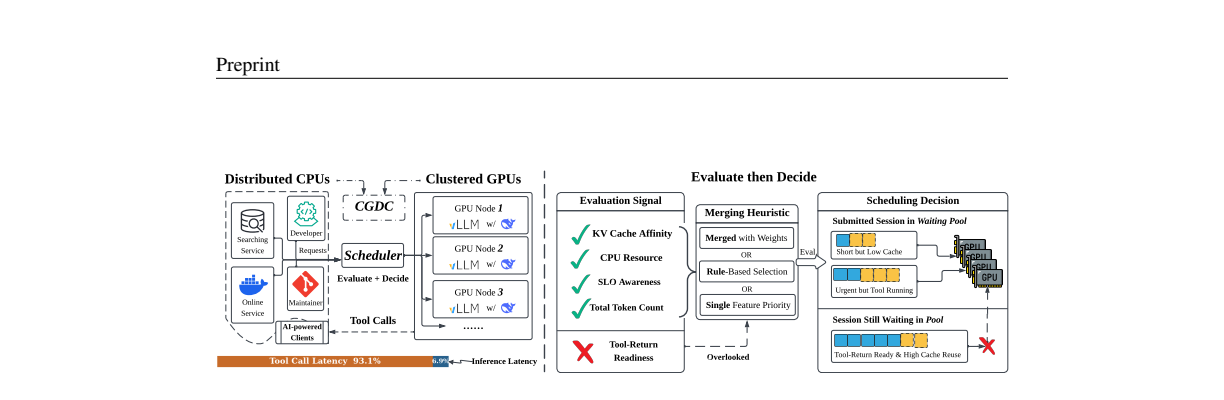
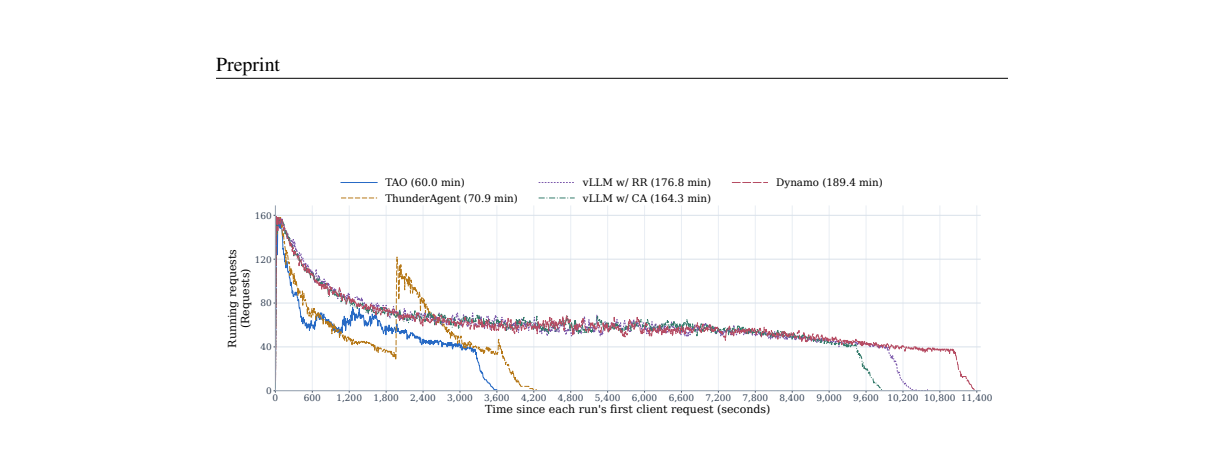
In this scenario, existing systems (1) overlook tool-return readiness in service evaluation, wasting limited resources, and (2) use heuristic strategies to decide admission and placement on GPUs, resulting in suboptimal scheduling decisions. To bridge this gap, we present TAO, a tool-aware joint scheduling framework for LLM-based agentic serving. Its value interface combines near-term tool readiness, node-specific cache credit with time-aware decay, and token footprint; a dynamic program jointly selects and places waiting sessions under capacity constraints. Across the 12 reported model-workload-concurrency settings, TAO reduces latency by up to 26.8%, reduces mean time to first token (TTFT) by up to 36.3%, and increases decode throughput by up to 29.5% relative to the best evaluated state-of-the-art baseline for each metric.
from the abstract
Pith says
Machine review · deepseek-v4-flash · 28 Oct 2026 · what was read was not recorded · not checked by a person
It can be wrong. Challenge this review or reply to it.
Holds up, with conditions. Worth reading for the scheduler design, but the quantitative claim is not yet established: the headline numbers rest on single natural-live runs, and the paper's own controlled replays show much smaller and partly negative effects. This line is wrong
4 major objections · 6 minor
How often objections from reviews like this one are right: not yet measured
Not checked: figures, code, what the 59 references say.
The paper says, at Tables 1–3, Appendix D, Appendix G
The review did not quote this passage.
Pith says: Objection 1 of 4 · major
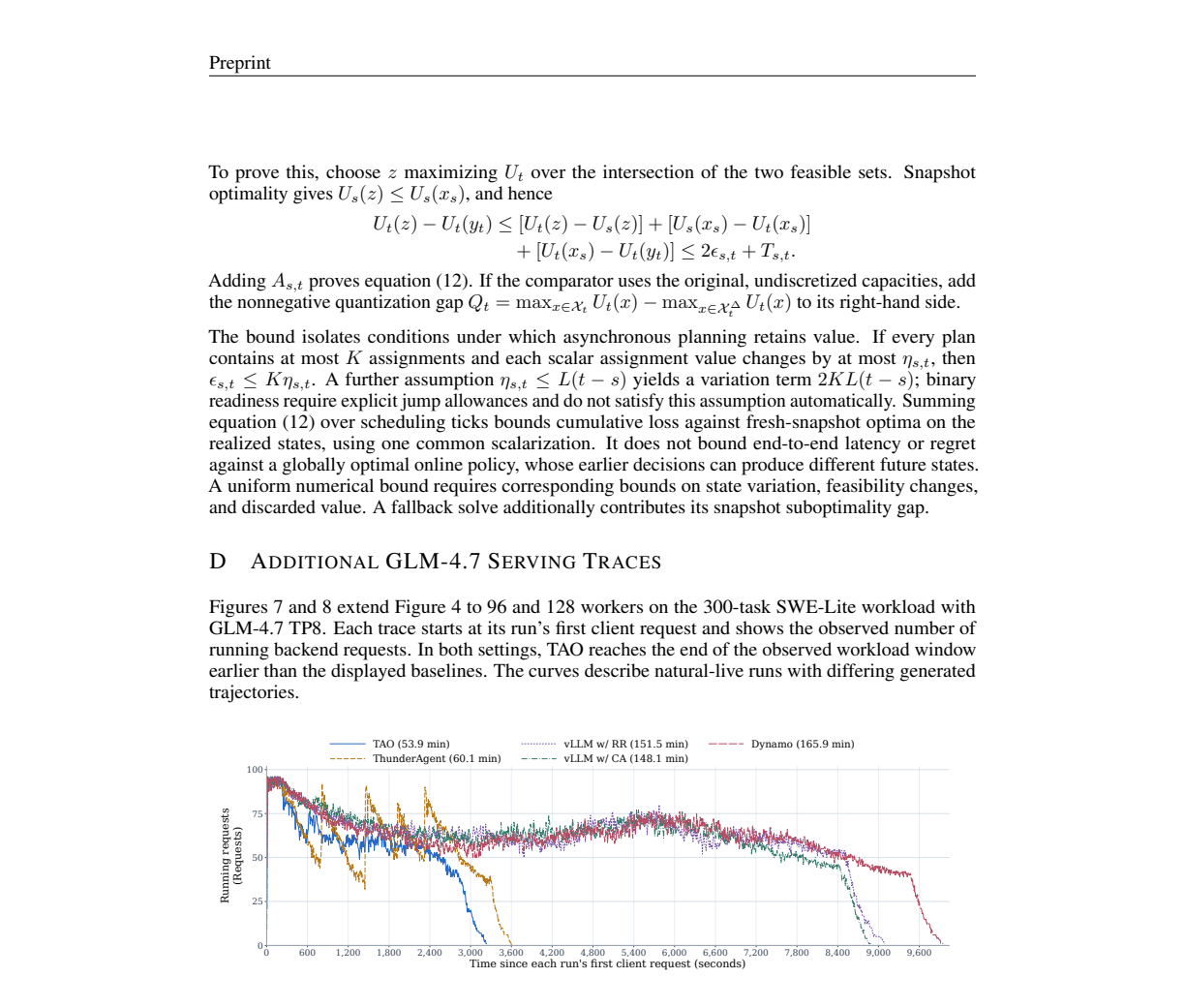
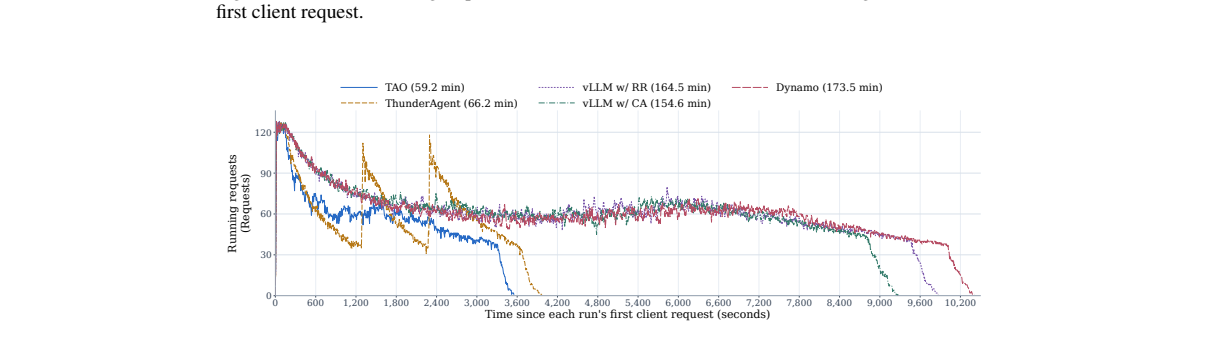
The central claim (b4, b124) is that TAO systematically improves responsiveness, but Tables 1–3 report single natural-live runs: Appendix D states the traces are 'natural-live runs with differing generated trajectories' and Appendix G calls each cell 'a single exploratory run.'
more of objection 1
Because each scheduler is evaluated on a different sample of stochastic agent trajectories for the same nominal tasks, the per-metric 'best baseline' comparisons in Tables 1–3 confound scheduling effects with trajectory difficulty. The paper must either supply repeated-seed runs (with variance reported) or re-base the headline claim on matched-trajectory controlled comparisons; as written, the 26.8%/36.3%/29.5% numbers cannot be attributed to the scheduler.
The paper says, at Table 7, Section 4.3
The review did not quote this passage.
Pith says: Objection 2 of 4 · major
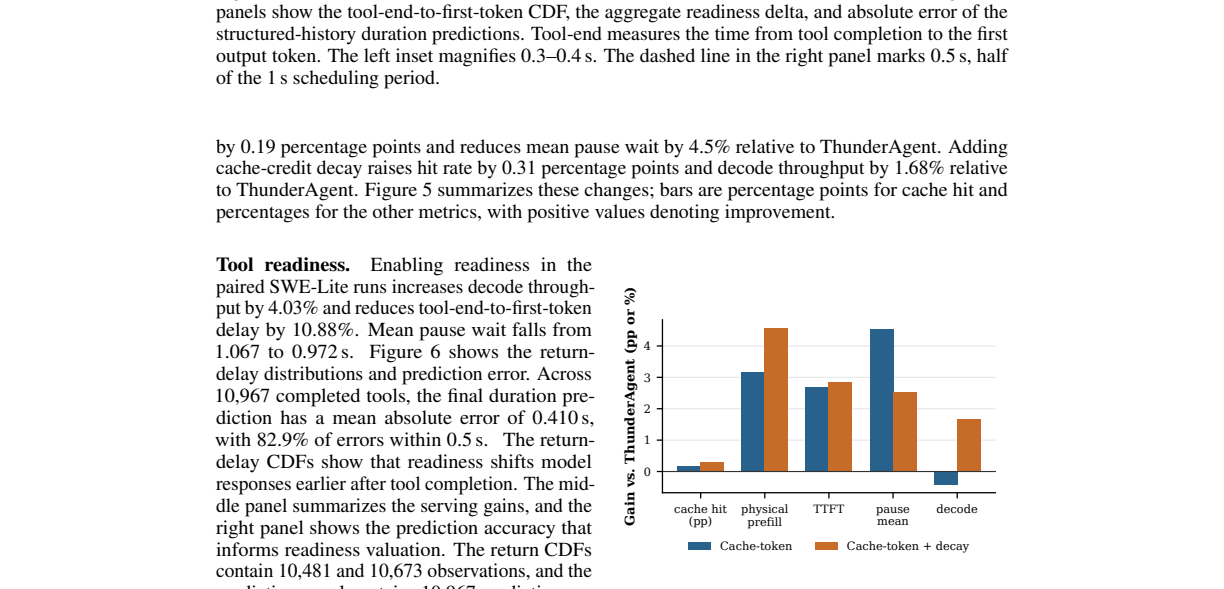
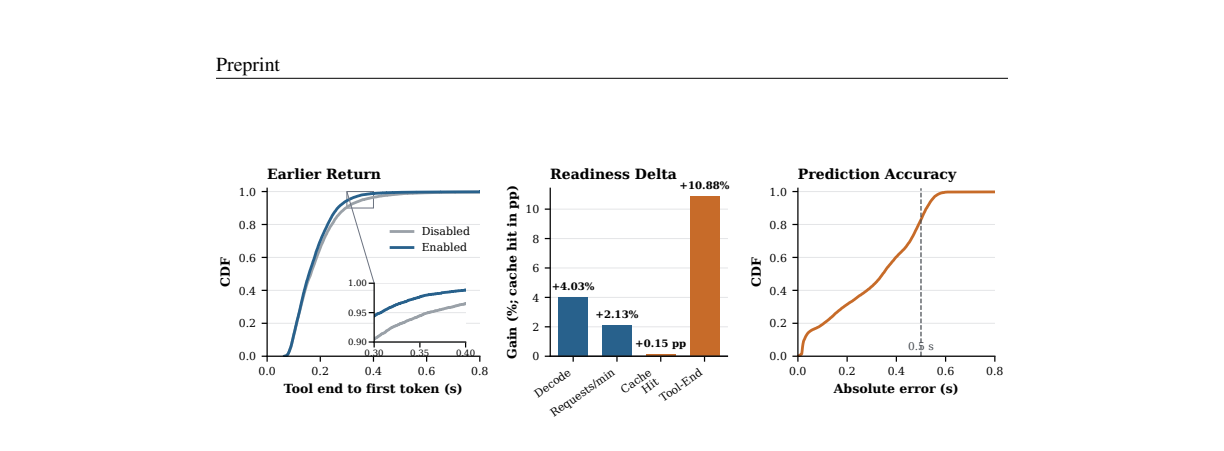
The paper's own controlled replays contradict the headline magnitude. In the fixed-trace InferenceX replay (Table 7), decode gains are only +4.2%/+1.8%/+10.1% at 16/32/64 workers, latency is +2.9%/−4.2%/+7.7%, and TTFT is +35.9%/−14.4%/−8.1%. In the fixed-workload replay of Section 4.3, cache-credit decay adds +1.68% decode and readiness adds +4.03%, and joint optimization improves the objective in only 17.1% of reconstructed snapshots (b161–b162).
more of objection 2
These controlled measurements are an order of magnitude below the headline and are sometimes negative. The paper needs to either reconcile why natural-live gains are so much larger than controlled gains, or substantially down-claim the contribution; this discrepancy is load-bearing for b124.
The paper says, at Eqs. (4) and (6), Section 3.3–3.4
The review did not quote this passage.
Pith says: Objection 3 of 4 · major
The two load-bearing scheduler constants, cache half-life h=10 s in Eq. (4) and readiness horizon H=1 s in Eq. (6), are hand-set with no sensitivity analysis. Since readiness changes a non-trivial fraction of DP decisions (1.65–7.93% in Table 8) and the cache–readiness balance is explicitly parameter-dependent, the reported gains could partly reflect tuning of these constants rather than the framework.
more of objection 3
The paper should report the headline metrics across a range of h and H (e.g., h∈{5,10,20,60} s, H∈{0.5,1,2,5} s) on at least one matched-trace configuration to show robustness.
The paper says, at Abstract, Tables 1–3
The review did not quote this passage.
Pith says: Objection 4 of 4 · major
The claim format 'relative to the best evaluated state-of-the-art baseline for each metric' permits a different baseline to define 'best' for each cell, which obscures outright losses. The disclosed counterexamples—Terminal-Bench decode −8.8%/−6.2%, Qwen SWE-Lite latency −0.2% and −2.5%, AutomationBench latency −7.0%, TTFT −504%, decode −11.2% at 128 workers—mean that b124 ('the strongest overall choice') is not supported by the tables as presented.
more of objection 4
The abstract should state the win/loss pattern across cells (e.g., positive on latency/TTFT on most, negative on several decode/TTFT cells) rather than only the positive maxima.
6 minor objections
The paper says, at Title
Pith says: minor objection 1 of 6
The running title 'TOOL- AWAREJ OINTSCHEDULING FORLLM- BASEDAGENTICSERVING' has broken spacing; it should read 'Tool-Aware Joint Scheduling for LLM-Based Agentic Serving'.
The paper says, at Section 4.2, b126
Pith says: minor objection 2 of 6
The sentence 'On SWE-Lite, , relative to the best competing method in each column' contains a doubled comma; the empty 'On SWE-Lite,' subject phrase is a typographical slip.
show 4 more
The paper says, at Tables 1 and 3
Pith says: minor objection 3 of 6
Several numeric cells are missing separators, e.g., '0.336876.138' and '839.274' in Table 1, and '1417.2123.166482.381' in Table 3; these should be formatted or the raw values given in a data appendix for traceability.
The paper says, at Section 4.2, Table 2
Pith says: minor objection 4 of 6
The text reports '14.05%' for TTFT at GLM SWE-Lite 160 workers while Table 2 shows 14.1%; the extra decimal place is inconsistent with the table precision.
The paper says, at Appendix A
Pith says: minor objection 5 of 6
The finite-sample margin δ=0.2 in Eq. (8) is stated with no rationale or sensitivity check; a sentence indicating whether results are sensitive to δ would reduce the free-parameter concern.
The paper says, at Section 3.5, Eq. (7)
Pith says: minor objection 6 of 6
The claim of DP exactness is correctly scoped by the authors (b98: rounding can exclude plans feasible before discretization), but the paper should state the chosen capacity quantum Δ and its effect on the approximation gap; currently Δ is defined but never given a value in the main text.
What would settle it
Run the Appendix G fixed-source SWE-Lite replay (6,942 tool records, 6,995 model-request records, live model outputs) at 64 workers with 10 independent RNG seeds per method, and report mean and 95% bootstrap CI for TAO minus the best baseline on latency, mean TTFT, and decode throughput. This is the cell that produced the abstract's 26.8%/36.3%/29.5% maxima; if the CIs exclude zero and reproduce gains of similar magnitude, the concern is resolved, and if the gains shrink below single digits or include zero, the natural-live maxima are not evidence of a systematic scheduler effect.
from the skeptic's reading
How the review went
4 readings by deepseek-v4-flash · 28 Oct 2026
- Reader holds up, with conditions
- Skeptic agrees
- Editor wrote the verdict above
- Referee major revision: 4 major objections, 6 minor
Not run on this paper: the simulated authors' defence.
Pith did not check this review's objections against the paper.
The review in full
The review in brief, machine-written
Short version: this is a plausible scheduler design with honest reporting, but the headline numbers are not yet a result. The 26.8%/36.3%/29.5% figures come from natural-live runs in which each scheduler sees a different sample of agent trajectories; the paper's own controlled replays show much smaller, mixed effects. I would not cite it as an empirical result until it has seeded repeats and error bars.
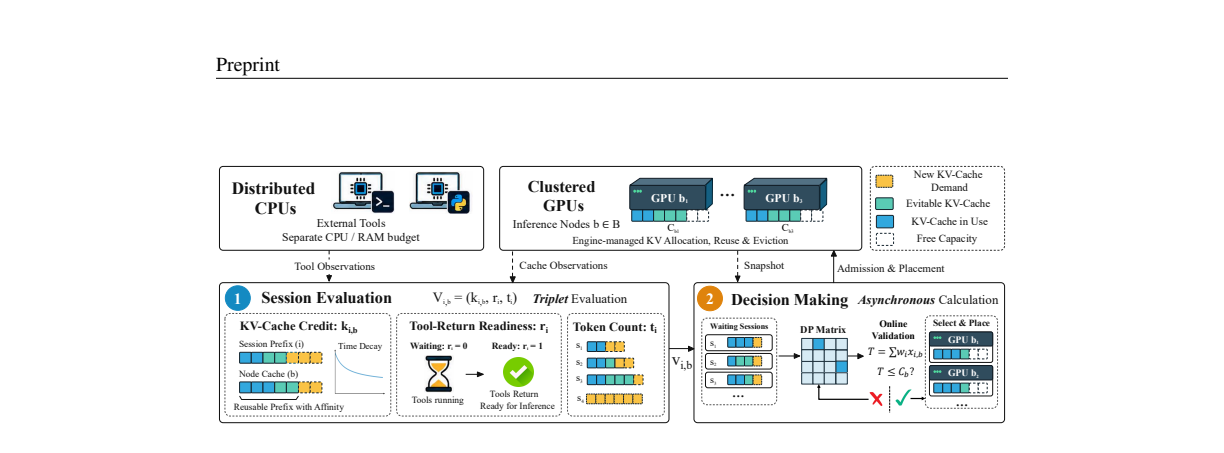
What is actually new: a lexicographic value triplet (time-decayed cache credit, binary tool-return readiness, token footprint) driving an exact DP over the waiting pool, with asynchronous revalidation before the plan is applied. I do not see that combination in the cited works, and the related work is candid about what TAO builds on (ThunderAgent, Continuum, TOPAS). The math is sound enough: DP exactness is stated for the frozen discretized problem, the async loss bound is scoped to a fresh-snapshot comparator, and the authors note that readiness jumps break the smooth-drift assumption. The ablations are informative—removing DP placement costs more than removing any valuation component—and scheduler overhead is measured and small (<0.12%). There is also no circularity: the value function is a heuristic interface, not fitted to the outcome metrics.
The main soft spot is evaluation variance. Tables 1–3 report natural-live runs; Appendix D describes "natural-live runs with differing generated trajectories," and Appendix G calls its cells "single exploratory run[s]." Under fixed trace or workload replay, the gains shrink: InferenceX decode +4.2/+1.8/+10.1%, TTFT +35.9/−14.4/−8.1%; the fixed-workload breakdown credits cache decay with +1.68% and readiness with +4.03%. Plausible scheduler effects, but not the abstract's "up to" numbers. The authors disclose this in appendices, so the failure is of emphasis, not concealment. Secondary issues: h=10 s and H=1 s are hand-set with no sensitivity analysis; no code or data artifacts; and the AutomationBench 128-worker cell shows TAO TTFT at 19.1 s versus a 3.2 s best baseline without explanation.
Who should read it: people working on agentic serving infrastructure. The design is worth their time; the measurements are not yet trustworthy. It deserves a serious referee rather than a desk reject, but the referee should demand repeated runs, error bars, h/H sensitivity, and artifacts before the main claims can stand.
The strongest objection
The central claim (b4, b124) is that TAO's value triplet and DP placement systematically improve agentic serving responsiveness. The evidence base is Tables 1-3, whose cells are single natural-live runs; Appendix D says the traces are "natural-live runs with differing generated trajectories," and Appendix G calls each cell "a single exploratory run." Each scheduler therefore sees a different sample of agent trajectories for the same nominal tasks, so the per-metric "best baseline" maxima could reflect trajectory difficulty rather than scheduling. The paper's controlled replays do not fully rescue the claim: in the fixed-trace InferenceX replay (Table 7), decode gains are +4.2%/+1.8%/+10.1% at 16/32/64 workers, latency is +2.9%/-4.2%/+7.7%, and TTFT is +35.9%/-14.4%/-8.1%. In the Section 4.3 fixed-workload replay, cache-credit decay adds +1.68% decode and readiness adds +4.03%. These magnitudes are far below the abstract's "up to 26.8%/36.3%/29.5%" and are sometimes negative. Without repeated-seed runs, the headline numbers cannot be assigned to scheduling rather than run-to-run noise. Secondary but unresolved: the hand-set constants h=10 s (Eq. 4) and H=1 s (Eq. 6) have no sensitivity analysis, and Eq. 4 discounts cache credit by half every 10 s, so the cache-readiness balance is parameter-dependent.
The reader's weakest_assumption identifies the core issue, and the paper's own controlled measurements sharpen it. The central claim is about systematic gains (b4, b124), but the evidence is dominated by single natural-live runs whose trajectories differ per run (Appendix D), so the "up to" maxima are not attributable to the scheduler without variance information. The controlled replay evidence is internally useful but not decisive: Table 7 shows mostly smaller and mixed gains; Section 4.3 shows component effects of +1.68% (cache decay) and +4.03% (readiness); only the DP-vs-BFD comparison in Table 4 reaches double digits. The design itself is coherent at the snapshot level: the DP is exact for the frozen discretized problem, the quantization gap is acknowledged (b98, b345), and the asynchronous loss bound is scoped (b350). Those facts support the mechanism but not the headline effect size. The hand-set h=10 s and H=1 s constants remain untested, which matters because Eq. 4 makes cache credit decay by half every 10 s, so the balance between cache and readiness is parameter-dependent. External verification is also blocked by the absence of code and data artifacts. I would leave the reader's CONDITIONAL verdict in place and require the repeated-seed replay plus a small h/H sensitivity sweep before final acceptance.
The referee's report
The system-level contribution is genuinely useful: converting tool-return timing into a scheduler-level admission signal, integrating it with node-specific cache credit and token footprint in a fixed lexicographic value contract, and solving the resulting multiple-knapsack/generalized-assignment problem exactly by DP is a clean, extensible design that other schedulers could adopt. The paper is more honest than most in this space: it discloses negative cells (Terminal-Bench decode −8.8% and −6.2%; Qwen SWE-Lite latency −0.2%; AutomationBench TTFT −504% at 128 workers), scopes the loss bound explicitly (b350: it does not bound end-to-end latency or regret against an optimal online policy), and provides overhead accounting with stated partial coverage (b441). If the headline gains hold, they would be a meaningful step toward tool-aware joint scheduling for agentic serving.
Pith's reading of the paper (a machine's summary, not the authors')
Agentic services alternate between GPU inference and external tool calls, so a session's GPU demand is interruptible and its node choice matters for cache reuse; the paper claims existing serving systems underuse both facts. TAO scores each waiting session–node pair with a value triplet — time-decayed KV-cache credit, a binary tool-return readiness signal, and token footprint — and then selects and places sessions jointly with an exact dynamic program under node capacities, instead of per-session heuristics. Across 12 model–workload–concurrency settings the paper reports latency reductions up to 26.8%, mean time-to-first-token reductions up to 36.3%, and decode-throughput gains up to 29.5% against the best baseline on each metric. If the gains hold, tool timing stops being an obstacle to route around and becomes a first-class GPU-admission signal, and joint placement recovers cache-reuse value that myopic rules leave behind.
What carries the argument. The load-bearing object is the lexicographic value triplet $v_{i,b}=(k_{i,b}, r_i, t_i)$ attached to each waiting session–node pair: time-decayed cache credit $k_{i,b}(t)=k^0_{i,b}\,2^{-\tau_{i,b}/h}$ with half-life $h=10$ s rewards returning a session to the node that still holds its KV prefix; binary tool-return readiness $r_i$ (Equation 6, horizon $H=1$ s) marks sessions whose external tool is done or predicted to finish imminently; and token count $t_i$ is the admission cost that also breaks ties. The triplet order is fixed — cache first, readiness second, tokens third — while its coordinates evolve as cache ages and tool calls progress, so the objective needs no weighted-sum tuning. A capacity-state dynamic program (Equation 7) then selects and places waiting sessions jointly, maximizing the additive triplets; induction gives exactness for the frozen, discretized problem, and an asynchronous planner with live revalidation protects the plan from staleness. The same value interface drives session interruption and restart, so evaluation and optimization are cleanly separated.
Core claim. The paper's claim, stated on its own terms: in the Clustered-GPUs/Distributed-CPUs (CGDC) regime, tool execution rather than model inference sets the pace of agent sessions, and the scheduler should treat both evaluation and decision making accordingly. Each session–node pair receives a lexicographic value triplet (decayed cache credit, binary readiness, token count); cache credit halves every 10 seconds after interruption, readiness marks tools done or predicted to finish within a 1-second horizon, and token count carries admission cost and breaks ties. The scheduling problem is then solved jointly — choose which waiting sessions to admit and to which nodes — by a capacity-state dynamic program that is exact for the frozen, discretized snapshot (rounding can exclude plans, which the authors acknowledge). The experiments claim this beats the strongest baseline per metric across the board, with the largest latency margin appearing under high concurrency and the largest TTFT margin after tool returns; component ablations attribute the gain to all three parts of the value triplet and to the joint solve, not to any single signal.
The premise it rests on. The headline gains are treated as systematic scheduler effects, but Tables 1–3 report single natural-live runs with no repeated-seed variance while agent traces are stochastic, so the improvements could sit inside run-to-run noise; the two hand-set scheduler constants, cache half-life $h=10$ s (Equation 4) and readiness horizon $H=1$ s (Equation 6), also carry unstated tuning weight.
If the paper is right (Pith's inferences, not the authors')
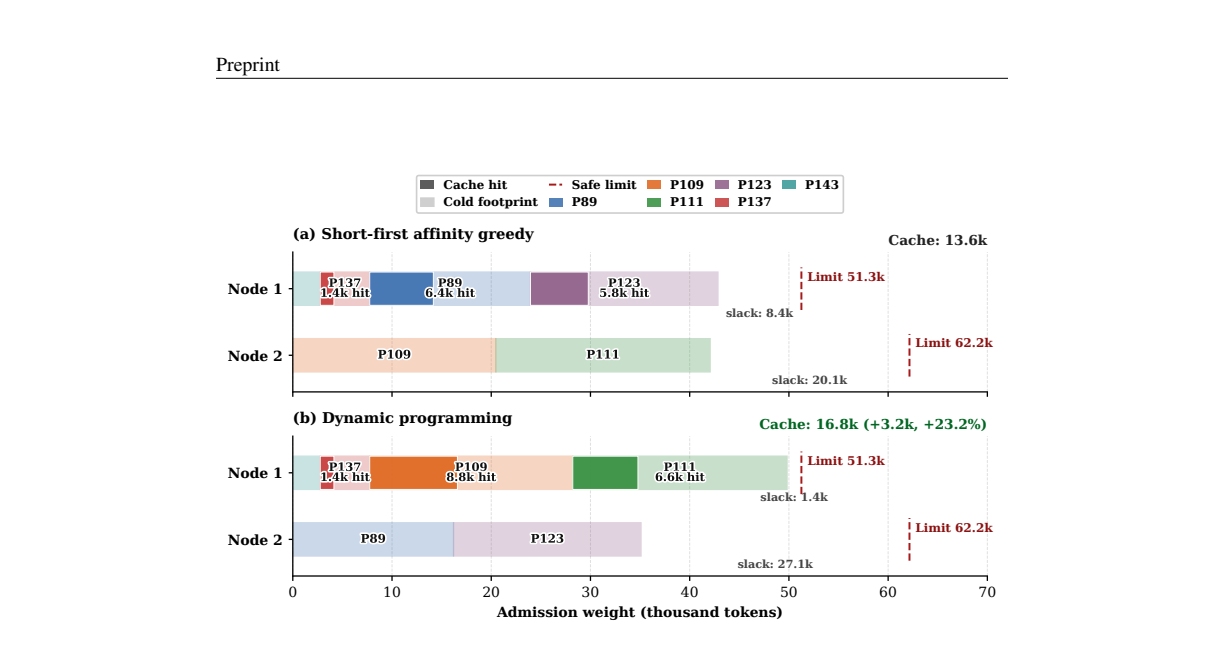
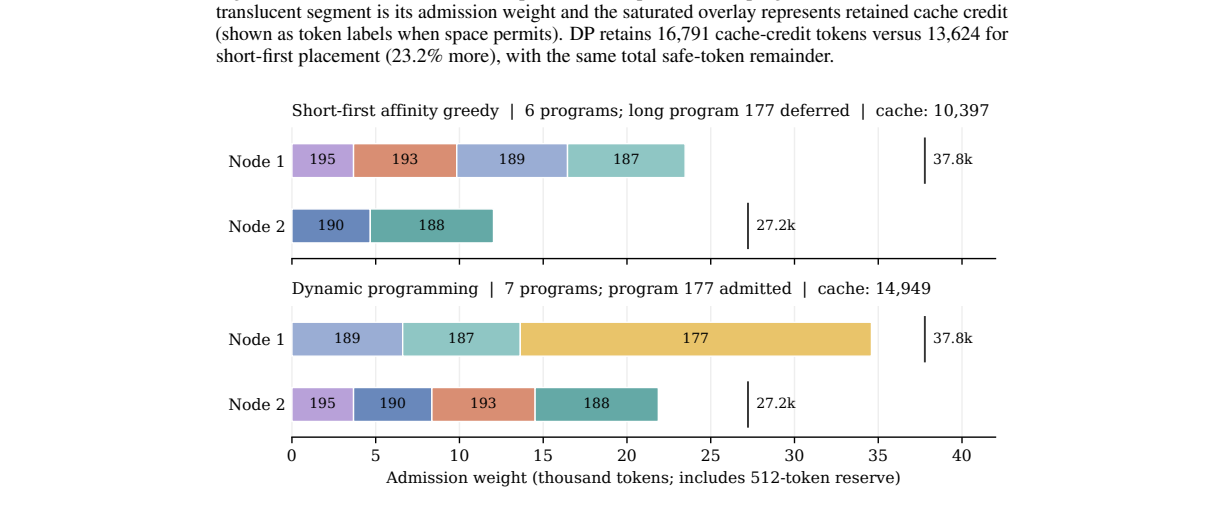
Joint placement does something per-session heuristics cannot: in reconstructed snapshots the dynamic program admits long-context sessions that a short-first heuristic defers and keeps up to 23.2% more cache credit on identical capacity.
Tool readiness becomes more valuable as tools slow down: the fraction of DP plans changed when readiness is removed rises from 1.65% at 1–5 s return delays to 7.93% at 4–20 s, while history-based duration predictions stay within about 2% of oracle timing on makespan.
The framework composes with engine-level KV management rather than competing with it: over the TokenCake engine, TAO lifts decode throughput by 12.9% and 4.2% at 16 and 32 workers and by up to 78.9% at 64 workers against the best of the other frontends.
The joint solve is cheap enough to sit inside a serving loop: measured scheduler preparation and planning stay below 0.12% of runtime at up to 160 workers, with most solves in the single-digit milliseconds.
Because evaluation is decoupled from optimization, new signals can enter the triplet without redesigning the planner, which is the paper's stated route to multi-agent orchestration, looped agents, and plain chatbot traffic.
A graded readiness signal may extract more than the binary one: the paper's own duration-prediction error is 0.41 s against a 1 s horizon, so many predictions straddle the boundary; replacing $r_i$ with the probability of returning within $H$, or with expected remaining tool time, is a testable variant on the same planner.
The lexicographic order (cache above readiness above tokens) has a possible blind spot: a session with marginally more cache credit always outranks one with a far larger token footprint, so a weighted or tier-bounded objective is worth testing on snapshots where cache differences are tiny.
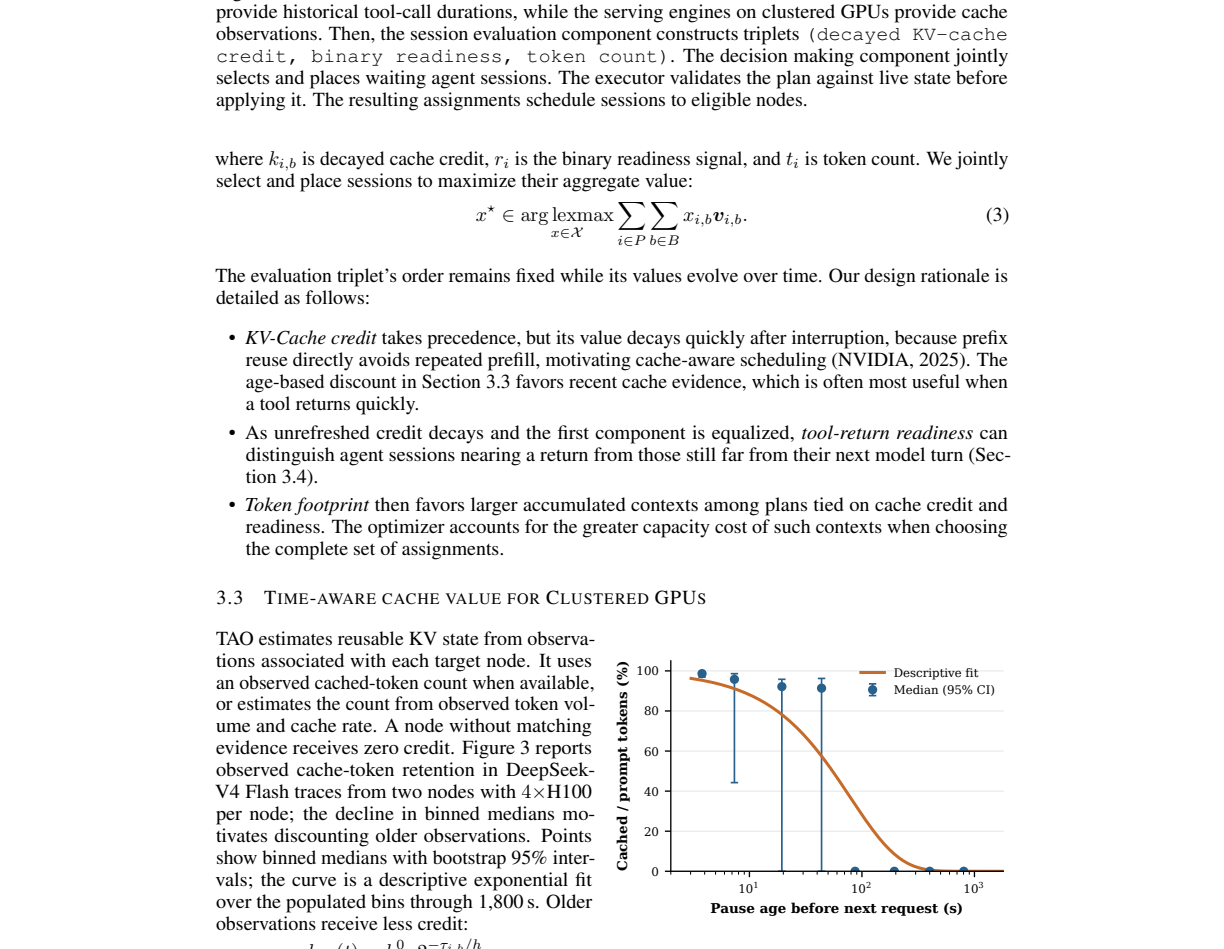
The fixed $h=10$ s half-life and $H=1$ s horizon are hand-set; inferring $h$ from the paper's own retention traces (Figure 3) or adapting it online per workload would reveal whether the mechanism or the tuning carries the gain.
If tool timing is a first-class admission signal, tool-side instrumentation becomes an economic input to serving: exposing richer progress metadata should scale the TTFT gains with prediction accuracy, which the paper's own readiness-accuracy panels make directly measurable.
Check this review
Pith stored no record of this review's passes and took no fingerprint of it. Reviews made by code from 13 Nov 2026 on carry both.
How often reviews like this one are right
Reviews like this one: written by deepseek-v4-flash, where what was read was not recorded.
How often objections from reviews like this one are right: not yet measured
Reviews by people
This review was written by a machine. No person has reviewed this paper on Pith yet. A scientist listed on Pith can review it for a fee, and their review is published here whatever it concludes.
The paper
Abstract
Agentic services alternate between model inference on clustered GPUs and external tools on distributed CPUs. In this scenario, existing systems (1) overlook tool-return readiness in service evaluation, wasting limited resources, and (2) use heuristic strategies to decide admission and placement on GPUs, resulting in suboptimal scheduling decisions. To bridge this gap, we present TAO, a tool-aware joint scheduling framework for LLM-based agentic serving. Its value interface combines near-term tool readiness, node-specific cache credit with time-aware decay, and token footprint; a dynamic program jointly selects and places waiting sessions under capacity constraints. Across the 12 reported model-workload-concurrency settings, TAO reduces latency by up to 26.8%, reduces mean time to first token (TTFT) by up to 36.3%, and increases decode throughput by up to 29.5% relative to the best evaluated state-of-the-art baseline for each metric.
The paper's own sentences, arranged, kept beside the review and separate from it. Each label is drawn from a closed vocabulary; the number beside it is the probability the classifier gave that label. No sentence in this record was written by a model.
abstract compiled · 2026-10-28
The authors' main claim, as the classifier picked it out 1.00
“Across the 12 reported model-workload-concurrency settings, TAO reduces latency by up to 26.8%, reduces mean time to first token (TTFT) by up to 36.3%, and increases decode throughput by up to 29.5% relative to the best evaluated state-of-the-art baseline for each metric.”
How the main claim is stated: asserted 1.00
What the abstract itself states, as probabilities: claims first 0.09 · states limitation 0.07 · human participants 0.02 · controlled comparison 0.93 · randomized assignment 0.02 · states quantitative result 0.99 · compares with prior results 0.98 · mentions code or data availability 0.03
The abstract, sentence by sentence
This table labels the abstract only (arXiv listing abstract v1). The number is the probability the classifier gave the label.
| Sentence | Role | The authors' own work | States the main conclusion | Strength |
|---|---|---|---|---|
| Agentic services alternate between model inference on clustered GPUs and external tools on distributed CPUs. | background 1.00 | 0.08 | 0.02 | asserted 1.00 |
| In this scenario, existing systems (1) overlook tool-return readiness in service evaluation, wasting limited resources, and (2) use heuristic strategies to decide admission and placement on GPUs, resulting in suboptimal scheduling decisions. | gap 0.95 | 0.05 | 0.04 | asserted 1.00 |
| To bridge this gap, we present TAO, a tool-aware joint scheduling framework for LLM-based agentic serving. | contribution 1.00 | 0.82 | 0.09 | asserted 0.98 |
| Its value interface combines near-term tool readiness, node-specific cache credit with time-aware decay, and token footprint; a dynamic program jointly selects and places waiting sessions under capacity constraints. | method 0.96 | 0.90 | 0.08 | asserted 0.99 |
| Across the 12 reported model-workload-concurrency settings, TAO reduces latency by up to 26.8%, reduces mean time to first token (TTFT) by up to 36.3%, and increases decode throughput by up to 29.5% relative to the best evaluated state-of-the-art baseline for each metric. | result 1.00 | 0.96 | 0.76 | asserted 1.00 |
What kind of paper the classifier reports this is: method or tool 1.00 · evidence from observation or experiment 0.95
What was examined, and what was not
Sources read
- arXiv listing abstract v1
Not examined
- full text
- figures and tables
- references and citing sentences
- relations to other papers
Levels run
- P abstract
Not run
- S sections
- T body sentences
- C citations
- R cross-paper relations
How the labels were made
Compiled by classifier-1.13.0 via TypeSafe API, question bank abstract-p1-20260923, 2026-10-28: 1 request, 4,391 input tokens.
Every quoted sentence on this record is the authors'. Every label is from Pith's closed vocabulary, with the probability shown beside it. This record as JSON
Figures (11)
Figures are the authors', reproduced from the paper.
References (59)
- [1] Bengio, Yoshua and LeCun, Yann , booktitle =. Scaling Learning Algorithms Towards on Pith
- [2] Hinton, Geoffrey E. and Osindero, Simon and Teh, Yee Whye , journal =. A Fast Learning Algorithm for Deep Belief Nets , volume = on Pith
- [3] Deep learning , author=. 2016 , publisher= on Pith
- [4] Tackling the Data-Parallel Load Balancing Bottleneck in LLM Serving: Practical Online Routing at Scale , author=. arXiv preprint arXiv:2605.06113 , year= on PithPith's reviewarXiv
- [5] Online Linear Programming for Multi-Objective Routing in LLM Serving , author=. arXiv preprint arXiv:2607.03948 , year= on PithPith's reviewarXiv
- [6] MoE-SpAc: Efficient MoE Inference Based on Speculative Activation Utility in Heterogeneous Edge Scenarios , author=. arXiv preprint arXiv:2603.09983 , year= on PithPith's reviewarXiv
- [7] MiMo-V2. 6: Scaling reinforcement learning towards self-improvement , author=. arXiv preprint arXiv:2610.11959 , year= on PithPith's reviewarXiv
- [8] GLM-4.5: Agentic, Reasoning, and Coding (ARC) Foundation Models , author=. 2025 , eprint= on Pith
- [9] DeepSeek-V4: Towards Highly Efficient Million-Token Context Intelligence , author=. 2026 , eprint= on Pith
- [10] Qwen3 Technical Report , author=. 2025 , eprint= on Pith
- [11] DeepSeek Elastic Compute (DSec): A Sandbox Infrastructure for Effective Agentic Training at Scale , author=. 2026 , eprint= on Pith
- [12] Empirical bernstein bounds and sample variance penalization , author=. arXiv preprint arXiv:0907.3740 , year= on PithPith's reviewarXiv
- [13] HexAGenT: Efficient Agentic LLM Serving via Workflow-and Heterogeneity-Aware Scheduling , author=. arXiv preprint arXiv:2605.16637 , year= on PithPith's reviewarXiv
- [14] Externalization in llm agents: A unified review of memory, skills, protocols and harness engineering , author=. arXiv preprint arXiv:2604.08224 , year= on PithPith's reviewarXiv
- [15] 2026 , howpublished= on Pith
- [16] How Tool Use Works , author=. 2026 , howpublished= on Pith
- [17] Computer Use , author=. 2026 , howpublished= on Pith
- [18] KAIROS: Stateful, Context-Aware Power-Efficient Agentic Inference Serving , author=. arXiv preprint arXiv:2604.16682 , year= on PithPith's reviewarXiv
- [19] n.d. , howpublished= on Pith
- [20] Improve Bash Timeout Retry Hint , author=. 2026 , howpublished= on Pith
show 39 more
- [21] Guy, Nili and Bortnikov, Vita and. Intelligent Inference Scheduling with. 2025 , howpublished= on Pith
- [22] Automatic Prefix Caching , author=. n.d. , howpublished= on Pith
- [23] Efficient Memory Management for Large Language Model Serving with PagedAttention , author=. Proceedings of the ACM SIGOPS Symposium on Operating Systems Principles , year= on Pith
- [24] Zheng, Lianmin and Yin, Liangsheng and Xie, Zhiqiang and Sun, Chuyue and Huang, Jeff and Yu, Cody Hao and Cao, Shiyi and Kozyrakis, Christos and Stoica, Ion and Gonzalez, Joseph E. and Barrett, Clark and Sheng, Ying , booktitle=. 2024 , doi= on Pith
- [25] Srivatsa, Vikranth and He, Zijian and Abhyankar, Reyna and Li, Dongming and Zhang, Yiying , booktitle=. 2025 , url= on Pith
- [26] Qin, Ruoyu and Li, Zheming and He, Weiran and Cui, Jialei and Ren, Feng and Zhang, Mingxing and Wu, Yongwei and Zheng, Weimin and Xu, Xinran , booktitle=. 2025 , url= on Pith
- [27] NVIDIA Dynamo: A Distributed Inference Framework , author=. 2025 , howpublished= on Pith
- [28] Efficient LLM Serving for Agentic Workflows: A Data Systems Perspective , author=. arXiv preprint arXiv:2603.16104 , year= on PitharXiv
- [29] SmoothAgent: Efficient Long-Horizon LLM-Based Agent Serving with Lookahead Context Engineering , author=. arXiv preprint arXiv:2607.00151 , year= on PithPith's reviewarXiv
- [30] Choi, Seungbeom and Goo, Jeonghoe and Jeon, Eunjoo and Yang, Mingyu and Jang, Minsung , journal=. 2025 , url= on Pith
- [31] Chen, Jinyuan and Shi, Jiuchen and Chen, Quan and Guo, Minyi , journal=. 2025 , url= on Pith
- [32] From LLM Inference to Agentic Workloads: Characterization and Implications for Serving Systems , author=. arXiv preprint arXiv:2608.15127 , year= on PithPith's reviewarXiv
- [33] Knapsack Problems , author=. 2004 , doi= on Pith
- [34] An approximation algorithm for the generalized assignment problem , author=. Mathematical Programming , volume=. 1993 , doi= on Pith
- [35] Xu, Yechen and Kong, Xinhao and Chen, Tingjun and Zhuo, Danyang , journal=. 2024 , url= on Pith
- [36] Kang, Hao and Li, Ziyang and Xu, Weili and Yang, Xinyu and Chen, Yinfang and Wang, Junxiong and Chen, Beidi and Krishna, Tushar and Xu, Chenfeng and Arora, Simran , journal=. 2026 , url= on Pith
- [37] Dynamic Programming , author= on Pith
- [38] An exact algorithm for large multiple knapsack problems , author=. European Journal of Operational Research , volume=. 1999 , doi= on Pith
- [39] A Polynomial Time Approximation Scheme for the Multiple Knapsack Problem , author=. SIAM Journal on Computing , volume=. 2005 , doi= on Pith
- [40] Simple and Fast Algorithm for Binary Integer and Online Linear Programming , author=. arXiv preprint arXiv:2003.02513 , year= on PithPith's reviewarXiv
- [41] Zhang, Rui and Kim, Chaeeun and Feng, Shaoting and Du, Kuntai and Liu, Yuhan and Zhong, Yi and Ching, Cheng-Wei and Jiang, Junchen and Hu, Liting , journal=. Learning Agent Execution for. 2026 , url= on Pith
- [42] Bian, Zhuohang and Wu, Feiyang and Ma, Teng and Zhuo, Youwei , journal=. 2025 , url= on Pith
- [43] Wang, Jiahao and Lin, Kaizhan and Zhang, Kaixi and Han, Jinbo and Wei, Xingda and Shen, Sijie and Fang, Chenguang and Yu, Wenyuan and Chen, Rong and Chen, Haibo , journal=. 2026 , url= on Pith
- [44] Biswas, Anish and Goel, Kanishk and. arXiv preprint arXiv:2601.12967 , year= on PithPith's reviewarXiv
- [45] Sui, Yifan and Zhao, Han and Ma, Rui and He, Zhiyuan and Wang, Hao and Li, Jianxun and Xu, Kaiqiang and Chen, Kai and Yang, Yuqing , journal=. Parallelizing Tool Execution and. 2026 , url= on Pith
- [46] Li, Hanchen and He, Runyuan and Mang, Qiuyang and Zhang, Qizheng and Mao, Huanzhi and Chen, Xiaokun and Zhou, Hangrui and Zhang, Huanchen and Cheung, Alvin and Gonzalez, Joseph and Stoica, Ion , journal=. 2025 , url= on Pith
- [47] Abhyankar, Reyna and He, Zijian and Srivatsa, Vikranth and Zhang, Hao and Zhang, Yiying , booktitle=. 2024 , url= on Pith
- [48] Lin, Chaofan and Han, Zhenhua and Zhang, Chengruidong and Yang, Yuqing and Yang, Fan and Chen, Chen and Qiu, Lili , booktitle=. 2024 , url= on Pith
- [49] Pan, Zaifeng and Patel, Ajjkumar Dahyalal and Shen, Yipeng and Hu, Zhengding and Guan, Yue and Li, Wan-Lu and Qin, Lianhui and Wang, Yida and Ding, Yufei , booktitle=. 2025 , doi= on Pith
- [50] Gim, In and Ma, Zhiyao and Lee, Seung-seob and Zhong, Lin , booktitle=. 2025 , doi= on Pith
- [51] Wang, Yifei and Ye, Hancheng and Xu, Yechen and Guo, Cong and Wei, Chiyue and Wang, Qinsi and Li, Dongting and Chen, Tingjun and Li, Hai. arXiv preprint arXiv:2604.26963 , year= on PithPith's reviewarXiv
- [52] Guo, Dongxin and Wu, Jikun and Yiu, Siu Ming , journal=. 2026 , url= on Pith
- [53] Ni, Hongqiu and Tian, Han and Zhang, Chi and Li, Guopeng and Tan, Haisheng , journal=. 2026 , url= on Pith
- [54] Feng, Bochao and Li, Jianjiang and Wang, Haojie and Qiao, Lin and Li, Yinghui and Yan, Yukun and Zhai, Jidong , journal=. Decoupling Readiness from Release for Tail-Aware Scheduling of Agentic. 2026 , url= on Pith
- [55] Luo, Michael and Shi, Xiaoxiang and Cai, Colin and Zhang, Tianjun and Wong, Justin and Wang, Yichuan and Wang, Chi and Huang, Yanping and Chen, Zhifeng and Gonzalez, Joseph E. and Stoica, Ion , journal=. 2025 , url= on Pith
- [56] Jimenez, Carlos E. and Yang, John and Wettig, Alexander and Yao, Shunyu and Pei, Kexin and Press, Ofir and Narasimhan, Karthik R. , booktitle=. 2024 , url= on Pith
- [57] Terminal-bench: Benchmarking agents on hard, realistic tasks in command line interfaces , author=. International Conference on Learning Representations , volume= on Pith
- [58] Openhands: An open platform for ai software developers as generalist agents , author=. International Conference on Learning Representations , volume= on Pith
- [59] Luo, Michael and Shi, Xiaoxiang and Cai, Colin and Zhang, Tianjun and Wong, Justin and Wang, Yichuan and Wang, Chi and Huang, Yanping and Chen, Zhifeng and Gonzalez, Joseph E. and Stoica, Ion , booktitle=. 2026 , pages= on Pith
Cited by 1 Pith paper
Reviewed papers on Pith that cite this one. The full citation record
Challenges and discussion
Disagree with the review, or know something it missed? Leave a comment, or challenge this review formally: a challenge becomes a permanent entry in this paper's record, and its decision is published here.
Come back by email
A short list of the week's newly reviewed papers. Nothing is sent until you confirm from your inbox, and every email has a link that stops it. No account.
No comments yet.
Sign in to comment