Distributed, Parallel, and Cluster Computing · arXiv:2609.18849 v1 · submitted 16 Sep 2026 · 64 references
Ask the Tool, Don't Guess: Agent Tool Calls Hold Their Progress, and the Serving System Should Read It
The paper says
“An agentic request spends substantial wall-clock time waiting for tools, and its KV cache holds GPU memory the whole time.”
more of the abstract
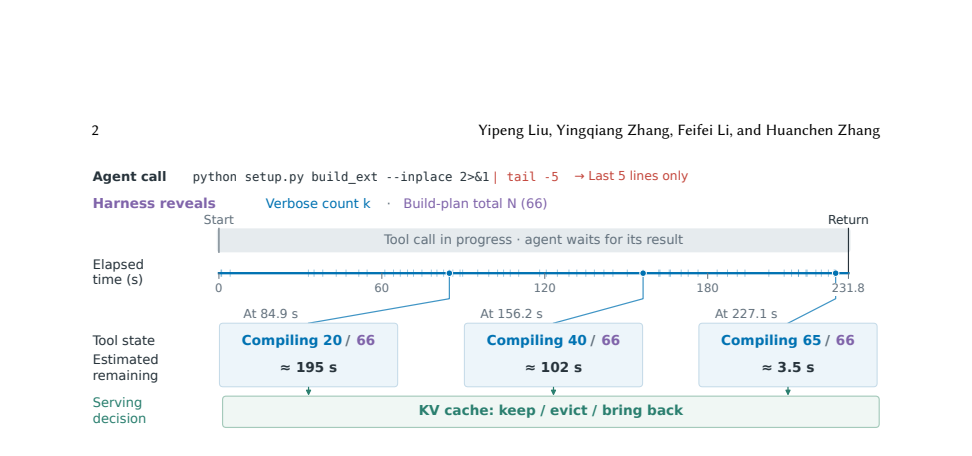
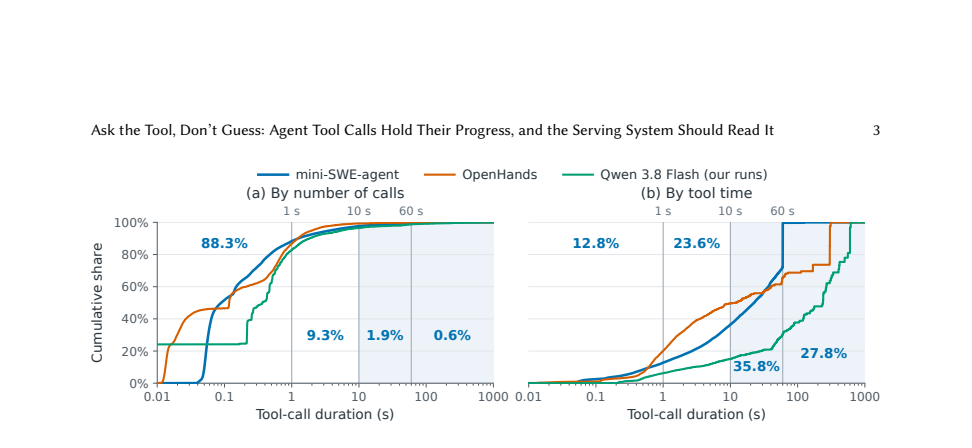
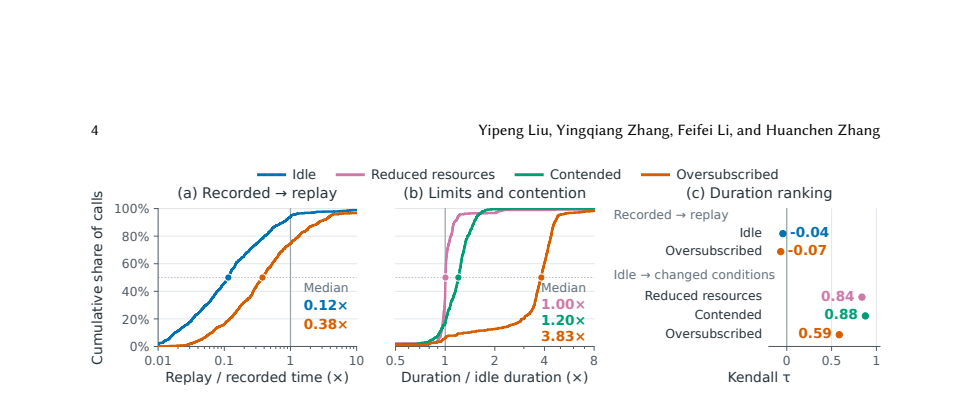
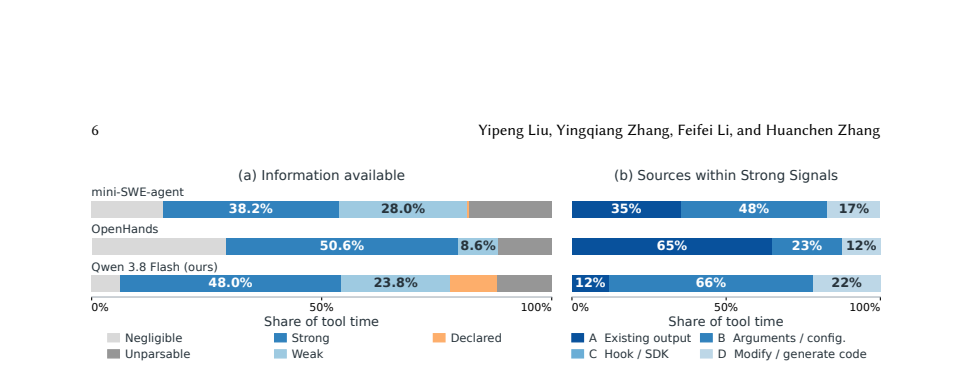
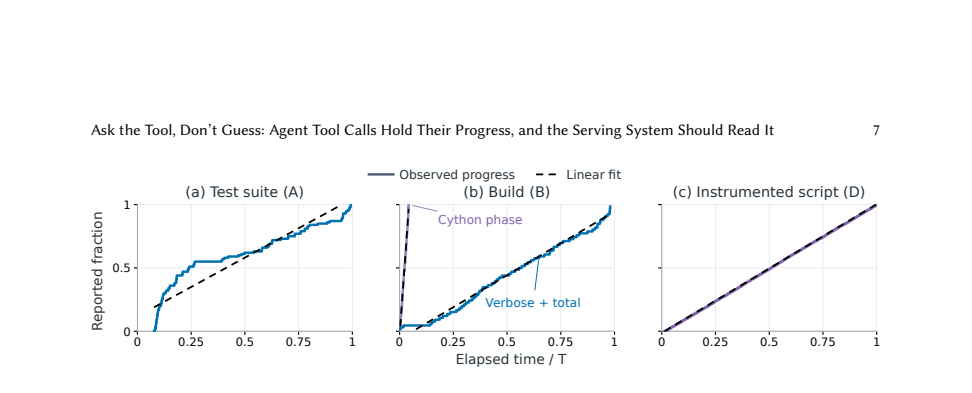
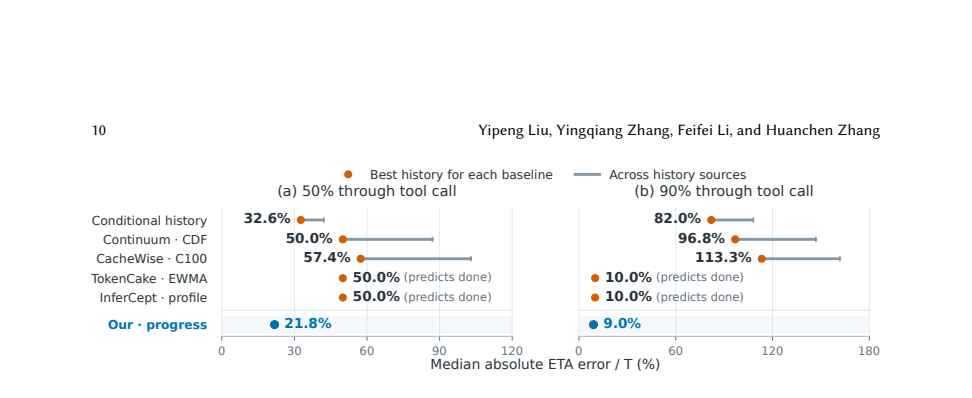
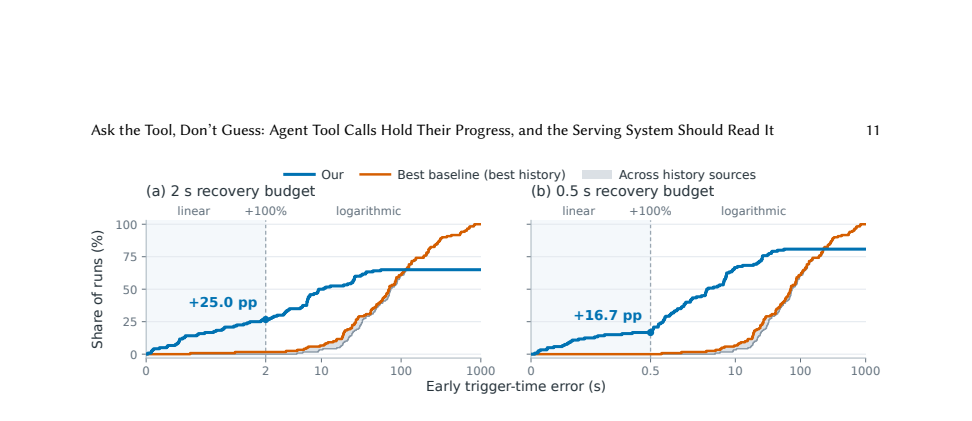
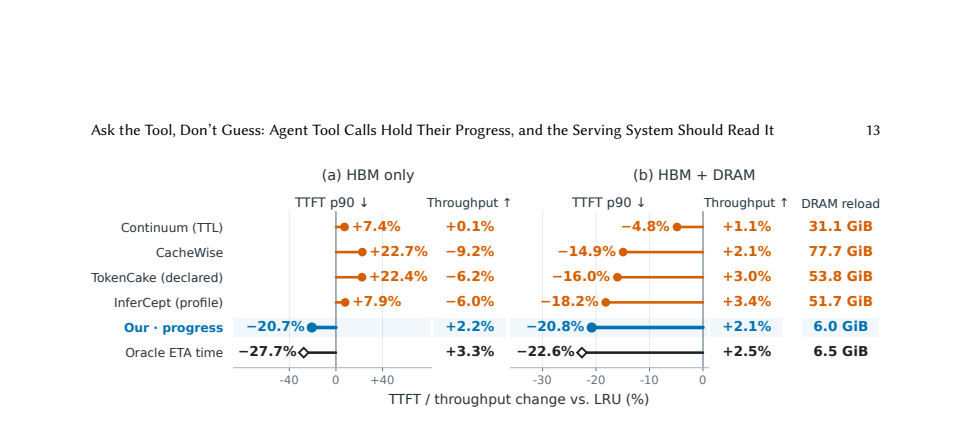
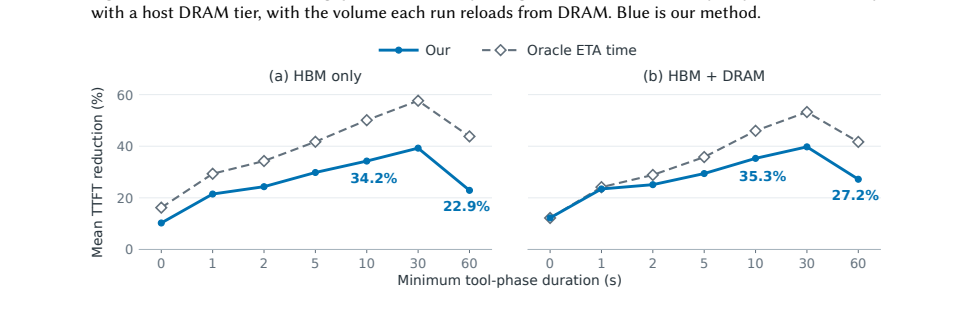
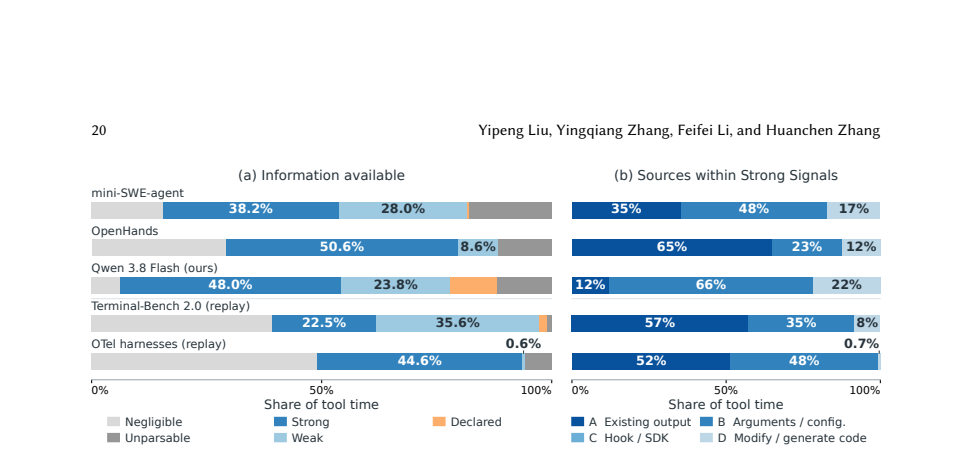
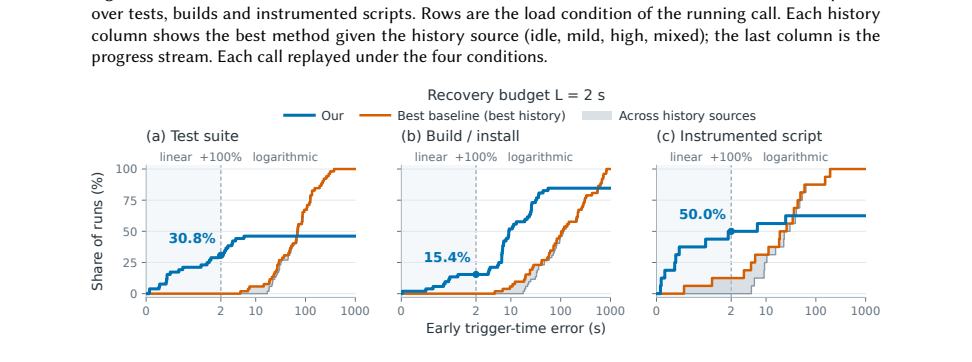
Serving systems decide whether that cache stays, leaves, or comes back by guessing how long the tool will run, from the tool's name, its history, a duration declared before the call, or the engine's own occupancy. We show that no estimate fixed before a call starts can know its duration, and such estimates may not even rank the calls. Meanwhile, the running tool already holds the answer, but the agent stack together with the tool silences it. We propose that tool calls report their progress explicitly while they run, and we measure what that takes. A census of four public agent corpora finds a readable signal in most tool time once it is revealed, in two strengths: a fraction of the work remaining, or an accurate signal that the end is near. A harness recovers it without changing what the agent sees, at no measurable cost to the agent's benchmark score. At the points where a KV cache decision is made, the reported progress is between several times and an order of magnitude more accurate than the best published predictors, and it stays accurate when the environment changes. Plugged into a production engine through a few small hints, it cuts the p90 time to first token (TTFT) after a tool call by 20.7% (HBM only) and 20.8% (HBM + DRAM) against LRU, close to an oracle. A serving system should not guess what its tools can tell it.
from the abstract
Pith says
Machine review · deepseek-v4-flash · 17 Sep 2026 · what was read was not recorded · not checked by a person
It can be wrong. Challenge this review or reply to it.
Holds up, with conditions. Solid, novel contribution: reading progress from tool calls for KV cache decisions is a clever idea, well-executed with thorough evaluation; minor overclaim on robustness under load transitions but overall a clear accept with minor revisions. This line is wrong
2 major objections · 5 minor
How often objections from reviews like this one are right: not yet measured
Not checked: figures, code, what the 64 references say.
The paper says, at Section 4.3 (Robustness across settings) and Appendix Figure 12
The review did not quote this passage.
Pith says: Objection 1 of 2 · major
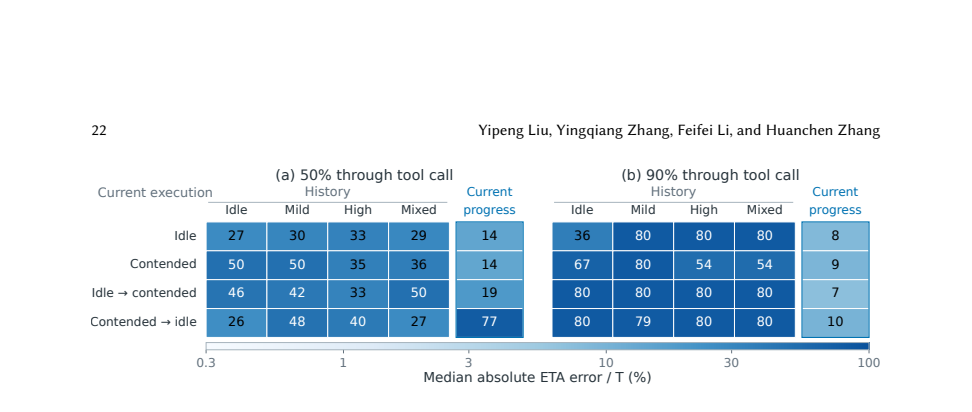
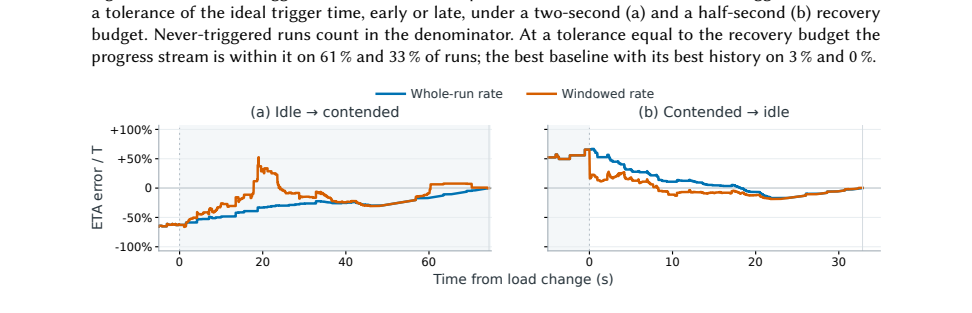
The main text claims that the progress stream "is equally accurate across the environments" (Section 4.3) and the abstract states that it "stays accurate when the environment changes." However, Appendix Figure 12 shows that at 50% of the call in the "contended → idle" transition, the median absolute ETA error is 77% of the call duration—significantly worse than all four history sources in that same condition (idle history: 26%, mild: 48%, high: 40%, mixed: 27%).
more of objection 1
This contradicts the "equally accurate" claim and weakens the promise of robustness. The paper acknowledges windowed-rate limitations in passing (Appendix C, label "Current progress" column), but this negative result is not reported or discussed in the main evaluation. The authors must either qualify the robustness claim explicitly in Sections 1 and 4.3, including the contended→idle degradation and its practical implications, or provide additional analysis (e.g., using a windowed rate for the progress stream) that actually achieves the claimed accuracy under that transition.
This review says the paper's mathematics is wrong. Pith did not check that against the paper's source.
The paper says, at Abstract and Section 4.3
The review did not quote this passage.
Pith says: Objection 2 of 2 · major
Related to the above, the claim that the progress stream "stays accurate when the environment changes" is too broad. The data show that the stream is accurate in three of four conditions (idle, contended, idle→contended) but fails in the contended→idle case at the midpoint, which is a realistic scenario (e.g., a background job finishing).
more of objection 2
The paper should present a nuanced statement, along with a clear table or figure in the main text (not only in the appendix) showing the error matrix of Figure 12, and discuss under what conditions the progress stream is or is not reliable.
5 minor objections
The paper says, at References
Pith says: minor objection 1 of 5
Many references are listed with future publication years (e.g., [6] 2027, [7] 2026, [12] 2026, [14] 2026, etc.). The authors should verify that these are publicly available or explain their status. If they are preprints or placeholders, this should be noted.
The paper says, at Section 2.2, Table 2
Pith says: minor objection 2 of 5
The classification of signals into "strong" and "weak" is intuitive, but the thresholds for when a signal is considered "strong" (fraction usable) versus "weak" (end marker only) could benefit from a short quantitative definition or rule (e.g., mean absolute fraction error below some bound).
show 3 more
The paper says, at Section 5.3 (When the reporter lies)
Pith says: minor objection 3 of 5
The session-credit mechanism is described at a high level and evaluated only via a preliminary simulation. Since lying is a critical concern for deploying this approach, more thorough analysis (e.g., worst-case bounds, impact on honest sessions) would strengthen the paper. A brief mention of this as future work is acceptable, but the current simulation (6% memory increase, 5% recovered) is too thin to robustly conclude "liars do not affect the system much."
The paper says, at Appendix B, Table 5
Pith says: minor objection 4 of 5
The table lists "Verdict" for each instrument. Some entries say "Transport, not a signal" (layer 1) which is unclear; please clarify what that means (e.g., the side channel receives the full stream but parsing yields no structured progress event).
The paper says, at Appendix A, Figure 11
Pith says: minor objection 5 of 5
The figure includes a corpus named "OTel harnesses (replay)" which is not described in the main text. Consider introducing all corpora in Section 2 or citing the appendix appropriately.
What would settle it
Recompute the median absolute ETA error for the contended→idle condition at 50% call duration using a windowed rate estimator (e.g., last 5 seconds of observed rate) instead of the whole-run rate used in Figure 12. If the error drops below 26% (the best history source), the concern is resolved; if it remains above 30%, the main-text overstatement stands.
from the skeptic's reading
How the review went
4 readings by deepseek-v4-flash · 17 Sep 2026
- Reader holds up, with conditions
- Skeptic partly agrees
- Editor wrote the verdict above
- Referee major revision: 2 major objections, 5 minor
Not run on this paper: the simulated authors' defence.
Pith did not check this review's objections against the paper.
The review in full
The review in brief, machine-written
This is a genuinely good paper. The core idea—reading progress from tools during execution and feeding it to the KV cache scheduler—is novel and practical. The census, the harness design, the side-channel approach, and the end-to-end integration into vLLM are all well done. The evaluation is thorough: they compare against four published baselines, measure accuracy at decision-relevant points, handle robustness across environments, and even address lying tenants. The limitations are honestly stated. I came away impressed.
What’s new: they don’t just propose an idea; they measure what tool calls actually hold (the census), build a working harness that recovers the signal without changing the agent’s observation, and show a 20% p90 TTFT reduction on GPUs. The session-credit mechanism for dishonest reports is a nice touch.
Soft spots: the main text’s claim that the progress signal “stays accurate when the environment changes” is slightly over-broad. Appendix Figure 12 shows that under a contended→idle transition, the median error at 50% of the call is 77% of call duration—worse than all history baselines. The paper acknowledges this transient in a windowed-rate note, but the main text doesn’t qualify it. That said, the error is a transient that lasts only until the new rate is observed, and the claim holds for the other three conditions. It’s a minor imprecision, not a load-bearing flaw. The end-to-end evaluation is on replayed traces, not live agents, but the replay setup is well-justified and the trace fidelity looks good. The census labeling uses LLM classifiers with human spot-checking; I’d like to see a larger human audit or a release of the labeled data, but the results are likely robust.
Overall, the paper makes a clear contribution. I’d recommend a minor revision to qualify the robustness claim (add a sentence in Section 4.3 about the transient condition). For the systems community, this is a strong paper. I would accept it with minor changes.
The strongest objection
The main text states that the progress stream 'stays accurate when the environment changes' (Section 4.3) and 'is equally accurate across the environments.' However, Appendix Figure 12 shows that in the contended→idle transition condition, the median absolute ETA error at 50% of the call is 77% of the call duration—far higher than in the other three conditions (14–19%) AND higher than all history sources in that same condition (idle history gives 26%, mild 48%, high 40%, mixed 27%). The progress stream is therefore less accurate than several history-based predictors at the eviction-relevant midpoint under this realistic load-drop scenario. The paper acknowledges this in passing with a note about windowed rates, but the main-text claim is not qualified accordingly. Since the central claim promises superior accuracy under changing environments, this discrepancy weakens that promise for a substantial fraction of decisions (the eviction decision, made near the midpoint).
The reader's verdict (CONDITONAL) and weakest_assumption focused on the harness's ability to recover signals without agent impact. My concern is different: it is about the accuracy robustness claim under a specific environment transition, which is inadequately qualified in the main text. This is a real but contained overstatement: the near-end accuracy (90%) remains strong across all conditions, and the paper does discuss the windowed-rate fix in the appendix. Therefore the existing CONDITONAL verdict (with its noted reservations about replay evaluation and LLM labeling) largely still fits, but the accuracy-vs-environment claim should be stated with more nuance. No change to the verdict is required, but the paper's reliance on the 'stays accurate' phrasing should be noted.
The referee's report
If the results hold, the paper addresses a practical and growing problem in serving agentic LLM workloads: the uncertainty of tool call durations and its impact on KV cache memory management. The core idea—reading progress from the tool itself rather than predicting it—is well-motivated and clearly explained. The census and harness construction are systematic, and the empirical accuracy evaluation (Figures 7-8) shows a substantial advantage over existing approaches at the decision-relevant moments. The end-to-end GPU experiments further demonstrate measurable latency benefits. However, the paper's central claim of robustness under environment changes is partially undermined by its own data, as the skeptic note highlights. Overall, the work offers a useful new angle for the serving community, but the overstatement of robustness needs correction before the paper can be accepted as is.
Pith's reading of the paper (a machine's summary, not the authors')
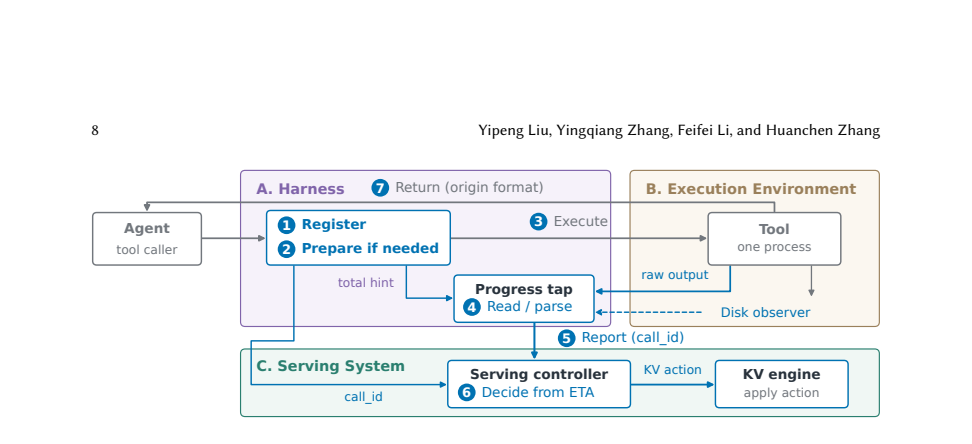
This paper argues that serving systems for agentic LLM workloads should not guess how long a tool call will run, but instead read the progress the tool itself reports while it runs. The authors show that most long tool calls already print or can be made to reveal a work count, a percentage, or a phase marker, but the standard agent stack silences this information. A lightweight harness recovers the signal through a side channel that leaves the agent's observation byte-identical. At the points where a KV-cache eviction or reload decision is made, the reported progress is several times to an order of magnitude more accurate than the best published predictors, and it stays accurate when the environment changes. Integrated into a production engine, this progress signal cuts the p90 time to first token after a tool call by about 20%, close to an oracle.
What carries the argument. A two-layer execution wrapper that (1) taps the tool's byte stream and the files it leaves on disk, producing timestamped progress events (work done, total if known, phase markers) through a side channel separate from the agent's result path, and (2) lifts three layers of silence: infrastructure- and agent-imposed output suppression, tools that only speak when asked (verbose flags, dry runs, object-file monitoring), and agent-generated scripts that lack progress output. The wrapper converts the events into a remaining-time estimate that the serving controller uses to decide whether to refresh, release, or reload the session's KV cache.
Core claim. The paper establishes that the duration of long tool calls is set by runtime conditions that no pre-call estimator can see, yet the running tool itself already holds the answer. A census of four public agent corpora reveals that 38–50% of tool time carries a strong progress signal (a known fraction of work done) after the standard silencing layers are lifted, and another 9–28% carries a weak signal (an accurate end-is-near marker). A harness that re-enables progress bars, reverses quiet flags, and parses output and disk events recovers this signal without changing what the agent reads, at no measurable cost to benchmark scores. Compared to four published timing predictors (Continuum, CacheWise, TokenCake, InferCept), the progress stream's remaining-time error is about 20% of the call duration at the midpoint and under 10% at 90% completion, versus over 30% and over 80% for the best baseline, and it remains accurate under changing load.
The premise it rests on. Most long tool calls expose some form of progress (a counter, a percentage, or a phase marker) that a harness can reliably recover by re-enabling suppressed output, adding silent flags, or monitoring disk writes, without changing the agent's observation or affecting what the agent sees from the tool's output or exit status.
If the paper is right (Pith's inferences, not the authors')
Serving systems can replace fixed time-to-live or learned duration models with live progress reports, improving KV-cache utilization and reducing TTFT by about 20% without changing any model code.
Agent harnesses and tool authors are incentivised to preserve or expose progress information, because it directly improves the latency and throughput of the serving layer.
The census method provides a template for any agent serving system to audit its own tool calls and estimate the fraction of tool time it could recover with progress signals.
The lying-reporter credit mechanism allows the serving system to treat tool-originated timing signals as untrusted input, bounding the harm of a malicious or buggy tenant without affecting honest sessions.
If tools and agent protocols adopt a standard progress notification (e.g., via the Model Context Protocol), the harness could be replaced by a simple relay, making the mechanism nearly universal and removing the need for tool-specific parsers and dry runs.
The paper's 20% TTFT reduction is measured on vLLM with prefix caching; similar or larger gains may be achievable on other engines that use KV cache offloading or disaggregated serving, where the cost of a wrong decision is higher.
Applying the same insight to other resource-waiting events in LLM serving—such as network I/O for large context retrieval or model-parallel synchronization—could extend the principle of 'ask, don't guess' beyond tool calls.
Check this review
Pith stored no record of this review's passes and took no fingerprint of it. Reviews made by code from 13 Nov 2026 on carry both.
How often reviews like this one are right
Reviews like this one: written by deepseek-v4-flash, where what was read was not recorded.
How often objections from reviews like this one are right: not yet measured
Reviews by people
This review was written by a machine. No person has reviewed this paper on Pith yet. A scientist listed on Pith can review it for a fee, and their review is published here whatever it concludes.
The paper
Abstract
An agentic request spends substantial wall-clock time waiting for tools, and its KV cache holds GPU memory the whole time. Serving systems decide whether that cache stays, leaves, or comes back by guessing how long the tool will run, from the tool's name, its history, a duration declared before the call, or the engine's own occupancy. We show that no estimate fixed before a call starts can know its duration, and such estimates may not even rank the calls. Meanwhile, the running tool already holds the answer, but the agent stack together with the tool silences it. We propose that tool calls report their progress explicitly while they run, and we measure what that takes. A census of four public agent corpora finds a readable signal in most tool time once it is revealed, in two strengths: a fraction of the work remaining, or an accurate signal that the end is near. A harness recovers it without changing what the agent sees, at no measurable cost to the agent's benchmark score. At the points where a KV cache decision is made, the reported progress is between several times and an order of magnitude more accurate than the best published predictors, and it stays accurate when the environment changes. Plugged into a production engine through a few small hints, it cuts the p90 time to first token (TTFT) after a tool call by 20.7% (HBM only) and 20.8% (HBM + DRAM) against LRU, close to an oracle. A serving system should not guess what its tools can tell it.
The paper's own sentences, arranged, kept beside the review and separate from it. Each label is drawn from a closed vocabulary; the number beside it is the probability the classifier gave that label. No sentence in this record was written by a model.
abstract compiled · 2026-09-23
The authors' main claim, as the classifier picked it out 0.99
“A serving system should not guess what its tools can tell it.”
How the main claim is stated: asserted 0.98
What the abstract itself states, as probabilities: claims first 0.09 · states limitation 0.26 · human participants 0.03 · controlled comparison 0.92 · randomized assignment 0.02 · states quantitative result 0.98 · compares with prior results 0.97 · mentions code or data availability 0.07
The abstract, sentence by sentence
This table labels the abstract only (arXiv listing abstract v1). The number is the probability the classifier gave the label.
| Sentence | Role | The authors' own work | States the main conclusion | Strength |
|---|---|---|---|---|
| An agentic request spends substantial wall-clock time waiting for tools, and its KV cache holds GPU memory the whole time. | background 1.00 | 0.33 | 0.03 | asserted 1.00 |
| Serving systems decide whether that cache stays, leaves, or comes back by guessing how long the tool will run, from the tool's name, its history, a duration declared before the call, or the engine's own occupancy. | background 0.98 | 0.07 | 0.03 | asserted 1.00 |
| We show that no estimate fixed before a call starts can know its duration, and such estimates may not even rank the calls. | result 0.68 | 0.82 | 0.13 | asserted 0.85 |
| Meanwhile, the running tool already holds the answer, but the agent stack together with the tool silences it. | gap 0.76 | 0.26 | 0.09 | asserted 1.00 |
| We propose that tool calls report their progress explicitly while they run, and we measure what that takes. | contribution 0.80 | 0.93 | 0.10 | asserted 0.94 |
| A census of four public agent corpora finds a readable signal in most tool time once it is revealed, in two strengths: a fraction of the work remaining, or an accurate signal that the end is near. | result 0.84 | 0.94 | 0.07 | asserted 1.00 |
| A harness recovers it without changing what the agent sees, at no measurable cost to the agent's benchmark score. | result 0.90 | 0.92 | 0.06 | asserted 1.00 |
| At the points where a KV cache decision is made, the reported progress is between several times and an order of magnitude more accurate than the best published predictors, and it stays accurate when the environment changes. | result 1.00 | 0.93 | 0.22 | asserted 1.00 |
| Plugged into a production engine through a few small hints, it cuts the p90 time to first token (TTFT) after a tool call by 20.7% (HBM only) and 20.8% (HBM + DRAM) against LRU, close to an oracle. | result 1.00 | 0.94 | 0.16 | asserted 1.00 |
| A serving system should not guess what its tools can tell it. | interpretation 0.90 | 0.11 | 0.91 | asserted 0.98 |
What kind of paper the classifier reports this is: method or tool 0.97 · evidence from observation or experiment 1.00
What was examined, and what was not
Sources read
- arXiv listing abstract v1
Not examined
- full text
- figures and tables
- references and citing sentences
- relations to other papers
Levels run
- P abstract
Not run
- S sections
- T body sentences
- C citations
- R cross-paper relations
How the labels were made
Compiled by classifier-1.13.0 via TypeSafe API, question bank abstract-p1-20260923, 2026-09-23: 1 request, 7,639 input tokens.
Every quoted sentence on this record is the authors'. Every label is from Pith's closed vocabulary, with the probability shown beside it. This record as JSON
Figures (16)


Figures are the authors', reproduced from the paper.
References (64)
- [1] Reyna Abhyankar, Zijian He, Vikranth Srivatsa, Hao Zhang, and Yiying Zhang. 2024. InferCept: Efficient Intercept Support for Augmented Large Language Model Inference. InProceedings of the 41st International Conference on Machine Learning (Proceedings of Machine Learning Resear... on Pith
- [2] Anthropic. 2026. Claude Fable 5.1 and Claude Mythos 5.1 System Card. https://www.anthropic.com/claude-fable-and- mythos-5-1 on Pith
- [3] Anthropic. 2026. Prompt caching (cache_control ttl 5m / 1h). https://platform.claude.com/docs/en/build-with- claude/prompt-caching on Pith
- [4] Ziyad Benomar, Romain Cosson, Alexander Lindermayr, and Jens Schlöter. 2025. Non-Clairvoyant Scheduling with Progress Bars. InAdvances in Neural Information Processing Systems, Vol. 38. Curran Associates, Inc., 93520–93561. arXiv:2509.19662 [cs.DS] doi:10.52202/085713-3127 on PitharXiv
- [5] Song Bian, Minghao Yan, Anand Jayarajan, Gennady Pekhimenko, and Shivaram Venkataraman. 2025. What Limits Agentic Systems Efficiency? arXiv:2510.16276 [cs.AI] https://arxiv.org/abs/2510.16276 on PitharXiv
- [6] Zhuohang Bian, Feiyang Wu, Zhuoran Li, Teng Ma, and Youwei Zhuo. 2027. TokenCake: A KV-Cache-centric Serving Framework for LLM-based Multi-Agent Applications. InProceedings of the European Conference on Computer Systems (EuroSys ’27). arXiv:2510.18586 [cs.DC] doi:10.48550/arXi... on PithPith's reviewarXivdoi:10.48550/arxiv.2510.18586
- [7] Anish Biswas, Kanishk Goel, Srivarshinee S, Jayashree Mohan, Alind Khare, Anjaly Parayil, Ramachandran Ramjee, and Chetan Bansal. 2026. Sutradhara: An Intelligent Orchestrator-Engine Co-design for Tool-based Agentic Inference. arXiv:2601.12967 [cs.DC] doi:10.48550/arXiv.2601.12967 on PithPith's reviewarXivdoi:10.48550/arxiv.2601.12967
- [8] Shiyi Cao, Yichuan Wang, Ziming Mao, Pin-Lun Hsu, Liangsheng Yin, Tian Xia, Dacheng Li, Shu Liu, Yineng Zhang, Yang Zhou, Ying Sheng, Joseph Gonzalez, and Ion Stoica. 2025. Locality-aware Fair Scheduling in LLM Serving. arXiv:2501.14312 [cs.DC] doi:10.48550/arXiv.2501.14312 on PithPith's reviewarXivdoi:10.48550/arxiv.2501.14312
- [9] Chaokun Chang, Yukun Zhou, Kaihua Fu, Dakai An, Tianyu Feng, Hanfeng Lu, Sheng Yao, Pu Guo, Yinghao Yu, Yizhou Shan, Bo Li, Binhang Yuan, and Wei Wang. 2026. From LLM Inference to Agentic Workloads: Characterization and Implications for Serving Systems. arXiv:2608.15127 [cs.OS... on PithPith's reviewarXiv
- [10] Surajit Chaudhuri, Raghav Kaushik, and Ravishankar Ramamurthy. 2005. When Can We Trust Progress Estimators for SQL Queries?. InProceedings of the 2005 ACM SIGMOD International Conference on Management of Data. ACM, 575–586. doi:10.1145/1066157.1066223 on PitharXiv
- [12] Minseo Choi and Ananya Joshi. 2026. Adaptive KV Retention for LLM Agents at Human-Approval Timescales. arXiv:2608.30830 [cs.OS] https://arxiv.org/abs/2608.30830 on PithPith's reviewarXiv
- [13] Jeffrey Dean and Luiz André Barroso. 2013. The Tail at Scale.Commun. ACM56, 2 (2013), 74–80. doi:10.1145/2408776. 2408794 on Pithdoi:10.1145/2408776
- [14] Jianru Ding, Ryien Hosseini, Pouya Mahdi Gholami, Mingyuan Xiang, and Henry Hoffmann. 2026. Observation, Not Prediction: Conversation-Level Disaggregated Scheduling for Agentic Serving. arXiv:2606.01839 [cs.DC] doi:10.48550/ arXiv.2606.01839 on PithPith's reviewarXivdoi:10.48550/arxiv.2606.01839
- [15] Docker, Inc. 2026. Docker Hub Pull Usage and Limits. Docker Docs. https://docs.docker.com/docker-hub/usage/pulls/ Accessed 14 September 2026 on Pith
- [16] Dominik Durner, Viktor Leis, and Thomas Neumann. 2023. Exploiting Cloud Object Storage for High-Performance Analytics.Proceedings of the VLDB Endowment16, 11 (2023), 2769–2782. doi:10.14778/3611479.3611486 on PitharXiv
- [17] Exgentic. 2026. Exgentic/agent-llm-traces: OpenTelemetry traces of LLM agent runs across benchmarks. https: //huggingface.co/datasets/Exgentic/agent-llm-traces. Accessed 14 September 2026 on Pith
- [18] Bin Gao, Zhuomin He, Puru Sharma, Qingxuan Kang, Djordje Jevdjic, Junbo Deng, Xingkun Yang, Zhou Yu, and Pengfei Zuo. 2024. Cost-Efficient Large Language Model Serving for Multi-turn Conversations with CachedAttention. In2024 USENIX Annual Technical Conference (USENIX ATC 24).... on Pith
- [19] Isaac Grosof and Michael Mitzenmacher. 2022. Incentive Compatible Queues Without Money. arXiv:2202.05747 [cs.GT] doi:10.48550/arXiv.2202.05747 on PithPith's reviewarXivdoi:10.48550/arxiv.2202.05747
- [20] Alexandru Iosup, Nezih Yigitbasi, and Dick H. J. Epema. 2011. On the Performance Variability of Production Cloud Services. In11th IEEE/ACM International Symposium on Cluster, Cloud and Grid Computing (CCGrid 2011). IEEE Computer Society, 104–113. doi:10.1109/CCGrid.2011.22 on Pithdoi:10.1109/ccgrid.2011.22
- [21] Jiabao Ji, Yujian Liu, Li An, Rohit Jain, Gungor Polatkan, Siyu Zhu, and Shiyu Chang. 2026. Speculate While You Reason: Teaching Agents to Predict Their Next Tool Call via Joint Agent-Speculator RL. arXiv:2607.25816 Ask the Tool, Don’t Guess: Agent Tool Calls Hold Their Progre... on PithPith's reviewarXiv
show 44 more
- [22] Carlos E. Jimenez, John Yang, Alexander Wettig, Shunyu Yao, Kexin Pei, Ofir Press, and Karthik Narasimhan on Pith
- [23] Hao Kang, Ziyang Li, Weili Xu, Xinyu Yang, Yinfang Chen, Junxiong Wang, Beidi Chen, Tushar Krishna, Chen- feng Xu, and Simran Arora. 2026. ThunderAgent: A Simple, Fast and Program-Aware Agentic Inference System. arXiv:2602.13692 [cs.OS] https://arxiv.org/abs/2602.13692 on PithPith's reviewarXiv
- [24] Woosuk Kwon, Zhuohan Li, Siyuan Zhuang, Ying Sheng, Lianmin Zheng, Cody Hao Yu, Joseph E. Gonzalez, Hao Zhang, and Ion Stoica. 2023. Efficient Memory Management for Large Language Model Serving with PagedAttention. InProceedings of the 29th Symposium on Operating Systems Princ... on Pithdoi:10.1145/3600006
- [25] Hanchen Li, Runyuan He, Qiuyang Mang, Qizheng Zhang, Huanzhi Mao, Xiaokun Chen, Hangrui Zhou, Huanchen Zhang, Alvin Cheung, Joseph Gonzalez, and Ion Stoica. 2025. Continuum: Efficient and Robust Multi-Turn LLM Agent Scheduling with KV Cache Time-to-Live. arXiv:2511.02230 [cs.O... on PithPith's reviewarXivdoi:10.48550/arxiv.2511.02230
- [26] Banruo Liu, Haoran Qiu, Íñigo Goiri, Rodrigo Fonseca, Ricardo Bianchini, and Esha Choukse. 2026. Agentic Coding in the Wild: Characterizing GitHub Copilot Traces at Production Scale. arXiv:2608.00101 [cs.AI] https://arxiv.org/abs/ 2608.00101 on PithPith's reviewarXiv
- [27] Gang Luo. 2017. Toward a Progress Indicator for Machine Learning Model Building and Data Mining Algorithm Execution: A Position Paper.ACM SIGKDD Explorations Newsletter19, 2 (2017), 13–24. doi:10.1145/3166054.3166057 on PitharXiv
- [28] Gang Luo, Tong Chen, and Hao Yu. 2007. Toward a progress indicator for program compilation.Software: Practice and Experience37, 9 (2007), 909–933. doi:10.1002/spe.792 on Pithdoi:10.1002/spe.792
- [29] Gang Luo, Jeffrey F. Naughton, Curt J. Ellmann, and Michael W. Watzke. 2004. Toward a Progress Indicator for Database Queries. InProceedings of the 2004 ACM SIGMOD International Conference on Management of Data. ACM, 791–802. doi:10.1145/1007568.1007658 on PitharXiv
- [30] Mike Merrill, Alexander Shaw, Nicholas Carlini, Boxuan Li, Harsh Raj, Ivan Bercovich, Lin Shi, Jeong Shin, Thomas Walshe, E. Kelly Buchanan, Junhong Shen, Guanghao Ye, Haowei Lin, Jason Poulos, Maoyu Wang, Marianna Nezhurina, Di Lu, Orfeas Menis Mastromichalakis, Zhiwei Xu, Zi... on Pith
- [31] Microsoft. 2022. Language Server Protocol Specification, Version 3.17. Specification, version 3.17.0 (10 May 2022). https://microsoft.github.io/language-server-protocol/specifications/lsp/3.17/specification/ Accessed 14 September 2026 on Pith
- [32] Model Context Protocol contributors. 2025. Model Context Protocol Specification (revision 2025-06-18): Progress. MCP specification, notifications/progress. https://modelcontextprotocol.io/specification/2025-06-18/basic/utilities/ progress Accessed 14 September 2026 on Pith
- [33] Model Context Protocol contributors. 2025. Tasks (SEP-1686), Model Context Protocol specification revision 2025-11-25. https://modelcontextprotocol.io/specification/2025-11-25/basic/utilities/tasks. Accessed 14 September 2026 on Pith
- [34] Mooncake contributors. 2026. [RFC]: Agent-Aware KV Cache Support in Mooncake (Phase 1) (Mooncake issue #2098). https://github.com/kvcache-ai/Mooncake/issues/2098. Accessed 14 September 2026 on Pith
- [35] NVIDIA. 2026. Agent Tracing: Export Dynamo request traces, tool-call metadata, and Perfetto timelines. https://github. com/ai-dynamo/dynamo/blob/main/docs/fern/pages/use-cases/agents/agent-tracing.md. Accessed 14 September 2026 on Pith
- [36] NVIDIA. 2026. TensorRT-LLM KV Cache System: KvCacheRetentionConfig and TokenRangeRetentionConfig. NVIDIA TensorRT-LLM documentation. https://github.com/NVIDIA/TensorRT-LLM/blob/main/docs/source/features/kvcache. md Accessed 14 September 2026 on Pith
- [37] OpenAI. 2024. Introducing SWE-bench Verified. https://openai.com/index/introducing-swe-bench-verified/. Accessed 14 September 2026. 18 Yipeng Liu, Yingqiang Zhang, Feifei Li, and Huanchen Zhang on Pith
- [38] OpenAI. 2026. GPT-6 Astra System Card. https://deploymentsafety.openai.com/gpt-6-astra. Accessed 14 September 2026 on Pith
- [39] Jun Woo Park, Alexey Tumanov, Angela Jiang, Michael A. Kozuch, and Gregory R. Ganger. 2018. 3Sigma: Distribution- based Cluster Scheduling for Runtime Uncertainty. InProceedings of the Thirteenth EuroSys Conference (EuroSys 2018). ACM, 1–17. doi:10.1145/3190508.3190515 on PitharXiv
- [40] R. Hugo Patterson, Garth A. Gibson, Eka Ginting, Daniel Stodolsky, and Jim Zelenka. 1995. Informed Prefetching and Caching. InProceedings of the Fifteenth ACM Symposium on Operating Systems Principles (SOSP 1995). ACM, 79–95. doi:10.1145/224056.224064 on PitharXiv
- [41] Fabian Pedregosa, Gaël Varoquaux, Alexandre Gramfort, Vincent Michel, Bertrand Thirion, Olivier Grisel, Mathieu Blondel, Peter Prettenhofer, Ron Weiss, Vincent Dubourg, Jake Vanderplas, Alexandre Passos, David Cournapeau, Matthieu Brucher, Matthieu Perrot, and Édouard Duchesna... on Pith
- [42] Zihan Qiu, Zekun Wang, Xiao Li, Yanpeng Li, Yang Xu, Yixuan Wang, Huaqing Zhang, Rui Men, Bochao Mao, Chengruidong Zhang, Fan Zhou, Hao Luo, Haofeng Huang, Haoran Lian, Haoyan Huang, Hongqing Chen, Jianwei Zhang, Jing Xu, Junjie Wang, Langshi Chen, Liangyu Wang, Linlang Jiang,... on PithPith's reviewarXiv
- [43] Gian Segato. 2026. Quantifying Infrastructure Noise in Agentic Coding Evals. Anthropic Engineering Blog, https: //www.anthropic.com/engineering/infrastructure-noise. Accessed 14 September 2026 on Pith
- [44] SGLang contributors. 2026. [RFC] Agent-Aware KV Cache Phase 1 for Agentic Workloads (SGLang issue #24656). https://github.com/sgl-project/sglang/issues/24656. Accessed 14 September 2026 on Pith
- [45] SGLang contributors. 2026. [RFC] First-Class, Versioned KV Hint Envelope for SGLang (SGLang issue #36224). https://github.com/sgl-project/sglang/issues/36224. Accessed 14 September 2026 on Pith
- [46] Rana Shahout, Cong Liang, Shiji Xin, Qianru Lao, Yong Cui, Minlan Yu, and Michael Mitzenmacher. 2025. Fast Inference for Augmented Large Language Models. InAdvances in Neural Information Processing Systems, D. Belgrave, C. Zhang, H. Lin, R. Pascanu, P. Koniusz, M. Ghassemi, an... on PithPith's reviewarXiv
- [47] Ying Sheng, Shiyi Cao, Dacheng Li, Banghua Zhu, Zhuohan Li, Danyang Zhuo, Joseph E. Gonzalez, and Ion Stoica on Pith
- [48] Linke Song, Zixuan Pang, Wenhao Wang, Zihao Wang, XiaoFeng Wang, Hongbo Chen, Wei Song, Yier Jin, Dan Meng, and Rui Hou. 2025. The Early Bird Catches the Leak: Unveiling Timing Side Channels in LLM Serving Systems.IEEE Transactions on Information Forensics and Security20 (2025... on PitharXiv
- [49] Fairness in Serving Large Language Models. In18th USENIX Symposium on Operating Systems Design and Implementation (OSDI 24). USENIX Association, Santa Clara, CA, USA, 965–988. https://www.usenix.org/conference/ osdi24/presentation/sheng on Pith
- [50] Shubham Tiwari, Tapan Chugh, Nash Rickert, Simon Peter, Ratul Mahajan, and Haiying Shen. 2026. CacheWise: Understanding Workloads and Optimizing KVCache Management for Efficiently Serving LLM Coding Agents. arXiv:2606.16824 [cs.DC] doi:10.48550/arXiv.2606.16824 on Pithdoi:10.48550/arxiv.2606.16824
- [51] SWE-agent contributors. 2025. mini-SWE-agent: The 100 Line AI Agent That Solves GitHub Issues. https://github. com/SWE-agent/mini-swe-agent. Accessed 14 September 2026 on Pith
- [52] vLLM project contributors. 2026. [RFC]: Context-Aware KV-Cache Retention API (Prioritized Evictions). vLLM issue #37003; implementation PR #38514, “[Feature] Context-Aware KV-Cache Retention API”. https://github.com/vllm- project/vllm/issues/37003 Accessed 14 September 2026 on Pith
- [53] Dan Tsafrir, Yoav Etsion, and Dror G. Feitelson. 2007. Backfilling Using System-Generated Predictions Rather than User Runtime Estimates.IEEE Transactions on Parallel and Distributed Systems18, 6 (2007), 789–803. doi:10.1109/TPDS. 2007.70606 on PitharXiv
- [54] Zhiyu Wang and Rajkumar Buyya. 2026. Preserving Admission Responsibility in Multi-Tenant Large Language Model Prefix Caches. arXiv:2608.01657 [cs.DC] doi:10.48550/arXiv.2608.01657 on PithPith's reviewarXivdoi:10.48550/arxiv.2608.01657
- [55] Xingyao Wang, Boxuan Li, Yufan Song, Frank F. Xu, Xiangru Tang, Mingchen Zhuge, Jiayi Pan, Yueqi Song, Bowen Li, Jaskirat Singh, Hoang Tran, Fuqiang Li, Ren Ma, Mingzhang Zheng, Bill Qian, Daniel Shao, Niklas Muennighoff, Yizhe Zhang, Binyuan Hui, Junyang Lin, Robert Brennan, ... on Pith
- [56] Tian Xia, Hanchen Li, Zhifei Li, Xiaokun Chen, Hao Kang, Yifan Qiao, Yi Xu, and Ion Stoica. 2026. Idleness is Relative: Exploiting Tool-Call Idle Windows for Offloading in Agentic Systems with MORI. arXiv:2606.00866 [cs.OS] doi:10.48550/arXiv.2606.00866 on PithPith's reviewarXivdoi:10.48550/arxiv.2606.00866
- [57] Alexander Wei and Fred Zhang. 2020. Optimal Robustness-Consistency Trade-offs for Learning-Augmented On- line Algorithms. InAdvances in Neural Information Processing Systems, Vol. 33. Curran Associates, Inc., 8042– on Pith
- [58] John Yang, Carlos E. Jimenez, Alexander Wettig, Kilian Lieret, Shunyu Yao, Karthik Narasimhan, and Ofir Press. 2024. SWE-agent: Agent-Computer Interfaces Enable Automated Software Engineering. InAdvances in Neural Information Processing Systems 37 (NeurIPS 2024), Vol. 37. Curr... on Pithdoi:10.52202/079017-1601
- [59] Mingyan Yang, Guanjie Wang, Manqi Luo, Yifei Liu, Chen Chen, Han Zhao, Yu Feng, Quan Chen, and Minyi Guo. 2025. Justitia: Fair and Efficient Scheduling of Task-parallel LLM Agents with Selective Pampering. arXiv:2510.17015 [cs.LG] doi:10.48550/arXiv.2510.17015 on Pithdoi:10.48550/arxiv.2510.17015
- [60] Yechen Xu, Xinhao Kong, Tingjun Chen, and Danyang Zhuo. 2024. Conveyor: Efficient Tool-aware LLM Serving with Tool Partial Execution. arXiv:2406.00059 [cs.CL] doi:10.48550/arXiv.2406.00059 on PithPith's reviewarXivdoi:10.48550/arxiv.2406.00059
- [61] Kaiyu Zhou, Yongsen Zheng, Yicheng He, Meng Xue, Xueluan Gong, Yuji Wang, Xuanye Zhang, and Kwok- Yan Lam. 2026. Beyond Max Tokens: Stealthy Resource Amplification via Tool Calling Chains in LLM Agents. arXiv:2601.10955 [cs.CR] doi:10.48550/arXiv.2601.10955 on Pithdoi:10.48550/arxiv.2601.10955
- [62] Kan Zhu, Mathew Jacob, Chenxi Ma, Yi Pan, Stephanie Wang, Arvind Krishnamurthy, and Baris Kasikci. 2026. TraceLab: Characterizing Coding Agent Workloads for LLM Serving. arXiv:2606.30560 [cs.LG] https://arxiv.org/abs/2606.30560 20 Yipeng Liu, Yingqiang Zhang, Feifei Li, and Hu... on PithPith's reviewarXiv
- [63] Lianmin Zheng, Liangsheng Yin, Zhiqiang Xie, Chuyue Sun, Jeff Huang, Cody Hao Yu, Shiyi Cao, Christos Kozyrakis, Ion Stoica, Joseph E. Gonzalez, Clark Barrett, and Ying Sheng. 2024. SGLang: Efficient Execution of Structured Language Model Programs. InAdvances in Neural Informa... on PithPith's reviewarXiv
- [2024] SWE-bench: Can Language Models Resolve Real-World GitHub Issues?. InInternational Conference on Learning Representations (ICLR 2024). 54107–54157. https://proceedings.iclr.cc/paper_files/paper/2024/hash/ edac78c3e300629acfe6cbe9ca88fb84-Abstract-Conference.html on Pith
- [8053] arXiv:2010.11443 [cs.LG] https://proceedings.neurips.cc/paper/2020/hash/5bd844f11fa520d54fa5edec06ea2507- Ask the Tool, Don’t Guess: Agent Tool Calls Hold Their Progress, and the Serving System Should Read It 19 Abstract.html on PithPith's reviewarXiv
Cited by 3 Pith papers
Reviewed papers on Pith that cite this one. The full citation record
- Towards Fair Resource Sharing in Agentic LLM Serving cs.OS · Nov 2026
- Inside the Trap: A Renewal Law for Prefix-Cache Collapse in LLM Agent Serving cs.DC · Nov 2026
- TripleKV: Predict, Prefetch, Protect -- KV Cache Management for AI Agents cs.DC · Nov 2026
Challenges and discussion
Disagree with the review, or know something it missed? Leave a comment, or challenge this review formally: a challenge becomes a permanent entry in this paper's record, and its decision is published here.
Come back by email
A short list of the week's newly reviewed papers. Nothing is sent until you confirm from your inbox, and every email has a link that stops it. No account.
No comments yet.
Sign in to comment