Artificial Intelligence · arXiv:2608.18261 v1 · submitted 18 Aug 2026 · 76 references
Cacheable by Design? Training Mixture-of-Experts Routers for Locality Against the Edge Memory-Bandwidth Wall: A Pre-Registered Negative Result with a Systems Measurement Study
The paper says
“Serving a 235B-parameter Mixture-of-Experts (MoE) model on a single 8 GB GPU is bottlenecked not by compute but by memory bandwidth: decode must stream each token's active experts from whichever tier holds them, and on consumer hardware most experts sit on an SSD far slower than RAM.”
more of the abstract
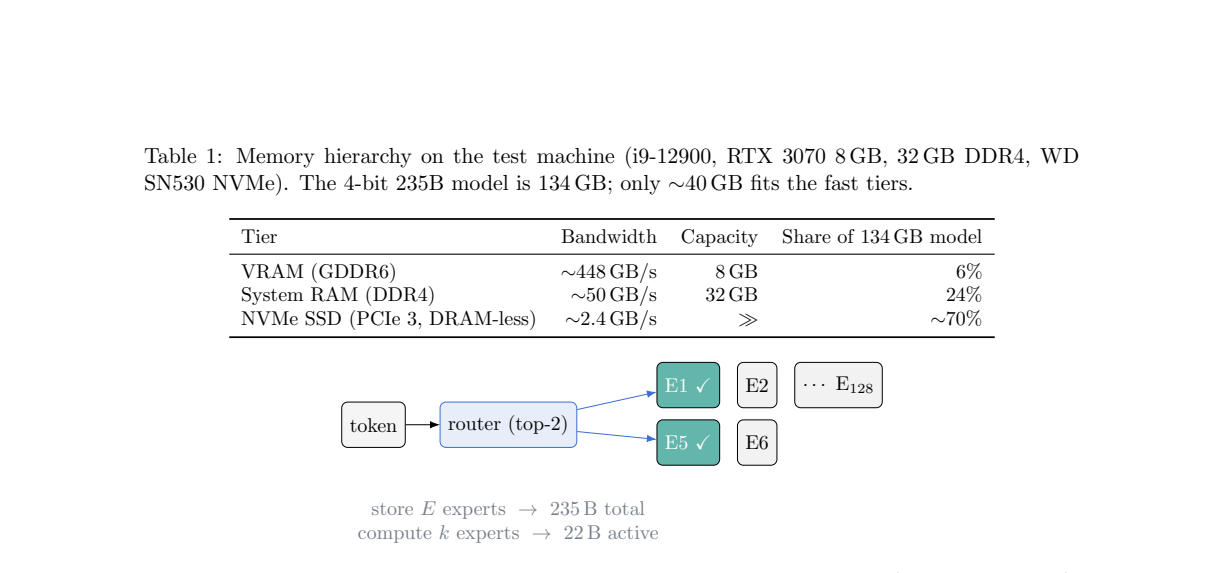
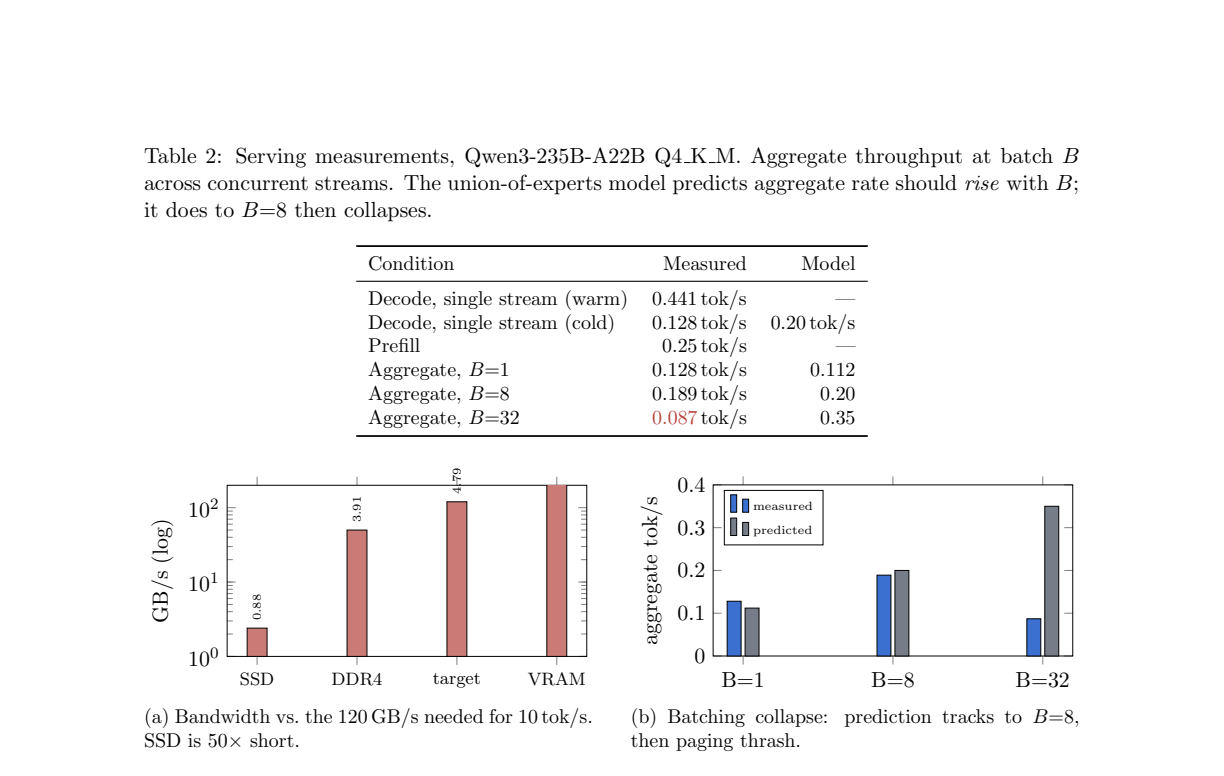
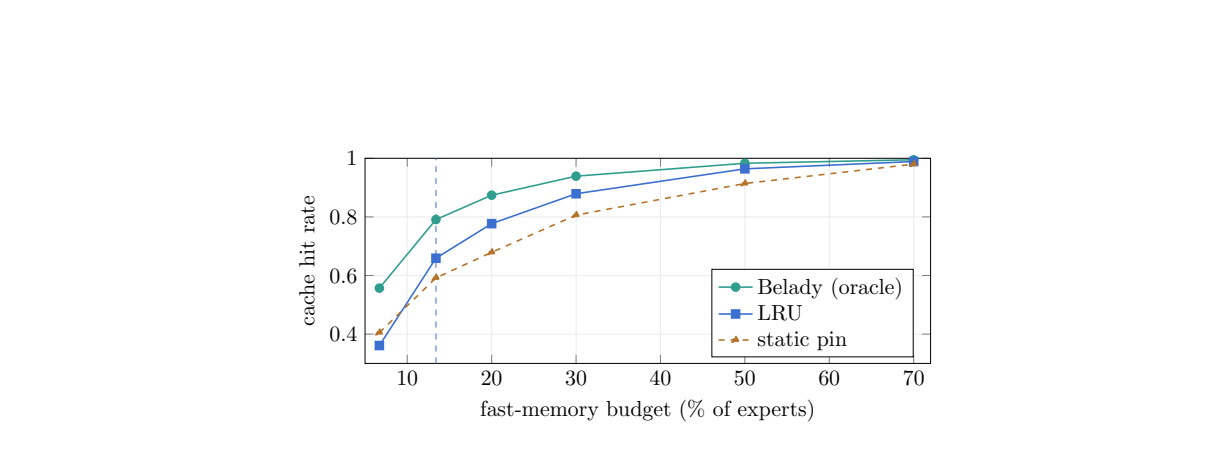
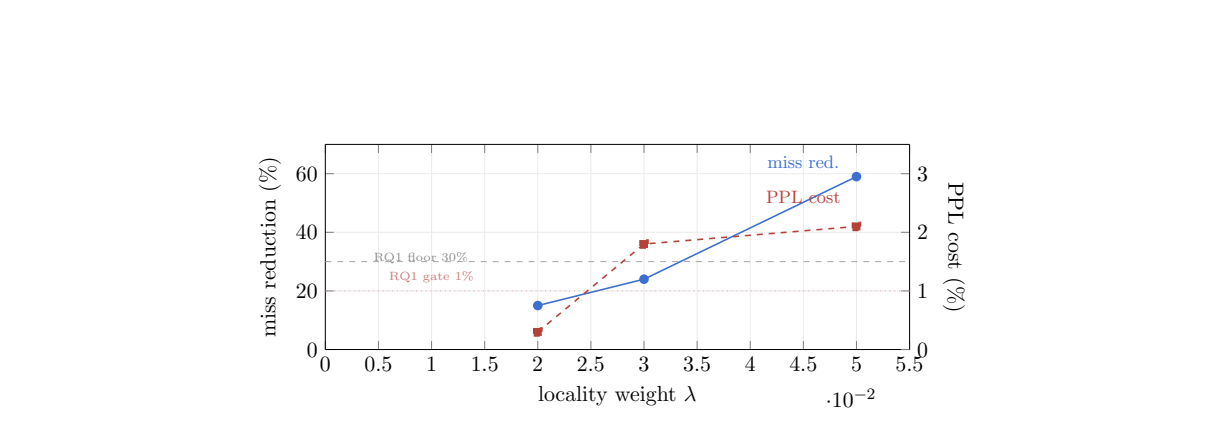
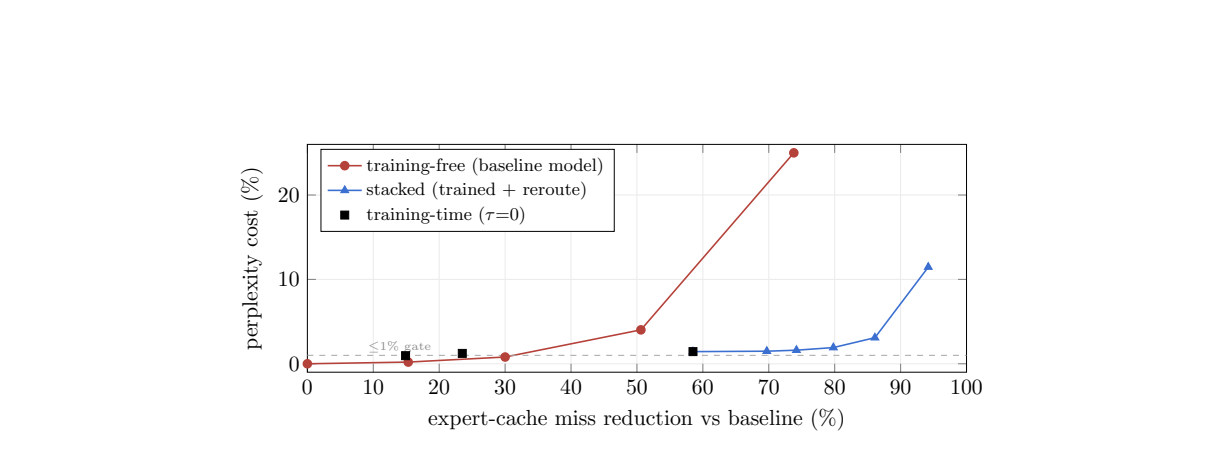
We quantify this bandwidth wall on Qwen3-235B (Q4_K_M, 134 GB): measured decode is 0.44 tok/s warm, matching a bytes-per-token / bandwidth model, while a batching scheme that should amortize one disk sweep instead collapses at batch 32 from paging thrash. We build llama-moe-trace, a zero-surgery router-telemetry tool, and measure routing on Qwen3-30B: adjacent-token expert reuse is 2.0x chance, 95% of traffic uses 52.5% of experts, and an LRU cache of 13.4% of experts serves 66% of requests. We then ask whether cacheability is trainable: we pre-register training of 137M MoE language models with auxiliary locality and domain router losses, under joint criteria on cache-miss reduction and perplexity. The mechanism works (misses down up to 60%; a 99% static-pin hit rate) but every configuration fails the pre-registered <=1% perplexity gate – miss reduction and quality are tightly coupled. Concurrent StickyMoE reports the same loss as near-free on single-domain sub-25M models; on multi-domain 137M we find the tax real. Our contribution is this pre-registered, stricter-criterion, multi-domain evaluation plus edge-serving measurements. A 340M rung shows the tax does not shrink with scale (it rises slightly). We further show training-free cache-aware rerouting stacks with trained locality – together 80% miss reduction at <=3.4% perplexity at both sizes, far cheaper than either alone – while domain-primed prefetching does not help. All code, traces, and the pre-registration are released.
from the abstract
Pith says
Machine review · deepseek-v4-flash · 27 Aug 2026 · what was read was not recorded · not checked by a person
It can be wrong. Challenge this review or reply to it.
Holds up, with conditions. Careful pre-registered negative result on training MoE routers for cache locality; credible at 137M, but the scaling claim is under-supported and the paper needs a unit fix. This line is wrong
3 major objections · 5 minor
How often objections from reviews like this one are right: not yet measured
Not checked: figures, code, what the 76 references say.
The paper says, at §3, Table 2
The review did not quote this passage.
Pith says: Objection 1 of 3 · major
The sentence 'dividing the 12 GB/token read by the measured rate recovers ~2.4 GB/s' is arithmetically wrong: the warm decode rate implies 12 GB/token × 0.44 tok/s ≈ 5.3 GB/s of effective bandwidth, and the cold rate implies 12 × 0.128 ≈ 1.5 GB/s, neither of which equals the stated 2.4 GB/s SSD ceiling.
more of objection 1
As a result, the abstract's claim that the warm rate 'matches a bytes-per-token / bandwidth model' is unsupported, and the cold measurement is about 36% below the model's 0.20 tok/s rather than within 6%. Please correct the calculation and restate precisely which measured rate is being compared with which model.
The paper says, at §8, Table 6, abstract
The review did not quote this passage.
Pith says: Objection 2 of 3 · major
The statement that the locality tax 'does not shrink with scale' is not supported by the reported data. Both rungs are trained for the same 200M tokens, so the 340M model is more undertrained than the 137M model; the 340M point has only one seed; and the observed increase from +2.0% to +2.5% is smaller than the 137M seed spread at λ=0.05 (+1.9% to +3.1%).
more of objection 2
The paper's own §9 states that a ≥1B or compute-optimal run is the definitive test. Please hedge or remove the scaling claim in the abstract and conclusion.
The paper says, at §7, RQ1 result
The review did not quote this passage.
Pith says: Objection 3 of 3 · major
The conclusion that 'no weight satisfies both gates' is based on a λ sweep of only three values at 200M tokens (0.02, 0.03, 0.05) plus one 50M point at 0.20. The logical argument requires monotonicity of both miss reduction and perplexity cost in λ; the manuscript should either state this monotonicity assumption explicitly or add an intermediate λ (e.g., 0.035–0.04) near the crossover to make the impossibility claim airtight.
5 minor objections
The paper says, at Table 5 and §7
Pith says: minor objection 1 of 5
The baseline is described as having 'LRU miss/token@25% of 8.21', but Table 5 reports 'LRU hit@25%'; please make the metric definitions consistent.
The paper says, at Contribution 1
Pith says: minor objection 2 of 5
The claim that measurements match 'a first-principles model to within 6%' is not accurate for all rows of Table 2: the B=1 aggregate differs by ~14% and the cold decode by ~36%. Please specify that the 6% figure applies only to the B=8 aggregate.
show 3 more
The paper says, at §7.1
Pith says: minor objection 3 of 5
The statement that the same τ=0→0.5 intervention costs +4.0–5.8% PPL on the baseline but only +0.5–0.9% on the trained model is difficult to reconcile with the earlier sentence reporting +0.8%/+2.0% for the low-τ baseline point; please clarify the τ values associated with each quoted cost.
The paper says, at §7.1 (domain-primed prefetching)
Pith says: minor objection 4 of 5
The null result for domain-primed prefetching is reported only in prose; a small table or figure with the measured mixed-stream miss/token values would strengthen the presentation.
The paper says, at §6 and Appendix F
Pith says: minor objection 5 of 5
The corrections log is a commendable practice; please add an explicit statement in §6 (or a cross-reference to Appendix F) clarifying that all amendments were logged before any results were unblinded, to avoid any impression of post hoc changes.
What would settle it
Run the 340M arm at a compute-matched budget (at least 2B tokens, roughly 10x current) with at least 3 seeds at λ=0.03 and λ=0.05 against a same-budget baseline, and report the PPL cost at 30% and 60% LRU miss reduction. If the cost at 30% reduction is ≤1% (or the 137M-to-340M trend reverses), the paper's scaling conclusion is an undertraining artifact; if the cost remains >1%, the conclusion that the locality tax does not shrink with scale would survive.
from the skeptic's reading
How the review went
4 readings by deepseek-v4-flash · 27 Aug 2026
- Reader holds up, with conditions
- Skeptic agrees
- Editor wrote the verdict above
- Referee major revision: 3 major objections, 5 minor
Not run on this paper: the simulated authors' defence.
Pith did not check this review's objections against the paper.
The review in full
The review in brief, machine-written
Two things to know. First, this is a real negative result, run with unusual discipline: pre-registered gates, a corrections log, released code and traces, and a dose-response that is monotone and seed-stable at 137M. Second, the paper's broader claim—that the locality tax does not shrink with scale—rests on a single 340M run at a matched token budget that is more undertrained than the 137M rung, plus only three lambda values at the main scale. The 137M result stands; the scaling story is thinner than the abstract suggests.
What's new: the pre-registered multi-domain evaluation of the sticky-router loss (concurrent with StickyMoE), the domain-confinement arm, the measured complementarity of trained locality and training-free cache-conditional rerouting (~80% miss reduction at ~3% perplexity, replicated at both sizes with two seeds at 137M), and the router-telemetry tool. The systems measurements—bandwidth wall, batching collapse, 13.4% LRU hit—are useful, though the 'agreement' between the bandwidth model and the warm decode rate has a unit problem: 12 GB/token at 0.44 tok/s implies ~5.3 GB/s, not 2.4 GB/s. The model matches the cold rate, which is fine, but the text muddles warm and cold.
Soft spots, in order: (1) The 'no weight satisfies both gates' conclusion is extrapolated from lambda = 0.02, 0.03, 0.05 at 200M tokens. The curve looks tight, but three points is a sparse basis for a universal negative. (2) The scale rung: 340M and 137M both get 200M tokens, so the larger model is farther from compute-optimal; the paper admits this, but the abstract still says the tax 'does not shrink with scale.' A one-seed, two-rung ladder is suggestive, not a denial of scale effects. (3) The training cache capacity is 25%, while the motivating edge budget is 13.4%—the main experiments don't match the motivating scenario. (4) Minor: the domain-primed prefetching null is underpowered but fine as reported.
None of these sink the core contribution. The 137M negative result, and the trained-plus-rerouting stacking result, are well-supported with released artifacts. The paper is a solid candidate for peer review; it will need a round of revision to fix the unit error, add a caveat to the scaling claim (or better, run at 13.4% capacity and a third seed at 340M), and present the lambda sweep more carefully. I'd be happy to see it in a systems/ML venue; the reproducibility practice is a model for this kind of work.
The strongest objection
The load-bearing assertion is that training-time locality is genuinely costly at multi-domain scale and that this cost does not shrink with model size (abstract; §8; Table 6). For that assertion to hold, the 340M rung must be a valid test of scale. It is not: both rungs are trained for the same 200M tokens, so the 340M model is much farther from compute-optimality than the 137M model; §9 concedes its baseline perplexity is higher. The observed 'rise' in tax from +2.0% to +2.5% at a fixed miss reduction is smaller than the seed spread at 137M alone (arm B seeds give +1.9% and +3.1% PPL cost at λ=0.05), so a single-seed 340M point cannot support the scaling claim. Similarly, the 137M 'no weight threads the gate' conclusion is measured at roughly one tenth of compute-optimal training; the monotone dose-response could shift downward with more training, consistent with StickyMoE reporting the same loss as free or beneficial on smaller single-domain models. Section 9 openly states that a ≥1B or compute-optimal run is the definitive test, so the concern is an admitted boundary condition, but the abstract and conclusion present the scaling claim without that hedge.
The reader's weakest assumption and my concern align: generalization beyond the tested compute/scale is the soft spot, not internal consistency of the 137M dose-response. The mechanism is real (monotonic, seed-stable at 137M), and the pre-registration plus corrections log are genuine strengths. The stress-test finds that the paper overreaches only in the scaling statement: one seed at 340M, a 200M-token matched budget that makes 340M more undertrained, and a tax difference inside the 137M seed range. Section 9 acknowledges this, so the correct disposition is conditional: accept the 137M negative result as a carefully bounded finding, but do not state 'tax does not shrink with scale' as a general conclusion until the compute-matched or 1B run is done. I therefore keep the reader's CONDITIONAL verdict unchanged. A secondary arithmetic issue in §3 (0.44 tok/s warm is claimed to 'recover' 2.4 GB/s from 12 GB/token, when the implied bandwidth is ~5.3 GB/s) is real and should be corrected in revision, but it does not affect the training-time central claim.
The referee's report
If the results hold, the paper provides a well-documented counterpoint to claims that adjacent-token locality training is nearly free (StickyMoE), showing that on a harder multi-domain corpus at 137M parameters the perplexity tax is real. The systems measurements are also useful: the bandwidth-wall quantification and the router-telemetry tool are concrete artifacts, and the pre-registered design with two seeds on key arms and a corrections log is a model of honest reporting. The scale claim, however, is currently over-reached.
Pith's reading of the paper (a machine's summary, not the authors')
Mixture-of-experts models spread their weights across many expert sub-networks, so serving them on a single GPU is limited by memory bandwidth: every generated token must stream the active experts from whatever tier holds them. The paper measures this wall directly (0.44 tok/s on a 134 GB 4-bit 235B model, matching a bytes-per-token divided by bandwidth model) and shows routing has real but accidental locality. It then asks whether that locality can be trained in without a quality penalty, using a pre-registered experiment on 137M-parameter models with two auxiliary router losses. The mechanism works—cache misses fall up to 60 percent and a domain-confinement loss reaches 99 percent static-pin hits—but no configuration meets the pre-registered perplexity gates, and a 340M rung does not show the quality tax shrinking. A training-free cache-aware rerouting strategy stacks with trained locality to reach about 80 percent miss reduction at 3.4 percent perplexity cost, which is the paper's positive practical route.
What carries the argument. The load-bearing object is the pair of auxiliary router losses, $L_{\text{loc}} = \frac{1}{L}\sum_\ell \mathrm{mean}_t(1-\langle p_t^\ell,p_{t-1}^\ell\rangle)$, which rewards adjacent tokens selecting the same experts, and $L_{\text{dom}}$, which penalizes routing outside a domain-assigned expert slice; both are added to the language-model loss alongside a load-balancing loss. The evaluation machinery is a pre-registered protocol with fixed pass/fail thresholds on cache-miss reduction and perplexity, plus a per-layer LRU/static-pin cache simulator that scores both frontier-model traces and trained-model traces with the same instrument. The losses are meant to attack the bytes-per-token term in the bandwidth bound, and the joint gates are what turn a large but costly cacheability effect into a testable claim.
Core claim. The paper's central claim is that routing cacheability is real but not free: at 137M parameters on a prose/code/math mix, the adjacent-token locality loss $L_{\text{loc}}$ produces a clean monotonic dose-response (miss reduction up to 59–60 percent at $\lambda=0.05$) and the domain-confinement loss $L_{\text{dom}}$ produces a 0.991 static-pin hit rate, yet every configuration fails the pre-registered joint gates—RQ1 requiring at least 30 percent LRU miss reduction at 25 percent capacity within +1 percent perplexity, RQ2 requiring at least 90 percent static-pin hit within +2 percent. The paper therefore refutes both research questions at this scale. It further reports a 340M-parameter rung in which the perplexity tax at fixed ~58 percent miss reduction rises from +2.0 percent to +2.5 percent, so the tax does not obviously shrink with scale under a matched 200M-token budget. The constructive result is that training-time locality and training-free cache-aware rerouting complement each other: applying the same rerouting tolerance that costs +4.0–5.8 percent perplexity on the baseline costs only +0.5–0.9 percent on the locality-trained model, and the stacked system reaches about 80 percent miss reduction at +1.9–3.1 percent perplexity, replicating at 340M.
The premise it rests on. The central negative result is assumed to generalize from two small, under-trained models—137M and 340M parameters on 200M tokens, with a single seed at 340M—to production-scale MoE serving, so a larger or better-trained run that clears the perplexity gates would overturn it.
If the paper is right (Pith's inferences, not the authors')
On small multi-domain MoE models, cacheability gains from routing losses are coupled to perplexity cost—there is no free operating point that clears a 1 percent quality bar.
Edge serving of large MoE models cannot rely on training-time locality alone; a trained router plus inference-time cache-aware rerouting is the demonstrated path, reaching about 80 percent miss reduction at 3.4 percent perplexity.
The bytes-per-token divided by bandwidth model reproduces measured decode within 6 percent, so throughput on this class of hardware is bounded by memory bandwidth rather than compute.
Domain confinement can make a domain's expert slice pin-able at 99 percent static-hit, but only at a perplexity cost that exceeds the pre-registered gate on the harder domains.
The measured routing structure (2.0x adjacent-token reuse, 52.5 percent working set, and a 13.4 percent LRU cache serving 66 percent of requests) means simple caching already helps before any router modification.
The paper's scale rung is suggestive rather than decisive; if a compute-optimal or 1B-parameter run shows the perplexity tax shrinking, the negative result would narrow to under-trained small models rather than to a fundamental tradeoff.
The near-zero tax on code (perplexity 4.7 unchanged) suggests the cost is concentrated where the model has little quality headroom; an extension would train on single-domain data or with mixing schedules that allocate more capacity to hard domains.
Because training-free rerouting becomes much cheaper after locality training, the two interventions act through different mechanisms—co-adaptation of experts into substitutable neighbourhoods versus cache-state substitution—so a merged-expert or clustered-expert variant is a natural next step.
The domain-primed prefetching null result implies the difficulty of mixed-domain streams is a training-time phenomenon, not a cache-warmup phenomenon; serving systems can focus on LRU-style temporal reuse and ignore domain-boundary prefetching.
Check this review
Pith stored no record of this review's passes and took no fingerprint of it. Reviews made by code from 13 Nov 2026 on carry both.
How often reviews like this one are right
Reviews like this one: written by deepseek-v4-flash, where what was read was not recorded.
How often objections from reviews like this one are right: not yet measured
Reviews by people
This review was written by a machine. No person has reviewed this paper on Pith yet. A scientist listed on Pith can review it for a fee, and their review is published here whatever it concludes.
The paper
Abstract
Serving a 235B-parameter Mixture-of-Experts (MoE) model on a single 8 GB GPU is bottlenecked not by compute but by memory bandwidth: decode must stream each token's active experts from whichever tier holds them, and on consumer hardware most experts sit on an SSD far slower than RAM. We quantify this bandwidth wall on Qwen3-235B (Q4_K_M, 134 GB): measured decode is 0.44 tok/s warm, matching a bytes-per-token / bandwidth model, while a batching scheme that should amortize one disk sweep instead collapses at batch 32 from paging thrash. We build llama-moe-trace, a zero-surgery router-telemetry tool, and measure routing on Qwen3-30B: adjacent-token expert reuse is 2.0x chance, 95% of traffic uses 52.5% of experts, and an LRU cache of 13.4% of experts serves 66% of requests. We then ask whether cacheability is trainable: we pre-register training of 137M MoE language models with auxiliary locality and domain router losses, under joint criteria on cache-miss reduction and perplexity. The mechanism works (misses down up to 60%; a 99% static-pin hit rate) but every configuration fails the pre-registered <=1% perplexity gate – miss reduction and quality are tightly coupled. Concurrent StickyMoE reports the same loss as near-free on single-domain sub-25M models; on multi-domain 137M we find the tax real. Our contribution is this pre-registered, stricter-criterion, multi-domain evaluation plus edge-serving measurements. A 340M rung shows the tax does not shrink with scale (it rises slightly). We further show training-free cache-aware rerouting stacks with trained locality – together 80% miss reduction at <=3.4% perplexity at both sizes, far cheaper than either alone – while domain-primed prefetching does not help. All code, traces, and the pre-registration are released.
The paper's own sentences, arranged, kept beside the review and separate from it. Each label is drawn from a closed vocabulary; the number beside it is the probability the classifier gave that label. No sentence in this record was written by a model.
abstract compiled · 2026-09-23
The authors' main claim, as the classifier picked it out 0.72
“The mechanism works (misses down up to 60%; a 99% static-pin hit rate) but every configuration fails the pre-registered <=1% perplexity gate -- miss reduction and quality are tightly coupled.”
How the main claim is stated: asserted 1.00
What the abstract itself states, as probabilities: claims first 0.08 · states limitation 0.94 · human participants 0.03 · controlled comparison 0.86 · randomized assignment 0.04 · states quantitative result 0.99 · compares with prior results 0.97 · mentions code or data availability 0.99
The abstract, sentence by sentence
This table labels the abstract only (arXiv listing abstract v1). The number is the probability the classifier gave the label.
| Sentence | Role | The authors' own work | States the main conclusion | Strength |
|---|---|---|---|---|
| Serving a 235B-parameter Mixture-of-Experts (MoE) model on a single 8 GB GPU is bottlenecked not by compute but by memory bandwidth: decode must stream each token's active experts from whichever tier holds them, and on consumer hardware most experts sit on an SSD far slower than RAM. | background 0.99 | 0.43 | 0.06 | asserted 1.00 |
| We quantify this bandwidth wall on Qwen3-235B (Q4_K_M, 134 GB): measured decode is 0.44 tok/s warm, matching a bytes-per-token / bandwidth model, while a batching scheme that should amortize one disk sweep instead collapses at batch 32 from paging thrash. | result 1.00 | 0.97 | 0.06 | asserted 1.00 |
| We build llama-moe-trace, a zero-surgery router-telemetry tool, and measure routing on Qwen3-30B: adjacent-token expert reuse is 2.0x chance, 95% of traffic uses 52.5% of experts, and an LRU cache of 13.4% of experts serves 66% of requests. | result 0.73 | 0.97 | 0.04 | asserted 1.00 |
| We then ask whether cacheability is trainable: we pre-register training of 137M MoE language models with auxiliary locality and domain router losses, under joint criteria on cache-miss reduction and perplexity. | method 0.89 | 0.94 | 0.05 | unclear 0.44 |
| The mechanism works (misses down up to 60%; a 99% static-pin hit rate) but every configuration fails the pre-registered <=1% perplexity gate -- miss reduction and quality are tightly coupled. | result 0.98 | 0.96 | 0.53 | asserted 1.00 |
| Concurrent StickyMoE reports the same loss as near-free on single-domain sub-25M models; on multi-domain 137M we find the tax real. | result 0.93 | 0.74 | 0.09 | asserted 1.00 |
| Our contribution is this pre-registered, stricter-criterion, multi-domain evaluation plus edge-serving measurements. | contribution 1.00 | 0.93 | 0.09 | asserted 0.97 |
| A 340M rung shows the tax does not shrink with scale (it rises slightly). | result 1.00 | 0.95 | 0.08 | asserted 1.00 |
| We further show training-free cache-aware rerouting stacks with trained locality -- together ~80% miss reduction at <=3.4% perplexity at both sizes, far cheaper than either alone -- while domain-primed prefetching does not help. | result 0.99 | 0.94 | 0.32 | asserted 1.00 |
| All code, traces, and the pre-registration are released. | contribution 0.93 | 0.80 | 0.03 | asserted 0.99 |
What kind of paper the classifier reports this is: empirical study 0.99 · evidence from observation or experiment 1.00
What was examined, and what was not
Sources read
- arXiv listing abstract v1
Not examined
- full text
- figures and tables
- references and citing sentences
- relations to other papers
Levels run
- P abstract
Not run
- S sections
- T body sentences
- C citations
- R cross-paper relations
How the labels were made
Compiled by classifier-1.13.0 via TypeSafe API, question bank abstract-p1-20260923, 2026-09-23: 1 request, 8,097 input tokens.
Every quoted sentence on this record is the authors'. Every label is from Pith's closed vocabulary, with the probability shown beside it. This record as JSON
Figures (6)
Showing 5 of the paper's 6 figures. Figures are the authors', reproduced from the paper.
References (76)
- [1] Sangjin Choi, Sukmin Cho, Yifan Xiong, Ziyue Yang, Youngjin Kwon, and Peng Cheng. ELDR : Expert-locality-aware decode routing for PD -disaggregated MoE serving. arXiv preprint arXiv:2607.00466, 2026. URL https://arxiv.org/abs/2607.00466 on PithPith's reviewarXiv
- [4] Zhiyuan Fang, Zicong Hong, Yuegui Huang, Yufeng Lyu, Wuhui Chen, Yue Yu, Fan Yu, and Zibin Zheng. Fate : Fast edge inference of mixture-of-experts models via cross-layer gate. arXiv preprint arXiv:2502.12224, 2025. URL https://arxiv.org/abs/2502.12224 on PithPith's reviewarXiv
- [5] William Fedus, Barret Zoph, and Noam Shazeer. Switch transformers: Scaling to trillion parameter models with simple and efficient sparsity. Journal of Machine Learning Research (JMLR), 23 0 (120): 0 1--39, 2022. URL https://arxiv.org/abs/2101.03961 on PithPith's reviewarXiv
- [7] Xin He, Shunkang Zhang, Kaijie Tang, Shaohuai Shi, Yuxin Wang, Zihao Zeng, Zhenheng Tang, Xiaowen Chu, Haiyan Yin, Ivor W. Tsang, and Yew Soon Ong. ExpertFlow : Efficient mixture-of-experts inference via predictive expert caching and token scheduling. In Proceedings of the 63r... on PitharXiv
- [9] Ali Kayyam. Sticky routing: Training MoE models for memory-efficient inference. arXiv preprint arXiv:2607.08780, 2026. URL https://arxiv.org/abs/2607.08780 on PithPith's reviewarXiv
- [12] Pingzhi Li, Zhenyu Zhang, Prateek Yadav, Yi-Lin Sung, Yu Cheng, Mohit Bansal, and Tianlong Chen. Merge, then compress: Demystify efficient SMoE with hints from its routing policy. In International Conference on Learning Representations (ICLR), 2024 a . URL https://arxiv.org/ab... on PithPith's reviewarXiv
- [19] Arian Raje, Anupam Nayak, and Gauri Joshi. MELINOE : Fine-tuning enables memory-efficient inference for mixture-of-experts models. arXiv preprint arXiv:2602.11192, 2026. URL https://arxiv.org/abs/2602.11192 on PitharXiv
- [30] Yujie Zhang, Shivam Aggarwal, and Tulika Mitra. DAOP : Data-aware offloading and predictive pre-calculation for efficient moe inference. arXiv preprint arXiv:2501.10375, 2025. URL https://arxiv.org/abs/2501.10375 on PithPith's reviewarXiv
- [32] Jixian Zhou, Fang Dong, Ruijun Huang, Hengjie Cao, Mengyi Chen, Yifeng Yang, Anrui Chen, Mingzhi Dong, Yujiang Wang, Dongsheng Li, David A. Clifton, Qin Lv, Rui Zhu, Chun Zhang, Fan Yang, Tun Lu, Ning Gu, and Li Shang. Oracle-MoE : Locality-preserving routing in the oracle spa... on Pith
- [33] Xiongwei Zhu, Xiaojian Liao, Tianyang Jiang, Yusen Zhang, Liang Wang, and Limin Xiao. ReMoE : Boosting expert reuse through router fine-tuning in memory-constrained moe llm inference. arXiv preprint arXiv:2605.27081, 2026. URL https://arxiv.org/abs/2605.27081 on PithPith's reviewarXiv
- [34] Du, Nan and Huang, Yanping and Dai, Andrew M. and Tong, Simon and Lepikhin, Dmitry and Xu, Yuanzhong and Krikun, Maxim and Zhou, Yanqi and Yu, Adams Wei and Firat, Orhan and Zoph, Barret and Fedus, Liam and Bosma, Maarten and Zhou, Zongwei and Wang, Tao and Wang, Yu Emma and W... on Pith
- [35] Zoph, Barret and Bello, Irwan and Kumar, Sameer and Du, Nan and Huang, Yanping and Dean, Jeff and Shazeer, Noam and Fedus, William , journal =. 2022 , eprint = on Pith
- [36] Mixture-of-Experts with Expert Choice Routing , author =. arXiv preprint arXiv:2202.09368 , year =. arXiv , primaryClass =:2202.09368 , url = on PithPith's reviewarXiv
- [37] Outrageously Large Neural Networks: The Sparsely-Gated Mixture-of-Experts Layer , author =. arXiv preprint arXiv:1701.06538 , year =. arXiv , primaryClass =:1701.06538 , url = on PithPith's reviewarXiv
- [38] Switch Transformers: Scaling to Trillion Parameter Models with Simple and Efficient Sparsity , author =. Journal of Machine Learning Research (JMLR) , volume =. 2022 , eprint = on Pith
- [39] GShard: Scaling Giant Models with Conditional Computation and Automatic Sharding , author =. arXiv preprint arXiv:2006.16668 , year =. arXiv , primaryClass =:2006.16668 , url = on PithPith's reviewarXiv
- [40] DeepSeekMoE: Towards Ultimate Expert Specialization in Mixture-of-Experts Language Models , author =. arXiv preprint arXiv:2401.06066 , year =. arXiv , primaryClass =:2401.06066 , url = on PithPith's reviewarXiv
- [41] Mixtral of Experts , author =. arXiv preprint arXiv:2401.04088 , year =. arXiv , primaryClass =:2401.04088 , url = on PithPith's reviewarXiv
- [42] PowerInfer: Fast Large Language Model Serving with a Consumer-grade GPU , author =. Proceedings of the ACM SIGOPS 30th Symposium on Operating Systems Principles (SOSP) , year =. arXiv , primaryClass =:2312.12456 , url = on PithPith's reviewarXiv
- [43] PowerInfer-2: Fast Large Language Model Inference on a Smartphone , author =. arXiv preprint arXiv:2406.06282 , year =. arXiv , primaryClass =:2406.06282 , url = on PithPith's reviewarXiv
show 56 more
- [44] EdgeMoE: Empowering Sparse Large Language Models on Mobile Devices , author =. arXiv preprint arXiv:2308.14352 , year =. arXiv , primaryClass =:2308.14352 , url = on PithPith's reviewarXiv
- [45] MoE-Infinity: Efficient MoE Inference on Personal Machines with Sparsity-Aware Expert Cache , author =. arXiv preprint arXiv:2401.14361 , year =. arXiv , primaryClass =:2401.14361 , url = on PithPith's reviewarXiv
- [46] Fiddler: CPU-GPU Orchestration for Fast Inference of Mixture-of-Experts Models , author =. International Conference on Learning Representations (ICLR) , year =. arXiv , primaryClass =:2402.07033 , url = on PithPith's reviewarXiv
- [47] Pre-gated MoE: An Algorithm-System Co-Design for Fast and Scalable Mixture-of-Expert Inference , author =. arXiv preprint arXiv:2308.12066 , year =. arXiv , primaryClass =:2308.12066 , url = on PithPith's reviewarXiv
- [48] SiDA-MoE: Sparsity-Inspired Data-Aware Serving for Efficient and Scalable Large Mixture-of-Experts Models , author =. Proceedings of Machine Learning and Systems (MLSys) , year =. arXiv , primaryClass =:2310.18859 , url = on PithPith's reviewarXiv
- [49] Fast Inference of Mixture-of-Experts Language Models with Offloading , author =. arXiv preprint arXiv:2312.17238 , year =. arXiv , primaryClass =:2312.17238 , url = on PithPith's reviewarXiv
- [50] DeepSeek-V3 Technical Report , author =. arXiv preprint arXiv:2412.19437 , year =. arXiv , primaryClass =:2412.19437 , url = on PithPith's reviewarXiv
- [51] Qwen3 Technical Report , author =. arXiv preprint arXiv:2505.09388 , year =. arXiv , primaryClass =:2505.09388 , url = on PithPith's reviewarXiv
- [52] OLMoE: Open Mixture-of-Experts Language Models , author =. arXiv preprint arXiv:2409.02060 , year =. arXiv , primaryClass =:2409.02060 , url = on PithPith's reviewarXiv
- [53] DeepSeek-V2: A Strong, Economical, and Efficient Mixture-of-Experts Language Model , author =. arXiv preprint arXiv:2405.04434 , year =. arXiv , primaryClass =:2405.04434 , url = on PithPith's reviewarXiv
- [54] Skywork-MoE: A Deep Dive into Training Techniques for Mixture-of-Experts Language Models , author =. arXiv preprint arXiv:2406.06563 , year =. arXiv , primaryClass =:2406.06563 , url = on PithPith's reviewarXiv
- [55] MoE-Lightning: High-Throughput MoE Inference on Memory-constrained GPUs , author =. arXiv preprint arXiv:2411.11217 , year =. arXiv , primaryClass =:2411.11217 , url = on PithPith's reviewarXiv
- [56] AdapMoE: Adaptive Sensitivity-based Expert Gating and Management for Efficient MoE Inference , author =. arXiv preprint arXiv:2408.10284 , year =. arXiv , primaryClass =:2408.10284 , url = on PithPith's reviewarXiv
- [57] HOBBIT: A Mixed Precision Expert Offloading System for Fast MoE Inference , author =. arXiv preprint arXiv:2411.01433 , year =. arXiv , primaryClass =:2411.01433 , url = on PithPith's reviewarXiv
- [58] ProMoE: Fast MoE-based LLM Serving using Proactive Caching , author =. arXiv preprint arXiv:2410.22134 , year =. arXiv , primaryClass =:2410.22134 , url = on PithPith's reviewarXiv
- [59] MoE-Gen: High-Throughput MoE Inference on a Single GPU with Module-Based Batching , author =. arXiv preprint arXiv:2503.09716 , year =. arXiv , primaryClass =:2503.09716 , url = on PithPith's reviewarXiv
- [60] SwapMoE: Serving Off-the-shelf MoE-based Large Language Models with Tunable Memory Budget , author =. arXiv preprint arXiv:2308.15030 , year =. arXiv , primaryClass =:2308.15030 , url = on PithPith's reviewarXiv
- [61] FlexGen: High-Throughput Generative Inference of Large Language Models with a Single GPU , author =. arXiv preprint arXiv:2303.06865 , year =. arXiv , primaryClass =:2303.06865 , url = on PithPith's reviewarXiv
- [62] DeepSpeed Inference: Enabling Efficient Inference of Transformer Models at Unprecedented Scale , author =. arXiv preprint arXiv:2207.00032 , year =. arXiv , primaryClass =:2207.00032 , url = on PithPith's reviewarXiv
- [63] Efficiently Scaling Transformer Inference , author =. arXiv preprint arXiv:2211.05102 , year =. arXiv , primaryClass =:2211.05102 , url = on PithPith's reviewarXiv
- [64] GPTQ: Accurate Post-Training Quantization for Generative Pre-trained Transformers , author =. International Conference on Learning Representations (ICLR) , year =. arXiv , primaryClass =:2210.17323 , url = on PithPith's reviewarXiv
- [65] AWQ: Activation-aware Weight Quantization for LLM Compression and Acceleration , author =. Proceedings of Machine Learning and Systems (MLSys) , year =. arXiv , primaryClass =:2306.00978 , url = on PithPith's reviewarXiv
- [66] SmoothQuant: Accurate and Efficient Post-Training Quantization for Large Language Models , author =. Proceedings of the 40th International Conference on Machine Learning (ICML) , year =. arXiv , primaryClass =:2211.10438 , url = on PithPith's reviewarXiv
- [67] SpinQuant: LLM Quantization with Learned Rotations , author =. International Conference on Learning Representations (ICLR) , year =. arXiv , primaryClass =:2405.16406 , url = on PithPith's reviewarXiv
- [68] BitNet: Scaling 1-bit Transformers for Large Language Models , author =. arXiv preprint arXiv:2310.11453 , year =. arXiv , primaryClass =:2310.11453 , url = on PithPith's reviewarXiv
- [69] The Era of 1-bit LLMs: All Large Language Models are in 1.58 Bits , author =. arXiv preprint arXiv:2402.17764 , year =. arXiv , primaryClass =:2402.17764 , url = on PithPith's reviewarXiv
- [70] ParetoQ: Improving Scaling Laws in Extremely Low-bit LLM Quantization , author =. arXiv preprint arXiv:2502.02631 , year =. arXiv , primaryClass =:2502.02631 , url = on PitharXiv
- [71] QLoRA: Efficient Finetuning of Quantized LLMs , author =. arXiv preprint arXiv:2305.14314 , year =. arXiv , primaryClass =:2305.14314 , url = on PithPith's reviewarXiv
- [72] LLM.int8(): 8-bit Matrix Multiplication for Transformers at Scale , author =. Advances in Neural Information Processing Systems (NeurIPS) , year =. arXiv , primaryClass =:2208.07339 , url = on PithPith's reviewarXiv
- [73] Efficient Streaming Language Models with Attention Sinks , author =. International Conference on Learning Representations (ICLR) , year =. arXiv , primaryClass =:2309.17453 , url = on PithPith's reviewarXiv
- [74] H2O: Heavy-Hitter Oracle for Efficient Generative Inference of Large Language Models , author =. arXiv preprint arXiv:2306.14048 , year =. arXiv , primaryClass =:2306.14048 , url = on PithPith's reviewarXiv
- [75] DuoAttention: Efficient Long-Context LLM Inference with Retrieval and Streaming Heads , author =. arXiv preprint arXiv:2410.10819 , year =. arXiv , primaryClass =:2410.10819 , url = on PithPith's reviewarXiv
- [76] Fast Inference from Transformers via Speculative Decoding , author =. Proceedings of the 40th International Conference on Machine Learning (ICML) , year =. arXiv , primaryClass =:2211.17192 , url = on PithPith's reviewarXiv
- [77] Medusa: Simple LLM Inference Acceleration Framework with Multiple Decoding Heads , author =. arXiv preprint arXiv:2401.10774 , year =. arXiv , primaryClass =:2401.10774 , url = on PithPith's reviewarXiv
- [78] EAGLE: Speculative Sampling Requires Rethinking Feature Uncertainty , author =. arXiv preprint arXiv:2401.15077 , year =. arXiv , primaryClass =:2401.15077 , url = on PithPith's reviewarXiv
- [79] EAGLE-2: Faster Inference of Language Models with Dynamic Draft Trees , author =. arXiv preprint arXiv:2406.16858 , year =. arXiv , primaryClass =:2406.16858 , url = on PithPith's reviewarXiv
- [80] EAGLE-3: Scaling up Inference Acceleration of Large Language Models via Training-Time Test , author =. arXiv preprint arXiv:2503.01840 , year =. arXiv , primaryClass =:2503.01840 , url = on PithPith's reviewarXiv
- [81] SpecInfer: Accelerating Generative Large Language Model Serving with Tree-based Speculative Inference and Verification , author =. Proceedings of the 29th ACM International Conference on Architectural Support for Programming Languages and Operating Systems (ASPLOS) , year =. a... on PithPith's reviewarXiv
- [82] Petals: Collaborative Inference and Fine-tuning of Large Models , author =. arXiv preprint arXiv:2209.01188 , year =. arXiv , primaryClass =:2209.01188 , url = on PithPith's reviewarXiv
- [83] Pipeline Parallelism for Inference on Heterogeneous Edge Computing , author =. arXiv preprint arXiv:2110.14895 , year =. arXiv , primaryClass =:2110.14895 , url = on PithPith's reviewarXiv
- [84] A Survey on Efficient Inference for Large Language Models , author =. arXiv preprint arXiv:2404.14294 , year =. arXiv , primaryClass =:2404.14294 , url = on PithPith's reviewarXiv
- [85] A Review of Sparse Expert Models in Deep Learning , author =. arXiv preprint arXiv:2209.01667 , year =. arXiv , primaryClass =:2209.01667 , url = on PithPith's reviewarXiv
- [86] Jamba: A Hybrid Transformer-Mamba Language Model , author =. arXiv preprint arXiv:2403.19887 , year =. arXiv , primaryClass =:2403.19887 , url = on PithPith's reviewarXiv
- [87] Kayyam, Ali , journal =. Sticky Routing: Training. 2026 , eprint = on Pith
- [88] Choi, Sangjin and Cho, Sukmin and Xiong, Yifan and Yang, Ziyue and Kwon, Youngjin and Cheng, Peng , journal =. 2026 , eprint = on Pith
- [89] Mixture of Cache-Conditional Experts for Efficient Mobile Device Inference , author =. Transactions on Machine Learning Research (TMLR) , year =. 2412.00099 , archivePrefix = on PithPith's reviewarXiv
- [90] Zhou, Jixian and Dong, Fang and Huang, Ruijun and Cao, Hengjie and Chen, Mengyi and Yang, Yifeng and Chen, Anrui and Dong, Mingzhi and Wang, Yujiang and Li, Dongsheng and Clifton, David A. and Lv, Qin and Zhu, Rui and Zhang, Chun and Yang, Fan and Lu, Tun and Gu, Ning and Shan... on Pith
- [91] Zhu, Xiongwei and Liao, Xiaojian and Jiang, Tianyang and Zhang, Yusen and Wang, Liang and Xiao, Limin , journal =. 2026 , eprint = on Pith
- [92] Li, Pingzhi and Zhang, Zhenyu and Yadav, Prateek and Sung, Yi-Lin and Cheng, Yu and Bansal, Mohit and Chen, Tianlong , booktitle =. Merge, Then Compress: Demystify Efficient. 2024 , eprint = on Pith
- [93] Fang, Zhiyuan and Hong, Zicong and Huang, Yuegui and Lyu, Yufeng and Chen, Wuhui and Yu, Yue and Yu, Fan and Zheng, Zibin , journal =. 2025 , eprint = on Pith
- [94] Zhang, Yujie and Aggarwal, Shivam and Mitra, Tulika , journal =. 2025 , eprint = on Pith
- [95] Three Phases of Expert Routing: How Load Balance Evolves During Mixture-of-Experts Training , author =. arXiv preprint arXiv:2604.04230 , year =. 2604.04230 , archivePrefix = on PithPith's reviewarXiv
- [96] Raje, Arian and Nayak, Anupam and Joshi, Gauri , journal =. 2026 , eprint = on Pith
- [97] A Survey on Inference Optimization Techniques for Mixture of Experts Models , author =. ACM Computing Surveys , year =. 2412.14219 , archivePrefix = on PithPith's reviewarXiv
- [98] He, Xin and Zhang, Shunkang and Tang, Kaijie and Shi, Shaohuai and Wang, Yuxin and Zeng, Zihao and Tang, Zhenheng and Chu, Xiaowen and Yin, Haiyan and Tsang, Ivor W. and Ong, Yew Soon , booktitle =. 2026 , eprint = on Pith
- [99] Not All Models Suit Expert Offloading: On Local Routing Consistency of Mixture-of-Expert Models , author =. International Conference on Learning Representations (ICLR) , year =. 2505.16056 , archivePrefix = on PitharXiv
Cited by 4 Pith papers
Reviewed papers on Pith that cite this one. The full citation record
- Inside the Trap: A Renewal Law for Prefix-Cache Collapse in LLM Agent Serving cs.DC · Nov 2026
- Prefetch-Steered Routing: Deterministic Cache-Aware Expert Selection for Offloaded Mixture-of-Experts Decoding cs.AI · Oct 2026
- Speculative Decoding for Mixture-of-Experts Models: Expert Bytes, Kernel Bandwidth and the Best Draft Length cs.LG · Oct 2026
- When Is High-Bandwidth Flash Cost-Effective for LLM Inference? cs.AR · Nov 2026
How the literature uses it
What this paper does with the arXiv papers it cites
What it cites · 24 sentences without a confident label
Compares with 1 paper
-
Independently and concurrently, StickyMoE [ref] proposed the same adjacent-token routing-consistency loss ([ref], $ℒ_loc$) and reports it as a favorable, quality-improving technique: on small ($8.8$M) and medium ($22$M) MoE LMs on the single-domain WikiText-2 corpus, its soft loss cuts the expert switch rate up to $59%$ and reduces cache misses up to $3.92×$ while perplexity improves on the medium ($22$M) model (up to $-4.1%$ at $λ=0.05$) and is essentially preserved on the small ($8.8$M) model ($+0.1%$ at that $λ$; best $-0.5%$).
Sticky Routing: Training MoE Models for Memory-Efficient Inference · Training Routers for Cacheability · 0.86
Cites as support 2 papers
-
Training for locality co-adapts experts into mutually substitutable neighbourhoods (expert redundancy and mergeability are well documented—similar experts can be merged with little loss [ref] —and routing specialisation strengthens over training [ref] ), so inference-time substitution within a neighbourhood barely perturbs the output.
Merge, Then Compress: Demystify Efficient SMoE with Hints from Its Routing Policy · Training-free rerouting, and its complementarity with trained locality · 0.96
-
Training for locality co-adapts experts into mutually substitutable neighbourhoods (expert redundancy and mergeability are well documented—similar experts can be merged with little loss [ref] —and routing specialisation strengthens over training [ref] ), so inference-time substitution within a neighbourhood barely perturbs the output.
Three Phases of Expert Routing: How Load Balance Evolves During Mixture-of-Experts Training · Training-free rerouting, and its complementarity with trained locality · 0.96
Cites as background 21 papers
-
Mixture-of-Experts (MoE) architectures decouple a model's total parameter count from the parameters active per token: a router sends each token to a small top-$k$ subset of many experts [ref] .
Switch Transformers: Scaling to Trillion Parameter Models with Simple and Efficient Sparsity · Introduction · 1.00
-
Mixture-of-Experts (MoE) architectures decouple a model's total parameter count from the parameters active per token: a router sends each token to a small top-$k$ subset of many experts [ref] .
Outrageously Large Neural Networks: The Sparsely-Gated Mixture-of-Experts Layer · Introduction · 1.00
-
An MoE layer replaces the single FFN with $E$ expert FFNs and a router that, per token, selects the top-$k$ by a learned gate [ref] .
GShard: Scaling Giant Models with Conditional Computation and Automatic Sharding · Background · 1.00
Challenges and discussion
Disagree with the review, or know something it missed? Leave a comment, or challenge this review formally: a challenge becomes a permanent entry in this paper's record, and its decision is published here.
Come back by email
A short list of the week's newly reviewed papers. Nothing is sent until you confirm from your inbox, and every email has a link that stops it. No account.
No comments yet.
Sign in to comment