Artificial Intelligence · arXiv:2610.34721 v1 · submitted 26 Oct 2026 · 41 references
Prefetch-Steered Routing: Deterministic Cache-Aware Expert Selection for Offloaded Mixture-of-Experts Decoding
The paper says
“When a Mixture-of-Experts (MoE) model does not fit in GPU memory, batch-1 decoding is dominated by copying expert weights from host memory.”
more of the abstract
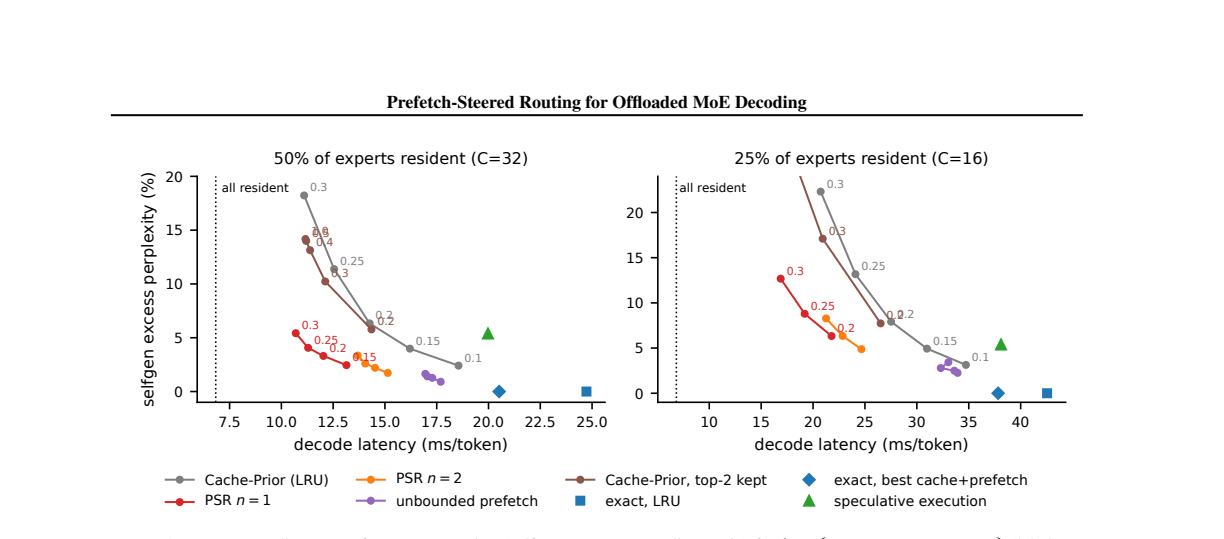
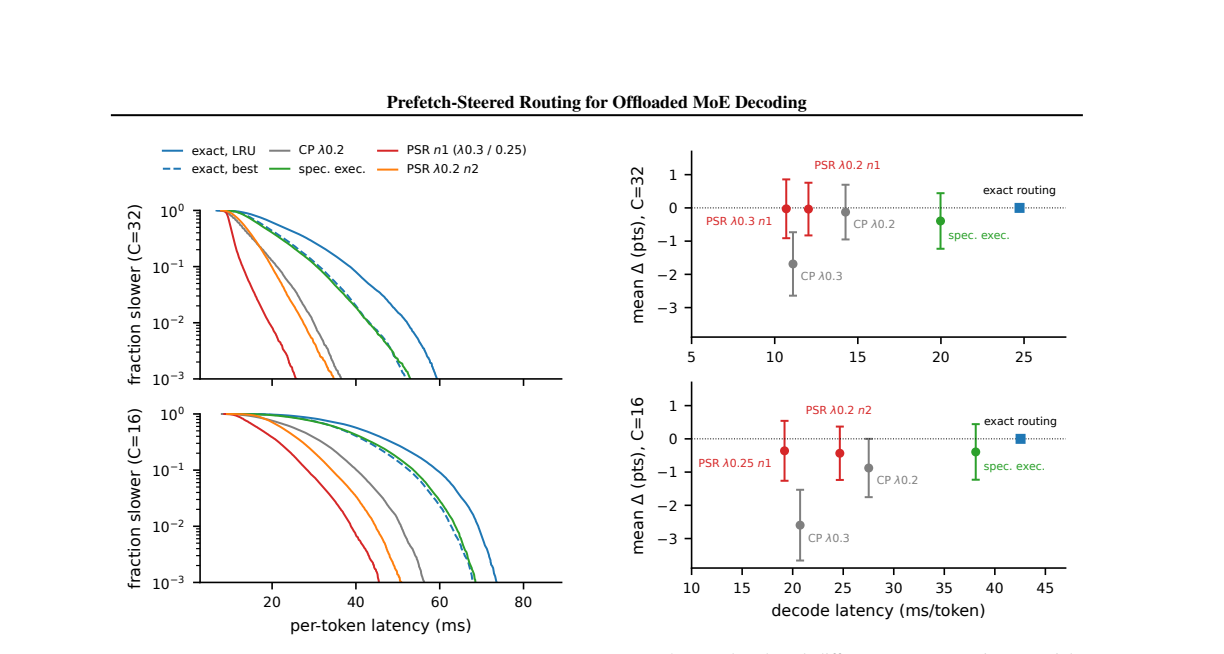
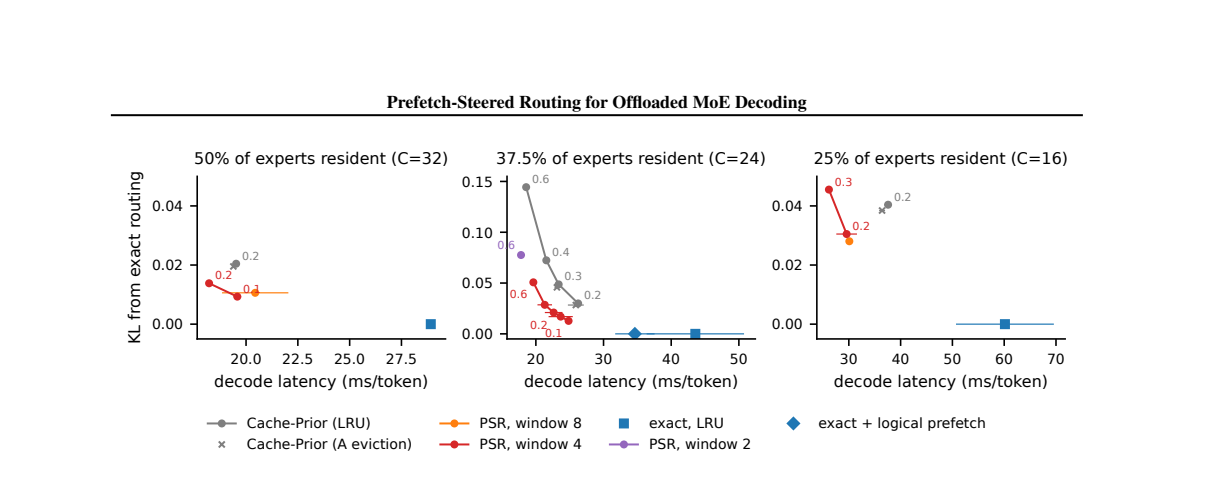
Cache-aware routing reduces these copies by biasing the router toward resident experts, but combined with asynchronous prefetching it makes the model's outputs depend on transfer timing, so a harness that does not simulate that timing no longer evaluates the deployed model. We propose prefetch-steered routing (PSR): routing conditions on a deterministic logical cache, into which at most n experts predicted by the next layer's router are inserted per layer and token; physical copies affect only latency. On OLMoE-1B-7B with 50% and 25% of experts resident on an RTX 4090, PSR decodes 2.2-2.3x faster than exact routing with LRU and 25-30% faster than the Cache-Prior operating point, with mean benchmark differences of +0.1 and +0.5 points (95% lower bounds -0.8 and -0.3). In greedy generation its lead over Cache-Prior depends on the workload and reverses on HumanEval at 50% residency. On Moonlight-16B-A3B, PSR is 1.9x faster than exact routing with LRU at 37.5% residency and, at the latency of Cache-Prior, significantly better on three of eight benchmarks. On Qwen3.6-35B-A3B, where copies are cheap relative to computation, PSR keeps its advantage over Cache-Prior on the likelihood benchmarks but not its speed. Distillation-trained gates did not help. Speculative decoding with block-level expert selection was slower than PSR with a 1B autoregressive drafter on OLMoE, but with a block drafter on Qwen3.6 it was 2.1-2.9x faster than any autoregressive configuration with at most its GPU memory on the 64 prompts we timed.
from the abstract
Pith says
Machine review · deepseek-v4-flash · 27 Oct 2026 · what was read was not recorded · not checked by a person
It can be wrong. Challenge this review or reply to it.
Holds up. Solid work on a real problem: deterministic cache-aware routing for offloaded MoE, well measured across three models. This line is wrong
1 major objection · 4 minor
How often objections from reviews like this one are right: not yet measured
Not checked: figures, code, what the 41 references say.
The paper says, at Section 6.1 (Configuration selection) and Appendix B
The review did not quote this passage.
A classifier read this sentence of the paper as acknowledging the concern (probability 0.86):
“The tests are paired and corrected for multiplicity, but the operating points were not pre-registered. 6.2.”
Pith says: Objection 1 of 1 · major
The operating points (λ, n) for the main comparisons were chosen based on selfgen diagnostic and engine latency results, then evaluated on the benchmark suite; the paper acknowledges that these were not pre-registered (sentence b153). This is a minor concern for confirmatory inference, because the same data that guided the choice of operating points also enters the reported comparisons (though the actual benchmark scores were not seen before selection).
more of objection 1
The paper's paired tests and Holm correction partially mitigate this. I suggest stating more explicitly in Section 6.1 that the selection of operating points preceded the benchmark runs, or adding a note that the reported p-values do not account for the selection step, and that independent replication would be desirable.
4 minor objections
The paper says, at General
Pith says: minor objection 1 of 4
The paper makes heavy use of abbreviations (PSR, CP, LRU, selfgen, KL, etc.). A glossary at the end of Section 1 or in an appendix would improve readability.
The paper says, at Figure 1
Pith says: minor objection 2 of 4
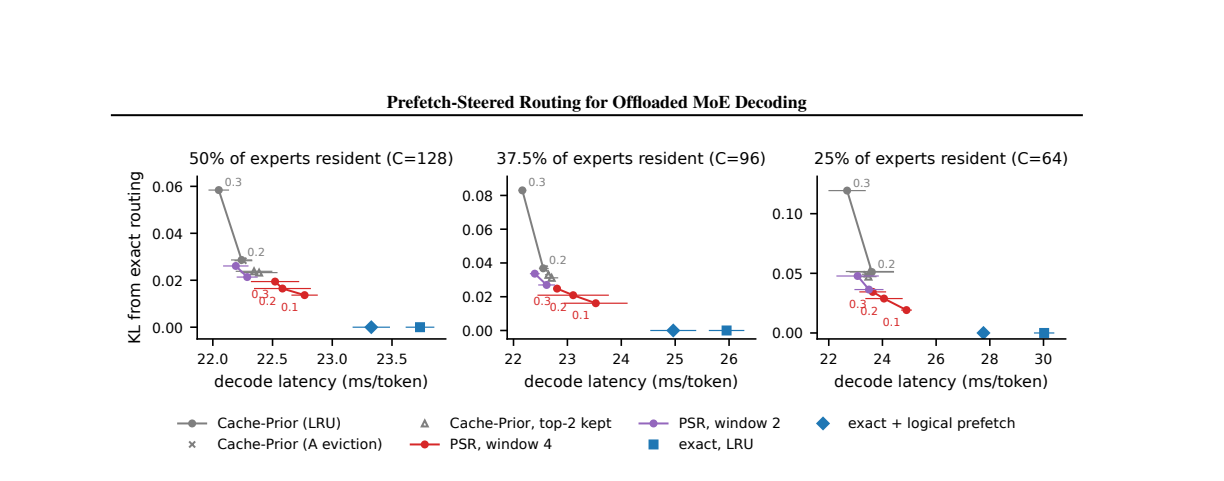
The λ labels are placed directly on the curves, which is helpful but the markers are small and the curves of different configurations (PSR n=1, n=2, Cache-Prior) are sometimes hard to distinguish in grayscale. Consider adding a numbered legend or using distinct line styles (dashed, dotted) in addition to colors.
show 2 more
The paper says, at Section 6.4, Table 5
Pith says: minor objection 3 of 4
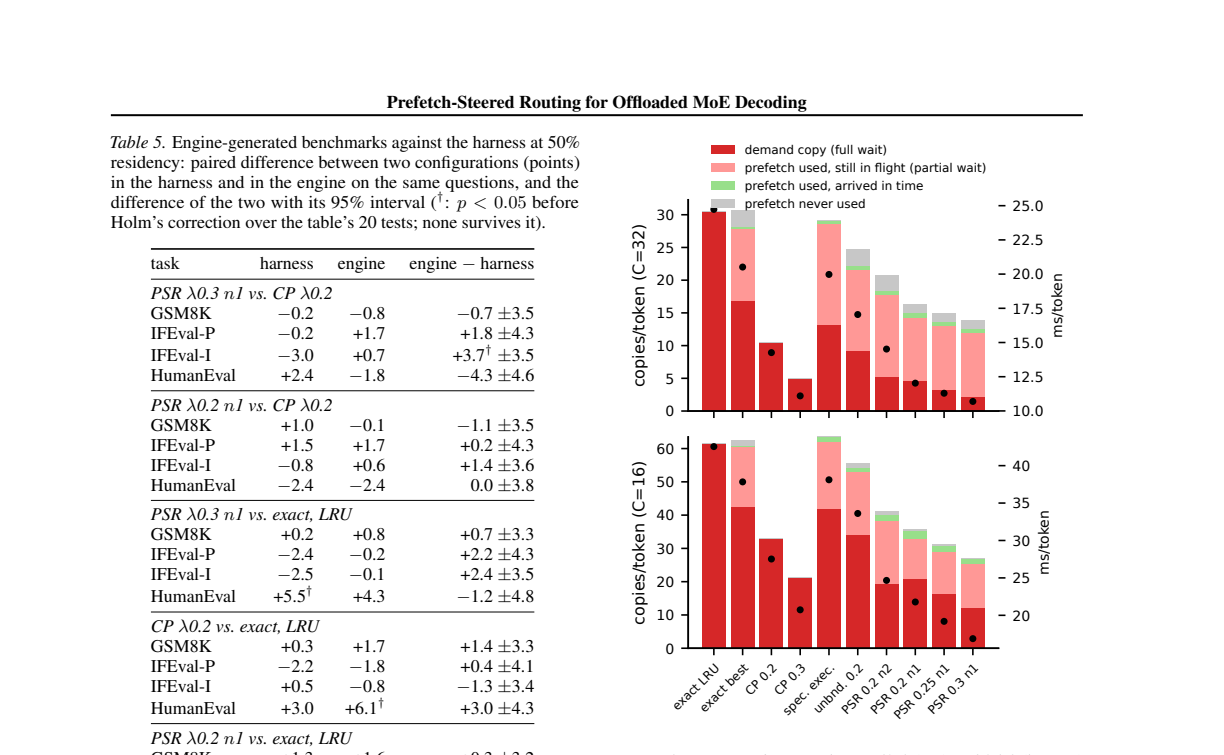
The engine check is described clearly, but the caption of Table 5 could note that the half-widths of the 95% intervals (3.2–4.8 points) are comparable to the per-task differences reported in Table 4 (typically 0.3–3 points). The paper already acknowledges the limited power; this is fine. Consider adding a sentence in the caption restating that the check does not exclude per-task discrepancies of the size reported.
The paper says, at Algorithm 1
Pith says: minor objection 4 of 4
The notation B for the 'protected set' is introduced without a label; the text says 'visited so far, resident or newly inserted, are protected from eviction'. Clarifying in the caption or pseudocode that B is the set of experts protected during this step would help.
What would settle it
On a fourth model with fewer, larger experts (e.g., Mixtral 8x7B), measure the fraction of token–layer pairs where the pre-gate ranking's top-8 contains the actual router's top-2; if below 0.5, PSR's steering depends on architecture-specific alignment and the claim of general effectiveness is weakened.
from the skeptic's reading
How the review went
4 readings by deepseek-v4-flash · 27 Oct 2026
- Reader holds up
- Skeptic agrees
- Editor wrote the verdict above
- Referee minor revision: 1 major objection, 4 minor
Not run on this paper: the simulated authors' defence.
Pith did not check this review's objections against the paper.
The review in full
The review in brief, machine-written
The core idea—separating the logical cache that routing sees from physical copies, then using a bounded budget of cross-layer predictions to steer which experts get the routing bonus—is simple and effective. The paper measures a real problem (timing-dependent outputs in cache-aware routing), documents it (Table 1), and provides a clean solution. The deterministic property is important for reproducibility in evaluation.
What makes this paper worth reading is the experimental rigor. Three models, proper paired statistical tests, ablations isolating the steering and eviction mechanisms, an engine-versus-harness check, and honest discussion of where the method fails to help (Qwen3.6 latency, HumanEval at 50% residency). The speedups on transfer-bound models (2.2–2.3× over exact, 25–30% over Cache-Prior on OLMoE) are genuine and come with confidence intervals.
The soft spots are minor for what the paper claims. The pre-gate ranking alignment is tested empirically but not guaranteed for every architecture. Operating points were chosen after seeing latency and perplexity diagnostics, not pre-registered. The engine-harness check has ±3.2–4.8 point confidence half-widths, so per-task differences around one point are not independently confirmed in the engine. The paper acknowledges all of these. On Qwen3.6, where copies are cheap, PSR loses its latency edge and Cache-Prior is faster in free generation; that is correctly reported as a conditional result.
The speculative decoding section on Qwen is based on 64 prompts, which the authors note, and shouldn't be overweighted. The OLMoE speculative analysis is thorough and negative.
This is a competent, practical paper that solves a clear problem and measures it honestly. I'd bring it to a reading group and would cite it for the logical-cache formulation. A serious referee should engage with it; I expect a clean review.
Recommendation: accept with minor revisions (suggest adding a sentence about pre-registration limitation and noting the Qwen prompt count more prominently).
The strongest objection
The paper is thorough and its central argument—that a deterministic logical cache separates routing semantics from transfer timing, enabling a harness that reproduces the deployed policy—is well-supported by experiments on three models, statistical tests, and an engine check. The pre-gate ranking alignment, identified by the reader as the weakest assumption, is tested empirically and the paper openly reports where the method fails to improve latency (Qwen3.6, HumanEval at 50% residency). All other limitations (single GPU, no external systems, limited engine-check power) are acknowledged and discussed. No unacknowledged flaw or internal inconsistency was found. The evidence meets the paper's claims.
The reader's ACCEPT verdict with HIGH confidence is justified. The paper presents a well-designed method, extensive evaluation, transparent limitations, and the central claim holds under scrutiny. The weakest assumption—pre-gate ranking alignment—is tested on three models and the paper acknowledges where it may fail. No new load-bearing concern was identified beyond what the paper and reader already discuss.
The referee's report
The paper identifies a nontrivial reproducibility problem: when cache-aware routing is combined with asynchronous prefetching, the model's outputs depend on transfer timing, so a harness that does not simulate that timing evaluates a different function than the one deployed. PSR's deterministic logical cache restores the property that the harness and engine implement the same routing policy, which is important for reliable evaluation of offloaded MoE systems. The empirical work is unusually thorough: three model architectures (including one that must be offloaded), multiple baselines reimplemented in a common engine, paired statistical tests with Holm correction, engine-vs-harness checks, teacher-forced and free-generation latency, and extensive ablations. The paper honestly reports where the method fails to improve latency (Qwen3.6, HumanEval at 50% residency) and discusses limitations explicitly. If the results hold, PSR provides a principled and practical improvement for transfer-bound MoE decoding on consumer hardware.
Pith's reading of the paper (a machine's summary, not the authors')
The paper proposes prefetch-steered routing (PSR), a method for offloaded Mixture-of-Experts decoding that conditions routing on a deterministic logical cache rather than on physical residency. This separates the routing policy from PCIe transfer timing, so the evaluation harness and the deployed engine implement the same function. On three models (OLMoE, Moonlight, Qwen3.6) PSR matches or improves the latency–quality trade-off of prior cache-aware routing, especially when expert copies dominate per-token time. The core insight is that a small budget of cross-layer prefetches, steered by the next layer's router, feeds the routing bonus with experts the router was likely to choose anyway, cutting demand copies while keeping the cache deterministic.
What carries the argument. The key machinery is a logical cache per layer that evolves deterministically from the token history and policy parameters (Cache-Prior bonus λ, pre-gate ranking from the next layer's router applied one layer early, a budget n of new insertions per layer and token, and a score-based eviction priority called A priority). Physical copies are issued to match the logical cache but do not influence routing; the layer waits only for copies of experts it executes. This makes the routed model a well-defined function of the input, reproducible by a harness that simulates the same logical cache.
Core claim. The paper discovers that combining a deterministic logical cache with a bounded pre-gate steering mechanism—inserting at most n experts predicted by the next layer's router into the logical cache, then applying the Cache-Prior bonus to that logical set—produces a better latency–quality frontier than existing cache-aware routing, while making the routed model independent of asynchronous transfer timing. On OLMoE-1B-7B at 50% residency, PSR decodes 2.3× faster than exact routing with LRU and 25% faster than Cache-Prior at its operating point (λ=0.2), with a mean benchmark difference of +0.1 points (95% lower bound −0.8). At matched latency, PSR is +1.7 points ahead. The advantage persists on Moonlight-16B-A3B, which must be fully offloaded, but diminishes on Qwen3.6-35B-A3B where expert copies are cheap relative to computation.
The premise it rests on. The pre-gate ranking (layer l's router applied to the hidden state entering layer l−1's MoE block) is sufficiently aligned with the actual top-K routing decisions of layer l to make bounded steering effective, and this alignment holds across architectures without per-model retuning except for the window size.
If the paper is right (Pith's inferences, not the authors')
PSR provides a deterministic baseline for cache-aware MoE routing that can be reliably evaluated without simulating PCIe timing, closing a reproducibility gap in prior work.
The method's speed advantage is largest when expert copies dominate decode time (long or low-locality text, low residency, thin PCIe link); on compute-bound models the quality gain (lower divergence) remains but latency benefit shrinks.
PSR's design suggests that combining a routing bonus with cross-layer prediction works best when the bonus targets experts that the router would have chosen anyway—a principle that may extend to other caching or speculative execution systems.
The deterministic logical cache makes it feasible to deploy PSR in multi-request or batching settings without worrying about timing-dependent variability.
On models with very cheap expert copies (like Qwen3.6 in FP8), cache-aware routing becomes less about speed and more about maintaining a smaller KL divergence from the exact model, which PSR provides.
The deterministic logical cache approach could be adopted as a standard evaluation methodology for any cache-conditioned routing, not just for MoE offloading; it eliminates the need to reproduce the exact engine timing for benchmarking.
The failure of training-based gate optimization (distillation) to improve benchmark quality over training-free PSR suggests that the deviation induced by cache-aware routing is either benign on standard benchmarks or compensated by other factors; this invites investigation into whether different training objectives or reward models could yield gains.
PSR's latency advantage depends on the ratio of copy time to computation time. As hardware evolves (faster PCIe, on-package memory), the regime where PSR matters may shrink, but its deterministic property remains valuable for reproducibility.
The result that speculative decoding with block-level expert selection is slower than PSR on OLMoE but faster on Qwen3.6 with a block drafter indicates that the choice between autoregressive and speculative decoding for offloaded MoE depends critically on drafter cost and target compute/copy ratio.
Check this review
Pith stored no record of this review's passes and took no fingerprint of it. Reviews made by code from 13 Nov 2026 on carry both.
How often reviews like this one are right
Reviews like this one: written by deepseek-v4-flash, where what was read was not recorded.
How often objections from reviews like this one are right: not yet measured
Reviews by people
This review was written by a machine. No person has reviewed this paper on Pith yet. A scientist listed on Pith can review it for a fee, and their review is published here whatever it concludes.
The paper
Abstract
When a Mixture-of-Experts (MoE) model does not fit in GPU memory, batch-1 decoding is dominated by copying expert weights from host memory. Cache-aware routing reduces these copies by biasing the router toward resident experts, but combined with asynchronous prefetching it makes the model's outputs depend on transfer timing, so a harness that does not simulate that timing no longer evaluates the deployed model. We propose prefetch-steered routing (PSR): routing conditions on a deterministic logical cache, into which at most n experts predicted by the next layer's router are inserted per layer and token; physical copies affect only latency. On OLMoE-1B-7B with 50% and 25% of experts resident on an RTX 4090, PSR decodes 2.2-2.3x faster than exact routing with LRU and 25-30% faster than the Cache-Prior operating point, with mean benchmark differences of +0.1 and +0.5 points (95% lower bounds -0.8 and -0.3). In greedy generation its lead over Cache-Prior depends on the workload and reverses on HumanEval at 50% residency. On Moonlight-16B-A3B, PSR is 1.9x faster than exact routing with LRU at 37.5% residency and, at the latency of Cache-Prior, significantly better on three of eight benchmarks. On Qwen3.6-35B-A3B, where copies are cheap relative to computation, PSR keeps its advantage over Cache-Prior on the likelihood benchmarks but not its speed. Distillation-trained gates did not help. Speculative decoding with block-level expert selection was slower than PSR with a 1B autoregressive drafter on OLMoE, but with a block drafter on Qwen3.6 it was 2.1-2.9x faster than any autoregressive configuration with at most its GPU memory on the 64 prompts we timed.
The paper's own sentences, arranged, kept beside the review and separate from it. Each label is drawn from a closed vocabulary; the number beside it is the probability the classifier gave that label. No sentence in this record was written by a model.
abstract compiled · 2026-10-27
The authors' main claim, as the classifier picked it out 0.60
“We propose prefetch-steered routing (PSR): routing conditions on a deterministic logical cache, into which at most n experts predicted by the next layer's router are inserted per layer and token; physical copies affect only latency.”
How the main claim is stated: asserted 1.00
What the abstract itself states, as probabilities: claims first 0.04 · states limitation 0.94 · human participants 0.03 · controlled comparison 0.96 · randomized assignment 0.02 · states quantitative result 0.99 · compares with prior results 0.98 · mentions code or data availability 0.03
The abstract, sentence by sentence
This table labels the abstract only (arXiv listing abstract v1). The number is the probability the classifier gave the label.
| Sentence | Role | The authors' own work | States the main conclusion | Strength |
|---|---|---|---|---|
| When a Mixture-of-Experts (MoE) model does not fit in GPU memory, batch-1 decoding is dominated by copying expert weights from host memory. | background 1.00 | 0.24 | 0.03 | asserted 1.00 |
| Cache-aware routing reduces these copies by biasing the router toward resident experts, but combined with asynchronous prefetching it makes the model's outputs depend on transfer timing, so a harness that does not simulate that timing no longer evaluates the deployed model. | background 0.58 | 0.24 | 0.08 | asserted 1.00 |
| We propose prefetch-steered routing (PSR): routing conditions on a deterministic logical cache, into which at most n experts predicted by the next layer's router are inserted per layer and token; physical copies affect only latency. | method 0.64 | 0.78 | 0.50 | asserted 1.00 |
| On OLMoE-1B-7B with 50% and 25% of experts resident on an RTX 4090, PSR decodes 2.2-2.3x faster than exact routing with LRU and 25-30% faster than the Cache-Prior operating point, with mean benchmark differences of +0.1 and +0.5 points (95% lower bounds -0.8 and -0.3). | result 1.00 | 0.97 | 0.40 | asserted 1.00 |
| In greedy generation its lead over Cache-Prior depends on the workload and reverses on HumanEval at 50% residency. | result 0.92 | 0.94 | 0.06 | asserted 1.00 |
| On Moonlight-16B-A3B, PSR is 1.9x faster than exact routing with LRU at 37.5% residency and, at the latency of Cache-Prior, significantly better on three of eight benchmarks. | result 1.00 | 0.96 | 0.10 | asserted 1.00 |
| On Qwen3.6-35B-A3B, where copies are cheap relative to computation, PSR keeps its advantage over Cache-Prior on the likelihood benchmarks but not its speed. | result 0.99 | 0.94 | 0.07 | asserted 1.00 |
| Distillation-trained gates did not help. | result 1.00 | 0.89 | 0.03 | asserted 1.00 |
| Speculative decoding with block-level expert selection was slower than PSR with a 1B autoregressive drafter on OLMoE, but with a block drafter on Qwen3.6 it was 2.1-2.9x faster than any autoregressive configuration with at most its GPU memory on the 64 prompts we timed. | result 1.00 | 0.91 | 0.07 | asserted 1.00 |
What kind of paper the classifier reports this is: method or tool 1.00 · evidence from observation or experiment 0.96
What was examined, and what was not
Sources read
- arXiv listing abstract v1
Not examined
- full text
- figures and tables
- references and citing sentences
- relations to other papers
Levels run
- P abstract
Not run
- S sections
- T body sentences
- C citations
- R cross-paper relations
How the labels were made
Compiled by classifier-1.13.0 via TypeSafe API, question bank abstract-p1-20260923, 2026-10-27: 1 request, 7,414 input tokens.
Every quoted sentence on this record is the authors'. Every label is from Pith's closed vocabulary, with the probability shown beside it. This record as JSON
Figures (6)
Showing 5 of the paper's 6 figures. Figures are the authors', reproduced from the paper.
References (41)
- [1] Austin, J., Odena, A., Nye, M., Bosma, M., Michalewski, H., Dohan, D., Jiang, E., Cai, C., Terry, M., Le, Q., and Sutton, C. Program synthesis with large language models. arXiv preprint arXiv:2108.07732, on PithPith's reviewarXiv
- [7] DeepSeek-AI. DeepSeek-V3 technical report.arXiv preprint arXiv:2412.19437, on PithPith's reviewarXiv
- [8] Eliseev, A. and Mazur, D. Fast inference of mixture-of- experts language models with offloading.arXiv preprint arXiv:2312.17238, on PithPith's reviewarXiv
- [10] 20 Prefetch-Steered Routing for Offloaded MoE Decoding Hoang, D., Jaiswal, A., Samragh, M., and Cho, M. SpecMD: A comprehensive study on speculative expert prefetching. arXiv preprint arXiv:2602.03921, on PitharXiv
- [12] Kalibera, T. and Jones, R. Rigorous benchmarking in rea- sonable time. InProceedings of the 2013 International Symposium on Memory Management (ISMM), pp. 63–74, on Pith
- [14] Kayyam, A. Sticky routing: Training MoE mod- els for memory-efficient inference.arXiv preprint arXiv:2607.08780, on PithPith's reviewarXiv
- [15] Kim, B., Lee, J., Han, D., Yoo, H.-J., and Kim, S. Flash- MoE: Reducing SSD I/O bottlenecks via ML-based cache replacement for mixture-of-experts inference on edge de- vices.arXiv preprint arXiv:2601.17063, on PithPith's reviewarXiv
- [16] Kundu, A., Xu, Z., Hou, B., Gao, C., Li, R., and Lei, T. Stepped MoE: Segment-level routing with configurable inference complexity.arXiv preprint arXiv:2610.07348, on PithPith's reviewarXiv
- [17] Liang, S., Chen, H. M., Mo, Z., Wang, Q., Li, G., Ma, L., and Luk, W. AcceptMoE: Commitment-weighted self- sizing verifier expert sets for efficient MoE speculative decoding.arXiv preprint arXiv:2608.02989, on PithPith's reviewarXiv
- [18] Liu, J., Su, J., Yao, X., Jiang, Z., Lai, G., Du, Y ., Qin, Y ., Xu, W., Lu, E., Yan, J., et al. Muon is scalable for LLM training.arXiv preprint arXiv:2502.16982, on PithPith's reviewarXiv
- [19] Madan, V ., Singhania, P., Bhatele, A., Goldstein, T., and Panda, A. Speculating experts accelerates inference for mixture-of-experts.arXiv preprint arXiv:2603.19289, on PitharXiv
- [20] McDanel, B., Li, S., Surineni, S., and Khaitan, H. MoE- Spec: Expert budgeting for efficient speculative decoding. arXiv preprint arXiv:2602.16052, on PitharXiv
- [21] arXiv:2409.02060. Qwen Team. Qwen3.6-35B-A3B: Agentic coding power, now open to all. https://qwen.ai/blog?id= qwen3.6-35b-a3b, April on PithPith's reviewarXiv
- [22] Raje, A., Nayak, A., and Joshi, G. MELINOE: Fine- tuning enables memory-efficient inference for mixture-of- experts models.arXiv preprint arXiv:2602.11192, on PitharXiv
- [23] 21 Prefetch-Steered Routing for Offloaded MoE Decoding Saxena, A., Tsai, P.-A., Taneja, H., Jaleel, A., and Qureshi, M. Utility-driven speculative decoding for mixture-of- experts.arXiv preprint arXiv:2506.20675, on PithPith's reviewarXiv
- [25] Shen, Z., Chu, K., Zhang, Y ., Xiang, D., Wu, R., and Zhang, W. ExpertFlow: Adaptive expert scheduling and memory coordination for efficient MoE inference.arXiv preprint arXiv:2510.26730, on PitharXiv
- [26] arXiv:2412.00099. Song, X., Zhong, Z., Chen, R., and Chen, H. ProMoE: Fast MoE-based LLM serving using proactive caching.arXiv preprint arXiv:2410.22134, on PithPith's reviewarXiv
- [27] Suram, S. R. Cacheable by design? training mixture-of- experts routers for locality against the edge memory- bandwidth wall: A pre-registered negative result, with a systems measurement study.arXiv preprint arXiv:2608.18261, on PithPith's reviewarXiv
- [28] Suzgun, M., Scales, N., Sch ¨arli, N., Gehrmann, S., Tay, Y ., Chung, H. W., Chowdhery, A., Le, Q. V ., Chi, E. H., Zhou, D., and Wei, J. Challenging BIG-Bench tasks and whether chain-of-thought can solve them. InFindings of the Association for Computational Linguistics: ACL 2023, on Pith
- [29] Tang, P. et al. HOBBIT: A mixed precision expert of- floading system for fast MoE inference.arXiv preprint arXiv:2411.01433, on PithPith's reviewarXiv
show 21 more
- [30] Wang, W., Liu, J., Hou, X., Xia, X., Tang, P., Zhang, M., Li, C., and Guo, M. MoE-SpeQ: Speculative quantized decoding with proactive expert prefetching and offloading for mixture-of-experts.arXiv preprint arXiv:2511.14102, on PithPith's reviewarXiv
- [31] Wang, Z., Wang, Y ., Gong, L., et al. SeqMoE: Toward full- load performance via predictive and graph-compatible MoE offloading.arXiv preprint arXiv:2609.12978, on PithPith's reviewarXiv
- [32] Wu, Z., Jin, Y ., Xing, Q., Zhou, H., He, W., Wu, X., Cheng, X., Yang, J., and Chen, H. Cache-aware joint router adaptation for memory-efficient MoE inference.arXiv preprint arXiv:2609.04895, on PithPith's reviewarXiv
- [33] Xue, L., Fu, Y ., Lu, Z., Mai, L., and Marina, M. MoE-Infinity: Efficient MoE inference on personal ma- chines with sparsity-aware expert cache.arXiv preprint arXiv:2401.14361, on PithPith's reviewarXiv
- [34] Yang, K., Gao, Y ., et al. MoE-CORE: Coordinated expert offloading and residency for memory-constrained MoE inference.arXiv preprint arXiv:2610.01950, 2026a. Yang, S., Kautz, J., and Hatamizadeh, A. Gated delta net- works: Improving Mamba2 with delta rule. InInterna- tional Co... on PitharXiv
- [35] Yang, S., Fan, X., Pan, M., Xi, H., Wang, Z., Sun, S., Keutzer, K., Han, S., Zaharia, M., Xu, C., and Sto- ica, I. FreeToken: Efficient edge-native MoE serv- ing with bandwidth-adaptive execution.arXiv preprint arXiv:2608.16157, 2026b. Zellers, R., Holtzman, A., Bisk, Y ., Far... on PithPith's reviewarXiv
- [37] arXiv:2408.10284. Zhong, S., Sun, Y ., Liang, L., Wang, R., Huang, R., and Li, M. HybriMoE: Hybrid CPU-GPU scheduling and cache management for efficient MoE inference. InProceedings of the 62nd ACM/IEEE Design Automation Conference (DAC), on PithPith's reviewarXiv
- [38] Zhou, J., Lu, T., Mishra, S., Brahma, S., Basu, S., Luan, Y ., Zhou, D., and Hou, L. Instruction-following evaluation for large language models.arXiv preprint arXiv:2311.07911, on PithPith's reviewarXiv
- [39] Zhu, G., Li, M., Dai, H., Liu, X., Wang, W., Li, K., Xiao, J., Chen, L., and Wang, W. SMoE: An algorithm-system co-design for pushing MoE to the edge via expert substi- tution.arXiv preprint arXiv:2508.18983, on PithPith's reviewarXiv
- [40] Zhu, X., Liao, X., Jiang, T., Zhang, Y ., Wang, L., and Xiao, L. ReMoE: Boosting expert reuse through router fine-tuning in memory-constrained MoE LLM inference. arXiv preprint arXiv:2605.27081, on PithPith's reviewarXiv
- [41] We ran six of the eight tasks (no BBH or MBPP). The chat template is used with the model’s reasoning mode disabled. On GSM8K’s plain-text 5-shot prompt, Qwen3.6 often opens a reasoning block anyway, whose text hits the task’s stop string (“Question:”) after a few tokens; GSM8K... on Pith
- [2013] Kamahori, K., Tang, T., Gu, Y ., Zhu, K., and Kasikci, B. Fiddler: CPU-GPU orchestration for fast infer- ence of mixture-of-experts models.arXiv preprint arXiv:2402.07033, on PithPith's reviewarXiv
- [2017] Shen, Z. and Henderson, P. Temporally extended mixture-of- experts models.arXiv preprint arXiv:2604.20156, on PithPith's reviewarXiv
- [2018] Cobbe, K., Kosaraju, V ., Bavarian, M., Chen, M., Jun, H., Kaiser, L., Plappert, M., Tworek, J., Hilton, J., Nakano, R., Hesse, C., and Schulman, J. Training verifiers to solve math word problems.arXiv preprint arXiv:2110.14168, on PithPith's reviewarXiv
- [2019] Zhang, Y . Reproducible evaluation of MoE expert caching: Replay semantics, workload contamination, and operat- ing regimes.arXiv preprint arXiv:2608.07911, on PithPith's reviewarXiv
- [2021] Clark, P., Cowhey, I., Etzioni, O., Khot, T., Sabharwal, A., Schoenick, C., and Tafjord, O. Think you have solved question answering? try ARC, the AI2 reasoning chal- lenge.arXiv preprint arXiv:1803.05457, on PithPith's reviewarXiv
- [2022] Huang, H., Qiu, S., and Li, M. S2-MoE: Enabling efficient self-speculative decoding for mixture-of-experts on edge devices.arXiv preprint arXiv:2608.15018, on PithPith's reviewarXiv
- [2023] Chen, H. et al. KTransformers: Unleashing the full potential of CPU/GPU hybrid inference for MoE models. 2025a. Chen, J., Liang, Y ., and Liu, Z. DFlash: Block dif- fusion for flash speculative decoding.arXiv preprint arXiv:2602.06036, on PithPith's reviewarXiv
- [2024] Han, D. DraftExpert: Expansion-aware self-speculative decoding for end-device MoE inference.arXiv preprint arXiv:2607.24434, on PithPith's reviewarXiv
- [2025] Chen, C., Borgeaud, S., Irving, G., Lespiau, J.-B., Sifre, L., and Jumper, J. Accelerating large language model decoding with speculative sampling.arXiv preprint arXiv:2302.01318, on PithPith's reviewarXiv
- [2026] Chen, L., Wen, Z., Wu, T., Zhang, X., and Wu, C. SP- MoE: Speculative decoding and prefetching for accel- erating MoE-based model inference.arXiv preprint arXiv:2510.10302, 2025b. Chen, M., Tworek, J., Jun, H., Yuan, Q., Pinto, H. P. d. O., et al. Evaluating large language mod... on PitharXiv
Challenges and discussion
Disagree with the review, or know something it missed? Leave a comment, or challenge this review formally: a challenge becomes a permanent entry in this paper's record, and its decision is published here.
Come back by email
A short list of the week's newly reviewed papers. Nothing is sent until you confirm from your inbox, and every email has a link that stops it. No account.
No comments yet.
Sign in to comment