Performance · arXiv:2610.02732 v1 · submitted 2 Oct 2026 · 23 references
ServeTwin: A Benchmark-Validated Simulator for Distributed LLM Architecture Exploration
The paper says
“Evaluating distributed LLM serving designs on physical clusters is costly. Yet existing simulators provide only subsets of the capabilities needed for realistic design exploration: stateful closed-loop execution, timing prediction without profiling target hardware, and direct execution of unmodified serving benchmarks.”
more of the abstract
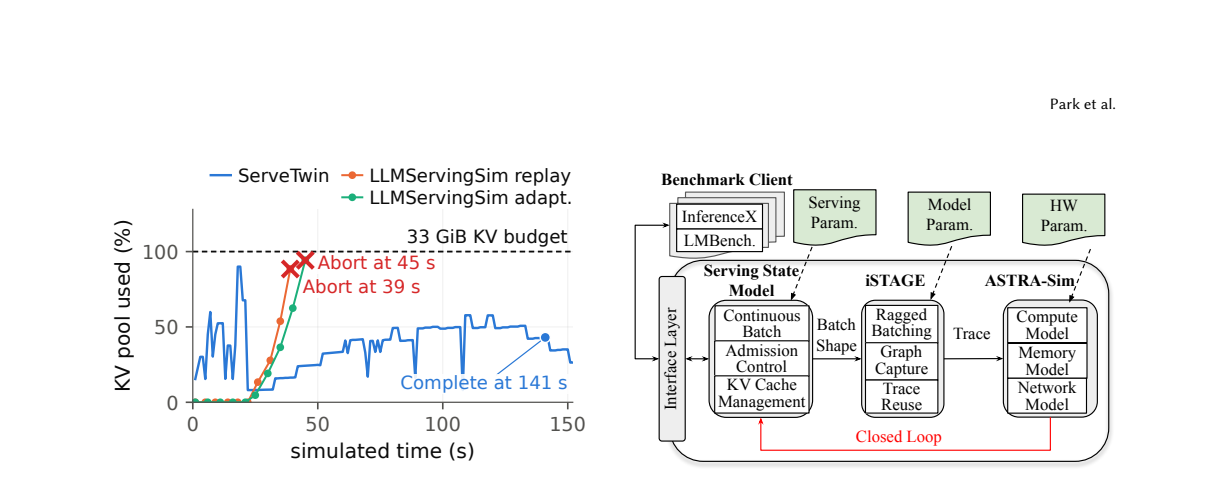
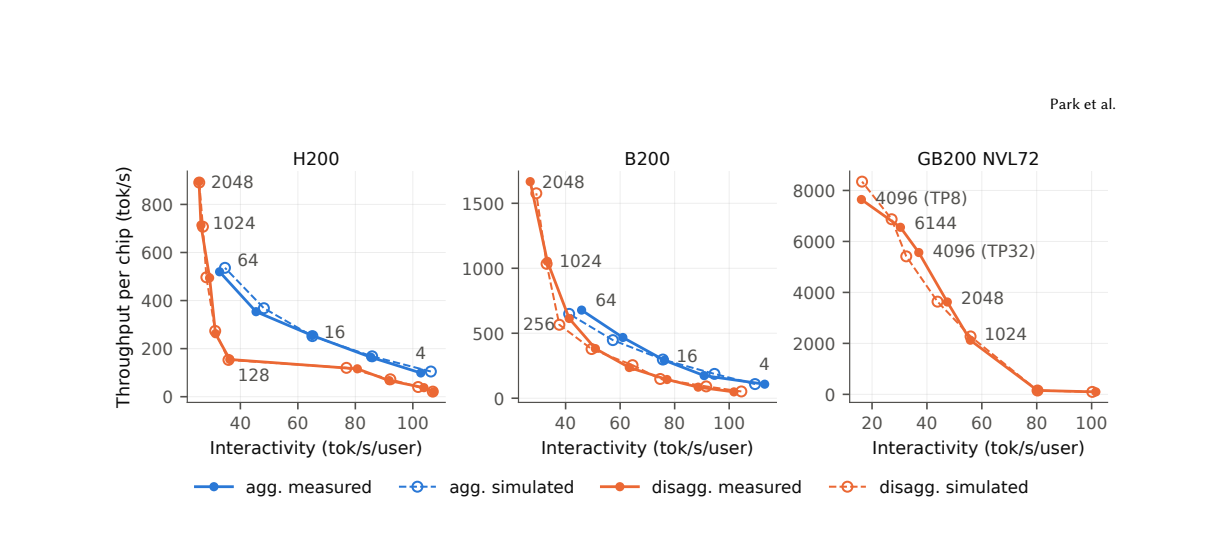
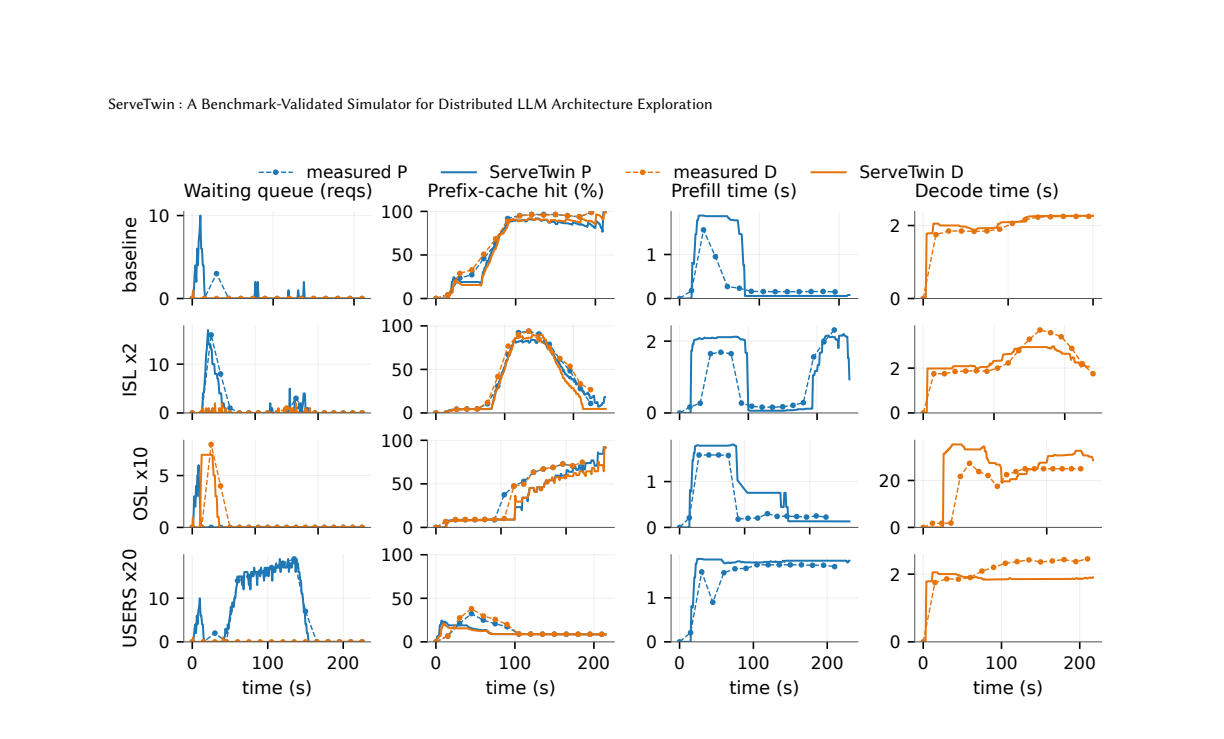
We present ServeTwin, a closed-loop simulator that couples specification-driven analytical timing with a stateful serving loop. This coupling captures feedback among request completion, scheduling, queue state, and KV-cache evolution, including prefill-decode disaggregation and multi-turn agent workloads. ServeTwin avoids target-hardware operator profiling through iSTAGE, an analytical trace generator that derives per-iteration traces from model and engine specifications while representing ragged batches and discrete engine mechanisms such as CUDA-graph batch padding. It further decomposes execution time into component-owned throughput, scheduler, and runtime costs. This ownership lets unaffected parameters transfer across platforms and confines recalibration to changed hardware or software components. ServeTwin implements a vLLM-compatible interface and runs unmodified serving benchmarks. Against real deployments, it reproduces InferenceX's steady-state throughput-interactivity frontier with a 3.6% mean error and predicts LMBenchmark's multi-turn performance with a 9.9% error while tracking KV-cache evolution. Pre-silicon sweeps reveal that the preferred HBM bandwidth-capacity tradeoff reverses across workload states and that increasing concurrency shifts the bottleneck from memory bandwidth to scheduler and runtime overheads. Together, these capabilities enable practical exploration of distributed LLM serving systems before target hardware is available.
from the abstract
Pith says
Machine review · deepseek-v4-flash · 5 Oct 2026 · what was read was not recorded · not checked by a person
It can be wrong. Challenge this review or reply to it.
Holds up, with conditions. A genuinely new closed-loop serving simulator with a real held-out steady-state validation, whose transient-accuracy headline is contradicted by its own Table 5. This line is wrong
3 major objections · 5 minor
How often objections from reviews like this one are right: not yet measured
Not checked: figures, code, what the 23 references say.
The paper says, at §1 / Abstract vs. Table 5
The review did not quote this passage.
Pith says: Objection 1 of 3 · major
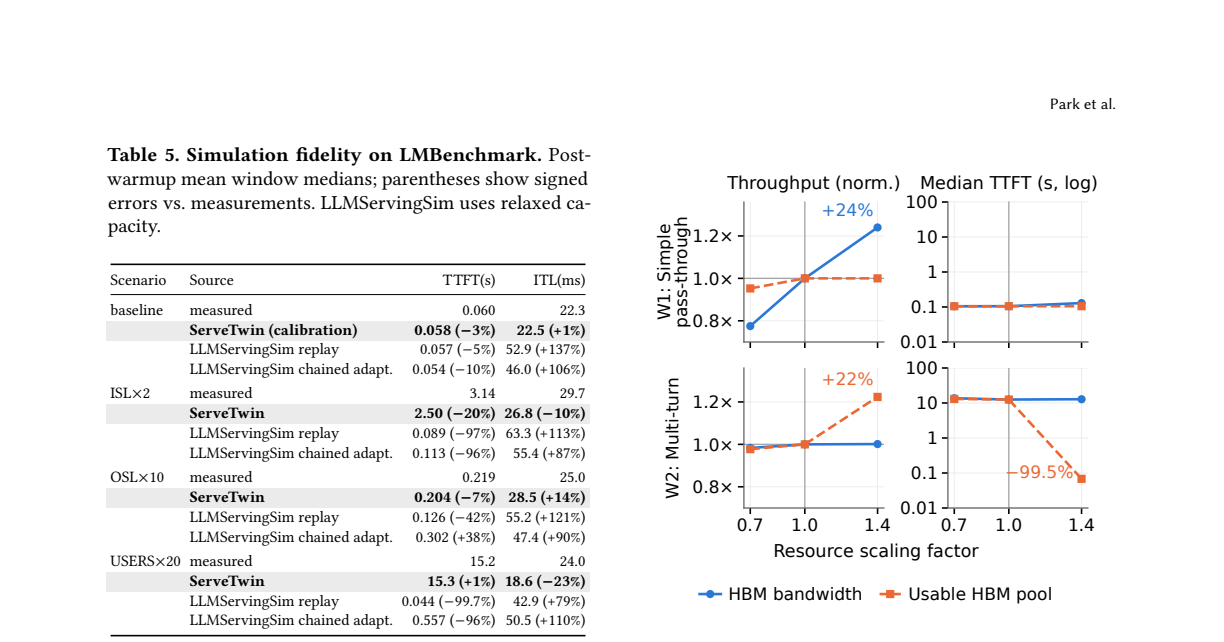
The claims that ServeTwin captures LMBenchmark transients 'within a 10% error margin' (§1, b49) and with a '9.9% error' (Abstract, b8) are contradicted by the paper's own Table 5: the held-out scenarios report TTFT -20% (ISL×2), ITL -23% (USERS×20), and ITL +14% (OSL×10).
more of objection 1
The 9.9% figure is the mean of the absolute errors across the eight entries and masks individual deviations of roughly twice the stated margin. These are exactly the pressure scenarios the simulator is designed to capture, and transient fidelity is the paper's differentiator against LLMServingSim (which aborts). The Abstract and §1 should state per-scenario errors or qualify the claim, rather than presenting only the mean.
The paper says, at §4.6 / Table 4
The review did not quote this passage.
Pith says: Objection 2 of 3 · major
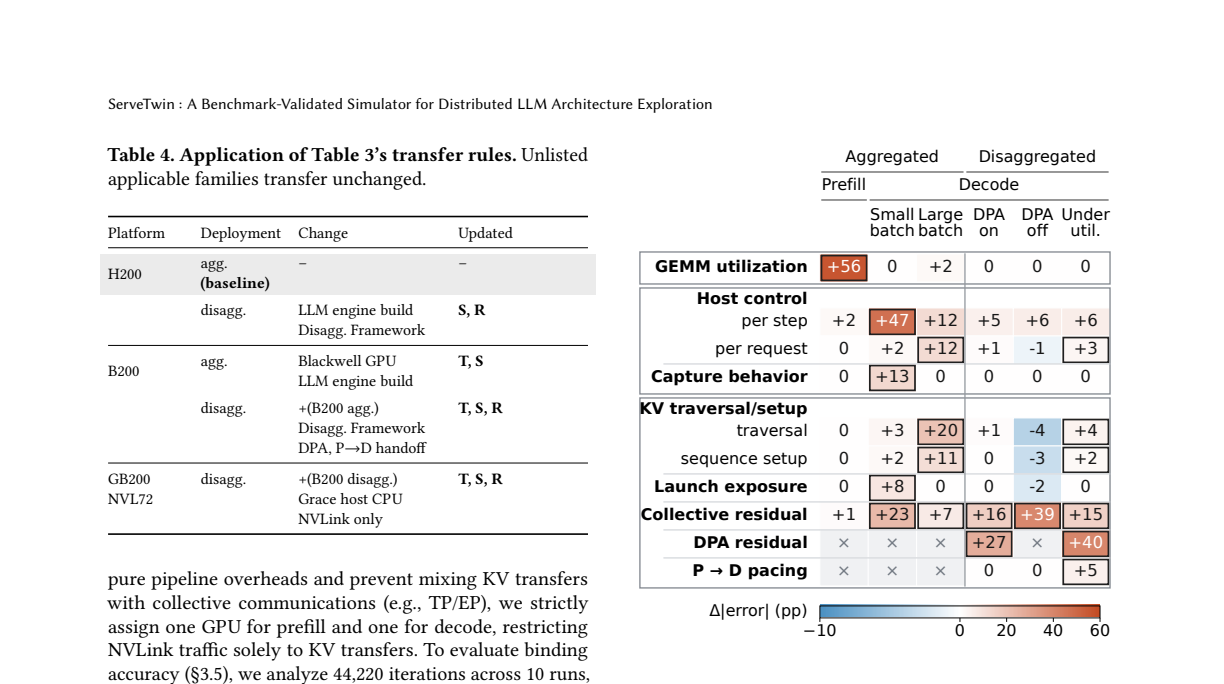
The LMBenchmark validation retains the H200-era scheduler (S) and runtime (R) constants while switching the serving engine from SGLang to vLLM ('we retain the H200 software overheads (KV-traversal, kernel launches, host costs, and CUDA-graphs)'). This violates the paper's own transfer rules in Table 4, where an 'LLM engine build' change is specified to update S and R.
more of objection 2
The largest individual errors in Table 5 (-20% TTFT on ISL×2, -23% ITL on USERS×20, +14% ITL on OSL×10) coincide precisely with this un-ruled transfer, which is evidence that S/R constants do not fully transfer across engine stacks. Because the transient-fidelity claim (RQ3) and the transferability claim (RQ2) both rest on this point, the authors should either re-calibrate the S/R constants for vLLM per Table 4 and re-validate, or present explicit evidence of which constants do transfer and quantify the resulting uncertainty.
The paper says, at §4.4 / Fig. 10
The review did not quote this passage.
A classifier read this sentence of the paper as acknowledging the concern (probability 0.68):
“It is important to note that these are simulated sensi- tivity analyses, rather than equal-cost hardware comparisons or measurements of unreleased silicon.”
Pith says: Objection 3 of 3 · major
The transferability evidence in §4.4 and Fig. 10 covers only a small set of transitions (H200→B200, aggregated→disaggregated, HGX→GB200), and the GB200 decode-step prediction in Fig. 10 is explicitly a 'transferred platform-model prediction rather than an empirical measurement.' The pre-silicon conclusions in §4.8 (bandwidth vs. scheduler/runtime trade-offs) inherit all of these transferred constants, so the sensitivity analysis is only as trustworthy as the unverified S/R transferability.
more of objection 3
This should be stated as a caveat attached to the Fig. 9/Fig. 10 design conclusions, not merely to the transfer section.
5 minor objections
The paper says, at §4.2
Pith says: minor objection 1 of 5
Typo: 'fix and resuse values' should read 'fix and reuse values'.
The paper says, at §3.5
Pith says: minor objection 2 of 5
The notation 'p9511%' is typeset incorrectly and should read 'p95 = 11%'.
show 3 more
The paper says, at Abstract / §2.3 / §4.1
Pith says: minor objection 3 of 5
The validation asymmetry should be stated explicitly: InferenceX errors are computed against third-party public dashboard data, whereas LMBenchmark errors are computed against the authors' own in-house deployment telemetry (with the baseline scenario used to re-anchor the GEMM utilization curve, §4.6). Disclosing that the transient evaluation is self-collected, and specifying the error aggregation behind the 9.9% figure, would strengthen reproducibility.
The paper says, at Table 4
Pith says: minor objection 4 of 5
The mapping in the disaggregated rows is ambiguous: the 'LLM engine build' entry under 'Deployment Change' is paired with the update 'S, R', and the 'B200 agg.' row lists 'T, S' — the table should clarify which changed component triggers each constant family, since the §4.6 engine change is precisely the case where the rule is not followed.
The paper says, at §1 / §2.3
Pith says: minor objection 5 of 5
The claim of being 'profiling-free' (Abstract, §3.5) is accurate at the operator level but should be qualified: the model still requires calibration measurements to set the overhead constants in Table 3, and the paper's own §4.2 describes such calibration. A sentence distinguishing 'no target-hardware operator profiling' from 'no measurements at all' would prevent over-reading.
What would settle it
Rerun the three held-out LMBenchmark variants (ISL×2, OSL×10, USERS×20) exactly as reported, except recalibrate the scheduler and runtime constants (host control, KV traversal, launch exposure, CUDA-graph capture) on the actual H100/vLLM stack, per Table 3's rule that an engine build change updates S and R. If the −20% ISL×2 TTFT and −23% USERS×20 ITL errors collapse below 10% while other predictions stay stable, then the frozen-constant engine-stack transfer is the source of the worst errors, and the abstract's 'within 10%' claim must be qualified. If the errors persist after recalibration, the transient accuracy claim is genuinely weaker than stated, and the paper should report per-scenario errors rather than a single mean.
from the skeptic's reading
How the review went
4 readings by deepseek-v4-flash · 5 Oct 2026
- Reader holds up, with conditions
- Skeptic partly agrees
- Editor wrote the verdict above
- Referee major revision: 3 major objections, 5 minor
Not run on this paper: the simulated authors' defence.
Pith did not check this review's objections against the paper.
The review in full
The review in brief, machine-written
The short version: ServeTwin earns its place as the rare serving simulator with a genuine held-out validation story, but the transient-accuracy headline does not survive contact with its own Table 5.
What is actually new and good: the combination of a stateful closed-loop serving loop, specification-driven analytical timing (iSTAGE), and direct execution of unmodified benchmarks is a real first. The most credible parts are the engineering around it — statistics-preserving ragged-batch binding with a 3.7% median step error, the component-ownership cost ledger with an ablation footprint for each term (RQ1), and the staged-KV waiting path that fixes the LLMServingSim abort. The steady-state InferenceX validation is legitimately out-of-sample: 3.6% mean over 27 points, held-out 3.7% vs calibration 3.5%, and the dense-vs-MoE efficiency ratio matching arithmetic intensity is a nice falsifiable check.
Now the soft spot, and it is the main one. The paper claims (b49) that LMBenchmark transient dynamics are captured 'within a 10% error margin.' That is false as stated. Table 5, their own table, shows -20% TTFT on ISL×2, +14% ITL on OSL×10, and -23% ITL on USERS×20 — all beyond 10%. The 9.9% figure is a mean of absolute errors, and it hides exactly the pressure scenarios the simulator exists to capture.
What makes this worse than a sloppy average is where the errors land. §4.6 discloses that they retained the H200 SGLang scheduler/runtime constants when moving to vLLM on H100. Table 4's own rules say an engine change should update S and R. So the worst errors occur precisely at the transfer boundary their own lifecycle defines, and the honest conclusion is that S/R constants do not fully transfer across engine stacks. That is a useful, publishable finding — but the paper leads with the mean instead of reporting it.
Two smaller notes. The 'avoids target-hardware operator profiling' claim is narrower and more defensible than the reader suggests: they do not profile operators on target hardware, and the component calibration is disclosed and held-out tested, which is not circularity. And there is no released code or data, which for a simulator is a real reproducibility gap.
Bottom line: the qualitative capability and the steady-state result hold up; the transient quantitative claim needs honest revision. This deserves a serious referee, with a request for artifact release and per-point error reporting.
The strongest objection
The central capability claim has two parts: steady-state frontier reproduction (3.6% mean, well supported with a real held-out split) and transient multi-turn fidelity, the paper's key differentiator. The transient claim rests entirely on Table 5, where the abstract's '9.9% error' and §1's 'within a 10% error margin' (b49) are means that mask individual held-out errors of −20% (ISL×2 TTFT), −23% (USERS×20 ITL), and +14% (OSL×10 ITL) — the exact settings the simulator is built to capture. More telling is where these errors occur. §4.6 states that 'despite shifting from SGLang to vLLM, we retain the H200 software overheads (KV-traversal, kernel launches, host costs, and CUDA-graphs)' — i.e., the scheduler (S) and runtime (R) constants are kept frozen while the serving engine, a component, changes. Table 3's ownership rules and Table 4's lifecycle both specify that an 'LLM engine build' change should update S and R; the LMBenchmark run violates this rule by design. The simulator is therefore least accurate precisely at the one place where its own transfer rules are not followed and where the frozen-constant assumption is load-bearing. This is not a hidden flaw — the paper discloses the retention — but it exposes an unresolved question: do S/R constants transfer across engine stacks? The evidence (worst errors at that exact transfer) suggests they do not fully, and the headline accuracy claim obscures that. Qualitative capability (completing where LLMServingSim aborts, tracking queue and cache dynamics) is supported by the staged-KV mechanism and is independent of this concern; the problem is the quantitative claim.
The reader's weakest assumption was transferability of calibrated constants across hardware platforms and deployment shapes. I agree that transferability is the core risk, but I narrow it: the paper's own evidence for transfer across hardware (H200→B200, HGX→GB200) is actually reasonable, with a genuine held-out split and errors in the low single digits. The soft spot is the engine-level transfer (SGLang→vLLM) exercised by §4.6/Table 5, which is simultaneously (a) the sole evidence for the multi-turn transient capability, (b) the place where the paper's own Table 3/Table 4 rules prescribe S and R recalibration that is deliberately skipped, and (c) where the largest errors in the paper (−20%, −23%, +14%) appear. The abstract's '9.9% error' and §1's 'within a 10% error margin' are averages over Table 5 that do not disclose these pointwise exceedances, so the headline accuracy claim is over-stated in exactly the regime the simulator claims as its differentiator. I give credit where due: the InferenceX validation has a real calibration/holdout split (3.5% vs 3.7%), the LMBenchmark baseline-calibration-then-variant-prediction design is an honest held-out protocol, and the qualitative capability to complete multi-turn runs under deployment KV budgets where LLMServingSim aborts is established by mechanism (staged-KV backpressure) independent of timing accuracy. Because the concern targets the quantitative transient claim and the selective-recalibration rule, not the architecture's viability, the CONDITIONAL verdict stands — the claims need tightening toward per-scenario error reporting and either recalibration or explicit justification for retaining S/R constants across engine changes. I do not see grounds to move to REJECT or ACCEPT on the current evidence.
The referee's report
If the claims hold, ServeTwin is a genuinely useful artifact: it is the first of the compared tools to combine a stateful closed-loop serving loop with profiling-free analytical timing and direct execution of unmodified benchmarks, and it resolves a real semantic failure in prior simulators (the staged-KV waiting path that makes LLMServingSim abort under deployment-equivalent KV budgets). The InferenceX validation is a genuine out-of-sample check against third-party public dashboard data, and the ablation in Fig. 5 is falsifiable in a concrete way (per-term errors of +40 to +56 pp where the term's mechanism dominates). The component-ownership discipline and the honest disclosure of retained constants in §4.6 are strengths. The paper's main weakness is that its headline transient-fidelity claim is contradicted by its own Table 5, and the worst errors occur exactly at the one transfer where the paper's own lifecycle rules are not followed. The paper deserves publication after the accuracy claims are corrected and the engine-transfer question is addressed.
Pith's reading of the paper (a machine's summary, not the authors')
ServeTwin claims to predict distributed LLM serving performance without ever profiling the target hardware, deriving per-iteration execution times from model and hardware specifications inside a stateful serving loop. The loop tracks queue state, KV-cache occupancy, admission control, and multi-turn session dependencies, so simulated timings feed back into the next batch's shape. Against real deployments it reproduces InferenceX's steady-state throughput–interactivity frontier at 3.6% mean error and LMBenchmark's multi-turn dynamics at roughly 9.9% error while tracking KV-cache evolution. Crucially, it completes multi-turn workloads under deployment-equivalent KV budgets where LLMServingSim simply aborts. A reader should care because this makes pre-silicon architectural exploration feasible: serving curves can be generated before the hardware exists.
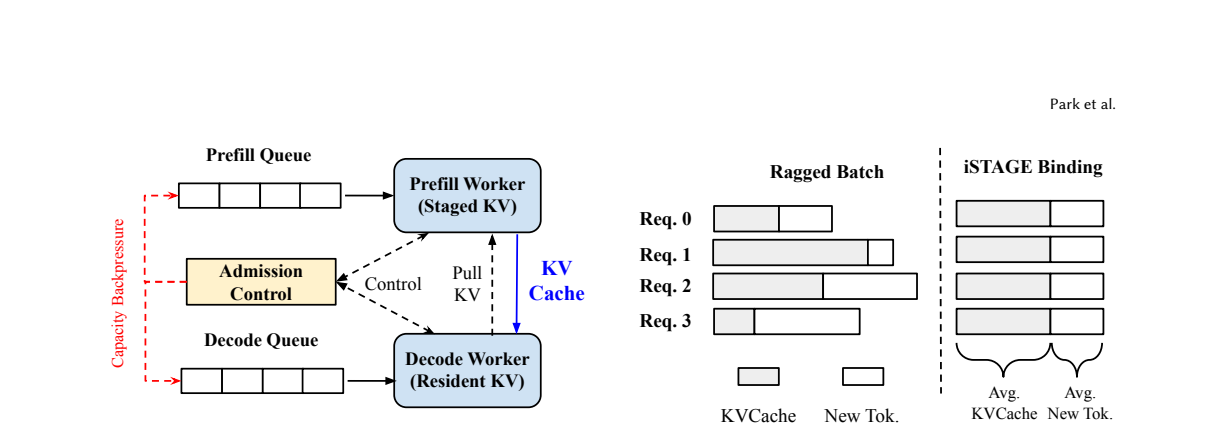
What carries the argument. Three coupled mechanisms carry the argument. First, a KV-lifecycle state machine with occupancy-coupled admission and consumer-driven pulls (modeling Dynamo/NIXL handoffs), which lets a completed prefill retain its KV cache on the producer when the decode worker is busy, creating backpressure instead of a crash. Second, iSTAGE, an analytical trace generator that binds ragged serving batches to statistics-preserving rectangles (exact token and attention FLOP counts), models discrete engine mechanisms such as CUDA-graph batch padding, and reuses traces aggressively to stay lightweight enough for per-iteration execution. Third, a component-owned cost ledger splitting each step into $t_{ ext{throughput}} + t_{ ext{scheduler}} + t_{ ext{runtime}}$, where each term maps to a specific system operation and is frozen unless its owning component changes.
Core claim. The central claim is that a closed-loop serving simulator can be built on specification-driven analytical timing rather than empirical hardware profiles, provided execution time is decomposed into component-owned costs: throughput physics, scheduler costs, and runtime mechanisms. This decomposition makes recalibration selective, so when hardware or software changes, only the parameters belonging to the changed component are re-measured, and the rest transfer unchanged. The paper demonstrates transfer across H200 to B200, aggregated to disaggregated, and HGX to GB200 NVL72, and shows that the resulting predictions are falsifiable: removing one cost term degrades accuracy specifically under the serving conditions that term represents. It also establishes that prior simulators fail semantically, not just numerically, on disaggregated multi-turn workloads because they lack a staged-KV waiting state.
The premise it rests on. The calibrated overhead constants (host control, KV traversal, launch exposure, collective residuals, DPA residuals, P→D pacing) are assumed to transfer unchanged across hardware platforms and software stacks, with recalibration confined to the changed component, yet this invariance is demonstrated on only a few specific transitions and there is no evidence the constants hold across broader workload, model, or engine families.
If the paper is right (Pith's inferences, not the authors')
Architects can generate serving curves from pre-silicon specifications, so HBM bandwidth-versus-capacity and scheduler/runtime design choices can be tuned before target hardware is available.
Hardware gains are batch-dependent: at a decode batch of $B=1$, runtime costs occupy 63–77% of step time, so a 1.53× faster compute core yields only ~1.07× total improvement, while at $B=32$ the gain is larger.
At high concurrency the bottleneck shifts from memory bandwidth to scheduler and runtime overheads: tripling HBM bandwidth stalls throughput entirely at concurrency 2048, whereas cutting those overheads by 40% raises throughput 60% and halves TTFT.
The HBM bandwidth–capacity tradeoff reverses across workloads: single-turn requests gain 24% from extra bandwidth but nothing from capacity, while multi-turn sessions gain 22% in throughput and cut median TTFT from 12.55 s to 0.068 s from extra capacity alone, by retaining reusable prefix-cache contexts.
Component ownership confines recalibration to changed components, so migration paths between platforms and deployment modes need only re-measure the affected owners rather than refit global overheads.
If component ownership truly holds, the frozen constants should transfer to other serving engines and model families sharing the same underlying mechanisms, a testable prediction beyond the paper's measured transitions.
The multi-turn capacity result implies that capacity-planning tools should treat prefix-cache residency as a first-class resource, since capacity's benefit comes from retaining reusable contexts rather than merely enlarging batch sizes.
The batch-dependent decode decomposition predicts that future hardware gains at low batch sizes will be throttled by runtime overheads, so reducing launch exposure and KV-traversal costs may matter as much as raw bandwidth for latency-sensitive serving.
Check this review
Pith stored no record of this review's passes and took no fingerprint of it. Reviews made by code from 13 Nov 2026 on carry both.
How often reviews like this one are right
Reviews like this one: written by deepseek-v4-flash, where what was read was not recorded.
How often objections from reviews like this one are right: not yet measured
Reviews by people
This review was written by a machine. No person has reviewed this paper on Pith yet. A scientist listed on Pith can review it for a fee, and their review is published here whatever it concludes.
The paper
Abstract
Evaluating distributed LLM serving designs on physical clusters is costly. Yet existing simulators provide only subsets of the capabilities needed for realistic design exploration: stateful closed-loop execution, timing prediction without profiling target hardware, and direct execution of unmodified serving benchmarks. We present ServeTwin, a closed-loop simulator that couples specification-driven analytical timing with a stateful serving loop. This coupling captures feedback among request completion, scheduling, queue state, and KV-cache evolution, including prefill-decode disaggregation and multi-turn agent workloads. ServeTwin avoids target-hardware operator profiling through iSTAGE, an analytical trace generator that derives per-iteration traces from model and engine specifications while representing ragged batches and discrete engine mechanisms such as CUDA-graph batch padding. It further decomposes execution time into component-owned throughput, scheduler, and runtime costs. This ownership lets unaffected parameters transfer across platforms and confines recalibration to changed hardware or software components. ServeTwin implements a vLLM-compatible interface and runs unmodified serving benchmarks. Against real deployments, it reproduces InferenceX's steady-state throughput-interactivity frontier with a 3.6% mean error and predicts LMBenchmark's multi-turn performance with a 9.9% error while tracking KV-cache evolution. Pre-silicon sweeps reveal that the preferred HBM bandwidth-capacity tradeoff reverses across workload states and that increasing concurrency shifts the bottleneck from memory bandwidth to scheduler and runtime overheads. Together, these capabilities enable practical exploration of distributed LLM serving systems before target hardware is available.
The paper's own sentences, arranged, kept beside the review and separate from it. Each label is drawn from a closed vocabulary; the number beside it is the probability the classifier gave that label. No sentence in this record was written by a model.
abstract compiled · 2026-10-05
The authors' main claim, as the classifier picked it out 0.97
“Together, these capabilities enable practical exploration of distributed LLM serving systems before target hardware is available.”
How the main claim is stated: asserted 0.98
What the abstract itself states, as probabilities: claims first 0.09 · states limitation 0.21 · human participants 0.02 · controlled comparison 0.51 · randomized assignment 0.01 · states quantitative result 0.99 · compares with prior results 0.76 · mentions code or data availability 0.07
The abstract, sentence by sentence
This table labels the abstract only (arXiv listing abstract v1). The number is the probability the classifier gave the label.
| Sentence | Role | The authors' own work | States the main conclusion | Strength |
|---|---|---|---|---|
| Evaluating distributed LLM serving designs on physical clusters is costly. | background 1.00 | 0.09 | 0.03 | asserted 1.00 |
| Yet existing simulators provide only subsets of the capabilities needed for realistic design exploration: stateful closed-loop execution, timing prediction without profiling target hardware, and direct execution of unmodified serving benchmarks. | gap 0.99 | 0.05 | 0.04 | asserted 1.00 |
| We present ServeTwin, a closed-loop simulator that couples specification-driven analytical timing with a stateful serving loop. | contribution 0.98 | 0.93 | 0.15 | asserted 1.00 |
| This coupling captures feedback among request completion, scheduling, queue state, and KV-cache evolution, including prefill-decode disaggregation and multi-turn agent workloads. | method 0.78 | 0.85 | 0.06 | asserted 1.00 |
| ServeTwin avoids target-hardware operator profiling through iSTAGE, an analytical trace generator that derives per-iteration traces from model and engine specifications while representing ragged batches and discrete engine mechanisms such as CUDA-graph batch padding. | method 0.99 | 0.91 | 0.04 | asserted 1.00 |
| It further decomposes execution time into component-owned throughput, scheduler, and runtime costs. | method 0.95 | 0.87 | 0.04 | asserted 1.00 |
| This ownership lets unaffected parameters transfer across platforms and confines recalibration to changed hardware or software components. | interpretation 0.63 | 0.62 | 0.06 | asserted 1.00 |
| ServeTwin implements a vLLM-compatible interface and runs unmodified serving benchmarks. | method 0.67 | 0.91 | 0.05 | asserted 1.00 |
| Against real deployments, it reproduces InferenceX's steady-state throughput-interactivity frontier with a 3.6% mean error and predicts LMBenchmark's multi-turn performance with a 9.9% error while tracking KV-cache evolution. | result 1.00 | 0.96 | 0.20 | asserted 1.00 |
| Pre-silicon sweeps reveal that the preferred HBM bandwidth-capacity tradeoff reverses across workload states and that increasing concurrency shifts the bottleneck from memory bandwidth to scheduler and runtime overheads. | result 0.90 | 0.94 | 0.22 | asserted 1.00 |
| Together, these capabilities enable practical exploration of distributed LLM serving systems before target hardware is available. | interpretation 0.84 | 0.53 | 0.73 | asserted 0.98 |
What kind of paper the classifier reports this is: method or tool 0.99 · evidence from simulation or computation 0.72
What was examined, and what was not
Sources read
- arXiv listing abstract v1
Not examined
- full text
- figures and tables
- references and citing sentences
- relations to other papers
Levels run
- P abstract
Not run
- S sections
- T body sentences
- C citations
- R cross-paper relations
How the labels were made
Compiled by classifier-1.13.0 via TypeSafe API, question bank abstract-p1-20260923, 2026-10-05: 1 request, 8,248 input tokens.
Every quoted sentence on this record is the authors'. Every label is from Pith's closed vocabulary, with the probability shown beside it. This record as JSON
Figures (9)


Showing 8 of the paper's 9 figures. Figures are the authors', reproduced from the paper.
References (23)
- [1] Amey Agrawal, Nitin Kedia, Jayashree Mohan, Ashish Panwar, Nipun Kwatra, Bhargav Gulavani, Ramachandran Ramjee, and Alexey Tu- manov. 2024. Vidur: A Large-Scale Simulation Framework for LLM Inference. InProceedings of Machine Learning and Systems (MLSys) on Pith
- [2] Abhimanyu Bambhaniya, Ritik Raj, Geonhwa Jeong, Souvik Kundu, Sudarshan Srinivasan, Suvinay Subramanian, Midhilesh Elavazhagan, Madhu Kumar, and Tushar Krishna. 2024. Demystifying Platform Requirements for Diverse LLM Inference Use Cases. InarXiv preprint arXiv:2406.01698 on PithPith's reviewarXiv
- [3] Jaehong Cho, Hyunmin Choi, Guseul Heo, and Jongse Park. 2026. LLMServingSim 2.0: A Unified Simulator for Heterogeneous and Dis- aggregated LLM Serving Infrastructure. arXiv:2602.23036 on PitharXiv
- [4] Jaehong Cho, Minsu Kim, Hyunmin Choi, Guseul Heo, and Jongse Park. 2024. LLMServingSim: A HW/SW Co-Simulation Infrastructure for LLM Inference Serving at Scale. InIEEE International Symposium on Workload Characterization (IISWC) on Pith
- [5] Michael Davies, Neal Crago, Karthikeyan Sankaralingam, and Christos Kozyrakis. 2025. LIMINAL: Exploring The Frontiers of LLM Decode Performance. arXiv:2507.14397 on PitharXiv
- [6] Woosuk Kwon, Zhuohan Li, Siyuan Zhuang, Ying Sheng, Lianmin Zheng, Cody Hao Yu, Joseph E. Gonzalez, Hao Zhang, and Ion Stoica on Pith
- [7] Yi-Chien Lin, Woosuk Kwon, Ronald Pineda, and Fanny Nina Parave- cino. 2024. APEX: An Extensible and Dynamism-Aware Simulator for Automated Parallel Execution in LLM Serving. arXiv:2411.17651 on PithPith's reviewarXiv
- [8] LMCache Team. 2025. LMBenchmark: Benchmarking Suite for LLM Serving Systems.https://github.com/LMCache/LMBenchmark on Pith
- [9] Changhai Man, Joongun Park, Hanjiang Wu, Huan Xu, Srinivas Sridha- ran, and Tushar Krishna. 2026. Scalable Synthesis of Distributed LLM Workloads through Symbolic Tensor Graphs. InProceedings of the 53rd Annual IEEE/ACM International Symposium on Computer Architecture (ISCA). ... on PithPith's reviewarXiv
- [10] NVIDIA. 2025. NIXL: NVIDIA Inference Xfer Library.https://github. com/ai-dynamo/nixl on Pith
- [11] NVIDIA. 2025. NVIDIA Dynamo: A Datacenter-Scale Distributed In- ference Serving Framework.https://github.com/ai-dynamo/dynamo on Pith
- [12] Pratyush Patel, Esha Choukse, Chaojie Zhang, Aashaka Shah, Íñigo Goiri, Saeed Maleki, and Ricardo Bianchini. 2024. Splitwise: Efficient Generative LLM Inference Using Phase Splitting. InProceedings of the 51st Annual International Symposium on Computer Architecture (ISCA) on Pith
- [13] Ruoyu Qin, Zheming Li, Weiran He, Mingxing Zhang, Yongwei Wu, Weimin Zheng, and Xinran Xu. 2025. Mooncake: A KVCache-centric Disaggregated Architecture for LLM Serving. In23rd USENIX Confer- ence on File and Storage Technologies (FAST) on Pith
- [14] Rakibul Hasan Rajib, Mengxin Zheng, and Qian Lou. 2026. AgentServeSim: A Hardware-aware Simulator for Multi-Turn LLM Agent Serving. arXiv:2606.09613 on PithPith's reviewarXiv
- [15] SemiAnalysis. 2026. InferenceX (formerly InferenceMAX): An Open, Continuously Updated LLM Inference Benchmark.https://inferencex. semianalysis.com on Pith
- [16] Srinivas Sridharan, Taekyung Heo, Louis Feng, Zhaodong Wang, Matt Bergeron, Wenyin Fu, Shengbao Zheng, Brian Coutinho, Saeed Rashidi, Changhai Man, and Tushar Krishna. 2023. Chakra: Advancing Perfor- mance Benchmarking and Co-design using Standardized Execution Traces. InarXiv... on PithPith's reviewarXiv
- [17] William Won, Taekyung Heo, Saeed Rashidi, Srinivas Sridharan, Sudar- shan Srinivasan, and Tushar Krishna. 2023. ASTRA-sim2.0: Modeling Hierarchical Networks and Disaggregated Systems for Large-model Training at Scale. InIEEE International Symposium on Performance Analysis of S... on Pith
- [18] Xiteng Yao, Taeho Kim, Hengzhi Pei, Xinle Liu, Kyle Ulrich, Leonard Lausen, Ashish Khetan, Xiang Song, George Karypis, and Martin Her- bordt. 2026. KernelSight-LM: A Kernel-Level LLM Inference Simulator. arXiv:2606.28565 on PithPith's reviewarXiv
- [19] Gyeong-In Yu, Joo Seong Jeong, Geon-Woo Kim, Soojeong Kim, and Byung-Gon Chun. 2022. Orca: A Distributed Serving System for Transformer-Based Generative Models. InOSDI on Pith
- [20] Hengrui Zhang, August Ning, Rohan Baskar Prabhakar, and David Wentzlaff. 2024. LLMCompass: Enabling Efficient Hardware Design for Large Language Model Inference. InISCA on Pith
show 3 more
- [21] Lianmin Zheng, Liangsheng Yin, Zhiqiang Xie, Chuyue Sun, Jeff Huang, Cody Hao Yu, Shiyi Cao, Christos Kozyrakis, Ion Stoica, Joseph E. Gonzalez, Clark Barrett, and Ying Sheng. 2024. SGLang: Effi- cient Execution of Structured Language Model Programs. InNeurIPS on Pith
- [22] Yinmin Zhong, Shengyu Liu, Junda Chen, Jianbo Hu, Yibo Zhu, Xu- anzhe Liu, Xin Jin, and Hao Zhang. 2024. DistServe: Disaggregating Prefill and Decoding for Goodput-optimized Large Language Model Serving. In18th USENIX Symposium on Operating Systems Design and Implementation (OSDI). 12 on Pith
- [2023] Efficient Memory Management for Large Language Model Serving with PagedAttention. InProceedings of the 29th Symposium on Operating Systems Principles (SOSP) on Pith
Cited by 1 Pith paper
Reviewed papers on Pith that cite this one. The full citation record
Challenges and discussion
Disagree with the review, or know something it missed? Leave a comment, or challenge this review formally: a challenge becomes a permanent entry in this paper's record, and its decision is published here.
Come back by email
A short list of the week's newly reviewed papers. Nothing is sent until you confirm from your inbox, and every email has a link that stops it. No account.
No comments yet.
Sign in to comment