REVIEW 4 major objections 5 minor 16 references
A multimodal NLP model that fuses Bangla-English text, images, sarcasm, and location reaches 98% accuracy for early fake-news and violence-risk detection.
Reviewed by Pith at T0; open to challenge. T0 means a machine referee read the full paper against a public rubric. the ladder, T0–T4 →
An attention-fused XLM-RoBERTa/CLIP model with sarcasm and geo metadata reaches 98% accuracy on a heterogeneous 138k Bangla-English fake-news corpus and supports hotspot maps.
T0 review reviewed 2026-07-12 challenge →
load-bearing objection Competent packaging of known multimodal pieces on a new Bangla–English fusion, with strong internal numbers that do not yet support the violence-early-warning claim. the 4 major comments →
Echoes of Unrest: A Multimodal NLP Framework for Early Warning of Fake News and Violence-Driven Mob Activity
The pith
A machine-rendered reading of the paper's core claim, the machinery that carries it, and where it could break.
The reading
Core claim
An attention-based multimodal fusion of XLM-RoBERTa text embeddings, CLIP visual embeddings, sarcasm flags, and geospatial metadata achieves 98% test accuracy (macro/weighted F1 approximately 0.98, AUC approximately 0.99) on a stratified 30% subset of a 138,256-record Bangla-English corpus, and the same predictions can be aggregated into geospatial hotspot maps that flag potential violence-driven escalation.
What carries the argument
AttentionFusion: multi-head attention that projects text, image, and metadata features into a shared latent space and dynamically re-weights them before a final real/fake classifier, with optional spatial aggregation of predicted fakes.
Load-bearing premise
That a single binary real/fake label space built by merging four sources with different annotation goals and only partial image coverage, then tested only on an internal 30% sample, is a valid stand-in for detecting real violence-prone misinformation dynamics.
What would settle it
Train and evaluate the identical architecture on fully image-aligned, source-isolated splits and on an external stream of geotagged social posts whose real-world violence outcomes are independently known; a large drop in accuracy or loss of predictive power for actual unrest events would falsify the central claim.
Editorial analysis
A structured set of objections, weighed in public.
Referee Report
Summary. The chapter proposes a multilingual, multimodal NLP framework for detecting fake news and providing early warning of violence-prone misinformation dynamics. It constructs a fused corpus of 138,256 Bangla and English records from BanFakeNews, Kaggle Fake News, a sarcasm headlines set, and a Twitter multimodal set, then trains an AttentionFusion model that combines XLM-RoBERTa text embeddings, CLIP visual features, sarcasm flags, and geospatial metadata via multi-head attention. On a stratified 30% sample (41,477 records) split 70/15/15, the model reports 98% test accuracy, macro/weighted F1 near 0.98, and AUC approximately 0.99. Predicted fakes with coordinates are optionally aggregated into hotspot maps. The authors position the work as addressing gaps in low-resource (Bangla) multimodality, sarcasm awareness, and geospatial violence monitoring.
Significance. A working Bangla–English multimodal detector with geospatial aggregation would be practically useful for fact-checkers and public-safety stakeholders in South Asia, where platform-driven unrest has been documented. The fused corpus construction and the explicit architecture (XLM-RoBERTa + CLIP + metadata + multi-head attention) are concrete engineering contributions. However, the distinctive claim—that the system provides early warning of violence-driven mob activity—depends on treating internal real/fake accuracy plus optional geo aggregation as a proxy for escalation risk. That proxy is not validated against event-linked violence labels, temporal escalation, or ablations of the geo/sarcasm channels. If those gaps were closed, the significance would rise substantially; as written, the work is a strong internal benchmark result on heterogeneous fake-news data rather than a demonstrated violence early-warning system.
major comments (4)
- [1.4.1 Experimental Setup; 1.5 Conclusion] §1.4.1 and §1.5: All reported metrics (98% accuracy, Table 1.4, AUC ~0.99) are obtained on a stratified 30% subset (41,477 of 138,256 records) with only an internal 70/15/15 split. No full-corpus run, no source-isolated hold-out, and no external real-world or event-linked test set are provided. The central claim of efficacy for early misinformation detection and violence-aware monitoring therefore rests on an internal benchmark that the authors themselves call preliminary. At minimum, full-corpus results and a source-isolated or temporally held-out evaluation are needed before the accuracy numbers can support the abstract’s and conclusion’s claims.
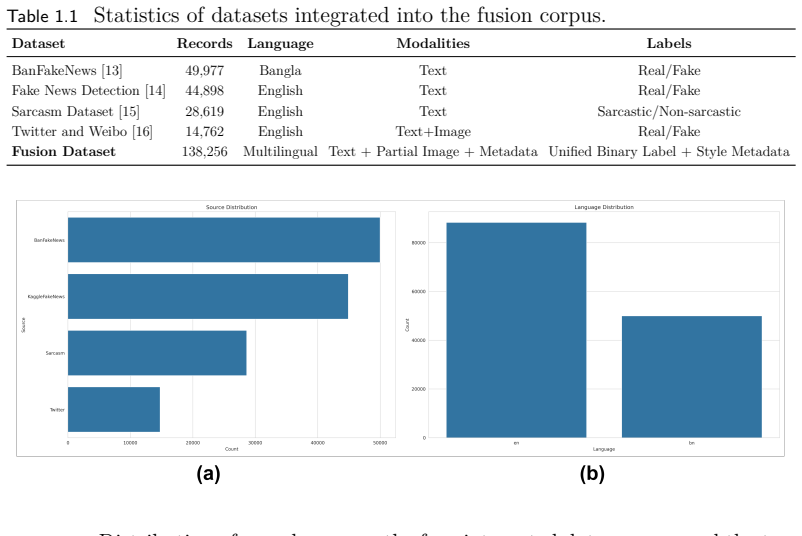
- [1.3.1 Dataset; Table 1.1] §1.3.1 and Table 1.1: Three of four sources are text-only; only the Twitter subset (~14.8k of 138k) supplies images and geotags. Missing images are replaced by a placeholder visual input so that CLIP always runs. Under this design, the multimodal fusion claim is dominated by text for the large majority of samples. The paper does not quantify how often the image branch is non-placeholder, nor does it report a text-only or text+metadata ablation. Without those controls, the 98% result cannot be attributed to multimodal fusion, and the “added value of geospatial signals” asserted in the abstract remains unmeasured.
- [1.3.1 Dataset; Abstract; 1.5] §1.3.1 label construction and abstract/conclusion framing: Sarcasm labels come from a separate non-veracity dataset and are retained as metadata while a unified binary real/fake target is imposed across sources with mismatched annotation purposes. Geospatial aggregation of predicted fakes is presented as violence early warning, yet there are no violence/escalation labels, no temporal prediction task, and no ablation removing sarcasm or geo. The violence-driven-mob-activity framing is therefore not empirically tested; high accuracy on ordinary veracity classification on BanFakeNews/Kaggle-dominated data is consistent with the reported numbers. Either the claim should be narrowed to multilingual multimodal fake-news detection, or experiments that isolate geo/sarcasm contribution and link predictions to escalation outcomes are required.
- [Table 1.5; 1.4.2 Performance Evaluation] Table 1.5: The SOTA comparison lists accuracies from prior work (85–99.6%) trained and tested on different languages, modalities, and datasets. No re-implementation or shared-split comparison is reported, and the proposed model’s 98% is not shown to improve on strong unimodal baselines on the same fused corpus. The table therefore does not establish superiority of the fusion design. A controlled comparison (text-only XLM-R, text+meta, text+image, full fusion) on the same splits is load-bearing for the architectural contribution.
minor comments (5)
- [Front matter] ArXiv date and copyright footer show “2 Jul 2026” and “©2001 by CRC Press LLC”; these look like template artifacts and should be corrected for consistency.
- [1.4.2; Figure 1.6] Figure 1.6(b) notes validation-loss fluctuation and possible mild overfitting; early stopping / stronger regularization are mentioned only as future work. A short note on whether the reported test metrics used the best validation checkpoint would help reproducibility.
- [Table 1.3; 1.4.1] Table 1.3 lists ~278M parameters for XLM-RoBERTa and ~11M for CLIP; training details (which layers frozen, if any) are not stated. Clarifying freeze/fine-tune policy would aid replication.
- [1.1 end] Section numbering in the body sometimes refers to “Section 2” etc. while the chapter uses 1.2-style numbering; align cross-references.
- [Bibliography [14], [16]] Kaggle and Figshare dataset URLs are useful; adding license and exact download versions would strengthen reproducibility of the fused corpus.
Circularity Check
Core 98% accuracy is ordinary held-out classification on a constructed corpus; only the violence-escalation early-warning claim is defined as spatial aggregation of those same fake predictions.
specific steps
-
self definitional
[§1.3.3 / Table 1.2 Step 6; Abstract; §1.1 research question]
"These predictions were subsequently aggregated by location and visualized as hotspot maps in order to provide early warning signals. ... Step 6: Optional Geospatial Visualization. When valid coordinates are available, Aggregate{g|ŷ=1}, cluster results, and visualize misinformation intensity. ... highlight the added value of geospatial signals for anticipating real-world escalation."
The paper’s claim of early warning for violence-driven mob activity / real-world escalation has no separate violence or escalation labels and no external event-linked evaluation. By the stated pipeline, the early-warning output is defined as the spatial aggregation of binary fake predictions wherever geotags exist. Thus the violence-aware contribution reduces by construction to mapping ŷ=1, not to an independently measured escalation outcome.
full rationale
This is an empirical multimodal classification paper, not a first-principles derivation. The load-bearing numerical claim (98% test accuracy, F1≈0.98, AUC≈0.99) comes from a stratified train/val/test split of a fused real/fake corpus and is not forced by fitting a constant that is then re-reported as a prediction, nor by self-citation of an author-owned uniqueness theorem (bibliography entries are external). Heterogeneous label merging, placeholder images, and evaluation only on an internal 30% sample are validity and generalization weaknesses, not circular reductions of Eq. X to Eq. Y. The sole mild circularity is rhetorical/self-definitional: “early warning” of violence-driven escalation is never an independent target; the pipeline defines hotspot early-warning signals as Aggregate{g | ŷ=1}. That does not contaminate the accuracy number itself, so the overall circularity score remains low (2).
Axiom & Free-Parameter Ledger
free parameters (5)
- learning_rate =
2e-5
- hidden_dimension =
256
- dropout =
0.2
- max_sequence_length =
128
- subset_fraction =
0.3
axioms (4)
- ad hoc to paper A unified binary real/fake label can be constructed from four source datasets that originally had different annotation purposes (including sarcasm vs. veracity).
- ad hoc to paper Missing images can be replaced by a placeholder visual input without destroying the validity of multimodal fusion claims.
- domain assumption High accuracy on an internal stratified sample of the fused corpus is evidence of efficacy for early warning of violence-driven mob activity.
- domain assumption XLM-RoBERTa and CLIP embeddings are adequate multilingual/multimodal feature extractors for Bangla and English social content.
invented entities (1)
-
AttentionFusion model
no independent evidence
Cite this review
Pith. "Pith review of Echoes of Unrest: A Multimodal NLP Framework for Early Warning of Fake News and Violence-Driven Mob Activity." pith.science (2026). https://pith.science/paper/UMVT2P6X
@misc{pith2026260702734,
  author       = {Pith},
  title        = {Pith review of: Echoes of Unrest: A Multimodal NLP Framework for Early Warning of Fake News and Violence-Driven Mob Activity},
  year         = {2026},
  howpublished = {\url{https://pith.science/paper/UMVT2P6X}},
  note         = {Machine review of arXiv:2607.02734}
}
read the original abstract
Rapid growth in social media has transformed global communication by enabling fast information exchange, but it has also accelerated the spread of misinformation. Fake news, manipulated content, and provocative narratives are increasingly linked to social unrest, political instability, and mob violence. Incidents in South Asia and elsewhere demonstrate how false information disseminated via platforms such as Facebook and WhatsApp can trigger real-world harm, often spreading faster than fact-checking efforts can respond. To address this challenge, this chapter presents a multilingual, multimodal Natural Language Processing (NLP) framework for early detection of misinformation and violence-prone dynamics. A fused dataset of 138,256 Bangla and English samples was created by combining multiple benchmark datasets. The framework integrates XLM-RoBERTa for multilingual text representation, CLIP for visual embedding, and a multi-head attention mechanism for multimodal fusion, enhanced with auxiliary features such as sarcasm and geospatial metadata. Experiments on a stratified 30% subset achieved 98% test accuracy with strong precision and recall. The outcomes show the efficacy of multimodal approaches in early misinformation detection and highlight the added value of geospatial signals for anticipating real-world escalation.
Figures



Reference graph
Works this paper leans on
-
[1]
and Sonagara, D
Singh, V.K., Ghosh, I. and Sonagara, D. (2021) Detecting fake news stories via multimodal analysis.Journal of the Association for Information Science and Technology, 72(1), 3–17
2021
-
[2]
Alam, F., Cresci, S., Chakraborty, T., Silvestri, F., Dimitrov, D., Da San Martino, G., Shaar, S., Firooz, H. and Nakov, P. (2021) A survey on multi- modal disinformation detection.arXiv preprintarXiv:2103.12541. Available at: https://doi.org/10.48550/arXiv.2103.12541
-
[3]
and Ahmed, T
Tufchi, S., Yadav, A. and Ahmed, T. (2023) A comprehensive survey of multi- modal fake news detection techniques: advances, challenges, and opportunities. International Journal of Multimedia Information Retrieval, 12(2), 28
2023
-
[4]
and Alrubaian, M
Mostafa, M., Almogren, A.S., Al-Qurishi, M. and Alrubaian, M. (2024) Modality deep-learning frameworks for fake news detection on social networks: a system- atic literature review.ACM Computing Surveys, 57(3), 1–50
2024
-
[5]
and Alonso-Bartolome, S
Segura-Bedmar, I. and Alonso-Bartolome, S. (2022) Multimodal fake news de- tection.Information, 13(6), 284
2022
-
[6]
and Yu, Y
Qi, P., Cao, J., Li, X., Liu, H., Sheng, Q., Mi, X., He, Q., Lv, Y., Guo, C. and Yu, Y. (2021) Improving fake news detection by using an entity-enhanced framework to fuse diverse multimodal clues. In:Proceedings of the 29th ACM International Conference on Multimedia, pp. 1212–1220
2021
-
[7]
and Yu, X
Xu, Q., Du, H., Łukasik, S., Zhu, T., Wang, S. and Yu, X. (2025) MDAM3: A misinformation detection and analysis framework for multitype multimodal media. In:Proceedings of the ACM Web Conference 2025, pp. 5285–5296
2025
-
[8]
Bansal, S., Singh, N.S., Dar, S.S. and Kumar, N. (2024) MMCFND: Multimodal multilingual caption-aware fake news detection for low-resource Indic languages. arXiv preprintarXiv:2410.10407
Pith/arXiv arXiv 2024
-
[9]
and Arya, A
Sharma, R. and Arya, A. (2024) MMHFND: Fusing modalities for multimodal multiclass Hindi fake news detection via contrastive learning.ACM Transactions on Asian and Low-Resource Language Information Processing, 23(11), 1–25. ©2001 by CRC Press LLC
2024
-
[10]
and Wang, S
Wang, L., Zhang, C., Xu, H., Xu, Y., Xu, X. and Wang, S. (2023) Cross-modal contrastive learning for multimodal fake news detection. In:Proceedings of the 31st ACM International Conference on Multimedia, pp. 5696–5704
2023
-
[11]
and Fu, C
Chen, J., Jia, C., Zheng, H., Chen, R. and Fu, C. (2023) Is multi-modal neces- sarily better? Robustness evaluation of multi-modal fake news detection.IEEE Transactions on Network Science and Engineering, 10(6), 3144–3158
2023
-
[12]
and Zhang, H
Jing, J., Wu, H., Sun, J., Fang, X. and Zhang, H. (2023) Multimodal fake news detection via progressive fusion networks.Information Processing & Manage- ment, 60(1), 103120
2023
-
[13]
and Kar, S
Hossain, M.Z., Rahman, M.A., Islam, M.S. and Kar, S. (2020) BanFakeNews: A dataset for detecting fake news in Bangla.arXiv e-prints
2020
-
[14]
Fake News Detection Dataset
Jain, P. Fake News Detection Dataset. Kaggle dataset. Available at:https: //www.kaggle.com/datasets/jainpooja/fake-news-detection/data(ac- cessed 1 March 2026)
2026
-
[15]
and Arora, P
Misra, R. and Arora, P. (2023) Sarcasm detection using news headlines dataset. AI Open, 4, 13–18
2023
-
[16]
(2025) Fake news multimodal datasets (Twitter and Weibo)
Ojo, A. (2025) Fake news multimodal datasets (Twitter and Weibo). Figshare dataset. Available at:https://doi.org/10.6084/m9.figshare.28516655.v2. ©2001 by CRC Press LLC
This paper was first reviewed by grok-4.5 on July 12, 2026.
discussion (0)
Sign in with ORCID, Apple, or X to comment. Anyone can read and Pith papers without signing in.