REVIEW 3 major objections 5 minor 37 references
A single function evaluation builds a full stochastic search tree for budget-constrained online discovery.
Reviewed by Pith at T0; open to challenge. T0 means a machine referee read the full paper against a public rubric. the ladder, T0–T4 →
T0 review · grok-4.5
2026-07-12 06:08 UTC pith:4IOQAEAK
load-bearing objection Solid engineering of single-NFE tree paths for budgeted online search; the BSS construction and dynamic schedule are real advances over DTS, theory is standard but clean, main soft spot is the unquantified distillation residual. the 3 major comments →
Bootstrap Flow-Map Tree Sampling Enables Online Feedback Driven Search
The pith
A machine-rendered reading of the paper's core claim, the machinery that carries it, and where it could break.
Core claim
BFMT shows that a teacher-distilled flow map together with a bootstrap sufficient-statistic loop yields exact DDPM-style stochastic transitions from any depth after a single network evaluation, and that the resulting tree, equipped with non-uniform transition schedules and a remaining-budget selection rule, converges in total variation to the soft optimal policy at rate O(β T² M^{-1/4}) while delivering higher reward under fixed NFE and feedback budgets than competing samplers.
What carries the argument
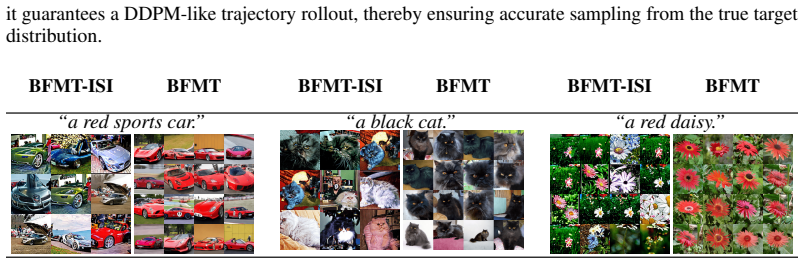
Bootstrap Sufficient Statistic (BSS) loop: after one flow-map evaluation that maps noise and the current state to a clean sample x0, intermediate nodes are obtained by a closed-form interpolant that re-uses the same pair (x0, ε); the construction is proved to match the true DDPM transition kernel at every step, enabling dynamic step sizes and full tree expansion for the cost of a single NFE.
Load-bearing premise
The distilled student flow map must recover the true conditional posterior accurately enough that the subsequent bootstrap interpolant still produces a valid DDPM trajectory; large distillation residual breaks both the theory and the single-evaluation claim.
What would settle it
Replace the distilled map with a deliberately under-trained student whose instantaneous and consistency losses remain high, then measure whether the generated intermediate states still match the analytic DDPM kernel and whether the reported reward curves collapse relative to a multi-NFE baseline under identical budgets.
If this is right
- Any setting that must discover high-utility modes under a hard query budget (drug design, interactive recommendation, rare-disease treatment search) can replace multi-step rollouts with single-NFE tree edges.
- Dynamic non-uniform transition schedules become a free design knob for controlling the exploration-exploitation trade-off without increasing network calls.
- Budget-aware node selection (BASE) systematically outperforms classical UCT when the total number of feedback queries is known and finite.
- Convergence rate improves quadratically with tree horizon T because a long horizon costs only one NFE, giving a concrete incentive to deepen trees rather than widen them.
Where Pith is reading between the lines
- The same single-NFE path construction could be grafted onto other flow or consistency models that already expose an analytic SNR schedule, potentially turning any one-step denoiser into a tree sampler.
- If the distillation residual can be bounded, the TV rate could be tightened further by replacing progressive widening with adaptive branching that depends on residual size rather than visit count alone.
- The hierarchical early-explore / late-exploit pattern observed in the qualitative figures suggests a natural curriculum for online reward-model training: early feedback can be used only for coarse mode discovery, later feedback for fine alignment.
Editorial analysis
A structured set of objections, weighed in public.
Referee Report
Summary. The paper introduces Bootstrap Flow-Map Tree (BFMT), a training-free tree sampler for online feedback-driven search and alignment under strict sampling budgets. It distills a flow map that maps any intermediate state xt to a one-step sample from the conditional posterior p(x0|xt), then uses a bootstrap sufficient-statistic (BSS) loop (Eq. 9) to synthesize a full DDPM-like stochastic trajectory from that single NFE. Flow-map flexibility further permits non-uniform transition schedules that shift from small early steps (global exploration) to large late steps (local exploitation), while a budget-aware selection rule (BASE, Eq. 13) replaces standard UCT. Soft Bellman backups propagate terminal rewards (from black-box feedback models) up the tree. Proposition 4.1 claims the BSS trajectory matches DDPM kernels; Proposition 4.3 bounds TV distance to the optimal soft policy by O(β T² M^{-1/4}). Experiments on ImageNet class search and compositional/quantity alignment report higher mean and max rewards than DTS, FKS, DAS and MFM at lower NFE and feedback budgets, with ablations isolating BSS, dynamic schedules and BASE.
Significance. Online feedback-driven discovery under evaluation budgets is a genuine bottleneck in scientific and engineering applications. Combining amortized one-step conditional sampling with tree search that needs only a single NFE per full path is a concrete efficiency advance over existing tree and SMC samplers. The dynamic-transition and budget-aware selection ideas are well-motivated and the soft-Bellman / progressive-widening analysis (Prop. 4.3) is standard and carefully written. Empirical ablations (Figs. 5–8) isolate each component and the qualitative exploration-to-exploitation visualizations (Figs. 9, 12) are informative. If the distillation residual is shown to be small and the statistical claims are tightened, the method would be a useful practical tool for inference-time alignment and search.
major comments (3)
- [§2, Prop. 4.1, Eqs. 7–9] Prop. 4.1 and the single-NFE claim rest on the assumption that the distilled student ˆv produces exact (or sufficiently accurate) draws from p(x0|xt). The teacher-distillation losses L_inst + L_cons are stated, and Fig. 5 contrasts BSS with an ISI baseline, yet the manuscript never reports a quantitative residual (conditional log-likelihood, Wasserstein distance, or multi-step ODE vs. one-step student error) as a function of noise level t. Without this, both the theoretical guarantee and the claimed NFE reduction remain conditional on an unmeasured approximation quality.
- [§3, Figs. 4, 7] Search experiments use only five randomly chosen ImageNet classes (Table 1 / Appendix). Mean and max reward curves (Figs. 4, 7) lack error bars, confidence intervals, or multi-seed statistics. Given the stochastic nature of tree expansion and BASE selection, the claim that BFMT “substantially outperforms” all baselines cannot be assessed for statistical reliability from the reported plots alone.
- [§2, Eq. 13, Eq. 15; §3 dynamic-schedule ablation] The free parameters of the method (β, progressive-widening C and ζ, the concrete sequence of transition times t′, distillation loss weights) are listed but never subjected to a sensitivity study. In particular, the dynamic schedule that is credited for the exploration–exploitation transition is described only qualitatively; an ablation that freezes the schedule to a few fixed non-uniform templates (or reports the exact schedule used) would make the contribution of “dynamic transition time steps scheduling” more reproducible and falsifiable.
minor comments (5)
- [§2 / Appendix] Proposition numbering jumps (Prop. 4.1, then 4.3); Prop. 4.2 appears to be missing or renumbered inconsistently between main text and appendix.
- [Fig. 1] Figure 1 caption and the surrounding text refer to “N Diffusion Depth / N BFMT depth” without defining N; a short legend would help.
- [Appendix §12] The reparameterization of the SANA/TrigFlow noise schedule (Appendix §12) is useful but dense; a short pseudocode block mapping (t_cm, α, σ) into the BSS loop of Eq. 9 would improve reproducibility.
- [Figs. 4, 11] Several figure panels (e.g., Fig. 4, Fig. 11) use overlapping markers without a clear legend for every series; increasing marker size or adding a table of final numbers would aid comparison.
- [Abstract, §2] Typographical inconsistencies: “Bootstrapped” vs. “Bootstrap” in the title/abstract; “L_distill_const” vs. “L_distill_cons”; occasional missing spaces before citations.
Circularity Check
No significant circularity; BFMT derivations are self-contained from independent target definition, flow-matching distillation, and standard soft-Bellman error propagation.
full rationale
The target policy π* is defined independently of the sampler via the standard soft-optimal form (Eq. 1–2) using an external pretrained prior and online black-box reward r(x). The single-NFE claim and Prop. 4.1 follow from an explicit construction (Eq. 9) whose law is proved to match the DDPM kernel by matching conditional means/covariances under the GLASS sufficient statistic (Appendix proof of Prop. 4.1); this is a derivation of equivalence, not a reduction of a prediction to its own input. Soft values and the optimal policy (Eq. 11–12) are the ordinary soft Bellman recursion. The TV bound of Prop. 4.3 is ordinary progressive-widening + Hoeffding + Lipschitz error propagation under stated boundedness assumptions; no free parameter is fitted to data and then re-presented as a prediction. Empirical rewards come from external models (CLIP-FlanT5 VQA, ImageReward, DINO+SAM counts). Citations to flow matching, consistency distillation, DTS, and progressive widening are external and non-load-bearing for uniqueness. No self-definitional loop, fitted-input-as-prediction, or self-citation chain appears. The distillation residual is an approximation assumption (already flagged by the reader), not circularity.
Axiom & Free-Parameter Ledger
free parameters (4)
- inverse temperature β
- progressive-widening constants C, ζ
- distillation loss weights / training schedule for ˆv
- dynamic transition schedule (sequence of t′)
axioms (4)
- domain assumption Existence of an ODE that transports the Gaussian prior to the conditional posterior p(x0|xt) whose drift is given by the conditional flow-matching field (Eq. 4-5).
- domain assumption Reward r(x0) is bounded and L-Lipschitz; transition kernels are Lipschitz.
- ad hoc to paper The distilled student ˆv approximates the analytic teacher field closely enough that one-step samples are exact draws from p(x0|xt).
- standard math Soft Bellman optimality yields the optimal policy expressed via the BSS transition (Eq. 12).
invented entities (3)
-
Bootstrap Sufficient Statistic (BSS) loop (Eq. 9)
independent evidence
-
Budget-Aware Stochastic Exploration (BASE) selection rule (Eq. 13)
no independent evidence
-
Bootstrap Flow-Map Tree (BFMT) sampler
no independent evidence
read the original abstract
In many scientific and engineering domains, maximizing discovery within a limited sampling budget demands strategic, observation-guided exploration. While generative models have enabled training-free reward alignment, current methods typically excel in local searches within narrow regions of the underlying distribution. These approaches struggle when preferences are unknown a priori and only revealed through sequential feedback-a scenario demanding broad exploration to uncover high-utility regions. To address this, we introduce Bootstrap Flow-Map-Tree (a.k.a BFMT), a novel computationally efficient sampling framework designed for history-aware global search and alignment under sampling budget constraints. BFMT enables full tree-path construction from any tree depth using a single function evaluation, drastically reducing computational overhead while providing critical foresight for sequential sampling. By enabling dynamic transition time steps scheduling, BFMT efficiently allocates its sampling budget, smoothly transitioning from broad global exploration to fine-grained local refinement of high-utility modes discovered through exploration. Extensive experiments and ablations across diverse search and alignment tasks demonstrate that BFMT substantially outperforms baseline approaches.
Figures




Reference graph
Works this paper leans on
-
[1]
Feedback efficient online fine-tuning of diffusion models.arXiv preprint arXiv:2402.16359, 2024
Masatoshi Uehara, Yulai Zhao, Kevin Black, Ehsan Hajiramezanali, Gabriele Scalia, Nathaniel Lee Diamant, Alex M Tseng, Sergey Levine, and Tommaso Biancalani. Feedback efficient online fine-tuning of diffusion models.arXiv preprint arXiv:2402.16359, 2024
Pith/arXiv arXiv 2024
-
[2]
Raghav Singhal, Zachary Horvitz, Ryan Teehan, Mengye Ren, Zhou Yu, Kathleen McKeown, and Rajesh Ranganath. A general framework for inference-time scaling and steering of diffusion models.arXiv preprint arXiv:2501.06848, 2025
Pith/arXiv arXiv 2025
-
[3]
Marta Skreta, Tara Akhound-Sadegh, Viktor Ohanesian, Roberto Bondesan, Alán Aspuru- Guzik, Arnaud Doucet, Rob Brekelmans, Alexander Tong, and Kirill Neklyudov. Feynman- kac correctors in diffusion: Annealing, guidance, and product of experts.arXiv preprint arXiv:2503.02819, 2025
Pith/arXiv arXiv 2025
-
[4]
Sunwoo Kim, Minkyu Kim, and Dongmin Park. Test-time alignment of diffusion models without reward over-optimization.arXiv preprint arXiv:2501.05803, 2025
Pith/arXiv arXiv 2025
-
[5]
Cheuk Kit Lee, Paul Jeha, Jes Frellsen, Pietro Lio, Michael Samuel Albergo, and Francisco Vargas. Debiasing guidance for discrete diffusion with sequential monte carlo.arXiv preprint arXiv:2502.06079, 2025
Pith/arXiv arXiv 2025
-
[6]
Yingqing Guo, Yukang Yang, Hui Yuan, and Mengdi Wang. Training-free guidance beyond differentiability: Scalable path steering with tree search in diffusion and flow models.arXiv preprint arXiv:2502.11420, 2025
Pith/arXiv arXiv 2025
-
[7]
Vineet Jain, Kusha Sareen, Mohammad Pedramfar, and Siamak Ravanbakhsh. Diffusion tree sampling: Scalable inference-time alignment of diffusion models.arXiv preprint arXiv:2506.20701, 2025
Pith/arXiv arXiv 2025
-
[8]
Flow matching for generative modeling.arXiv preprint arXiv:2210.02747, 2022
Yaron Lipman, Ricky TQ Chen, Heli Ben-Hamu, Maximilian Nickel, and Matt Le. Flow matching for generative modeling.arXiv preprint arXiv:2210.02747, 2022
Pith/arXiv arXiv 2022
-
[9]
Peter Holderrieth, Uriel Singer, Tommi Jaakkola, Ricky TQ Chen, Yaron Lipman, and Brian Karrer. Glass flows: Transition sampling for alignment of flow and diffusion models.arXiv preprint arXiv:2509.25170, 2025
arXiv 2025
-
[10]
Nicholas M Boffi, Michael S Albergo, and Eric Vanden-Eijnden. How to build a consistency model: Learning flow maps via self-distillation.arXiv preprint arXiv:2505.18825, 2025
arXiv 2025
-
[11]
Continuous upper confidence trees
Adrien Couëtoux, Jean-Baptiste Hoock, Nataliya Sokolovska, Olivier Teytaud, and Nicolas Bonnard. Continuous upper confidence trees. InInternational conference on learning and intelligent optimization, pages 433–445. Springer, 2011
2011
-
[12]
Meta flow maps enable scalable reward alignment.arXiv preprint arXiv:2601.14430, 2026
Peter Potaptchik, Adhi Saravanan, Abbas Mammadov, Alvaro Prat, Michael S Albergo, and Yee Whye Teh. Meta flow maps enable scalable reward alignment.arXiv preprint arXiv:2601.14430, 2026
Pith/arXiv arXiv 2026
-
[13]
Evaluating text-to-visual generation with image-to-text generation
Zhiqiu Lin, Deepak Pathak, Baiqi Li, Jiayao Li, Xide Xia, Graham Neubig, Pengchuan Zhang, and Deva Ramanan. Evaluating text-to-visual generation with image-to-text generation. In European Conference on Computer Vision, pages 366–384. Springer, 2024
2024
-
[14]
Imagereward: Learning and evaluating human preferences for text-to-image generation
Jiazheng Xu, Xiao Liu, Yuchen Wu, Yuxuan Tong, Qinkai Li, Ming Ding, Jie Tang, and Yuxiao Dong. Imagereward: Learning and evaluating human preferences for text-to-image generation. Advances in Neural Information Processing Systems, 36:15903–15935, 2023
2023
-
[15]
Genai arena: An open evaluation platform for generative models.Advances in Neural Information Processing Systems, 37:79889–79908, 2024
Dongfu Jiang, Max Ku, Tianle Li, Yuansheng Ni, Shizhuo Sun, Rongqi Fan, and Wenhu Chen. Genai arena: An open evaluation platform for generative models.Advances in Neural Information Processing Systems, 37:79889–79908, 2024
2024
-
[16]
Kaiyi Huang, Chengqi Duan, Kaiyue Sun, Enze Xie, Zhenguo Li, and Xihui Liu. T2i- compbench++: An enhanced and comprehensive benchmark for compositional text-to-image generation.IEEE Transactions on Pattern Analysis and Machine Intelligence, 47(5):3563–3579, 2025. 13
2025
-
[17]
Grounding dino: Marrying dino with grounded pre-training for open-set object detection
Shilong Liu, Zhaoyang Zeng, Tianhe Ren, Feng Li, Hao Zhang, Jie Yang, Qing Jiang, Chunyuan Li, Jianwei Yang, Hang Su, et al. Grounding dino: Marrying dino with grounded pre-training for open-set object detection. InEuropean conference on computer vision, pages 38–55. Springer, 2024
2024
-
[18]
Segment anything
Alexander Kirillov, Eric Mintun, Nikhila Ravi, Hanzi Mao, Chloe Rolland, Laura Gustafson, Tete Xiao, Spencer Whitehead, Alexander C Berg, Wan-Yen Lo, et al. Segment anything. In Proceedings of the IEEE/CVF international conference on computer vision, pages 4015–4026, 2023
2023
-
[19]
Sana-sprint: One-step diffusion with continuous-time consistency distillation
Junsong Chen, Shuchen Xue, Yuyang Zhao, Jincheng Yu, Sayak Paul, Junyu Chen, Han Cai, Song Han, and Enze Xie. Sana-sprint: One-step diffusion with continuous-time consistency distillation. InProceedings of the IEEE/CVF International Conference on Computer Vision, pages 16185–16195, 2025
2025
-
[20]
Sequential monte carlo samplers.Journal of the Royal Statistical Society Series B: Statistical Methodology, 68(3):411–436, 2006
Pierre Del Moral, Arnaud Doucet, and Ajay Jasra. Sequential monte carlo samplers.Journal of the Royal Statistical Society Series B: Statistical Methodology, 68(3):411–436, 2006
2006
-
[21]
Particle denoising diffusion sampler.arXiv preprint arXiv:2402.06320, 2024
Angus Phillips, Hai-Dang Dau, Michael John Hutchinson, Valentin De Bortoli, George Deligiannidis, and Arnaud Doucet. Particle denoising diffusion sampler.arXiv preprint arXiv:2402.06320, 2024
Pith/arXiv arXiv 2024
-
[22]
Gabriel Cardoso, Yazid Janati El Idrissi, Sylvain Le Corff, and Eric Moulines. Monte carlo guided diffusion for bayesian linear inverse problems.arXiv preprint arXiv:2308.07983, 2023
Pith/arXiv arXiv 2023
-
[23]
Diffusion posterior sampling for linear inverse problem solving: A filtering perspective
Zehao Dou and Yang Song. Diffusion posterior sampling for linear inverse problem solving: A filtering perspective. InThe Twelfth International Conference on Learning Representations, 2024
2024
-
[24]
Brian L Trippe, Jason Yim, Doug Tischer, David Baker, Tamara Broderick, Regina Barzilay, and Tommi Jaakkola. Diffusion probabilistic modeling of protein backbones in 3d for the motif-scaffolding problem.arXiv preprint arXiv:2206.04119, 2022
Pith/arXiv arXiv 2022
-
[25]
Practi- cal and asymptotically exact conditional sampling in diffusion models.Advances in Neural Information Processing Systems, 36:31372–31403, 2023
Luhuan Wu, Brian Trippe, Christian Naesseth, David Blei, and John P Cunningham. Practi- cal and asymptotically exact conditional sampling in diffusion models.Advances in Neural Information Processing Systems, 36:31372–31403, 2023
2023
-
[26]
Learning to summarize with human feedback
Nisan Stiennon, Long Ouyang, Jeffrey Wu, Daniel Ziegler, Ryan Lowe, Chelsea V oss, Alec Radford, Dario Amodei, and Paul F Christiano. Learning to summarize with human feedback. Advances in neural information processing systems, 33:3008–3021, 2020
2020
-
[27]
Theoretical guarantees on the best-of-n alignment policy
Ahmad Beirami, Alekh Agarwal, Jonathan Berant, Alex D’Amour, Jacob Eisenstein, Chirag Nagpal, and Ananda Theertha Suresh. Theoretical guarantees on the best-of-n alignment policy. 2024.URL https://api. semanticscholar. org/CorpusID, 266741736(3), 1879
2024
-
[28]
Webgpt: Browser-assisted question-answering with human feedback, 2022.URL https://arxiv
Reiichiro Nakano, Jacob Hilton, Suchir Balaji, Jeff Wu, Long Ouyang, Christina Kim, Christo- pher Hesse, Shantanu Jain, Vineet Kosaraju, William Saunders, et al. Webgpt: Browser-assisted question-answering with human feedback, 2022.URL https://arxiv. org/abs/2112.09332, 35, 2022
Pith/arXiv arXiv 2022
-
[29]
Training language models to follow instructions with human feedback.Advances in neural information processing systems, 35:27730–27744, 2022
Long Ouyang, Jeffrey Wu, Xu Jiang, Diogo Almeida, Carroll Wainwright, Pamela Mishkin, Chong Zhang, Sandhini Agarwal, Katarina Slama, Alex Ray, et al. Training language models to follow instructions with human feedback.Advances in neural information processing systems, 35:27730–27744, 2022
2022
-
[30]
Llama 2: Open foundation and fine-tuned chat models.arXiv preprint arXiv:2307.09288, 2023
Hugo Touvron, Louis Martin, Kevin Stone, Peter Albert, Amjad Almahairi, Yasmine Babaei, Nikolay Bashlykov, Soumya Batra, Prajjwal Bhargava, Shruti Bhosale, et al. Llama 2: Open foundation and fine-tuned chat models.arXiv preprint arXiv:2307.09288, 2023
Pith/arXiv arXiv 2023
-
[31]
Aligning text-to-image models using human feedback.arXiv preprint arXiv:2302.12192, 2023
Kimin Lee, Hao Liu, Moonkyung Ryu, Olivia Watkins, Yuqing Du, Craig Boutilier, Pieter Abbeel, Mohammad Ghavamzadeh, and Shixiang Shane Gu. Aligning text-to-image models using human feedback.arXiv preprint arXiv:2302.12192, 2023. 14
Pith/arXiv arXiv 2023
-
[32]
Xiaoshi Wu, Keqiang Sun, Feng Zhu, Rui Zhao, and Hongsheng Li. Better aligning text-to- image models with human preference.arXiv preprint arXiv:2303.14420, 1(3), 2023
Pith/arXiv arXiv 2023
-
[33]
Imagereward: Learning and evaluating human preferences for text-to-image generation
Jiazheng Xu, Xiao Liu, Yuchen Wu, Yuxuan Tong, Qinkai Li, Ming Ding, Jie Tang, and Yuxiao Dong. Imagereward: Learning and evaluating human preferences for text-to-image generation. Advances in Neural Information Processing Systems, 36, 2024
2024
-
[34]
Anurag Ajay, Yilun Du, Abhi Gupta, Joshua Tenenbaum, Tommi Jaakkola, and Pulkit Agrawal. Is conditional generative modeling all you need for decision-making?arXiv preprint arXiv:2211.15657, 2022
Pith/arXiv arXiv 2022
-
[35]
Planning with diffusion for flexible behavior synthesis.arXiv preprint arXiv:2205.09991, 2022
Michael Janner, Yilun Du, Joshua B Tenenbaum, and Sergey Levine. Planning with diffusion for flexible behavior synthesis.arXiv preprint arXiv:2205.09991, 2022
Pith/arXiv arXiv 2022
-
[36]
Training diffusion models with reinforcement learning.arXiv preprint arXiv:2305.13301, 2023
Kevin Black, Michael Janner, Yilun Du, Ilya Kostrikov, and Sergey Levine. Training diffusion models with reinforcement learning.arXiv preprint arXiv:2305.13301, 2023. 15 Bootstrap Flow-Map Tree Sampling Enables Online Feedback Driven Search (Appendix) Appendix Table of Contents Appendix: Theoretical Derivations Page 1 Derivation of BFMT Convergence Rate ....
Pith/arXiv arXiv 2023
-
[37]
a red sports car
Z min(ˆq(xt−1|xt), π∗(xt−1|xt))dx≥e −2βϵ Substitute this back into the TV distance definition: DT V (ˆq(xt−1|xt)∥π ∗(xt−1|xt))≤1−e −2βϵ For anyy≥0, the exponential inequality1−e −y ≤yholds true. Settingy= 2βϵ: 1−e −2βϵ ≤2βϵ Thus, we conclude that: DT V (ˆq(xt−1|xt)∥π ∗(xt−1|xt))≤2βϵ= 2βsup xt−1 | ˆVt−1(xt−1)−V t−1(xt−1)| Substituting our propagated value ...
discussion (0)
Sign in with ORCID, Apple, or X to comment. Anyone can read and Pith papers without signing in.