REVIEW 2 major objections 5 minor 1 cited by
Entropy regularization in continuous-time RL yields explicit worst-case robustness guarantees whose certified sets grow with the temperature.
Reviewed by Pith at T0; open to challenge. T0 means a machine referee read the full paper against a public rubric. the ladder, T0–T4 →
T0 review · grok-4.5
2026-07-12 04:22 UTC pith:G7QVK74S
load-bearing objection First clean continuous-time robustness certificates for entropy regularization, without the discrete-time state-entropy term and without step-size degeneracy. the 2 major comments →
Entropy Regularization Improves Policy Robustness in Continuous-Time Reinforcement Learning
The pith
A machine-rendered reading of the paper's core claim, the machinery that carries it, and where it could break.
Core claim
Maximizing the entropy-regularized continuous-time objective is equivalent to a robust control problem under pure reward uncertainty and provides a certified lower bound under joint reward-and-dynamics uncertainty; the corresponding robust sets expand monotonically with the temperature, so stronger entropy enlarges the class of perturbations against which the policy is protected.
What carries the argument
Two analytically characterized robust sets: an occupancy-based set that measures global distortion of discounted state-action measures, and a local set built from the relative-entropy rate of transition intensities together with a log-reward cost; both are defined by a soft-max (log-sum-exp) constraint that widens with temperature.
Load-bearing premise
The local certificate requires that every perturbed model keeps exactly the same possible jumps as the baseline model; if new transitions can appear or existing ones can vanish, that certificate no longer applies.
What would settle it
Train entropy-regularized and greedy policies on a continuous-time MDP whose jump support can change under realistic misspecification, then measure whether worst-case performance still improves with temperature on the enlarged support; if it does not, the local robustness claim fails.
Editorial analysis
A structured set of objections, weighed in public.
Referee Report
Summary. The paper establishes the first robustness guarantees for entropy-regularized continuous-time MDPs with controlled CTMC dynamics. Maximizing the entropy-regularized objective J_τ(π) is shown to yield a lower bound on worst-case performance under joint reward and transition perturbations (Theorems 3.2 and 3.6), with exact equivalence under reward-only uncertainty (Theorem 3.1). The induced robust sets are characterized both via discounted occupancy measures and via local relative-entropy rates of transition intensities, and are proved to expand monotonically with the regularization strength τ (Propositions 3.4 and 3.8). The continuous-time certificates avoid the intractable state-distribution entropy term that appears in discrete-time analyses and remain non-degenerate as action frequency increases (Example 3.7). Experiments on criss-cross queueing control and market making support the qualitative claims.
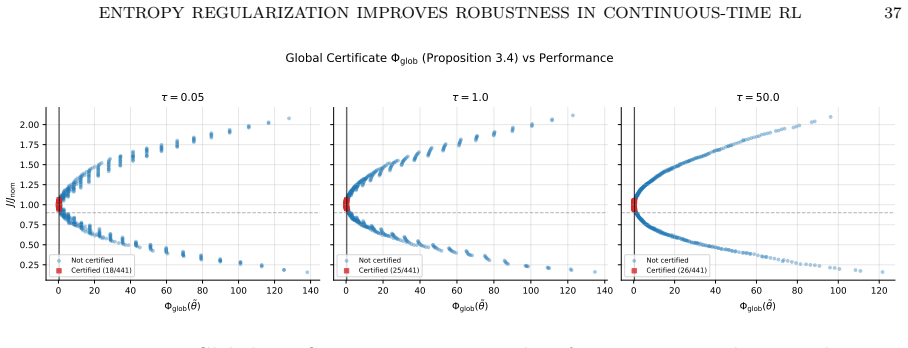
Significance. If the results hold, the paper supplies a clean theoretical foundation for a practice that is already widespread in continuous-time RL (entropy regularization for robustness) without requiring an explicit adversary or minimax solver. The continuous-time certificates are genuinely better adapted to the setting than discrete-time analogues: they remove the state-entropy term, stay non-degenerate under refinement of the action grid, and admit an event-driven implementation. The proofs (Appendices B.2–B.7) are complete and use standard tools (Lagrange duality, Jensen, Girsanov for CTMCs, Donsker–Varadhan). The market-making and queueing experiments, together with the certificate-tightness study in Appendix E, give concrete evidence that moderate τ improves worst-case performance over greedy and ε-greedy baselines. The main limitations (common jump support, finite spaces, certificate conservatism) are already acknowledged by the authors and do not undermine the formal lower-bound statements.
major comments (2)
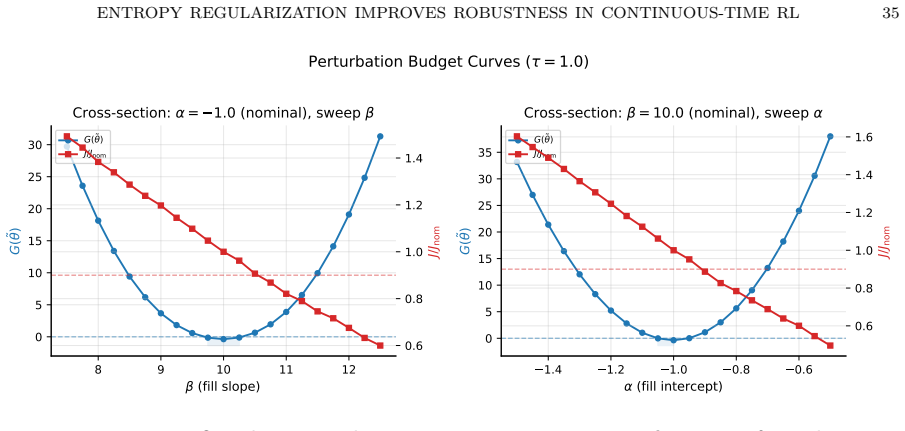
- Assumption 3.5 (identical jump support of baseline and perturbed rates) is load-bearing for Theorem 3.6 and the local certificate C^π_τ,ε. The Girsanov/semi-martingale argument in Appendix B.6 and the definition of the local relative-entropy rate ℓ require that no new transitions appear and none vanish. The paper should state more prominently (in the introduction or after Theorem 3.6) that the local certificate does not cover support-changing misspecification, while the global occupancy certificate of Theorem 3.2 remains valid without this assumption. A short remark on how one might extend the local construction (e.g., via absolute continuity of path measures) would strengthen the scope discussion.
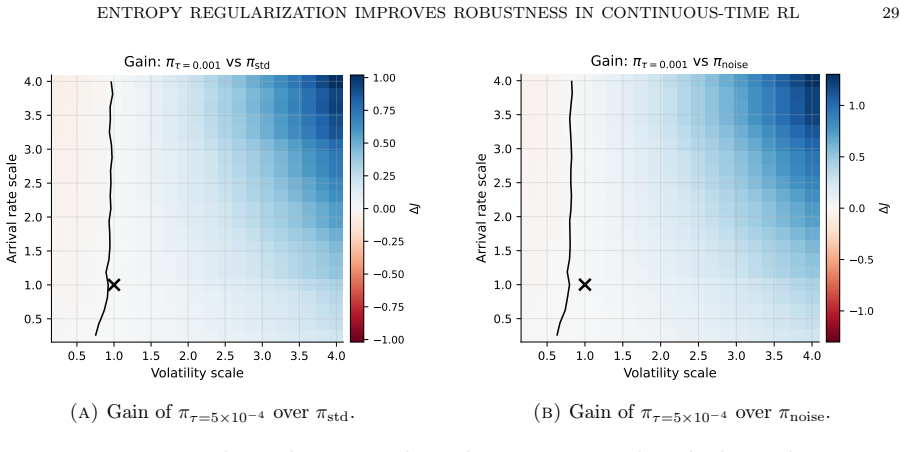
- The experimental gains, while directionally consistent with the theory, are modest and temperature-sensitive (Tables 3–4, Figures 2–3 and 6–9). Worst-case improvements of order 0.3–2% over π_std are statistically significant for carefully chosen small τ, but the inverted-U pattern shows that larger τ quickly degrades both nominal and worst-case performance. The manuscript should more clearly separate the formal lower-bound claims (which hold for any τ) from the practical claim that moderate entropy regularization improves robustness; the latter is supported only for a narrow temperature range and should be presented as such.
minor comments (5)
- Notation for the robust sets (bC, eC, C) is dense; a short table or paragraph summarizing the three constructions and the assumptions each requires would help the reader.
- In the market-making illustration (Section 3.3 and Appendix C), the reward is shifted by a large constant C to enforce positivity. The effect of this shift on the log-transformed objective and on the numerical size of the robust sets should be briefly discussed.
- Example 3.7 is useful; making the continuous-time limit of the discrete-time constraint fully rigorous (or citing the appropriate large-deviations reference) would remove any residual ambiguity.
- Appendix F on event-driven versus fixed-grid discretization is valuable but somewhat long relative to the main contribution; a shorter summary in the main text with the full comparison left in the appendix would improve balance.
- A few minor typos appear (e.g., “ε-greedy” spacing, occasional missing articles). A careful proof-reading pass is recommended.
Circularity Check
No significant circularity: dual robust-set constructions and Girsanov/KL lower bounds are self-contained mathematical characterizations, not fits or self-citation chains.
full rationale
The load-bearing claims (Theorems 3.1, 3.2, 3.6; Propositions 3.4, 3.8) are proved from standard tools—Lagrange duality for reward-only KL balls, Jensen on occupancy measures, Girsanov for CTMC likelihood ratios, Donsker–Varadhan/KL duality, and log-sum-exp monotonicity—without reducing the target to a fitted parameter or to an unverified self-citation. Defining robust sets so that the entropy-regularized objective lower-bounds worst-case performance is the usual dual characterization of entropy regularization, not circular prediction: the sets are analytically characterized (occupancy ratios vs local relative-entropy rates), shown to expand with τ, and contrasted with discrete-time constructions that degenerate (Example 3.7). Experiments choose τ and perturbation grids independently and compare against greedy/ε-greedy baselines; they do not reverse-engineer parameters to force the theorems. Self-citations concern continuous-time RL algorithms and related work, not uniqueness or the robustness dualities themselves. Assumption 3.5 and R>0 restrict scope but do not create circularity. Score 0 with empty steps is the honest finding.
Axiom & Free-Parameter Ledger
free parameters (4)
- entropy temperature τ
- adversary budget ε
- reference policy μ
- experimental environment scales and network hyperparameters
axioms (6)
- domain assumption Finite state and action spaces with stationary randomized Markov policies and discounted infinite-horizon CTMDP structure.
- domain assumption Instantaneous rewards strictly positive for all models in Θ.
- domain assumption Assumption 3.5: baseline and perturbed transition rates share the same support.
- standard math Girsanov theorem / likelihood-ratio semi-martingale decomposition for controlled CTMCs.
- standard math Donsker–Varadhan variational formula for KL divergence.
- standard math Joint convexity of the relative-entropy rate function f(x,y)=x log(x/y)−x+y.
invented entities (2)
-
Local relative entropy rate ℓ(λ^a_θ, λ^a_˜θ) and joint cost c_θ,˜θ
independent evidence
-
Policy-dependent robust sets bC, eC, C parameterized by τ and ε
independent evidence
read the original abstract
Entropy regularization is widely used in continuous-time reinforcement learning (RL) to reduce sensitivity to environmental perturbations, yet its robustness benefits lack a rigorous theoretical foundation. This paper establishes the first robustness guarantees for entropy-regularized continuous-time Markov decision processes. We show that maximizing an entropy-regularized objective yields a lower bound on a worst-case robust RL problem with joint reward and transition perturbations. We analytically characterize the induced robust sets and prove that they expand monotonically with the regularization strength, justifying the empirical observation that stronger entropy improves robustness. In contrast to prior discrete-time analyses, our results remove the intractable state-distribution entropy term and provide guarantees invariant to action frequency. Experiments on queueing network control and market making confirm our theory, showing that entropy-regularized policies outperform greedy and $\epsilon$-greedy baselines under dynamics perturbations.
Figures








Forward citations
Cited by 1 Pith paper
-
Feedback Cycles in Exploratory Equilibria
In exploratory equilibria, low-temperature policy susceptibility grows polynomially on causal chains but exponentially on positive feedback cycles, with Lambert-W critical temperature τ* = βT/W(βT√n).
Reference graph
Works this paper leans on
-
[1]
The reality gap in robotics: Challenges, solutions, and best practices.Annual Review of Control, Robotics, and Autonomous Systems, 9:403–432, 2026
Elie Aljalbout, Jiaxu Xing, Angel Romero, Iretiayo Akinola, Caelan Reed Garrett, Eric Heiden, Abhishek Gupta, Tucker Hermans, Yashraj Narang, Dieter Fox, Davide Scaramuzza, and Fabio Ramos. The reality gap in robotics: Challenges, solutions, and best practices.Annual Review of Control, Robotics, and Autonomous Systems, 9:403–432, 2026
2026
-
[2]
State entropy regularization for robust reinforcement learning
Yonatan Ashlag, Uri Koren, Mirco Mutti, Esther Derman, Pierre-Luc Bacon, and Shie Mannor. State entropy regularization for robust reinforcement learning. InAdvances in Neural Information Processing Systems, volume 38, 2025
2025
-
[3]
Algorithmic market making in dealer markets with hedging and market impact.Mathematical Finance, 33(1):41–79, 2023
Alexander Barzykin, Philippe Bergault, and Olivier Guéant. Algorithmic market making in dealer markets with hedging and market impact.Mathematical Finance, 33(1):41–79, 2023
2023
-
[4]
Continuous-time q-learning in jump-diffusion models under Tsallis entropy, 2024
Lijun Bo, Yijie Huang, Xiang Yu, and Tingting Zhang. Continuous-time q-learning in jump-diffusion models under Tsallis entropy, 2024
2024
-
[5]
Rob Brekelmans, Tim Genewein, Jordi Grau-Moya, Grégoire Delétang, Markus Kunesch, Shane Legg, and Pedro A. Ortega. Your policy regularizer is secretly an adversary.Transactions on Machine Learning Research, 2022
2022
-
[6]
Robust multi-agent reinforcement learning via adversarial regularization: Theoretical foundation and stable algorithms
Alexander Bukharin, Yan Li, Yue Yu, Qingru Zhang, Zhehui Chen, Simiao Zuo, Chao Zhang, Songan Zhang, and Tuo Zhao. Robust multi-agent reinforcement learning via adversarial regularization: Theoretical foundation and stable algorithms. InAdvances in Neural Information Processing Systems, volume 36, pages 68121–68133, 2023
2023
-
[7]
Cambridge University Press, 2015
Álvaro Cartea, Sebastian Jaimungal, and José Penalva.Algorithmic and High-Frequency Trading. Cambridge University Press, 2015
2015
-
[8]
Robust reinforcement learning with general utility
Ziyi Chen, Yan Wen, Zhengmian Hu, and Heng Huang. Robust reinforcement learning with general utility. In Advances in Neural Information Processing Systems, volume 37, pages 11290–11344, 2024
2024
-
[9]
Deterministic policy gradient for reinforcement learning with continuous time and state, 2026
Ziheng Cheng, Xin Guo, and Yufei Zhang. Deterministic policy gradient for reinforcement learning with continuous time and state, 2026
2026
-
[10]
Dai and Mark Gluzman
Jim G. Dai and Mark Gluzman. Queueing network controls via deep reinforcement learning.Stochastic Systems, 12(1):30–67, 2022
2022
-
[11]
Twice regularized MDPs and the equivalence between robustness and regularization.Advances in Neural Information Processing Systems, 34:22274–22287, 2021
Esther Derman, Matthieu Geist, and Shie Mannor. Twice regularized MDPs and the equivalence between robustness and regularization.Advances in Neural Information Processing Systems, 34:22274–22287, 2021
2021
-
[12]
Robustness and regularization in rein- forcement learning
Esther Derman, Yevgeniy Men, Matthieu Geist, and Shie Mannor. Robustness and regularization in rein- forcement learning. InNeurIPS 2023 Workshop on Generalization in Planning, 2023
2023
-
[13]
Entropy regularization in mean-field games of optimal stopping.arXiv preprint arXiv:2509.18821, 2025
Jodi Dianetti, Roxana Dumitrescu, Giorgio Ferrari, and Renyuan Xu. Entropy regularization in mean-field games of optimal stopping.arXiv preprint arXiv:2509.18821, 2025
arXiv 2025
-
[14]
Donsker and S
Monroe D. Donsker and S. R. Srinivasa Varadhan. Asymptotic evaluation of certain Markov process expecta- tions for large time—iii.Communications on Pure and Applied Mathematics, 29(4):389–461, 1976. ENTROPY REGULARIZATION IMPROVES ROBUSTNESS IN CONTINUOUS-TIME RL 12
1976
-
[15]
Maximum entropy RL (provably) solves some robust RL problems
Benjamin Eysenbach and Sergey Levine. Maximum entropy RL (provably) solves some robust RL problems. InInternational Conference on Learning Representations, 2022
2022
-
[16]
Actor-critic learning for mean-field control in continuous time.Journal of Machine Learning Research, 26(127):1–42, 2025
Noufel Frikha, Maximilien Germain, Mathieu Laurière, Huyên Pham, and Xuanye Song. Actor-critic learning for mean-field control in continuous time.Journal of Machine Learning Research, 26(127):1–42, 2025
2025
-
[17]
Reinforcement learning for jump-diffusions, with financial applications.Mathematical Finance, 2026
Xuefeng Gao, Lingfei Li, and Xun Yu Zhou. Reinforcement learning for jump-diffusions, with financial applications.Mathematical Finance, 2026. Early View
2026
-
[18]
A theory of regularized Markov decision processes
Matthieu Geist, Bruno Scherrer, and Olivier Pietquin. A theory of regularized Markov decision processes. In Proceedings of the 36th International Conference on Machine Learning, volume 97 ofProceedings of Machine Learning Research, pages 2160–2169, 2019
2019
-
[19]
Convergence of policy gradient methods for finite-horizon exploratory linear-quadratic control problems.SIAM Journal on Control and Optimization, 62(2):1060–1092, 2024
Michael Giegrich, Christoph Reisinger, and Yufei Zhang. Convergence of policy gradient methods for finite-horizon exploratory linear-quadratic control problems.SIAM Journal on Control and Optimization, 62(2):1060–1092, 2024
2024
-
[20]
Scalable first-order methods for robust MDPs
Julien Grand-Clément and Christian Kroer. Scalable first-order methods for robust MDPs. InProceedings of the AAAI Conference on Artificial Intelligence, volume 35, pages 12086–12094, 2021
2021
-
[21]
Continuous-time Markov decision processes
Xianping Guo and Onésimo Hernández-Lerma. Continuous-time Markov decision processes. InContinuous- Time Markov Decision Processes: Theory and Applications, pages 9–18. Springer, 2009
2009
-
[22]
Entropy regularization for mean field games with learning
Xin Guo, Renyuan Xu, and Thaleia Zariphopoulou. Entropy regularization for mean field games with learning. Mathematics of Operations Research, 47(4):3239–3260, 2022
2022
-
[23]
Soft actor-critic algorithms and applications
Tuomas Haarnoja, Aurick Zhou, Kristian Hartikainen, George Tucker, Sehoon Ha, Jie Tan, Vikash Kumar, Henry Zhu, Abhishek Gupta, Pieter Abbeel, and Sergey Levine. Soft actor-critic algorithms and applications. arXiv preprint arXiv:1812.05905, abs/1812.05905, 2018
Pith/arXiv arXiv 2018
-
[24]
Continuous-time reinforcement learning for optimal switching over multiple regimes, 2025
Yijie Huang, Mengge Li, Xiang Yu, and Zhou Zhou. Continuous-time reinforcement learning for optimal switching over multiple regimes, 2025
2025
-
[25]
Regularized policies are reward robust
Hisham Husain, Kamil Ciosek, and Ryota Tomioka. Regularized policies are reward robust. InInternational Conference on Artificial Intelligence and Statistics, pages 64–72. PMLR, 2021
2021
-
[26]
Garud N. Iyengar. Robust dynamic programming.Mathematics of Operations Research, 30(2):257–280, 2005
2005
-
[27]
Continuous-time risk-sensitive reinforcement learning via quadratic variation penalty.Applied Mathematics & Optimization, 93(2):58, 2026
Yanwei Jia. Continuous-time risk-sensitive reinforcement learning via quadratic variation penalty.Applied Mathematics & Optimization, 93(2):58, 2026
2026
-
[28]
Yanwei Jia, Du Ouyang, and Yufei Zhang. Accuracy of discretely sampled stochastic policies in continuous-time reinforcement learning.arXiv preprint arXiv:2503.09981, 2025
arXiv 2025
-
[29]
Policy evaluation and temporal-difference learning in continuous time and space: A martingale approach.Journal of Machine Learning Research, 23(154):1–55, 2022
Yanwei Jia and Xun Yu Zhou. Policy evaluation and temporal-difference learning in continuous time and space: A martingale approach.Journal of Machine Learning Research, 23(154):1–55, 2022
2022
-
[30]
Policy gradient and actor-critic learning in continuous time and space: Theory and algorithms.Journal of Machine Learning Research, 23(275):1–50, 2022
Yanwei Jia and Xun Yu Zhou. Policy gradient and actor-critic learning in continuous time and space: Theory and algorithms.Journal of Machine Learning Research, 23(275):1–50, 2022
2022
-
[31]
q-learning in continuous time.Journal of Machine Learning Research, 24(161):1–61, 2023
Yanwei Jia and Xun Yu Zhou. q-learning in continuous time.Journal of Machine Learning Research, 24(161):1–61, 2023
2023
-
[32]
A Fisher–Rao gradient flow for entropy-regularised Markov decision processes in Polish spaces.Foundations of Computational Mathematics, pages 1–75, 2025
Bekzhan Kerimkulov, James-Michael Leahy, David Siska, Lukasz Szpruch, and Yufei Zhang. A Fisher–Rao gradient flow for entropy-regularised Markov decision processes in Polish spaces.Foundations of Computational Mathematics, pages 1–75, 2025
2025
-
[33]
Policy gradient for rectangular robust Markov decision processes
Navdeep Kumar, Esther Derman, Matthieu Geist, Kfir Levy, and Shie Mannor. Policy gradient for rectangular robust Markov decision processes. InAdvances in Neural Information Processing Systems, volume 36, 2023
2023
-
[34]
Policy mirror descent for reinforcement learning: Linear convergence, new sampling complexity, and generalized problem classes.Mathematical Programming, 198:1059–1106, 2023
Guanghui Lan. Policy mirror descent for reinforcement learning: Linear convergence, new sampling complexity, and generalized problem classes.Mathematical Programming, 198:1059–1106, 2023
2023
-
[35]
Policy gradient algorithms for robust MDPs with nonrectan- gular uncertainty sets.SIAM Journal on Optimization, 36(1):120–151, 2026
Mengmeng Li, Daniel Kuhn, and Tobias Sutter. Policy gradient algorithms for robust MDPs with nonrectan- gular uncertainty sets.SIAM Journal on Optimization, 36(1):120–151, 2026
2026
-
[36]
Efficient adversarial training without attacking: Worst-case-aware robust reinforcement learning.Advances in Neural Information Processing Systems, 35:22547–22561, 2022
Yongyuan Liang, Yanchao Sun, Ruijie Zheng, and Furong Huang. Efficient adversarial training without attacking: Worst-case-aware robust reinforcement learning.Advances in Neural Information Processing Systems, 35:22547–22561, 2022
2022
-
[37]
Reinforcement learning in robust Markov decision processes
Shiau Hong Lim, Huan Xu, and Shie Mannor. Reinforcement learning in robust Markov decision processes. InAdvances in Neural Information Processing Systems, volume 26, 2013
2013
-
[38]
Robust value iteration for continuous control tasks
Michael Lutter, Shie Mannor, Jan Peters, Dieter Fox, and Animesh Garg. Robust value iteration for continuous control tasks. InRobotics: Science and Systems, 2021
2021
-
[39]
Huiling Meng, Ningyuan Chen, and Xuefeng Gao. Reinforcement learning for intensity control: An application to choice-based network revenue management.arXiv preprint arXiv:2406.05358, 2024
Pith/arXiv arXiv 2024
-
[40]
Robust reinforcement learning.Neural Computation, 17(2):335–359, 2005
Jun Morimoto and Kenji Doya. Robust reinforcement learning.Neural Computation, 17(2):335–359, 2005
2005
-
[41]
Robust control of Markov decision processes with uncertain transition matrices.Operations Research, 53(5):780–798, 2005
Arnab Nilim and Laurent El Ghaoui. Robust control of Markov decision processes with uncertain transition matrices.Operations Research, 53(5):780–798, 2005
2005
-
[42]
Springer, 2007
Bernt Øksendal and Agnès Sulem.Applied Stochastic Control of Jump Diffusions, volume 3. Springer, 2007
2007
-
[43]
Variational inference for Markov jump processes.Advances in Neural Information Processing Systems, 20, 2007
Manfred Opper and Guido Sanguinetti. Variational inference for Markov jump processes.Advances in Neural Information Processing Systems, 20, 2007
2007
-
[44]
Robustness and risk-sensitivity in Markov decision processes
Takayuki Osogami. Robustness and risk-sensitivity in Markov decision processes. InAdvances in Neural Information Processing Systems, volume 25, 2012. ENTROPY REGULARIZATION IMPROVES ROBUSTNESS IN CONTINUOUS-TIME RL 13
2012
-
[45]
Sim-to-real transfer of robotic control with dynamics randomization
Xue Bin Peng, Marcin Andrychowicz, Wojciech Zaremba, and Pieter Abbeel. Sim-to-real transfer of robotic control with dynamics randomization. In2018 IEEE International Conference on Robotics and Automation (ICRA), pages 3803–3810. IEEE, 2018
2018
-
[46]
Continuous-time reinforcement learning for robust control under worst-case uncertainty.International Journal of Systems Science, 52(4):770–784, 2021
Adolfo Perrusquía and Wen Yu. Continuous-time reinforcement learning for robust control under worst-case uncertainty.International Journal of Systems Science, 52(4):770–784, 2021
2021
-
[47]
Robust adversarial reinforcement learning
Lerrel Pinto, James Davidson, Rahul Sukthankar, and Abhinav Gupta. Robust adversarial reinforcement learning. InInternational Conference on Machine Learning, 2017
2017
-
[48]
Puterman.Markov Decision Processes: Discrete Stochastic Dynamic Programming
Martin L. Puterman.Markov Decision Processes: Discrete Stochastic Dynamic Programming. Wiley, 1994
1994
-
[49]
On stochastic optimal control and reinforcement learning by approximate inference
Konrad Rawlik, Marc Toussaint, and Sethu Vijayakumar. On stochastic optimal control and reinforcement learning by approximate inference. InProceedings of the Twenty-Third International Joint Conference on Artificial Intelligence, pages 3052–3056, 2013
2013
-
[50]
Regularity and stability of feedback relaxed controls.SIAM Journal on Control and Optimization, 59(5):3118–3151, 2021
Christoph Reisinger and Yufei Zhang. Regularity and stability of feedback relaxed controls.SIAM Journal on Control and Optimization, 59(5):3118–3151, 2021
2021
-
[51]
Continuous-time q-learning for mean-field control with common noise, part-I: Theoretical foundations, 2026
Zhenjie Ren, Xiaoli Wei, Xiang Yu, and Xun Yu Zhou. Continuous-time q-learning for mean-field control with common noise, part-I: Theoretical foundations, 2026
2026
-
[52]
Continuous-time q-learning for mean-field control with common noise, part-II: q-learning algorithms, 2026
Zhenjie Ren, Xiaoli Wei, Xiang Yu, and Xun Yu Zhou. Continuous-time q-learning for mean-field control with common noise, part-II: q-learning algorithms, 2026
2026
-
[53]
Trust region policy optimization
John Schulman, Sergey Levine, Pieter Abbeel, Michael Jordan, and Philipp Moritz. Trust region policy optimization. InInternational Conference on Machine Learning, pages 1889–1897. PMLR, 2015
2015
-
[54]
Proximal policy optimization algorithms.arXiv preprint arXiv:1707.06347, 2017
John Schulman, Filip Wolski, Prafulla Dhariwal, Alec Radford, and Oleg Klimov. Proximal policy optimization algorithms.arXiv preprint arXiv:1707.06347, 2017
Pith/arXiv arXiv 2017
-
[55]
Optimal scheduling of entropy regularizer for continuous-time linear-quadratic reinforcement learning.SIAM Journal on Control and Optimization, 62(1):135–166, 2024
Lukasz Szpruch, Tanut Treetanthiploet, and Yufei Zhang. Optimal scheduling of entropy regularizer for continuous-time linear-quadratic reinforcement learning.SIAM Journal on Control and Optimization, 62(1):135–166, 2024
2024
-
[56]
Action robust reinforcement learning and applications in continuous control
Chen Tessler, Yonathan Efroni, and Shie Mannor. Action robust reinforcement learning and applications in continuous control. InInternational Conference on Machine Learning, pages 6215–6224. PMLR, 2019
2019
-
[57]
Domain randomization for transferring deep neural networks from simulation to the real world
Josh Tobin, Rachel Fong, Alex Ray, Jonas Schneider, Wojciech Zaremba, and Pieter Abbeel. Domain randomization for transferring deep neural networks from simulation to the real world. In2017 IEEE/RSJ International Conference on Intelligent Robots and Systems (IROS), pages 23–30. IEEE, 2017
2017
-
[58]
Linearly-solvable Markov decision problems
Emanuel Todorov. Linearly-solvable Markov decision problems. InAdvances in Neural Information Processing Systems, volume 19, pages 1369–1376, 2006
2006
-
[59]
Policy gradient in robust MDPs with global convergence guarantee
Qiuhao Wang, Chin Pang Ho, and Marek Petrik. Policy gradient in robust MDPs with global convergence guarantee. InProceedings of the 40th International Conference on Machine Learning, volume 202 ofProceedings of Machine Learning Research, pages 35763–35797. PMLR, 2023
2023
-
[60]
Continuous time q-learning for mean-field control problems.Applied Mathematics & Optimization, 91(1):10, 2025
Xiaoli Wei and Xiang Yu. Continuous time q-learning for mean-field control problems.Applied Mathematics & Optimization, 91(1):10, 2025
2025
-
[61]
Robust Markov decision processes.Mathematics of Operations Research, 38(1):153–183, 2013
Wolfram Wiesemann, Daniel Kuhn, and Berç Rustem. Robust Markov decision processes.Mathematics of Operations Research, 38(1):153–183, 2013
2013
-
[62]
Continuous-time q-learning for Markov regime switching system under Tsallis entropy, 2026
Minghui Zhang, Xun Li, and Xin Zhang. Continuous-time q-learning for Markov regime switching system under Tsallis entropy, 2026
2026
-
[63]
Policy optimization for continuous reinforcement learning
Hanyang Zhao, Wenpin Tang, and David Yao. Policy optimization for continuous reinforcement learning. Advances in Neural Information Processing Systems, 36:13637–13663, 2023
2023
-
[64]
X s∈S ¯dπ ρ(s) X a∈As µ(a|s) exp R(s, a)−R ˜θ∗(s, a) τ # =τlog
Ruida Zhou, Tao Liu, Min Cheng, Dileep Kalathil, Panganamala R. Kumar, and Chao Tian. Natural actor-critic for robust reinforcement learning with function approximation. InAdvances in Neural Information Processing Systems, volume 36, 2023. ENTROPY REGULARIZATION IMPROVES ROBUSTNESS IN CONTINUOUS-TIME RL 14 AppendixA.Extended Related Work Continuous-time R...
2023
-
[65]
The test statistic is t= WC(πτ)−WC(π std)q SE2 τ + SE2 0 , where SEτ and SE0 are the standard errors (across seeds) at the respective worst-case grid cells
= arg mini,j ¯R0(i, j)denote the worst-case grid cells forπ τ andπ std respectively, where ¯Ris the seed-averaged reward. The test statistic is t= WC(πτ)−WC(π std)q SE2 τ + SE2 0 , where SEτ and SE0 are the standard errors (across seeds) at the respective worst-case grid cells. Under H0, this follows an approximatet-distribution (Welch’st-test with unequa...
2000
-
[66]
In both market making and queueing, performance peaks at an intermediate∆t and degrades for both coarser and finer grids
Fixed-grid performance is non-monotone in∆ t. In both market making and queueing, performance peaks at an intermediate∆t and degrades for both coarser and finer grids. This is not a training budget artefact: all configurations receive the same number of epochs. The root cause is a trade-off betweendiscretization bias(large∆t, too few decisions) andcredit ...
-
[67]
The arrival-driven implementation has no grid resolution hyperparameter
Event-based discretization eliminates∆ t. The arrival-driven implementation has no grid resolution hyperparameter. It automatically operates at the natural time scale of the stochastic process, making decisions only when events occur. This yields competitive performance without tuning: event-driven PG achieves95.2%of J ∗ in market making (vs.97.5%for the ...
-
[68]
Computational cost scales with physics. In the event-based approach, the number of steps per episode is determined by the event rate of the environment (e.g., order arrival intensity in market making, transition rates in queueing), not by an artificial grid. This avoids wasting computation on time intervals where no events occur. In the market-making disc...
discussion (0)
Sign in with ORCID, Apple, or X to comment. Anyone can read and Pith papers without signing in.