REVIEW 3 major objections 5 minor 35 references
Spectral generative denoising recovers high-frequency pedestrian kinematics from noisy MEMS IMUs in a single reverse step while staying viable on edge hardware.
Reviewed by Pith at T0; open to challenge. T0 means a machine referee read the full paper against a public rubric. the ladder, T0–T4 →
T0 review · grok-4.5
2026-07-12 03:06 UTC pith:XRA7JLIT
load-bearing objection Solid empirical spectral-diffusion pipeline for 6D inertial odometry with useful T=1 and CLIP ablations; the preconditioning math is a sketch, not a derivation, and edge claims are amortized batch only. the 3 major comments →
PedestrianDiffusion: Multimodal Generative Denoising and Dense State Estimation for Inertial Navigation
The pith
A machine-rendered reading of the paper's core claim, the machinery that carries it, and where it could break.
Core claim
Reformulating dense 6D inertial state estimation as spectral-domain conditional diffusion, with STFT preconditioning of anisotropic sensor covariance plus CLIP semantic conditioning, allows a single-step deterministic probability-flow ODE solve to recover high-fidelity trajectories that outperform MSE regression baselines on absolute and relative error, path-length ratio and directional consistency across four public pedestrian benchmarks while remaining computationally tractable for asynchronous batch refinement on edge devices.
What carries the argument
Spectral-domain conditional diffusion: IMU windows are transformed by STFT into a compact time-frequency tensor, globally standardized by five standard deviations, then denoised by a CLIP-conditioned 3D UNet whose reverse process is solved in one DPM-Solver++ step (T=1); the frequency projection bounds the condition number of the signal covariance so the reverse trajectory stays well-posed.
Load-bearing premise
The claim that projecting IMU signals into the frequency domain and scaling them by a global standard deviation makes the reverse diffusion process well-conditioned enough that a single deterministic step already recovers accurate 6D trajectories.
What would settle it
Retrain and evaluate the identical architecture on the same RoNIN and TLIO splits using pure time-domain diffusion and multi-step sampling (T greater than 1); if the single-step spectral model no longer saturates accuracy or if TLR and MCS collapse relative to the multi-step or regression counterparts, the spectral-preconditioning justification fails.
If this is right
- Generative models become practical for high-throughput asynchronous inertial batch refinement on commodity edge CPUs once amortized over short windows.
- High-frequency kinematic fidelity no longer has to be sacrificed for numerical stability in neural odometry.
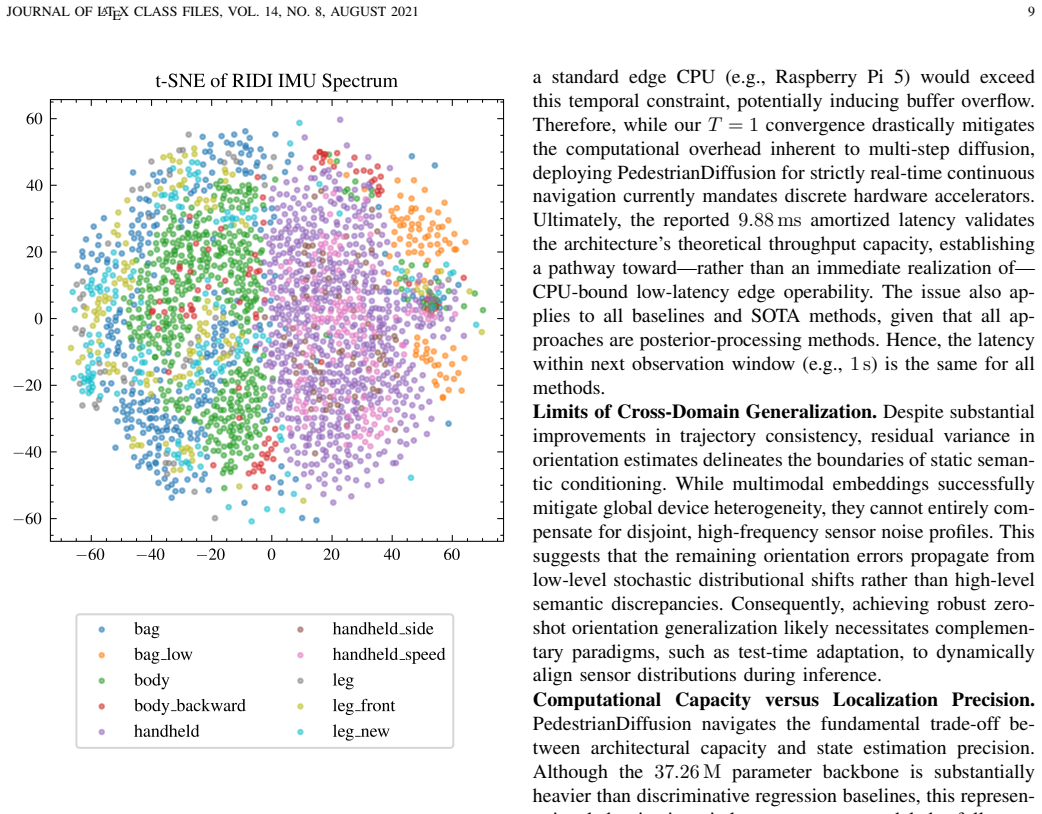
- Zero-shot adaptation to unseen sensor placements and noise profiles is possible through semantic proximity in language embedding space without weight updates.
- Next-generation Neural IMUs can be built around spectral generative backbones rather than pure regression or classical filters.
- Single-step diffusion is sufficient for the near-periodic structure of pedestrian gait, removing the usual multi-step cost of generative models.
Where Pith is reading between the lines
- The same spectral preconditioning may transfer to other anisotropic wearable sensors (magnetometers, barometers) whose raw covariances are equally ill-conditioned under isotropic noise assumptions.
- Because T=1 success appears to rest on gait periodicity, non-periodic regimes such as vehicles or drones would likely need adaptive windowing or multi-step schedules.
- Hardware co-design of STFT plus UNet accelerators could close the remaining gap from amortized batch throughput to strict causal hard real-time on CPUs.
- Treating free-text device metadata as categorical side information via vision-language embeddings suggests a general route for multi-modal foundation models in wearable sensing.
Editorial analysis
A structured set of objections, weighed in public.
Referee Report
Summary. The paper proposes PedestrianDiffusion, a spectral-domain conditional diffusion framework that reformulates dense 6D (velocity + angular velocity) inertial state estimation as generative denoising of STFT-transformed IMU signals. It uses a VAE + CLIP text embeddings of device/placement metadata for multimodal conditioning, a dual-domain (time + frequency) Huber + cosine loss with homoscedastic uncertainty weighting, and a single-step (T=1) deterministic DPM-Solver++ probability-flow ODE. The authors claim this bounds spectral covariance as a preconditioner, recovers high-frequency kinematics lost to MSE regression “jittering,” generalizes zero-shot across sensor profiles, and yields SOTA ATE/RTE with TLR near 1 and competitive MCS on OxIOD, RIDI, RoNIN and TLIO while remaining amortized-efficient (9.88 ms/frame) on edge CPUs for asynchronous batch refinement.
Significance. If the empirical gains and T=1 viability hold under broader scrutiny, the work is a meaningful step toward generative Neural IMUs: it shows diffusion can be made practical for dense trajectory refinement rather than remaining a multi-step offline tool, supplies useful ablations isolating spectral vs. time-domain and generative vs. regression objectives, and demonstrates CLIP-style semantic clustering as a lightweight zero-shot adapter for heterogeneous MEMS noise. Open-sourcing the code and reporting multi-dataset joint-training results plus amortized edge numbers strengthen reproducibility and practical relevance for consumer navigation and AR/VR. The dual-domain loss and HACF alignment are sensible engineering contributions even if the theoretical preconditioning story is incomplete.
major comments (3)
- [III-A/B, Appendix VIII-A, Eq. 16, Fig. 3] §III-A/B and Appendix VIII-A (Eq. 16): The central claim that STFT + global 5σ standardization acts as a mathematical preconditioner bounding κ(Σ_STFT) ≤ C (and thereby balancing SNR so that a single deterministic PF-ODE step saturates accuracy) is asserted without a derivation of C, without reported condition numbers or eigenvalue spectra of Σ_0 versus Σ_STFT, and without any measurement of the score Lipschitz constant. Fig. 3 shows only that ATE/RTE degrade for T > 1 (post-hoc labeled “diffusion hallucination”). Because the edge-viability argument (amortized 9.88 ms/frame, T=1) rests on this preconditioning story, either supply the missing analysis/empirics or reframe T=1 as an empirical operating point rather than a consequence of spectral geometry.
- [Abstract, I, IV] Abstract, §I and §IV: The claim of “unprecedented robustness to impulse perturbations and coupled 6D kinematic drift” is not supported by a dedicated experiment or ablation (e.g., injected impulses, bias steps, or lever-arm shocks). Tables I–III report standard ATE/RTE/TLR/MCS under clean public-dataset protocols; without a controlled perturbation study the robustness language overreaches the evidence and should be removed or backed by new results.
- [IV, Tables I-II] Tables I–II and surrounding text: SOTA comparisons mix fully reimplemented 3D baselines (IoNet, RoNIN variants, TLIO, LLIO) with numbers taken from original papers (CTIN, DiffusionIMU) or official weights (EqNIO) that may differ in evaluation protocol, alignment, or 2D/3D projection. The paper itself notes caution for some entries. To underwrite the SOTA claim, either re-run all competitors under a single unified protocol (including identical train/test splits and 6D-to-2D projection) or clearly quarantine reported-vs-reimplemented numbers and avoid declaring overall superiority.
minor comments (5)
- [Fig. 3] Fig. 3 caption and surrounding text highlight a green “optimal range” of 20–25 steps typical for image generation, yet the paper’s own operating point and best metrics are at T=1; the visual is therefore misleading and should be revised or removed.
- [Table I] Table I “PD single Domain” row shows artificially low ATE but TLR ≈ 0.65 and MCS < 0.15; the text correctly notes the failure of shape retention, yet the table still lists it under “Ours” without a clearer visual separation from the full model.
- [III-F] Notation for the dual-domain loss (Eqs. 5–11) introduces five component losses and learnable s_m,k without an explicit statement of which terms receive the 10κ scaling mentioned in the text; a short clarifying sentence would help.
- [Abstract, I] Several minor grammatical slips and repeated phrases appear (“estimation jittering”, “asynchronous batch trajectory refinement” twice in the abstract, “N-IMUs” introduced without expansion on first use in the abstract). A light language pass would improve readability.
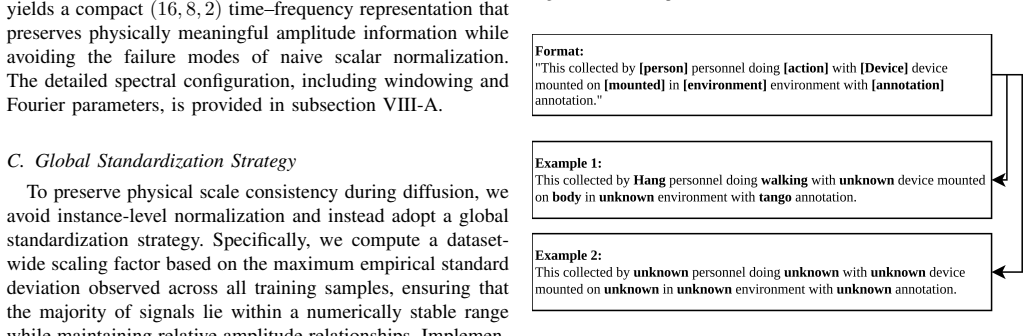
- [III-D, Fig. 2] The CLIP prompt templates (Fig. 2) and “unknown” averaging strategy are useful; stating the exact CLIP model version and whether text embeddings are frozen or fine-tuned would aid reproducibility.
Circularity Check
No load-bearing circularity: standard supervised generative pipeline evaluated on held-out public benchmarks; spectral preconditioning and T=1 are asserted/empirical, not reductions by construction.
full rationale
The paper trains a conditional spectral diffusion model (STFT + UNet + dual-domain Huber losses + CLIP text embeddings) on public IMU datasets (OxIOD/RIDI/RoNIN/TLIO) and reports ATE/RTE/TLR/MCS against external baselines on held-out users/sequences. Performance numbers are not forced by any fitted constant renamed as prediction. The dual-domain loss (Eqs. 5–11) and global 5σ standardization are design choices frozen before evaluation. The claim that STFT yields κ(Σ_STFT)≤C (Appendix Eq. 16) is an unquantified assertion used to motivate single-step DPM-Solver++ (T=1), but the operating point itself is selected from the empirical curves in Fig. 3 (where error rises for T>1, post-hoc labeled “diffusion hallucination”). No equation equates a claimed prediction to a training fit, no uniqueness theorem is imported from the authors’ prior work, and self-comparisons among PD ablations (Table I) are ordinary internal controls. The derivation chain therefore remains non-circular; any weakness is in the strength of the theoretical justification, not circular reduction.
Axiom & Free-Parameter Ledger
free parameters (6)
- STFT window / N_fft / hop =
30 / 30 / 14
- Global spectral standardization scale =
5×σ
- Diffusion training steps T and schedule offset s =
T=1000 train / T=1 infer
- Homoscedastic uncertainty log-variances s_m,k =
learned
- Time-reconstruction loss scale 10κ =
10κ
- UNet / VAE capacity and latent size =
37.26 M
axioms (6)
- ad hoc to paper Isotropic Gaussian forward process is ill-conditioned on raw unbounded IMU signals because Σ_0 is anisotropic and rank-deficient; STFT + per-modality global scaling restores a bounded condition number κ(Σ_STFT)≤C.
- domain assumption Pedestrian kinematics are sufficiently periodic that a 1 s STFT window isolates motion structure from stochastic MEMS noise.
- ad hoc to paper CLIP ViT-B/32 text embeddings of device/placement metadata form a useful categorical clustering of sensor noise profiles even though CLIP has no physical knowledge of MEMS.
- ad hoc to paper A single deterministic DPM-Solver++ step (Order 2, Zero-SNR) is sufficient once spectral preconditioning is applied; additional steps induce ‘diffusion hallucination’.
- domain assumption Heading-agnostic coordinate frame obtained by North-East rotation augmentation removes global orientation dependence without destroying kinematic content.
- standard math Standard DDPM / score-based reverse process and DPM-Solver++ ODE theory apply after the spectral transform.
invented entities (3)
-
PedestrianDiffusion (PD) spectral generative pipeline
no independent evidence
-
Dual-domain consistent loss with uncertainty weighting
no independent evidence
-
Spectral covariance preconditioner for unbounded IMU diffusion
no independent evidence
Cite this review
Pith. "Pith review of PedestrianDiffusion: Multimodal Generative Denoising and Dense State Estimation for Inertial Navigation." pith.science (2026). https://pith.science/paper/XRA7JLIT
@misc{pith2026260703349,
  author       = {Pith},
  title        = {Pith review of: PedestrianDiffusion: Multimodal Generative Denoising and Dense State Estimation for Inertial Navigation},
  year         = {2026},
  howpublished = {\url{https://pith.science/paper/XRA7JLIT}},
  note         = {Machine review of arXiv:2607.03349}
}
read the original abstract
The accuracy of consumer-grade inertial navigation is bottlenecked by the stochastic noise of Micro-Electro-Mechanical Systems (MEMS). Traditional deterministic neural architectures often succumb to ``estimation jittering,'' sacrificing high-frequency kinematic fidelity for numerical stability. We propose PedestrianDiffusion, a multimodal spectral-domain generative framework reformulating dense 6D state estimation as a continuous conditional denoising process. By operating in the frequency domain, our formulation bounds the spectral covariance, acting as a mathematical preconditioner to stabilize the reverse diffusion trajectory. Furthermore, we introduce a zero-shot semantic conditioning mechanism leveraging vision-language embeddings as categorical priors to generalize across heterogeneous sensor noise profiles. To address the computational intractability of generative tracking, we deploy a single-step deterministic probability flow ODE solver ($T=1$). This yields high-capacity asynchronous batch trajectory refinement, establishing the viability of generative architectures for asynchronous batch trajectory refinement on edge hardware. Extensive evaluations on the OxIOD, RIDI, RoNIN, and TLIO benchmarks demonstrate that PedestrianDiffusion achieves state-of-the-art performance, exhibiting unprecedented robustness to impulse perturbations and coupled 6D kinematic drift. This work provides a rigorous algorithmic blueprint for next-generation Neural Inertial Measurement Units (N-IMUs).
Figures


Reference graph
Works this paper leans on
-
[1]
Performance evaluation of different grade imus for diagnosis applications in land vehicular multi-sensor architectures,
J. Otegui, A. Bahillo, I. Lopetegi, and L. E. D ´ıez, “Performance evaluation of different grade imus for diagnosis applications in land vehicular multi-sensor architectures,”IEEE Sensors Journal, vol. 21, no. 3, pp. 2658–2668, 2021
2021
-
[2]
Stance-phase detection for zupt-aided foot-mounted pedestrian navigation system,
Z. Wang, H. Zhao, S. Qiu, and Q. Gao, “Stance-phase detection for zupt-aided foot-mounted pedestrian navigation system,”IEEE/ASME Transactions on Mechatronics, vol. 20, no. 6, pp. 3170–3181, 2015
2015
-
[3]
Reevaluation of algorithmic basics for zupt-based pedestrian navigation,
J. F. Wagner, M. Kohl, and B. Gy ¨orfi, “Reevaluation of algorithmic basics for zupt-based pedestrian navigation,”IEEE Access, vol. 10, pp. 118 419–118 437, 2022
2022
-
[4]
Ronin: Robust neural inertial navigation in the wild: Benchmark, evaluations, & new methods,
S. Herath, H. Yan, and Y . Furukawa, “Ronin: Robust neural inertial navigation in the wild: Benchmark, evaluations, & new methods,” in2020 IEEE International Conference on Robotics and Automation (ICRA), 2020, pp. 3146–3152
2020
-
[5]
Tlio: Tight learned inertial odometry,
W. Liu, D. Caruso, E. Ilg, J. Dong, A. I. Mourikis, K. Daniilidis, V . Kumar, and J. Engel, “Tlio: Tight learned inertial odometry,”IEEE Robotics and Automation Letters, vol. 5, no. 4, pp. 5653–5660, 2020
2020
-
[6]
Ionet: Learning to cure the curse of drift in inertial odometry,
C. Chen, X. Lu, A. Markham, and N. Trigoni, “Ionet: Learning to cure the curse of drift in inertial odometry,”Proceedings of the AAAI Conference on Artificial Intelligence, vol. 32, no. 1, Apr. 2018. [Online]. Available: https://ojs.aaai.org/index.php/AAAI/article/view/12102
2018
-
[7]
Ridi: Robust imu double integration,
H. Yan, Q. Shan, and Y . Furukawa, “Ridi: Robust imu double integration,” 2017. [Online]. Available: https://arxiv.org/abs/1712.09004
Pith/arXiv arXiv 2017
-
[8]
Personal inertial navigation system (pins),
L. Sher, “Personal inertial navigation system (pins),”DARPA, Arlington, TX, USA, Tech. Rep, 1996
1996
-
[9]
Pedestrian tracking with shoe-mounted inertial sensors,
E. Foxlin, “Pedestrian tracking with shoe-mounted inertial sensors,” IEEE Computer Graphics and Applications, vol. 25, no. 6, pp. 38–46, 2005
2005
-
[10]
Evaluation of zero-velocity detec- tors for foot-mounted inertial navigation systems,
I. Skog, J.-O. Nilsson, and P. H ¨andel, “Evaluation of zero-velocity detec- tors for foot-mounted inertial navigation systems,” in2010 International Conference on Indoor Positioning and Indoor Navigation, 2010, pp. 1–6
2010
-
[11]
Ctin: Robust contextual transformer network for inertial navigation,
B. Rao, E. Kazemi, Y . Ding, D. M. Shila, F. M. Tucker, and L. Wang, “Ctin: Robust contextual transformer network for inertial navigation,” in Proceedings of the AAAI Conference on Artificial Intelligence, vol. 36, no. 5, 2022, pp. 5413–5421
2022
-
[12]
Llio: Lightweight learned inertial odometer,
Y . Wang, J. Kuang, X. Niu, and J. Liu, “Llio: Lightweight learned inertial odometer,”IEEE Internet of Things Journal, vol. 10, no. 3, pp. 2508– 2518, 2022
2022
-
[13]
Eqnio: Subequivariant neural inertial odometry,
R. K. Jayanth, Y . Xu, Z. Wang, E. Chatzipantazis, K. Daniilidis, and D. Gehrig, “Eqnio: Subequivariant neural inertial odometry,” in International Conference on Learning Representations, vol. 2025, 2025, pp. 40 857–40 893
2025
-
[14]
Trajectory diffusion for objectgoal navigation,
X. Yu, S. Zhang, X. Song, X. Qin, and S. Jiang, “Trajectory diffusion for objectgoal navigation,”Advances in Neural Information Processing Systems, vol. 37, pp. 110 388–110 411, 2024
2024
-
[15]
Diffusionimu: Diffusion-based inertial navigation with iterative motion refinement,
X. Teng, C. Li, S. Xu, Z. Hao, D. Guo, J. Li, H. Li, W. Meng, and X. Zhang, “Diffusionimu: Diffusion-based inertial navigation with iterative motion refinement,” inProceedings of the Thirty-Fourth Inter- national Joint Conference on Artificial Intelligence, 2025, pp. 8787– 8795
2025
-
[16]
Denoising diffusion probabilistic models,
J. Ho, A. Jain, and P. Abbeel, “Denoising diffusion probabilistic models,” inAdvances in Neural Information Processing Systems, vol. 33, 2020, pp. 6840–6851. [Online]. Available: https://proceedings.neurips. cc/paper/2020/file/4c5bcfec8584af0d967f1ab10179ca4b-Paper.pdf
2020
-
[17]
Diffusion models beat gans on image synthesis,
P. Dhariwal and A. Nichol, “Diffusion models beat gans on image synthesis,” inProceedings of the 35th International Conference on Neural Information Processing Systems, ser. NIPS ’21. Red Hook, NY , USA: Curran Associates Inc., 2021
2021
-
[18]
Hierarchical text-conditional image generation with clip latents,
A. Ramesh, P. Dhariwal, A. Nichol, C. Chu, and M. Chen, “Hierarchical text-conditional image generation with clip latents,”arXiv preprint arXiv:2204.06125, vol. 1, no. 2, p. 3, 2022
Pith/arXiv arXiv 2022
-
[19]
Deep unsupervised learning using nonequilibrium thermodynamics,
J. Sohl-Dickstein, E. Weiss, N. Maheswaranathan, and S. Ganguli, “Deep unsupervised learning using nonequilibrium thermodynamics,” in International conference on machine learning. pmlr, 2015, pp. 2256– 2265
2015
-
[20]
Score-based generative modeling through stochastic differential equations,
Y . Song, J. Sohl-Dickstein, D. P. Kingma, A. Kumar, S. Ermon, and B. Poole, “Score-based generative modeling through stochastic differential equations,” 2021. [Online]. Available: https://arxiv.org/abs/ 2011.13456
Pith/arXiv arXiv 2021
-
[21]
Repaint: Inpainting using denoising diffusion probabilistic models,
A. Lugmayr, M. Danelljan, A. Romero, F. Yu, R. Timofte, and L. Van Gool, “Repaint: Inpainting using denoising diffusion probabilistic models,” inProceedings of the IEEE/CVF conference on computer vision and pattern recognition, 2022, pp. 11 461–11 471
2022
-
[22]
Joint pedestrian trajectory prediction through posterior sampling,
H. Lin, Y . Wang, M. Huo, C. Peng, Z. Liu, and M. Tomizuka, “Joint pedestrian trajectory prediction through posterior sampling,” in2024 IEEE/RSJ International Conference on Intelligent Robots and Systems (IROS). IEEE, 2024, pp. 5672–5679
2024
-
[23]
Leapfrog diffu- sion model for stochastic trajectory prediction,
W. Mao, C. Xu, Q. Zhu, S. Chen, and Y . Wang, “Leapfrog diffu- sion model for stochastic trajectory prediction,” inProceedings of the IEEE/CVF conference on computer vision and pattern recognition, 2023, pp. 5517–5526
2023
-
[24]
Auto-encoding variational bayes,
D. P. Kingma and M. Welling, “Auto-encoding variational bayes,” in International Conference on Learning Representations (ICLR), 2014
2014
-
[25]
Oxiod: The dataset for deep inertial odometry,
C. Chen, P. Zhao, C. X. Lu, W. Wang, A. Markham, and N. Trigoni, “Oxiod: The dataset for deep inertial odometry,” 2018. [Online]. Available: https://arxiv.org/abs/1809.07491
Pith/arXiv arXiv 2018
-
[26]
Learning transferable visual models from natural language supervision,
A. Radford, J. W. Kim, C. Hallacy, A. Ramesh, G. Goh, S. Agarwal, G. Sastry, A. Askell, P. Mishkin, J. Clarket al., “Learning transferable visual models from natural language supervision,” inInternational Conference on Machine Learning. PMLR, 2021, pp. 8748–8763
2021
-
[27]
Scalable diffusion models with transformers,
W. Peebles and S. Xie, “Scalable diffusion models with transformers,” arXiv preprint arXiv:2212.09748, 2022
Pith/arXiv arXiv 2022
-
[28]
Diffusion model for generative image denoising,
Y . Xie, M. Yuan, B. Dong, and Q. Li, “Diffusion model for generative image denoising,” 2023. [Online]. Available: https://arxiv.org/abs/2302. 02398
2023
-
[29]
Dpm-solver++: Fast solver for guided sampling of diffusion probabilistic models,
C. Lu, Y . Zhou, F. Bao, J. Chen, C. Li, and J. Zhu, “Dpm-solver++: Fast solver for guided sampling of diffusion probabilistic models,”Machine Intelligence Research, pp. 1–22, 2025
2025
-
[30]
Improved denoising diffusion probabilis- tic models,
A. Q. Nichol and P. Dhariwal, “Improved denoising diffusion probabilis- tic models,” inInternational conference on machine learning. PMLR, 2021, pp. 8162–8171
2021
-
[31]
Dpm-solver: A fast ode solver for diffusion probabilistic model sampling in around 10 steps,
C. Lu, Y . Zhou, F. Bao, J. Chen, C. Li, and J. Zhu, “Dpm-solver: A fast ode solver for diffusion probabilistic model sampling in around 10 steps,” inAdvances in Neural Information Processing Systems, vol. 35, 2022, pp. 5775–5787. [Online]. Available: https://proceedings.neurips.cc/paper files/paper/ 2022/file/27988358485203369a4d32095f9c9b13-Paper-Conference.pdf
arXiv 2022
-
[32]
Multi-task learning using uncer- tainty to weigh losses for scene geometry and semantics,
A. Kendall, Y . Gal, and R. Cipolla, “Multi-task learning using uncer- tainty to weigh losses for scene geometry and semantics,” inProceedings of the IEEE conference on computer vision and pattern recognition, 2018, pp. 7482–7491
2018
-
[33]
Consistency models,
Y . Song, P. Dhariwal, M. Chen, and I. Sutskever, “Consistency models,” inInternational Conference on Machine Learning. PMLR, 2023, pp. 32 211–32 252. JOURNAL OF LATEX CLASS FILES, VOL. 14, NO. 8, AUGUST 2021 11
2023
-
[34]
One-step diffusion with distribution matching distillation,
T. Yin, M. Gharbi, R. Zhang, E. Shechtman, F. Durand, W. T. Freeman, and T. Park, “One-step diffusion with distribution matching distillation,” inProceedings of the IEEE/CVF conference on computer vision and pattern recognition, 2024, pp. 6613–6623
2024
-
[35]
A benchmark for the evaluation of rgb-d slam systems,
J. Sturm, N. Engelhard, F. Endres, W. Burgard, and D. Cremers, “A benchmark for the evaluation of rgb-d slam systems,” in2012 IEEE/RSJ International Conference on Intelligent Robots and Systems, 2012, pp. 573–580. JOURNAL OF LATEX CLASS FILES, VOL. 14, NO. 8, AUGUST 2021 12 TABLE VI DETAILED STATISTICS FOR THEOXIOD, RIDI, RONIN,ANDTLIODATASETS.SEQ: NUMBER...
2012
discussion (0)
Sign in with ORCID, Apple, or X to comment. Anyone can read and Pith papers without signing in.