REVIEW 4 major objections 6 minor 29 references
Individually permitted AI tools can violate policy when chained; a monotonic policy compositor plus runtime taint tracking can block those chains before and during execution.
Reviewed by Pith at T0; open to challenge. T0 means a machine referee read the full paper against a public rubric. the ladder, T0–T4 →
T0 review · grok-4.5
2026-07-12 02:34 UTC pith:E6PQQPQT
load-bearing objection Clean, usable composition design for a real multi-tool risk, but the headline block rates are mostly catalog geometry and Phase 2 is only three walkthroughs. the 4 major comments →
Securing Multi-Tool AI Agent Chains With Dynamic, Real-Time Compositional Policies
The pith
A machine-rendered reading of the paper's core claim, the machinery that carries it, and where it could break.
Core claim
The paper claims that compositional security for multi-tool agent chains is achievable by treating the agent as an untrusted stochastic caller and composing per-tool policies with a Most Restrictive Set operator that has a formal monotonicity invariant—extending a chain can only tighten controls—then enforcing the same high-water-mark taint state at runtime so unsafe paths are refused at checkout or revoked when actual data exposure would breach policy.
What carries the argument
The Most Restrictive Set (MRS) algorithm: it takes each tool’s six-tuple policy (control bindings, classification, prohibition flag, flow direction, zones, TTL), resolves controls by the maximum restriction level, takes classification and prohibition high-water marks, intersects network zones, and rejects chains that fail compatibility, clearance (default mode), or DENY-level boundary checks. The same max operators feed a session-level taint state in Phase 2.
Load-bearing premise
Every tool must carry an accurate standardized security policy, and every resource the agent touches must have a correct sensitivity label at access time; if those labels are missing or wrong, both static composition and runtime taint checks fail by construction.
What would settle it
Apply the same MRS enumeration and runtime guards to a production agent tool catalog with real classification labels and measured workflows; if multi-tool chains that move Confidential or Restricted data to outbound tools still execute without Phase 1 rejection or Phase 2 revocation, the defense-in-depth claim fails.
If this is right
- Organizations can refuse cross-classification tool combinations at session checkout instead of discovering violations after the fact.
- A single effective control set per session gives auditors one policy artifact rather than an unenforced pile of per-tool rules.
- Clearance mode partitions tools into classification-level clusters; taint mode allows mixed levels while still containing exfiltration above Public.
- Policy work becomes a continuous federated task: a central team owns the vocabulary, tool developers author bindings, and denials point to the blocking binding.
- Fail-closed composition can sit as a control-level backstop for frontier agent risk, either always on or switched stricter when capability thresholds are crossed.
Where Pith is reading between the lines
- Production agents with thousands of tools will force either finer policies or workflow decomposition into smaller sub-chains, or else block rates will dominate day-to-day use.
- The same n-way zone-intersection failures that pairwise checks miss will matter more as multi-agent teams and cross-server tool protocols become common.
- Incomplete resource classification catalogs create Phase 2 false negatives even when Phase 1 policies are perfect, so labeling accuracy becomes a first-order operational risk.
- The reported block rates are catalog-dependent; a different distribution of tools across classification levels would change the utility cost without changing the structural guarantee.
Editorial analysis
A structured set of objections, weighed in public.
Referee Report
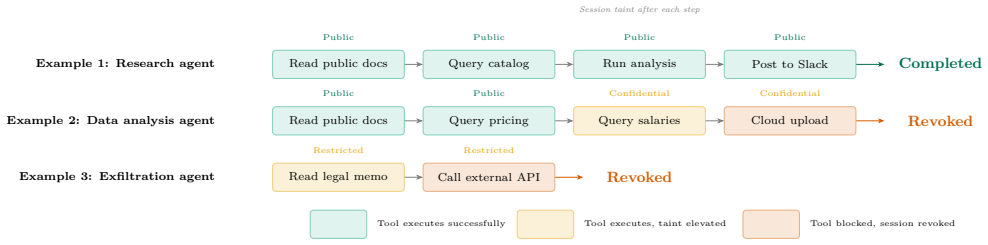
Summary. The paper proposes DSCC, a two-phase architecture for compositional security of multi-tool LLM agent chains. Phase 1 applies a Most Restrictive Set (MRS) algorithm at session checkout that merges per-tool six-tuple policies (NIST control bindings, classification, prohibition, flow direction, zones, TTL) into a single effective control set via max/min/intersection operators, with a formal monotonicity invariant that chain extension can only tighten constraints. Two modes are defined: clearance (default), which rejects cross-classification chains, and taint, which admits mixed-classification chains while preserving an exfiltration boundary. Phase 2 maintains a monotonic session taint state over resource classifications at runtime and revokes the session before outbound calls that would violate accumulated constraints. A .NET 9 reference implementation over 32 tools and 16 NIST SP 800-53-aligned policies reports block rates of 79.2%/95.5% (pairs/triples) in clearance mode and 42.5%/60.5% in taint mode, plus three illustrative Phase 2 walkthroughs. Governance implications for policy lifecycle and frontier-risk mitigation are discussed.
Significance. The compositional authorization gap for multi-tool agents is real and timely: the paper correctly situates the problem against STAC, ChainFuzzer, and MCP threat work, and the MRS design is a coherent systems response. Strengths include a clean policy model (Definition 1), an explicit four-step composition procedure with attributed rejections, a well-stated monotonicity invariant (Invariant 1) that follows from the operators, dual composition modes that make the utility-security tradeoff operational, and a fully specified reference catalog (Appendix Tables 6–8) that makes Phase 1 enumeration reproducible. If the architecture can be shown to block realistic multi-tool violations under production-like policy distributions and resource catalogs, it would be a useful control-layer complement to capability evaluations. The contribution is primarily architectural and definitional rather than empirical; its significance therefore hinges on whether the evaluation is reframed and strengthened to match the defense-in-depth claim.
major comments (4)
- §4.3, Table 5, Figure 2: The headline block rates (79.2%/95.5% clearance; 42.5%/60.5% taint) are presented as evaluation of DSCC’s security effectiveness, but as the paper itself states, they are “a function of how policies are distributed across levels in this catalog, not an intrinsic property of the algorithm.” Under clearance, 95.8% of blocked pairs fail solely on the high-water-mark clearance check. The numbers therefore characterize the authors’ hand-built 16-policy distribution, not the operators. Either reframe Table 5 as a catalog characterization (not a security efficacy result), or evaluate under multiple realistic policy distributions (e.g., production coding-agent tool mixes, MCP server catalogs) and report sensitivity of block rates to classification-level occupancy.
- §4.4, Figure 3: Phase 2 is load-bearing for the “defense in depth” claim in the abstract and §1, yet it is supported only by three hand-chosen walkthroughs. There is no enumeration, no attack-corpus evaluation, and no measurement of false-positive/false-negative revocation under realistic resource-label noise. Given that the introduction cites STAC (>90% ASR via multi-turn tool chains) and ChainFuzzer (82.7% of vulnerabilities multi-tool), Phase 2 should be evaluated against at least one of these corpora or an equivalent multi-tool attack suite, with reported detection and over-revocation rates. Without that, the runtime half of the architecture remains unvalidated.
- §2.1 Definition 1 and §3 (resource classification): Both phases assume that every tool carries a correct six-tuple policy and every accessed resource has an accurate classification/prohibition label at access time. This is the load-bearing operational assumption, but the manuscript never stress-tests mislabeled tools, incomplete catalogs, or adversarial policy under-declaration. A short sensitivity analysis (e.g., fraction of chains that become incorrectly permitted under random under-classification of k tools, or under missing prohibition flags) would bound how much the security guarantees degrade when the axiom fails—which is the realistic deployment case.
- §2.2–2.3: Monotonicity (Invariant 1) is stated and follows by construction from max/min/intersection, but there is no formal security theorem connecting MRS + taint to a non-interference or information-flow property (e.g., “no session that reaches an outbound tool can have touched data with ϕ=1 or C≥Confidential”). The Bell–LaPadula analogy is mentioned but not carried through. A short theorem (even informal) stating what is and is not guaranteed—especially the difference between clearance and taint modes—would make the central claim precise and falsifiable rather than architectural description alone.
minor comments (6)
- Abstract and §1: “Outputs of any tool call propagate their classification constraints into a session-level taint state” is described as part of Phase 1 in the abstract, but §3 places taint updates in Phase 2. Align the phase boundary wording.
- Table 5 note: Tool-level pairs are directed (32×31) while operators are commutative; reporting undirected tool pairs would avoid double-counting and match the policy-level presentation.
- §2.2 Step 3: The classification boundary rule (reject if Ceff≥Confidential and chain contains outbound tools) is stated in prose and in Table 3, but is not numbered as an equation alongside (2)–(4); numbering it would aid citation.
- Figure 1: The right-hand “enforcement checks (§3)” box is underspecified relative to the three guards listed in §3; labeling the three guards on the figure would improve readability.
- §5.3: Frontier-governance citations [19–22] are useful, but the claim that DSCC is “orthogonal” to capability evaluations would benefit from one concrete example of a capability that MRS cannot bound (e.g., within-cluster lateral movement among Confidential tools).
- Typos: “defaultclearancemode” / “taintmode” spacing in abstract; “session session” in §1; “ccessed” in [21]; “Int.+Out” legend in Figure 2 is unexplained in the caption.
Circularity Check
No significant circularity: MRS operators, monotonicity, and catalog block rates are explicit systems design and enumeration, not fitted or self-referential predictions.
full rationale
DSCC’s load-bearing chain is definitional and algorithmic, not an empirical derivation that collapses into its inputs. Definition 1 fixes a six-tuple policy model; §2.2 defines composition via max on restriction/classification/prohibition, intersection on zones, and min on TTL; Invariant 1 then states the immediate consequence that chain extension can only tighten those quantities. That is a formal property of the chosen operators (analogous to lattice join/meet), not a claim that something independent was predicted from data. Phase 2 reuses the same max operators on resource labels (Eq. 5) and three outbound/taint guards—again by design, not by fit. The reported 79.2%/95.5% (clearance) and 42.5%/60.5% (taint) figures are exhaustive enumeration over a hand-authored 16-policy/32-tool catalog (§4.2–4.3, Table 5); the paper itself notes they depend on classification distribution, not on free parameters tuned to a target rate. There are no self-citations of prior author uniqueness theorems, no ansatz smuggled from overlapping work, and no renaming of an external empirical law as a new prediction. Residual concerns (synthetic catalog, three hand-picked Phase-2 scenarios) are evaluation/generalization limits, not circular reductions of a claimed first-principles result. Score 0 is therefore the correct finding.
Axiom & Free-Parameter Ledger
free parameters (4)
- composition_mode (Clearance vs Taint)
- policy_catalog_distribution (16 policies across 4 classification levels)
- default_session_TTL (48h) and per-policy TTLs
- classification_boundary_threshold (Confidential+)
axioms (6)
- domain assumption Restriction and classification levels form total orders so max is well-defined (Allow<Restrict<Deny; Public<Internal<Confidential<Restricted).
- domain assumption Composition operators max, min, Boolean OR, and set intersection are the correct semantics for merging multi-tool security constraints.
- domain assumption NIST SP 800-53 control identifiers (AC-3/4/6, SC-7/8/13/28, AU-2/6, SI-4, MP-5) are an adequate shared vocabulary for tool policies.
- domain assumption An agent is an untrusted stochastic caller whose tool sequence cannot be predicted at session checkout.
- standard math Monotonicity of max/min/intersection implies Invariant 1: extending a chain never relaxes the effective control set.
- ad hoc to paper Resource classification catalogs exist and can be resolved accurately at access time for every resource the agent touches.
invented entities (4)
-
Dynamic Security Control Compositor (DSCC)
no independent evidence
-
Most Restrictive Set (MRS) algorithm
no independent evidence
-
Session taint state S=(Cs, ϕs)
no independent evidence
-
Effective Control Set E
no independent evidence
read the original abstract
Modern AI agent implementations such as frontier coding agents chain multiple tools at runtime that create a security surface that per-tool guardrails are unable to address, as individually permitted tools can violate organizational policies when composed. We propose the Dynamic Security Control Compositor (DSCC), a two-phase approach to compositional security for multi-tool agent chains. In Phase 1, at session checkout, a Most Restrictive Set (MRS) algorithm composes per-tool security policies into a single effective policy with a formal monotonicity invariant that extending a chain can only tighten the result, blocking incompatible combinations before any tool executes. Outputs of any tool call propagate their classification constraints into a session-level taint state, so subsequent invocations must satisfy the most restrictive constraints seen so far. In Phase 2, at runtime, the system tracks the sensitivity of data the agent touches through a monotonic taint state and revokes the session if the accumulated exposure would make a subsequent tool call a policy violation. Together, these phases provide defense in depth, where static composition prevents unsafe chains from starting, and runtime taint tracking catches violations that emerge from the specific data used. We provide a reference implementation on 32 tools governed by 16 NIST SP 800-53 aligned policies and evaluate it under two composition modes. In the default clearance mode, permitted combinations are partitioned into classification-level clusters, blocking 79.2% of policy pairs and 95.5% of triples. The alternative taint mode admits mixed-classification chains within the exfiltration boundary, blocking 42.5% and 60.5% respectively. We discuss the governance implications for organizations deploying multi-tool agents, including the utility-security tradeoff and the changes needed to operationalize chain-aware policies.
Figures


Reference graph
Works this paper leans on
-
[1]
Toolformer: Language models can teach themselves to use tools
Timo Schick, Jane Dwivedi-Yu, Roberto Dessì, Roberta Raileanu, Maria Lomeli, Luke Zettlemoyer, Nicola Cancedda, and Thomas Scialom. Toolformer: Language models can teach themselves to use tools. arXiv preprint arXiv:2302.04761, 2023
Pith/arXiv arXiv 2023
-
[2]
Re- act: Synergizing reasoning and acting in language models
Shunyu Yao, Jeffrey Zhao, Dian Yu, Nan Du, Izhak Shafran, Karthik Narasimhan, and Yuan Cao. Re- act: Synergizing reasoning and acting in language models. InProceedings of the International Confer- ence on Learning Representations (ICLR), 2023
2023
-
[3]
Patil, Tianjun Zhang, Xin Wang, and Joseph E
Shishir G. Patil, Tianjun Zhang, Xin Wang, and Joseph E. Gonzalez. Gorilla: Large language model connected with massive apis.arXiv preprint arXiv:2305.15334, 2023
Pith/arXiv arXiv 2023
-
[4]
Yujia Qin, Shihao Liang, Yining Ye, Kunlun Zhu, Lan Yan, Yaxi Lu, Yankai Lin, Xin Cong, Xiangru Tang, Bill Qian, Sihan Zhao, Lauren Hong, Runchu Tian, Ruobing Xie, Jie Zhou, Mark Gerstein, Dahai Li, Zhiyuan Liu, and Maosong Sun. Toolllm: Fa- cilitating large language models to master 16000+ real-world apis.arXiv preprint arXiv:2307.16789, 2023
Pith/arXiv arXiv 2023
-
[5]
Github Copilot coding agent, 2025
GitHub. Github Copilot coding agent, 2025. URL https://github.com/features/copilot/agen ts. Agentic coding agent. Accessed 2026-04-09
2025
-
[6]
Claude code, 2025
Anthropic. Claude code, 2025. URLhttps://do cs.anthropic.com/en/docs/claude-code/over view. Agentic coding tool. Accessed 2025-03-24
2025
-
[7]
Codex CLI, 2025
OpenAI. Codex CLI, 2025. URLhttps://openai .com/codex/. Open-source coding agent. Accessed 2025-03-24
2025
-
[8]
STAC:Wheninnocenttools form dangerous chains to jailbreak LLM agents
Jing-Jing Li, Jianfeng He, Chao Shang, Devang Kul- shreshtha, Xun Xian, Yi Zhang, Hang Su, Sandesh Swamy, andYanjunQi. STAC:Wheninnocenttools form dangerous chains to jailbreak LLM agents. arXiv preprint arXiv:2509.25624, 2025
arXiv 2025
-
[9]
Jiangrong Wu, Zitong Yao, Yuhong Nan, and Zibin Zheng. ChainFuzzer: Greybox fuzzing for workflow- levelmulti-toolvulnerabilitiesinLLMagents.arXiv preprint arXiv:2603.12614, 2026
arXiv 2026
-
[10]
MSA: A cross-MCP privacy attack via memory exfiltration of large language models
Yiheng Sun, Linkang Du, Zhou Su, Yuntao Wang, Han Liu, Quan Zhao, and Xiaolin Niu. MSA: A cross-MCP privacy attack via memory exfiltration of large language models. InProceedings of the 24th Workshop on Privacy in the Electronic Society (WPES), 2025. Co-located with ACM CCS 2025. DOI: 10.1145/3733802.3764057
-
[11]
Qianlong Lan, Anuj Kaul, Shaun Jones, and Stephanie Westrum. Silent egress: When implicit prompt injection makes LLM agents leak without a trace.arXiv preprint arXiv:2602.22450, 2026
arXiv 2026
-
[12]
Ruiqi Li, Zhiqiang Wang, Yunhao Yao, and Xiang- Yang Li. MCP-ITP: An automated framework for implicit tool poisoning in MCP.arXiv preprint arXiv:2601.07395, 2026
arXiv 2026
-
[13]
Charoes Huang, Xin Huang, Ngoc Phu Tran, and Amin Milani Fard. Model context protocol threat modeling and analyzing vulnerabilities to prompt injection with tool poisoning.arXiv preprint arXiv:2603.22489, 2026
arXiv 2026
-
[14]
Dongsen Zhang, Zekun Li, Xu Luo, Xuannan Liu, Peipei Li, and Wenjun Xu. MCP security bench (MSB): Benchmarking attacks against model context protocol in LLM agents.arXiv preprint arXiv:2510.15994, 2025. Accepted at ICLR 2026
arXiv 2025
-
[15]
Function calling and other API updates,
OpenAI. Function calling and other API updates,
-
[16]
Blog post, 13 June 2023
URL https://openai.com/blog/functi on-calling-and-other-api-updates. Blog post, 13 June 2023. Accessed 2026-03-25
2023
-
[17]
LangChain, 2022
Harrison Chase. LangChain, 2022. URL https: //github.com/langchain-ai/langchain. Open- source LLM application framework. Accessed 2026- 03-25
2022
-
[18]
White, Doug Burger, and Chi Wang
Qingyun Wu, Gagan Bansal, Jieyu Zhang, Yi- ran Wu, Beibin Li, Erkang Zhu, Li Jiang, Xi- aoyun Zhang, Shaokun Zhang, Jiale Liu, Ahmed Awadallah, Ryen W. White, Doug Burger, and Chi Wang. Autogen: Enabling next-gen llm applica- tions via multi-agent conversation.arXiv preprint arXiv:2308.08155, 2023
Pith/arXiv arXiv 2023
-
[19]
LaPadula
David Elliott Bell and Leonard J. LaPadula. Se- cure computer systems: Mathematical foundations. Technical Report MTR-2547, Vol. I, MITRE Cor- poration, 1973. ESD-TR-73-278-I
1973
-
[20]
Microsoft frontier governance framework,
Microsoft. Microsoft frontier governance framework,
-
[21]
Accessed 2026-06-26
URL https://cdn-dynmedia-1.microsoft .com/is/content/microsoftcorp/microsoft/ final/en-us/microsoft-brand/documents/Mic rosoft-Frontier-Governance-Framework.pdf . Accessed 2026-06-26
2026
-
[22]
Frontier safety framework, ver- sion 3.0, 2025
Google DeepMind. Frontier safety framework, ver- sion 3.0, 2025. URL https://storage.google apis.com/deepmind-media/DeepMind.com/Blog /strengthening-our-frontier-safety-frame work/frontier-safety-framework_3.pdf . Ac- cessed 2026-06-26
2025
-
[23]
Responsible scaling policy, 2025
Anthropic. Responsible scaling policy, 2025. URL https://www.anthropic.com/responsible-sca ling-policy. ccessed 2026-06-26
2025
-
[24]
Preparedness framework, version 2, 2025
OpenAI. Preparedness framework, version 2, 2025. URL https://cdn.openai.com/pdf/18a02b5d-6 b67-4cec-ab64-68cdfbddebcd/preparedness-f ramework-v2.pdf. Accessed 2026-06-26
2025
-
[25]
Regulation (EU) 2024/1689 of the euro- pean parliament and of the council laying down harmonised rules on artificial intelligence (Arti- ficial Intelligence Act)
European Parliament and Council of the European Union. Regulation (EU) 2024/1689 of the euro- pean parliament and of the council laying down harmonised rules on artificial intelligence (Arti- ficial Intelligence Act). Official Journal of the 11 European Union, L series, 2024. URL https: //eur-lex.europa.eu/eli/reg/2024/1689/oj . (Arts. 51–55). Accessed 2026-06-26
2024
-
[26]
Managing misuse risk for dual-use foundation mod- els
National Institute of Standards and Technology. Managing misuse risk for dual-use foundation mod- els. Technical Report NIST AI 800-1 (Initial Public Draft), NIST, 2024. URL https://nvlpubs.ni st.gov/nistpubs/ai/NIST.AI.800-1.ipd.pdf . Accessed 2026-06-26
2024
-
[27]
International AI safety report 2026
Yoshua Bengio, Stephen Clare, Carina Prunkl, et al. International AI safety report 2026. Techni- cal Report DSIT 2026/001, Department for Sci- ence, Innovation and Technology, 2026. URL https://internationalaisafetyreport.org
2026
-
[29]
URL https://arxiv.org/abs/2305.15324
-
[30]
Lin, Hjalmar Wijk, Joel Burget, Aaron Ho, Elizabeth Barnes, and Paul Christiano
Megan Kinniment, Lucas Jun Koba Sato, Haox- ing Du, Brian Goodrich, Max Hasin, Lawrence Chan, Luke Harold Miles, Tao R. Lin, Hjalmar Wijk, Joel Burget, Aaron Ho, Elizabeth Barnes, and Paul Christiano. Evaluating language-model agentsonrealisticautonomoustasks.arXiv preprint arXiv:2312.11671, 2024. URLhttps://arxiv.or g/abs/2312.11671. 12 Appendix This app...
Pith/arXiv arXiv 2024
discussion (0)
Sign in with ORCID, Apple, or X to comment. Anyone can read and Pith papers without signing in.