REVIEW 3 major objections 6 minor 14 references
Continuous test-time training that downweights repeated n-grams keeps multi-turn LLM agents from drifting on long trajectories.
Reviewed by Pith at T0; open to challenge. T0 means a machine referee read the full paper against a public rubric. the ladder, T0–T4 →
T0 review · grok-4.5
2026-07-12 02:26 UTC pith:2J4J4NDI
load-bearing objection Solid empirical recipe for continuous within-episode TTT with n-gram token reweighting; modest ~5pp gains framed honestly as competence preservation, with the causal status of repetition as the main soft joint. the 3 major comments →
No Time Like the Present: Agentic Test-Time Training for LLM Agents
The pith
A machine-rendered reading of the paper's core claim, the machinery that carries it, and where it could break.
Core claim
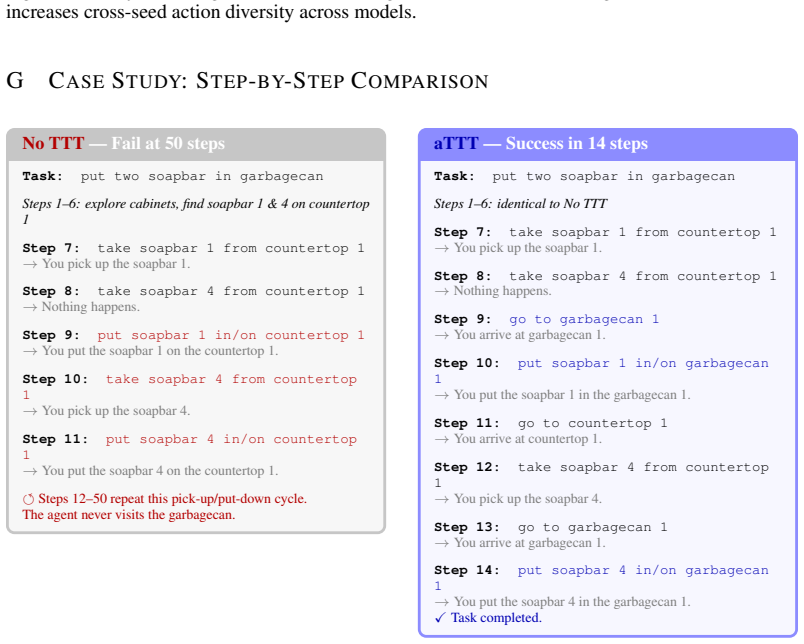
In multi-turn agent episodes, continuous test-time training is useful only when the repeated self-training loop is controlled. aTTT does this by token-level reweighting: the loss on tokens that appear in repeated n-grams from earlier updates is reduced while novel tokens remain fully weighted, so the adapter can retain fresh trajectory evidence without reinforcing stuck patterns. Gains concentrate where models already possess nontrivial task-solving potential but lose it over long rollouts, indicating that aTTT mainly preserves existing competence rather than teaching new abilities.
What carries the argument
Agentic Test-Time Training (aTTT): a token-level reweighting of the next-token prediction loss, where each token's weight is max(w_min, 1/(1+f)) and f is its maximum n-gram exposure in the history of prior update texts within the same episode.
Load-bearing premise
That update-text repetition is a reliable enough signal of the harmful self-training regime that downweighting repeated n-grams will stabilize the policy without any external reward or success signal.
What would settle it
If, on long-horizon agent tasks where models already have nontrivial solve rates, continuous TTT with aTTT's n-gram reweighting fails to beat unfiltered online TTT and sequence-level filters by a clear margin, or if the same gains appear only for models that start too weak or already stable on short trajectories, the central claim would not hold.
Editorial analysis
A structured set of objections, weighed in public.
Referee Report
Summary. The paper studies continuous test-time training (TTT) inside multi-turn LLM agent episodes, where each weight update changes the policy that generates later training text, creating an endogenous self-training loop. It argues that update-text repetition distinguishes helpful from harmful regimes of this loop, and proposes Agentic Test-Time Training (aTTT): next-token training on Self/Env/Summary trajectory signals with token-level loss reweighting that downweights tokens appearing in repeated n-grams from prior updates (Eqs. 8–10, Alg. 1) while leaving novel tokens fully weighted. A concurrent vLLM runtime-LoRA serving system keeps wall-clock cost to about 1.9× no-TTT. Empirically, aTTT improves ALFWorld success by up to 5.0 points and SWE-bench Lite resolve rates by up to 4.9 points over no-TTT and static pre-rollout TTT, with gains concentrated where models already have nontrivial competence but drift on long trajectories; the authors interpret this as stabilizing existing competence rather than teaching new abilities.
Significance. If the results hold, the paper makes a useful contribution at the intersection of test-time adaptation and multi-turn agents: it formulates continuous in-episode TTT as a distinct setting from static single-input TTT, identifies a simple operational failure mode (repeated self-training), and gives a practical LoRA-based intervention with a concurrent serving design that is actually deployable. Strengths include multi-legged empirical support (static qTTT, unfiltered online TTT, sequence filter, random-drop, cadence, in-context Summary, decoding repetition penalty), policy-level diagnostics (KL drift, self-text repetition on rescued pairs), and an honest scope claim that aTTT mainly preserves competence rather than acquiring new skills. The concurrent system (16 episodes, ~1.9× cost) is a concrete engineering contribution that makes the method evaluable. The work is incremental relative to prior TTT and agent adaptation papers, but the endogenous-loop framing and token-level repetition control are a clear, falsifiable methods package for long-horizon agents.
major comments (3)
- [§3.2–3.3, Eqs. (6)–(10), Fig. 3] §3.2–3.3, Eqs. (6)–(10), Fig. 3: The load-bearing interpretive step is that update-text repetition is a sufficiently causal diagnostic of the harmful self-training loop, so that n-gram exposure reweighting stabilizes the policy. Fig. 3 shows that repetition rises earlier on failed episodes, but the paper correctly notes it does not assume repetition alone causes failure. Random-drop (Fig. 7) and sequence filter show that *which* updates are attenuated matters, yet they do not isolate whether the specific n-gram token reweighting rule is necessary versus simply continuing next-token training on residual high-novelty trajectory text of still-progressing episodes. A control that (i) reweights tokens by frequency without n-gram structure, or (ii) trains only on explicitly extracted novel spans, would substantially strengthen the mechanism claim behind Eqs. (8)–(10).
- [Table 1, §4.4–5] Table 1 and §4.4–5: Gains and best update source are strongly model-dependent (Env for Qwen3.5-4B, Self/Env for 9B, Summary for Gemma-3-12B), and the paper acknowledges source selection as an open problem. Because aTTT is defined as making a *chosen* stream safer rather than choosing the stream, the practical central claim—that continuous TTT with repetition control improves multi-turn agents—is incomplete without either an automatic source-selection rule or a clearer protocol for when Self vs Env vs Summary should be used. At minimum, the main results should report a single fixed source policy (or a simple selection heuristic) evaluated out-of-sample, not only the best signal per model from the main sweep.
- [Table 2, §4.3] Table 2 / §4.3: The SWE-bench Lite evaluation is thinner than ALFWorld: only the Summary signal, two model sizes, and no No-filter / sequence-filter / random-drop ablations on that benchmark. The 4.9-point gain on Qwen3.5-27B is important for the long-horizon claim in Fig. 4, but without the same filter controls it is hard to attribute the gain to repetition-aware reweighting rather than any online Summary TTT. Extending at least the No-filter vs sequence-filter vs aTTT comparison to SWE-bench Lite would make the cross-benchmark claim load-bearing rather than suggestive.
minor comments (6)
- [Abstract, Table 1] Abstract and §1 state gains of “up to 5.0” / “4.9” points; Table 1’s best ALFWorld cell for Qwen3.5-9B Self is +5.0 over ReAct, but several other cells are much smaller and some sequence-filter cells beat aTTT (e.g., Env on Qwen3.5-4B). A short caveat that peak gains are signal- and model-specific would avoid over-reading the headline numbers.
- [§4.1, Appendix C–D] §4.1 / Appendix C: Hyperparameters (n=3, w_min=0.05, K=5, LoRA rank 8, lr 5e-4, two gradient steps, Jaccard τ=0.5) are listed and partially ablated (Tables 4, 6, 7), but the main text should point more explicitly to which ablations are in the appendix so readers can assess free-parameter sensitivity without hunting.
- [Figure 1] Figure 1 and Figure 2 are helpful, but the “Repetition filter / token-weighted” path in Fig. 1 could more clearly distinguish sequence-level dropping from token reweighting, since that distinction is central to §3.3 and Table 1.
- [§4.5, Appendix E] §4.5 in-context baseline: the main text reports no-TTT as 50.7% while Appendix E says 51.4%; reconcile the baseline number.
- [§2] Related work is generally appropriate; a brief explicit contrast with continual TTA methods that already use reliability/sample filtering (EATA, CoTTA, SAR, cited in §2) on *what is new* about endogenous agent-generated text would sharpen novelty without lengthening much.
- [§1 and throughout] Minor polish: “therepeated self-training loop” (missing space) in §1; consistent hyphenation of “test-time” / “n-gram”; ensure all appendix cross-references (A–G) match the final layout.
Circularity Check
Empirical methods paper with designed intervention and external-benchmark evaluation; no derivation reduces to its inputs by construction.
full rationale
aTTT is a designed token-level loss reweighting rule (Eqs. 8–10, Alg. 1) motivated by an observational diagnostic (update-text Jaccard repetition, Fig. 3), not a first-principles derivation that claims to predict success from fitted parameters. Success/resolve rates on ALFWorld and SWE-bench Lite are external task metrics, not quantities recovered from the reweighting formula by construction. Hyperparameters (n, w_min, K, LoRA rank) are chosen and ablated (Tables 4, 6–7; Fig. 7), not smuggled in as predictions. Related-work citations (qTTT, Reflexion, CoTTA, etc.) supply context; none is a load-bearing uniqueness theorem or self-citation that forces the central claim. Concerns about whether repetition is causal versus co-symptomatic of being stuck are mechanism/correctness issues, not circularity of the derivation chain. Score 0 with empty steps is the appropriate honest finding.
Axiom & Free-Parameter Ledger
free parameters (6)
- n-gram size n =
3 (default)
- token weight floor w_min =
0.05
- update cadence K =
5 (default)
- LoRA rank and alpha =
rank 8, α=16
- TTT learning rate and gradient steps =
5e-4, 2 steps
- sequence-filter Jaccard threshold τ =
0.5
axioms (4)
- domain assumption Next-token prediction on Self, Env, or Summary trajectory text is a useful unsupervised test-time objective for improving multi-turn agent policies.
- ad hoc to paper Update-text repetition (word Jaccard / n-gram exposure) distinguishes helpful vs harmful regimes of the endogenous self-training loop well enough to guide intervention.
- domain assumption Episode-private LoRA adapters updated online and hot-swapped into a frozen base model faithfully implement continuous policy adaptation without blocking concurrent episodes.
- domain assumption Standard evaluation protocols for ALFWorld (50-step ReAct) and SWE-bench Lite (mini-swe-agent, 150-call budget) are valid measures of agent success for the claim.
invented entities (2)
-
aTTT repetition-aware token reweighting objective
no independent evidence
-
Update-text repetition ρ and novelty ν
no independent evidence
Cite this review
Pith. "Pith review of No Time Like the Present: Agentic Test-Time Training for LLM Agents." pith.science (2026). https://pith.science/paper/2J4J4NDI
@misc{pith2026260703441,
  author       = {Pith},
  title        = {Pith review of: No Time Like the Present: Agentic Test-Time Training for LLM Agents},
  year         = {2026},
  howpublished = {\url{https://pith.science/paper/2J4J4NDI}},
  note         = {Machine review of arXiv:2607.03441}
}
read the original abstract
LLM agents often degrade over long episodes: as trajectories grow, they revisit explored states, repeat failed actions, and lose strategies that previously worked. Test-time training (TTT) offers a way to adapt model weights to the evolving task state, but existing LLM TTT methods largely adapt once to a fixed input. We study continuous TTT in multi-turn agent episodes, where each update changes the policy that generates later training text. This creates a self-training loop that helps when new trajectory information appears, but can amplify drift when the agent gets stuck and repeatedly trains on similar text. We find that update-text repetition distinguishes these regimes and introduce Agentic Test-Time Training (aTTT), a token-level reweighting method that downweights the loss on tokens appearing in repeated $n$-grams from prior updates while leaving novel tokens fully weighted. To run such updates inside live episodes, we build a concurrent serving system using vLLM's runtime LoRA API, limiting overhead to 1.9$\times$ the no-TTT cost. aTTT improves success by up to 5.0 points on ALFWorld and 4.9 points on SWE-bench Lite. The gains concentrate where models already have task competence but drift over long trajectories, suggesting that aTTT mainly preserves existing competence rather than teaching new abilities.
Figures


Reference graph
Works this paper leans on
-
[1]
Self-improving llm agents at test-time.arXiv preprint arXiv:2510.07841,
Emre Can Acikgoz, Cheng Qian, Heng Ji, Dilek Hakkani-T¨ur, and Gokhan Tur. Self-improving llm agents at test-time.arXiv preprint arXiv:2510.07841,
-
[2]
Ekin Aky¨urek, Mehul Damani, Adam Zweiger, Linlu Qiu, Han Guo, Jyothish Pari, Yoon Kim, and Jacob Andreas. The surprising effectiveness of test-time training for few-shot learning.arXiv preprint arXiv:2411.07279,
-
[3]
Rachit Bansal, Aston Zhang, Rishabh Tiwari, Lovish Madaan, Sai Surya Duvvuri, Devvrit Kha- tri, David Brandfonbrener, David Alvarez-Melis, Prajjwal Bhargava, Mihir Sanjay Kale, et al. Let’s (not) just put things in context: Test-time training for long-context llms.arXiv preprint arXiv:2512.13898,
-
[4]
10 Preprint Ganqu Cui, Yuchen Zhang, Jiacheng Chen, Lifan Yuan, Zhi Wang, Yuxin Zuo, Haozhan Li, Yuchen Fan, Huayu Chen, Weize Chen, et al. The entropy mechanism of reinforcement learning for reasoning language models.arXiv preprint arXiv:2505.22617,
-
[5]
In-place test-time training.arXiv preprint arXiv:2604.06169,
Guhao Feng, Shengjie Luo, Kai Hua, Ge Zhang, Di He, Wenhao Huang, and Tianle Cai. In-place test-time training.arXiv preprint arXiv:2604.06169,
-
[6]
Test-time training on nearest neighbors for large language models
Moritz Hardt and Yu Sun. Test-time training on nearest neighbors for large language models. In International Conference on Learning Representations, volume 2024, pp. 54625–54640,
2024
-
[7]
Swe-bench: Can language models resolve real-world github issues? InInternational Conference on Learning Representations, volume 2024, pp
Carlos E Jimenez, John Yang, Alexander Wettig, Shunyu Yao, Kexin Pei, Ofir Press, and Karthik Narasimhan. Swe-bench: Can language models resolve real-world github issues? InInternational Conference on Learning Representations, volume 2024, pp. 54107–54157,
2024
-
[8]
Towards stable test-time adaptation in dynamic wild world.arXiv preprint arXiv:2302.12400,
Shuaicheng Niu, Jiaxiang Wu, Yifan Zhang, Zhiquan Wen, Yaofo Chen, Peilin Zhao, and Mingkui Tan. Towards stable test-time adaptation in dynamic wild world.arXiv preprint arXiv:2302.12400,
-
[9]
Mohit Shridhar, Xingdi Yuan, Marc-Alexandre C ˆot´e, Yonatan Bisk, Adam Trischler, and Matthew Hausknecht. Alfworld: Aligning text and embodied environments for interactive learning.arXiv preprint arXiv:2010.03768,
Pith/arXiv arXiv 2010
-
[10]
URLhttps://arxiv.org/abs/2503.19786. Qwen Team. Qwen3.5: Accelerating productivity with native multimodal agents, February
-
[11]
Dequan Wang, Evan Shelhamer, Shaoteng Liu, Bruno Olshausen, and Trevor Darrell
URLhttps://qwen.ai/blog?id=qwen3.5. Dequan Wang, Evan Shelhamer, Shaoteng Liu, Bruno Olshausen, and Trevor Darrell. Tent: Fully test-time adaptation by entropy minimization.arXiv preprint arXiv:2006.10726,
Pith/arXiv arXiv 2006
-
[12]
Shunyu Yao, Jeffrey Zhao, Dian Yu, Nan Du, Izhak Shafran, Karthik Narasimhan, and Yuan Cao
URL https://arxiv.org/abs/2405.15793. Shunyu Yao, Jeffrey Zhao, Dian Yu, Nan Du, Izhak Shafran, Karthik Narasimhan, and Yuan Cao. React: Synergizing reasoning and acting in language models.arXiv preprint arXiv:2210.03629,
-
[13]
Kiarash Zahirnia, Zahra Golpayegani, Walid Ahmed, and Yang Liu. Ett: Expanding the long context understanding capability of llms at test-time.arXiv preprint arXiv:2507.06313,
-
[14]
Our implemen- tation decouples training from inference using vLLM’s runtime LoRA API (Kwon et al., 2023)
12 Preprint A SYSTEMARCHITECTURE ANDTHROUGHPUT aTTT requires repeated private updates while many agent episodes remain active. Our implemen- tation decouples training from inference using vLLM’s runtime LoRA API (Kwon et al., 2023). A frozen base model serves 16 episodes concurrently, each with a private LoRA adapter slot. Dedi- cated training GPUs comput...
2023
discussion (0)
Sign in with ORCID, Apple, or X to comment. Anyone can read and Pith papers without signing in.