REVIEW 3 major objections 5 minor 54 references
Multimodal models shift attention to the image or text exactly when the next token needs that modality, and boosting it on schedule improves their answers.
Reviewed by Pith at T0; open to challenge. T0 means a machine referee read the full paper against a public rubric. the ladder, T0–T4 →
T0 review · grok-4.5
2026-07-12 00:16 UTC pith:DN3MRDHZ
load-bearing objection Clean token-level map of when MLLMs attend to image vs text, causally validated and turned into a simple timed boost that actually moves accuracy. the 3 major comments →
Attending to Multimodal Generation One Token at a Time
The pith
A machine-rendered reading of the paper's core claim, the machinery that carries it, and where it could break.
Core claim
Across four open-weight MLLMs, attention to image tokens peaks at the generation steps that require image-derived information, instruction tokens are revisited at task hand-offs, and attention to previously generated tokens increases throughout decoding; total blocking of these peaks produces language-prior fallback, leakage, denial or recovery, while selective boosting of the relevant modality at those steps measurably improves multimodal task performance.
What carries the argument
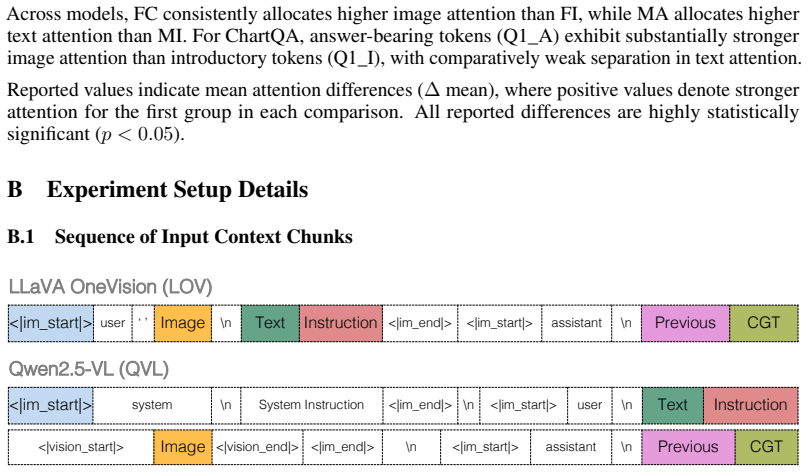
One Token at a Time (OTaT) analysis: average post-softmax attention from the currently generating token onto semantic chunks (image, text, instruction, previous tokens), normalize by mean subtraction, aggregate over role-tagged output tokens, then intervene by total blocking or multiplicative reweighting of the resulting scalar.
Load-bearing premise
Averaging attention uniformly across every layer and head still yields a scalar that is functionally meaningful enough that blocking or boosting it alone can change the model’s answers.
What would settle it
Measure fruit or spatial-relation accuracy after total blocking of image attention only at the concept token and after timed boosting only at the same token; if accuracy is statistically unchanged relative to the unblocked and always-boost baselines, the claimed causal role of the timed peaks is false.
If this is right
- A training-free, token-timed attention boost can raise accuracy on tasks that require modality switches inside one answer.
- Failure to answer the second part of a multi-part prompt can be diagnosed by checking whether instruction attention spikes at the hand-off token.
- The same temporal routing appears in pure language models given two text tasks, indicating the pattern is inherited from the base LLM.
- Disrupted visual attention produces stereotyped failure modes (prior, leakage, denial, recovery) that can be used as reliability diagnostics.
Where Pith is reading between the lines
- Because late layers dominate the observed spikes, a global boost still hits the critical computation even without head- or layer-selective targeting.
- Role-aware boosting could be stacked with existing head- or layer-selective interventions for larger gains than either alone.
- Post-hoc semantic tagging of free-form outputs would let the same analysis be run without forcing a fixed response format.
- Cross-modal leakage under blocking in the smallest model may signal incomplete modality separation that larger models later suppress.
Editorial analysis
A structured set of objections, weighed in public.
Referee Report
Summary. The paper studies token-level attention dynamics during autoregressive generation in MLLMs (OTaT), tracking attention from the currently generating token to semantic chunks (image, text, instruction, previous tokens). Using a diagnostic Fruit-Math task plus ChartQA and VSR, it reports consistent patterns across LLaVA-OneVision and Qwen2.5-VL models (0.5B–7B): image attention peaks at image-derived concepts, instruction attention rises at task hand-offs, and previous-token attention grows over decoding. Total attention blocking at these peaks produces predicted failures (language priors, cross-modal leakage, denial, recovery); timed multiplicative boosting of the relevant modality at the right step improves VSR accuracy substantially, especially for the weaker model.
Significance. If the patterns and causal effects hold, the work supplies a useful complementary ‘when’ perspective to existing layer/head (‘where’) interpretability of MLLMs, with concrete functional validation via total blocking and a simple, architecture-agnostic test-time boost that yields large gains on an entangled spatial-reasoning task. Strengths include multi-family/multi-size consistency, explicit causal interventions (Tables 1–3), qualitative failure-mode profiling, layer-group consensus checks (App. A.2), and an immediately usable intervention. The contribution is primarily empirical and methodological rather than theoretical, but it is actionable for both analysis and reliability improvements.
major comments (3)
- [§2.1, Eq. (1); App. A.2] Eq. (1) and §2.1 define the core scalar α_t(c_k) by uniform averaging of post-softmax attention over all layers and heads. While App. A.2 shows directional consensus across early/mid/late groups and the blocking/boosting results (Tables 1, 3) are consistent with the scalar being functionally meaningful, the paper should more explicitly quantify how much of the causal effect is carried by late layers alone (e.g., by repeating total blocking only on late layers). Without that, the claim that the global average is a sufficient intervention target remains only partially stress-tested.
- [§4.3; App. C] The timed boosting intervention (§4.3, Table 3) and the dataset-level bar plots both rely on knowing semantic role tags (Fruit Concept, ISR/TSR, Handoff, etc.) in advance. For free-form generation this knowledge is unavailable; the paper notes the limitation (App. C) but does not demonstrate an automatic, model-internal detector of the critical steps. A minimal experiment showing that a simple heuristic (e.g., first occurrence of a format keyword or entropy spike) recovers most of the gain would strengthen the practical claim.
- [§3; Tables 1–3; App. D] Fruit and VSR accuracy, answer rates, and error profiles (Tables 1–3, Fig. 7) are obtained via Gemini 2.5 Pro prompts (App. D.3–D.4) with only ‘spot-checks’. Because these numbers underwrite the causal claims, the manuscript should report inter-annotator agreement on a non-trivial human-labeled subset (or release the exact scored outputs) so that the magnitude of the reported drops and gains can be independently verified.
minor comments (5)
- [Fig. 1; App. A.1] Fig. 1D–E and the per-token plots in App. A.1 are dense; adding a short legend or color-blind-safe palette note would help readers who cannot zoom.
- [§2.2.1] The distinction between ‘lazy’ and ‘total’ blocking (Fig. 2, §2.2.1) is clear, but the main text could briefly restate why intermediate-token leakage is possible under lazy blocking before presenting Table 1.
- [§4.1] In §4.1 the claim that attention scores are influenced by both y_t and y_{t−1} is interesting; a one-sentence pointer to the corresponding spike at EOG in the per-token plots would make the observation easier to locate.
- [§4.1; App. A.4] App. A.4 (Math-Sport on the base LLM) is valuable; a single sentence in the main text noting that the same patterns appear in the text-only setting would better advertise the generality.
- [App. A.5] Minor typographical inconsistencies appear in the appendix (e.g., ‘oranges’ misspelled in one recovery example, occasional missing spaces around citations). A light proof-reading pass would suffice.
Circularity Check
Empirical observational + interventional study; measured attention peaks and causal effects are not defined by their own inputs.
full rationale
The paper is not a first-principles derivation. Its load-bearing claims are (i) observed token-level attention reallocations (image peaks at image-derived concepts, instruction at hand-offs, rising previous-token attention), (ii) causal validation via total blocking of those peaks, and (iii) a test-time multiplicative boost of the relevant modality at the right semantic tag. The scalar α_t(c_k) (Eq. 1) is a uniform average of post-softmax attention; it is measured, not fitted to force the peaks. Normalization subtracts a dataset-wide mean and does not create the relative spikes. Blocking sets attention mass to zero and reports accuracy collapse / failure modes; those outcomes are not algebraically forced by the definition of α. Boost factors β/γ are chosen by a post-hoc sweep on VSR, but the existence of the peaks was established earlier on Fr-Ma/ChartQA, the always-boost-image control degrades performance, and Fig. 18 shows a wide plateau—so the improvement is not a tautological rename of a fitted constant. No self-citation uniqueness theorem, no ansatz smuggled from the authors’ prior work, and no renaming of a known closed-form result. The study is self-contained against external open-weight models and public benchmarks; circularity score is zero.
Axiom & Free-Parameter Ledger
free parameters (1)
- effective boost factor γ =
≈11 (LOV), ≈13 (QVL)
axioms (3)
- ad hoc to paper Post-softmax attention averaged uniformly over layers and heads is a sufficient proxy for functional information flow from a semantic chunk.
- domain assumption Total blocking (zeroing attention from a chunk to all future tokens) completely severs information flow from that chunk.
- ad hoc to paper Response-format instructions plus automatic POS tagging produce role labels that align across variable-length free generations.
invented entities (3)
-
Fruit-Math diagnostic task
no independent evidence
-
total blocking operator
no independent evidence
-
OTaT (One Token at a Time) analysis framework
no independent evidence
read the original abstract
Multimodal large language models (MLLMs) generate responses autoregressively, integrating visual and linguistic information in an evolving context. Prior work on interpretability has focused on individual layers and circuits (where), leaving the token-level dynamics of multimodal computation during generation (when) underexplored. We address this gap and study attention shifts as per semantic role; tracking model attention to image, text, instruction, and previously generated tokens, One Token at a Time (OTaT). We introduce multimodal tasks that require explicit switching between visual and textual context within a single response. Across two mainstream model families and four open-weight MLLMs of varying sizes, we establish consistent patterns: attention to image peaks at tokens requiring image-derived information, instruction tokens are revisited during task transitions, and attention to previously generated tokens increases as the generation progresses. Causal attention blocking interventions validate the functional role of these trends. We profile model behavior under disrupted attention and observe responses falling back to language priors, or exhibiting cross-modal leakage, denial, or recovery. Finally, informed of the attention dynamics through our novel analysis, we propose a simple test-time intervention to boost attention to the relevant modality at the right time, significantly improving multimodal task performance.
Figures




Reference graph
Works this paper leans on
-
[1]
Possible Principles Underlying the Transformation of Sensory Messages
Horace B Barlow. Possible Principles Underlying the Transformation of Sensory Messages. Sensory communication, 1(01), 1961. 1
1961
-
[2]
Walid Bousselham, Angie Boggust, Hendrik Strobelt, and Hilde Kuehne. DEX-AR: A Dy- namic Explainability Method for Autoregressive Vision-Language Models.arXiv preprint arXiv:2603.06302, 2026. 1, 2, 10
arXiv 2026
-
[3]
Ruoyu Chen, Xiaoqing Guo, Kangwei Liu, Si Yuan Liang, Shiming Liu, et al. Where MLLMs Attend and What They Rely On: Explaining Autoregressive Token Generation.arXiv preprint arXiv:2509.22496, 2025. 10
arXiv 2025
-
[4]
What Does BERT Look At? An Analysis of BERT’s Attention
Kevin Clark, Urvashi Khandelwal, Omer Levy, and Christopher D Manning. What Does BERT Look At? An Analysis of BERT’s Attention. InACL Workshop BlackboxNLP: Analyzing and Interpreting Neural Networks for NLP, 2019. 9
2019
-
[5]
Training Verifiers to Solve Math Word Problems.arXiv preprint arXiv:2110.14168,
Karl Cobbe, Vineet Kosaraju, Mohammad Bavarian, Mark Chen, Heewoo Jun, Lukasz Kaiser, Matthias Plappert, Jerry Tworek, Jacob Hilton, Reiichiro Nakano, Christopher Hesse, and John Schulman. Training Verifiers to Solve Math Word Problems.arXiv preprint arXiv:2110.14168,
-
[6]
Flashattention: Fast and Memory-efficient Exact Attention with IO-Awareness
Tri Dao, Dan Fu, Stefano Ermon, Atri Rudra, and Christopher Ré. Flashattention: Fast and Memory-efficient Exact Attention with IO-Awareness. InAdvances in Neural Information Processing Systems (NeurIPS), 2022. 24
2022
-
[7]
An Image is Worth 16x16 Words: Transformers for Image Recognition At Scale
Alexey Dosovitskiy. An Image is Worth 16x16 Words: Transformers for Image Recognition At Scale. InInternational Conference on Learning Representations (ICLR), 2021. 9
2021
-
[8]
A Mathematical Framework for Transformer Circuits.Transformer Circuits Thread, 2021
Nelson Elhage, Neel Nanda, Catherine Olsson, Tom Henighan, Nicholas Joseph, Ben Mann, Amanda Askell, Yuntao Bai, Anna Chen, Tom Conerly, et al. A Mathematical Framework for Transformer Circuits.Transformer Circuits Thread, 2021. 1
2021
-
[9]
Toy Models of Superposition.arXiv preprint arXiv:2209.10652, 2022
Nelson Elhage, Tristan Hume, Catherine Olsson, Nicholas Schiefer, Tom Henighan, Shauna Kravec, Zac Hatfield-Dodds, Robert Lasenby, Dawn Drain, Carol Chen, et al. Toy Models of Superposition.arXiv preprint arXiv:2209.10652, 2022. 1
Pith/arXiv arXiv 2022
-
[10]
Mitigating Hallucination in Large Vision-Language Models via Adaptive Attention Calibration
Mehrdad Fazli, Bowen Wei, Ahmet Sari, and Ziwei Zhu. Mitigating Hallucination in Large Vision-Language Models via Adaptive Attention Calibration. InFindings of North American Chapter of Association of Computational Linguistics (NAACL-F), 2025. 10
2025
-
[11]
Dissecting Recall of Factual Associations in Auto-regressive Language Models
Mor Geva, Jasmijn Bastings, Katja Filippova, and Amir Globerson. Dissecting Recall of Factual Associations in Auto-regressive Language Models. InAssociation of Computational Linguistics (ACL), 2023. 1, 9
2023
-
[12]
LLMSteer: Improving Long-Context LLM Inference by Steering Attention on Reused Contexts
Zhuohan Gu, Jiayi Yao, Kuntai Du, and Junchen Jiang. LLMSteer: Improving Long-Context LLM Inference by Steering Attention on Reused Contexts. InMachine Learning for Systems Workshop (NeurIPS), 2024. 10
2024
-
[13]
Tianze Hua, Tian Yun, and Ellie Pavlick. How Do Vision-Language Models Process Conflicting Information Across Modalities?arXiv preprint arXiv:2507.01790, 2025. 9
Pith/arXiv arXiv 2025
-
[14]
Opera: Alleviating Hallucination in Multi-modal Large Language Models via Over-Trust Penalty and Retrospection-allocation
Qidong Huang, Xiaoyi Dong, Pan Zhang, Bin Wang, Conghui He, Jiaqi Wang, Dahua Lin, Weiming Zhang, and Nenghai Yu. Opera: Alleviating Hallucination in Multi-modal Large Language Models via Over-Trust Penalty and Retrospection-allocation. InConference on Computer Vision and Pattern Recognition (CVPR), 2024. 4
2024
-
[15]
The Platonic Representation Hypothesis
Minyoung Huh, Brian Cheung, Tongzhou Wang, and Phillip Isola. The Platonic Representation Hypothesis. InInternational Conference on Machine Learning (ICML), 2024. 9
2024
-
[16]
What’s in The Image? A Deep-Dive Into the Vision of Vision Language Models
Omri Kaduri, Shai Bagon, and Tali Dekel. What’s in The Image? A Deep-Dive Into the Vision of Vision Language Models. InConference on Computer Vision and Pattern Recognition (CVPR), 2025. 4, 9 11
2025
-
[17]
See What You Are Told: Visual Attention Sink in Large Multimodal Models
Seil Kang, Jinyeong Kim, Junhyeok Kim, and Seong Jae Hwang. See What You Are Told: Visual Attention Sink in Large Multimodal Models. InInternational Conference on Learning Representations (ICLR), 2025. 10
2025
-
[18]
The Open Images Dataset V4: Unified Image Classification, Object detection, and Visual relationship detection at Scale
Alina Kuznetsova, Hassan Rom, Neil Alldrin, Jasper Uijlings, Ivan Krasin, Jordi Pont-Tuset, Shahab Kamali, Stefan Popov, Matteo Malloci, Alexander Kolesnikov, Tom Duerig, and Vittorio Ferrari. The Open Images Dataset V4: Unified Image Classification, Object detection, and Visual relationship detection at Scale. InInternational Journal of Computer Vision (IJCV),
-
[19]
LLaV A-OneVision: Easy Visual Task Transfer
Bo Li, Yuanhan Zhang, Dong Guo, Renrui Zhang, Feng Li, Hao Zhang, Kaichen Zhang, Peiyuan Zhang, Yanwei Li, Ziwei Liu, and Chunyuan Li. LLaV A-OneVision: Easy Visual Task Transfer. InTransactions on Machine Learning (TMLR), 2025. 1, 5, 16
2025
-
[20]
Xiaoyu Liang, Chaofeng Guan, Jiaying Lu, Huiyao Chen, Huan Wang, and Haoji Hu. Dy- namic Token Reduction During Generation for Vision Language Models.arXiv preprint arXiv:2501.14204, 2025. 1, 2, 10
Pith/arXiv arXiv 2025
-
[21]
Paying More Attention to Image: A Training-free Method for Alleviating Hallucination in LVLMs
Shi Liu, Kecheng Zheng, and Wei Chen. Paying More Attention to Image: A Training-free Method for Alleviating Hallucination in LVLMs. InEuropean Conference on Computer Vision (ECCV), 2024. 10
2024
-
[22]
Vision-language Models Create Cross-modal Task Representations
Grace Luo, Trevor Darrell, and Amir Bar. Vision-language Models Create Cross-modal Task Representations. InInternational Conference on Machine Learning (ICML), 2024. 9
2024
-
[23]
Guangtao Lyu, Qi Liu, Chenghao Xu, Jiexi Yan, Muli Yang, Xueting Li, Fen Fang, and Cheng Deng. Revealing and Enhancing Core Visual Regions: Harnessing Internal Attention Dynamics for Hallucination Mitigation in LVLMs.arXiv preprint arXiv:2602.15556, 2026. 10
arXiv 2026
-
[24]
Chartqa: A Benchmark for Question Answering About Charts with Visual and Logical Reasoning
Ahmed Masry, Xuan Long Do, Jia Qing Tan, Shafiq Joty, and Enamul Hoque. Chartqa: A Benchmark for Question Answering About Charts with Visual and Logical Reasoning. In Findings of the Association for Computational Linguistics (ACL-F), pages 2263–2279, 2022. 5, 9
2022
-
[25]
Towards Interpreting Visual Information Processing in Vision-Language Models
Clement Neo, Luke Ong, Philip Torr, Mor Geva, David Krueger, and Fazl Barez. Towards Interpreting Visual Information Processing in Vision-Language Models. InInternational Conference on Learning Representations (ICLR), 2024. 1, 4, 9
2024
-
[26]
Same Task, Different Circuits: Disentangling Modality-Specific Mechanisms in VLMs
Yaniv Nikankin, Dana Arad, Yossi Gandelsman, and Yonatan Belinkov. Same Task, Different Circuits: Disentangling Modality-Specific Mechanisms in VLMs. InAdvances in Neural Information Processing Systems (NeurIPS), 2025. 1, 9
2025
-
[27]
Token-wise Decomposition of Autoregressive Language Model Hidden States for Analyzing Model Predictions
Byung-Doh Oh and William Schuler. Token-wise Decomposition of Autoregressive Language Model Hidden States for Analyzing Model Predictions. InAssociation of Computational Linguistics (ACL), 2023. 10
2023
-
[28]
Mixed Signals: Decoding VLMs’ Reasoning and Underlying Bias in Vision-language Conflict
Pouya Pezeshkpour, Moin Aminnaseri, and Estevam Hruschka. Mixed Signals: Decoding VLMs’ Reasoning and Underlying Bias in Vision-language Conflict. InFindings of the Associ- ation for Computational Linguistics (ACL-F), 2025. 5, 9
2025
-
[29]
Seeing Far and Clearly: Mitigating Hallucinations in MLLMs with Attention Causal Decoding
Feilong Tang, Chengzhi Liu, Zhongxing Xu, Ming Hu, Zile Huang, Haochen Xue, Ziyang Chen, Zelin Peng, Zhiwei Yang, Sijin Zhou, et al. Seeing Far and Clearly: Mitigating Hallucinations in MLLMs with Attention Causal Decoding. InConference on Computer Vision and Pattern Recognition (CVPR), 2025. 10
2025
-
[30]
Attention Is All You Need
Ashish Vaswani, Noam Shazeer, Niki Parmar, Jakob Uszkoreit, Llion Jones, Aidan N Gomez, Łukasz Kaiser, and Illia Polosukhin. Attention Is All You Need. InAdvances in Neural Information Processing Systems (NeurIPS), 2017. 3, 9
2017
-
[31]
MLLM Can See? Dynamic Correction Decoding for Hallucination Mitigation
Chenxi Wang, Xiang Chen, Ningyu Zhang, Bozhong Tian, Haoming Xu, et al. MLLM Can See? Dynamic Correction Decoding for Hallucination Mitigation. InInternational Conference on Learning Representations (ICLR), 2025. 1, 9 12
2025
-
[32]
ASCD: Attention-Steerable Contrastive Decoding for Reducing Hallucination in MLLM
Yujun Wang, Jinhe Bi, Soren Pirk, Yunpu Ma, et al. ASCD: Attention-Steerable Contrastive Decoding for Reducing Hallucination in MLLM. InAssociation for the Advancement of Artificial Intelligence (AAAI), 2026. 10
2026
-
[33]
Measuring Cross-modal Interactions in Multimodal Models
Laura Wenderoth, Konstantin Hemker, Nikola Simidjievski, and Mateja Jamnik. Measuring Cross-modal Interactions in Multimodal Models. InAssociation for the Advancement of Artificial Intelligence (AAAI), 2025. 9
2025
-
[34]
Qwen2 Technical Report.arXiv preprint arXiv:2407.10671, 2024
An Yang, Baosong Yang, Binyuan Hui, Bo Zheng, Bowen Yu, Chang Zhou, et al. Qwen2 Technical Report.arXiv preprint arXiv:2407.10671, 2024. 16
Pith/arXiv arXiv 2024
-
[35]
Qwen2.5 Technical Report.arXiv preprint arXiv:2502.13923, 2025
An Yang, Baosong Yang, Beichen Zhang, Binyuan Hui, Bo Zheng, Bowen Yu, et al. Qwen2.5 Technical Report.arXiv preprint arXiv:2502.13923, 2025. 1, 2, 5
Pith/arXiv arXiv 2025
-
[36]
Lifting the Veil on Visual Information Flow in MLLMs: Unlocking Pathways to Faster Inference
Hao Yin, Guangzong Si, and Zilei Wang. Lifting the Veil on Visual Information Flow in MLLMs: Unlocking Pathways to Faster Inference. InConference on Computer Vision and Pattern Recognition (CVPR), 2025. 9
2025
-
[37]
Jiacheng Zhang, Feng Liu, Chao Du, and Tianyu Pang. AdaVBoost: Mitigating Hallucinations in LVLMs via Token-Level Adaptive Visual Attention Boosting.arXiv preprint arXiv:2602.13600,
-
[38]
Tell Your Model Where to Attend: Post-hoc Attention Steering for LLMs
Qingru Zhang, Chandan Singh, Liyuan Liu, Xiaodong Liu, Bin Yu, Jianfeng Gao, and Tuo Zhao. Tell Your Model Where to Attend: Post-hoc Attention Steering for LLMs. InInternational Conference on Learning Representations (ICLR), 2024. 10
2024
-
[39]
Adaptinfer: Adaptive Token Pruning for Vision-language Model Inference with Dynamical Text Guidance
Weichen Zhang, Zhui Zhu, Ningbo Li, Shilong Tao, Kebin Liu, and Yunhao Liu. Adaptinfer: Adaptive Token Pruning for Vision-language Model Inference with Dynamical Text Guidance. arXiv preprint arXiv:2508.06084, 2025. 1, 2, 10
arXiv 2025
-
[40]
Cross-modal Information Flow in Multimodal Large Language Models
Zhi Zhang, Srishti Yadav, Fengze Han, and Ekaterina Shutova. Cross-modal Information Flow in Multimodal Large Language Models. InConference on Computer Vision and Pattern Recognition (CVPR), 2025. 1, 4, 9
2025
-
[41]
The fruit is
Lanyun Zhu, Deyi Ji, Tianrun Chen, Peng Xu, Jieping Ye, and Jun Liu. Ibd: Alleviating Hallucinations in Large Vision-language Models via Image-biased Decoding. InConference on Computer Vision and Pattern Recognition (CVPR), 2025. 10 13 Appendix A Additional Results . . . . . . . . . . . . . . . . . . . . . . . . . . . . . . . . . . . . . . . . . . . . . ....
2025
-
[42]
Determine whether a fruit answer was provided
-
[43]
Determine whether the fruit answer is correct
-
[44]
Determine whether a math answer was provided
-
[45]
Determine whether the math answer is correct
-
[46]
Extract the final fruit prediction committed by the model
-
[47]
Extract the final numeric/math answer committed by the model
-
[48]
Copy the exact phrase corresponding to the final fruit answer and normalize it to a canonical label if possible
-
[49]
Copy the exact phrase corresponding to the final math answer and normalize it to a canonical form if possible
-
[50]
I see no fruit... it is a cherry
If the fruit prediction is incorrect, assign one error category: - CROSS: Model is misdirected by terms/nouns from the math puzzle. - DENIAL: Model explicitly denies fruit presence or refuses to answer. - RESCUE: Model shows conflict or self-correction (e.g., “I see no fruit... it is a cherry” or “Apple, no, Banana”). - PRIOR: Simple misidentification or ...
-
[51]
fruit_answered
Provide a brieferror_explanation. Output Format (STRICT JSON) { "fruit_answered": "True/False", "fruit_correct": "True/False", "math_answered": "True/False", "math_correct": "True/False", "predicted_fruit": "string", "predicted_math": "string", "final_fruit_span": "string", "final_math_span": "string", "fruit_error_profiling": "CROSS/DENIAL/RESCUE/PRIOR/O...
-
[52]
True” or “False
Visual Check: Determine whether the model correctly identifies {expected_image_relation} as the spatial relation present in the image. Output “True” or “False”
-
[53]
True” or “False
Text Check: Determine whether the model correctly identifies {expected_text_relation} as the spatial relation described in the text. Output “True” or “False”
-
[54]
visual_check
Alignment Classification: -correct: Both image and text relations are correctly identified. -incorrect - both image: Model claims both modalities show or indicate the image relation. -incorrect - both text: Model claims both modalities show or indicate the text relation. -incorrect - flip: Model swaps them, using the text relation for the image part and t...
discussion (0)
Sign in with ORCID, Apple, or X to comment. Anyone can read and Pith papers without signing in.