REVIEW 2 major objections 4 minor 31 references
Diffusion classifiers bind attributes more cleanly than CLIP-style models, yet lean harder on object size and background when they score prompts by reconstruction error.
Reviewed by Pith at T0; open to challenge. T0 means a machine referee read the full paper against a public rubric. the ladder, T0–T4 →
T0 review · grok-4.5
2026-07-11 23:38 UTC pith:UH2XJOVZ
load-bearing objection Solid empirical diagnostic of diffusion-classifier decision rules: distinct bias profile (less attribute misbinding, more size-order and background shortcuts) with heatmaps that actually explain the scoring mechanism. the 2 major comments →
How Do Diffusion Classifiers Decide? A Bias-Centric Evaluation
The pith
A machine-rendered reading of the paper's core claim, the machinery that carries it, and where it could break.
Core claim
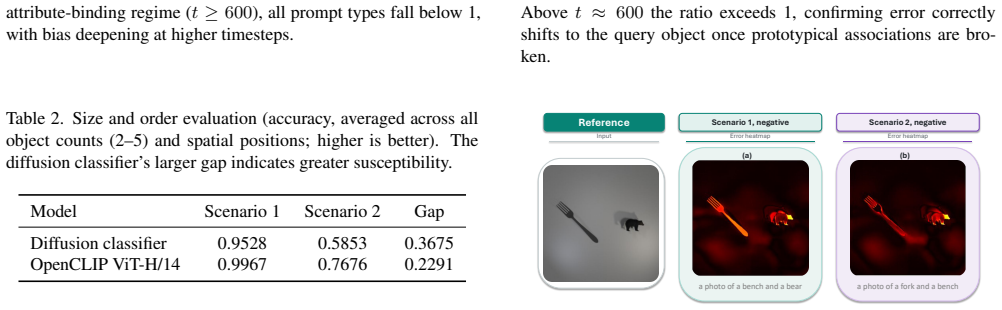
Diffusion classifiers exhibit a distinct bias profile from contrastive vision-language models: they are less prone to systematic attribute misbinding (lower CAB with higher two-object accuracy across seven categories) yet substantially more susceptible to size-order shortcuts (accuracy gap 0.37 versus 0.23 on ComCo) and background dependency (15–19-point drops versus roughly 2 points on ImageNet-B). Reconstruction-error heatmaps and U-Net cross-attention maps trace each bias to the pixel-aggregated reconstruction-error score itself.
What carries the argument
ASOB-Bench and the text-conditioned reconstruction-error score: the classifier picks the prompt that minimizes total noise-prediction error; heatmaps of that error and of cross-attention reveal where and why the score is hijacked by size, order, or background.
Load-bearing premise
That sharing only the text encoder with the OpenCLIP baseline is enough to isolate the effect of reconstruction-error scoring from differences in visual representation or training data.
What would settle it
Run the same three ASOB-Bench probes on a diffusion classifier and a contrastive model trained on identical image–text data and architecture; if the attribute, size-order, and background gaps reverse or disappear, the claim of a scoring-rule-driven distinct bias profile is false.
If this is right
- Headline accuracy alone will continue to hide systematic failures of diffusion classifiers on multi-object and out-of-context scenes.
- Mitigations that re-weight error by object area or suppress background regions can be expected to shrink the size-order and background gaps.
- The same single-pass diagnostics diagnose analogous attribute-leakage and background-dominance failures in text-to-image generation.
- Practitioners can choose diffusion classifiers when attribute binding matters more than size or context robustness, and avoid them when the reverse is true.
Where Pith is reading between the lines
- Because the bias is intrinsic to total-error aggregation, any future scoring rule that normalizes error by region size or by foreground mask should systematically reduce the size-order and background gaps without retraining.
- The color-driven cross-attention routing observed here is likely a shared bottleneck for any method that re-uses the same U-Net or DiT cross-attention for grounding or editing.
- Extending ASOB-Bench to flow-matching and consistency models would test whether the bias profile is specific to noise-prediction objectives or common to all reconstruction-based classifiers.
Editorial analysis
A structured set of objections, weighed in public.
Referee Report
Summary. The paper introduces ASOB-Bench, a three-axis bias evaluation of diffusion classifiers (Stable Diffusion 2, with an SD3 DiT check) that score candidate prompts by noise-prediction error. Along attribute binding (CAB and related metrics on natural/unnatural color plus five new attribute categories), size-order (ComCo Scenarios 1–2), and background dependency (ImageNet-B plus a no-background condition), it reports that diffusion classifiers are less prone to attribute misbinding than an OpenCLIP ViT-H/14 baseline sharing the same text encoder, yet substantially more susceptible to size-order shortcuts and background reliance. Reconstruction-error heatmaps, full reconstructions, and U-Net cross-attention maps are used to attribute each pattern to the pixel-aggregated scoring rule and to color-driven attention routing. The authors argue that the same diagnostics illuminate failure modes of the shared generative denoiser.
Significance. If the reported profile holds, the work supplies the first systematic, mechanism-level account of how reconstruction-error classifiers decide, filling a gap that has been extensively studied for contrastive VLMs but not for diffusion classifiers. The combination of controlled probes, unnatural-color and prompt-template controls, timestep-resolved ratios, and an SD3 replication is a concrete contribution; public code and data further raise the bar for follow-up work on robust diffusion-based models and on analogous generative failure modes.
major comments (2)
- §3.1 and the comparative claims in Tables 1–3 rest on the premise that OpenCLIP ViT-H/14, sharing only the SD2 text encoder, isolates scoring mechanism (contrastive vs. reconstruction-error) from residual differences in visual representation and training data. The within-model diagnostics (error-on-distractor, area-weighted residual error, object/background ratio <1) already establish the absolute mechanisms without the baseline, so the premise is not load-bearing for the existence of the profile; it is load-bearing for every quantitative “less/more” statement. A short additional control (e.g., another CLIP-scale model or a frozen-encoder ablation) or an explicit caveat that the comparison is mechanism-plus-representation would make the comparative language fully defensible.
- §3.3 and Appendix F: ComCo (12 780) and ImageNet-B (2 625 / 525) are evaluated on compute-driven subsamples without reported standard errors, confidence intervals, or a sensitivity check against the full sets. The directional gaps (size-order 0.3675 vs 0.2291; background drops of 15–19 points) are large, yet the absence of uncertainty quantification leaves open whether the reported magnitudes are stable. Adding bootstrap intervals or a note that the full sets were scored on a smaller timestep budget would close this gap without changing the experimental design.
minor comments (4)
- Table 1 mixes proportions (0–1) for color with percentages for the other categories; a uniform scale would improve readability.
- Appendix E notes that SD3 absolute accuracies are substantially lower than SD2; a one-sentence reminder in the main text that only relative trends are claimed would prevent misreading of Table 5.
- Figure 1 and the later heatmap figures would benefit from a brief caption note that error maps are single-step (or full-trajectory where stated) so readers do not conflate them with multi-step generation artifacts.
- A few citation keys appear with slight numbering drift between the main text and the appendix (e.g., ImageNet-B / BiRefNet); a final pass would align them.
Circularity Check
No circularity: empirical bias measurements and heatmaps against external benchmarks; nothing reduces by construction to fitted inputs or self-citation.
full rationale
ASOB-Bench is an empirical evaluation paper. Its load-bearing claims are measured quantities (CAB from Tang et al., Scenario-1/2 accuracy gap on ComCo from Abbasi et al., accuracy drops on ImageNet-B from Malik et al.) plus reconstruction-error and cross-attention visualizations that diagnose the pixel-aggregated scoring rule. None of these numbers is obtained by fitting a free parameter of the authors and then re-reporting it as a prediction; the CAB formula (Eq. 3), the two ComCo scenarios, and the six ImageNet-B conditions are taken from external sources and applied unchanged (or with only the authors’ added no-background segmentation). The OpenCLIP baseline shares the text encoder but is an independent contrastive model; the within-model diagnostics (error-on-distractor, area-weighted residual, object/background ratio <1) do not even require that baseline. The single self-citation to the authors’ compositionality survey is background, not a uniqueness theorem or ansatz that forces the reported bias profile. Appendix E’s SD3 DiT replication further shows the same qualitative trends without relying on any fitted quantity of the present paper. Consequently the derivation chain is self-contained against external data and contains no circular step.
Axiom & Free-Parameter Ledger
free parameters (3)
- timestep sampling range for attribute tasks =
800-999
- number of timesteps for scoring =
50
- ComCo and ImageNet-B subsample sizes =
12780 ComCo / 2625 ImageNet-B used
axioms (4)
- domain assumption Noise-prediction error under a text prompt approximates -log p(z|y) and is therefore a valid zero-shot classification score (Eq. 1–2).
- domain assumption CAB = two-object* - two-object + 1/2 correctly quantifies directional attribute misbinding.
- ad hoc to paper OpenCLIP ViT-H/14 sharing the SD2 text encoder isolates the effect of scoring mechanism rather than text encoding.
- domain assumption Pixel-aggregated reconstruction error is the operative decision variable that produces size and background shortcuts.
invented entities (1)
-
ASOB-Bench
independent evidence
read the original abstract
Diffusion models have recently been repurposed for zero-shot classification, giving rise to diffusion classifiers that identify the best-matching text prompt by minimizing the noise-prediction error. Despite their growing adoption, how these models make classification decisions remains poorly understood. We introduce ASOB-Bench, a bias evaluation for diffusion classifiers along three dimensions: Attribute binding, Size-Order bias, and Background dependency. These dimensions serve not as an exhaustive taxonomy but as targeted probes of how the text-conditioned reconstruction-error score reaches a decision. Such a perspective is well studied for discriminative vision-language models, yet remains overlooked for diffusion classifiers. Extending an existing framework with five new attribute categories on newly constructed datasets, we find diffusion classifiers are less prone to attribute misbinding than an OpenCLIP baseline; on the established ComCo benchmark they are substantially more susceptible to size-order shortcuts; and on ImageNet-B they suffer far larger accuracy drops, revealing heavy reliance on background over foreground cues. Reconstruction-error heatmaps and U-Net cross-attention visualizations expose the mechanism behind each bias. Because diffusion classifiers share the same denoiser as text-to-image models, these single-pass diagnostics also point toward analogous failure modes in generation. Overall, diffusion classifiers exhibit a distinct bias profile from vision-language models, offering guidance for building more robust diffusion-based models.
Figures




Reference graph
Works this paper leans on
-
[1]
Clip under the microscope: A fine-grained analysis of multi-object representation.2025 IEEE/CVF Conference on Computer Vision and Pattern Recognition (CVPR), pages 9308–9317, 2025
Reza Abbasi, Ali Nazari, Aminreza Sefid, Moham- madali Banayeeanzade, Mohammad Hossein Rohban, and Mahdieh Soleymani Baghshah. Clip under the microscope: A fine-grained analysis of multi-object representation.2025 IEEE/CVF Conference on Computer Vision and Pattern Recognition (CVPR), pages 9308–9317, 2025. 3, 4, 13, 14
2025
-
[2]
Compositionality in con- trastive vision-language models: A survey of methods and benchmarks
Maryam Abdolali, Fardin Ayar, Roozbeh Tavanaei, Saba Fathi, Arshia Momtazi, Ehsan Javanmardi, Manabu Tsukada, and Mahdi Javanmardi. Compositionality in con- trastive vision-language models: A survey of methods and benchmarks. TechRxiv, 2026. 1, 3
2026
-
[3]
Improving image genera- tion with better captions, 2023
James Betker, Gabriel Goh, Li Jing, Tim Brooks, Jianfeng Wang, Linjie Li, Long Ouyang, Juntang Zhuang, Joyce Lee, Yufei Guo, Wesam Manassra, Prafulla Dhariwal, Casey Chu, Yunxin Jiao, and Aditya Ramesh. Improving image genera- tion with better captions, 2023. 4
2023
-
[4]
Blattmann, Tim Dockhorn, Sumith Kulal, Daniel Mendelevitch, Maciej Kilian, and Dominik Lorenz
A. Blattmann, Tim Dockhorn, Sumith Kulal, Daniel Mendelevitch, Maciej Kilian, and Dominik Lorenz. Sta- ble video diffusion: Scaling latent video diffusion models to large datasets.ArXiv, abs/2311.15127, 2023. 2
Pith/arXiv arXiv 2023
-
[5]
Blattmann, Robin Rombach, Huan Ling, Tim Dockhorn, Seung Wook Kim, Sanja Fidler, and Karsten Kreis
A. Blattmann, Robin Rombach, Huan Ling, Tim Dockhorn, Seung Wook Kim, Sanja Fidler, and Karsten Kreis. Align your latents: High-resolution video synthesis with latent dif- fusion models.2023 IEEE/CVF Conference on Computer Vi- sion and Pattern Recognition (CVPR), pages 22563–22575,
2023
-
[6]
Text-to-image diffusion mod- els are zero-shot classifiers.ArXiv, abs/2303.15233, 2023
Kevin Clark and Priyank Jaini. Text-to-image diffusion mod- els are zero-shot classifiers.ArXiv, abs/2303.15233, 2023. 1, 2, 3
Pith/arXiv arXiv 2023
-
[7]
Zach Evans, CJ Carr, Josiah Taylor, Scott H. Hawley, and Jordi Pons. Fast timing-conditioned latent audio diffusion. ArXiv, abs/2402.04825, 2024. 2
Pith/arXiv arXiv 2024
-
[8]
Geneval: An object-focused framework for evaluating text- to-image alignment
Dhruba Ghosh, Hanna Hajishirzi, and Ludwig Schmidt. Geneval: An object-focused framework for evaluating text- to-image alignment. InAdvances in Neural Information Pro- cessing Systems (NeurIPS), Datasets and Benchmarks Track,
-
[9]
Woojung Han, Yeonkyung Lee, Chanyoung Kim, Kwanghyun Park, and Seong Jae Hwang. Spatial transport optimization by repositioning attention map for training-free text-to-image synthesis.2025 IEEE/CVF Conference on Computer Vision and Pattern Recognition (CVPR), pages 18401–18410, 2025. 3
2025
-
[10]
Narayana, Sugato Basu, William Yang Wang, and Xin Eric Wang
Xuehai He, Weixi Feng, Tsu-Jui Fu, Varun Jampani, Ar- jun Reddy Akula, P. Narayana, Sugato Basu, William Yang Wang, and Xin Eric Wang. Discffusion: Discriminative diffusion models as few-shot vision and language learners. Trans. Mach. Learn. Res., 2024, 2024. 2
2024
-
[11]
Jonathan Ho, Ajay Jain, and P. Abbeel. Denoising diffusion probabilistic models.ArXiv, abs/2006.11239, 2020. 1, 2
Pith/arXiv arXiv 2006
-
[12]
Kaiyi Huang, Chengqi Duan, Kaiyue Sun, Enze Xie, Zhen- guo Li, and Xihui Liu. T2i-compbench++: An enhanced and comprehensive benchmark for compositional text-to-image generation.IEEE Transactions on Pattern Analysis and Ma- chine Intelligence, 47:3563–3579, 2025. 2
2025
-
[13]
Yujin Jeong, Arnas Uselis, Seong Joon Oh, and Anna Rohrbach. Diffusion classifiers understand compositional- ity, but conditions apply.ArXiv, abs/2505.17955, 2025. 1, 2, 3, 6, 13
arXiv 2025
-
[14]
V oleti, Christopher Joseph Pal, and Siva Reddy
Benno Krojer, Elinor Poole-Dayan, Vikram S. V oleti, Christopher Joseph Pal, and Siva Reddy. Are diffusion mod- els vision-and-language reasoners? InAdvances in Neural Information Processing Systems (NeurIPS), 2023. 1, 2, 3
2023
-
[15]
Li, Mihir Prabhudesai, Shivam Duggal, Ellis Brown, and Deepak Pathak
Alexander C. Li, Mihir Prabhudesai, Shivam Duggal, Ellis Brown, and Deepak Pathak. Your diffusion model is secretly a zero-shot classifier.2023 IEEE/CVF International Confer- ence on Computer Vision (ICCV), pages 2206–2217, 2023. 1, 2, 3
2023
-
[16]
Crepe: Can vision- language foundation models reason compositionally?2023 IEEE/CVF Conference on Computer Vision and Pattern Recognition (CVPR), pages 10910–10921, 2023
Zixian Ma, Jerry Hong, Mustafa Omer Gul, Mona Gandhi, Irena Gao, and Ranjay Krishna. Crepe: Can vision- language foundation models reason compositionally?2023 IEEE/CVF Conference on Computer Vision and Pattern Recognition (CVPR), pages 10910–10921, 2023. 3
2023
-
[17]
Khan, and Fahad Shahbaz Khan
Hashmat Shadab Malik, Muhammad Huzaifa, Muzammal Naseer, Salman H. Khan, and Fahad Shahbaz Khan. Ob- jectcompose: Evaluating resilience of vision-based models on object-to-background compositional changes. InAsian Conference on Computer Vision, 2024. 3, 4, 13, 14
2024
-
[18]
Dick, and Hidenori Tanaka
Maya Okawa, Ekdeep Singh Lubana, Robert P. Dick, and Hidenori Tanaka. Compositional abilities emerge multiplica- tively: Exploring diffusion models on a synthetic task. InAd- vances in Neural Information Processing Systems (NeurIPS),
-
[19]
Learning transferable visual models from natural language supervision
Alec Radford, Jong Wook Kim, Chris Hallacy, Aditya Ramesh, Gabriel Goh, Sandhini Agarwal, Girish Sastry, Amanda Askell, Pamela Mishkin, Jack Clark, Gretchen Krueger, and Ilya Sutskever. Learning transferable visual models from natural language supervision. InInternational Conference on Machine Learning, 2021. 1, 2
2021
-
[20]
Blattmann, Dominik Lorenz, Patrick Esser, and Bj ¨orn Ommer
Robin Rombach, A. Blattmann, Dominik Lorenz, Patrick Esser, and Bj ¨orn Ommer. High-resolution image synthesis with latent diffusion models.2022 IEEE/CVF Conference on Computer Vision and Pattern Recognition (CVPR), pages 10684–10695, 2022. 2, 3
2022
-
[21]
Chitwan Saharia, William Chan, Saurabh Saxena, Lala Li, Jay Whang, Emily L. Denton, Seyed Kamyar Seyed Ghasemipour, Burcu Karagol Ayan, Seyedeh Sara Mah- davi, Raphael Gontijo Lopes, Tim Salimans, Jonathan Ho, David J. Fleet, and Mohammad Norouzi. Photorealistic text- to-image diffusion models with deep language understand- ing.ArXiv, abs/2205.11487, 2022. 2
Pith/arXiv arXiv 2022
-
[22]
Kingma, Ab- hishek Kumar, Stefano Ermon, and Ben Poole
Yang Song, Jascha Sohl-Dickstein, Diederik P. Kingma, Ab- hishek Kumar, Stefano Ermon, and Ben Poole. Score-based generative modeling through stochastic differential equa- tions. 2020. 2
2020
-
[23]
What the daam: Interpreting stable dif- fusion using cross attention
Raphael Tang, Linqing Liu, Akshat Pandey, Zhiying Jiang, Gefei Yang, Karun Kumar, Pontus Stenetorp, Jimmy Lin, and Ferhan Ture. What the daam: Interpreting stable dif- fusion using cross attention. InAnnual Meeting of the Asso- ciation for Computational Linguistics (ACL), 2023. 5, 11
2023
-
[24]
When are lemons purple? the concept association bias of vision-language models
Yingtian Tang, Yutaro Yamada, Yoyo Zhang, and Ilker Yildirim. When are lemons purple? the concept association bias of vision-language models. InConference on Empirical Methods in Natural Language Processing, 2023. 3, 4, 5, 13, 14
2023
-
[25]
A good crepe needs more than just sugar: Investigating biases in compositional vision-language benchmarks, 2025
Vishaal Udandarao, Mehdi Cherti, Shyamgopal Karthik, Je- nia Jitsev, Samuel Albanie, and Matthias Bethge. A good crepe needs more than just sugar: Investigating biases in compositional vision-language benchmarks, 2025. 1
2025
-
[26]
Xingrui Wang, Wufei Ma, Tiezheng Zhang, Celso M de Melo, Jieneng Chen, and Alan Yuille. Spatial457: A di- agnostic benchmark for 6d spatial reasoning of large multi- modal models.2025 IEEE/CVF Conference on Computer Vi- sion and Pattern Recognition (CVPR), pages 24669–24679,
2025
-
[27]
Noise matters: Optimizing matching noise for diffusion classifiers
Yanghao Wang and Long Chen. Noise matters: Optimizing matching noise for diffusion classifiers. InThe Thirty-ninth Annual Conference on Neural Information Processing Sys- tems, 2025. 2
2025
-
[28]
Xindi Wu, Dingli Yu, Yangsibo Huang, Olga Russakovsky, and Sanjeev Arora. Conceptmix: A compositional image generation benchmark with controllable difficulty.ArXiv, abs/2408.14339, 2024. 3
Pith/arXiv arXiv 2024
-
[29]
Few-Shot Learner Parameterization by Diffusion Time-Steps
Zhongqi Yue, Pan Zhou, Richang Hong, Hanwang Zhang, and Qianru Sun. Few-Shot Learner Parameterization by Diffusion Time-Steps . In2024 IEEE/CVF Conference on Computer Vision and Pattern Recognition (CVPR), 2024. 2
2024
-
[30]
Mert Yuksekgonul, Federico Bianchi, Pratyusha Kalluri, Dan Jurafsky, and James Y . Zou. When and why vision- language models behave like bags-of-words, and what to do about it? InInternational Conference on Learning Repre- sentations (ICLR), 2023. 3
2023
-
[31]
in a complex scene
Peng Zheng, Dehong Gao, Deng-Ping Fan, Li Liu, Jorma Laaksonen, Wanli Ouyang, and Nicu Sebe. Bilateral refer- ence for high-resolution dichotomous image segmentation. CAAI Artificial Intelligence Research, 3:1–12, 2024. 4, 13, 14 Appendix This appendix provides additional details and analyses that support the findings reported in the main paper. Specifi- ...
2024
discussion (0)
Sign in with ORCID, Apple, or X to comment. Anyone can read and Pith papers without signing in.