REVIEW 1 major objections 4 minor 23 references
A Python front-end to Why3 can verify that hypothesis tests and meta-analyses are used under the assumptions they actually require.
Reviewed by Pith at T0; open to challenge. T0 means a machine referee read the full paper against a public rubric. the ladder, T0–T4 →
Why3-py is a Python front-end to Why3 plus an extended StatWhy that verifies annotated hypothesis-testing and meta-analysis programs by discharging assumption and interpretation obligations.
T0 review reviewed 2026-07-11 challenge →
load-bearing objection Working Python front-end + meta-analysis contracts that actually flag missing publication-bias and p-hacking assumptions; the only real soft spot is the usual hand-written library contracts. the 1 major comments →
Why3-py: A Tool for Formal Verification of Hypothesis Testing and Meta-Analysis in Python
The pith
A machine-rendered reading of the paper's core claim, the machinery that carries it, and where it could break.
The reading
Core claim
Why3-py together with the extended StatWhy modules is the first practical system that can automatically verify, for ordinary Python statistical programs, that the programmer has correctly annotated the assumptions and statistical interpretations required by hypothesis tests and by standard meta-analysis combiners.
What carries the argument
Why3-py: a mixed Python/WhyML parser and translator that uses mypy type information, embeds full WhyML contracts inside Python comments, and replaces external library calls by logical contracts, so that Belief-Hoare-logic verification conditions can be generated and discharged by Why3.
Load-bearing premise
The hand-written logical contracts supplied for SciPy, statsmodels and the meta-analysis combiners must faithfully capture every precondition the real library functions rely on; if a contract is incomplete or too strong the verifier will either reject correct code or accept incorrect code.
What would settle it
Take a published Python meta-analysis that is known to ignore publication bias or to misuse Fisher combination, annotate it with the paper's required contracts, and check whether Why3-py correctly reports the missing assumption and refuses verification.
Editorial analysis
A structured set of objections, weighed in public.
Referee Report
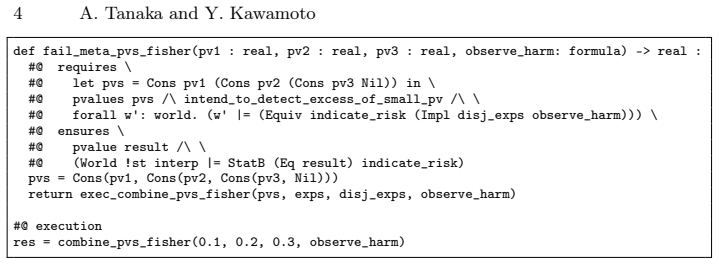
Summary. The paper proposes Why3-py, a Python front-end for the Why3 platform that translates mypy-checkable, Gospel-annotated Python statistical programs into WhyML for automated verification of hypothesis-testing and meta-analysis code. It addresses Python’s dynamic typing via static type reconstruction, embeds full WhyML specifications in comments, abstracts external libraries (SciPy, statsmodels) by logical contracts, and extends StatWhy 1.4 with modules for Fisher’s, Stouffer’s and Mantel-Haenszel methods (including publication-bias predicates). The central claim is that the resulting framework can detect missing assumptions and certain misuses (e.g., p-hacking, publication bias) on realistic Python programs; this is illustrated by a motivating Fisher meta-analysis example, case studies that correctly fail or succeed according to the presence of required annotations, and performance numbers for practical problem sizes.
Significance. If the claims hold, the work supplies the first practical, automated formal-verification path for Python statistical code that is actually used by analysts, directly addressing a recognised source of the reproducibility crisis. Concrete strengths that raise the contribution above a pure engineering exercise are: (i) a public artifact containing the tool, documentation and examples; (ii) machine-checked verification conditions discharged by independent SMT solvers rather than by hand; (iii) explicit detection of non-runtime errors such as omitted publication-bias assumptions; and (iv) timing data (Table 1 and the 2–30-study meta-analysis experiments) showing that verification remains feasible for the sizes that appear in practice. The contract-based treatment of libraries is a pragmatic enabler of modularity, even though it shifts the soundness burden onto the contracts themselves.
major comments (1)
- Section 4 (“Verification with External Libraries”) and the corresponding StatWhy 1.4 modules: the soundness of every verification result rests on the hand-written logical contracts for SciPy/statsmodels functions and for the meta-analysis combiners. The paper correctly notes that only usage, not implementation, is checked, yet it provides no systematic evidence (cross-checks against library documentation, differential testing, or a contract-validation suite) that the contracts are neither incomplete nor overly strong. Because an incomplete contract can accept incorrect usage and an overly strong one can reject correct usage, this is a load-bearing assumption for the central claim that “overlooked assumptions and misuse” are reliably identified; a short validation subsection or appendix would make the claim substantially more robust.
minor comments (4)
- Throughout the manuscript (especially the abstract and §§1–3) many words are concatenated without spaces (“widespreadrecognition”, “meta-analysesthat”, “Why3-pytool”, etc.). These appear to be transcription artefacts; they should be corrected for readability.
- Table 1, Tukey HSD row for 7 groups: the reported time “87,86” uses a comma as decimal separator inconsistently with the rest of the table; standardise to a period.
- Figure 2 is referenced but never described beyond the caption “overview of the construction”; a one-sentence walk-through of the pipeline stages would help readers who cannot consult the artifact immediately.
- Related-work discussion of other Python verifiers (Nagini, PyVeritas, dafny-of-python) is accurate but could briefly note which of them already support real arithmetic or external-library contracts, clarifying the precise novelty of Why3-py’s design choices.
Circularity Check
No significant circularity; tool paper whose verification outcomes are external SMT checks on user annotations, not self-derived predictions.
full rationale
This is a systems/tool paper (Why3-py front-end + StatWhy 1.4 meta-analysis modules) whose central claims are engineering: a mypy-assisted translation of annotated Python into WhyML, contract-based abstraction of SciPy/statsmodels, and generation of VCs discharged by independent SMT solvers (cvc5). Success or failure of verification is an external check against user-supplied requires/ensures clauses and hand-written library contracts, not a numerical constant or statistical quantity fitted from the same data being “predicted.” Self-citations to the authors’ prior BHL/StatWhy papers supply the logical foundation (belief modalities, Gospel annotations) but are not load-bearing uniqueness theorems that force the present results by construction; the paper does not redefine a quantity as its own prediction, smuggle an ansatz via self-citation, or rename a known empirical pattern. The acknowledged soft spot (fidelity of library contracts) is a modular-verification limitation, not circularity. Derivation chain is therefore self-contained against external solvers and benchmarks; steps array left empty.
Axiom & Free-Parameter Ledger
axioms (4)
- standard math Why3’s VC generation and the underlying SMT solvers are sound for the WhyML fragment used by the front-end.
- domain assumption mypy’s static type information is a sound over-approximation of the runtime types of the supported Python subset.
- ad hoc to paper The logical contracts written for SciPy/statsmodels and for the meta-analysis combiners correctly capture every precondition that the real implementations rely on.
- domain assumption Belief Hoare Logic correctly models the epistemic content of statistical hypothesis testing and p-value combination.
invented entities (2)
-
Why3-py front-end (mixed Python–WhyML parser + type-directed translation)
independent evidence
-
StatWhy 1.4 meta-analysis contract modules (Fisher, Stouffer, Mantel-Haenszel, publication-bias predicates)
independent evidence
Cite this review
Pith. "Pith review of Why3-py: A Tool for Formal Verification of Hypothesis Testing and Meta-Analysis in Python." pith.science (2026). https://pith.science/paper/VDE4AW6A
@misc{pith2026260703951,
  author       = {Pith},
  title        = {Pith review of: Why3-py: A Tool for Formal Verification of Hypothesis Testing and Meta-Analysis in Python},
  year         = {2026},
  howpublished = {\url{https://pith.science/paper/VDE4AW6A}},
  note         = {Machine review of arXiv:2607.03951}
}
read the original abstract
The reproducibility crisis in scientific research has received widespread recognition, thereby increasing the importance of meta-analyses that integrate statistical analyses from multiple studies. However, statistical methods often have ambiguous and implicit underlying assumptions, which can lead to their erroneous applications and interpretations. To address this issue, we propose a formal verification framework for statistical programs written in Python. Specifically, we present Why3-py, a Python front-end for the Why3 verification platform that transforms Python programs into verification-oriented WhyML representations suitable for formal verification, addressing the challenges arising from Python's dynamic typing and runtime polymorphism. Furthermore, we extend the StatWhy tool to support the verification of meta-analysis methods. These tools enable users to identify overlooked assumptions and misuse of analyses, and to verify the correctness of Python programs for hypothesis testing and for meta-analyses.
Figures

Reference graph
Works this paper leans on
-
[1]
Ahrendt, W., Beckert, B., Bubel, R., Hähnle, R., Schmitt, P.H., Ulbrich, M.: De- ductive Software Verification - The KeY Book - From Theory to Practice (2016)
2016
-
[2]
Arbuthnot, J.: An argument for divine providence, taken from the constant regu- larity observ’d in the births of both sexes. Philosophical Transactions of the Royal SocietyofLondon27(328),186–190(1710).https://doi.org/10.1098/rstl.1710.0011
-
[3]
Charguéraud, A., Filliâtre, J., Lourenço, C., Pereira, M.: GOSPEL - providing ocamlwithaformalspecificationlanguage.In:FM’19.pp.484–501.Springer(2019)
2019
-
[4]
GitHub repository (2020), https://github.com/arsalan0c/dafny-of-python
Choudhury, A.: dafny-of-python: A tool for deductive verification of Python pro- grams. GitHub repository (2020), https://github.com/arsalan0c/dafny-of-python
2020
-
[5]
In: SEFM’12
Cuoq, P., Kirchner, F., Kosmatov, N., Prevosto, V., Signoles, J., Yakobowski, B.: Frama-C - A software analysis perspective. In: SEFM’12. pp. 233–247 (2012)
2012
-
[6]
In: Proc
Eilers, M., Müller, P.: Nagini: A static verifier for python. In: Proc. CAV 2018, Part I. LNCS, vol. 10981, pp. 596–603. Springer (2018)
2018
-
[7]
In: ESOP’13
Filliâtre, J., Paskevich, A.: Why3 - where programs meet provers. In: ESOP’13. LNCS, vol. 7792, pp. 125–128. Springer (2013)
2013
-
[8]
In: The Art of Modelling Computational Systems: A Journey from Logic and Concurrency to Security and Privacy
Kawamoto, Y.: Statistical epistemic logic. In: The Art of Modelling Computational Systems: A Journey from Logic and Concurrency to Security and Privacy. LNCS, vol. 11760, pp. 344–362. Springer (2019)
2019
-
[9]
In: Proc
Kawamoto, Y.: Towards logical specification of statistical machine learning. In: Proc. SEFM 2019. pp. 293–311 (2019)
2019
-
[10]
Software and Systems Modeling20(2), 293–310 (2020)
Kawamoto, Y.: An epistemic approach to the formal specification of statistical machine learning. Software and Systems Modeling20(2), 293–310 (2020)
2020
-
[11]
Kawamoto, Y., Kobayashi, K., Suenaga, K.: User Documentation for StatWhy v1.4 (2026), available at https://github.com/fm4stats/statwhy
2026
-
[12]
In: Proc
Kawamoto, Y., Sato, T., Suenaga, K.: Formalizing statistical beliefs in hypothesis testing using program logic. In: Proc. KR’21. pp. 411–421 (2021)
2021
-
[13]
In: Proc
Kawamoto, Y., Sato, T., Suenaga, K.: Formalizing statistical causality via modal logic. In: Proc. JELIA’23. LNCS, vol. 14281, pp. 681–696. Springer (2023)
2023
-
[14]
Kawamoto, Y., Sato, T., Suenaga, K.: Sound and relatively complete belief Hoare logic for statistical hypothesis testing programs. Artif. Intell.326, 104045 (2024)
2024
-
[15]
Lehtosalo, J., van Rossum, G., Levkivskyi, I., Sullivan, M.J.: mypy: Static typing for python (2026), https://github.com/python/mypy
2026
-
[16]
In: LPAR’16
Leino, K.R.M.: Dafny: An automatic program verifier for functional correctness. In: LPAR’16. LNCS, vol. 6355, pp. 348–370. Springer (2010)
2010
-
[17]
In: ICSE ’13
Leino, K.R.M.: Developing verified programs with dafny. In: ICSE ’13. pp. 1488–
-
[18]
IEEE Computer Society (2013)
2013
-
[19]
arXiv preprint arXiv:2501.06283 (2025)
Li, Y.C., Zetzsche, S., Somayyajula, S.: Dafny as verification-aware intermediate language for code generation. arXiv preprint arXiv:2501.06283 (2025)
Pith/arXiv arXiv 2025
-
[20]
Orvalho, P., Kwiatkowska, M.: Pyveritas: On verifying Python via LLM-based transpilation and bounded model checking for C. CoRRabs/2508.08171(2025)
Pith/arXiv arXiv 2025
-
[21]
In: Proc
Pereira, M., Ravara, A.: Cameleer: A deductive verification tool for OCaml. In: Proc. CAV 2021, Part II. LNCS, vol. 12760, pp. 677–689. Springer (2021)
2021
-
[22]
Régis-Gianas, Y., Jeannerod, N., Treinen, R.: Morbig: A static parser for POSIX shell. J. Comput. Lang.57, 100944 (2020)
2020
-
[23]
Tanaka, A., Kawamoto, Y.: User Documentation for Why3-py v1.0 (2026), avail- able at https://github.com/fm4stats/why3-py
2026
This paper was first reviewed by grok-4.5 on July 11, 2026.
discussion (0)
Sign in with ORCID, Apple, or X to comment. Anyone can read and Pith papers without signing in.