REVIEW 2 major objections 5 minor 67 references
FocusGS reconstructs driving scenes from sparse views by completing geometry only where it is ambiguous, cutting Gaussians by ~74% and render time by ~34%.
Reviewed by Pith at T0; open to challenge. T0 means a machine referee read the full paper against a public rubric. the ladder, T0–T4 →
T0 review · grok-4.5
2026-07-11 15:36 UTC pith:KDEUZTPV
load-bearing objection Clean engineering win: targeted completion on a depth-gradient ambiguity manifold beats Omni-Scene on quality while cutting Gaussians ~74% and latency ~34%. the 2 major comments →
Targeted Structure Completion for Sparse-View 3D Reconstruction in Autonomous Driving
The pith
A machine-rendered reading of the paper's core claim, the machinery that carries it, and where it could break.
Core claim
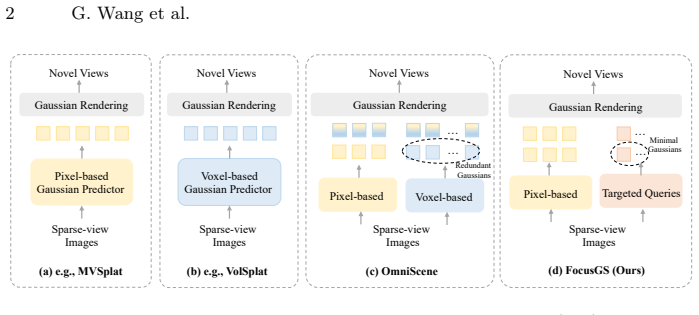
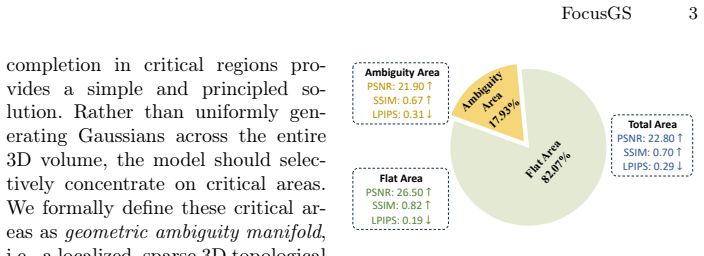
Structural completion for sparse-view 3D Gaussians can be fully decoupled from deterministic regions: localize a sparse 3D Geometric Ambiguity Manifold from depth-gradient boundaries, then instantiate and optimize continuous Gaussian queries only inside that manifold. This targeted strategy recovers occluded geometry at the quality of uniform volumetric methods while eliminating the redundant Gaussians those methods place on flat, well-observed surfaces.
What carries the argument
The 3D Geometric Ambiguity Manifold: a sparse topological subspace obtained by thresholding and dilating depth gradients in each view, then lifting the resulting 2D bands into short 3D segments along camera rays; all subsequent completion queries are sampled and updated exclusively inside this subspace.
Load-bearing premise
The depth-gradient map (plus a fixed dilation and thickness) is assumed to mark every geometrically incomplete region that actually hurts novel-view quality; if the predicted depth is already wrong or sensor artifacts dominate, the manifold misses or over-includes the wrong places.
What would settle it
On the same nuScenes splits, replace the depth-gradient manifold with a pure random mask of equal volume or with ground-truth high-error regions and measure whether PSNR/SSIM/PCC still improve by the reported margins while keeping the same query budget; collapse of the gains would falsify the claim that the manifold is the essential localizer.
If this is right
- Dual-branch pixel-plus-voxel pipelines can drop their dense volumetric branch and still recover occlusions by completing only the ambiguity manifold.
- Total Gaussian count and rendering latency become largely independent of scene volume and scale mainly with the size of the uncertain subspace.
- The same manifold-plus-targeted-queries pattern can be dropped onto other pixel-based feed-forward predictors to raise their geometric completeness without full re-architecture.
- Driving reconstruction systems can allocate compute adaptively at runtime by monitoring the fraction of pixels that fall inside the current ambiguity manifold.
Where Pith is reading between the lines
- If the manifold is recomputed every few frames from streaming depth, the method naturally extends to online dynamic scenes without storing a static dense volume.
- Adverse-weather failures suggest a natural next step: treat lens artifacts themselves as an extra ambiguity class so the completion module can ignore or inpaint them rather than bake them into 3D.
- The fixed query budget N_q acts as a hard efficiency dial; practitioners can trade a few dB of PSNR for still lower memory by lowering N_q once the saturation point is known.
Editorial analysis
A structured set of objections, weighed in public.
Referee Report
Summary. FocusGS addresses sparse-view 3D reconstruction for ego-centric autonomous driving by decoupling structural completion from deterministic surfaces. It first builds a pixel-aligned base Gaussian representation, then derives a 2D geometric ambiguity manifold from depth-gradient discontinuities (Eqs. 3–5), lifts it into a sparse 3D uncertainty subspace via longitudinal thickness (Eqs. 6–8), and instantiates a fixed budget of continuous Gaussian queries only inside that subspace. These queries are refined by sparse self-context aggregation, deformable cross-view attention, and an MLP decoder. On nuScenes the method reports higher PSNR/SSIM/PCC and lower LPIPS than Omni-Scene while cutting total Gaussians by ~74 % and rendering latency by ~34 %; competitive or better numbers appear on RealEstate10K, and ablations isolate the contribution of targeted localization over random completion.
Significance. If the efficiency–quality claims hold under broader deployment, FocusGS supplies a practical middle path between pure pixel-based feed-forward Gaussians (fast but incomplete under low overlap) and dual-branch voxel methods (complete but redundant). The explicit geometric-ambiguity manifold and fixed-budget query design are simple, modular, and immediately usable by other sparse-view pipelines; the systematic ablations (Tables 3–8) and the public project page further raise the work’s utility for the autonomous-driving reconstruction community.
major comments (2)
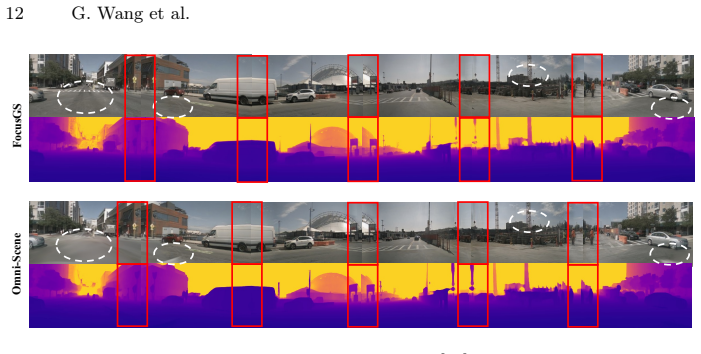
- The central efficiency claim rests on the premise that the depth-gradient manifold (Eqs. 3–5, τ_g = 3, 3×3 dilation) plus longitudinal thickness (Eq. 7) captures essentially all regions whose completion improves novel-view metrics. Table 5 shows solid recall (0.82) against an oracle error mask, yet the paper itself documents systematic failure under rain/lens artifacts (Fig. 7 and Limitations). A quantitative stress test—e.g., controlled depth-noise injection or evaluation on a rainy nuScenes subset—would make the robustness boundary of this load-bearing assumption explicit rather than anecdotal.
- Table 1 reports latency and quality gains versus Omni-Scene, and Fig. 6 visualizes Gaussian counts, but the manuscript never states the absolute Gaussian budgets (base + compensatory) used for each method under identical hardware and resolution. Without those numbers the ~74 % / ~34 % reductions cannot be independently verified or compared with other sparse-view baselines that also claim efficiency.
minor comments (5)
- Hyper-parameters κ_rel and κ_abs that define longitudinal thickness (Eq. 7) are never given numerical values; they should appear in the implementation details or an appendix.
- Fig. 2 percentages (82 % flat / 18 % ambiguity) are presented without stating how the regions were segmented or whether they are averaged over the full test set; a short caption clarification would help.
- In §3.3 the notation switches between N_q and “Nums” (Tables 6–7); consistent symbols would improve readability.
- The RealEstate10K protocol (number of input views, exact train/test split) is only sketched; a one-sentence alignment with the Omni-Scene protocol would remove ambiguity.
- A few typographical inconsistencies remain (e.g., “F ocusGS”, “V oxel-based”, missing spaces around ~74 %).
Circularity Check
No significant circularity; FocusGS is an empirical architecture whose efficiency-quality claims are measured against held-out novel views and external baselines, not forced by construction or self-citation.
full rationale
The paper defines a 2D geometric ambiguity manifold via depth-gradient thresholding and morphological dilation (Eqs. 3-5), lifts it to a 3D uncertainty subspace (Eqs. 6-8), and samples a fixed budget of continuous Gaussian queries strictly inside that subspace for targeted completion. All quality metrics (PSNR/SSIM/LPIPS/PCC) and efficiency numbers (~74% fewer Gaussians, ~34% lower latency) are obtained by rendering novel views and comparing against independent ground-truth images and published baselines (Omni-Scene, MVSplat, etc.). Ablations (Tables 3-8) isolate the contribution of the manifold versus random completion and quantify mask recall against an oracle error mask; none of these steps reduce a claimed prediction to a fitted input or to a self-citation uniqueness theorem. The manifold is derived from the model's own depth prediction, yet supervision remains photometric/depth losses on held-out data, so the central SOTA claim is not circular by construction. No load-bearing self-citations, ansatz smuggling, or renaming of known results appear. Residual risk is ordinary domain-shift sensitivity (rain artifacts) already acknowledged by the authors, not circularity.
Axiom & Free-Parameter Ledger
free parameters (5)
- gradient threshold τ_g =
3
- dilation kernel size k =
3
- query budget N_q =
60k
- longitudinal thickness coefficients κ_rel, κ_abs
- number of completion blocks =
4
axioms (3)
- domain assumption Depth discontinuities (large finite-difference gradients) are a reliable proxy for geometric ambiguity and occlusion boundaries in ego-centric driving scenes.
- ad hoc to paper A fixed global query budget sampled uniformly from the lifted subspace is sufficient to complete all critical missing structure without dense volumetric context.
- domain assumption Pixel-aligned base Gaussians already achieve high fidelity on deterministic surfaces (flat roads, sky), so completion can be completely decoupled from those regions.
invented entities (2)
-
3D Geometric Ambiguity Manifold (O_3d)
no independent evidence
-
Targeted Structure Completion module (continuous Gaussian queries + sparse self/cross aggregation)
no independent evidence
read the original abstract
Reconstructing 3D scene structures from sparse, low-overlap observations remains a fundamental challenge in autonomous driving. Recent state-of-the-art frameworks achieve promising results by incorporating voxel-based Gaussians, but incur substantial computational redundancy due to a uniform volumetric processing strategy. To bridge the gap between the efficiency of pixel-based Gaussian methods and the structural completeness of voxel-based Gaussian approaches, we propose FocusGS, a simple yet effective framework that shifts the paradigm from global densification to targeted structural completion. Our central insight is that structural completion should be decoupled from deterministic regions, with computation concentrated exclusively on areas exhibiting geometric ambiguity. Specifically, FocusGS addresses the localization challenge by deriving a 3D Geometric Ambiguity Manifold to accurately isolate localized areas prone to occlusion and high geometric uncertainty. To overcome the subsequent manifold completion challenge, we design a lightweight targeted structure completion module that selectively instantiates and optimizes continuous Gaussian queries strictly within this unstructured, sparse topological subspace. Extensive experiments demonstrate that FocusGS achieves a superior efficiency-quality trade-off, advancing state-of-the-art performance on driving-centric benchmarks while naturally reducing the total number of Gaussians by ~74% and decreasing rendering time by ~34%.
Figures




Reference graph
Works this paper leans on
-
[1]
In: CVPR
Caesar, H., Bankiti, V., Lang, A.H., Vora, S., Liong, V.E., Xu, Q., Krishnan, A., Pan, Y., Baldan, G., Beijbom, O.: nuscenes: A multimodal dataset for autonomous driving. In: CVPR. pp. 11621–11631 (2020)
2020
-
[2]
In: CVPR
Cao, A., Johnson, J.: Hexplane: A fast representation for dynamic scenes. In: CVPR. pp. 130–141 (2023)
2023
-
[3]
In: CVPR
Cao, A.Q., De Charette, R.: Monoscene: Monocular 3d semantic scene completion. In: CVPR. pp. 3991–4001 (2022)
2022
-
[4]
In: ICCV
Caron, M., Touvron, H., Misra, I., Jégou, H., Mairal, J., Bojanowski, P., Joulin, A.: Emerging properties in self-supervised vision transformers. In: ICCV. pp. 9650– 9660 (2021)
2021
-
[5]
Charatan,D.,Li,S.L.,Tagliasacchi,A.,Sitzmann,V.:pixelsplat:3dgaussiansplats fromimagepairsforscalablegeneralizable3dreconstruction.In:CVPR.pp.19457– 19467 (2024)
2024
-
[6]
In: ICCV (2021)
Chen, A., Xu, Z., Zhao, F., Zhang, X., Xiang, F., Yu, J., Su, H.: Mvsnerf: Fast generalizable radiance field reconstruction from multi-view stereo. In: ICCV (2021)
2021
-
[7]
IEEE TVCG (2024)
Chen, D., Li, H., Ye, W., Wang, Y., Xie, W., Zhai, S., Wang, N., Liu, H., Bao, H., Zhang, G.: Pgsr: Planar-based gaussian splatting for efficient and high-fidelity surface reconstruction. IEEE TVCG (2024)
2024
-
[8]
In: ECCV
Chen, Y., Xu, H., Zheng, C., Zhuang, B., Pollefeys, M., Geiger, A., Cham, T.J., Cai, J.: Mvsplat: Efficient 3d gaussian splatting from sparse multi-view images. In: ECCV. pp. 370–386 (2024)
2024
-
[9]
In: ECCV
Chen, Z., Ye, M., Xu, S., Cao, T., Chen, Q.: Ppad: Iterative interactions of pre- diction and planning for end-to-end autonomous driving. In: ECCV. pp. 239–256. Springer (2024)
2024
-
[10]
com/traveller59/spconv(2022)
Contributors, S.: Spconv: Spatially sparse convolution library.https://github. com/traveller59/spconv(2022)
2022
-
[11]
In: CVPR
Du, Y., Smith, C., Tewari, A., Sitzmann, V.: Learning to render novel views from wide-baseline stereo pairs. In: CVPR. pp. 4970–4980 (2023)
2023
-
[12]
In: ICCV
Gan, W., Liu, F., Xu, H., Mo, N., Yokoya, N.: Gaussianocc: Fully self-supervised and efficient 3d occupancy estimation with gaussian splatting. In: ICCV. pp. 28980–28990 (2025)
2025
-
[13]
In: CVPR
Hu, Y., Yang, J., Chen, L., Li, K., Sima, C., Zhu, X., Chai, S., Du, S., Lin, T., Wang, W., et al.: Planning-oriented autonomous driving. In: CVPR. pp. 17853– 17862 (2023)
2023
-
[14]
Huang, J., Huang, G., Zhu, Z., Ye, Y., Du, D.: Bevdet: High-performance multi- camera 3d object detection in bird-eye-view. arXiv:2112.11790 (2021)
Pith/arXiv arXiv 2021
-
[15]
In: ECCV
Huang, Y., Zheng, W., Zhang, Y., Zhou, J., Lu, J.: Gaussianformer: Scene as gaussians for vision-based 3d semantic occupancy prediction. In: ECCV. pp. 376–
-
[16]
arXiv preprint arXiv:2311.13549 (2023)
Jia, F., Mao, W., Liu, Y., Zhao, Y., Wen, Y., Zhang, C., Zhang, X., Wang, T.: Adriver-i: A general world model for autonomous driving. arXiv preprint arXiv:2311.13549 (2023)
Pith/arXiv arXiv 2023
-
[17]
In: ICCV
Jiang, B., Chen, S., Xu, Q., Liao, B., Chen, J., Zhou, H., Zhang, Q., Liu, W., Huang,C.,Wang,X.:Vad:Vectorizedscenerepresentationforefficientautonomous driving. In: ICCV. pp. 8340–8350 (2023)
2023
-
[18]
In: CVPR
Jiang,H.,Liu,L.,Cheng,T.,Wang,X.,Lin,T.,Su,Z.,Liu,W.,Wang,X.:Gausstr: Foundation model-aligned gaussian transformer for self-supervised 3d spatial un- derstanding. In: CVPR. pp. 11960–11970 (2025) FocusGS 17
2025
-
[19]
ACM TOG44(6), 1–16 (2025)
Jiang, L., Mao, Y., Xu, L., Lu, T., Ren, K., Jin, Y., Xu, X., Yu, M., Pang, J., Zhao, F., et al.: Anysplat: Feed-forward 3d gaussian splatting from unconstrained views. ACM TOG44(6), 1–16 (2025)
2025
-
[20]
In: CVPR
Johari, M.M., Lepoittevin, Y., Fleuret, F.: Geonerf: Generalizing nerf with geom- etry priors. In: CVPR. pp. 18365–18375 (2022)
2022
-
[21]
ACM TOG42(4), 139–1 (2023)
Kerbl, B., Kopanas, G., Leimkühler, T., Drettakis, G.: 3d gaussian splatting for real-time radiance field rendering. ACM TOG42(4), 139–1 (2023)
2023
-
[22]
Kingma, D.P., Ba, J.: Adam: A method for stochastic optimization. arXiv:1412.6980 (2014)
Pith/arXiv arXiv 2014
-
[23]
AAAI37(2), 1477– 1485 (2023)
Li, Y., Ge, Z., Yu, G., Yang, J., Wang, Z., Shi, Y., Sun, J., Li, Z.: Bevdepth: Acquisition of reliable depth for multi-view 3d object detection. AAAI37(2), 1477– 1485 (2023)
2023
-
[24]
In: ECCV
Li, Z., Wang, W., Li, H., Xie, E., Sima, C., Lu, T., Qiao, Y., Dai, J.: Bevformer: Learning bird’s-eye-view representation from multi-camera images via spatiotem- poral transformers. In: ECCV. pp. 1–18 (2022)
2022
-
[25]
In: CVPR
Liu, Y., Peng, S., Liu, L., Wang, Q., Wang, P., Theobalt, C., Zhou, X., Wang, W.: Neural rays for occlusion-aware image-based rendering. In: CVPR. pp. 7824–7833 (2022)
2022
-
[26]
In: ICRA
Liu, Z., Tang, H., Amini, A., Yang, X., Mao, H., Rus, D.L., Han, S.: Bevfu- sion: Multi-task multi-sensor fusion with unified bird’s-eye view representation. In: ICRA. pp. 2774–2781 (2023)
2023
-
[27]
arXiv preprint arXiv:2412.09043 (2024)
Lu, H., Xu, T., Zheng, W., Zhang, Y., Zhan, W., Du, D., Tomizuka, M., Keutzer, K., Chen, Y.: Drivingrecon: Large 4d gaussian reconstruction model for au- tonomous driving. arXiv preprint arXiv:2412.09043 (2024)
Pith/arXiv arXiv 2024
-
[28]
In: ECCV
Lu, J., Huang, Z., Yang, Z., Zhang, J., Zhang, L.: Wovogen: World volume-aware diffusion for controllable multi-camera driving scene generation. In: ECCV. pp. 329–345 (2024)
2024
-
[29]
ACM TOG38(4), 1–14 (2019)
Mildenhall, B., Srinivasan, P.P., Ortiz-Cayon, R., Kalantari, N.K., Ramamoorthi, R., Ng, R., Kar, A.: Local light field fusion: Practical view synthesis with prescrip- tive sampling guidelines. ACM TOG38(4), 1–14 (2019)
2019
-
[30]
Mildenhall, B., Srinivasan, P.P., Tancik, M., Barron, J.T., Ramamoorthi, R., Ng, R.:Nerf:Representingscenesasneuralradiancefieldsforviewsynthesis.In:ECCV. pp. 405–421 (2020)
2020
-
[31]
In: CVPR
Min, C., Zhao, D., Xiao, L., Zhao, J., Xu, X., Zhu, Z., Jin, L., Li, J., Guo, Y., Xing, J., et al.: Driveworld: 4d pre-trained scene understanding via world models for autonomous driving. In: CVPR. pp. 15522–15533 (2024)
2024
-
[32]
NeurIPS37, 56828–56858 (2024)
Ren, J., Xie, C., Mirzaei, A., Kreis, K., Liu, Z., Torralba, A., Fidler, S., Kim, S.W., Ling, H., et al.: L4gm: Large 4d gaussian reconstruction model. NeurIPS37, 56828–56858 (2024)
2024
-
[33]
arXiv preprint arXiv:2403.17898 (2024)
Ren, K., Jiang, L., Lu, T., Yu, M., Xu, L., Ni, Z., Dai, B.: Octree-gs: Towards consistent real-time rendering with lod-structured 3d gaussians. arXiv preprint arXiv:2403.17898 (2024)
Pith/arXiv arXiv 2024
-
[34]
NeurIPS 37, 97670–97698 (2024)
Ren, X., Lu, Y., Liang, H., Wu, Z., Ling, H., Chen, M., Fidler, S., Williams, F., Huang, J.: Scube: Instant large-scale scene reconstruction using voxsplats. NeurIPS 37, 97670–97698 (2024)
2024
-
[35]
arXiv preprint arXiv:2511.04595 (2025)
Shi, C., Shi, S., Lyu, X., Liu, C., Sheng, K., Zhang, B., Jiang, L.: Unisplat: Unified spatio-temporal fusion via 3d latent scaffolds for dynamic driving scene reconstruc- tion. arXiv preprint arXiv:2511.04595 (2025)
arXiv 2025
-
[36]
NeurIPS 34, 19313–19325 (2021) 18 G
Sitzmann, V., Rezchikov, S., Freeman, B., Tenenbaum, J., Durand, F.: Light field networks: Neural scene representations with single-evaluation rendering. NeurIPS 34, 19313–19325 (2021) 18 G. Wang et al
2021
-
[37]
arXiv preprint arXiv:2504.00437 (2025)
Song, Q., Li, C., Lin, H., Peng, S., Huang, R.: Adgaussian: Generalizable gaus- sian splatting for autonomous driving with multi-modal inputs. arXiv preprint arXiv:2504.00437 (2025)
arXiv 2025
-
[38]
In: CVPR
Suhail, M., Esteves, C., Sigal, L., Makadia, A.: Light field neural rendering. In: CVPR. pp. 8269–8279 (2022)
2022
-
[39]
In: CVPR
Tang, P., Wang, Z., Wang, G., Zheng, J., Ren, X., Feng, B., Ma, C.: Sparseocc: Rethinking sparse latent representation for vision-based semantic occupancy pre- diction. In: CVPR. pp. 15035–15044 (2024)
2024
-
[40]
AAAI 39(7), 7374–7382 (2025)
Tian, Q., Tan, X., Xie, Y., Ma, L.: Drivingforward: Feed-forward 3d gaussian splatting for driving scene reconstruction from flexible surround-view input. AAAI 39(7), 7374–7382 (2025)
2025
-
[41]
In: NeurIPS
Tian, X., Jiang, T., Yun, L., Mao, Y., Yang, H., Wang, Y., Wang, Y., Zhao, H.: Occ3d: A large-scale 3d occupancy prediction benchmark for autonomous driving. In: NeurIPS. vol. 36 (2024)
2024
-
[42]
In: ECCV (2024)
Wang, G., Wang, Z., Tang, P., Zheng, J., Ren, X., Feng, B., Ma, C.: Occgen: Gen- erative multi-modal 3d occupancy prediction for autonomous driving. In: ECCV (2024)
2024
-
[43]
In: CVPR
Wang, Q., Wang, Z., Genova, K., Srinivasan, P.P., Zhou, H., Barron, J.T., Martin- Brualla, R., Snavely, N., Funkhouser, T.: Ibrnet: Learning multi-view image-based rendering. In: CVPR. pp. 4690–4699 (2021)
2021
-
[44]
arXiv preprint arXiv:2509.19297 (2025)
Wang, W., Chen, Y., Zhang, Z., Liu, H., Wang, H., Feng, Z., Qin, W., Zhu, Z., Chen, D.Y., Zhuang, B.: Volsplat: Rethinking feed-forward 3d gaussian splatting with voxel-aligned prediction. arXiv preprint arXiv:2509.19297 (2025)
Pith/arXiv arXiv 2025
-
[45]
In: ECCV
Wang, X., Zhu, Z., Huang, G., Chen, X., Zhu, J., Lu, J.: Drivedreamer: Towards real-world-drive world models for autonomous driving. In: ECCV. pp. 55–72 (2024)
2024
-
[46]
Wang, X., Zhu, Z., Huang, G., Wang, B., Chen, X., Lu, J.: Worlddreamer: To- wards general world models for video generation via predicting masked tokens. arXiv:2401.09985 (2024)
Pith/arXiv arXiv 2024
-
[47]
In: ICCV
Wang, X., Zhu, Z., Xu, W., Zhang, Y., Wei, Y., Chi, X., Ye, Y., Du, D., Lu, J., Wang, X.: Openoccupancy: A large scale benchmark for surrounding semantic occupancy perception. In: ICCV. pp. 17850–17859 (2023)
2023
-
[48]
IEEE TIP13(4), 600–612 (2004)
Wang, Z., Bovik, A.C., Sheikh, H.R., Simoncelli, E.P.: Image quality assessment: from error visibility to structural similarity. IEEE TIP13(4), 600–612 (2004)
2004
-
[49]
In: CVPR
Wei, D., Li, Z., Liu, P.: Omni-scene: Omni-gaussian representation for ego-centric sparse-view scene reconstruction. In: CVPR. pp. 22317–22327 (2025)
2025
-
[50]
Wei, J., Yuan, S., Li, P., Hu, Q., Gan, Z., Ding, W.: Occllama: An occupancy- language-action generative world model for autonomous driving. arXiv:2409.03272 (2024)
Pith/arXiv arXiv 2024
-
[51]
In: ICCV
Wei, Y., Zhao, L., Zheng, W., Zhu, Z., Zhou, J., Lu, J.: Surroundocc: Multi- camera 3d occupancy prediction for autonomous driving. In: ICCV. pp. 21729– 21740 (2023)
2023
-
[52]
Computational Visual Media10(4), 613–642 (2024)
Wu, T., Yuan, Y.J., Zhang, L.X., Yang, J., Cao, Y.P., Yan, L.Q., Gao, L.: Recent advances in 3d gaussian splatting. Computational Visual Media10(4), 613–642 (2024)
2024
-
[53]
In: CVPR
Xu, H., Chen, A., Chen, Y., Sakaridis, C., Zhang, Y., Pollefeys, M., Geiger, A., Yu, F.: Murf: multi-baseline radiance fields. In: CVPR. pp. 20041–20050 (2024)
2024
-
[54]
In: CVPR
Xu, H., Peng, S., Wang, F., Blum, H., Barath, D., Geiger, A., Pollefeys, M.: Depth- splat: Connecting gaussian splatting and depth. In: CVPR. pp. 16453–16463 (2025)
2025
-
[55]
In: ECCV
Yan, Y., Lin, H., Zhou, C., Wang, W., Sun, H., Zhan, K., Lang, X., Zhou, X., Peng, S.: Street gaussians: Modeling dynamic urban scenes with gaussian splatting. In: ECCV. pp. 156–173 (2024) FocusGS 19
2024
-
[56]
In: ICLR
Yang, J., Huang, J., Ivanovic, B., Chen, Y., Wang, Y., Li, B., You, Y., Sharma, A., Igl, M., Karkus, P., et al.: Storm: Spatio-temporal reconstruction model for large-scale outdoor scenes. In: ICLR. vol. 2025, pp. 50446–50465 (2025)
2025
-
[57]
In: CVPR
Yu, A., Ye, V., Tancik, M., Kanazawa, A.: pixelnerf: Neural radiance fields from one or few images. In: CVPR. pp. 4578–4587 (2021)
2021
-
[58]
In: CVPR
Yu, Z., Chen, A., Huang, B., Sattler, T., Geiger, A.: Mip-splatting: Alias-free 3d gaussian splatting. In: CVPR. pp. 19447–19456 (2024)
2024
-
[59]
In: CVPR
Zhang, R., Isola, P., Efros, A.A., Shechtman, E., Wang, O.: The unreasonable effectiveness of deep features as a perceptual metric. In: CVPR. pp. 586–595 (2018)
2018
-
[60]
In: ICCV
Zhang, Y., Zhu, Z., Du, D.: Occformer: Dual-path transformer for vision-based 3d semantic occupancy prediction. In: ICCV. pp. 9433–9443 (2023)
2023
-
[61]
Zhou, T., Tucker, R., Flynn, J., Fyffe, G., Snavely, N.: Stereo magnification: Learn- ingviewsynthesisusingmultiplaneimages.arXivpreprintarXiv:1805.09817(2018)
Pith/arXiv arXiv 2018
-
[62]
In: CVPR
Zhou, X., Lin, Z., Shan, X., Wang, Y., Sun, D., Yang, M.H.: Drivinggaussian: Composite gaussian splatting for surrounding dynamic autonomous driving scenes. In: CVPR. pp. 21634–21643 (2024)
2024
-
[63]
arXiv preprint arXiv:2503.23463 (2025)
Zhou, X., Han, X., Yang, F., Ma, Y., Knoll, A.C.: Opendrivevla: Towards end-to- end autonomous driving with large vision language action model. arXiv preprint arXiv:2503.23463 (2025)
arXiv 2025
-
[64]
arXiv preprint arXiv:2506.13757 (2025)
Zhou, Z., Cai, T., Zhao, S.Z., Zhang, Y., Huang, Z., Zhou, B., Ma, J.: Autovla: A vision-language-action model for end-to-end autonomous driving with adaptive reasoning and reinforcement fine-tuning. arXiv preprint arXiv:2506.13757 (2025)
Pith/arXiv arXiv 2025
-
[65]
arXiv preprint arXiv:2010.04159 (2020)
Zhu, X., Su, W., Lu, L., Li, B., Wang, X., Dai, J.: Deformable detr: Deformable transformers for end-to-end object detection. arXiv preprint arXiv:2010.04159 (2020)
Pith/arXiv arXiv 2010
-
[66]
In: CVPR
Zhu, Z., Wang, S., Xie, J., Liu, J.j., Wang, J., Yang, J.: Voxelsplat: Dynamic gaussian splatting as an effective loss for occupancy and flow prediction. In: CVPR. pp. 6761–6771 (2025)
2025
-
[67]
In: CVPR
Zuo, S., Zheng, W., Huang, Y., Zhou, J., Lu, J.: Gaussianworld: Gaussian world model for streaming 3d occupancy prediction. In: CVPR. pp. 6772–6781 (2025)
2025
discussion (0)
Sign in with ORCID, Apple, or X to comment. Anyone can read and Pith papers without signing in.