REVIEW 2 major objections 5 minor 81 references
Imbalanced pretraining separates task circuits so refusal fine-tuning stays selective instead of spilling over.
Reviewed by Pith at T0; open to challenge. T0 means a machine referee read the full paper against a public rubric. the ladder, T0–T4 →
T0 review · grok-4.5
2026-07-11 12:35 UTC pith:RYJIALGX
load-bearing objection Solid controlled evidence that task-imbalance curricula produce separable circuits and cleaner selective refusal; the only real limit is scale. the 2 major comments →
Pretraining Curricula Enable Selective Fine-tuning
The pith
A machine-rendered reading of the paper's core claim, the machinery that carries it, and where it could break.
Core claim
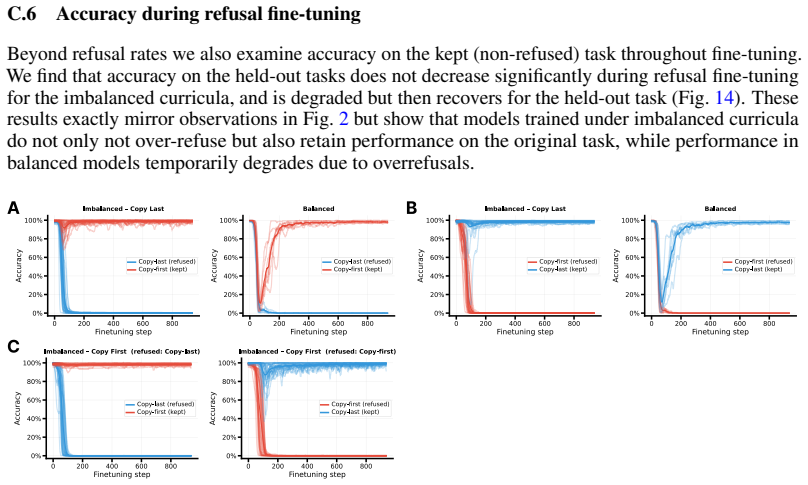
Imbalanced pretraining curricula induce task-specialized circuitry that supports selective refusal fine-tuning with low overrefusal, whereas balanced pretraining routes both tasks through a common pathway that is co-opted during fine-tuning and produces substantial spillover. The same curriculum effect appears in a rule-based synthetic language task, where imbalance yields more localized early-layer rule representations and more robust rule-following after fine-tuning on aligned data.
What carries the argument
Curriculum-dependent circuit organization, diagnosed by mean ablations, direct logit attribution, and denoising activation patching: under imbalance, copy-first routes mainly through layer-2 attention (especially keys) and copy-last through layer-2 feed-forward, while balanced training recovers both tasks from the same layer-2 key pathway.
Load-bearing premise
The circuit separation and selective-fine-tuning gains seen in small transformers on two synthetic tasks will still matter for large models trained on many real, entangled behaviors.
What would settle it
Train multi-task models under matched imbalanced versus balanced pretraining schedules, then apply selective refusal fine-tuning; if overrefusal rates and shared-circuit recovery under activation patching are indistinguishable across curricula, the central claim fails.
If this is right
- Safety fine-tuning that refuses one capability will leave related kept capabilities more intact when pretraining was imbalanced rather than interleaved.
- Pretraining data order can be treated as a design lever for promoting disentangled representations, not only as a speed or difficulty schedule.
- Surface-aligned free generation after fine-tuning can mask residual misalignment that only appears under targeted elicitation prompts.
- Tasks learned together are more likely to share circuitry and therefore more likely to interfere under later selective unlearning.
Where Pith is reading between the lines
- Ordering safety-relevant versus ordinary data early in large-scale pretraining corpora may be as consequential as the total fraction of each.
- Cosine similarity between residual-stream task directions during fine-tuning could serve as a cheap early-warning signal for unwanted capability interference.
- Curriculum design for alignment may need to prioritize when rule-consistent examples appear, not only how many of them exist.
Editorial analysis
A structured set of objections, weighed in public.
Referee Report
Summary. The paper studies how explicit pretraining curricula shape circuit organization and the selectivity of subsequent fine-tuning in small transformers. In a controlled ICL setting with two conflicting copy tasks (copy-first vs copy-last), an imbalanced curriculum (one task early, annealed to 50:50) yields reliable generalization and low overrefusal under selective refusal fine-tuning, whereas a balanced 50:50 mixture often memorizes and, when it generalizes, routes both tasks through a shared L2-attention pathway that is co-opted during fine-tuning. Mean ablations, direct logit attribution, and denoising activation patching (with full recovery tables) support task-specialized circuitry under imbalance (copy-first primarily via L2 K, copy-last primarily via L2 FFN). A second synthetic language-learning task with rule-consistent vs rule-violating profiles shows that imbalanced curricula produce more localized early-layer condition-token attention and more robust rule adherence after aligned fine-tuning. The authors conclude that imbalanced pretraining can promote disentangled representations that improve the precision of safety-style fine-tuning.
Significance. If the reported circuit-level mechanism holds, the work supplies a concrete, testable link between pretraining data order, task disentanglement, and selective fine-tuning—directly relevant to overrefusal and safety alignment. Strengths include multi-seed evidence (up to 100 seeds for ICL), reverse and constant-imbalance controls, residual-stream cosine similarity and linear probes, causal interventions (mean ablation, DLA, denoising patching of L2 Q/K/V/FFN with recovery tables), and a second SLL setting with attention ablations and patching. The hyperparameter sweeps (2- and 4-layer nets; learning rate, batch size, width, weight decay, imbalance fraction) and the explicit external-validity caveat in §4 further strengthen the contribution as a careful mechanistic study rather than an overclaimed scaling result.
major comments (2)
- The central causal claim—that curriculum-induced circuit specialization drives selective refusal—is well supported within the 2–4 layer synthetic settings (Figs. 2–4, Table 3, residual cosine similarities in App. C.4, and the specialization–overrefusal correlation in Fig. 33). No load-bearing internal inconsistency was found. The remaining substantive limitation is external validity: §4 correctly notes that transfer to frontier-scale multi-task LLMs is untested. This does not invalidate the reported results, but the abstract and conclusion should keep the claim scoped to the demonstrated regimes and treat LLM safety implications as a hypothesis rather than a demonstrated consequence.
- In the SLL experiments (§3, Figs. 6–7), free-generation misalignment collapses similarly under both curricula after fine-tuning; the curriculum advantage appears only under elicitation prompts. That is a legitimate and interesting distinction, but the paper’s framing of “more robust rule-following” and “direct consequences for safety fine-tuning” should more explicitly state that surface behavior is matched and that the advantage is in targeted probing / localization of condition information. Without that qualification, readers may over-read the practical safety claim.
minor comments (5)
- Typo in Discussion §4: “verrefusal for tasks that were trained simultaneously” appears to be a missing capital / incomplete sentence.
- Fig. 3A is a schematic summary of pathways; ensure the caption and main text consistently distinguish primary vs residual capacity (the App. D.3 note that L2 ATT is sufficient but not necessary for copy-last under imbalance is important and could be cross-referenced in the main figure caption).
- Appendix B.4 says “We train 30 seeds per condition” while the main text reports 100 seeds for the primary ICL comparison; reconcile seed counts across text and figures.
- Clarify early that “aligned/misaligned” in the SLL task is an operational label for rule satisfaction/violation within the synthetic grammar, not a claim about real-world AI alignment (the parenthetical in §3 helps; a single sentence in the abstract would further reduce ambiguity).
- Minor notation: k=5 tokens and n=4 context pairs are introduced clearly in §2, but the total sequence length (38) and vocabulary size (53) appear only in the appendix; a brief main-text mention would aid reproducibility.
Circularity Check
No circularity: empirical curriculum comparison with causal circuit interventions; no fitted parameters renamed as predictions and no load-bearing self-citation chain.
full rationale
The paper is an empirical comparative study of balanced vs. imbalanced pretraining curricula on two synthetic multi-task settings (copy-first/copy-last ICL and a rule-based synthetic language). Curriculum schedules (e.g., linear interpolation of task mixture from 90:10 to 50:50, or fixed 50:50), architecture sizes, and optimizers are experimental choices, not parameters fitted to the target outcomes and then re-presented as predictions. Generalization rates, overrefusal rates, and rule-adherence metrics are measured on held-out data. Circuit conclusions rest on causal interventions (mean ablations of L2 ATT/FFN, direct logit attribution, denoising activation patching of L2 Q/K/V/FFN with recovery metric (Acc_patched - Acc_corrupt)/(Acc_clean - Acc_corrupt), residual-stream cosine similarities, and SLL condition-token attention ablations/patching). These interventions do not reduce by construction to the curriculum definitions. Related-work citations (ICL data properties, induction heads, overrefusal, curriculum learning, disentanglement) provide context; none is a uniqueness theorem or ansatz that forces the central claim. The Discussion explicitly scopes external validity to larger models as an open question rather than smuggling it in as a derivation. Therefore the derivation chain is self-contained experimental evidence with score 0.
Axiom & Free-Parameter Ledger
free parameters (3)
- imbalanced curriculum start ratio and anneal schedule =
90:10 → 50:50 (or reverse)
- model width / depth / heads =
128 / 2–4 / 4
- SLL misaligned weight schedule (w_low, w_high, plateau) =
5 % → 80 % (avg 40 %)
axioms (3)
- domain assumption Mean ablation, direct logit attribution and denoising activation patching identify necessary/sufficient components of the residual-stream computation for the studied behaviors.
- domain assumption A 2–4 layer causal transformer with learned or rotary positional embeddings is a sufficient model class in which curriculum-induced circuit differences can be observed and causally tested.
- ad hoc to paper In the synthetic language task, rule satisfaction vs violation is a valid operationalization of 'aligned' vs 'misaligned' behavior for studying selective fine-tuning.
read the original abstract
Transformers follow implicit curricula whereby some tasks are learned before others. However, how explicit pretraining curricula influence learning, generalization, and the selectivity of fine-tuning is unclear. This is important for AI safety, where fine-tuning is used to selectively suppress misaligned behaviors. Here, we compare curricula that pretrain tasks in a balanced (sampled uniformly) or an imbalanced (one task early, the other late) fashion. We show that imbalanced learning of two conflicting copy tasks promotes in-context learning and improves the selectivity of refusal fine-tuning. Ablations and activation patching show that this occurs because imbalanced pretraining encourages tasks to be disentangled in separable neural circuits, whereas balanced training routes both tasks through a common pathway. We extend these findings to a synthetic language learning task involving rule-consistent and rule-violating data, where imbalanced curricula similarly lead to more localized, less entangled rule representations, resulting in more robust rule-following behavior. Together, these results suggest that imbalanced pretraining curricula may be an important tool for promoting disentangled representations, with direct consequences for the precision and reliability of safety fine-tuning.
Figures




Reference graph
Works this paper leans on
-
[1]
Z. Allen-Zhu and Y . Li. Physics of Language Models: Part 3.1, Knowledge Storage and Extraction, July 2024. URLhttp://arxiv.org/abs/2309.14316. arXiv:2309.14316 [cs]
Pith/arXiv arXiv 2024
-
[2]
Y . Bai, A. Jones, K. Ndousse, A. Askell, A. Chen, N. DasSarma, D. Drain, S. Fort, D. Ganguli, T. Henighan, N. Joseph, S. Kadavath, J. Kernion, T. Conerly, S. El-Showk, N. Elhage, Z. Hatfield- Dodds, D. Hernandez, T. Hume, S. Johnston, S. Kravec, L. Lovitt, N. Nanda, C. Olsson, D. Amodei, T. Brown, J. Clark, S. McCandlish, C. Olah, B. Mann, and J. Kaplan....
- [3]
-
[4]
Belrose, Q
N. Belrose, Q. Pope, L. Quirke, A. Mallen, and X. Fern. Neural networks learn statistics of increasing complexity. InProceedings of the 41st International Conference on Machine Learning, volume 235 ofICML’24, pages 3382–3409, Vienna, Austria, July 2024. JMLR.org
2024
-
[5]
Y . Bengio, J. Louradour, R. Collobert, and J. Weston. Curriculum learning. InProceedings of the 26th Annual International Conference on Machine Learning, ICML ’09, pages 41–48, New York, NY , USA, June 2009. Association for Computing Machinery. ISBN 978-1-60558-516-1. doi: 10.1145/1553374.1553380. URL https://dl.acm.org/doi/10.1145/1553374.1553380
-
[6]
Bengio, A
Y . Bengio, A. Courville, and P. Vincent. Representation learning: A review and new perspectives,
-
[7]
URLhttps://arxiv.org/abs/1206.5538
-
[8]
J. Betley, D. Tan, N. Warncke, A. Sztyber-Betley, X. Bao, M. Soto, N. Labenz, and O. Evans. Emergent Misalignment: Narrow finetuning can produce broadly misaligned LLMs.Nature, 649 (8097):584–589, Jan. 2026. ISSN 0028-0836, 1476-4687. doi: 10.1038/s41586-025-09937-5. URLhttp://arxiv.org/abs/2502.17424. arXiv:2502.17424 [cs]
-
[9]
S. Chan, A. Santoro, A. Lampinen, J. Wang, A. Singh, P. Richemond, J. McClel- land, and F. Hill. Data Distributional Properties Drive Emergent In-Context Learning in Transformers.Advances in Neural Information Processing Systems, 35:18878–18891, Dec. 2022. URL https://proceedings.neurips.cc/paper_files/paper/2022/hash/ 77c6ccacfd9962e2307fc64680fc5ace-Abs...
2022
-
[10]
J. Chen, X. Pan, D. Yu, K. Song, X. Wang, D. Yu, and J. Chen. Skills-in-Context: Unlock- ing Compositionality in Large Language Models. In Y . Al-Onaizan, M. Bansal, and Y .-N. Chen, editors,Findings of the Association for Computational Linguistics: EMNLP 2024, pages 13838–13890, Miami, Florida, USA, Nov. 2024. Association for Computational Linguis- tics....
-
[11]
M. F. Chen, N. Roberts, K. Bhatia, J. Wang, C. Zhang, F. Sala, and C. Ré. Skill-it! A Data- Driven Skills Framework for Understanding and Training Language Models, July 2023. URL http://arxiv.org/abs/2307.14430. arXiv:2307.14430 [cs]
Pith/arXiv arXiv 2023
-
[12]
Conmy, A
A. Conmy, A. Mavor-Parker, A. Lynch, S. Heimersheim, and A. Garriga-Alonso. Towards Automated Circuit Discovery for Mechanistic Interpretability.Ad- vances in Neural Information Processing Systems, 36:16318–16352, Dec. 2023. URL https://proceedings.neurips.cc/paper_files/paper/2023/hash/ 34e1dbe95d34d7ebaf99b9bcaeb5b2be-Abstract-Conference.html
2023
-
[13]
Elhage, N
N. Elhage, N. Nanda, C. Olsson, T. Henighan, N. Joseph, B. Mann, A. Askell, Y . Bai, A. Chen, T. Conerly, et al. A mathematical framework for transformer circuits.Transformer Circuits Thread, 1(1):12, 2021
2021
-
[14]
T. Flesch, J. Balaguer, R. Dekker, H. Nili, and C. Summerfield. Comparing continual task learning in minds and machines.Proceedings of the National Academy of Sciences, 115 (44), Oct. 2018. ISSN 0027-8424, 1091-6490. doi: 10.1073/pnas.1800755115. URL https: //pnas.org/doi/full/10.1073/pnas.1800755115. 11
-
[15]
T. Flesch, K. Juechems, T. Dumbalska, A. Saxe, and C. Summerfield. Orthogonal representations for robust context-dependent task performance in brains and neural networks.Neuron, 110 (7):1258–1270.e11, Apr. 2022. ISSN 08966273. doi: 10.1016/j.neuron.2022.01.005. URL https://linkinghub.elsevier.com/retrieve/pii/S0896627322000058
-
[16]
S. Garg, D. Tsipras, P. Liang, and G. Valiant. What Can Transformers Learn In-Context? A Case Study of Simple Function Classes, Aug. 2023. URL http://arxiv.org/abs/2208.01066. arXiv:2208.01066 [cs]
Pith/arXiv arXiv 2023
-
[17]
M. Geva, R. Schuster, J. Berant, and O. Levy. Transformer Feed-Forward Layers Are Key-Value Memories, Sept. 2021. URL http://arxiv.org/abs/2012.14913. arXiv:2012.14913 [cs]
Pith/arXiv arXiv 2021
-
[18]
C. Gibson, W. Cui, and G. Reddy. Distinct mechanisms underlying in-context learning in transformers, Apr. 2026. URL http://arxiv.org/abs/2604.12151. arXiv:2604.12151 [cs] version: 1
Pith/arXiv arXiv 2026
-
[19]
M. Hanna, O. Liu, and A. Variengien. How does GPT-2 compute greater-than?: Interpreting mathematical abilities in a pre-trained language model, Nov. 2023. URL http://arxiv.org/ abs/2305.00586. arXiv:2305.00586 [cs]
Pith/arXiv arXiv 2023
-
[20]
S. Heimersheim and N. Nanda. How to use and interpret activation patching, Apr. 2024. URL http://arxiv.org/abs/2404.15255. arXiv:2404.15255 [cs]
Pith/arXiv arXiv 2024
-
[21]
Higgins, L
I. Higgins, L. Matthey, A. Pal, C. Burgess, X. Glorot, M. Botvinick, S. Mohamed, and A. Ler- chner. beta-V AE: Learning Basic Visual Concepts with a Constrained Variational Framework. Feb. 2017. URLhttps://openreview.net/forum?id=Sy2fzU9gl
2017
-
[22]
Kalimeris, G
D. Kalimeris, G. Kaplun, P. Nakkiran, B. Edelman, T. Yang, B. Barak, and H. Zhang. SGD on Neural Networks Learns Functions of Increasing Complexity. InAdvances in Neural Information Processing Systems, volume 32. Curran Associates, Inc., 2019
2019
-
[23]
J. Kirkpatrick, R. Pascanu, N. Rabinowitz, J. Veness, G. Desjardins, A. A. Rusu, K. Milan, J. Quan, T. Ramalho, A. Grabska-Barwinska, D. Hassabis, C. Clopath, D. Kumaran, and R. Hadsell. Overcoming catastrophic forgetting in neural networks.Proceedings of the National Academy of Sciences, 114(13):3521–3526, 2017. doi: 10.1073/pnas.1611835114. URLhttps://w...
-
[24]
K. A. Krueger and P. Dayan. Flexible shaping: How learning in small steps helps.Cognition, 110(3):380–394, Mar. 2009. ISSN 00100277. doi: 10.1016/j.cognition.2008.11.014. URL https://linkinghub.elsevier.com/retrieve/pii/S0010027708002850
-
[25]
B. M. Lake, T. D. Ullman, J. B. Tenenbaum, and S. J. Gershman. Building machines that learn and think like people.Behavioral and Brain Sciences, 40:e253, 2017. doi: 10.1017/ S0140525X16001837
2017
-
[26]
J. H. Lee, S. S. Mannelli, and A. Saxe. Why Do Animals Need Shaping? A Theory of Task Composition and Curriculum Learning, June 2024. URL http://arxiv.org/abs/2402. 18361. arXiv:2402.18361 [q-bio]
Pith/arXiv arXiv 2024
-
[27]
J. H. Lee, A. K. Lampinen, A. K. Singh, and A. M. Saxe. Distinct Computations Emerge From Compositional Curricula in In-Context Learning, June 2025. URL http://arxiv.org/abs/ 2506.13253. arXiv:2506.13253 [cs]
Pith/arXiv arXiv 2025
-
[28]
Lieberum, M
T. Lieberum, M. Rahtz, J. Kramár, N. Nanda, G. Irving, R. Shah, and V . Mikulik. Does Circuit Analysis Interpretability Scale? Evidence from Multiple Choice Capabilities in Chinchilla, July
-
[29]
URLhttps://arxiv.org/abs/2307.09458v3
-
[30]
Z. Lin and K. Lee. Dual Operating Modes of In-Context Learning, Aug. 2024. URL http: //arxiv.org/abs/2402.18819. arXiv:2402.18819 [cs]
Pith/arXiv arXiv 2024
-
[31]
E. Liu, K. Sun, M. Li, I. Lee, L. Tjuatja, J.-t. Huang, and G. Neubig. What do Language Models Learn and When? The Implicit Curriculum Hypothesis, Apr. 2026. URL http: //arxiv.org/abs/2604.08510. arXiv:2604.08510 [cs] version: 1. 12
Pith/arXiv arXiv 2026
-
[32]
Locatello, S
F. Locatello, S. Bauer, M. Lu ˇci´c, G. Rätsch, S. Gelly, B. Schölkopf, and O. F. Bachem. Challenging common assumptions in the unsupervised learning of disentangled representations. InInternational Conference on Machine Learning, 2019. URL http://proceedings.mlr. press/v97/locatello19a.html. Best Paper Award
2019
-
[33]
I. Loshchilov and F. Hutter. Decoupled Weight Decay Regularization, Jan. 2019. URL http://arxiv.org/abs/1711.05101. arXiv:1711.05101 [cs]
Pith/arXiv arXiv 2019
-
[34]
J. M. Mandler and L. McDonough. Concept Formation in Infaricy.Cognitive Development, (8): 291–318, 1993
1993
-
[35]
S. S. Mannelli, Y . Ivashinka, A. Saxe, and L. Saglietti. Tilting the Odds at the Lottery: the Interplay of Overparameterisation and Curricula in Neural Networks, June 2024. URL http://arxiv.org/abs/2406.01589. arXiv:2406.01589 [cond-mat, q-bio, stat]
Pith/arXiv arXiv 2024
-
[36]
V . Mante, D. Sussillo, K. V . Shenoy, and W. T. Newsome. Context-dependent computation by recurrent dynamics in prefrontal cortex.Nature, 503(7474):78–84, Nov. 2013. ISSN 1476-4687. doi: 10.1038/nature12742
-
[37]
F. Mathy and J. Feldman. A rule-based presentation order facilitates category learning. Psychonomic Bulletin & Review, 16(6):1050–1057, Dec. 2009. ISSN 1531-5320. doi: 10.3758/PBR.16.6.1050. URLhttps://doi.org/10.3758/PBR.16.6.1050
-
[38]
K. Meng, D. Bau, A. Andonian, and Y . Belinkov. Locating and Editing Factual Associations in GPT, Jan. 2023. URLhttp://arxiv.org/abs/2202.05262. arXiv:2202.05262 [cs]
Pith/arXiv arXiv 2023
-
[39]
J. Merullo, C. Eickhoff, and E. Pavlick. Circuit Component Reuse Across Tasks in Transformer Language Models, May 2024. URL http://arxiv.org/abs/2310.08744. arXiv:2310.08744 [cs] version: 3
Pith/arXiv arXiv 2024
-
[40]
Michaud, Z
E. Michaud, Z. Liu, U. Girit, and M. Tegmark. The Quantization Model of Neu- ral Scaling.Advances in Neural Information Processing Systems, 36:28699–28722, Dec. 2023. URL https://proceedings.neurips.cc/paper_files/paper/2023/hash/ 5b6346a05a537d4cdb2f50323452a9fe-Abstract-Conference.html
2023
-
[41]
S. M. Noh, V . X. Yan, R. A. Bjork, and W. T. Maddox. Optimal sequencing during category learning: Testing a dual-learning systems perspective.Cognition, 155:23–29, Oct. 2016. ISSN 0010-0277. doi: 10.1016/j.cognition.2016.06.007. URL https://www.sciencedirect. com/science/article/pii/S0010027716301548
-
[42]
C. Olsson, N. Elhage, N. Nanda, N. Joseph, N. DasSarma, T. Henighan, B. Mann, A. Askell, Y . Bai, A. Chen, T. Conerly, D. Drain, D. Ganguli, Z. Hatfield-Dodds, D. Hernandez, S. Johnston, A. Jones, J. Kernion, L. Lovitt, K. Ndousse, D. Amodei, T. Brown, J. Clark, J. Kaplan, S. McCandlish, and C. Olah. In-context Learning and Induction Heads, Sept. 2022. UR...
Pith/arXiv arXiv 2022
-
[43]
L. Ouyang, J. Wu, X. Jiang, D. Almeida, C. L. Wainwright, P. Mishkin, C. Zhang, S. Agarwal, K. Slama, A. Ray, J. Schulman, J. Hilton, F. Kelton, L. Miller, M. Simens, A. Askell, P. Welinder, P. Christiano, J. Leike, and R. Lowe. Training language models to follow instructions with human feedback, Mar. 2022. URL http://arxiv.org/abs/2203.02155. arXiv:2203....
Pith/arXiv arXiv 2022
-
[44]
J. Pan, T. Gao, H. Chen, and D. Chen. What In-Context Learning "Learns" In-Context: Disentangling Task Recognition and Task Learning, May 2023. URL http://arxiv.org/ abs/2305.09731. arXiv:2305.09731 [cs]
Pith/arXiv arXiv 2023
-
[45]
L. Pan, Y . Tong, X. Zhang, X. Zhang, J. Zhou, and Z. Chu. Understanding and Mitigat- ing Overrefusal in LLMs from an Unveiling Perspective of Safety Decision Boundary. In C. Christodoulopoulos, T. Chakraborty, C. Rose, and V . Peng, editors,Proceedings of the 2025 Conference on Empirical Methods in Natural Language Processing, pages 21057–21075, Suzhou, ...
-
[46]
R. Pastrana. Disentangling Variational Autoencoders, Nov. 2022. URL http://arxiv.org/ abs/2211.07700. arXiv:2211.07700 [cs]
Pith/arXiv arXiv 2022
-
[47]
J. Pesnot Lerousseau and C. Summerfield. Shared sensitivity to data distribution during learning in humans and transformer networks.Nature Human Behaviour, 10(3):601–614, Mar. 2026. ISSN 2397-3374. doi: 10.1038/s41562-025-02359-3. URL https://www.nature.com/ articles/s41562-025-02359-3
-
[48]
X. Qi, A. Panda, K. Lyu, X. Ma, S. Roy, A. Beirami, P. Mittal, and P. Henderson. Safety Alignment Should Be Made More Than Just a Few Tokens Deep, June 2024. URL https: //arxiv.org/abs/2406.05946v1
Pith/arXiv arXiv 2024
-
[49]
P. Quirke and F. Barez. Understanding Addition in Transformers, Apr. 2024. URL http: //arxiv.org/abs/2310.13121. arXiv:2310.13121 [cs]
Pith/arXiv arXiv 2024
-
[50]
R. Rafailov, A. Sharma, E. Mitchell, S. Ermon, C. D. Manning, and C. Finn. Direct Preference Optimization: Your Language Model is Secretly a Reward Model, July 2024. URL http: //arxiv.org/abs/2305.18290. arXiv:2305.18290 [cs]
Pith/arXiv arXiv 2024
-
[51]
Rahaman, A
N. Rahaman, A. Baratin, D. Arpit, F. Draxler, M. Lin, F. Hamprecht, Y . Bengio, and A. Courville. On the Spectral Bias of Neural Networks. InProceedings of the 36th International Conference on Machine Learning, pages 5301–5310. PMLR, May 2019
2019
-
[52]
G. Reddy. The mechanistic basis of data dependence and abrupt learning in an in-context classification task. InThe Twelfth International Conference on Learning Representations, Oct
-
[53]
URLhttps://openreview.net/forum?id=aN4Jf6Cx69
-
[54]
Rubruck, J
J. Rubruck, J. P. Bauer, A. M. Saxe, and C. Summerfield. Early learning of the optimal constant solution in neural networks and humans. InProceedings of the 8th Annual Conference on Cognitive Computational Neuroscience, July 2025. URL https://openreview.net/forum? id=6Xyu486HRh
2025
-
[55]
J. Russin, E. Pavlick, and M. J. Frank. Parallel trade-offs in human cognition and neural networks: The dynamic interplay between in-context and in-weight learning.Proceedings of the National Academy of Sciences, 122(35):e2510270122, 2025. doi: 10.1073/pnas.2510270122. URLhttps://www.pnas.org/doi/abs/10.1073/pnas.2510270122
-
[56]
A. M. Saxe, J. L. McClelland, and S. Ganguli. A mathematical theory of semantic development in deep neural networks.Proceedings of the National Academy of Sciences, 116(23):11537– 11546, June 2019. doi: 10.1073/pnas.1820226116
-
[57]
S. Si, X. Wang, G. Zhai, N. Navab, and B. Plank. Think Before Refusal : Triggering Safety Reflection in LLMs to Mitigate False Refusal Behavior, Mar. 2025. URLhttp://arxiv.org/ abs/2503.17882. arXiv:2503.17882 [cs]
Pith/arXiv arXiv 2025
-
[58]
Singh, S
A. Singh, S. Chan, T. Moskovitz, E. Grant, A. Saxe, and F. Hill. The Transient Nature of Emer- gent In-Context Learning in Transformers.Advances in Neural Information Processing Systems, 36:27801–27819, Dec. 2023. URL https://proceedings.neurips.cc/paper_files/ paper/2023/hash/58692a1701314e09cbd7a5f5f3871cc9-Abstract-Conference. html
2023
-
[59]
A. K. Singh, T. Moskovitz, F. Hill, S. C. Y . Chan, and A. M. Saxe. What needs to go right for an induction head? A mechanistic study of in-context learning circuits and their formation, Apr
- [60]
-
[61]
A. K. Singh, T. Moskovitz, S. Dragutinovic, F. Hill, S. C. Y . Chan, and A. M. Saxe. Strategy Coopetition Explains the Emergence and Transience of In-Context Learning, Mar. 2025. URL http://arxiv.org/abs/2503.05631. arXiv:2503.05631 [cs]
Pith/arXiv arXiv 2025
-
[62]
B. F. Skinner. Reinforcement today.American Psychologist, 13(3):94–99, 1958. doi: 10.1037/ h0049039. URLhttps://doi.org/10.1037/h0049039
-
[63]
P. Soviany, R. T. Ionescu, P. Rota, and N. Sebe. Curriculum learning: A survey.CoRR, abs/2101.10382, 2021. URLhttps://arxiv.org/abs/2101.10382. 14
Pith/arXiv arXiv 2021
-
[64]
Srivastava, G
N. Srivastava, G. Hinton, A. Krizhevsky, I. Sutskever, and R. Salakhutdinov. Dropout: A Simple Way to Prevent Neural Networks from Overfitting.Journal of Machine Learning Research, 15(56):1929–1958, 2014. ISSN 1533-7928. URL http://jmlr.org/papers/ v15/srivastava14a.html
1929
-
[65]
X. Steenbrugge, S. Leroux, T. Verbelen, and B. Dhoedt. Improving Generalization for Abstract Reasoning Tasks Using Disentangled Feature Representations, Nov. 2018. URL http:// arxiv.org/abs/1811.04784. arXiv:1811.04784 [cs]
Pith/arXiv arXiv 2018
-
[66]
H. Touvron, L. Martin, K. Stone, P. Albert, A. Almahairi, Y . Babaei, N. Bashlykov, S. Batra, P. Bhargava, S. Bhosale, D. Bikel, L. Blecher, C. C. Ferrer, M. Chen, G. Cucurull, D. Esiobu, J. Fernandes, J. Fu, W. Fu, B. Fuller, C. Gao, V . Goswami, N. Goyal, A. Hartshorn, S. Hosseini, R. Hou, H. Inan, M. Kardas, V . Kerkez, M. Khabsa, I. Kloumann, A. Koren...
Pith/arXiv arXiv 2023
-
[67]
Vaswani, N
A. Vaswani, N. Shazeer, N. Parmar, J. Uszkoreit, L. Jones, A. N. Gomez, L. Kaiser, and I. Polosukhin. Attention is All you Need. InAdvances in Neural Information Processing Systems, volume 30. Curran Associates, Inc., 2017. URL https://proceedings.neurips. cc/paper/2017/hash/3f5ee243547dee91fbd053c1c4a845aa-Abstract.html
2017
-
[68]
V olk, C
C. V olk, C. C. Pack, and S. Bakhtiari. The curriculum effect in visual learning: the role of readout dimensionality, Sept. 2025. URL https://www.biorxiv.org/content/10.1101/ 2025.09.19.677409v1. ISSN: 2692-8205 Pages: 2025.09.19.677409 Section: New Results
2025
-
[69]
K. R. Wang, A. Variengien, A. Conmy, B. Shlegeris, and J. Steinhardt. Interpretability in the Wild: a Circuit for Indirect Object Identification in GPT-2 Small. Sept. 2022. URL https://openreview.net/forum?id=NpsVSN6o4ul
2022
-
[70]
X. Wang, C. Hu, P. Röttger, and B. Plank. Surgical, Cheap, and Flexible: Mitigating False Refusal in Language Models via Single Vector Ablation, Oct. 2024. URL https://arxiv. org/abs/2410.03415v2
Pith/arXiv arXiv 2024
-
[71]
Warstadt, A
A. Warstadt, A. Mueller, L. Choshen, E. Wilcox, C. Zhuang, J. Ciro, R. Mosquera, B. Paranjabe, A. Williams, T. Linzen, et al. Findings of the babylm challenge: Sample-efficient pretraining on developmentally plausible corpora. InProceedings of the babylm challenge at the 27th conference on computational natural language learning, pages 1–34, 2023
2023
-
[72]
X. Wu, E. Dyer, and B. Neyshabur. When Do Curricula Work?, Feb. 2021. URL http: //arxiv.org/abs/2012.03107. arXiv:2012.03107
Pith/arXiv arXiv 2021
-
[73]
Z. Xue, Z. Qi, G. Liu, B. Chen, and R. Pedarsani. Deactivating Refusal Triggers: Understanding and Mitigating Overrefusal in Safety Alignment, Mar. 2026. URL http://arxiv.org/abs/ 2603.11388. arXiv:2603.11388 [cs]
arXiv 2026
-
[74]
Zhang, A
Y . Zhang, A. M. Saxe, and P. E. Latham. Saddle-to-Saddle Dynamics Explains A Simplicity Bias Across Neural Network Architectures. Oct. 2025. URL https://openreview.net/ forum?id=Vit5M0G5Gb
2025
- [75]
-
[76]
N. Zucchet, J. Bornschein, S. Chan, A. Lampinen, R. Pascanu, and S. De. How do language models learn facts? Dynamics, curricula and hallucinations, July 2025. URL http://arxiv. org/abs/2503.21676. arXiv:2503.21676 [cs] version: 2. 15 Appendix Roadmap The appendix is organized as follows: Section Contents Appendix A Extended related work: data-distribution...
Pith/arXiv arXiv 2025
-
[77]
or through the targeted prompting with specific safety reflections [53]. While previous work has focused on representational factors driving overrefusal, our work seeks to explain how learning dynamics and curricula can give rise to entangled task representations that can give rise to unintended overgeneralization behaviors. Curriculum learningHuman and a...
-
[78]
clean" sequence drawn from one task, we construct a
perhaps the partial acquisition of memorizing, in-weights solutions facilitates in-context learning in a more cooperative manner [56]. 0 20 40 60 80 100 120 0 20 40 60 80 100Fraction (%) A Copy First Copy Last 0 20 40 60 80 100 120 0 20 40 60 80 100T est Acc. (%) 0 20 40 60 80 100 120 0.0 0.5 1.0 1.5 2.0 2.5Train Loss 0 20 40 60 80 100 120 Epoch 0 20 40 6...
-
[79]
We increased the number of values (Alice, Bob, ...) for each feature (NAME, JOB, ...) from 4 to 15, to allow for more rule variety
-
[80]
We vary the number of rules (from 5 to 40), and randomly sample that number of rules for each run independently
discussion (0)
Sign in with ORCID, Apple, or X to comment. Anyone can read and Pith papers without signing in.