REVIEW 4 major objections 22 references
A CPU-side linguistic forecast can route patent claims before any edge GPU memory is allocated, cutting misroutes by roughly ten times while holding peak VRAM under an 8 GiB ceiling.
Reviewed by Pith at T0; open to challenge. T0 means a machine referee read the full paper against a public rubric. the ladder, T0–T4 →
T0 review · grok-4.5
2026-07-11 11:01 UTC pith:W4M2E5OU
load-bearing objection Real edge-collapse fix for patent claims: ~10× fewer misroutes and safe 4.82 GiB VRAM inside H04L; trap-band labels and the result itself stay local, which the paper already shows. the 4 major comments →
When Words Predict Workload
The pith
A machine-rendered reading of the paper's core claim, the machinery that carries it, and where it could break.
Core claim
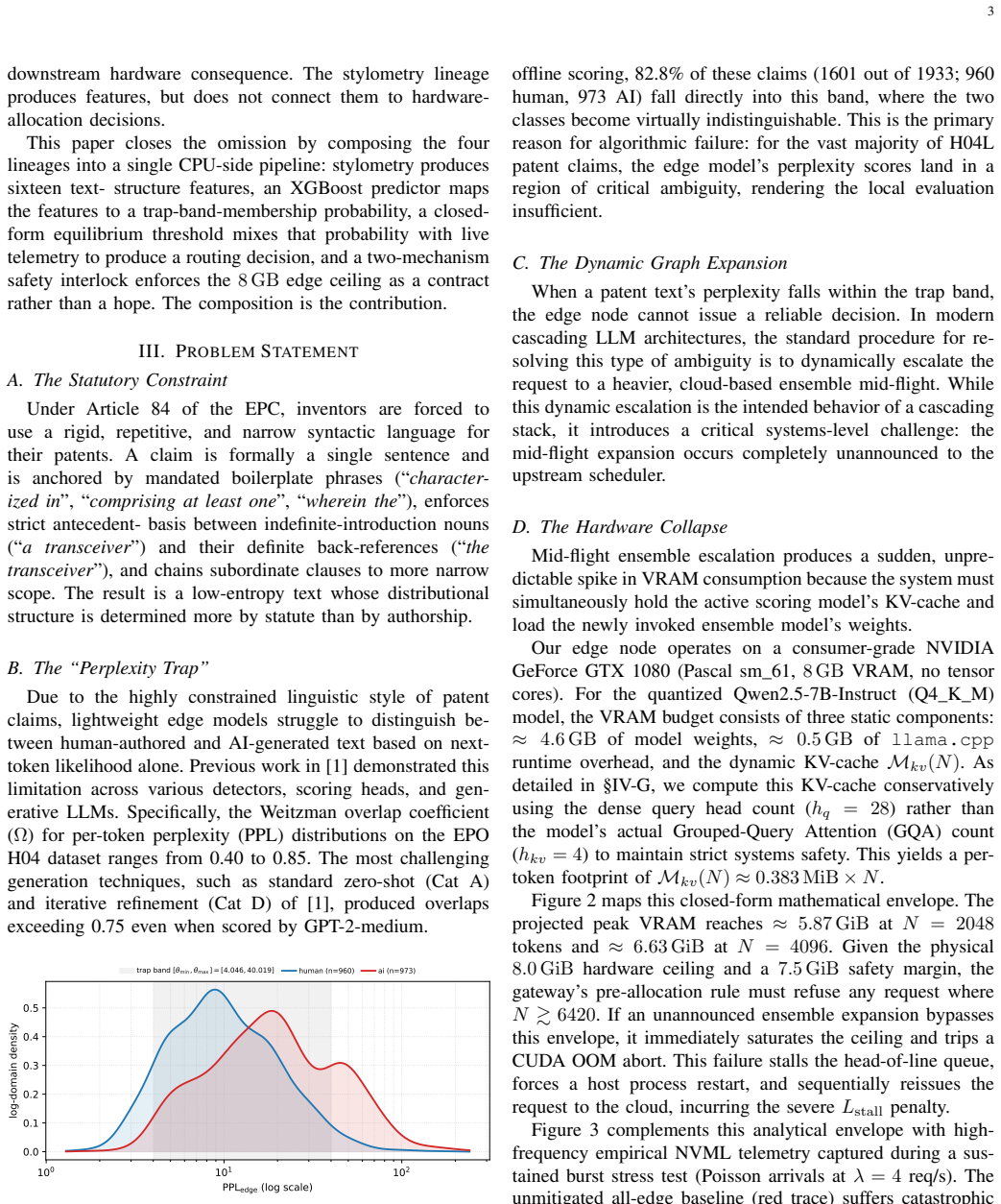
On EPO-style patent claims the linguistic register itself, not token length, drives whether a lightweight edge model will fall into an ambiguous perplexity band and force an expensive ensemble escalation. A sixteen-dimensional CPU-side feature vector plus an XGBoost trap-band predictor, gated by a telemetry-derived closed-form threshold, can forecast that escalation probability and route the request before any edge GPU memory is allocated, reducing operational misroutes by an order of magnitude while strictly respecting an 8 GiB VRAM ceiling.
What carries the argument
Linguistic Resource Forecasting (LRF) gateway: a sub-5 ms CPU pipeline that extracts a fixed 16-dimensional text-structure vector, feeds it to an XGBoost trap-band classifier to obtain P_escalate, then compares that probability against a closed-form, latency-telemetry threshold τ_route(t) before any edge GPU allocation occurs.
Load-bearing premise
The single trap-band interval calibrated on H04L claim-level perplexity is treated as a stable ground-truth label for “hardware-threatening” requests, yet the paper itself shows that band fails to transfer to other patent classes or even to abstracts of the same class without recalibration.
What would settle it
Re-run the identical 6 000-request live trial on a held-out IPC (for example C07D abstracts) while deliberately reusing the original H04L claim-level trap band without recalibration; if the operational misroute fraction does not stay near 0.09 and VRAM safety is lost, the central claim does not hold under distribution shift.
Editorial analysis
A structured set of objections, weighed in public.
Referee Report
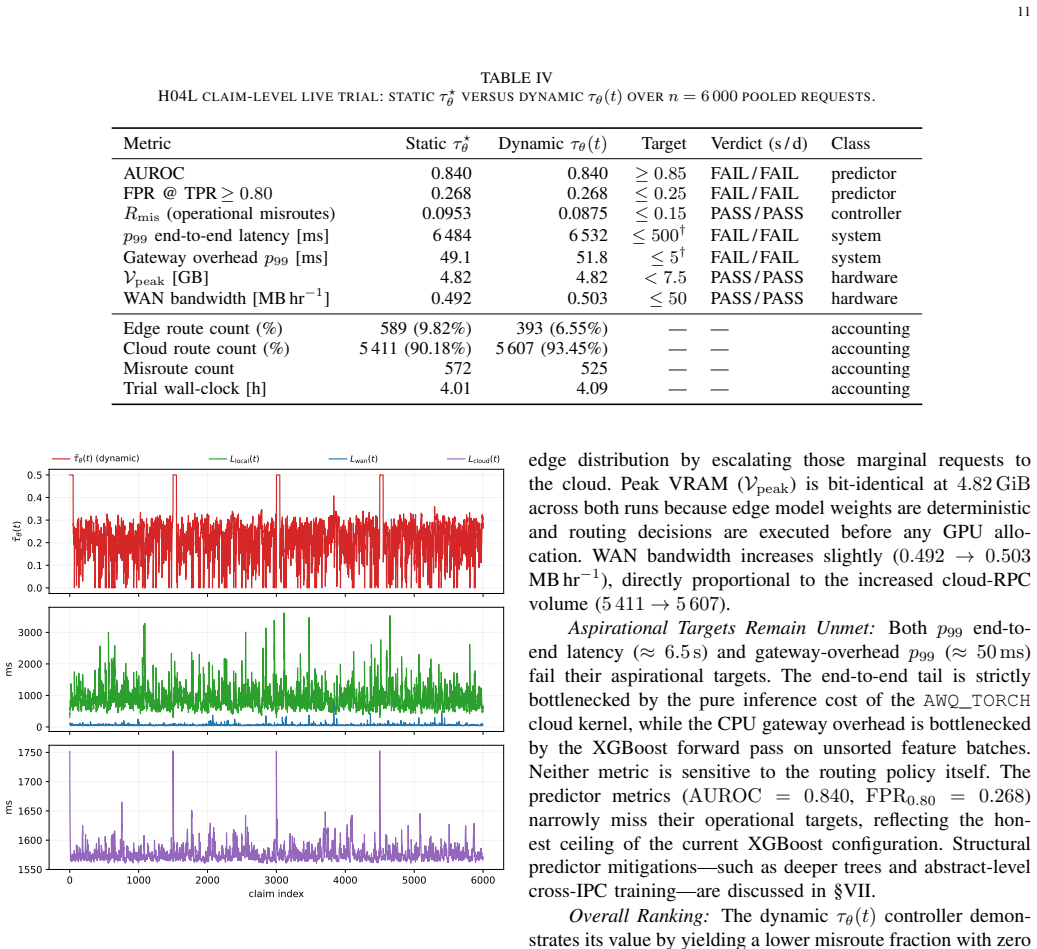
Summary. The paper proposes a CPU-side Linguistic Resource Forecasting (LRF) gateway for edge–cloud LLM routing on statutorily constrained text (EPO patent claims). It extracts a 16-dimensional text-structure vector, predicts edge-perplexity trap-band membership with XGBoost (P_escalate), and compares that probability to a closed-form, telemetry-driven routing threshold τ_θ(t) derived by equating expected edge vs. cloud latencies under a Bernoulli escalation model. A dual VRAM safety interlock (closed-form pre-allocation + cooperative NVML abort) is intended to keep a GTX 1080 under 8 GiB. In a 6,000-request H04L live trial the system reports R_mis of 0.087–0.095 versus 0.849 for a token-count baseline, peak edge VRAM of 4.82 GiB, live AUROC 0.84, and an 8.2% relative misroute reduction from the dynamic threshold versus a static one, with additional WAN-shaping and cross-IPC ablations.
Significance. If the result holds under the stated scope, the work is a genuine systems contribution: it connects register-aware stylometry to hardware-resource forecasting and pre-allocation routing, a gap the paper correctly identifies in token-count and static-threshold schedulers. Strengths that should be credited include (i) a closed-form equilibrium threshold with an explicit override hierarchy, (ii) an analytical non-GQA VRAM envelope plus dual safety interlock, (iii) multi-seed 6,000-request live trials, (iv) a 27× WAN-shaping ablation showing R_mis stability, and (v) unusually honest reporting of missed operational targets (AUROC, FPR, p99, gateway overhead). The problem of content-triggered mid-flight ensemble expansion on consumer-grade edge GPUs is real and under-served. The main significance is therefore engineering and architectural rather than a universal linguistic law; the contribution is defensible once claims are scoped to the calibration niche the paper itself measures.
major comments (4)
- §VI-D / Table VI / Fig. 12: The paper shows that zero of four per-IPC abstract-level trap bands fall within ±5% of the H04L claim-level endpoints used as ground truth for every R_mis and AUROC number (even H04L abstracts shift θ_min by +38.5% and θ_max by −31.8%). The abstract and §I headline the order-of-magnitude R_mis reduction without that scope. Either (a) restate the central claim as H04L-claim-specific and move transferability into the abstract/intro as a hard limitation, or (b) report at least one full live-trial pipeline (recalibrated band + XGBoost + τ_θ) on a second IPC/text kind so the 10× claim is not defined only against a non-transferable label.
- §I / §IV-A vs Table IV: The architecture is repeatedly specified as a “sub-5 ms” / “<5 ms end-to-end” CPU pipeline. Live-trial gateway overhead p99 is 49.1–51.8 ms (pilot already 26.4 ms). That is an order-of-magnitude miss of a load-bearing systems claim, not an aspirational footnote. Either close the gap (C++/pybind11 extractor, batched XGBoost, dedicated core as promised in §V-F) and re-measure, or remove the sub-5 ms claim from the abstract/intro and replace it with the measured envelope so readers are not sold a real-time gateway the evaluation does not deliver.
- §V-A / §IV-C / Table IV: R_mis is defined as agreement with offline Weitzman-α trap-band membership of PPL_edge, not as prevented OOMs, end-to-end correctness of authorship verdicts, or oracle latency. Live AUROC 0.840 and FPR@TPR≥0.80 = 0.268 both fail the paper’s own operational gates (≥0.85, ≤0.25), and 90–93% of requests are cloud-routed. The 10× improvement over token-count is therefore “correctness relative to a local, imperfect label” under a mostly-cloud policy. Clarify in §V-A and §VI-B what fraction of R_mis reduction is (i) true hardware-threat interception vs (ii) over-escalation of edge-safe claims, and report secondary R_lat_mis (already defined) as a first-class number so the systems benefit is not solely label agreement.
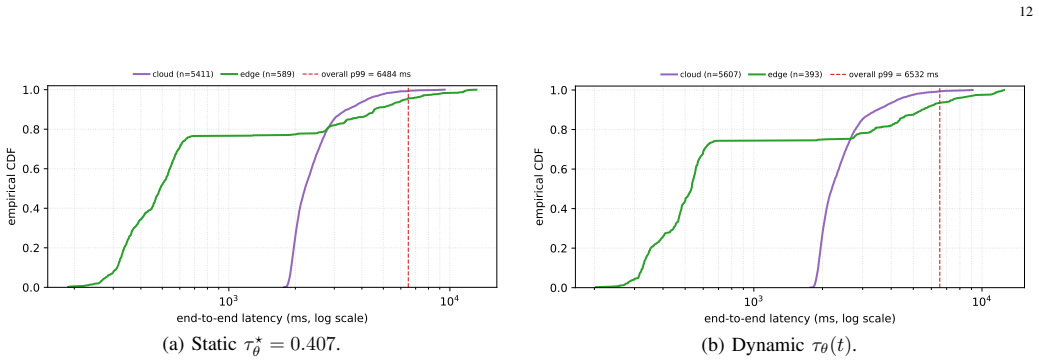
- §V-C / §VI-B: Cloud latency is deliberately inflated 2–3× by the pure-PyTorch AWQ_TORCH kernel (L_cloud ≈ 1.8 s), making p99 ≈ 6.5 s and rendering the ≤500 ms target unreachable by construction. That choice is disclosed, but it also softens the latency cost of the LRF’s high cloud fraction relative to the token-count baseline (p99 5.37 s, almost all-edge). A sensitivity run with a faster kernel (or a reported Marlin/sm90 estimate) is needed to show that the R_mis win survives when cloud is cheap; otherwise the comparison partly rewards a self-imposed cloud penalty.
Circularity Check
No derivation reduces to its inputs by construction; mild self-citation of the prior trap phenomenon and features is present but not load-bearing for the routing algebra or live-trial metrics.
specific steps
-
self citation load bearing
[§I-B Relation to Prior Work; Table II features F1–F2,F5–F9]
"This paper builds partly on the [1], which established the perplexity-trap phenomenon as a structural failure of likelihood-based AI-text detectors on EPO claims. ... Inherited features F1, F2, F5, F6, F7, F8, F9 lift the [1] F1–F7 set"
The existence of the trap band and seven of the linguistic features are imported from the same author’s prior paper rather than re-derived from first principles inside the present manuscript. The citation is not load-bearing for the routing algebra or the live-trial numbers, but it is the sole external justification offered for the phenomenon that motivates the entire gateway.
full rationale
The closed-form routing threshold (Eq. 5) is obtained by equating two expected-latency expressions under a Bernoulli escalation model and solving for the equilibrium probability; the algebra cancels L_local and is independent of any linguistic features or the XGBoost predictor. Trap-band labels used as training targets and as ground truth for R_mis are produced offline by a Weitzman-α procedure on edge PPL densities (Eq. 1 and §IV-E), not from the 16-dimensional LRF vector itself, so the classifier is ordinary supervised prediction rather than a tautology. The dual VRAM interlock is a conservative closed-form envelope plus NVML polling, again independent of the linguistic model. The only self-citation is to the author’s prior workshop paper [1] for the existence of the perplexity trap and seven of the fifteen off-axis features; that citation is not required for the derivation of τ_θ(t), the safety interlocks, or the empirical 6 000-request measurements, all of which are re-demonstrated on the present Qwen2.5 stack. Consequently the central systems claims do not reduce by construction to their inputs.
Axiom & Free-Parameter Ledger
free parameters (7)
- Weitzman α-mass for trap-band extraction =
0.90
- Trap-band endpoints [θ_min, θ_max] =
[4.046, 40.019]
- Static latency seeds for frozen τ★_θ trial =
τ★_θ=0.407
- XGBoost hyperparameters (depth, lr, subsample, rounds) =
depth=6, lr=0.05
- Conservative non-GQA KV head count h_kv=28 =
h_kv=28 (vs true 4)
- VRAM safety margins (7.5 GiB refuse, 95 %/85 % abort hysteresis) =
7.5 GiB / 95 % / 85 %
- EWMA α and cold-start prior for dynamic τ_θ(t) =
α=0.2, prior=0.50
axioms (5)
- domain assumption Article 84 EPC forces a low-entropy, boilerplate-heavy claim register that produces a large Weitzman overlap (perplexity trap) between human and AI text under lightweight edge models.
- domain assumption Token count and rolling latency averages are content-invariant proxies that cannot separate trap-band from out-of-band claims on short patent text.
- standard math Expected edge and cloud latencies under Bernoulli escalation can be equated to yield a unique equilibrium escalation probability τ_θ(t).
- domain assumption A consumer-grade 8 GB Pascal GPU with quantized 7B weights will OOM under unannounced mid-flight ensemble expansion for typical claim lengths.
- ad hoc to paper Sixteen static text-structure features (including eight new EPC-aware ones) are sufficiently orthogonal to likelihood to predict trap-band membership at AUROC ~0.84.
invented entities (3)
-
Linguistic Resource Forecasting (LRF) gateway
no independent evidence
-
Closed-form dynamic routing threshold τ_θ(t) with override hierarchy
no independent evidence
-
Hybrid VRAM safety interlock (Mechanism A cooperative NVML abort + Mechanism B closed-form pre-allocation)
no independent evidence
read the original abstract
Standard distributed \ac{llm} schedulers rely on static token counts or rolling latency averages, making them susceptible to failures on statutorily constrained text. On \ac{epo} claims governed by Article 84 \ac{epc}, linguistic rigidity makes human and machine authorship statistically indistinguishable. Resolving this ambiguity mid-flight forces dynamic multi-model ensemble expansion, triggering unpredictable KV-cache and weight-allocation spikes that saturate consumer-grade edge GPU VRAM and cause severe \ac{oom} crashes. To prevent hardware collapse, we propose a CPU-side Linguistic Resource Forecasting (LRF) gateway. The gateway extracts a 16-dimensional text-structure vector and applies an XGBoost predictor to forecast trap-band membership. The resulting escalation probability ($\Pesc$) is evaluated against a dynamic, closed-form routing threshold ($\Tauroute(t)$) computed via real-time latency telemetry. Requests are safely routed to either a local Qwen2.5-7B edge worker or a remote contrastive ensemble (Qwen2.5 7B + 32B) on an NVIDIA H100 \emph{before} any edge GPU memory is allocated. In a 6,000-request live trial, the LRF gateway reduced the operational misroute fraction ($R_{\mathrm{mis}}$) to $0.087$--$0.095$, an order of magnitude below the token-count baseline ($0.849$). Peak edge VRAM remained safely bounded at $\SI{4.82}{\gibi\byte}$ (under the $\SI{8}{\gibi\byte}$ ceiling) across a $27\times$ variation in \ac{wan} delay. The predictor achieved a live-trial AUROC of $0.84$, and the dynamic $\Tauroute(t)$ controller yielded an $8.2\%$ relative reduction in misroutes compared to an equivalent static threshold.
Figures




Reference graph
Works this paper leans on
-
[1]
, title =
Banerjee, A. , title =
-
[2]
Proceedings of the 2025 Conference on Empirical Methods in Natural Language Processing , pages=
Divscore: Zero-shot detection of llm-generated text in specialized domains , author=. Proceedings of the 2025 Conference on Empirical Methods in Natural Language Processing , pages=
2025
-
[3]
Journal of Patient-Centered Research and Reviews , volume=
Charting Truth, Trust, and Transformers: A Critical Look at AI Text Detection and Recommendations for Medical Journals , author=. Journal of Patient-Centered Research and Reviews , volume=
-
[4]
International conference on machine learning , pages=
DetectGPT: Zero-Shot Machine-Generated Text Detection using Probability Curvature , author=. International conference on machine learning , pages=. 2023 , organization=
2023
-
[5]
Proceedings of the 41st International Conference on Machine Learning , pages=
Spotting LLMs with Binoculars: Zero-Shot Detection of Machine-Generated Text , author=. Proceedings of the 41st International Conference on Machine Learning , pages=
-
[6]
and Shen, X
He, X. and Shen, X. and Chen, Z. and Backes, M. and Zhang, Y. , booktitle=
-
[7]
Technology, Knowledge and Learning , pages=
Efficacy of AI-Text Detection Tools in Distinguishing Student-Produced, AI-Edited, and AI-Generated Essays , author=. Technology, Knowledge and Learning , pages=. 2025 , publisher=
2025
-
[8]
Patterns , volume=
GPT detectors are biased against non-native English writers , author=. Patterns , volume=. 2023 , publisher=
2023
-
[9]
and Hancock, J
Jakesch, M. and Hancock, J. T. and Naaman, M. , journal=. Human heuristics for. 2023 , publisher=
2023
-
[10]
Proceedings of the 63rd Annual Meeting of the Association for Computational Linguistics (Volume 1: Long Papers) , pages=
People who frequently use ChatGPT for writing tasks are accurate and robust detectors of AI-generated text , author=. Proceedings of the 63rd Annual Meeting of the Association for Computational Linguistics (Volume 1: Long Papers) , pages=
-
[11]
Big Data and Cognitive Computing , volume=
What Distinguishes AI-Generated from Human Writing? A Rapid Review of the Literature , author=. Big Data and Cognitive Computing , volume=. 2026 , publisher=
2026
-
[12]
arXiv preprint arXiv:2310.05130 , year=
Fast-detectgpt: Efficient zero-shot detection of machine-generated text via conditional probability curvature , author=. arXiv preprint arXiv:2310.05130 , year=
-
[13]
arXiv preprint arXiv:2604.16607 , year=
Spotlights and Blindspots: Evaluating Machine-Generated Text Detection , author=. arXiv preprint arXiv:2604.16607 , year=
-
[14]
Pudasaini, S. and Miralles-Pechu. Why. arXiv preprint arXiv:2603.23146 , year=
-
[15]
Baidya, M. S. and Baidya, S. S. and Chawla, C. , journal=. Detecting the Machine: A Comprehensive Benchmark of
-
[16]
and Zhang, X
Guo, B. and Zhang, X. and Wang, Z. and Jiang, M. and Nie, J. and Ding, Y. and Yue, J. and Wu, Y. , journal =. How Close is
-
[17]
Kwon, W. et. al. , title =. Proceedings of the 29th Symposium on Operating Systems Principles (. 2023 , pages =
2023
-
[18]
Triton Inference Server: An Optimized Cloud and Edge Inferencing Solution , year =
-
[19]
Yu, G. et. al. , title =. 16th. 2022 , pages =
2022
-
[20]
llama.cpp: Port of Facebook's
Georgi Gerganov and. llama.cpp: Port of Facebook's. 2023 , howpublished =
2023
-
[21]
Chen, L. and Zaharia, M. and Zou, J. , title =. arXiv preprint arXiv:2305.05176 , year =
-
[22]
and Kalman, M
Leviathan, Y. and Kalman, M. and Matias, Y. , title =. Proceedings of the 40th International Conference on Machine Learning (. 2023 , pages =
2023
discussion (0)
Sign in with ORCID, Apple, or X to comment. Anyone can read and Pith papers without signing in.