REVIEW 3 major objections 2 minor 2 cited by
No single machine-generated text detector excels across all datasets and metrics, with high variance and poor results on novel human texts.
Reviewed by Pith at T0; open to challenge. T0 means a machine referee read the full paper against a public rubric. the ladder, T0–T4 →
T0 review · grok-4.3
2026-05-10 08:43 UTC
load-bearing objection Detector rankings flip a lot with dataset and metric choice, and all of them struggle on fresh creative human text, but the paper needs tighter controls on how the test sets were picked. the 3 major comments →
Spotlights and Blindspots: Evaluating Machine-Generated Text Detection
The pith
A machine-rendered reading of the paper's core claim, the machinery that carries it, and where it could break.
Core claim
No single system excels in all areas and nearly all are effective for certain tasks, with the representation of model performance critically linked to dataset and metric choices. There is high variance in model ranks based on datasets and metrics, and overall poor performance on novel human-written texts in high-risk domains. Methodological choices that are often assumed or overlooked are essential for clearly and accurately reflecting model performance.
What carries the argument
Comparative evaluation of 22 detection models across seven textual test sets and three creative human-written datasets using multiple metrics to expose performance differences and dependencies.
Load-bearing premise
The selected seven textual test sets and three creative human-written datasets together with the chosen metrics are representative enough to reveal general strengths and weaknesses without selection bias.
What would settle it
A new study using an independent collection of novel human-written texts from additional high-risk domains that shows one or more detectors achieving consistently high accuracy across several standard metrics would falsify the claim of overall poor performance and high variance.
Editorial analysis
A structured set of objections, weighed in public.
Referee Report
Summary. The paper evaluates 15 detection models (from six systems plus seven trained variants) on seven English textual test sets and three creative human-written datasets. It claims that no single system excels across all tasks, that nearly all detectors are effective in specific settings, that model performance rankings exhibit high variance depending on dataset and metric choices, and that detectors show overall poor performance on novel human-written texts in high-risk domains. The authors conclude that often-overlooked methodological choices are essential for accurate assessment of detector effectiveness.
Significance. If the empirical findings hold after addressing controls and representativeness, the work is significant for the MGT detection field: it supplies concrete evidence that single-benchmark claims of superiority are unreliable and that detector blind spots are dataset-dependent. This could encourage more cautious deployment and standardized multi-dataset evaluation protocols.
major comments (3)
- [Abstract and §3] Abstract and §3 (Datasets): The central claims of high rank variance and poor performance on 'novel human-written texts in high-risk domains' rest on the representativeness of the seven textual test sets plus three creative datasets. No selection criteria, domain coverage analysis, or controls for text length/domain overlap are described, so the observed variance could be an artifact of the particular collection rather than a general property.
- [§4 and §5] §4 (Evaluation) and §5 (Results): The reported high variance in model ranks across datasets and metrics is presented without statistical significance tests, confidence intervals, or ablation on confounders such as length and topic. This makes it impossible to determine whether the variance is robust or driven by small per-dataset sample sizes.
- [§5] §5 (Results, high-risk domains subsection): The claim of 'overall poor performance on novel human-written texts in high-risk domains' is load-bearing for the 'blindspots' narrative, yet the paper does not define the high-risk domains, specify how novelty was ensured, or compare against matched human-written controls from the same sources.
minor comments (2)
- [§4] Table captions and metric definitions in §4 should explicitly state whether accuracy, F1, or AUROC is used per dataset and whether thresholds are fixed or optimized.
- [§3] The abstract states 'seven trained models' but the methods section should clarify whether these are fine-tuned on subsets of the test sets or held-out data to avoid leakage.
Simulated Author's Rebuttal
We thank the referee for the constructive and detailed feedback, which helps clarify key aspects of our evaluation methodology. We address each major comment below and indicate the revisions planned for the next version of the manuscript.
read point-by-point responses
-
Referee: [Abstract and §3] Abstract and §3 (Datasets): The central claims of high rank variance and poor performance on 'novel human-written texts in high-risk domains' rest on the representativeness of the seven textual test sets plus three creative datasets. No selection criteria, domain coverage analysis, or controls for text length/domain overlap are described, so the observed variance could be an artifact of the particular collection rather than a general property.
Authors: We agree that the dataset selection process merits more explicit documentation to support the generalizability of our claims. The seven textual test sets were selected to cover diverse domains including news, academic writing, web content, and social media, while the three creative human-written datasets were included specifically to evaluate performance on novel, non-standard text. In the revised manuscript, we will add a dedicated subsection to §3 that details the selection criteria, provides a domain coverage analysis (e.g., via topic modeling or category breakdown), and describes controls applied for text length and domain overlap. revision: yes
-
Referee: [§4 and §5] §4 (Evaluation) and §5 (Results): The reported high variance in model ranks across datasets and metrics is presented without statistical significance tests, confidence intervals, or ablation on confounders such as length and topic. This makes it impossible to determine whether the variance is robust or driven by small per-dataset sample sizes.
Authors: This observation is correct and we will strengthen the statistical rigor of our analysis. In the revised §4 and §5, we will add bootstrap-derived confidence intervals for all reported metrics, apply non-parametric tests (such as the Friedman test followed by Nemenyi post-hoc comparisons) to assess the statistical significance of rank differences, and include ablation experiments that control for text length and topic by length-matching and topic-stratified subsampling across datasets. revision: yes
-
Referee: [§5] §5 (Results, high-risk domains subsection): The claim of 'overall poor performance on novel human-written texts in high-risk domains' is load-bearing for the 'blindspots' narrative, yet the paper does not define the high-risk domains, specify how novelty was ensured, or compare against matched human-written controls from the same sources.
Authors: We will revise the high-risk domains subsection to provide clearer definitions and supporting details. High-risk domains are operationalized as settings where undetected machine-generated text carries substantial societal consequences (education, journalism, and scientific publishing); the creative datasets serve as proxies for novel human text in these areas. Novelty was ensured via temporal separation (texts created after the detectors' training cutoffs) and source verification. We will add explicit definitions, a description of the novelty protocol, and, where source-matched human controls are available in our collection, direct comparisons to better ground the performance claims. revision: partial
Circularity Check
No circularity: purely empirical evaluation of existing detectors on external datasets.
full rationale
The paper performs direct empirical benchmarking of 15+ detection models (from six systems plus seven trained ones) on seven English textual test sets and three creative human-written datasets. No derivations, equations, fitted parameters, or predictions are present; all claims about rank variance, lack of universal best system, and poor performance on novel high-risk texts follow immediately from the reported evaluation results. No self-citations are invoked as load-bearing uniqueness theorems or ansatzes. The analysis is self-contained against external model outputs and datasets, satisfying the default expectation for non-circular empirical work.
Axiom & Free-Parameter Ledger
axioms (1)
- domain assumption The selected English-language test sets and creative human datasets adequately sample the space of machine-generated and human text that detectors will encounter in practice.
read the original abstract
With the rise of generative language models, machine-generated text detection has become a critical challenge. A wide variety of models is available, but inconsistent datasets, evaluation metrics, and assessment strategies obscure comparisons of model effectiveness. To address this, we evaluate 15 different detection models from six distinct systems, as well as seven trained models, across seven English-language textual test sets and three creative human-written datasets. We provide an empirical analysis of model performance, the influence of training and evaluation data, and the impact of key metrics. We find that no single system excels in all areas and nearly all are effective for certain tasks, and the representation of model performance is critically linked to dataset and metric choices. We find high variance in model ranks based on datasets and metrics, and overall poor performance on novel human-written texts in high-risk domains. Across datasets and metrics, we find that methodological choices that are often assumed or overlooked are essential for clearly and accurately reflecting model performance.
Figures

Forward citations
Cited by 2 Pith papers
-
ARB: A Matched Authorship-Rewriting Benchmark Dataset for AI-Text Detector Evaluation
A matched four-regime benchmark shows AI-text detectors catch direct LLM output but lose most of their recall on human text rewritten by an LLM.
-
When Words Predict Workload
Linguistic features plus a closed-form latency threshold route patent-claim LLM requests before edge GPU allocation, cutting misroutes from 0.85 to ~0.09 while bounding VRAM at 4.82 GiB.
Reference graph
Works this paper leans on
-
[1]
Spotlights and Blindspots: Evaluating Machine-Generated Text Detection
Introduction Recent years have witnessed remarkable advance- ments in generative systems capable of produc- ing realistic video, audio, and text. While these technologies offer significant benefits, they also introduce serious challenges in verifying the ori- gin of content. Distinguishing between machine- generatedandhuman-writtentext,inparticular,has be...
work page internal anchor Pith review Pith/arXiv arXiv 2025
-
[2]
Systems We assemble a diverse collection of contemporary machine-generated text detection systems, includ- ing zero-shot and trained public models, pretrained transformers, and feature-based approaches. Ta- ble 1 summarizes the selected model variants, de- tailingtheiroriginalevaluationdata, metrics, andre- ported performance. Our goal is to explore impac...
work page 2025
-
[3]
Data To ensure standardized, robust evaluations, we establish a unified dataset comprising seven test sets derived from four benchmark datasets: MAGE (aka Deepfake) (Li et al., 2024):This datasetconsistsofa447khumanandAI-generated text samples covering diverse models and method- ologies. We extract three test sets: (1) a class- balanced sample of 10k from...
work page 2024
-
[4]
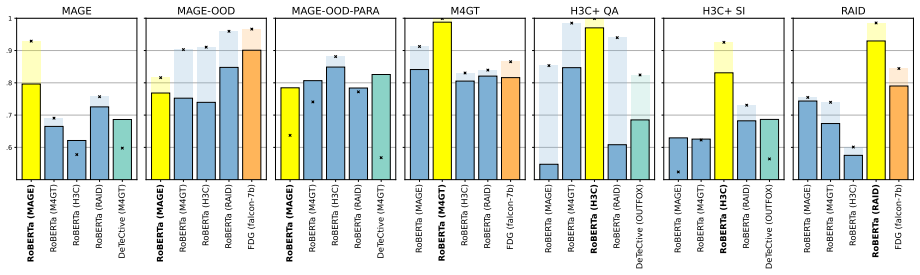
Experiments We evaluate each system on each of the eight datasets described above. For comparison include a trivial baseline system (All positive) that assigns every sample a score of 1 (machine-generated).3 For our initial evaluation, we use F1 score (thresh- old=0.5)andAUROC;wediscussmoreonmetrics in Section 5. Results are shown in Figure 1. We start by...
work page 2025
-
[5]
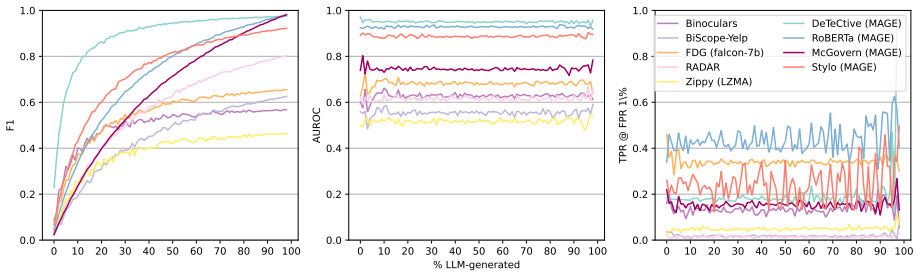
Metrics Our dataset analysis reveals divergences between F1 and AUROC metrics: while Binoculars, BiS- cope, and Fast-DetectGPT achieve strong AUROC scores despite comparatively low F1 scores, De- Threshold 0.5 Threshold by EER Threshold invariant Model Precision Recall F1 Accuracy AvgRec Precision Recall F1 Accuracy AvgRec AUROC TPR@FPR 1% TPR@FPR .01% Va...
-
[6]
(2024), who explicitly advocate for AUROC’s threshold- agnostic benefits, and Hans et al
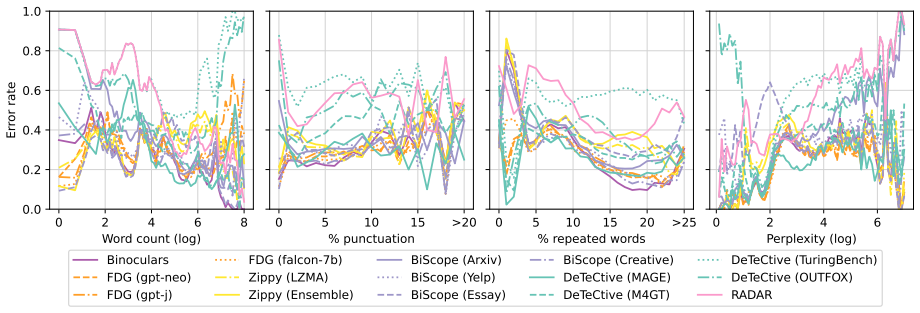
Analysis To investigate performance differences, we ex- plore four key textual attributes commonly used for machine-generated text detection: length (in words), punctuation, repetition, and perplexity under the facebook/opt-1.3b (Zhang et al., 2022),definedinAppendixD.Weploteachmodels’ error rates against each of these attributes (Figure 5With the notable...
work page 2022
-
[7]
Model behavior patterns in different ways for each attribute
with the goal of identifying trends in these at- tributes that may contribute to disparity in model performance. Model behavior patterns in different ways for each attribute. For word count, models exhibit highly variable performance on low-word count texts, but typically improve as the text length in- creases. However, certain of the DeTeCtive vari- ants...
-
[8]
Conclusions In this work we demonstrate that the choice of datasets and metrics critically influences our as- sessment of machine-generated text detection sys- tem capabilities. Model performance varies sub- stantially across different evaluation frameworks, with each system under specific metric and data conditions. This underscores the necessity of cont...
work page 2024
-
[9]
Ethical Considerations The primary ethical consideration surrounding this work is the ethical application of machine- generated text detection models. We aim to avoid making claims about the general usage of these models, and whether it is appropriate, but under- stand there are ethical implications for employing automated systems for decision making that...
-
[10]
Limitations While our evaluation spans a diverse range of mod- els, it is not exhaustive—many systems and bench- marks fall outside our analysis. We demonstrate that our core findings (evaluation variance on differ- ent datasets, importance of metrics, and relatively weak performance on human-written texts) hold across a representative sample of prevalent...
-
[11]
References Ebtesam Almazrouei, Hamza Alobeidli, Abdulaziz Alshamsi, Alessandro Cappelli, Ruxandra Co- jocaru, Mérouane Debbah, Étienne Goffinet, Daniel Hesslow, Julien Launay, Quentin Malartic, Daniele Mazzotta, Badreddine Noune, Baptiste Pannier, and Guilherme Penedo. 2023. The fal- con series of open language models. Tal August, Maarten Sap, Elizabeth C...
work page 2023
-
[12]
Amrita Bhattacharjee, Raha Moraffah, Joshua Gar- land, and Huan Liu
Longformer: The long-document trans- former. Amrita Bhattacharjee, Raha Moraffah, Joshua Gar- land, and Huan Liu. 2024. Eagle: A domain generalization framework for ai-generated text detection. Steven Bird, Edward Loper, and Ewan Klein. 2009.Natural Language Processing with Python. O’Reilly Media Inc. Scott A. Crossley, Yu Tian, Perpetual Baffour, Alex Fr...
work page 2024
-
[13]
ZeyanLiu, ZijunYao, FengjunLi, andBoLuo.2024
Openorca: An open dataset of gpt aug- mented flan reasoning traces. ZeyanLiu, ZijunYao, FengjunLi, andBoLuo.2024. On the detectability of chatgpt content: Bench- marking, methodology, and evaluation through the lens of academic writing. InProceedings of the 2024 on ACM SIGSAC Conference on Com- puter and Communications Security, CCS ’24, page 2236–2250, N...
work page 2024
-
[14]
Does human collaboration enhance the accuracy of identifying llm-generated deepfake texts? Adaku Uchendu, Zeyu Ma, Thai Le, Rui Zhang, and Dongwon Lee. 2021. TURINGBENCH: A benchmarkenvironmentforTuringtestintheage of neural text generation. InFindings of the As- sociation for Computational Linguistics: EMNLP 2021, pages 2001–2016, Punta Cana, Domini- can...
work page 2021
-
[15]
M4GT-bench: Evaluation benchmark for black-box machine-generated text detection. InProceedings of the 62nd Annual Meeting of the Association for Computational Linguistics (Volume 1: Long Papers), pages 3964–3992, Bangkok, Thailand. Association for Computa- tional Linguistics. Thomas Wolf, Lysandre Debut, Victor Sanh, Julien Chaumond, Clement Delangue, Ant...
work page 2020
-
[16]
Kangxi Wu, Liang Pang, Huawei Shen, Xueqi Cheng, and Tat-Seng Chua
Detectrl: Benchmarkingllm-generatedtext detection in real-world scenarios. Kangxi Wu, Liang Pang, Huawei Shen, Xueqi Cheng, and Tat-Seng Chua. 2023. LLMDet: A third party large language models generated text detection tool. InFindings of the Association for Computational Linguistics: EMNLP 2023, pages 2113–2133, Singapore. Association for Compu- tational ...
work page 2023
-
[17]
short" text types (Yelp and Arxiv), and two
ArobustlyoptimizedBERTpre-trainingap- proach with post-training. InProceedings of the 20th Chinese National Conference on Compu- tational Linguistics, pages 1218–1227, Huhhot, China. Chinese Information Processing Society of China. A. Metrics We here define the metrics used for evaluation. We use thenumpy and scikit-learn packages to calculate these metri...
work page 2024
discussion (0)
Sign in with ORCID, Apple, or X to comment. Anyone can read and Pith papers without signing in.