REVIEW 2 major objections 6 minor 73 references
Offline robustness scores do not reliably flag the sensor corruptions that make autonomous cars fail on the road.
Reviewed by Pith at T0; open to challenge. T0 means a machine referee read the full paper against a public rubric. the ladder, T0–T4 →
T0 review · grok-4.5
2026-07-11 10:59 UTC pith:5GICPC7Y
load-bearing objection Solid empirical demonstration that offline perturbation rankings only moderately predict closed-loop failures on a real vehicle; the gap is real on this platform even if generalizability is limited. the 2 major comments →
Real-World Perturbation Testing of Autonomous Driving Systems
The pith
A machine-rendered reading of the paper's core claim, the machinery that carries it, and where it could break.
Core claim
Across both camera and LiDAR modalities, model-level metrics alone are insufficient to identify the most harmful perturbations. Robustness observations from recorded data do not consistently transfer to closed-loop behavior on a physical vehicle: camera perturbations with limited offline impact can still induce unstable control and failures in real driving, while LiDAR degradation is more consistent at the perception level but weakly predictive of system-level failures.
What carries the argument
A unified library of 72 camera and LiDAR perturbations executed at three nested levels—offline model evaluation, hardware-in-the-loop ROS replay, and live vehicle-in-the-loop injection—so the same corruptions can be compared from prediction error through real driving outcomes.
Load-bearing premise
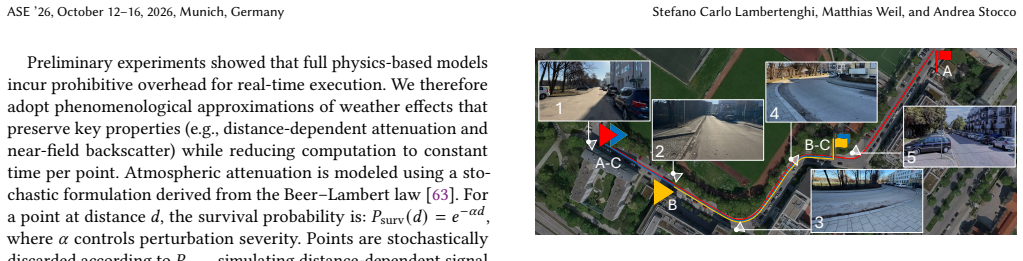
The broad claim that offline metrics are systematically insufficient rests on one short urban route, one vehicle platform, fixed low speed, and two specific driving stacks.
What would settle it
Repeat the same multi-level protocol on several different routes, speeds, and ADS architectures; if offline rankings of harmful perturbations then reliably match vehicle-in-the-loop failure rankings (strong correlation and high top-k overlap), the transfer-gap claim fails.
If this is right
- Offline metrics such as steering MSE or detection retention will mis-rank which perturbations are safety-critical in closed-loop driving.
- Real-time latency budgets must be part of any real-world perturbation suite; several published LiDAR weather models are too slow to run live.
- Simple training on perturbed data can remove failures under rain, glare, mud, and wet roads while preserving nominal performance.
- Vision and LiDAR stacks fail differently: camera systems show diverse control instability; LiDAR systems fail more often by collision after unstable detections.
- Claiming robustness for ADS requires complementary physical closed-loop evaluation, not dataset scores alone.
Where Pith is reading between the lines
- Certification processes that rely mainly on static corruption benchmarks may systematically under-detect closed-loop failure modes.
- Even high-fidelity simulators will leave the same gap unless they reproduce vehicle dynamics, sensor timing, and feedback tightly enough to match live ViL rankings.
- End-to-end stacks need control-stability metrics under perturbation; modular stacks need temporal detection stability, not only frame-wise recall.
- Extending this multi-level protocol to multi-route, multi-vehicle fleets is the natural test of whether the offline-to-online gap is structural.
Editorial analysis
A structured set of objections, weighed in public.
Referee Report
Summary. The paper presents a large-scale empirical study of 72 camera and LiDAR perturbations applied to two ADS stacks (an end-to-end vision model and a modular LiDAR perception–planning stack) across three testing modalities: offline model-level evaluation, hardware-in-the-loop on vehicle compute, and closed-loop vehicle-in-the-loop driving on a full-scale Passat. Using MSE/max deviation for camera steering, retention/ATE for LiDAR detections, latency budgets, completion rates, failure-type taxonomies, CTE, jitter, and near-field coverage, the authors report that offline model-level metrics transfer only moderately (Spearman ρ ≈ 0.40–0.56) and with weak top-k agreement to closed-loop failures, that real-time feasibility filters many published LiDAR weather models, and that perturbation-based fine-tuning of the vision model improves robustness under real weather while preserving nominal performance. The central claim is that model-level metrics alone are insufficient to identify the most harmful perturbations and that recorded-data robustness does not consistently transfer to physical closed-loop behavior.
Significance. If the reported transfer gap holds under the studied conditions, the work is a substantial contribution to software engineering for ADS: it is among the first systematic cross-modality, cross-level robustness studies that include real full-scale closed-loop driving rather than only datasets or simulation. Strengths include a unified ROS perturbation library spanning 72 techniques, transparent real-time cut-offs (33 ms camera / 200 ms LiDAR), quantified transfer analysis with bootstrap CIs and BH correction, failure-hotspot clustering, and a practical demonstration that simple synthetic fine-tuning can reduce real-weather failures. These results give concrete evidence that offline robustness rankings can mislead system-level risk assessment and that runtime feasibility is a first-class constraint for on-vehicle testing—findings that are actionable for both researchers and practitioners building ADS test pipelines.
major comments (2)
- [Abstract; §4.2; §5 Transfer analysis; §8 Conclusions] The abstract, introduction, and conclusions state quite generally that “model-level metrics alone are insufficient” and that offline observations “do not consistently transfer” to closed-loop physical behavior. The supporting evidence (Table 1, RQ3 failure profiles, Section 5 Spearman/top-k analysis) is convincing for the studied platform, but all ViL results come from a single 450 m urban route without intersections, fixed 20 km/h, one vehicle, and two specific stacks (Section 4.2; Threats to Validity). This design is already acknowledged, yet the breadth of the claim still exceeds the sampling frame. Please either (a) rephrase the central claims to the scope of the evidence (these systems, this route class, these severity schedules) or (b) add at least one additional route/environment or speed regime that shows the same qualitative mismatch, so the transfer-gap conclusion is not carrie
- [§4.4.3 RQ3; Table 1; §5 Transfer analysis] ViL coverage is 119 runs across 72 perturbations and multiple severities (Section 4.4.5). For many camera/LiDAR entries in Table 1 the outcome vector is a single severity ladder rather than repeated trials, so failure-type labels and completion rates have no reported run-to-run variance. The transfer analysis therefore pools perturbation–intensity pairs that may be noisy. Please report the number of independent ViL repetitions per (perturbation, severity) cell used in the Spearman and top-k calculations, or add a short sensitivity check (e.g., bootstrap over runs where multiples exist) so that the moderate ρ and low top-5 overlap cannot be attributed to single-shot outcomes.
minor comments (6)
- [Table 1] Table 1 is extremely dense (camera + LiDAR, many columns, mixed units). Consider splitting into two tables or moving latency/completion columns to an appendix figure so that the offline-vs-ViL mismatch is easier to read at a glance.
- [Figure 4; §5 Failure hotspots] Figure 4 hotspots are informative but the legend and semi-transparent noise points are hard to parse in grayscale; a small inset table of cluster centroids and dominant categories would help.
- [§4.2 Driving Scenario] Camera and LiDAR ViL use different sub-routes (B vs C). A one-sentence justification that the shared geometry still allows qualitative cross-modality comparison would reduce a possible confound.
- [§4.5.4 RQ4] RQ4 fine-tuning is only for the vision E2E model. Briefly note why an analogous LiDAR augmentation experiment was out of scope, or flag it as future work more explicitly.
- [§2; Table 1] A few identifiers are inconsistent in the text (e.g., C-C-XII vs C-CXII style). Normalize the compact IDs throughout.
- [§3.3 Perturbation Library] The Beer–Lambert survival formula is given without a numbered equation; numbering it would make the lightweight LiDAR approximations easier to cite.
Circularity Check
No circularity: independent offline vs. closed-loop measurements; transfer is empirical correlation, not definitional.
full rationale
This is a purely empirical SE study. Model-level metrics (MSE, max steering deviation, retention, ATE) are computed offline on recorded data; HiL latency and ViL outcomes (completion, failure type, CTE, jitter, coverage) are measured separately on hardware and on a physical vehicle. The central claim—that offline metrics do not reliably identify the most harmful perturbations—is supported by comparing these independently obtained quantities (Table 1; Section 5 Spearman ρ and top-k overlap), not by fitting a parameter and renaming it as a prediction. Fine-tuning (RQ4) trains on synthetic perturbations and evaluates on real weather, so the robustness gain is not forced by construction. Self-citations (e.g., PerturbationDrive) supply the library and prior methodology; they do not define or force the transfer gap. No equation, uniqueness theorem, or ansatz reduces a claimed result to its inputs. Score 0 is appropriate.
Axiom & Free-Parameter Ledger
free parameters (5)
- camera real-time latency budget =
33 ms
- LiDAR real-time latency budget =
200 ms
- CTE pre-failure truncation distance d =
5 m
- severity level schedules =
5 / 3 levels
- near-field detection coverage radius =
5 m
axioms (4)
- domain assumption Controlled synthetic perturbations of camera images and LiDAR point clouds are useful proxies for rare real-world adverse conditions.
- ad hoc to paper A single 450 m urban route without intersections, driven at fixed 20 km/h, is sufficiently representative to expose general transfer gaps between testing levels.
- domain assumption DAVE-2-style end-to-end vision and Autoware Mini modular LiDAR stacks are representative of the two major ADS architectural families.
- ad hoc to paper Beer–Lambert-style stochastic attenuation plus near-field back-scatter is a faithful enough phenomenological model of weather effects for real-time LiDAR testing.
invented entities (2)
-
Lightweight LiDAR weather approximations (L-AIV, L-AVI, L-AIX)
no independent evidence
-
ROS-based unified perturbation framework spanning model/HiL/ViL
no independent evidence
read the original abstract
Autonomous Driving Systems (ADS) must operate reliably under diverse conditions, yet representative data for rare or adverse scenarios is difficult to obtain. Perturbation-based testing is widely used to assess robustness, but most studies focus on offline datasets or simulation, leaving open questions about how such results translate to real-world driving. We present a large-scale study of 72 camera and LiDAR perturbations, evaluated across three testing modalities: offline model-level analysis, hardware-in-the-loop execution, and closed-loop system-level testing on a full-scale autonomous vehicle. The study covers both an end-to-end vision-based driving model and a modular LiDAR-based perception and planning stack. Our results reveal a clear gap between testing levels. For camera-based systems, perturbations with limited offline impact can still induce unstable control and failures in real-world driving. For LiDAR-based systems, degradation is more consistent at the perception level but weakly predictive of system-level failures. Across both modalities, model-level metrics alone are insufficient to identify the most harmful perturbations. We further show that real-time feasibility is a key constraint in real-world testing, and that robustness observations obtained from recorded data do not consistently transfer to closed-loop behavior on a physical vehicle, highlighting the importance of complementary real-world, system-level evaluation.
Figures



Reference graph
Works this paper leans on
-
[1]
PerturbationDrive
2023. PerturbationDrive. https://github.com/HannesLeonhard/ PerturbationDrive
2023
-
[2]
Nourdine Aliane. 2025. A Survey of Open-Source Autonomous Driving Systems and Their Impact on Research.Information16, 4 (2025). https://www.mdpi.com/ 2078-2489/16/4/317
2025
-
[3]
Anonymous authors. 2019. Anonymized work
2019
-
[4]
Autonomous Driving Lab, University of Tartu. 2023. Vehicle. https://adl.cs.ut.ee/ lab/vehicle. Accessed: 2026-03-06
2023
-
[5]
Jon Ayerdi, Asier Iriarte, Pablo Valle, Ibai Roman, Miren Illarramendi, and Aitor Arrieta. 2024. MarMot: Metamorphic Runtime Monitoring of Autonomous Driv- ing Systems.ACM Trans. Softw. Eng. Methodol.34, 1, Article 18 (Dec. 2024), 35 pages. doi:10.1145/3678171
-
[6]
Luciano Baresi, Davide Yi Xian Hu, Andrea Stocco, and Paolo Tonella. 2025. Efficient Domain Augmentation for Autonomous Driving Testing Using Diffusion Models. InProceedings of 47th International Conference on Software Engineering (ICSE ’25). IEEE
2025
-
[7]
Till Beemelmanns, Quan Zhang, Christian Geller, and Lutz Eckstein. 2024. Multi- Corrupt: A Multi-Modal Robustness Dataset and Benchmark of LiDAR-Camera Fusion for 3D Object Detection. In2024 IEEE Intelligent Vehicles Symposium (IV). 3255–3261. doi:10.1109/IV55156.2024.10588664
-
[8]
Matteo Biagiola, Andrea Stocco, Vincenzo Riccio, and Paolo Tonella. 2024. Two is better than one: digital siblings to improve autonomous driving testing.Empirical Softw. Engg.29, 4 (May 2024), 33 pages. doi:10.1007/s10664-024-10458-4
-
[9]
Jackel, Mathew Monfort, Urs Muller, Jiakai Zhang, Xin Zhang, Jake Zhao, and Karol Zieba
Mariusz Bojarski, Davide Del Testa, Daniel Dworakowski, Bernhard Firner, Beat Flepp, Prasoon Goyal, Lawrence D. Jackel, Mathew Monfort, Urs Muller, Jiakai Zhang, Xin Zhang, Jake Zhao, and Karol Zieba. 2016. End to End Learning for Self-Driving Cars. arXiv:1604.07316 [cs.CV]
Pith/arXiv arXiv 2016
-
[10]
Boudette
Neal E. Boudette. 2017. Tesla’s Self-Driving System Cleared in Deadly Crash. https://www.nytimes.com/2017/01/19/business/tesla-model-s-autopilot- fatal-crash.html
2017
-
[11]
Caesar, V
H. Caesar, V. Bankiti, A. H. Lang, S. Vora, V. E. Liong, Q. Xu, A. Krishnan, Y. Pan, G. Baldan, and O. Beijbom. 2020. nuScenes: A Multimodal Dataset for Autonomous Driving. InProceedings of the IEEE/CVF Conference on Computer Vision and Pattern Recognition. 11621–11631
2020
-
[12]
ROS Community. 2021. velodyne - ROS Wiki. https://wiki.ros.org/velodyne. Accessed: 2025-05-22
2021
-
[13]
Victor Crespo-Rodriguez, Neelofar, and Aldeida Aleti. 2024. PAFOT: A Position- Based Approach for Finding Optimal Tests of Autonomous Vehicles. InProceed- ings of the 5th ACM/IEEE International Conference on Automation of Software Test (AST 2024)(Lisbon, Portugal)(AST ’24). ACM, 159–170. doi:10.1145/3644032. 3644457
-
[14]
Ekin Dogus Cubuk, Barret Zoph, Jon Shlens, and Quoc Le. 2020. RandAug- ment: Practical Automated Data Augmentation with a Reduced Search Space. In Advances in Neural Information Processing Systems, Vol. 33. Curran Associates, Inc
2020
-
[15]
Sha, Victor Chung Sing Lee, and Sang Hyuk Son
Penglin Dai, Kai Liu, Qingfeng Zhuge, Edwin H.-M. Sha, Victor Chung Sing Lee, and Sang Hyuk Son. 2016. Quality-of-Experience-Oriented Autonomous Intersection Control in Vehicular Networks.IEEE Transactions on Intelligent Transportation Systems17, 7 (2016), 1956–1967. doi:10.1109/TITS.2016.2514271
-
[16]
Samuel Dodge and Lina Karam. 2016. Understanding how image quality affects deep neural networks. In2016 Eighth International Conference on Quality of Multimedia Experience (QoMEX). 1–6. doi:10.1109/QoMEX.2016.7498955
-
[18]
Yinpeng Dong, Caixin Kang, Jinlai Zhang, Zijian Zhu, Yikai Wang, Xiao Yang, Hang Su, Xingxing Wei, and Jun Zhu. 2023. Benchmarking Robust- ness of 3D Object Detection to Common Corruptions in Autonomous Driving. arXiv:2303.11040 [cs.CV] https://arxiv.org/abs/2303.11040 nuscenes-C + pertur- bations
Pith/arXiv arXiv 2023
-
[19]
dSPACE dSPACE. 2026. dSPACE Microautobox. https://www.dspace.com/de/ gmb/home.cfm
2026
-
[20]
Martin Ester, Hans-Peter Kriegel, Jörg Sander, and Xiaowei Xu. 1996. A density- based algorithm for discovering clusters in large spatial databases with noise. In Proceedings of the Second International Conference on Knowledge Discovery and Data Mining(Portland, Oregon)(KDD’96). AAAI Press, 226–231
1996
-
[21]
2022–2025
Autoware Foundation. 2022–2025. Autoware Core/Universe. https://github.com/ autowarefoundation/autoware
2022
-
[22]
Andreas Geiger, Philip Lenz, Christoph Stiller, and Raquel Urtasun. 2013. Vision meets Robotics: The KITTI Dataset.International Journal of Robotics Research (IJRR)(2013)
2013
-
[23]
Robert Geirhos, Carlos R. M. Temme, Jonas Rauber, Heiko H. Schütt, Matthias Bethge, and Felix A. Wichmann. 2018. Generalisation in humans and deep neural networks. InAdvances in Neural Information Processing Systems, Vol. 31. Curran Associates, Inc
2018
-
[24]
Sorin Grigorescu, Bogdan Trasnea, Tiberiu Cocias, and Gigel Macesanu. 2020. A survey of deep learning techniques for autonomous driving.Journal of Field Robotics37, 3 (2020), 362–386
2020
-
[25]
David Grossman. 2018. Uber Self-Driving Car Kills Pedestrian in Ari- zona. https://www.popularmechanics.com/technology/infrastructure/a19482100/ uber-self-driving-car-kills-pedestrian-in-arizona/
2018
-
[26]
Martin Hahner, Christos Sakaridis, Mario Bijelic, Felix Heide, Fisher Yu, Dengxin Dai, and Luc Van Gool. 2022. LiDAR Snowfall Simulation for Robust 3D Object Detection. InIEEE/CVF Conference on Computer Vision and Pattern Recognition (CVPR)
2022
-
[27]
Fitash Ul Haq, Donghwan Shin, Shiva Nejati, and Lionel Briand. 2020. Comparing Offline and Online Testing of Deep Neural Networks: An Autonomous Car Case Study. InProceedings of 13th IEEE International Conference on Software Testing, Verification and Validation (ICST ’20). IEEE
2020
-
[28]
Fitash Ul Haq, Donghwan Shin, Shiva Nejati, and Lionel Briand. 2021. Can offline testing of deep neural networks replace their online testing? a case study of automated driving systems.Empirical Software Engineering26, 5 (2021), 90
2021
-
[29]
Dan Hendrycks and Thomas Dietterich. 2019. Benchmarking Neural Network Robustness to Common Corruptions and Perturbations. arXiv:1903.12261 [cs.LG] https://arxiv.org/abs/1903.12261
Pith/arXiv arXiv 2019
-
[30]
Dan Hendrycks and Thomas Dietterich. 2019. Benchmarking Neural Network Ro- bustness to Common Corruptions and Perturbations. InInternational Conference on Learning Representations (ICLR)
2019
-
[31]
Cubuk, Barret Zoph, Justin Gilmer, and Balaji Lakshminarayanan
Dan Hendrycks, Norman Mu, Ekin D. Cubuk, Barret Zoph, Justin Gilmer, and Balaji Lakshminarayanan. 2020. AugMix: A Simple Data Processing Method to Improve Robustness and Uncertainty.Proceedings of the International Conference on Learning Representations (ICLR)(2020)
2020
-
[32]
Gabriel M. Hoffmann, Claire J. Tomlin, Michael Montemerlo, and Sebastian Thrun. 2007. Autonomous Automobile Trajectory Tracking for Off-Road Driving: Controller Design, Experimental Validation and Racing. In2007 American Control Conference. 2296–2301. doi:10.1109/ACC.2007.4282788
-
[33]
Nargiz Humbatova, Gunel Jahangirova, Gabriele Bavota, Vincenzo Riccio, An- drea Stocco, and Paolo Tonella. 2020. Taxonomy of real faults in deep learning systems. InProceedings of the ACM/IEEE 42nd international conference on software engineering. 1110–1121. ASE ’26, October 12–16, 2026, Munich, Germany Stefano Carlo Lambertenghi, Matthias Weil, and Andrea Stocco
2020
-
[34]
2025.Tesla found partly to blame for fatal Autopilot crash
Lily Jamali. 2025.Tesla found partly to blame for fatal Autopilot crash. BBC News. https://www.bbc.com/news/articles/c93dqpkwx4xo Accessed: 2026-02-03
2025
-
[35]
Chiranjeevi Karri, José Machado da Silva, and Miguel Velhote Correia. 2023. Key Indicators to Assess the Performance of LiDAR-Based Perception Algorithms: A Literature Review.IEEE Access11 (2023), 109142–109168. doi:10.1109/ACCESS. 2023.3321912
doi:10.1109/access 2023
-
[36]
Diederik P. Kingma and Jimmy Ba. 2017. Adam: A Method for Stochastic Opti- mization. arXiv:1412.6980 [cs.LG] https://arxiv.org/abs/1412.6980
Pith/arXiv arXiv 2017
-
[37]
Philip Koopman and Michael Wagner. 2017. Autonomous Vehicle Safety: An Interdisciplinary Challenge.IEEE Intelligent Transportation Systems Magazine9, 1 (2017), 90–96. doi:10.1109/MITS.2016.2583491
-
[38]
Jan Laermann, Wojciech Samek, and Nils Strodthoff. 2019. Achieving Gener- alizable Robustness of Deep Neural Networks by Stability Training. InPattern Recognition. Springer, 360–373
2019
-
[39]
Stefano Carlo Lambertenghi, Hannes Leonhard, and Andrea Stocco. 2025. Bench- marking Image Perturbations for Testing Automated Driving Assistance Systems. InProceedings of the 18th IEEE International Conference on Software Testing, Veri- fication and Validation (ICST ’25). IEEE, 12 pages
2025
-
[40]
Stefano Carlo Lambertenghi and Andrea Stocco. 2024. Assessing Quality Metrics for Neural Reality Gap Input Mitigation in Autonomous Driving Testing. In Proceedings of 17th IEEE International Conference on Software Testing, Verification and Validation (ICST ’24). IEEE, 12 pages
2024
-
[41]
Stefano Carlo Lambertenghi, Mirena Flores Valdez, and Andrea Stocco. 2025. A Multi-Modality Evaluation of the Reality Gap in Autonomous Driving Systems. In40th IEEE/ACM International Conference on Automated Software Engineering, ASE 2025, Seoul, Korea, Republic of, November 16-20, 2025. IEEE, 2808–2820. doi:10. 1109/ASE63991.2025.00230
arXiv 2025
-
[42]
Damon Lavrinc. 2018. This Is How Bad Self-Driving Cars Suck In The Rain. https://jalopnik.com/this-is-how-bad-self-driving-cars-suck-in-the-rain- 1666268433
2018
-
[43]
Hannes Leonhard, Stefano Carlo Lambertenghi, and Andrea Stocco. 2026. PerturbationDrive: A Framework for Perturbation-Based Testing of ADAS. arXiv:2603.23661 [cs.SE] https://arxiv.org/abs/2603.23661
arXiv 2026
-
[44]
Yunge Li and Lanyu Xu. 2024. Panoptic Perception for Autonomous Driving: A Survey. arXiv:2408.15388 [cs.RO] https://arxiv.org/abs/2408.15388
Pith/arXiv arXiv 2024
-
[45]
Dongjie Liu, Jin Zhao, Axin Xi, Xinnian Huang Chao Wang, Kuncheng Lai, and Chang Liu. 2020. Data Augmentation Technology Driven By Image Style Transfer in Self-Driving Car Based on End-to-End Learning.Computer Modeling in Engineering & Sciences122, 2 (2020), 593–617
2020
-
[46]
Chengjie Lu, Shaukat Ali, and Tao Yue. 2024. EpiTESTER: Testing Autonomous Vehicles with Epigenetic Algorithm and Attention Mechanism.IEEE Transactions on Software Engineering(2024), 1–19. doi:10.1109/TSE.2024.3449429
-
[47]
Chengjie Lu, Tao Yue, Man Zhang, and Shaukat Ali. 2023. DeepQTest: Testing Autonomous Driving Systems with Reinforcement Learning and Real-world Weather Data. arXiv:2310.05170 [cs.SE] https://arxiv.org/abs/2310.05170
Pith/arXiv arXiv 2023
-
[48]
Siyu Luan, Zonghua Gu, and Shaohua Wan. 2023. Efficient Performance Predic- tion of End-to-End Autonomous Driving Under Continuous Distribution Shifts Based on Anomaly Detection.Journal of Signal Processing Systems95, 12 (12 2023), 1455–1468. doi:10.1007/s11265-023-01893-5
-
[49]
Ecker, Matthias Bethge, and Wieland Brendel
Claudio Michaelis, Benjamin Mitzkus, Robert Geirhos, Evgenia Rusak, Oliver Bringmann, Alexander S. Ecker, Matthias Bethge, and Wieland Brendel. 2020. Benchmarking Robustness in Object Detection: Autonomous Driving when Win- ter is Coming. arXiv:1907.07484 [cs.CV] https://arxiv.org/abs/1907.07484
Pith/arXiv arXiv 2020
-
[50]
Agnieszka Mikołajczyk and Michał Grochowski. 2018. Data augmentation for improving deep learning in image classification problem. In2018 International Interdisciplinary PhD Workshop (IIPhDW). 117–122. doi:10.1109/IIPHDW.2018. 8388338
-
[51]
Norman Mu and Justin Gilmer. 2019. MNIST-C: A Robustness Benchmark for Computer Vision.CoRRabs/1906.02337 (2019). arXiv:1906.02337 https://arxiv. org/abs/1906.02337
Pith/arXiv arXiv 2019
-
[52]
Neelofar Neelofar and Aldeida Aleti. 2024. Identifying and Explaining Safety- critical Scenarios for Autonomous Vehicles via Key Features.ACM Trans. Softw. Eng. Methodol.33, 4, Article 94 (April 2024), 32 pages. doi:10.1145/3640335
-
[53]
Neelofar Neelofar and Aldeida Aleti. 2024. Towards Reliable AI: Adequacy Metrics for Ensuring the Quality of System-level Testing of Autonomous Vehicles. In Proceedings of the IEEE/ACM 46th International Conference on Software Engineering (ICSE)(Lisbon, Portugal). ACM, Article 68, 12 pages. doi:10.1145/3597503.3623314
-
[54]
Kexin Pei, Yinzhi Cao, Junfeng Yang, and Suman Jana. 2017. DeepXplore: Auto- mated Whitebox Testing of Deep Learning Systems. InProceedings of the 26th Symposium on Operating Systems Principles(Shanghai, China)(SOSP ’17). ACM, 1–18. doi:10.1145/3132747.3132785
-
[55]
Fabian Poggenhans, Jan-Hendrik Pauls, Johannes Janosovits, Stefan Orf, Max- imilian Naumann, Florian Kuhnt, and Matthias Mayr. 2018. Lanelet2: A High- Definition Map Framework for the Future of Automated Driving. InProc. IEEE Intell. Trans. Syst. Conf.Hawaii, USA. http://www.mrt.kit.edu/z/publ/download/ 2018/Poggenhans2018Lanelet2.pdf
2018
-
[56]
2026.US opens probe after Waymo self-driving vehicle strikes child near school
Reuters. 2026.US opens probe after Waymo self-driving vehicle strikes child near school. Reuters. https://www.reuters.com/world/us/us-opens-probe-after- waymo-self-driving-vehicle-strikes-child-near-school-2026-01-29/ Accessed: 2026-02-03
2026
-
[57]
Vincenzo Riccio, Gunel Jahangirova, Andrea Stocco, Nargiz Humbatova, Michael Weiss, and Paolo Tonella. 2020. Testing machine learning based systems: a systematic mapping.Empirical Software Engineering25 (2020), 5193–5254
2020
-
[58]
Zimmermann, Julian Bitterwolf, Oliver Bringmann, Matthias Bethge, and Wieland Brendel
Evgenia Rusak, Lukas Schott, Roland S. Zimmermann, Julian Bitterwolf, Oliver Bringmann, Matthias Bethge, and Wieland Brendel. 2020. A Simple Way to Make Neural Networks Robust Against Diverse Image Corruptions. InComputer Vision – ECCV 2020. Springer, 53–69
2020
-
[59]
Lev Sorokin, Matteo Biagiola, and Andrea Stocco. 2025. Simulator Ensembles for Trustworthy Autonomous Driving Testing. arXiv:2503.08936 [cs.SE] https: //arxiv.org/abs/2503.08936
Pith/arXiv arXiv 2025
-
[60]
2025.Tesla sued over Model S crash that killed three in New Jersey
Jonathan Stempel. 2025.Tesla sued over Model S crash that killed three in New Jersey. Reuters. https://www.reuters.com/legal/litigation/tesla-sued-over-new- jersey-crash-model-s-that-killed-three-2025-06-23/ Accessed: 2026-02-03
2025
-
[61]
Andrea Stocco, Brian Pulfer, and Paolo Tonella. 2023. Mind the Gap! A Study on the Transferability of Virtual Versus Physical-World Testing of Autonomous Driving Systems.IEEE Transactions on Software Engineering49, 04 (apr 2023), 1928–1940. doi:10.1109/TSE.2022.3202311
-
[62]
Andrea Stocco, Brian Pulfer, and Paolo Tonella. 2023. Model vs system level test- ing of autonomous driving systems: a replication and extension study.Empirical Software Engineering28, 3 (May 2023), 73. doi:10.1007/s10664-023-10306-x
-
[63]
DF Swinehart. 1962. The beer-lambert law.Journal of chemical education39, 7 (1962), 333
1962
-
[64]
Shuncheng Tang, Zhenya Zhang, Yi Zhang, Jixiang Zhou, Yan Guo, Shuang Liu, Shengjian Guo, Yan-Fu Li, Lei Ma, Yinxing Xue, and Yang Liu. 2023. A Survey on Automated Driving System Testing: Landscapes and Trends.ACM Trans. Softw. Eng. Methodol.32, 5, Article 124 (July 2023), 62 pages. doi:10.1145/3579642
doi:10.1145/3579642 2023
-
[65]
Yuchi Tian, Kexin Pei, Suman Jana, and Baishakhi Ray. 2018. DeepTest: automated testing of deep-neural-network-driven autonomous cars. InProceedings of the 40th International Conference on Software Engineering(Gothenburg, Sweden) (ICSE ’18). ACM, 303–314. doi:10.1145/3180155.3180220
-
[66]
Autonomous Driving Lab University of Tartu. 2026. Autoware Mini. https:// github.com/UT-ADL/autoware_mini/tree/release/nodes/detection/lidar/cluster
2026
-
[67]
Meriel von Stein, David Shriver, and Sebastian Elbaum. 2023. DeepManeuver: Adversarial Test Generation for Trajectory Manipulation of Autonomous Vehicles. IEEE Transactions on Software Engineering49, 10 (2023), 4496–4509. doi:10.1109/ TSE.2023.3301443
arXiv 2023
-
[68]
Shuai Wang and Zhendong Su. 2019. Metamorphic Testing for Object Detection Systems.CoRRabs/1912.12162 (2019). arXiv:1912.12162 http://arxiv.org/abs/ 1912.12162
Pith/arXiv arXiv 2019
-
[69]
Shuai Wang and Zhendong Su. 2021. Metamorphic object insertion for test- ing object detection systems. InProceedings of the 35th IEEE/ACM International Conference on Automated Software Engineering(Virtual Event, Australia)(ASE ’20). Association for Computing Machinery, New York, NY, USA, 1053–1065. doi:10.1145/3324884.3416584
-
[70]
Hyung-Jin Yoon, Hamidreza Jafarnejadsani, and Petros Voulgaris. 2023. Learning When to Use Adaptive Adversarial Image Perturbations Against Autonomous Vehicles.IEEE Robotics and Automation Letters8, 7 (2023), 4179–4186. doi:10. 1109/LRA.2023.3280813
arXiv 2023
-
[71]
Ekim Yurtsever, Jacob Lambert, Alexander Carballo, and Kazuya Takeda. 2020. A survey of autonomous driving: Common practices and emerging technologies. IEEE access8 (2020), 58443–58469
2020
-
[72]
Mengshi Zhang, Yuqun Zhang, Lingming Zhang, Cong Liu, and Sarfraz Khur- shid. 2018. DeepRoad: GAN-based metamorphic testing and input validation framework for autonomous driving systems. InProceedings of the 33rd ACM/IEEE ASE (ASE ’18). ACM, 132–142. doi:10.1145/3238147.3238187
-
[73]
Xingyu Zhao, Javier Salido, Simos Gerasimou, and Radu Calinescu. 2025. On the Need for a Statistical Foundation in Scenario-Based Testing of Autonomous Vehicles.arXiv preprint arXiv:2505.02274(2025). https://arxiv.org/abs/2505.02274 Supported by UK EPSRC New Investigator Award
Pith/arXiv arXiv 2025
-
[74]
Husheng Zhou, Wei Li, Yuankun Zhu, Yuqun Zhang, Bei Yu, Lingming Zhang, and Cong Liu. 2018. DeepBillboard: Systematic Physical-World Testing of Au- tonomous Driving Systems. doi:10.48550/ARXIV.1812.10812
work page internal anchor Pith review Pith/arXiv arXiv doi:10.48550/arxiv.1812.10812 2018
discussion (0)
Sign in with ORCID, Apple, or X to comment. Anyone can read and Pith papers without signing in.