REVIEW 2 major objections 4 minor 20 references
When high-quality data is spaced at the model's memorization window, repeated tokens can keep improving loss and accuracy far past the usual four-epoch limit.
Reviewed by Pith at T0; open to challenge. T0 means a machine referee read the full paper against a public rubric. the ladder, T0–T4 →
T0 review · grok-4.5
2026-07-11 10:44 UTC pith:P7VB6OOV
load-bearing objection Clean framing of a memorization window with honest 100M evidence that useful HQ reuse can go well past four epochs, but the HQ-ratio confound keeps the strongest claim only partially supported. the 2 major comments →
Train Smarter, Not Longer: Memorization-Guided Data Reuse for Efficient LLM Training
The pith
A machine-rendered reading of the paper's core claim, the machinery that carries it, and where it could break.
Core claim
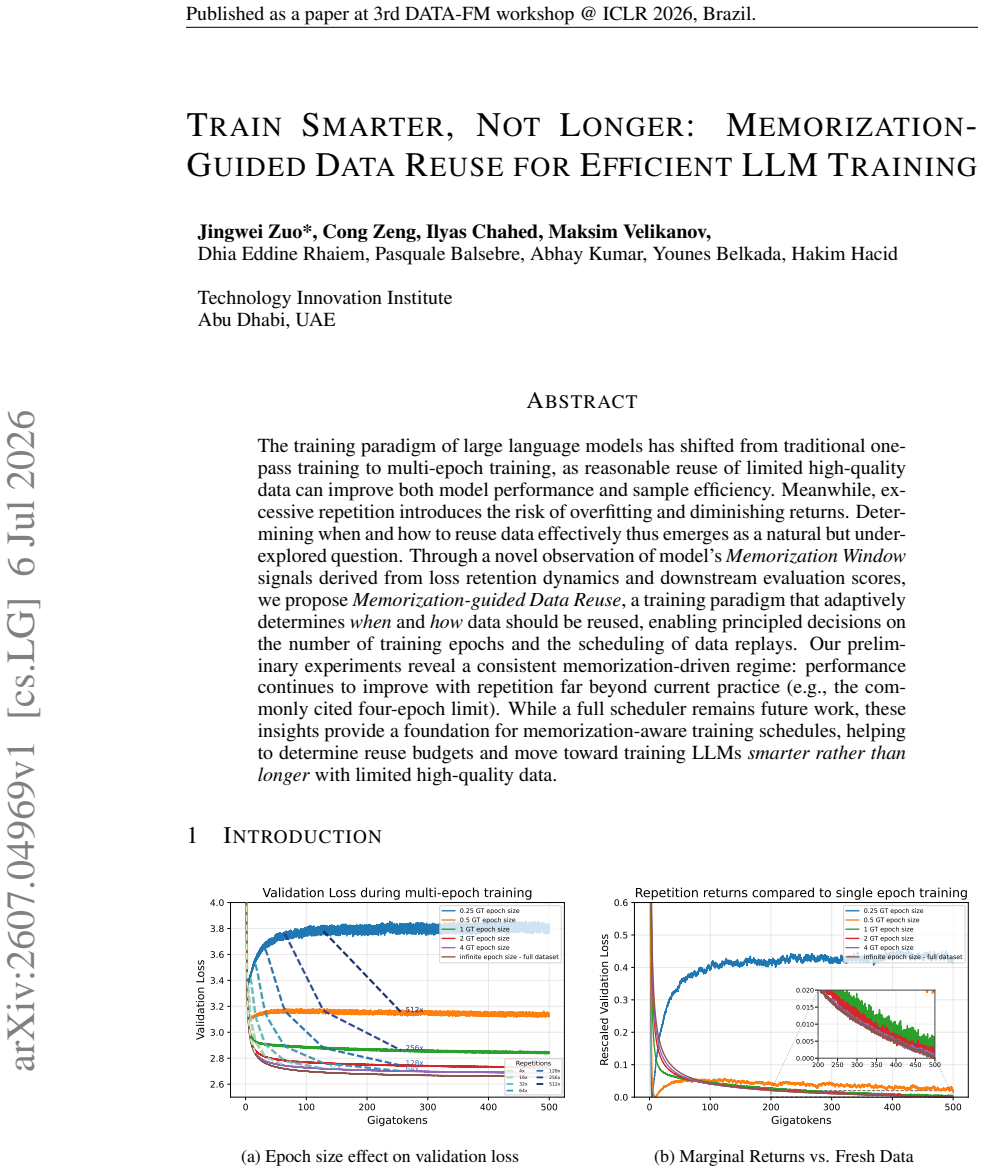
The authors claim that LLM pretraining has a Memorization Window τ* = min(τ_ret, τ_gen) that governs beneficial data reuse: if the epoch length N is at least τ*, repeated high-quality tokens keep improving validation loss and downstream accuracy well beyond the commonly cited four-epoch limit, and under sufficient spacing the marginal utility of a repeated token matches that of a fresh token once the model has forgotten it.
What carries the argument
The Memorization Window τ* is the safe reuse interval defined as the minimum of the retention window (how long loss retention stays above a threshold) and the generalization window (where downstream performance peaks); it is estimated via rollback loss gaps and accuracy-vs-reuse curves and used to set epoch length N and epoch budget E.
Load-bearing premise
The method treats a simple rollback loss gap on past tokens as a faithful enough proxy for true per-sample forgetting, so the observed 1–5 billion-token decay can be used to set the reuse interval.
What would settle it
Train the same 100M model with fixed unique high-quality tokens while sweeping epoch lengths around and above the reported 1–5 GT window; if larger spacing fails to delay the accuracy peak or if repeated tokens never match the loss reduction of fresh data once spacing is met, the central claim fails.
Editorial analysis
A structured set of objections, weighed in public.
Referee Report
Summary. The paper argues that multi-epoch LLM training should be governed by a Memorization Window τ* = min(τ_ret, τ_gen), where τ_ret is estimated from a rollback loss-retention gap Δ_R(τ) and τ_gen from the peak of downstream accuracy. With epoch length N ≥ τ*, repeated high-quality tokens continue to improve validation loss and MATH500 accuracy far past the commonly cited four-epoch limit, and under sufficient spacing the marginal loss reduction from a repeated token can match that of a fresh token (Fig. 1b). Experiments on a 100 M Transformer with OpenMathInstruct-2 (0.8 B unique HQ tokens) mixed with FineWeb support delayed peaks for larger N, saturation once N exceeds ~1.6 B, and a beneficial role for LQ diversity. The authors present this as preliminary evidence for memorization-aware scheduling rather than a complete adaptive scheduler.
Significance. If the central claim holds, the work supplies a concrete, measurable criterion for how far high-quality data can be safely reused, directly addressing the practical tension between data scarcity and overfitting. The rollback protocol and the explicit definitions of τ_ret / τ_gen are falsifiable and reusable by others; the observation that Δ_R trajectories collapse across training stages (20–500 GT) is a clean empirical finding. Even as a workshop-scale study the framing is useful: it reframes the four-epoch heuristic as a special case of insufficient spacing rather than a universal limit, and it opens clear follow-ups on scaling of τ* with model size, architecture, and domain.
major comments (2)
- §4.2 and Limitations paragraph: every comparison that varies epoch size N (Figs. 3a–c and the Fig. 1b family) simultaneously changes the HQ/LQ mixture ratio while holding unique HQ tokens fixed at 0.8 B. Larger-N curves therefore have strictly lower HQ fractions. The authors correctly flag this confound, yet still interpret delayed peaks and the “same-rate” brown curve as evidence that spacing alone restores fresh-token marginal returns. Without an orthogonal control that holds HQ fraction fixed while only the inter-exposure interval changes (e.g., by padding with held-out HQ or by replaying the same mixture under different deterministic schedules), the attribution of gains to the memorization-window mechanism remains under-determined. This attribution is load-bearing for the practical recommendation “set N ≥ τ* and reuse far past four epochs.”
- §4.1, Def. 3.1 vs. Eq. (9): the retention window τ_ret is estimated solely from the rollback gap Δ_R(τ) = ℓ_base(θ_t) − ℓ(θ_t; x_{t−τ}). The text itself enumerates two systematic biases (different capability-evolution component; per-sample loss variance). No quantitative bound or side-by-side comparison with true per-sample Δ_i(τ) is provided, yet the 1–5 GT decay of Δ_R is treated as the operational τ_ret that should govern scheduling. A modest validation (even on a small held-out set of tracked samples) is needed before the proxy can underwrite the framework.
minor comments (4)
- Table 1 lists “Optimal N* ≈ 0.95 B” on the basis of the highest peak in Fig. 3a, but the same Limitations paragraph notes that peak height is confounded by HQ ratio; the table entry should be qualified or removed.
- Fig. 1 caption and §1 claim mathematical equivalence of repeated and fresh tokens under sufficient spacing; the body text correctly softens this to “same rate of loss decrease” while acknowledging a residual diversity gap. Align the abstract and caption language with the more careful body statement.
- Notation: both GT and B are used for billion tokens; a single convention would improve readability. Likewise τ_ret / τ_gen / τ* are introduced cleanly but occasionally appear without the asterisk or subscript in later discussion.
- The secondary performance rises noted in §4.2 (possible grokking) are left unexplored; a short remark on whether they alter the recommended E_max would be helpful even if full analysis is deferred.
Circularity Check
No load-bearing circularity: memorization windows are independently measured empirical constructs, not algebraic identities or fitted-then-predicted quantities; only peripheral same-author citations appear.
specific steps
-
self citation load bearing
[§5.1 Deterministic data loading; also §5.2 Model architecture]
"Recent work on deterministic data loading (Zuo et al., 2025) demonstrates the benefits of sequential sample processing... Our framework complements this approach... (Zuo et al., 2025). Across architecture families... hybrid architectures (Qwen Team) likely have distinct retention properties... (Zuo et al., 2025)."
The only same-author citations are to Falcon-H1. They supply supporting context for scheduling and architecture remarks but are not used to establish the existence, size, or functional form of τ_ret / τ_gen / τ*. Removing them leaves the experimental claims of §4 intact. The step is therefore a minor, non-load-bearing self-citation and does not raise the score above 1–2.
full rationale
The paper's central chain is definitional-plus-empirical rather than a first-principles derivation that collapses onto its inputs. Def. 3.1–3.3 introduce the loss-retention gap Δ_i(τ), the retention window τ_ret = sup{τ : Δ(τ) ≥ ϵ}, the generalization window τ_gen = arg max G(θ_τ), and τ* = min(τ_ret, τ_gen). These are then estimated by two separate protocols (rollback loss Δ_R on FineWeb in §4.1 / Fig. 2, and MATH500 accuracy peaks under varying epoch size N in §4.2 / Fig. 3). The experimental outcomes (τ_ret ∈ [1,5] GT, delayed peaks for larger N, saturation once N ≳ τ*) are not forced by the definitions; they are observations that could have been otherwise. The practical recommendation “set N ≥ τ* and reuse past four epochs” is therefore an interpretation of those measurements, not a tautology. Self-citations to Zuo et al. (2025) (Falcon-H1) appear only in the discussion (§5.1, §5.2) for deterministic loading and architecture remarks; they do not underwrite the existence or size of the memorization window. No uniqueness theorem, fitted constant re-used as a “prediction,” or ansatz smuggled via citation is present. The HQ-ratio confound noted by the skeptic is a validity concern, not a circularity of the derivation chain. Hence the score remains at the low end of the 0–2 band reserved for essentially non-circular empirical papers.
Axiom & Free-Parameter Ledger
free parameters (3)
- ϵ (memorization threshold)
- epoch sizes N
- unique HQ token budget
axioms (3)
- domain assumption The loss retention gap (or its rollback proxy) measures functional memorization that is relevant to the utility of data reuse.
- domain assumption The first peak of downstream MATH500 accuracy marks the generalization window τ_gen at which overfitting begins for scheduling purposes.
- ad hoc to paper The rollback gap Δ_R(τ) approximates the true retention gap Δ(τ) closely enough to estimate τ_ret.
invented entities (2)
-
Memorization Window τ*
no independent evidence
-
Loss Retention Gap Δ_i(τ)
no independent evidence
read the original abstract
The training paradigm of large language models has shifted from traditional one-pass training to multi-epoch training, as reasonable reuse of limited high-quality data can improve both model performance and sample efficiency. Meanwhile, excessive repetition introduces the risk of overfitting and diminishing returns. Determining when and how to reuse data effectively thus emerges as a natural but under-explored question. Through a novel observation of model's "Memorization Window" signals derived from loss retention dynamics and downstream evaluation scores, we propose "Memorization-guided Data Reuse", a training paradigm that adaptively determines when and how data should be reused, enabling principled decisions on the number of training epochs and the scheduling of data replays. Our preliminary experiments reveal a consistent memorization-driven regime: performance continues to improve with repetition far beyond current practice (e.g., the commonly cited four-epoch limit). While a full scheduler remains future work, these insights provide a foundation for memorization-aware training schedules, helping to determine reuse budgets and move toward training LLMs smarter rather than longer with limited high-quality data.
Figures


Reference graph
Works this paper leans on
-
[1]
Phi-4 techni- cal report.arXiv preprint arXiv:2412.08905,
Marah Abdin, Jyoti Aneja, Harkirat Behl, S ´ebastien Bubeck, Ronen Eldan, Suriya Gunasekar, Michael Harrison, Russell J Hewett, Mojan Javaheripi, Piero Kauffmann, et al. Phi-4 techni- cal report.arXiv preprint arXiv:2412.08905,
-
[2]
Loubna Ben Allal, Anton Lozhkov, Elie Bakouch, Gabriel Mart ´ın Bl´azquez, Guilherme Penedo, Lewis Tunstall, Andr´es Marafioti, Hynek Kydl´ıˇcek, Agust´ın Piqueres Lajar´ın, Vaibhav Srivastav, et al. Smollm2: When smol goes big–data-centric training of a small language model.arXiv preprint arXiv:2502.02737,
-
[3]
Xin Cheng, Wangding Zeng, Damai Dai, Qinyu Chen, Bingxuan Wang, Zhenda Xie, Kezhao Huang, Xingkai Yu, Zhewen Hao, Yukun Li, et al. Conditional memory via scalable lookup: A new axis of sparsity for large language models.arXiv preprint arXiv:2601.07372,
-
[4]
Reformulation for pretraining data augmentation.arXiv preprint arXiv:2502.04235,
Xintong Hao, Ruijie Zhu, Ge Zhang, Ke Shen, and Chenggang Li. Reformulation for pretraining data augmentation.arXiv preprint arXiv:2502.04235,
-
[5]
Scaling laws and inter- pretability of learning from repeated data.arXiv preprint arXiv:2205.10487,
Danny Hernandez, Tom Brown, Tom Conerly, Nova DasSarma, Dawn Drain, Sheer El-Showk, Nel- son Elhage, Zac Hatfield-Dodds, Tom Henighan, Tristan Hume, et al. Scaling laws and inter- pretability of learning from repeated data.arXiv preprint arXiv:2205.10487,
-
[6]
Train- ing compute-optimal large language models.arXiv preprint arXiv:2203.15556,
Jordan Hoffmann, Sebastian Borgeaud, Arthur Mensch, Elena Buchatskaya, Trevor Cai, Eliza Rutherford, Diego de Las Casas, Lisa Anne Hendricks, Johannes Welbl, Aidan Clark, et al. Train- ing compute-optimal large language models.arXiv preprint arXiv:2203.15556,
-
[7]
Ultra- sparse memory network.arXiv preprint arXiv:2411.12364,
Zihao Huang, Qiyang Min, Hongzhi Huang, Defa Zhu, Yutao Zeng, Ran Guo, and Xun Zhou. Ultra- sparse memory network.arXiv preprint arXiv:2411.12364,
-
[8]
Ziyue Li, Chenrui Fan, and Tianyi Zhou
10 Published as a paper at 3rd DATA-FM workshop @ ICLR 2026, Brazil. Ziyue Li, Chenrui Fan, and Tianyi Zhou. Where to find grokking in llm pretraining? monitor memorization-to-generalization without test.arXiv preprint arXiv:2506.21551,
arXiv 2026
-
[9]
Let’s verify step by step.arXiv preprint arXiv:2305.20050,
Hunter Lightman, Vineet Kosaraju, Yura Burda, Harri Edwards, Bowen Baker, Teddy Lee, Jan Leike, John Schulman, Ilya Sutskever, and Karl Cobbe. Let’s verify step by step.arXiv preprint arXiv:2305.20050,
-
[10]
Smollm2: When smol goes big—data-centric training of a fully open small language model
Anton Lozhkov, Elie Bakouch, Gabriel Martin Blazquez, Guilherme Penedo, Lewis Tunstall, Andr´es Marafioti, Agust´ın Piqueres Lajar´ın, Hynek Kydl´ıˇcek, Vaibhav Srivastav, Joshua Lochner, et al. Smollm2: When smol goes big—data-centric training of a fully open small language model. In Second Conference on Language Modeling. John X Morris, Chawin Sitawarin...
-
[11]
Olmo 3.arXiv preprint arXiv:2512.13961,
Team Olmo, Allyson Ettinger, Amanda Bertsch, Bailey Kuehl, David Graham, David Heineman, Dirk Groeneveld, Faeze Brahman, Finbarr Timbers, Hamish Ivison, et al. Olmo 3.arXiv preprint arXiv:2512.13961,
-
[12]
Jupinder Parmar, Sanjev Satheesh, Mostofa Patwary, Mohammad Shoeybi, and Bryan Catanzaro. Reuse, don’t retrain: A recipe for continued pretraining of language models.arXiv preprint arXiv:2407.07263,
-
[13]
Guilherme Penedo, Quentin Malartic, Daniel Hesslow, Ruxandra Cojocaru, Alessandro Cappelli, Hamza Alobeidli, Baptiste Pannier, Ebtesam Almazrouei, and Julien Launay. The refinedweb dataset for falcon llm: outperforming curated corpora with web data, and web data only.arXiv preprint arXiv:2306.01116,
-
[14]
Qwen3-coder-next technical report
Qwen Team. Qwen3-coder-next technical report. Technical report. URLhttps: //github.com/QwenLM/Qwen3-Coder/blob/main/qwen3_coder_next_tech_ report.pdf. Accessed: 2026-02-03. Ross Taylor, Marcin Kardas, Guillem Cucurull, Thomas Scialom, Anthony Hartshorn, Elvis Saravia, Andrew Poulton, Viktor Kerkez, and Robert Stojnic. Galactica: A large language model for...
Pith/arXiv arXiv 2026
-
[15]
Kimi k2: Open agentic intelligence.arXiv preprint arXiv:2507.20534,
Kimi Team, Yifan Bai, Yiping Bao, Guanduo Chen, Jiahao Chen, Ningxin Chen, Ruijue Chen, Yanru Chen, Yuankun Chen, Yutian Chen, et al. Kimi k2: Open agentic intelligence.arXiv preprint arXiv:2507.20534,
-
[16]
Shubham Toshniwal, Wei Du, Ivan Moshkov, Branislav Kisacanin, Alexan Ayrapetyan, and Igor Gitman. Openmathinstruct-2: Accelerating ai for math with massive open-source instruction data.arXiv preprint arXiv:2410.01560,
-
[17]
Xinyi Wang, Antonis Antoniades, Yanai Elazar, Alfonso Amayuelas, Alon Albalak, Kexun Zhang, and William Yang Wang. Generalization vs memorization: Tracing language models’ capabilities back to pretraining data.arXiv preprint arXiv:2407.14985,
-
[18]
Tingkai Yan, Haodong Wen, Binghui Li, Kairong Luo, Wenguang Chen, and Kaifeng Lyu. Larger datasets can be repeated more: A theoretical analysis of multi-epoch scaling in linear regression. arXiv preprint arXiv:2511.13421,
-
[19]
Nicolas Zucchet, Francesco d’Angelo, Andrew K Lampinen, and Stephanie CY Chan
11 Published as a paper at 3rd DATA-FM workshop @ ICLR 2026, Brazil. Nicolas Zucchet, Francesco d’Angelo, Andrew K Lampinen, and Stephanie CY Chan. The emer- gence of sparse attention: impact of data distribution and benefits of repetition.arXiv preprint arXiv:2505.17863,
arXiv 2026
-
[20]
Jingwei Zuo, Maksim Velikanov, Ilyas Chahed, Younes Belkada, Dhia Eddine Rhayem, Guillaume Kunsch, Hakim Hacid, Hamza Yous, Brahim Farhat, Ibrahim Khadraoui, et al. Falcon-h1: A family of hybrid-head language models redefining efficiency and performance.arXiv preprint arXiv:2507.22448,
discussion (0)
Sign in with ORCID, Apple, or X to comment. Anyone can read and Pith papers without signing in.