REVIEW 3 major objections 4 minor 44 references
Surfaces of g-wave altermagnets turn on d-wave spin splitting and a usable spin-splitter effect that the bulk cannot host.
Reviewed by Pith at T0; open to challenge. T0 means a machine referee read the full paper against a public rubric. the ladder, T0–T4 →
2026-07-11 10:44 UTC pith:CBEYAYDO
load-bearing objection Clean Kubo demonstration that (210) surfaces of a g-wave slab produce additive d-wave SSE (up to ~15°) plus weak ferromagnetism; model-dependent but internally solid and worth engaging. the 3 major comments →
Functionalization of g-wave altermagnets: spin-splitter effect enabled by surfaces
The pith
A machine-rendered reading of the paper's core claim, the machinery that carries it, and where it could break.
Core claim
A (210)-oriented slab of a g-wave altermagnet develops identical-sign d-wave spin splitting on both surfaces; the two surfaces therefore contribute additively to a linear spin-splitter conductivity that is strictly absent in the bulk, producing a spin-splitter angle as large as 15 degrees in the minimal model, while the same surface reconstruction generates a weak ferromagnetism that can couple to an external field.
What carries the argument
Bulk-boundary correspondence for magnetic multipoles: the rank-5 multipole order parameter of bulk g-wave altermagnetism forces a rank-3 magnetic octupole (and the associated d-wave Zeeman term ~ky kz σz) to appear at the reduced-symmetry (210) surface; Kubo evaluation of the resulting slab spin conductivity then quantifies the spin-splitter effect.
Load-bearing premise
The hand-tuned single-orbital tight-binding slab, with fixed hoppings, exchange, and a constant scattering rate, is assumed to capture the surface bands and transport of real g-wave materials well enough that the additive spin-splitter angle remains representative.
What would settle it
Fabricate a (210)-oriented thin film of metallic g-wave CrSb (or an isostructural analogue), measure the transverse spin current under a longitudinal charge current, and check whether a finite, thickness-dependent spin-splitter angle of several degrees appears and whether a weak in-plane magnetization of order 10^{-5} µB can be detected and used to switch domains.
Editorial analysis
A structured set of objections, weighed in public.
Referee Report
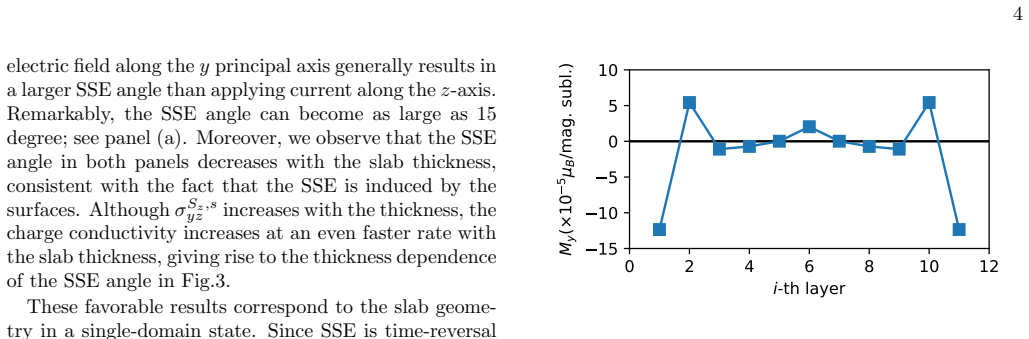
Summary. The manuscript shows that a (210) slab of a minimal single-orbital g-wave altermagnet supports surface-induced d-wave spin splitting of identical sign on both faces. Using the Kubo formula for the spin conductivity, the authors obtain a finite spin-splitter effect (SSE) that is absent in the bulk; the two surfaces add constructively, producing an SSE angle that reaches ~15° for charge current along the high-conductivity principal axis. The same surface symmetry reduction also generates a weak magnetization My of order 10^{-5} μ_B that couples linearly to an external Zeeman field, offering a route to monodomain control. The results are interpreted via a bulk-boundary correspondence rooted in the rank-5 magnetic multipole character of the g-wave order parameter, and the authors propose thin-film engineering of materials such as CrSb as a practical realization.
Significance. If the surface-enabled additive SSE survives in real multi-orbital g-wave compounds, the work supplies a concrete materials route to the technologically sought d-wave spin-splitter functionality without external strain or SOC. The multipole bulk-boundary argument is conceptually clean and immediately suggests which surface orientations to target. Strengths include an explicit Kubo evaluation of both σ^{Sz,s}_{yz} and the SSE angle, systematic thickness and chemical-potential dependence, and a falsifiable prediction (weak My plus finite SSE angle in (210) CrSb films). The calculation is fully reproducible from the supplied tight-binding parameters and Kubo formulae.
major comments (3)
- [Spin-splitter effect; Fig. 2(b,c) and Fig. 3] The claim that both surfaces contribute with identical sign (and therefore add) is central, yet the only supporting evidence is the bulk multipole argument (imported from the companion paper) and the overall thickness trend of the angle. A layer-projected spin texture or a layer-resolved decomposition of σ^{Sz,s}_{yz} for the same slab Hamiltonian would make the additivity quantitative and self-contained.
- [Fig. 2(c) and accompanying text] σ^{Sz,s}_{yz} continues to rise from 11l_0 to 81l_0 rather than saturating at twice the single-surface value. While the angle falls as expected, the non-saturating conductivity leaves open the possibility of residual bulk or finite-size contributions. An explicit check that the conductivity plateaus for still thicker slabs (or a penetration-depth estimate) is needed to confirm a purely surface origin.
- [Abstract; SM parameter list; Fig. 3] The quoted 15° angle is obtained for one hand-chosen parameter set (t1,t2,t3,tAM,J,λ)=(1,1,1,0.5,8,0.05) and fixed γ=0.05. Because the abstract and conclusion present this number as a key result, a brief sensitivity scan (or a comparison against the ab-initio surface bands of the companion paper) is required to establish that the angle remains sizable under reasonable variations.
minor comments (4)
- [Supplementary Material, SOC definitions] In the SM the third SOC component is labeled λ_{k,x} a second time; it should be λ_{k,z}.
- [Abstract and main text] Several compound words lack spaces or hyphens ("ag-wave", "abinitio", "spin-splitter effect(SSE)"). Standardize throughout.
- [Fig. 2] Fig. 2(b) caption states "film thickness 4l_0" while the conductivity panels use 11–81l_0; a brief remark on why the thinner slab is used for the spectrum would help the reader.
- [Spin-splitter effect paragraph after Eq. (4)] The constant-γ approximation is stated to leave the SSE angle nearly γ-independent, yet no supporting plot or analytic argument is given; a one-sentence derivation or a supplementary curve would suffice.
Circularity Check
Minor self-citation of companion paper for bulk-boundary multipole rationale; Kubo SSE and same-sign surface contributions are independently computed on the slab Hamiltonian and do not reduce by construction.
specific steps
-
self citation load bearing
[Introduction (bulk-boundary correspondence paragraph) and Conclusion]
"Through the combination of a magnetic group analysis and ab initio results in a companion paper [25], the author and collaborators have formulated a bulk-boundary correspondence between the order parameter (OP) of a bulk g-wave AM and the d-wave character of the electronic band splitting at an optimal surface orientation of a slab geometry. ... These results can be understood in terms of a bulk–boundary correspondence between surface states and bulk altermagnetic order parameters, where the magnetic multipolar character of the latter plays a central role."
The premise that the (210) surface of a g-wave AM necessarily hosts d-wave spin splitting (and the associated multipole reduction that also permits weak My) is justified by citation to the companion paper by the same author rather than derived from first principles inside the present manuscript. While the subsequent Kubo computation of SSE on the minimal model is independent and does not tautologically equal its inputs, the conceptual claim of a bulk-boundary correspondence that 'explains' the surface functionality load-bears on that self-citation.
full rationale
The paper's central numerical claims (finite surface SSE absent in bulk, identical d-wave sign pattern on both faces of the (210) slab yielding additive contributions, spin-splitter angle up to 15°, and layer-resolved weak My) are obtained by direct diagonalization of a stated single-orbital tight-binding slab Hamiltonian followed by Kubo evaluation of spin and charge conductivities (Eqs. for σ Sz_ab and heta_aa, constant-γ approximation). These steps do not fit parameters to the target observables and then re-predict them, nor do they define the SSE angle in terms of itself. The multipole bulk-boundary correspondence and the group-theoretic permission of surface My are imported from the companion paper [25] (same lead author) and from the literature on magnetic multipoles; this supplies the conceptual framing and motivation for the surface orientation, but the transport results themselves remain independent evaluations on the model. No uniqueness theorem is invoked to forbid alternatives, no ansatz is smuggled via citation into the Kubo formulae, and no known empirical pattern is merely renamed. The self-citation is therefore present but not load-bearing for the quantitative SSE claim, producing only minor circularity (score 2).
Axiom & Free-Parameter Ledger
free parameters (4)
- hopping set (t1,t2,t3,tAM) =
(1,1,1,0.5)
- exchange J =
8
- SOC strength λ =
0.05
- scattering rate γ =
0.05
axioms (3)
- domain assumption Bulk-boundary multipole correspondence: the rank-5 magnetic multipole of a g-wave AM induces a rank-3 octupole (hence d-wave spin splitting) on the (210) surface.
- domain assumption Constant relaxation-time (constant-γ) approximation for the Kubo conductivity.
- ad hoc to paper Single-orbital tight-binding model on the CrSb/MnTe lattice is sufficient to capture the qualitative surface transport.
Cite this review
Pith. "Pith review of Functionalization of $g$-wave altermagnets: spin-splitter effect enabled by surfaces." pith.science (2026). https://pith.science/paper/CBEYAYDO
@misc{pith2026260704970,
  author       = {Pith},
  title        = {Pith review of: Functionalization of $g$-wave altermagnets: spin-splitter effect enabled by surfaces},
  year         = {2026},
  howpublished = {\url{https://pith.science/paper/CBEYAYDO}},
  note         = {Machine review of arXiv:2607.04970}
}
read the original abstract
We investigate surfaces of a $g$-wave altermagnet(AM) and show that they provide a platform for realizing $d$-wave altermagnetism and the associated spin-splitter functionality. Using the Kubo formalism applied to a minimal slab model, we evaluate the spin-splitter effect(SSE) by computing the spin conductivity corresponding to a transverse spin current induced by a longitudinal electric field. We find a finite SSE, absent in the bulk, that emerges from surface-induced $d$-wave altermagnetism. Strikingly, the sign pattern of the $d$-wave altermagnetism on both surfaces of the slab geometry is identical to each other, leading to additive contributions to SSE from the two surfaces, with a spin-splitter angle reaching up to 15 degrees. In addition, this response is intrinsically linked to an accompanying surface-induced weak ferromagnetism, which potentially enables control of altermagnetic domains via an external magnetic field and provides a route to optimize the SSE functionality. These results can be understood in terms of a bulk-boundary correspondence between surface states and bulk altermagnetic order parameters, where the magnetic multipolar character of the latter plays a central role. Our findings strongly suggest thin-film engineering as a viable strategy to functionalize non-$d$-wave AMs.
Figures


Reference graph
Works this paper leans on
-
[1]
Beyond conventional ferromagnetism and antiferromag- netism: A phase with nonrelativistic spin and crys- tal rotation symmetry.Phys
Libor ˇSmejkal, Jairo Sinova, and Tomas Jungwirth. Beyond conventional ferromagnetism and antiferromag- netism: A phase with nonrelativistic spin and crys- tal rotation symmetry.Phys. Rev. X, 12:031042, Sep
-
[2]
URLhttps: 5 //link.aps.org/doi/10.1103/PhysRevX.12.031042
doi:10.1103/PhysRevX.12.031042. URLhttps: 5 //link.aps.org/doi/10.1103/PhysRevX.12.031042
-
[3]
Emerging research landscape of altermag- netism.Phys
Libor ˇSmejkal, Jairo Sinova, and Tomas Jung- wirth. Emerging research landscape of altermag- netism.Phys. Rev. X, 12:040501, Dec 2022. doi: 10.1103/PhysRevX.12.040501. URLhttps://link.aps. org/doi/10.1103/PhysRevX.12.040501
-
[4]
Altermagnetism: Exploring new frontiers in magnetism and spintronics
Ling Bai, Wanxiang Feng, Siyuan Liu, Libor ˇSmejkal, Yuriy Mokrousov, and Yugui Yao. Altermagnetism: Exploring new frontiers in magnetism and spintronics. Advanced Functional Materials, 34(49):2409327, 2024. doi:https://doi.org/10.1002/adfm.202409327. URL https://advanced.onlinelibrary.wiley.com/doi/ abs/10.1002/adfm.202409327
-
[5]
Satoru Hayami, Yuki Yanagi, and Hiroaki Kusunose. Momentum-dependent spin splitting by collinear an- tiferromagnetic ordering.Journal of the Physi- cal Society of Japan, 88(12):123702, 2019. doi: 10.7566/JPSJ.88.123702. URLhttps://doi.org/10. 7566/JPSJ.88.123702
-
[6]
Efficient electrical spin splitter based on nonrelativistic collinear antiferromag- netism.Phys
Rafael Gonz´ alez-Hern´ andez, Libor ˇSmejkal, Karel V´ yborn´ y, Yuta Yahagi, Jairo Sinova, Tom´ a ˇ s Jung- wirth, and Jakub ˇZelezn´ y. Efficient electrical spin splitter based on nonrelativistic collinear antiferromag- netism.Phys. Rev. Lett., 126:127701, Mar 2021. doi: 10.1103/PhysRevLett.126.127701. URLhttps://link. aps.org/doi/10.1103/PhysRevLett.1...
-
[7]
Krempask´ y, L
J. Krempask´ y, L. ˇSmejkal, S. W. D’Souza, M. Ha- jlaoui, G. Springholz, K. Uhl´ ıˇ rov´ a, F. Alarab, P. C. Constantinou, V. Strokov, D. Usanov, W. R. Pudelko, R. Gonz´ alez-Hern´ andez, A. Birk Hellenes, Z. Jansa, H. Reichlov´ a, Z. ˇSob´ aˇ n, R. D. Gonzalez Betancourt, P. Wadley, J. Sinova, D. Kriegner, J. Min´ ar, J. H. Dil, and T. Jungwirth. Alterm...
2023
-
[8]
Broken kramers degeneracy in altermagnetic mnte
Suyoung Lee, Sangjae Lee, Saegyeol Jung, Ji- won Jung, Donghan Kim, Yeonjae Lee, Byeongjun Seok, Jaeyoung Kim, Byeong Gyu Park, Libor ˇSmejkal, Chang-Jong Kang, and Changyoung Kim. Broken kramers degeneracy in altermagnetic mnte. Phys. Rev. Lett., 132:036702, Jan 2024. doi: 10.1103/PhysRevLett.132.036702. URLhttps://link. aps.org/doi/10.1103/PhysRevLett.1...
-
[9]
Osumi, S
T. Osumi, S. Souma, T. Aoyama, K. Yamauchi, A. Honma, K. Nakayama, T. Takahashi, K. Ohgushi, and T. Sato. Observation of a giant band splitting in altermagnetic mnte.Phys. Rev. B, 109:115102, Mar
-
[10]
URLhttps: //link.aps.org/doi/10.1103/PhysRevB.109.115102
doi:10.1103/PhysRevB.109.115102. URLhttps: //link.aps.org/doi/10.1103/PhysRevB.109.115102
-
[11]
Strocov, Procopios Constantinou, Anna B
Sonka Reimers, Lukas Odenbreit, Libor ˇSmejkal, Vladimir N. Strocov, Procopios Constantinou, Anna B. Hellenes, Rodrigo Jaeschke Ubiergo, Warlley H. Cam- pos, Venkata K. Bharadwaj, Atasi Chakraborty, Thibaud Denneulin, Wen Shi, Rafal E. Dunin-Borkowski, Suvadip Das, Mathias Kl¨ aui, Jairo Sinova, and Martin Jourdan. Direct observation of altermagnetic band...
-
[12]
doi:10.1038/s41467-024-46476-5
ISSN 2041-1723. doi:10.1038/s41467-024-46476-5. URLhttps://doi.org/10.1038/s41467-024-46476-5
-
[13]
A. Hariki, A. Dal Din, O. J. Amin, T. Yam- aguchi, A. Badura, D. Kriegner, K. W. Edmonds, R. P. Campion, P. Wadley, D. Backes, L. S. I. Veiga, S. S. Dhesi, G. Springholz, L. ˇSmejkal, K. V´ yborn´ y, T. Jungwirth, and J. Kuneˇ s. X- ray magnetic circular dichroism in altermagneticα- mnte.Phys. Rev. Lett., 132:176701, Apr 2024. doi: 10.1103/PhysRevLett.132...
-
[14]
Large band splitting ing-wave altermagnet crsb.Phys
Jianyang Ding, Zhicheng Jiang, Xiuhua Chen, Zicheng Tao, Zhengtai Liu, Tongrui Li, Jishan Liu, Jian- ping Sun, Jinguang Cheng, Jiayu Liu, Yichen Yang, Runfeng Zhang, Liwei Deng, Wenchuan Jing, Yu Huang, Yuming Shi, Mao Ye, Shan Qiao, Yilin Wang, Yanfeng Guo, Donglai Feng, and Dawei Shen. Large band splitting ing-wave altermagnet crsb.Phys. Rev. Lett., 133...
-
[15]
Observation of spin splitting in room-temperature metallic antifer- romagnet crsb.Advanced Science, 11(43):2406529,
Meng Zeng, Ming-Yuan Zhu, Yu-Peng Zhu, Xiang-Rui Liu, Xiao-Ming Ma, Yu-Jie Hao, Pengfei Liu, Gexing Qu, Yichen Yang, Zhicheng Jiang, Kohei Yamagami, Masashi Arita, Xiaoqian Zhang, Tian-Hao Shao, Yue Dai, Kenya Shimada, Zhengtai Liu, Mao Ye, Yaobo Huang, Qihang Liu, and Chang Liu. Observation of spin splitting in room-temperature metallic antifer- romagnet...
-
[16]
URL https://advanced.onlinelibrary.wiley.com/doi/ abs/10.1002/advs.202406529
doi:https://doi.org/10.1002/advs.202406529. URL https://advanced.onlinelibrary.wiley.com/doi/ abs/10.1002/advs.202406529
-
[17]
Three-dimensional map- ping of the altermagnetic spin splitting in crsb.Na- ture Communications, 16(1):1442, Feb 2025
Guowei Yang, Zhanghuan Li, Sai Yang, Jiyuan Li, Hao Zheng, Weifan Zhu, Ze Pan, Yifu Xu, Saizheng Cao, Wenxuan Zhao, Anupam Jana, Jiawen Zhang, Mao Ye, Yu Song, Lun-Hui Hu, Lexian Yang, Jun Fujii, Ivana Vobornik, Ming Shi, Huiqiu Yuan, Yongjun Zhang, Yuanfeng Xu, and Yang Liu. Three-dimensional map- ping of the altermagnetic spin splitting in crsb.Na- ture...
2025
-
[18]
URLhttps: //doi.org/10.1038/s41467-025-56647-7
doi:10.1038/s41467-025-56647-7. URLhttps: //doi.org/10.1038/s41467-025-56647-7
-
[19]
Motohiko Ezawa. Third-order and fifth-order nonlin- ear spin-current generation ing-wave andi-wave alter- magnets and perfectly nonreciprocal spin current inf- wave magnets.Phys. Rev. B, 111:125420, Mar 2025. doi:10.1103/PhysRevB.111.125420. URLhttps://link. aps.org/doi/10.1103/PhysRevB.111.125420
-
[20]
Strain-induced phase transition from antiferromagnet to altermag- net.Phys
Atasi Chakraborty, Rafael Gonz´ alez Hern´ andez, Li- bor ˇSmejkal, and Jairo Sinova. Strain-induced phase transition from antiferromagnet to altermag- net.Phys. Rev. B, 109:144421, Apr 2024. doi: 10.1103/PhysRevB.109.144421. URLhttps://link. aps.org/doi/10.1103/PhysRevB.109.144421
-
[21]
Verbeek, Rodrigo Jaeschke- Ubiergo, Libor ˇSmejkal, and Jairo Sinova
Bennet Karetta, Xanthe H. Verbeek, Rodrigo Jaeschke- Ubiergo, Libor ˇSmejkal, and Jairo Sinova. Strain- controlledg- tod-wave transition in altermagnetic crsb.Phys. Rev. B, 112:094454, Sep 2025. doi: 10.1103/pbbr-hwz4. URLhttps://link.aps.org/doi/ 10.1103/pbbr-hwz4
-
[22]
San-Dong Guo. External-field-induced altermagnetism in experimentally synthesized monolayer CrX 3 (x=cl, br and i), 2025. URLhttps://arxiv.org/abs/2503.23036
Pith/arXiv arXiv 2025
-
[23]
Un- locking altermagnetism in antiferromagnetic 2d films via adsorption, 2025
Dong Liu, Sike Zeng, Ji-Hai Liao, and Yu-Jun Zhao. Un- locking altermagnetism in antiferromagnetic 2d films via adsorption, 2025. URLhttps://arxiv.org/abs/2507. 09518
2025
-
[24]
Induced monolayer altermagnetism in mnp(s,se)3 and fese, 2023
Igor Mazin, Rafael Gonz´ alez-Hern´ andez, and Li- bor ˇSmejkal. Induced monolayer altermagnetism in mnp(s,se)3 and fese, 2023. URLhttps://arxiv.org/ abs/2309.02355. 6
Pith/arXiv arXiv 2023
-
[25]
Layered topological antiferro- magnetic metal at room temperature: ybmn 2ge2.Phys
Nirmalya Jana, Atasi Chakraborty, Anamitra Mukher- jee, and Amit Agarwal. Layered topological antiferro- magnetic metal at room temperature: ybmn 2ge2.Phys. Rev. B, 112:075127, Aug 2025. doi:10.1103/34g5-q2g6. URLhttps://link.aps.org/doi/10.1103/34g5-q2g6
-
[26]
Observation of hidden altermagnetism in cs1−δv2te2o, 2026
Guowei Yang, Ruihan Chen, Changchao Liu, Jing Li, Ze Pan, Teng Hua, Pengyue Xiong, Liwei Deng, Naifu Zheng, Yu Tang, Hao Zheng, Weifan Zhu, Yifu Xu, Xiny- ing Zheng, Xin Ma, Xiaoping Wang, Shengtao Cui, Zhe Sun, Zhengtai Liu, Mao Ye, Chao Cao, Ming Shi, Lun- hui Hu, Qihang Liu, Shan Qiao, Guanghan Cao, Yu Song, and Yang Liu. Observation of hidden altermag...
2026
-
[27]
Valentin Leeb, Peru d’Ornellas, Fernando de Juan, and Adolfo G. Grushin. Topologically protected surface al- termagnetism on antiferromagnets, 2026. URLhttps: //arxiv.org/abs/2602.10108
arXiv 2026
-
[28]
Verbeek, Libor ˇSmejkal, Jairo Sinova, and Alexander Mook
Colin Lange, Rodrigo Jaeschke-Ubiergo, Atasi Chakraborty, Xanthe H. Verbeek, Libor ˇSmejkal, Jairo Sinova, and Alexander Mook. Emergent altermag- netism at surfaces of antiferromagnets: full symmetry classification and material identification, 2026. URL https://arxiv.org/abs/2602.08773
Pith/arXiv arXiv 2026
-
[29]
URLhttps://arxiv.org/abs/ 2602.08790
Ersoy Sasioglu, Ingrid Mertig, and Samir Lounis.d-wave surface altermagnetism in centrosymmetric collinear an- tiferromagnets, 2026. URLhttps://arxiv.org/abs/ 2602.08790
Pith/arXiv arXiv 2026
-
[30]
Projected altermagnetism by symmetry re- duction at surfaces and in thin films, 2026
Sopheak Sorn, Charanpreet Singh, Lukasz Plucin- ski, Gustav Bihlmayer, Yuriy Mokrousov, and Wulf Wulfhekel. Projected altermagnetism by symmetry re- duction at surfaces and in thin films, 2026. URLhttps: //arxiv.org/abs/2606.18964
Pith/arXiv arXiv 2026
-
[31]
Charles R. W. Steward, Rafael M. Fernandes, and J¨ org Schmalian. Dynamic paramagnon-polarons in alter- magnets.Phys. Rev. B, 108:144418, Oct 2023. doi: 10.1103/PhysRevB.108.144418. URLhttps://link. aps.org/doi/10.1103/PhysRevB.108.144418
-
[32]
Sayantika Bhowal and Nicola A. Spaldin. Fer- roically ordered magnetic octupoles ind-wave alter- magnets.Phys. Rev. X, 14:011019, Feb 2024. doi: 10.1103/PhysRevX.14.011019. URLhttps://link.aps. org/doi/10.1103/PhysRevX.14.011019
-
[33]
Paul A. McClarty and Jeffrey G. Rau. Landau theory of altermagnetism.Phys. Rev. Lett., 132:176702, Apr 2024. doi:10.1103/PhysRevLett.132.176702. URLhttps:// link.aps.org/doi/10.1103/PhysRevLett.132.176702
-
[34]
Collinear altermagnets and their landau the- ories.arXiv preprint arXiv:2412.18025, 2024
Hana Schiff, Paul McClarty, Jeffrey G Rau, and Judit Romhanyi. Collinear altermagnets and their landau the- ories.arXiv preprint arXiv:2412.18025, 2024
arXiv 2024
-
[36]
Rafael M. Fernandes, Vanuildo S. de Carvalho, Tu- ran Birol, and Rodrigo G. Pereira. Topological transi- tion from nodal to nodeless zeeman splitting in alter- magnets.Phys. Rev. B, 109:024404, Jan 2024. doi: 10.1103/PhysRevB.109.024404. URLhttps://link. aps.org/doi/10.1103/PhysRevB.109.024404
-
[37]
Here, I adopt the Miller index convention to label the surface orientation, and I have chosen the lattice unit vectors given in Fig.2(a)
Note1. Here, I adopt the Miller index convention to label the surface orientation, and I have chosen the lattice unit vectors given in Fig.2(a)
-
[38]
David Vanderbilt and R. D. King-Smith. Electric po- larization as a bulk quantity and its relation to surface charge.Phys. Rev. B, 48:4442–4455, Aug 1993. doi: 10.1103/PhysRevB.48.4442. URLhttps://link.aps. org/doi/10.1103/PhysRevB.48.4442
-
[39]
Wladimir A. Benalcazar, B. Andrei Bernevig, and Taylor L. Hughes. Quantized electric multipole in- sulators.Science, 357(6346):61–66, 2017. doi: 10.1126/science.aah6442. URLhttps://www.science. org/doi/abs/10.1126/science.aah6442
-
[42]
Thermodynamic theory of weak fer- romagnetism in antiferromagnetic substances.Soviet Physics Jetp-Ussr, 5(6):1259–1272, 1957
IE Dzialoshinskii. Thermodynamic theory of weak fer- romagnetism in antiferromagnetic substances.Soviet Physics Jetp-Ussr, 5(6):1259–1272, 1957
1957
-
[43]
Weber, Andrea Urru, Sayantika Bhowal, Claude Ederer, and Nicola A
Sophie F. Weber, Andrea Urru, Sayantika Bhowal, Claude Ederer, and Nicola A. Spaldin. Surface magnetization in antiferromagnets: Classification, ex- ample materials, and relation to magnetoelectric re- sponses.Phys. Rev. X, 14:021033, May 2024. doi: 10.1103/PhysRevX.14.021033. URLhttps://link.aps. org/doi/10.1103/PhysRevX.14.021033
-
[44]
Takuya Aoyama and Kenya Ohgushi. Piezo- magnetic properties in altermagnetic mnte. Phys. Rev. Mater., 8:L041402, Apr 2024. doi: 10.1103/PhysRevMaterials.8.L041402. URLhttps: //link.aps.org/doi/10.1103/PhysRevMaterials.8. L041402. Supplementary Material: Functionalization ofg-wave altermagnets: spin-splitter effect enabled by surfaces Sopheak Sorn 1, 2 1In...
-
[45]
Merc` e Roig, Andreas Kreisel, Yue Yu, Brian M. Ander- sen, and Daniel F. Agterberg. Minimal models for alter- magnetism.Phys. Rev. B, 110:144412, Oct 2024. doi: 10.1103/PhysRevB.110.144412. URLhttps://link.aps. org/doi/10.1103/PhysRevB.110.144412
-
[46]
Domain wall skew scattering in ferromagnetic weyl met- als.Phys
Sopheak Sorn and Arun Paramekanti. Domain wall skew scattering in ferromagnetic weyl met- als.Phys. Rev. B, 103:104413, Mar 2021. doi: 10.1103/PhysRevB.103.104413. URLhttps://link.aps. org/doi/10.1103/PhysRevB.103.104413
-
[47]
Activation of anoma- lous hall effect and orbital magnetization by domain walls in altermagnets.Phys
Sopheak Sorn and Yuriy Mokrousov. Activation of anoma- lous hall effect and orbital magnetization by domain walls in altermagnets.Phys. Rev. B, 112:245115, Dec 2025. doi: 10.1103/vzmh-mxlz. URLhttps://link.aps.org/doi/ 10.1103/vzmh-mxlz
This paper was first reviewed by grok-4.5 on July 11, 2026.
discussion (0)
Sign in with ORCID, Apple, or X to comment. Anyone can read and Pith papers without signing in.