REVIEW 2 major objections 5 minor 40 references
The edge of stability is the first bifurcation of the training map, not where optimization ends.
Reviewed by Pith at T0; open to challenge. T0 means a machine referee read the full paper against a public rubric. the ladder, T0–T4 →
T0 review · grok-4.5
2026-07-11 10:23 UTC pith:MG6ONPAK
load-bearing objection Exact finite-step maps that reframe the edge of stability as a flip bifurcation, with a universal depth-limit Ricker form and closed-form balancing laws that continuous-time analyses miss. the 2 major comments →
The Map Behind the Flow: Finite-Step Gradient Descent as a Dynamical System
The pith
A machine-rendered reading of the paper's core claim, the machinery that carries it, and where it could break.
Core claim
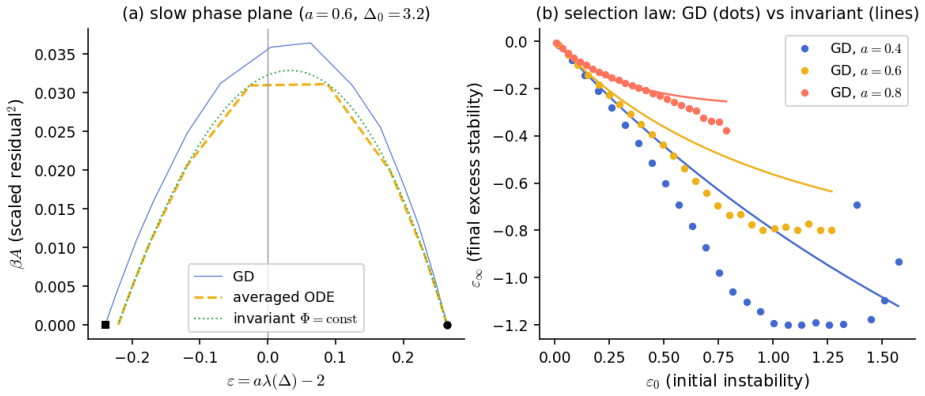
In the balanced scalar reduction of a deep linear chain the post-edge dynamics of fixed-step gradient descent are explicit; under the natural large-depth scaling a = c/n the maps converge to a universal Ricker-type map, so the edge of stability is the first flip bifurcation of the training map rather than a breakdown of optimization. Re-embedding this map into factored, wider, data-coupled, activated and noisy models shows that residual finite-step oscillations systematically contract factorization imbalance and select flatter, more balanced representations.
What carries the argument
The cubic gradient map of the quartic loss (and its depth-n quotients that limit to the Ricker map h_c(u) = u exp{2c u(1-u)}) together with the exact finite-step imbalance identity Δ₊ = (1 - a² r²) Δ. The map supplies the post-edge orbits; the identity converts residual oscillations into contraction of factorization imbalance.
Load-bearing premise
That the scalar balanced reduction, once embedded on invariant aligned or diagonal manifolds, continues to organize the dynamics of realistic high-dimensional networks that are neither aligned nor homogeneous.
What would settle it
In a wide deep linear network started from a deliberately misaligned initialization, measure whether residual oscillations still drive the leading singular modes onto the scalar post-edge two-cycle and contract layer imbalance at the rates predicted by the transverse Lyapunov exponents; systematic failure of that contraction would falsify the claim that the scalar map remains the organizing backbone.
Editorial analysis
A structured set of objections, weighed in public.
Referee Report
Summary. The paper studies fixed-step gradient descent as a discrete dynamical system on a hierarchy of exactly solvable models that retain depth, factorization, width, data coupling, activation, and stochasticity. Starting from the balanced scalar reduction of a deep linear chain (quartic loss, cubic gradient map), it derives explicit post-edge objects: a period-two orbit, sharpness straddling, a period-doubling cascade, and a Chebyshev endpoint. Under the large-depth scaling a=c/n the quotient maps converge to a universal Ricker-type map (Prop. 8), so the edge of stability is the first flip of the training map rather than an escape threshold. Embedding the scalar dynamics into two-factor and wider linear models shows that finite steps break gradient-flow conservation of imbalance (Prop. 14), residual oscillations select flatter balanced minima, and spectral modes produce a ladder of edges with optimal rates beyond the first edge. Data coupling, activations, and persistent label noise preserve the same organizing principle, with an exact noisy-edge crossover (Prop. 20).
Significance. If the results hold, the paper supplies a coherent dynamical-systems account of edge-of-stability training that is largely missing from the small-step literature. Strengths include closed-form multipliers and selection laws, Singer-theorem control of attractors via critical orbits, an analytic embedding of the depth sequence, and parameter-free predictions (e.g. the universal selection law G and the noisy crossover F) that are checked against direct simulation of the exact maps. The hierarchy is carefully scoped: progressive sharpening from below and residual rotations under anisotropic data are left outside the analysis rather than overclaimed. The work therefore isolates mechanisms that any broader theory of large-step training must accommodate, and it does so with explicit maps rather than fitted phenomenology.
major comments (2)
- Sec. 5.4 and App. D.4: the claim that the diagonal remains transversely attracting throughout the post-edge regime (including chaotic windows) rests on the exact two-cycle multiplier 3-2a together with numerical sweeps of chi_perp. The manuscript itself notes that a complete analytic proof for the physical measure is missing. Because transverse stability is load-bearing for the reduction of the two-factor model to the scalar backbone, either a proof for the principal cascade (or a rigorous bound excluding blowout before a=2) or a clearer demarcation of the numerical status is needed.
- Sec. 6.2 / Prop. 16 and Sec. 6.5: the ladder-of-edges and data-coupled claims are proved on aligned or exactly balanced manifolds. The paper correctly flags residual rotations under anisotropic data and progressive sharpening as outside scope (Sec. 6.8, Conclusion), yet the abstract and introduction still present these mechanisms as organizing principles for realistic networks. A short, explicit statement of the domain of validity (invariant manifolds and near-edge normal forms) in the abstract and at the start of Part II would prevent over-reading without changing the theorems.
minor comments (5)
- Figure 1 and Figure 2 captions: the numerical values of a_infty / c_infty and a* are given to different precisions in text and captions; unify to a consistent number of digits.
- Sec. 2.7: the classical cubic dictionary alpha=a+2 is clean; a one-line pointer to the corresponding Rogers-Whitley / May parameter intervals would help readers coming from the dynamical-systems side.
- App. G is a useful toolbox; a single forward reference from Sec. 2.8 (Schwarzian / Singer) would make it easier to find on first reading.
- Notation: residual r is used both for the scalar residual and, later, for vector residuals; a brief local redefinition when data coupling is introduced would avoid momentary confusion.
- Typos / style: occasional missing spaces after periods in the abstract and early sections; 'T wo-F actor' and similar line-break artifacts in headings should be cleaned.
Circularity Check
No significant circularity: all thresholds, maps, and selection laws are obtained by direct algebra or analysis of the explicit gradient maps themselves.
full rationale
The derivation chain begins from elementary losses (quartic ℓ(x)=¼(x²-1)², depth-n family, two-factor ℓ(x,y)=½(xy-1)², etc.) and produces the cubic map ga, its quotient ha, the Ricker limit hc under a=c/n, multipliers, period-two points, selection laws gμa, transverse exponents, and Floquet multipliers by solving the fixed-point/periodicity/multiplier equations or taking explicit limits (Props. 1–20, Appendices A–F). No free parameters are fitted to external data and then re-presented as predictions; numerical phase diagrams and simulations merely illustrate the closed-form objects. Classical citations (May, Rogers–Whitley, Singer, Feigenbaum, Ricker) supply standard one-dimensional tools whose hypotheses are verified inside the paper (negative Schwarzian, unique critical point). Prior EoS literature is re-derived rather than assumed as load-bearing uniqueness. The scalar reductions are exact on invariant manifolds by construction of the models, not by circular redefinition of the target phenomena. The paper is therefore self-contained against its own equations.
Axiom & Free-Parameter Ledger
axioms (4)
- standard math Singer’s theorem: a C^{3} interval map with negative Schwarzian has every attracting cycle attracting a critical or boundary point.
- domain assumption Gradient flow on the two-factor loss conserves the imbalance Δ = x^{2} − y^{2}.
- domain assumption Aligned singular-frame initializations remain invariant under gradient descent on deep linear networks.
- ad hoc to paper The finite-depth quotient maps admit an analytic embedding in reciprocal depth that recovers the Ricker limit.
read the original abstract
Many phenomena of deep learning are dynamical: they concern not only which minima exist, but how gradient descent reaches, avoids, or selects among them. Edge-of-stability behavior, sharpness oscillations, catapult phases, balancing, and movement toward flatter representations are effects of the training map itself, and are poorly captured by the small-step gradient-flow limit. This paper studies fixed-step gradient descent as a discrete dynamical system in a hierarchy of exactly solvable models retaining basic structures of deep learning: depth, factorization, width, data coupling, activation, and stochasticity. The starting point is the balanced scalar reduction of a deep linear chain, giving a quartic loss and a cubic gradient map whose post-edge behavior is explicit. Under the natural large-depth scaling, this dynamics converges to a universal Ricker-type map. The edge of stability is therefore not a breakdown of optimization, but the first bifurcation of the training map. Embedding the scalar dynamics back into factored models turns these regimes into learning phenomena. Finite steps break conservation laws of gradient flow and contract factorization imbalance; residual oscillations move parameters toward flatter, more balanced representations. Wider linear networks produce a ladder of spectral edges, so the optimal learning rate can lie beyond the first edge. Data coupling, nonlinear activations, and stochastic targets preserve the same organizing principle: finite-step oscillations drive alignment, balancing, and representation selection. Thus the learning rate is not merely a numerical stability parameter. It is a structural parameter of the training dynamics, determining its attractors and shaping the representations gradient descent selects.
Figures




Reference graph
Works this paper leans on
-
[1]
, title =
May, Robert M. , title =. Science , volume =. 1974 , doi =
1974
-
[2]
and Whitley, David C
Rogers, Thomas D. and Whitley, David C. , title =. Mathematical Modelling , volume =. 1983 , doi =
1983
-
[3]
International Conference on Learning Representations , year =
Exact solutions to the nonlinear dynamics of learning in deep linear neural networks , author =. International Conference on Learning Representations , year =
-
[4]
International Conference on Learning Representations , year =
Gradient Descent on Neural Networks Typically Occurs at the Edge of Stability , author =. International Conference on Learning Representations , year =
-
[5]
International Conference on Learning Representations , year =
Learning Dynamics of Deep Matrix Factorization Beyond the Edge of Stability , author =. International Conference on Learning Representations , year =
-
[6]
arXiv preprint arXiv:2310.01687 , year =
Chen, Xuxing and Balasubramanian, Krishnakumar and Ghosal, Promit and Agrawalla, Bhavya , title =. arXiv preprint arXiv:2310.01687 , year =
-
[7]
Journal of the Fisheries Research Board of Canada , volume =
Stock and recruitment , author =. Journal of the Fisheries Research Board of Canada , volume =
-
[8]
International Conference on Learning Representations , year =
Learning Dynamics of Deep Linear Networks Beyond the Edge of Stability , author =. International Conference on Learning Representations , year =
-
[9]
arXiv preprint arXiv:2003.02218 , year =
The large learning rate phase of deep learning: the catapult mechanism , author =. arXiv preprint arXiv:2003.02218 , year =
Pith/arXiv arXiv 2003
-
[10]
, title =
Branner, Bodil and Hubbard, John H. , title =. Acta Mathematica , volume =
-
[11]
Experimental Mathematics , volume =
Milnor, John , title =. Experimental Mathematics , volume =
-
[12]
Proceedings of the 40th International Conference on Machine Learning (ICML) , series =
Agarwala, Atish and Pedregosa, Fabian and Pennington, Jeffrey , title =. Proceedings of the 40th International Conference on Machine Learning (ICML) , series =
-
[13]
The Twelfth International Conference on Learning Representations , year =
Quadratic models for understanding catapult dynamics of neural networks , author =. The Twelfth International Conference on Learning Representations , year =
-
[14]
de Melo, Welington and van Strien, Sebastian , title =
-
[15]
Communications in Mathematical Physics , volume =
Guckenheimer, John , title =. Communications in Mathematical Physics , volume =
-
[16]
Absolutely continuous measures for certain maps of an interval , journal =
Misiurewicz, Micha. Absolutely continuous measures for certain maps of an interval , journal =
-
[17]
Annals of Mathematics , volume =
Kozlovski, Oleg , title =. Annals of Mathematics , volume =
-
[18]
, title =
Feigenbaum, Mitchell J. , title =. Journal of Statistical Physics , volume =
-
[19]
Journal de Physique Colloques , volume =
Coullet, Pierre and Tresser, Charles , title =. Journal de Physique Colloques , volume =
-
[20]
, title =
Lanford III, Oscar E. , title =. Bulletin of the AMS , volume =
-
[21]
, title =
McMullen, Curtis T. , title =
-
[22]
Annals of Mathematics , volume =
Lyubich, Mikhail , title =. Annals of Mathematics , volume =
-
[23]
, title =
May, Robert M. , title =. Nature , volume =
-
[24]
SIAM Journal on Applied Mathematics , volume =
Singer, David , title =. SIAM Journal on Applied Mathematics , volume =
-
[25]
Proceedings of the 42nd International Conference on Machine Learning , year =
Yoo, Geonhui and Song, Minhak and Yun, Chulhee , title =. Proceedings of the 42nd International Conference on Machine Learning , year =
-
[26]
Discourse on the Method , publisher =
Descartes, Ren. Discourse on the Method , publisher =
-
[27]
Proceedings of the 40th International Conference on Machine Learning , year =
Chen, Lei and Bruna, Joan , title =. Proceedings of the 40th International Conference on Machine Learning , year =
-
[28]
, title =
Damian, Alex and Nichani, Eshaan and Lee, Jason D. , title =. International Conference on Learning Representations , year =
-
[29]
Advances in Neural Information Processing Systems , year =
Song, Minhak and Yun, Chulhee , title =. Advances in Neural Information Processing Systems , year =
-
[30]
Proceedings of the 39th International Conference on Machine Learning , year =
Ahn, Kwangjun and Zhang, Jingzhao and Sra, Suvrit , title =. Proceedings of the 39th International Conference on Machine Learning , year =
-
[31]
International Conference on Learning Representations , year =
Understanding Edge-of-Stability Training Dynamics with a Minimalist Example , author =. International Conference on Learning Representations , year =
-
[32]
Proceedings of the 40th International Conference on Machine Learning , year =
Kreisler, Itai and Nacson, Mor Shpigel and Soudry, Daniel and Carmon, Yair , title =. Proceedings of the 40th International Conference on Machine Learning , year =
-
[33]
and Hu, Wei and Lee, Jason D
Du, Simon S. and Hu, Wei and Lee, Jason D. , title =. Advances in Neural Information Processing Systems , year =
-
[34]
Proceedings of the 35th International Conference on Machine Learning , year =
Arora, Sanjeev and Cohen, Nadav and Hazan, Elad , title =. Proceedings of the 35th International Conference on Machine Learning , year =
-
[35]
Conference on Learning Theory , year =
Blanc, Guy and Gupta, Neha and Valiant, Gregory and Valiant, Paul , title =. Conference on Learning Theory , year =
-
[36]
, title =
Damian, Alex and Ma, Tengyu and Lee, Jason D. , title =. Advances in Neural Information Processing Systems , year =
-
[37]
and Nauenberg, Michael and Rudnick, Joseph , title =
Crutchfield, James P. and Nauenberg, Michael and Rudnick, Joseph , title =. Physical Review Letters , volume =
-
[38]
Eugene and Martin, Paul C
Shraiman, Boris and Wayne, C. Eugene and Martin, Paul C. , title =. Physical Review Letters , volume =
-
[39]
arXiv preprint arXiv:2404.19261 , year =
Agarwala, Atish and Pennington, Jeffrey , title =. arXiv preprint arXiv:2404.19261 , year =
-
[40]
arXiv preprint arXiv:1903.06733 , year =
Lu, Lu and Shin, Yeonjong and Su, Yanhui and Karniadakis, George Em , title =. arXiv preprint arXiv:1903.06733 , year =
Pith/arXiv arXiv 1903
discussion (0)
Sign in with ORCID, Apple, or X to comment. Anyone can read and Pith papers without signing in.