REVIEW 3 major objections 7 minor 54 references
A data-driven weather model matches operational forecasts out to week 6 while cutting energy use by about 200 times and extending skilful MJO convection forecasts by eight days.
Reviewed by Pith at T0; open to challenge. T0 means a machine referee read the full paper against a public rubric. the ladder, T0–T4 →
T0 review · grok-4.5
2026-07-11 08:48 UTC pith:A3LIUEBN
load-bearing objection Solid operational-grade S2S ML adaptation that matches IFS skill with large efficiency gains; the eight-day MJO OLR claim is real on the reported sample but rests on a short, bracketed window the authors themselves flag. the 3 major comments →
AIFS-SUBS: Extending Data-Driven Forecasting to Sub-Seasonal Timescales
The pith
A machine-rendered reading of the paper's core claim, the machinery that carries it, and where it could break.
Core claim
Across weeks 2–6, AIFS-SUBS matches the operational Integrated Forecasting System in probabilistic skill while reducing systematic biases; for the convective (OLR) component of the Madden–Julian Oscillation it extends skilful forecasts (correlation > 0.5) by eight days relative to the IFS, while matching or exceeding the IFS on the full multivariate RMM index, and it reproduces SSW frequency, surface impact, and MJO modulation of tropical cyclone activity comparably.
What carries the argument
AIFS-SUBS: an encoder–processor–decoder graph-transformer ensemble trained with a continuous-ranked-probability-score objective, using a 24 h autoregressive time step, stratospheric levels up to 2 hPa, and top-of-atmosphere thermal radiation, with fine-tuning that mixes reanalysis and operational analyses and verification against a held-out five-year window plus real-time competition entries.
Load-bearing premise
That a five-year verification window bracketed by training years, plus a six-month real-time sample, contains enough independent rare events (major sudden warmings and MJO episodes) for the reported skill differences and frequency statistics to generalise.
What would settle it
A longer multi-year independent verification (or extended real-time competition period) that shows the eight-day OLR-MJO skill gain, the bias reductions, or the SSW frequency and surface-impact match disappear or reverse relative to the operational physics model.
Editorial analysis
A structured set of objections, weighed in public.
Referee Report
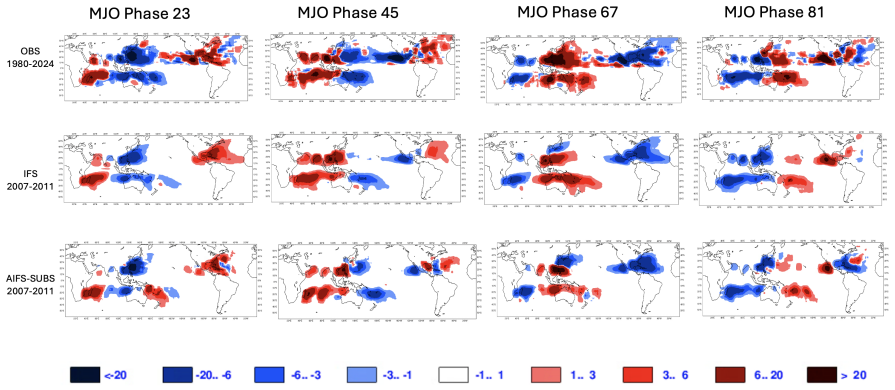
Summary. The manuscript presents AIFS-SUBS, an adaptation of ECMWF’s AIFS-CRPS graph-transformer ensemble for sub-seasonal (weeks 2–6) forecasting. Relative to the medium-range system it uses a 24 h autoregressive step, adds stratospheric levels and top-of-atmosphere thermal radiation, and holds out 2007–2011 for verification. Two configurations are evaluated: AIFS-SUBS (fine-tuned on operational analyses) and AIFS-SUBS-ERA5 (ERA5 only). On the held-out reforecasts the model matches IFS probabilistic anomaly skill (fCRPSS) while reducing mean absolute biases, extends skilful MJO OLR-component forecasts (COR > 0.5) from 25 to 33 days, reproduces MJO–tropical-cyclone modulation and SSW frequency/surface impact comparably to IFS, and in a six-month AI Weather Quest real-time sample attains a variable-averaged RPSS slightly ahead of IFS at weeks 3–4, at roughly 200× lower inference energy.
Significance. If the reported skill parity, bias reduction, and MJO/SSW diagnostics hold under broader verification, this is a substantial operational contribution: ECMWF’s first dedicated ML sub-seasonal system, competitive with IFS on standard S2S diagnostics while enabling much larger real-time ensembles. Strengths include a proper probabilistic training objective (afCRPS), explicit reforecast climatology and fair scores, side-by-side IFS comparisons, IBTrACS-based TC teleconnection checks, ensemble-generated SSW statistics, and an independent live competition entry. The energy claim, with the stated resolution/variable caveats, is practically important. The work is carefully scoped and does not overclaim coupling or diurnal-cycle fidelity.
major comments (3)
- Abstract and §3.2 headline the eight-day OLR-component MJO skill extension (COR > 0.5 to day 33 vs 25 for IFS; Fig. 3b,d). That estimate rests solely on the five-year 2007–2011 window, which the authors correctly call a compromise (§2.4, §3.3) and which contains few independent MJO episodes and is temporally bracketed by training data. Bootstrap CIs on start dates do not fully capture inter-event variability or possible climate/trend leakage from adjacent years. Please either (i) soften the abstract claim to match the in-text caution (e.g., “extends skilful OLR forecasts by up to ~8 days in the 2007–2011 sample”), or (ii) add a robustness check (alternate held-out windows, leave-one-event-out, or AI Weather Quest RMM if available) so the central empirical claim is not period-specific.
- §2.4 and the end of §3.3 note that 2007–2011 is not a strict temporal-causal split. For a first operational ML S2S paper this is understandable, but the AI Weather Quest sample (mid-Aug 2025–mid-Feb 2026) is the only genuine future test and is only six months / 29 weeks. The manuscript should state more explicitly which claims are supported by the live sample (variable-averaged RPSS, spatial patterns in Fig. 7) versus which rest only on the bracketed reforecasts (MJO OLR lead-time extension, SSW frequency and surface composites, TC phase anomalies). That separation will keep the load-bearing claims aligned with the evidence.
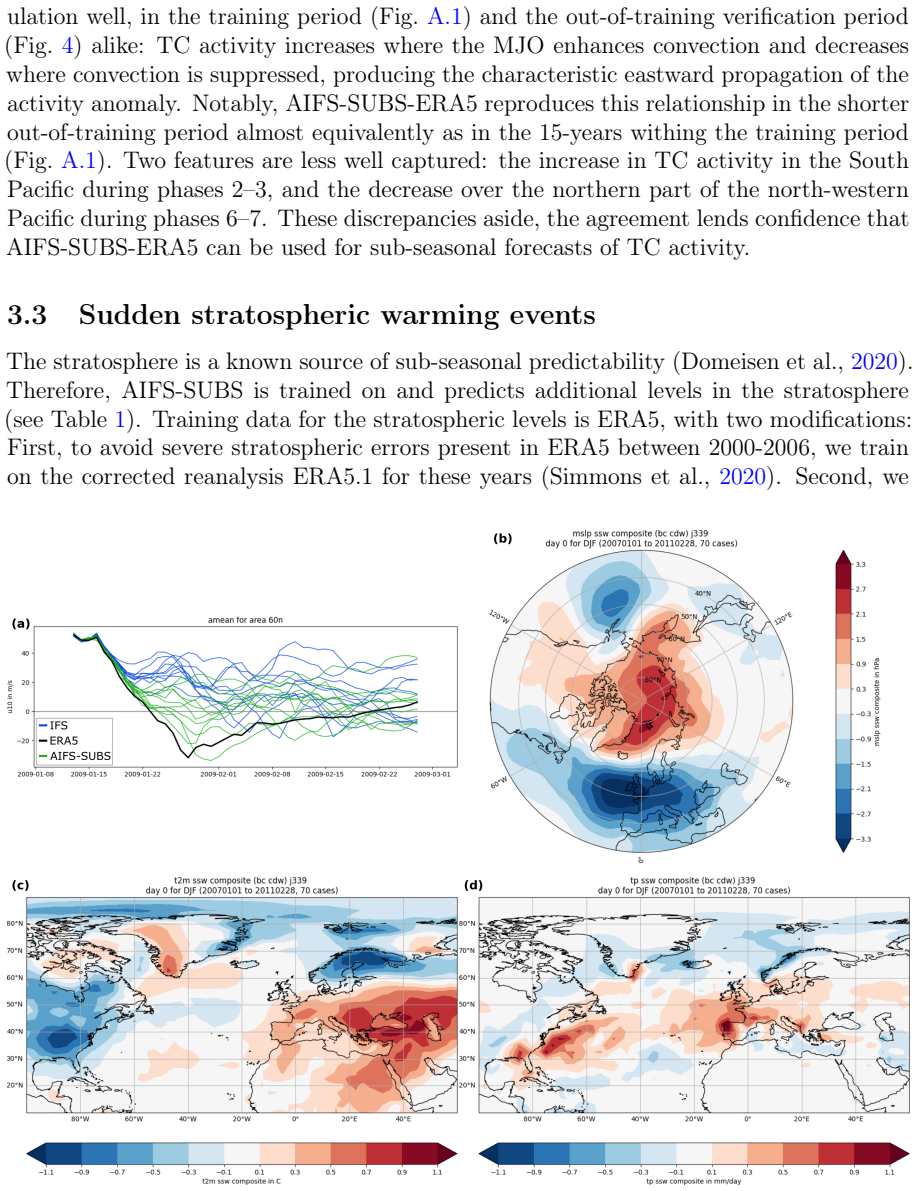
- §3.3 reports 112 ensemble-generated SSWs (day 10–36) for AIFS-SUBS vs 98 for IFS 49r1, with similar strong-surface-impact fractions (~49–51%), and shows surface composites (Fig. 5b–d). The approach of counting model-generated events is appropriate given only four observed major SSWs in the test window, but the text should clarify how SSW detection thresholds, ensemble size, and initialisation density enter the frequency comparison so that “comparable to IFS and consistent with the observational record” is not over-interpreted from a short calendar period.
minor comments (7)
- §2.2 energy comparison (~200× less energy, ~920× faster wall-clock) is useful; the resolution (O96 vs O320) and vertical-level (18 vs 137) caveats are already stated—consider also noting ensemble-size differences when readers compare operational cost.
- Fig. 2 caption and text: “IFS (49r1)” is clear; ensure cycle and ensemble size are stated once in Methods so fCRPSS differences are not confounded with ensemble-size effects (fair CRPS helps, but documentation still matters).
- Table 1: “W wind same levels diagnostic” and the humidity cut-off (≥150 hPa / no humidity above 100 hPa) are important design choices; a one-sentence rationale in the main text (beyond the humidity quality remark in §3.3) would help reproducibility.
- Fig. 3e,f amplitude bias: units/normalisation of the RMM amplitude bias should be stated in the caption for readers less familiar with RMM conventions.
- Fig. 6 asterisk models (AIFS-SUBS*, AIFS-ENS-v2*) initialised from ERA5 rather than operational analyses: the caption already explains this; a short sentence in the main text that operational AIFS-SUBS is expected to score higher when initialised from 50r1 analyses would avoid misreading the ranking.
- Typos / wording: Abstract “config-durations” → “configurations”; Introduction “In constrast” → “In contrast”; “afCRPS” / “fCRPS” usage should be consistent with the cited Ferro/Leutbecher definitions; “REFS” placeholder in the Introduction should be replaced with the intended citations.
- §3.1: “As in the real-time evaluation, we focus on anomaly scores…” appears before the AI Weather Quest section; rephrase to avoid forward-reference confusion.
Circularity Check
No significant circularity: empirical ML evaluation against external benchmarks (IFS, ERA5, IBTrACS, AI Weather Quest) with held-out and future data; no derivation reduces by construction to fitted inputs.
full rationale
AIFS-SUBS is an engineering adaptation of AIFS-CRPS (24 h step, stratospheric levels, ttr/OLR, held-out 2007–2011 window, mixed fine-tuning). All load-bearing claims are empirical skill comparisons (fCRPSS, MABS, RMM COR/fCRPSS, SSW frequency/surface composites, AI Weather Quest RPSS) computed on data withheld from training or on genuine future cases, verified against independent references (ERA5, IBTrACS, operational IFS). Self-citations (Lang et al. 2024/2026) supply the base architecture and afCRPS objective; they are not uniqueness theorems that force the sub-seasonal results, nor do they redefine the evaluation metrics. No parameter is fitted to a subset and then reported as a prediction of a statistically equivalent quantity; no equation equates a claimed prediction to its own input by construction. The short verification window is a statistical-power limitation (correctness risk), not circularity. Score 0 is therefore the honest finding.
Axiom & Free-Parameter Ledger
free parameters (5)
- autoregressive time step =
24 h
- fine-tuning rollout length =
3 steps
- peak learning rates and iteration counts =
1e-3 / 5e-5
- ensemble size and noise dimension =
4 / 10–200
- held-out verification window =
2007–2011
axioms (4)
- domain assumption ERA5 (with ERA5.1 stratospheric correction) and operational analyses are sufficiently accurate ground truth for training and verification of sub-seasonal skill.
- domain assumption A proper scoring rule (afCRPS) trained on short rollouts yields calibrated long-lead probabilistic forecasts after multi-step fine-tuning.
- domain assumption Weekly-mean anomalies relative to model-own reforecast climatology remove systematic bias sufficiently for fair skill comparison.
- domain assumption Graph-transformer encoder–processor–decoder with conditional layer-norm noise injection is an adequate architecture for global atmospheric state evolution.
read the original abstract
Data-driven models now rival numerical weather prediction in the medium range, but extending them to sub-seasonal lead times raises challenges absent at shorter horizons. Errors accumulate over long autoregressive rollouts, systematic biases grow with lead time, and several years of data must be held out for independent verification, even though machine-learning models otherwise benefit from longer training records. To address these challenges, we adapt ECMWF's AIFS-CRPS medium-range model. AIFS-SUBS adopts a 24h autoregressive time step to reduce error accumulation, adds stratospheric levels and top-of-atmosphere thermal radiation as predictors, and reserves 2007--2011 as an independent verification window. We evaluate two config-durations: AIFS-SUBS, fine-tuned on operational analyses, and AIFS-SUBS-ERA5, trained on ERA5 alone. Across weeks 2--6, AIFS-SUBS matches the operational Integrated Forecasting System (IFS) in probabilistic skill while reducing systematic biases. For the convective (OLR) component of the Madden--Julian Oscillation (MJO), AIFS-SUBS extends skilful forecasts (correlation > 0.5) by eight days relative to the IFS, while matching or exceeding the IFS for the full multivariate RMM index. AIFS-SUBS also reproduces the observed MJO modulation of tropical cyclone activity comparably. Stratospheric skill is particularly strong with AIFS-SUBS reproducing sudden stratospheric warming (SSW) frequency and surface impact. In the AI Weather Quest, AIFS-SUBS-ERA5 attains a variable-averaged ranked probability skill score slightly ahead of the IFS at weeks 3 and 4. At inference, AIFS-SUBS uses about 200 times less energy than the IFS, opening the door to much larger real-time ensembles. AIFS-SUBS is ECMWF's first machine-learning model targeted at sub-seasonal time-scales.
Figures




Reference graph
Works this paper leans on
-
[1]
Baldwin, Mark P. and Dunkerton, Timothy J. , year = 2001, month = oct, journal =. Stratospheric. doi:10.1126/science.1063315 , urldate =
-
[2]
Bouall. Improving. Artificial Intelligence for the Earth Systems , volume =. doi:10.1175/AIES-D-23-0027.1 , urldate =
-
[3]
Earth System Science Data , volume =
A Sudden Stratospheric Warming Compendium , author =. Earth System Science Data , volume =. doi:10.5194/essd-9-63-2017 , urldate =
-
[4]
Camargo, Suzana J. and Wheeler, Matthew C. and Sobel, Adam H. , year = 2009, month = oct, journal =. Diagnosis of the. doi:10.1175/2009JAS3101.1 , urldate =
-
[5]
A Machine Learning Model That Outperforms Conventional Global Subseasonal Forecast Models , author =. Nat Commun , volume =. doi:10.1038/s41467-024-50714-1 , urldate =
-
[6]
QuantWeather: Quantile-Aware Probabilistic Forecasting for Subseasonal Precipitation
Chen, Lei and Su, Xinyu and Zhong, Xiaohui and Li, Hao , year = 2026, month = may, number =. doi:10.48550/arXiv.2605.10297 , urldate =. arXiv , keywords =:2605.10297 , primaryclass =
work page internal anchor Pith review Pith/arXiv arXiv doi:10.48550/arxiv.2605.10297 2026
-
[7]
FuXi-S2S: A machine learning model that outperforms conventional global subseasonal forecast models
Chen, Lei and Zhong, Xiaohui and Wu, Jie and Chen, Deliang and Xie, Shangping and Chao, Qingchen and Lin, Chensen and Hu, Zixin and Lu, Bo and Li, Hao and Qi, Yuan , year = 2023, month = dec, number =. doi:10.48550/arXiv.2312.09926 , urldate =. arXiv , keywords =:2312.09926 , primaryclass =
work page internal anchor Pith review Pith/arXiv arXiv doi:10.48550/arxiv.2312.09926 2023
-
[8]
, year = 2022, month = aug, journal =
Delaunay, Antoine and Christensen, Hannah M. , year = 2022, month = aug, journal =. Interpretable. doi:10.1029/2022GL098566 , urldate =
-
[9]
Domeisen, Daniela I. V. and Butler, Amy H. and. The. Journal of Geophysical Research: Atmospheres , volume =. doi:10.1029/2019JD030923 , urldate =
-
[10]
Meteorological Applications , volume =
On the Effect of Ensemble Size on the Discrete and Continuous Ranked Probability Scores , author =. Meteorological Applications , volume =. doi:10.1002/met.45 , urldate =
-
[11]
Ferro, C. A. T. , year = 2014, month = jul, journal =. Fair Scores for Ensemble Forecasts:. doi:10.1002/qj.2270 , urldate =
doi:10.1002/qj.2270 2014
-
[12]
Gneiting, Tilmann and Raftery, Adrian E , year = 2007, month = mar, journal =. Strictly. doi:10.1198/016214506000001437 , urldate =
-
[13]
Gottschalck, J. and Wheeler, M. and Weickmann, K. and Vitart, F. and Savage, N. and Lin, H. and Hendon, H. and Waliser, D. and Sperber, K. and Nakagawa, M. and Prestrelo, C. and Flatau, M. and Higgins, W. , year = 2010, month = sep, journal =. A. doi:10.1175/2010BAMS2816.1 , urldate =
-
[14]
and Mackey, Lester , year = 2026, month = apr, number =
Guan, Hannah and Mouatadid, Soukayna and Orenstein, Paulo and Cohen, Judah and Dong, Haiyu and Ni, Zekun and Berman, Jeremy and Flaspohler, Genevieve and Lu, Alex and Schloer, Jakob and Talib, Joshua and Weyn, Jonathan A. and Mackey, Lester , year = 2026, month = apr, number =. Enhancing. doi:10.48550/arXiv.2604.16238 , urldate =. arXiv , keywords =:2604....
-
[15]
Hahner, Sara and Zampieri, Lorenzo and Bidlot, Jean-Raymond and Browne, Philip and Chantry, Matthew and Clare, Mariana C. A. and Cook, Harrison and Dueben, Peter and Furner, Rachel and Keeley, Sarah and Kousal, Josh and Lang, Simon and Lessig, Christian and Mertes, Gert and Mogensen, Kristian and Moldovan, Gabriel and Pelletier, Charles and Pinault, Flori...
work page internal anchor Pith review Pith/arXiv arXiv doi:10.48550/arxiv.2604.25559 2026
-
[16]
Ham, Yoo-Geun and Kim, Jeong-Hwan and Luo, Jing-Jia , year = 2019, month = sep, journal =. Deep Learning for Multi-Year. doi:10.1038/s41586-019-1559-7 , urldate =
-
[17]
and Keeley, Sarah and Laloyaux, Patrick and Lopez, Philippe and Lupu, Cristina and Radnoti, Gabor and
Hersbach, Hans and Bell, Bill and Berrisford, Paul and Hirahara, Shoji and Nicolas, Julien and Peubey, Carole and Radu, Raluca and Schepers, Dinand and Simmons, Adrian and Soci, Cornel and Abdalla, Saleh and Abellan, Xavier and Balsamo, Gianpaolo and Bechtold, Peter and Biavati, Gionata and Bidlot, Jean and Bonavita, Massimo and De Chiara, Giovanna and Da...
-
[18]
International
Information (NCEI), National Centers for Environmental , urldate =. International
-
[19]
Judt, Falko , year = 2020, month = jan, journal =. Atmospheric. doi:10.1175/JAS-D-19-0116.1 , urldate =
-
[20]
Quarterly Journal of the Royal Meteorological Society , volume =
Predictability of Downward Propagation of Major Sudden Stratospheric Warmings , author =. Quarterly Journal of the Royal Meteorological Society , volume =. doi:10.1002/qj.3017 , urldate =
-
[21]
Karpechko, Alexey Yu. and. Predicting. Geophysical Research Letters , volume =. doi:10.1029/2018GL081091 , urldate =
-
[22]
and Dias, Juliana and Straub, Katherine H
Kiladis, George N. and Dias, Juliana and Straub, Katherine H. and Wheeler, Matthew C. and Tulich, Stefan N. and Kikuchi, Kazuyoshi and Weickmann, Klaus M. and Ventrice, Michael J. , year = 2014, month = may, journal =. A. doi:10.1175/MWR-D-13-00301.1 , urldate =
-
[23]
Knapp, Kenneth R. and Kruk, Michael C. and Levinson, David H. and Diamond, Howard J. and Neumann, Charles J. , year = 2010, month = mar, journal =. The. doi:10.1175/2009BAMS2755.1 , urldate =
-
[24]
Koster, R. D. and Mahanama, S. P. P. and Yamada, T. J. and Balsamo, Gianpaolo and Berg, A. A. and Boisserie, M. and Dirmeyer, P. A. and. Contribution of Land Surface Initialization to Subseasonal Forecast Skill:. Geophysical Research Letters , volume =. doi:10.1029/2009GL041677 , urldate =
-
[25]
Lang, S. T. K. and Leutbecher, M. and Jones, S. C. , year = 2012, journal =. Impact of Perturbation Methods in the. doi:10.1002/qj.1942 , urldate =
-
[26]
Lang, Simon T. K. and Lock, Sarah-Jane and Leutbecher, Martin and Bechtold, Peter and Forbes, Richard M. , year = 2021, journal =. Revision of the. doi:10.1002/qj.3978 , urldate =
-
[27]
Lang, Simon and Alexe, Mihai and Clare, Mariana C. A. and Roberts, Christopher and Adewoyin, Rilwan and Ben Bouall. npj Artif. Intell. , volume =. doi:10.1038/s44387-026-00073-7 , urldate =
-
[28]
Lang, Simon and Alexe, Mihai and Chantry, Matthew and Dramsch, Jesper and Pinault, Florian and Raoult, Baudouin and Clare, Mariana C. A. and Lessig, Christian and. doi:10.48550/arXiv.2406.01465 , urldate =. arXiv , keywords =:2406.01465 , primaryclass =
-
[29]
Journal of Computational Physics , series =
Ensemble Forecasting , author =. Journal of Computational Physics , series =. doi:10.1016/j.jcp.2007.02.014 , urldate =
-
[30]
Leutbecher, Martin , year = 2019, journal =. Ensemble Size:. doi:10.1002/qj.3387 , urldate =
doi:10.1002/qj.3387 2019
-
[31]
doi:10.48550/arXiv.2411.10191 , urldate =
Ling, Fenghua and Chen, Kang and Wu, Jiye and Han, Tao and Luo, Jing-Jia and Ouyang, Wanli and Bai, Lei , year = 2024, month = nov, number =. doi:10.48550/arXiv.2411.10191 , urldate =. arXiv , keywords =:2411.10191 , publisher =
-
[32]
Loegel, Olga and Talib, Joshua and Vitart, Frederic and Hoffmann, J. The. Mach. Learn.: Earth , volume =. doi:10.1088/3049-4753/adf649 , urldate =
-
[33]
Madden, Roland A. and Julian, Paul R. , year = 1972, month = sep, journal =. Description of. doi:10.1175/1520-0469(1972)029<1109:DOGSCC>2.0.CO;2 , urldate =
-
[34]
Madden, Roland A. and Julian, Paul R. , year = 1994, month = may, journal =. Observations of the 40--50-. doi:10.1175/1520-0493(1994)122<0814:OOTDTO>2.0.CO;2 , urldate =
-
[35]
and Becker, Emily and Butler, Amy and Collins, Dan C
Mariotti, Annarita and Baggett, Cory and Barnes, Elizabeth A. and Becker, Emily and Butler, Amy and Collins, Dan C. and Dirmeyer, Paul A. and Ferranti, Laura and Johnson, Nathaniel C. and Jones, Jeanine and Kirtman, Ben P. and Lang, Andrea L. and Molod, Andrea and Newman, Matthew and Robertson, Andrew W. and Schubert, Siegfried and Waliser, Duane E. and A...
-
[36]
Polyak, B. T. and Juditsky, A. B. , year = 1992, month = jul, journal =. Acceleration of. doi:10.1137/0330046 , urldate =
doi:10.1137/0330046 1992
-
[37]
Quarterly Journal of the Royal Meteorological Society , volume =
Unbiased Calculation, Evaluation, and Calibration of Ensemble Forecast Anomalies , author =. Quarterly Journal of the Royal Meteorological Society , volume =. doi:10.1002/qj.4993 , urldate =
-
[38]
Roberts, Christopher David , year = 2026, month = feb, number =. Ensemble-Size-Dependence of Deep-Learning Post-Processing Methods That Minimize an (Un)Fair Score: Motivating Examples and a Proof-of-Concept Solution , shorttitle =. doi:10.48550/arXiv.2602.15830 , urldate =. arXiv , keywords =:2602.15830 , primaryclass =
-
[39]
Roberts, Christopher David and Keeley, Sarah and Mogensen, Kristian and Pelletier, Charles and Zuo, Hao , year = 2026, month = may, number =. The Role of the Oceans for Subseasonal Prediction: Insights from Eddy-Permitting and Eddy-Rich Coupled Forecast Systems , shorttitle =. doi:10.48550/arXiv.2605.00621 , urldate =. arXiv , keywords =:2605.00621 , prim...
work page internal anchor Pith review Pith/arXiv arXiv doi:10.48550/arxiv.2605.00621 2026
-
[40]
and Vitart, Frederic , year = 2026, journal =
Roberts, Christopher D. and Vitart, Frederic , year = 2026, journal =. Ensemble Reliability and the Signal-to-Noise Paradox in. doi:10.1002/qj.70224 , urldate =
-
[41]
and Vitart, Frederic and Camargo, Suzana J
Robertson, Andrew W. and Vitart, Frederic and Camargo, Suzana J. , year = 2020, journal =. Subseasonal to. doi:10.1029/2018JD029375 , urldate =
-
[42]
Schl. A. doi:10.48550/arXiv.2412.03743 , urldate =. arXiv , keywords =:2412.03743 , primaryclass =
-
[43]
Global Stratospheric Temperature Bias and Other Stratospheric Aspects of
Simmons, Adrian and Soci, Cornel and Nicolas, Julien and Bell, Bill and Berrisford, Paul and Dragani, Rossana and Flemming, Johannes and Haimberger, Leo and Healy, Sean and Hersbach, Hans and Horanyi, Andras and Inness, Antje and Sabater, Joaquin Munoz and Radu, Raluca and Schepers, Dinand , year = 2020, doi =. Global Stratospheric Temperature Bias and Ot...
2020
-
[44]
Spaeth, Jonas and Birner, Thomas , year = 2022, month = aug, journal =. Stratospheric Modulation of. doi:10.5194/wcd-3-883-2022 , urldate =
-
[45]
Mean Teachers Are Better Role Models:
Tarvainen, Antti and Valpola, Harri , year = 2017, month = dec, series =. Mean Teachers Are Better Role Models:. Proceedings of the 31st
2017
-
[46]
Mean Teachers Are Better Role Models:
Tarvainen, Antti and Valpola, Harri , abstract =. Mean Teachers Are Better Role Models:
-
[47]
Vitart, F. , year = 2009, journal =. Impact of the. doi:10.1029/2009GL039089 , urldate =
-
[48]
Vitart, Fr. Madden---. Quarterly Journal of the Royal Meteorological Society , volume =. doi:10.1002/qj.3079 , urldate =
-
[49]
Vitart, F. and Robertson, A. W. and Spring, A. and Pinault, F. and Ro. Outcomes of the. Bulletin of the American Meteorological Society , volume =. doi:10.1175/BAMS-D-22-0046.1 , urldate =
-
[50]
Weyn, Jonathan A. and Durran, Dale R. and Caruana, Rich and. Sub-. Journal of Advances in Modeling Earth Systems , volume =. doi:10.1029/2021MS002502 , urldate =
-
[51]
Wheeler, Matthew C. and Hendon, Harry H. , year = 2004, month = aug, journal =. An. doi:10.1175/1520-0493(2004)132<1917:AARMMI>2.0.CO;2 , urldate =
-
[52]
and Scheuerer, Michael and Hamill, Thomas M
Worsnop, Rochelle P. and Scheuerer, Michael and Hamill, Thomas M. and Smith, Timothy A. and Schl. Artificial Intelligence for the Earth Systems , volume =. doi:10.1175/AIES-D-24-0020.1 , urldate =
-
[53]
Zhang, Chidong , year = 2005, journal =. Madden-. doi:10.1029/2004RG000158 , urldate =
-
[54]
Latex-Aifs-Subs , urldate =
discussion (0)
Sign in with ORCID, Apple, or X to comment. Anyone can read and Pith papers without signing in.