Unified Audio Intelligence Without Regressing on Text Intelligence
pith:BUVY2XMUreviewed 2026-07-07 23:52 UTCmodel glm-5.2open to challenge →
The pith
One model learns audio in, audio out, keeps its text mind
A machine-rendered reading of the paper's core claim, the machinery that carries it, and where it could break.
Core claim
The paper demonstrates that a unified single-decoder architecture, when trained with a multi-stage curriculum that freezes text embeddings during audio warmup and maintains high text data blending ratios throughout, can absorb six distinct audio-related capabilities without measurable regression on text reasoning benchmarks. The authors report that their model scores 91.2 on AIME 2025 versus the text backbone's 92.4, 86.4 on MMLU-Redux versus 86.3, and 99.4 on needle-in-a-haystack at 256K context versus 100 for the backbone, while simultaneously achieving state-of-the-art or near-state-of-the-art performance on speech recognition, audio understanding, text-to-speech, and text-to-audio among
What carries the argument
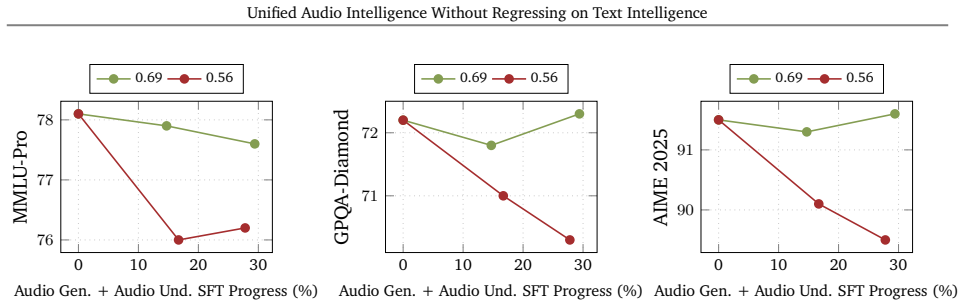
Single Transformer decoder with extended vocabulary; audio encoder + MLP projection into text embedding space; separate codec vocabularies for speech (X-Codec2, 50Hz, single-layer FSQ, 65536 codes) and non-speech audio (X-Codec, 50Hz, 4-layer RVQ, 4096 codes); multi-stage SFT with text embedding freezing during audio warmup; text-only Cascade RL with multi-domain on-policy distillation; classifier-free guidance training via pre-processed unconditional samples
If this is right
- If text-only RL preserves audio capabilities acquired during SFT, then audio-specific RL could further improve audio tasks without text regression, which the authors identify as future work.
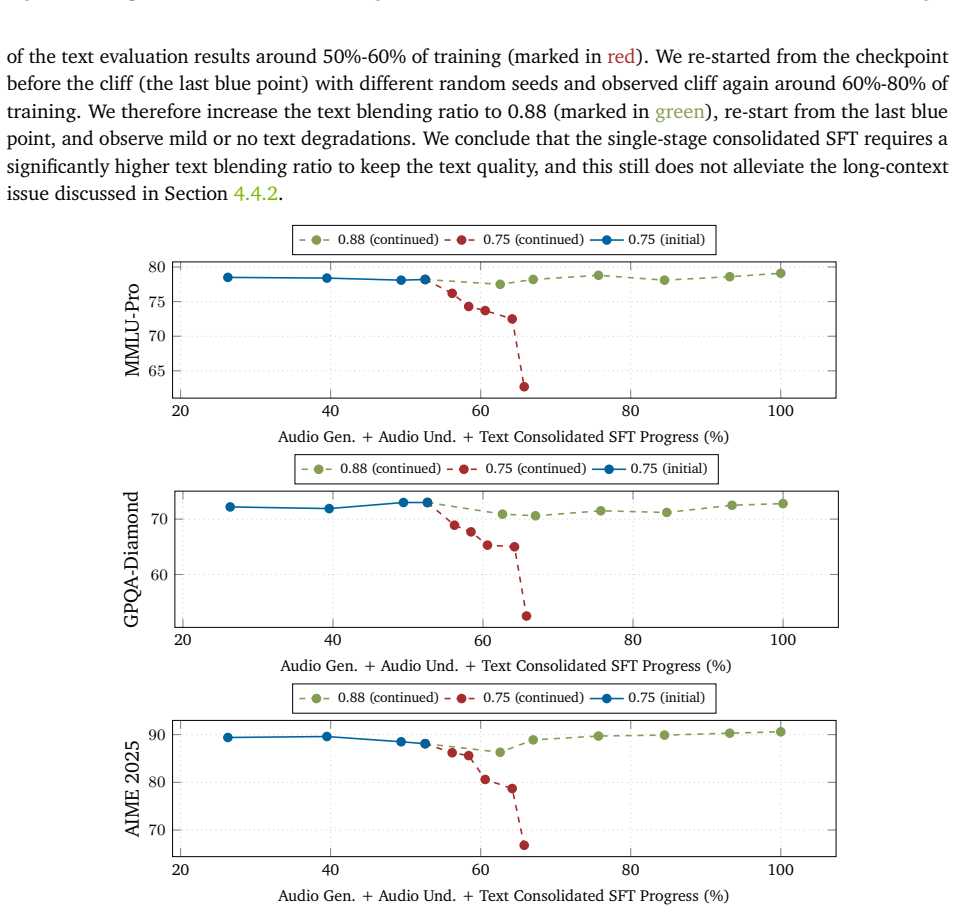
- The multi-stage training recipe where text embeddings are frozen during audio warmup and text data ratios are carefully tuned suggests that the failure mode of multimodal models losing text intelligence is primarily an optimization problem, not a capacity problem.
- The finding that single-stage consolidated SFT breaks long-context attention while multi-stage SFT preserves it implies that the order in which capabilities are introduced matters for maintaining structural properties of the base model's attention mechanism.
- The separate codec dispatch design for speech versus non-speech audio suggests that unified multimodal generation may benefit from modality-specific tokenization rather than a single universal codec.
- The compatibility with standard LLM training and inference infrastructure means the approach is directly scalable to larger backbone models and could be applied to other modalities.
Load-bearing premise
The claim of no text regression rests on comparing Audex's evaluation results against numbers for the text-only backbone reported in a separate publication, without a controlled ablation where an identically trained text-only model is evaluated in the same run with the same harness. Some observed score differences, both positive and negative, could reflect evaluation variance or minor training differences rather than true capability preservation.
What would settle it
A controlled ablation where the text-only backbone is trained with identical text data but no audio components, evaluated on the same benchmarks in the same run, showing a systematic gap that exceeds evaluation noise.
Figures



read the original abstract
Audio intelligence involves understanding, reasoning about, and generating both audio and speech. In this work, we introduce Nemotron-Labs-Audex-30B-A3B (Audex), a unified audio-text LLM built on Nemotron-Cascade-2-30B-A3B, a strong text-only MoE LLM. Audex adopts a simple unified design with a single Transformer decoder: audio inputs are encoded and projected into the text embedding space, while text tokens and quantized audio output tokens are treated uniformly during generation. This architecture enables strong audio-text fusion, seamless multimodal generation, and compatibility with standard LLM training and inference infrastructure. For training, we meticulously curate audio-text datasets comprising 157.4B audio tokens and 320.5B text tokens. We apply multi-stage supervised training on these datasets, followed by text-only Cascade RL and multi-domain on-policy distillation. Audex delivers state-of-the-art audio understanding, speech recognition and translation, text-to-speech, audio generation, and speech-to-speech generation, while preserving very compelling reasoning, alignment, knowledge, long-context, and agentic capabilities of its text-only LLM backbone with marginal or no regression. We release the model checkpoints to facilitate open research.
Editorial analysis
A structured set of objections, weighed in public.
Referee Report
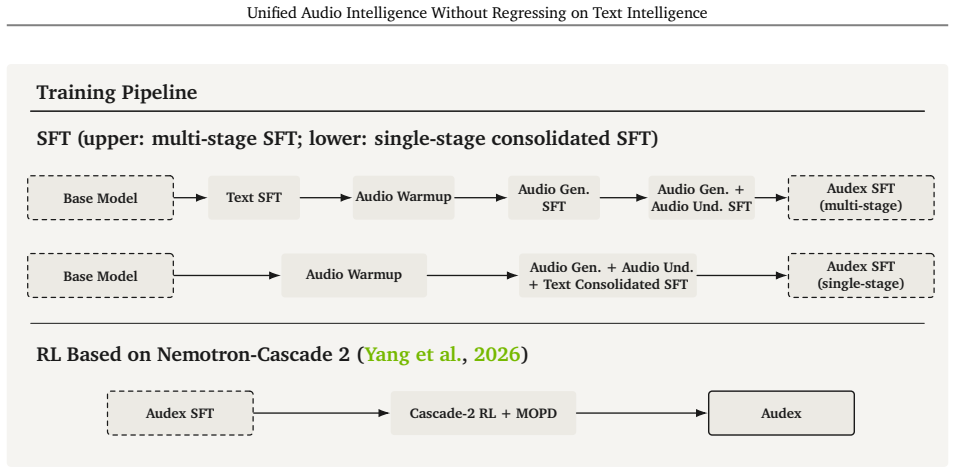
Summary. The paper introduces Nemotron-Labs-Audex-30B-A3B (Audex), a unified audio-text LLM built on the text-only Nemotron-Cascade-2-30B-A3B backbone. The architecture uses a single Transformer decoder with an audio encoder and MLP adapters for input, and extended vocabulary for discrete audio codec tokens for output. Training proceeds in multiple SFT stages (audio warmup, audio generation, audio generation + understanding) followed by text-only Cascade RL. The authors evaluate Audex across text reasoning, knowledge, alignment, long-context, agentic tasks, audio understanding, ASR, AST, TTS, TTA, and speech-to-speech, reporting state-of-the-art or competitive results across these domains. The central claim is that Audex preserves the text intelligence of its backbone with 'marginal or no regression' while gaining strong audio capabilities. Model checkpoints are released.
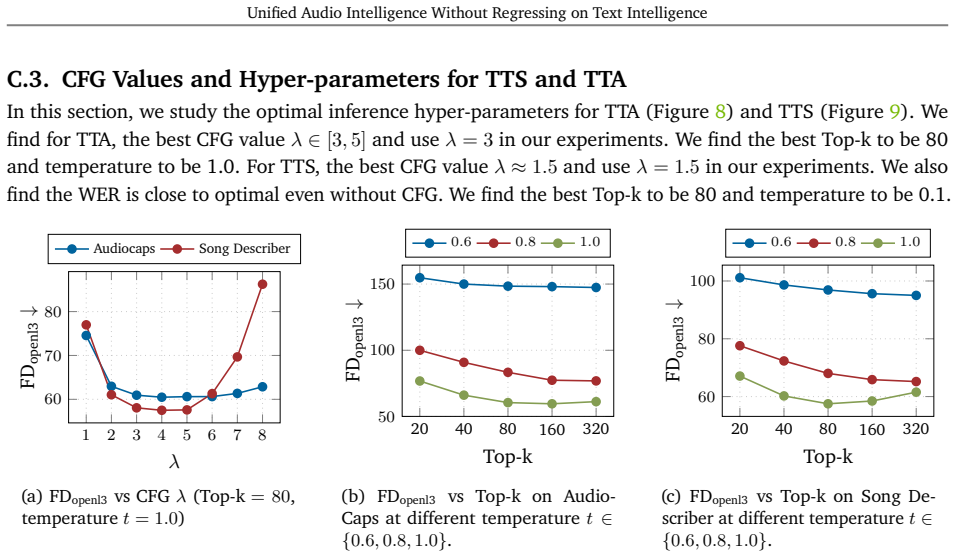
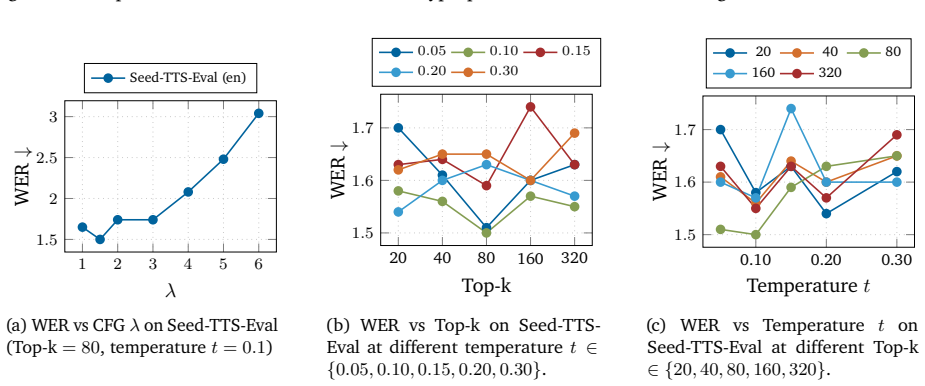
Significance. The paper makes a substantial contribution to the unified multimodal LLM literature by demonstrating that a strong text-only MoE backbone can be extended to handle both audio understanding and generation (speech, non-speech, music) across input and output modalities, without requiring audio-related pretraining. The multi-stage SFT curriculum with frozen text embeddings during audio warmup is a well-motivated design choice, and the ablation in Appendix C.1 provides clear evidence for its necessity. The release of model checkpoints and the comprehensive evaluation across a wide battery of benchmarks (text, audio, speech) are commendable. The CFG training and inference recipes for TTA and TTS, including the hyperparameter sweeps in Figures 4 and 8-9, are useful for reproducibility. The finding that text-only Cascade RL does not catastrophically forget audio abilities is an interesting empirical observation.
major comments (3)
- Table 1 and §2: The headline claim of 'marginal or no regression' on text intelligence is not fully supported by the paper's own data. Table 1 shows NIAH at 1M context dropping from 99.0 (backbone) to 83.4 (Audex), a 15.6-point regression. IFBench drops from 82.9 to 77.8 (−5.1 points). These are not marginal. The paper does not acknowledge or contextualize these regressions anywhere in the main text or in §5.1. The claim should be revised to accurately reflect the spectrum of outcomes: negligible regression on reasoning/knowledge benchmarks, but substantial regression on long-context retrieval and instruction-following. At minimum, the paper should explicitly discuss these specific drops and explain whether they are expected consequences of the audio SFT stages (e.g., the single-stage SFT NIAH collapse in Table 4 suggests attention mechanism disruption, which may persist at 1M context).
- Appendix A.5, τ²-Bench evaluation: The paper uses a 'latest-turn thought retention' policy that differs from the official 'no thought carry-over' policy, and Appendix A.5 states this inflates scores by 3–5 points. The reported Audex score of 57.2 vs. backbone 58.9 (Table 1) would thus become a regression of approximately 4.7–6.7 points under the official policy. This evaluation deviation should be disclosed in the main results table or discussed as a limitation, as it affects the agentic capability preservation claim. The paper should either also report the official-policy number or clearly flag this caveat in §5.1.
- §4.4.1 and Table 1: The 'no regression' claim relies on comparing Audex's evaluation results against backbone numbers from Yang et al. (2026) (Nemotron-Cascade-2). The paper states (§4.4.1) that Audex initializes from the SFT checkpoint and applies the same Cascade RL pipeline, but it does not provide a controlled ablation where the backbone is re-evaluated using Audex's exact evaluation harness in the same runs. Some benchmarks show Audex scoring higher than the backbone (e.g., IMO AnswerBench 81.1 vs. 79.3), which could reflect evaluation variance or minor setup differences rather than true improvement. The paper should either (a) re-run the backbone with the same harness for direct comparability, or (b) explicitly state that the backbone numbers are taken from the external report and may not be directly comparable due to potential differences in evaluation infrastructure.
minor comments (9)
- Table 1: The 'N/S' (not supported) markers are used extensively for baseline models but are not defined in the table caption. Please add a definition.
- §3.3: The vocabulary size computation is described in detail (131,072 + 65,536 + 8,192 + 5 = 204,805, padded to 205,312), but the text says '8192 non-speech audio tokens' while only 4 RVQ layers are used (4 × 1,024 = 4,096). The text explains the full 8-layer depth is reserved, but this could be clearer.
- Table 2: The 'Total tokens' column (477.9B) is described as 'a simple addition of audio and text tokens,' but the per-row 'total tokens' values do not always equal audio tokens + text tokens (e.g., TTS: 75.8B + 5.2B = 81.0B, which matches, but this should be stated more explicitly for all rows).
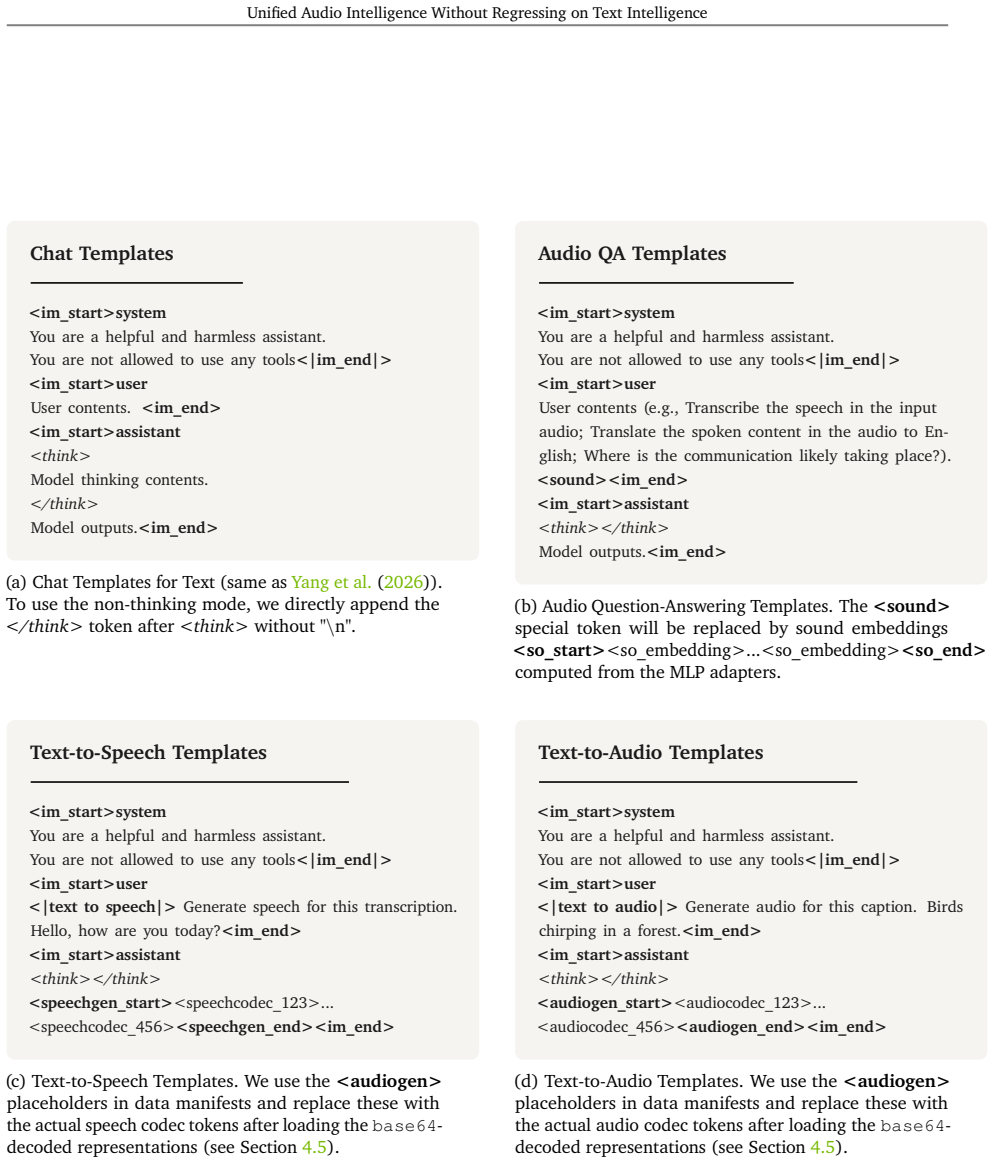
- Figure 2(a): The chat template shows a token that appears as a placeholder for a special token but is rendered ambiguously in the text. Please ensure all special tokens are clearly typeset.
- §4.4.2, Table 4: The multi-stage SFT NIAH result is 99.3|86.8, but the final Audex model (after RL) reports 99.4|83.4 in Table 1. The 1M context NIAH drops from 86.8 (SFT) to 83.4 (after RL). This suggests the text-only RL stage caused a 3.4-point regression on NIAH at 1M, which should be noted given the Long-context RL stage is part of the pipeline.
- Table 5: Several baseline entries are marked with ‡ (evaluated by the authors) but the specific evaluation settings used for these baselines are not always clear. For example, Voxtral-Small-24B-2507 and MiMo-Audio are evaluated on some benchmarks but not others, with '–' markers. A brief note on why certain benchmarks were skipped would help.
- §5.2: The TTA results state 'marginal drop of the scores (+6.0/4.6, respectively)' after text RL, but the sign convention is confusing — the FD_openl3 metric is lower-is-better, so an increase of 6.0/4.6 means worse quality. Using 'increase' rather than 'drop' would be clearer.
- Appendix A.5: The SWE-bench Verified evaluation uses a 'full interaction retention policy' that 'closely mirrors our training environment.' This train-test alignment should be discussed as a potential confound, since the model may benefit from scaffold familiarity rather than generalizable agentic ability.
- References: Several citations refer to 2026-dated arXiv preprints (e.g., Yang et al., 2026; Team, 2026; Blakeman et al., 2025b). Please verify these are correctly cited and that DOIs/URLs are included where available.
Simulated Author's Rebuttal
We thank the referee for a careful and constructive review. The referee raises three major points, all of which concern the precision and evidentiary support of our headline claim of 'marginal or no regression' on text intelligence. We agree with the substance of all three points and will revise the manuscript accordingly. Specifically: (1) we will revise the 'marginal or no regression' claim to accurately reflect the spectrum of outcomes, including the substantial regressions on NIAH at 1M context and IFBench, and add discussion contextualizing these drops; (2) we will disclose the τ²-Bench evaluation deviation in the main results table and/or §5.1, noting the approximate 3–5 point inflation; and (3) we will explicitly state that backbone numbers are sourced from the external Nemotron-Cascade-2 report and may not be directly comparable due to potential evaluation infrastructure differences. We do not have standing objections to any of the referee's comments.
read point-by-point responses
-
Referee: Table 1 and §2: The headline claim of 'marginal or no regression' on text intelligence is not fully supported by the paper's own data. Table 1 shows NIAH at 1M context dropping from 99.0 (backbone) to 83.4 (Audex), a 15.6-point regression. IFBench drops from 82.9 to 77.8 (−5.1 points). These are not marginal. The paper does not acknowledge or contextualize these regressions anywhere in the main text or in §5.1. The claim should be revised to accurately reflect the spectrum of outcomes: negligible regression on reasoning/knowledge benchmarks, but substantial regression on long-context retrieval and instruction-following. At minimum, the paper should explicitly discuss these specific drops and explain whether they are expected consequences of the audio SFT stages (e.g., the single-stage SFT NIAH collapse in Table 4 suggests attention mechanism disruption, which may persist at 1M context).
Authors: The referee is correct. The data in Table 1 do show substantial regressions on NIAH at 1M context (−15.6 points) and IFBench (−5.1 points), and our headline claim of 'marginal or no regression' does not accurately characterize these outcomes. We will revise the manuscript to address this in three ways. First, we will qualify the claim throughout the paper (abstract, §1, §2, §5.1) to state that Audex preserves text intelligence with negligible regression on reasoning and knowledge benchmarks, but with measurable regression on certain long-context retrieval and instruction-following benchmarks. Second, we will add an explicit discussion in §5.1 that acknowledges the specific NIAH and IFBench drops and contextualizes them relative to the overall spectrum of results. Third, we will connect this discussion to the single-stage SFT NIAH collapse finding in Table 4 and §4.4.2: the multi-stage SFT strategy substantially mitigates but does not fully eliminate attention disruption at very long context lengths, which is consistent with the 1M-context NIAH regression we observe. We note that at 256K context, NIAH remains high (99.4 vs. 100.0 for the backbone), so the regression is specific to the 1M setting. We agree this should be transparently stated rather than left implicit. revision: yes
-
Referee: Appendix A.5, τ²-Bench evaluation: The paper uses a 'latest-turn thought retention' policy that differs from the official 'no thought carry-over' policy, and Appendix A.5 states this inflates scores by 3–5 points. The reported Audex score of 57.2 vs. backbone 58.9 (Table 1) would thus become a regression of approximately 4.7–6.7 points under the official policy. This evaluation deviation should be disclosed in the main results table or discussed as a limitation, as it affects the agentic capability preservation claim. The paper should either also report the official-policy number or clearly flag this caveat in §5.1.
Authors: We agree. The τ²-Bench evaluation deviation is currently documented only in Appendix A.5, which is insufficient given that it materially affects the agentic capability comparison in Table 1. We will add a footnote or caveat to the τ²-Bench row in Table 1 and a brief discussion in §5.1 stating that our evaluation uses a latest-turn thought retention policy that differs from the official no-thought-carry-over policy, and that this inflates scores by approximately 3–5 points. Under the official policy, Audex's score would be approximately 52–54, representing a regression of roughly 5–7 points relative to the backbone's 58.9. We chose the latest-turn retention policy because it matches our SFT data construction and the thought-state management strategy used in Nemotron-3-Nano-v3 and DeepSeek-V3.2, reducing train-test mismatch, but we agree this rationale does not excuse the need for transparent disclosure in the main results. We will also note this as a limitation and indicate that reporting the official-policy number is a natural follow-up for future work. revision: yes
-
Referee: §4.4.1 and Table 1: The 'no regression' claim relies on comparing Audex's evaluation results against backbone numbers from Yang et al. (2026) (Nemotron-Cascade-2). The paper states (§4.4.1) that Audex initializes from the SFT checkpoint and applies the same Cascade RL pipeline, but it does not provide a controlled ablation where the backbone is re-evaluated using Audex's exact evaluation harness in the same runs. Some benchmarks show Audex scoring higher than the backbone (e.g., IMO AnswerBench 81.1 vs. 79.3), which could reflect evaluation variance or minor setup differences rather than true improvement. The paper should either (a) re-run the backbone with the same harness for direct comparability, or (b) explicitly state that the backbone numbers are taken from the external report and may not be directly comparable due to potential differences in evaluation infrastructure.
Authors: The referee raises a valid methodological concern. The backbone (Nemotron-Cascade-2) numbers in Table 1 are taken from Yang et al. (2026), and while we use the same evaluation setups described in Appendix A.1–A.5, we cannot guarantee that every detail of the evaluation infrastructure is identical. The cases where Audex scores slightly higher than the backbone (e.g., IMO AnswerBench 81.1 vs. 79.3) could indeed reflect evaluation variance or minor setup differences rather than genuine improvement. We will adopt option (b): we will add an explicit statement in §4.4.1 and/or Table 1 noting that the backbone numbers are sourced from the external Nemotron-Cascade-2 report and that while we use the same evaluation configurations, minor differences in evaluation infrastructure cannot be fully ruled out. We will frame cases where Audex exceeds the backbone as within the range of evaluation variance rather than as improvements. Re-running the backbone with our exact harness (option a) would be the strongest response, but we are unable to guarantee this can be completed within the revision timeframe due to compute constraints; we will therefore pursue it as a follow-up if feasible. revision: partial
Circularity Check
No circularity: Audex's 'no regression' claim is an empirical measurement against external benchmarks, not a quantity defined in terms of a fitted parameter or self-citation chain.
full rationale
The paper's central claim—that Audex preserves text intelligence with 'marginal or no regression'—is an empirical measurement against external benchmarks (AIME, MMLU, GPQA, NIAH, IFBench, etc.), not a quantity defined in terms of a fitted parameter or a self-citation chain. The training recipe reuses data and RL pipelines from Nemotron-Cascade-2 (Yang et al., 2026) and techniques from UALM (Tian et al., 2026), both co-authored by overlapping author sets, but these citations describe training methodology (data curation, RL stages, codec choices), not a theorem or fitted parameter that would make the evaluation results tautological. The backbone numbers in Table 1 come from Yang et al. (2026), but Audex's numbers are independently measured on the same benchmarks. The τ²-Bench evaluation (Appendix A.5) uses a custom 'latest-turn thought retention' policy that differs from the official code, but this is a train-test alignment concern (correctness risk), not circularity—the score is still an empirical measurement, not a definition. The paper does not fit a parameter to a subset of data and then 'predict' a closely related quantity, nor does it invoke a uniqueness theorem from prior work to forbid alternatives. The CFG value λ is tuned on TTA/TTS benchmarks (Figure 4), but this is a standard inference hyperparameter sweep, not a fit that is then presented as a first-principles prediction. No step in the derivation chain reduces to its own inputs by construction.
Axiom & Free-Parameter Ledger
free parameters (11)
- Data blending ratios per SFT stage =
See Table 3 (e.g., text 0.44-1.0, ASR+AST 0-1.0, audio understanding 0-2.0)
- Learning rates per stage =
2e-5 to 2e-3 depending on stage
- CFG lambda for TTA =
3
- CFG lambda for TTS =
1.5
- Top-k for TTA =
80
- Temperature for TTA/TTS =
1.0 / 0.1
- RVQ layers used for non-speech =
4 of 8
- Text blending ratio threshold for stability =
0.69-0.88
- Audio encoder frame rate =
25 Hz
- Codec frame rate =
50 Hz
- Fixed TTA output duration =
10 seconds
axioms (5)
- domain assumption Text-only RL applied after multimodal SFT does not cause catastrophic forgetting of audio capabilities.
- domain assumption Freezing text token embeddings during audio warmup preserves text quality.
- domain assumption Multi-stage SFT is preferable to single-stage consolidated SFT for preserving long-context abilities.
- domain assumption Standard LLM next-token prediction loss is sufficient for learning audio generation.
- domain assumption AF-Whisper audio encoder features contain sufficient information for general audio understanding.
invented entities (2)
-
Enhancement VAE for non-speech audio decoding
independent evidence
-
Streaming causal ConvNeXt decoder for X-Codec2
independent evidence
discussion (0)
Sign in with ORCID, Apple, or X to comment. Anyone can read and Pith papers without signing in.