REVIEW 3 major objections 8 minor 50 references
Published hyperbolic vision-language models stay near-Euclidean and do not activate the radial and cone hierarchy their geometry was meant to provide.
Reviewed by Pith at T0; open to challenge. T0 means a machine referee read the full paper against a public rubric. the ladder, T0–T4 →
T0 review · grok-4.5
2026-07-14 16:14 UTC pith:AAVRH44L
load-bearing objection A careful multi-family audit shows published hyperbolic VLMs sit near-Euclidean with saturated cones; the real advance is the operating-point framing, closed-form edge, and reusable five-number report. the 3 major comments →
Is the Geometry Doing the Work? An Operating-Point Audit of Hierarchy in Hyperbolic Vision-Language Models
The pith
A machine-rendered reading of the paper's core claim, the machinery that carries it, and where it could break.
Core claim
The audited hyperbolic vision-language formulations do not show an operative radial or cone-based hierarchy mechanism under the paper's diagnostics. All converged checkpoints remain near-Euclidean, with local distortion near one and none reaching dimensionless radius above one; releasing the curvature floor changes curvature and norms without leaving that regime or substantially degrading downstream performance. Trained-parent apertures are saturated or nearly saturated, graded traversal fails including under native distance metrics, and external parent-child ordering shows no shuffle-controlled pair-specific radial signal at quantified sensitivity—with only a small non-operative residual on
What carries the argument
The dimensionless operating point √cρ together with the closed-form cone saturation edge √cρ ≤ 2K. These convert abstract curvature into a checkable regime: small √cρ means locally Euclidean geometry; parent means at or below 2K mean fully open parent cones and near-trivial containment. Gradient diagnostics show the entailment objective accelerates collapse by widening apertures without learning order.
Load-bearing premise
That geometry is doing the work only if embeddings leave the near-Euclidean band and show shuffle-surviving pair-specific radial order with active, non-saturated cones—if hierarchy lives only in angles or level-wise norm offsets, the negative mechanism claim is narrower than the title suggests.
What would settle it
A trained hyperbolic vision-language checkpoint with median image and text √cρ well above one, parent means clearly above the 2K saturation edge, shuffle-controlled parent-child radial excess above the paper's roughly 13-percentage-point 80%-power threshold, and graded traversal that is strictly monotonic under native-distance retrieval with a gain over a pure norm-only control.
If this is right
- Hierarchy claims for hyperbolic vision-language models should publish the five-number geometry report—operating point, cone saturation state, directed violations, shuffle-controlled radial excess, and radial increment beyond cosine—rather than relying on taxonomy correlations or retrieval scores alone.
- Releasing curvature floors or tightening entailment thresholds is not enough; training objectives must identify curvature separately from radial scale and must not reward low-curvature wide-cone shortcuts.
- Coarse-retrieval gains that track box or compositional supervision should not be read as evidence of an active hyperbolic radial mechanism.
- Contrastive or alignment training alone also fails to hold a nonlocal operating point, so future models must make curvature identifiable under the non-entailment objective, not only revise the cone loss.
- Symmetric taxonomy-distance correlations and zero cone-violation rates are underdetermined without angular-versus-radial decompositions and shuffle controls.
Where Pith is reading between the lines
- Stabilization methods that only break the norm-to-cone coupling may still leave models near-Euclidean unless they also make curvature identifiable under the contrastive objective.
- The same operating-point and saturation-edge audit could be applied to hyperbolic graph and taxonomy embeddings outside vision-language to test whether hierarchy claims there rest on active geometry.
- If contrastive training cannot hold a nonlocal operating point, an explicit curvature-identifying term may be a design requirement rather than an optional add-on.
- Much of the hierarchy-like performance reported for these models may be angular semantic organization or box-supervision effects misread as radial hyperbolic depth.
Editorial analysis
A structured set of objections, weighed in public.
Referee Report
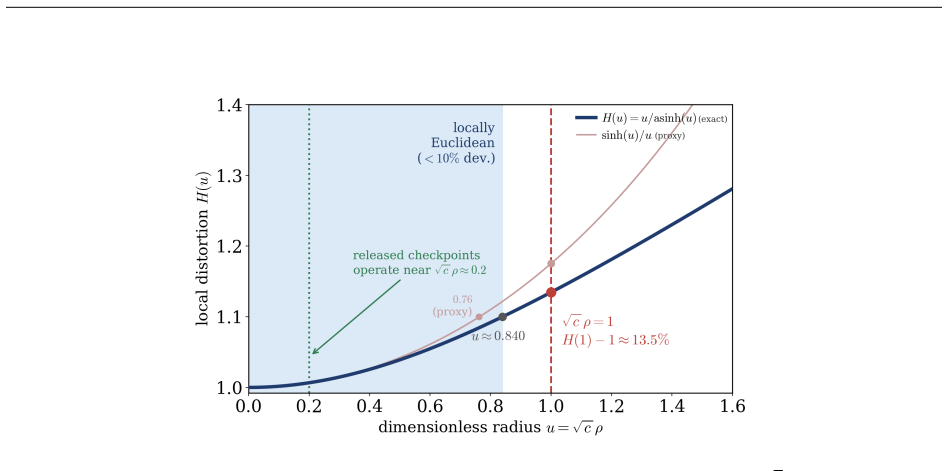
Summary. The paper audits whether three published hyperbolic vision–language families (MERU, HyCoCLIP, PHyCLIP) actually use nonlocal hyperbolic geometry and radial/cone hierarchy. Across released checkpoints and matched current-GRIT interventions, all converged models remain near-Euclidean (H(u)≈1; √cρ≈0.2–0.3; none reaches √cρ>1). Releasing the curvature floor rescales c and norms without leaving this regime or substantially harming downstream metrics. Entailment cones are inactive or saturated; graded traversal fails under cosine and native-distance readouts; shuffle-controlled pair-specific radial excess is a sensitivity-bounded non-detection on external taxonomy, with only a small non-operative residual on the native GRIT box→caption relation. Taxonomy correlations are angular rather than radial. Gradient diagnostics and a closed-form aperture identity (saturation at √cρ≤2K) identify a low-curvature, wide-cone shortcut in the entailment objective as the dominant accelerator of collapse, while entailment-off runs show that contrastive/alignment alone also fails to hold a nonlocal operating point. The authors distill the audit into a five-number geometry report for future hierarchy claims.
Significance. If the result holds, this is a high-value negative and diagnostic contribution for hyperbolic representation learning in vision–language models. It separates curvature as a scalar from the dimensionless operating point √cρ, shows that standard hierarchy-looking metrics are underdetermined, and supplies a mechanistic account (aperture identity plus gradient attribution) of why published entailment objectives favor collapse. Strengths that raise the bar for the field include: multi-family released-checkpoint and matched from-scratch interventions; multi-seed ViT-B runs; shuffle nulls with quantified MDEs (≈13.5 pp radial excess; ≈0.013 ΔR²_norm); synthetic planted-tree positive controls; cosine-plus-norm taxonomy decomposition; native-distance traversal readouts; and a closed-form, parameter-free saturation edge √cρ≤2K derived from the models’ own aperture formula. The five-number geometry report is a concrete, adoptable evaluation contract. The paper is carefully scoped as necessary-condition diagnostics rather than a claim that hyperbolic geometry is useless.
major comments (3)
- §7.3 (aperture identity and edge-settling claim): The closed-form saturation edge √cρ≤2K is sound and follows from the published aperture formula with fixed K=0.1. The stronger dynamical claim—that box-supervised trained image-parent coordinates settle at this edge as an equilibrium rather than a clamp artifact—is currently correlational: all three families share the same K, and no K-sweep is reported. The manuscript already notes this limitation. Please either (i) add a small matched K-sweep (or K-rescaled aperture constant) on at least one box-supervised family, or (ii) demote the language from edge-linked equilibrium / attractor framing to “consistent with the saturation edge under the shared K,” and keep the load-bearing claim as the identity plus the observed parent means lying at or below the edge under clampOff.
- §7.4 / abstract (“shortcut is the dominant accelerator… not its sole cause”): Curvature collapse under λ_e=0 is well supported (c is excluded from weight decay; Table 6; Figure 5). The accompanying √cρ contraction after the transient nonlocal overshoot is, as the paper notes, confounded by encoder weight decay (0.2) and possibly temperature. The abstract and conclusion currently state the dual failure (entailment shortcut + contrastive under-identification) at equal rhetorical weight. Please tighten the abstract/conclusion so that (a) c-collapse without entailment is the primary “not sole cause” claim, and (b) ρ-side operating-point contraction is explicitly flagged as weight-decay-confounded unless a reduced-WD control is added. This does not overturn the released-checkpoint or clampOff negative findings, but it is load-bearing for the mechanistic dual-failure narrative.
- Scope of the primary estimand (§3.4, §5.1, abstract): The paper correctly takes shuffle-controlled pair-specific radial excess as the primary hierarchy estimand and quantifies sensitivity. It also correctly notes that radial depth can exist in near-Euclidean spaces and that diagnostics are necessary not sufficient (§4, §7.5). The title and some summary sentences (“do not show an operative radial/cone mechanism”) can still be read as ruling out all hierarchy-like structure. Please add one explicit scoping sentence in the abstract and conclusion stating what is ruled out (shuffle-surviving pair-specific radial alignment and active non-saturated cones under the stated readouts) versus what is not (angular organization, purely marginal level offsets, cosine-redundant level codes). The body already has this; the front matter should match.
minor comments (8)
- Figure 1: The exact H(u)=u/asinh(u) vs sinh(u)/u proxy comparison is useful; consider marking the audited max √cρ≈0.37 on the plot in addition to the 0.2 and 1.0 verticals for immediate visual context.
- Table 3 caption and §4.3: “does not substantially degrade” is fair for MERU/PHyCLIP; for HyCoCLIP-B several retrieval/SugarCrepe deltas are positive under clampOff. A short clause that some metrics improve under collapse would strengthen the decoupling reading.
- §5.2 / Table 4: Released MERU t→i rates on GRIT are flagged as domain-shifted (RedCaps-trained). Consider moving that caveat into the main-text table caption, not only the appendix footnote, so readers do not over-interpret those violation rates.
- §6.4 multi-granularity retrieval: Averaging leaf embeddings for ancestor queries mechanically shrinks norms. The paper notes this is a supervision probe, not a radial readout; a one-sentence reminder in the main text (not only Appendix G) would prevent misreading the coarse-depth AP gains as geometric.
- Notation Table 7: K is both the aperture constant and numerically equal to the baseline curvature floor (0.1). A parenthetical “distinct from the curvature floor despite equal numerical value” in the main text near Eq. (10) would reduce confusion.
- Reproducibility: The commitment to release current-GRIT checkpoints on request / upon publication is good; if the journal allows, state a stable archive plan (e.g., DOI or Hugging Face) for the audit suite hashes already listed in Appendix I.
- Related work: ARGENT is handled carefully as concurrent and unaudited. A single sentence on whether ARGENT’s adaptive loss removes the √c factor in the aperture (not only the norm coupling) would help readers map the two analyses.
- Typos / polish: “AnOperating-PointAudit” spacing in the title block; occasional missing spaces after commas in dense diagnostic sentences; “from-scratch interventions” vs “matched current-GRIT interventions” could be standardized early.
Circularity Check
No significant circularity: the audit measures third-party models with external nulls, closed-form identities from published cone formulas, and empirical operating points—not fits or self-citation chains that force the negative hierarchy claim.
full rationale
This is a diagnostic audit of released MERU/HyCoCLIP/PHyCLIP checkpoints and matched from-scratch interventions, not a first-principles derivation that could collapse into its inputs. Load-bearing claims are empirical: measured √cρ and H(u) on checkpoints (Tables 1–2, 8–9); shuffle-controlled radial excess with planted-tree and MDE sensitivity controls (Appendix F); cone saturation checked against the models’ published aperture formula ω=arcsin(min{1,2K/(√cρ)}) with fixed K=0.1, which the paper itself labels an identity whose falsifiable content is where trained parent means land (Section 7.3); gradient attribution on full-objective trajectories; and entailment-off ablations that continue contracting past the edge. Authors do not import uniqueness theorems or ansatzes from their own prior work; related-work citations are third-party. Reporting H(u) alongside √cρ is explicitly acknowledged as two views of one quantity, not independent confirmation. Defining “operative radial/cone mechanism” via necessary-condition diagnostics scopes the claim (as the paper states in Sections 3 and 7.5) but does not make the negative findings true by construction—positive controls show the tests can fire when structure is planted. No fitted parameter is renamed a prediction; no self-citation is load-bearing for the central result.
Axiom & Free-Parameter Ledger
free parameters (5)
- Aperture constant K =
0.1
- Curvature floor (baseline clamp) =
0.1 (baseline); 0.001 (clampOff)
- Nonlocal / 10%-distortion markers √cρ>1 and ≈0.84 =
√cρ>1; 10% at ≈0.84
- Detection threshold z≥+1.6 for shuffle-controlled radial excess =
z≥+1.6
- Entailment weight λ_e and threshold η =
λ_e∈{0,0.2}; η∈{0.7,1.2}
axioms (5)
- standard math In Lorentz/Poincaré models, local Euclidean deviation is governed by the dimensionless product u=√cρ via H(u)=u/asinh(u), not by scalar c alone.
- domain assumption Entailment half-aperture is ω(ρ)=arcsin(min{1, 2K/(√cρ)}), so cones saturate exactly when √cρ≤2K.
- ad hoc to paper Shuffle-controlled pair-specific radial excess (not raw norm order) is the primary estimand for the radial-hierarchy claim these models make.
- domain assumption Matched within-snapshot current-GRIT interventions (reduced crawl) identify mechanisms that also apply to released checkpoints via shared operating band and parameter-free saturation criterion.
- domain assumption Downstream retrieval/ZSC/compositionality remaining comparable under curvature collapse decouples those metrics from active hyperbolic hierarchy.
invented entities (2)
-
Five-number geometry report (operating point, saturation state, directed violations, shuffle-controlled radial excess, radial increment beyond angle)
no independent evidence
-
Low-curvature wide-cone shortcut (entailment-driven curvature collapse mechanism)
no independent evidence
read the original abstract
Whether a hyperbolic representation model uses its geometry cannot be inferred from curvature alone: what matters is the dimensionless operating point $\sqrt{c}\rho$ and whether the radial and cone mechanisms are operational there. We develop necessary-condition diagnostics and audit three published hyperbolic vision-language families -- MERU, HyCoCLIP, and PHyCLIP -- across released checkpoints and matched interventions. All converged checkpoints remain near-Euclidean ($H(u)\approx1$; none reaches $\sqrt{c}\rho>1$), and releasing the curvature floor changes $c$ and norms without leaving this regime or substantially degrading downstream performance. Entailment cones are inactive or saturated, and graded traversal fails under controlled readouts, including the models' native distance metrics. External parent-child ordering shows no shuffle-controlled pair-specific radial signal at quantified sensitivity; the only surviving pair-specific signal, a statistically detectable but small residual on the GRIT box-to-full-caption relation, remains non-operative under the evaluated readouts. Taxonomy correlations show no detectable norm contribution beyond cosine, and coarse-retrieval gains co-vary with box/compositional supervision without establishing an active radial mechanism. Gradient diagnostics expose a low-curvature, wide-cone shortcut in the entailment objective. A closed-form aperture identity places the saturation edge at $\sqrt{c}\rho\le2K$: with the floor released, all trained relation-level parent means lie at or below this edge, leaving the parent cones fully or nearly saturated. Entailment-off runs pass the edge and continue contracting. The shortcut is the dominant accelerator of collapse, not its sole cause. These audited formulations do not show an operative radial/cone mechanism under our diagnostics. We distill the audit into a five-number geometry report for hierarchy claims.
Figures



Reference graph
Works this paper leans on
-
[1]
Comparing euclidean and hyperbolic embeddings on the wordnet nouns hypernymy graph
Sameer Bansal and Adrian Benton. Comparing euclidean and hyperbolic embeddings on the wordnet nouns hypernymy graph. In Proceedings of the Second Workshop on Insights from Negative Results in NLP, pp.\ 49--53, 2021
2021
-
[2]
Metric spaces of non-positive curvature, volume 319
Martin R Bridson and Andr \'e Haefliger. Metric spaces of non-positive curvature, volume 319. Springer Science & Business Media, 1999
1999
-
[3]
Embedding geometries of contrastive language-image pre-training
Jason Chuan-Chih Chou and Nahid Alam. Embedding geometries of contrastive language-image pre-training. In European Conference on Computer Vision, pp.\ 399--416. Springer, 2024
2024
-
[4]
Imagenet: A large-scale hierarchical image database
Jia Deng, Wei Dong, Richard Socher, Li-Jia Li, Kai Li, and Li Fei-Fei. Imagenet: A large-scale hierarchical image database. In 2009 IEEE conference on computer vision and pattern recognition, pp.\ 248--255. Ieee, 2009
2009
-
[5]
Hyperbolic image-text representations
Karan Desai, Maximilian Nickel, Tanmay Rajpurohit, Justin Johnson, and Shanmukha Ramakrishna Vedantam. Hyperbolic image-text representations. In International Conference on Machine Learning, pp.\ 7694--7731. PMLR, 2023
2023
-
[6]
Hyperbolic entailment cones for learning hierarchical embeddings
Octavian Ganea, Gary B \'e cigneul, and Thomas Hofmann. Hyperbolic entailment cones for learning hierarchical embeddings. In International conference on machine learning, pp.\ 1646--1655. PMLR, 2018
2018
-
[8]
Learning mixed-curvature representations in product spaces
Albert Gu, Frederic Sala, Beliz Gunel, and Christopher R \'e . Learning mixed-curvature representations in product spaces. In International Conference on Learning Representations (ICLR), 2019
2019
-
[9]
Yunhui Guo, Xudong Wang, Yubei Chen, and Stella X. Yu. Clipped hyperbolic classifiers are super-hyperbolic classifiers. In IEEE/CVF Conference on Computer Vision and Pattern Recognition (CVPR), 2022
2022
-
[10]
Sugarcrepe: Fixing hackable benchmarks for vision-language compositionality
Cheng-Yu Hsieh, Jieyu Zhang, Zixian Ma, Aniruddha Kembhavi, and Ranjay Krishna. Sugarcrepe: Fixing hackable benchmarks for vision-language compositionality. Advances in neural information processing systems, 36: 0 31096--31116, 2023
2023
-
[12]
Intriguing properties of hyperbolic embeddings in vision-language models
Sarah Ibrahimi, Mina Ghadimi Atigh, Nanne Van Noord, Pascal Mettes, and Marcel Worring. Intriguing properties of hyperbolic embeddings in vision-language models. Transactions on Machine Learning Research, 2024
2024
-
[13]
Learning multiple layers of features from tiny images
Alex Krizhevsky, Geoffrey Hinton, et al. Learning multiple layers of features from tiny images. 2009
2009
-
[14]
Microsoft coco: Common objects in context
Tsung-Yi Lin, Michael Maire, Serge Belongie, James Hays, Pietro Perona, Deva Ramanan, Piotr Doll \'a r, and C Lawrence Zitnick. Microsoft coco: Common objects in context. In European conference on computer vision, pp.\ 740--755. Springer, 2014
2014
-
[15]
Wordnet: a lexical database for english
George A Miller. Wordnet: a lexical database for english. Communications of the ACM, 38 0 (11): 0 39--41, 1995
1995
-
[16]
Poincar \'e embeddings for learning hierarchical representations
Maximilian Nickel and Douwe Kiela. Poincar \'e embeddings for learning hierarchical representations. Advances in neural information processing systems, 30, 2017
2017
-
[17]
Compositional entailment learning for hyperbolic vision-language models
Avik Pal, Max Van Spengler, Guido D'Amely di Melendugno, Alessandro Flaborea, Fabio Galasso, and Pascal Mettes. Compositional entailment learning for hyperbolic vision-language models. In International Conference on Learning Representations, volume 2025, pp.\ 87371--87399, 2025
2025
-
[18]
Grounding multimodal large language models to the world
Zhiliang Peng, Wenhui Wang, Li Dong, Yaru Hao, Shaohan Huang, Shuming Ma, Qixiang Ye, and Furu Wei. Grounding multimodal large language models to the world. In International Conference on Learning Representations, volume 2024, pp.\ 51575--51598, 2024
2024
-
[19]
Learning transferable visual models from natural language supervision
Alec Radford, Jong Wook Kim, Chris Hallacy, Aditya Ramesh, Gabriel Goh, Sandhini Agarwal, Girish Sastry, Amanda Askell, Pamela Mishkin, Jack Clark, et al. Learning transferable visual models from natural language supervision. In International conference on machine learning, pp.\ 8748--8763. PmLR, 2021
2021
-
[20]
Accept the modality gap: An exploration in the hyperbolic space
Sameera Ramasinghe, Violetta Shevchenko, Gil Avraham, and Ajanthan Thalaiyasingam. Accept the modality gap: An exploration in the hyperbolic space. In Proceedings of the IEEE/CVF Conference on Computer Vision and Pattern Recognition, pp.\ 27263--27272, 2024
2024
-
[21]
Imagenet large scale visual recognition challenge
Olga Russakovsky, Jia Deng, Hao Su, Jonathan Krause, Sanjeev Satheesh, Sean Ma, Zhiheng Huang, Andrej Karpathy, Aditya Khosla, Michael Bernstein, et al. Imagenet large scale visual recognition challenge. International journal of computer vision, 115 0 (3): 0 211--252, 2015
2015
-
[22]
Representation tradeoffs for hyperbolic embeddings
Frederic Sala, Christopher De Sa, Albert Gu, and Christopher R \'e . Representation tradeoffs for hyperbolic embeddings. In International Conference on Machine Learning (ICML), 2018
2018
-
[23]
Low distortion delaunay embedding of trees in hyperbolic plane
Rik Sarkar. Low distortion delaunay embedding of trees in hyperbolic plane. In International symposium on graph drawing, pp.\ 355--366. Springer, 2011
2011
-
[25]
Daiki Yoshikawa and Takashi Matsubara. PHyCLIP : _1 -product of hyperbolic factors unifies hierarchy and compositionality in vision-language representation learning. arXiv preprint arXiv:2510.08919, 2025
arXiv 2025
-
[26]
From image descriptions to visual denotations: New similarity metrics for semantic inference over event descriptions
Peter Young, Alice Lai, Micah Hodosh, and Julia Hockenmaier. From image descriptions to visual denotations: New similarity metrics for semantic inference over event descriptions. Transactions of the association for computational linguistics, 2: 0 67--78, 2014
2014
-
[28]
Communications of the ACM , volume=
WordNet: a lexical database for English , author=. Communications of the ACM , volume=. 1995 , publisher=
1995
-
[29]
Advances in neural information processing systems , volume=
Sugarcrepe: Fixing hackable benchmarks for vision-language compositionality , author=. Advances in neural information processing systems , volume=
-
[30]
arXiv preprint arXiv:2207.00221 , year=
Vl-checklist: Evaluating pre-trained vision-language models with objects, attributes and relations , author=. arXiv preprint arXiv:2207.00221 , year=
-
[31]
International journal of computer vision , volume=
Imagenet large scale visual recognition challenge , author=. International journal of computer vision , volume=. 2015 , publisher=
2015
-
[32]
International Conference on Learning Representations (ICLR) , year=
Learning Mixed-Curvature Representations in Product Spaces , author=. International Conference on Learning Representations (ICLR) , year=
-
[33]
International Conference on Machine Learning (ICML) , year=
Representation Tradeoffs for Hyperbolic Embeddings , author=. International Conference on Machine Learning (ICML) , year=
-
[34]
European conference on computer vision , pages=
Microsoft coco: Common objects in context , author=. European conference on computer vision , pages=. 2014 , organization=
2014
-
[35]
1999 , publisher=
Metric spaces of non-positive curvature , author=. 1999 , publisher=
1999
-
[36]
Transactions of the association for computational linguistics , volume=
From image descriptions to visual denotations: New similarity metrics for semantic inference over event descriptions , author=. Transactions of the association for computational linguistics , volume=
-
[37]
2009 , publisher=
Learning multiple layers of features from tiny images , author=. 2009 , publisher=
2009
-
[38]
2009 IEEE conference on computer vision and pattern recognition , pages=
Imagenet: A large-scale hierarchical image database , author=. 2009 IEEE conference on computer vision and pattern recognition , pages=. 2009 , organization=
2009
-
[39]
International conference on machine learning , pages=
Learning transferable visual models from natural language supervision , author=. International conference on machine learning , pages=. 2021 , organization=
2021
-
[40]
International Conference on Learning Representations , volume=
Grounding multimodal large language models to the world , author=. International Conference on Learning Representations , volume=
-
[41]
International Conference on Machine Learning , pages=
Hyperbolic image-text representations , author=. International Conference on Machine Learning , pages=. 2023 , organization=
2023
-
[42]
International Conference on Learning Representations , volume=
Compositional entailment learning for hyperbolic vision-language models , author=. International Conference on Learning Representations , volume=
-
[43]
Yoshikawa, Daiki and Matsubara, Takashi , journal=
-
[44]
International symposium on graph drawing , pages=
Low distortion delaunay embedding of trees in hyperbolic plane , author=. International symposium on graph drawing , pages=. 2011 , organization=
2011
-
[45]
Nickel, Maximilian and Kiela, Douwe , journal=. Poincar
-
[46]
International conference on machine learning , pages=
Hyperbolic entailment cones for learning hierarchical embeddings , author=. International conference on machine learning , pages=. 2018 , organization=
2018
-
[47]
Transactions on Machine Learning Research , year=
Intriguing properties of hyperbolic embeddings in vision-language models , author=. Transactions on Machine Learning Research , year=
-
[48]
arXiv preprint arXiv:1511.06361 , year=
Order-embeddings of images and language , author=. arXiv preprint arXiv:1511.06361 , year=
-
[49]
Proceedings of the Second Workshop on Insights from Negative Results in NLP , pages=
Comparing Euclidean and hyperbolic embeddings on the WordNet nouns hypernymy graph , author=. Proceedings of the Second Workshop on Insights from Negative Results in NLP , pages=
-
[50]
arXiv preprint arXiv:2303.02995 , year=
Hiclip: Contrastive language-image pretraining with hierarchy-aware attention , author=. arXiv preprint arXiv:2303.02995 , year=
-
[51]
European Conference on Computer Vision , pages=
Embedding geometries of contrastive language-image pre-training , author=. European Conference on Computer Vision , pages=. 2024 , organization=
2024
-
[52]
Proceedings of the IEEE/CVF Conference on Computer Vision and Pattern Recognition , pages=
Accept the modality gap: An exploration in the hyperbolic space , author=. Proceedings of the IEEE/CVF Conference on Computer Vision and Pattern Recognition , pages=
-
[53]
IEEE/CVF Conference on Computer Vision and Pattern Recognition (CVPR) , year=
Clipped Hyperbolic Classifiers Are Super-Hyperbolic Classifiers , author=. IEEE/CVF Conference on Computer Vision and Pattern Recognition (CVPR) , year=
-
[54]
arXiv preprint arXiv:2603.23311 , year=
ARGENT: Adaptive Hierarchical Image-Text Representations , author=. arXiv preprint arXiv:2603.23311 , year=
discussion (0)
Sign in with ORCID, Apple, or X to comment. Anyone can read and Pith papers without signing in.