REVIEW 4 major objections 10 minor 299 references
Pathway-Constrained Autoencoders Integrate Six Omics Layers for Cancer Subtyping and Survival Prediction
Reviewed by Pith at T0; open to challenge. T0 means a machine referee read the full paper against a public rubric. the ladder, T0–T4 →
A pathway-constrained autoencoder extended to multi-omics integration improves breast cancer stratification and provides interpretable pathway activity scores.
T0 review reviewed 2026-07-07 challenge →
load-bearing objection Solid multi-omics extension of prior PAAE work with useful repeatability findings, but the 'superior representations' claim overreaches given no external multi-omics validation and no modern multi-omics baselines. the 4 major comments →
Biologically Informed Deep Neural Networks for Multi-Omic Integration, Pathway Activity Inference and Risk Stratification in Cancer
The pith
A machine-rendered reading of the paper's core claim, the machinery that carries it, and where it could break.
The reading
Core claim
The central object is the pathway activity score: a single scalar per pathway, produced by a sub-encoder that sees only the genes belonging to that pathway, trained jointly to reconstruct the full molecular input. The paper claims these scores are biologically meaningful because they separate cancer subtypes in unsupervised clustering, rank consistently across independent cohorts, stratify patient survival, and map onto pathways with known cancer relevance. The second central finding is that late multi-omics integration—combining independently learned pathway activity scores from separate omics layers—outperforms early integration, and that gene expression, RPPA, and microRNA are the highest
What carries the argument
Pathway Activity Autoencoder (PAAE): an autoencoder whose encoder is partitioned into pathway-specific sub-encoders, each receiving only the molecular features mapped to genes in one biological pathway and outputting a single activity score; these scores are concatenated into a pathway activity vector that is further compressed into a latent space and then decoded to reconstruct the full input. Late integration trains separate PAAE models per omics layer and combines their pathway activity vectors by concatenation or averaging. Early integration concatenates all omics layers before feeding them into a single PAAE.
Load-bearing premise
The paper assumes that pathway activity scores learned by the autoencoder are biologically meaningful representations of actual pathway activity, rather than artifacts of the reconstruction objective. The model optimizes mean squared error of the full molecular input, not biological fidelity of pathway scores, and the paper validates only downstream predictive utility and cross-cohort consistency—not comparison to gold-standard pathway activity measurements or perturbation实验.
What would settle it
If pathway activity scores fail to correlate with direct experimental measurements of pathway activity (e.g., from phosphoproteomics or perturbation assays), the interpretability claims would be undermined regardless of downstream classification performance.
If this is right
- If pathway activity scores are biologically faithful, they could serve as a standard intermediate representation for clinical decision support, allowing clinicians to see which named pathways drive a patient's subtype classification and survival risk.
- The finding that late integration outperforms early integration suggests that cross-omics interactions within individual pathways are less informative than layer-specific pathway signals combined downstream, which has practical implications for how multi-omics models should be architected.
- The Shapley value analysis of omics layer contributions could guide data collection priorities: if gene expression, RPPA, and microRNA carry most of the signal, clinical multi-omics panels might be streamlined.
- The dropout phase transition at 70–80%—where repeatability sharply increases but performance collapses—identifies a regime boundary that other biologically informed neural networks should test for.
Editorial analysis
A structured set of objections, weighed in public.
Referee Report
Summary. This manuscript extends the authors' prior Pathway Activity Autoencoder (PAAE) framework to the multi-omics setting, applying it to TCGA-BRCA data for subtype classification and survival prediction. The paper introduces early and late integration strategies for combining six omics layers, presents a large-scale repeatability study (2560 models) on the effect of dropout on pathway activity representations, provides an interpretable decision-tree case study using top-ranked pathways, and adapts Shapley value analysis to quantify per-omics-layer marginal contributions. The authors find that late integration generally outperforms early integration, that gene expression, RPPA, and microRNA are the strongest contributors, and that excessive dropout improves repeatability but harms predictive performance. External validation is performed for single-omics experiments (TCGA to Metabric) but is not possible for multi-omics due to Metabric's missing modalities.
Significance. The manuscript addresses a practically important problem — how to integrate multi-omics data in a biologically informed, interpretable manner — and the PAAE framework's architectural constraint to pathway gene sets is a reasonable design choice. The repeatability study is commendable in scale (2560 models) and yields a useful, actionable finding: dropout improves cross-run consistency but degrades signal beyond a phase transition at 70–80%. The Shapley-value decomposition of omics-layer contributions is a thoughtful addition. The interpretable decision-tree case study with cross-cohort validation (TCGA to Metabric) for single-omics is a concrete demonstration of clinical translatability. Code is promised upon acceptance, which would support reproducibility.
major comments (4)
- §3.3 and §4.5: The central claim that multi-omics integration yields 'superior latent representations' (Abstract, §5) rests entirely on within-TCGA cross-validation against baselines (AE, VAE, PACL, PASL, PathME) that are all single-omics methods carried over from the predecessor paper (Supp. B). No modern multi-omics integration method (e.g., MOFA+, VEGA, DeepMOCCA, or similar) is included as a comparator. The claim of 'superior' is thus not established relative to the state of the art in multi-omics integration; it is established only relative to the authors' own single-omics baselines applied to concatenated inputs. This is load-bearing for the paper's central contribution. The authors should either (a) soften the 'superior' claim to 'beneficial relative to single-omics PAAE' or (b) add at least one dedicated multi-omics integration baseline.
- §3.3: The authors state that external validation is not performed for multi-omics because 'the Metabric dataset lacks several omics layers.' This means all multi-omics claims — integration benefit, late vs. early comparison, per-layer Shapley contributions — are supported by a single-cohort internal cross-validation on TCGA-BRCA only. Given that the single-omics results show notable train-to-test performance drops (e.g., decision-tree AUC drops from 0.85 on TCGA to 0.74 on Metabric in Fig. 21), the absence of any external check on the multi-omics claims is a significant gap. The authors should explicitly acknowledge this as a primary limitation in §5 and qualify the multi-omics conclusions accordingly, or discuss whether a subset of layers available in both cohorts could support a partial external validation.
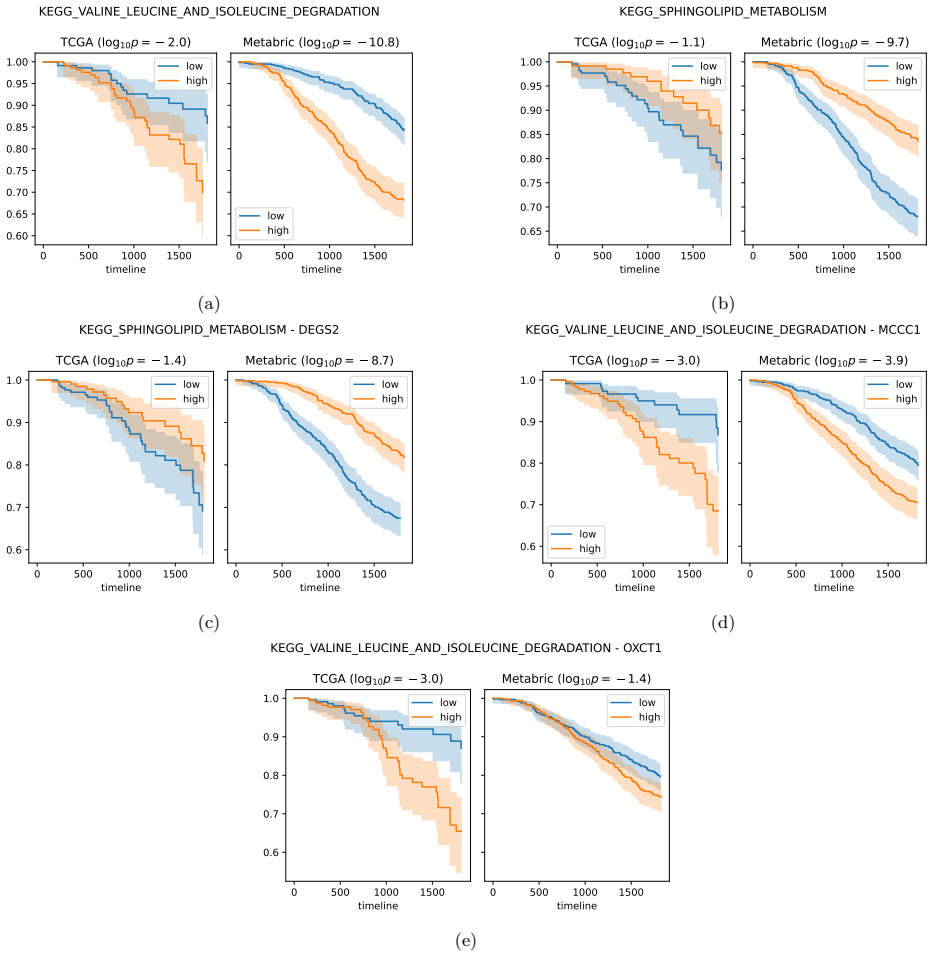
- §2.2 and Supp. F: The survival analysis uses a 5-year time window (1825 days) and tertile stratification, both of which appear to be chosen without prior justification. The 5-year cutoff is applied uniformly across all pathways and genes. For the Cox-PH models used in §4.5 (Fig. 9), it is unclear whether the same window and stratification apply, and whether the variance threshold (0.01) and L2 penalty (0.001) described in §3.3 were selected post-hoc. These choices affect which features pass significance filtering (Fig. 4) and which models are ranked highest (Fig. 9). The authors should state whether these parameters were pre-specified or selected on the training data, and ideally provide a sensitivity analysis for at least the time-window choice.
- §4.1 and Supp. C: The claim that pathway activity scores are 'biologically meaningful' is supported by cross-cohort MI consistency (Fig. 2), literature support for selected pathways, and survival stratification (Fig. 4). However, the reconstruction objective (Eq. 2) optimizes MSE on the full molecular input, not biological fidelity of pathway scores. No comparison against gold-standard pathway activity metrics (e.g., PROGENy, perturbation-derived activity scores) is performed. While the authors provide necessary conditions (predictive utility, consistency), they do not provide sufficient evidence for biological validity of the scores themselves. This concern is load-bearing for the interpretability claims (decision tree, pathway rankings, survival stratification). The authors should either add a comparison against at least one established pathway activity scoring method or explicitly re-
minor comments (10)
- Abstract: 'use linear models that may overlook complex interactions' — the phrase 'use' should be 'using' for grammatical consistency.
- §2.1, Eq. (2): The optimization objective is written as min_{Ω,Γ} (x̂−x)² without the expectation or summation over samples. This should be clarified (e.g., mean over the batch) for precision.
- §2.5, Eq. (10): The Shapley value adaptation uses f as the median of marginal contributions, but the equation as written does not clearly show how the median enters. A brief clarifying sentence would help readers.
- §4.3: The 'phase transition' between 70% and 80% dropout is mentioned but not mechanistically explained. A brief hypothesis (e.g., effective number of active pathways dropping below a threshold) would strengthen the discussion.
- Figure 8: The x-axis labels for omics combinations are very dense and difficult to read. Consider faceting by number of omics layers or using a more compact encoding.
- §4.5: The statement that mutation and CNV layers 'performed worse than random chance' for survival (Fig. 9) is surprising and deserves brief discussion of possible causes (e.g., sparse binary features, small sample size effects).
- Supp. B: The description of baseline adaptations (PACL, PASL, PathME) notes several compatibility and stability issues (CPU-only training, NaN/Inf values). These are important caveats that should be briefly mentioned in the main text where baseline comparisons are discussed, so readers can assess fairness.
- References: Several citations are to preprints (e.g., Selby et al. 2024, Uyar et al. 2021, Wissel et al. 2022). Where peer-reviewed versions exist, they should be updated.
- §3.2: SMOTE is applied prior to training the decision tree, but it is unclear whether it was applied only to the training fold or before cross-validation. This should be clarified to rule out data leakage.
- Figure 4 caption: The genes shown (DEGS2, MCCC1, OXCT1) represent 4 of 7 significant genes in TCGA. It would help to list all 7 genes in a supplementary table for completeness.
Simulated Author's Rebuttal
We thank the referee for a thorough and constructive report. The comments identify legitimate gaps in our comparator set, external validation, parameter justification, and pathway activity score validation. We address each point below and commit to revisions for all four major comments, ranging from softening claims and adding limitations to conducting new sensitivity analyses and comparisons with established pathway scoring methods.
read point-by-point responses
-
Referee: §3.3 and §4.5: The central claim that multi-omics integration yields 'superior latent representations' rests entirely on within-TCGA cross-validation against single-omics baselines. No modern multi-omics integration method (MOFA+, VEGA, DeepMOCCA) is included. The claim of 'superior' is not established relative to the state of the art.
Authors: The referee is correct that our baselines are carried over from the single-omics predecessor paper and that no dedicated multi-omics integration method is included as a comparator. We agree that the word 'superior' in the Abstract and §5 overstates what our experiments establish. Our results demonstrate that multi-omics integration within the PAAE framework is beneficial relative to single-omics PAAE, and that late integration generally outperforms early integration within our framework — but we have not shown superiority over other multi-omics integration methods. We will revise the manuscript in two ways: (1) we will soften 'superior latent representations' to 'beneficial relative to single-omics PAAE' or equivalent language throughout the Abstract and Discussion; (2) we will add at least one dedicated multi-omics integration baseline. We plan to include MOFA+ as a comparator, since it is widely used, operates on multi-omics factor decomposition, and can be applied to our TCGA-BRCA data with the same downstream evaluation pipeline. We note that VEGA, which is architecturally related to our pathway-constrained approach, is also a strong candidate and we will consider including it as well. We cannot honestly claim that our current experiments establish superiority over the state of the art in multi-omics integration, and the revised manuscript will reflect this. revision: yes
-
Referee: §3.3: External validation is not performed for multi-omics because Metabric lacks several omics layers. All multi-omics claims are supported by single-cohort internal cross-validation on TCGA-BRCA only. The absence of any external check on multi-omics claims is a significant gap given the train-to-test performance drops seen in single-omics.
Authors: This is a fair and important point. We acknowledge that all multi-omics claims rest on within-TCGA-BRCA cross-validation, and the referee is correct that the single-omics train-to-test drops (e.g., decision-tree AUC from 0.85 to 0.74) illustrate the risk of overfitting to a single cohort. We will make the following revisions: (1) We will explicitly acknowledge the absence of multi-omics external validation as a primary limitation in §5 and qualify the multi-omics conclusions accordingly. (2) We will investigate whether a partial external validation is feasible using the subset of omics layers available in both cohorts. TCGA and Metabric share gene expression, copy number, and mutation data; a partial multi-omics external validation on these three layers, while not covering the full six-layer setting, would provide at least some cross-cohort evidence. We will report the results of this analysis if the data compatibility is sufficient, and if not, we will state this explicitly. We note that methylation platform differences (Illumina 27K vs 450K) and the absence of RPPA and microRNA in Metabric prevent a full multi-omics external validation, and this will be stated clearly. revision: yes
-
Referee: §2.2 and Supp. F: The survival analysis uses a 5-year time window (1825 days) and tertile stratification without prior justification. It is unclear whether the variance threshold (0.01) and L2 penalty (0.001) in §3.3 were selected post-hoc. The authors should state whether these parameters were pre-specified or selected on the training data, and provide a sensitivity analysis for the time-window choice.
Authors: We appreciate the referee raising this issue. To be transparent: the 5-year time window, tertile stratification, variance threshold (0.01), and L2 penalty (0.001) were not pre-specified based on prior clinical or biological rationale. They were selected during the development of the analysis pipeline, primarily on the TCGA training data, to ensure numerical stability (e.g., the variance threshold was introduced to exclude features that perfectly determined survival status in cross-validation folds, which impeded Cox-PH convergence). We agree that this should be stated explicitly and that the sensitivity of the results to these choices should be assessed. In the revision, we will: (1) clearly state in §2.2 and Supp. F that these parameters were selected on the training data and were not pre-specified; (2) provide a sensitivity analysis for the time-window choice, e.g., comparing 3-year, 5-year, and 7-year cutoffs on the survival stratification results (Fig. 4); (3) provide a sensitivity analysis for the variance threshold and L2 penalty on the multi-omics survival results (Fig. 9). If the results are robust to these variations, this will strengthen the claims; if not, we will report the dependence honestly. revision: yes
-
Referee: §4.1 and Supp. C: The claim that pathway activity scores are 'biologically meaningful' is supported by cross-cohort MI consistency, literature support, and survival stratification, but the reconstruction objective optimizes MSE, not biological fidelity. No comparison against gold-standard pathway activity metrics (PROGENy, perturbation-derived scores) is performed. The authors should add a comparison or explicitly reframe the claim.
Authors: The referee correctly identifies a gap between what we claim ('biologically meaningful') and what we demonstrate. Our evidence — cross-cohort MI consistency, survival stratification, and literature support for identified pathways — provides necessary conditions for biological relevance, but does not constitute sufficient evidence for biological validity of the scores themselves, particularly given that the reconstruction objective optimizes MSE on molecular inputs rather than biological fidelity of pathway activities. We will address this in two ways: (1) We will add a comparison against at least one established pathway activity scoring method. PROGENy is a natural choice because it provides perturbation-derived pathway activity scores for a focused set of well-characterized signaling pathways, and we can directly compare our PAAE-derived scores against PROGENy scores in terms of downstream task performance (subtype classification, survival prediction) and cross-cohort consistency. We will also consider including a simpler method such as GSVA or ssGSEA as an additional reference point. (2) We will reframe the 'biologically meaningful' language to be more precise, distinguishing between 'predictively useful and consistent across cohorts' (which we demonstrate) and 'biologically validated pathway activity' (which would require comparison to gold-standard metrics). The revised language will accurately reflect the evidence provided. revision: yes
Circularity Check
No significant circularity; self-citation establishes base architecture but does not force new results
full rationale
The paper builds on the authors' own PAAE framework (da Costa Avelar et al. 2023, 2024), but this self-citation establishes the base autoencoder architecture (Eqs. 1-2), not the central claims of the present paper. The new contributions—multi-omics integration strategies (Eqs. 5-8), Shapley value omics-layer contribution analysis (Eq. 9-10), dropout robustness studies (2560 models), and the interpretable decision-tree case study—are each evaluated against external benchmarks: TCGA-BRCA and Metabric datasets, PAM50 clinical labels, KEGG/Hallmark/miRTarBase pathway databases, and standard metrics (ROC AUC, C-index, MI, logrank tests). Pathway selection via OvR MI is performed on the training set (TCGA) and validated on an external cohort (Metabric) with cross-cohort consistency explicitly reported (Sec. 4.1). Survival stratification selects genes by ANPW ranking and logrank significance on TCGA, then confirms significance and directionality matching on Metabric (Sec. 4.2, Supplementary F). No step reduces to its inputs by construction: the reconstruction objective (Eq. 2) defines what the pathway scores optimize for, but the paper's biological-meaningfulness claims are supported by external evidence (cross-cohort MI consistency, survival stratification, literature support), not by definition. The gap between reconstruction-optimized scores and biological fidelity is a correctness risk, not a circularity. The self-citation chain is present but not load-bearing for the new results. Score 1 reflects the minor self-citation for the base framework, which is standard and does not raise circularity concerns.
Axiom & Free-Parameter Ledger
free parameters (9)
- Pathway encoder hidden layer sizes =
[32] or [32,16]
- Latent space dimensionality =
64
- Dropout rate on pathway activity layer =
0.0 to 0.9 in repeatability study; 0.5 for main models
- Learning rate =
1e-4
- Number of training epochs =
1024
- L2 regularization for survival models =
0.001
- Variance threshold for survival features =
0.01
- Survival time window =
1825 days (5 years)
- Number of top pathways selected per subtype =
5
axioms (5)
- domain assumption Biological pathway gene sets (KEGG, Hallmark) accurately represent underlying biological processes
- domain assumption Reconstruction of the full molecular input is a suitable objective for learning meaningful pathway activity scores
- domain assumption CpG-to-gene mapping from Illumina 450K annotation correctly associates methylation sites with their regulating genes
- domain assumption miRTarBase experimentally validated miRNA-target interactions are comprehensive enough for pathway mapping
- domain assumption PAM50 subtypes derived from gene expression are the correct classification target for multi-omics integration
Cite this review
Pith. "Pith review of Biologically Informed Deep Neural Networks for Multi-Omic Integration, Pathway Activity Inference and Risk Stratification in Cancer." pith.science (2026). https://pith.science/paper/UYW3BJS2
@misc{pith2026260705306,
  author       = {Pith},
  title        = {Pith review of: Biologically Informed Deep Neural Networks for Multi-Omic Integration, Pathway Activity Inference and Risk Stratification in Cancer},
  year         = {2026},
  howpublished = {\url{https://pith.science/paper/UYW3BJS2}},
  note         = {Machine review of arXiv:2607.05306}
}
read the original abstract
Integrating complex, multi-omics data presents significant challenges. Existing approaches often face a trade-off between model interpretability and representational capacity, with most either relying on post-hoc interpretation or use linear models that may overlook complex interactions. We report Pathway Activity Autoencoders for the multi-omics setting, which embed prior knowledge via pathway-informed architectural constraints, fostering interpretability, while preserving representational power. Our multi-omic framework is applied in the context of breast cancer and is evaluated in survival prediction and subtype classification with results indicating a positive effect of integration. We conduct analysis of individual omics layer impact on end-task performance, revealing that gene, protein, and microRNA expression layers provide the strongest contribution. Repeatability studies indicate that, while dropout improves model robustness and consistency, excessive regularisation can reduce predictive performance. Finally, visualizations of the learned feature space illustrate the framework's intrinsic transparency and clinical relevance. The results underscore the value of multi-omic integration and delineate the impact of individual omics layers, establishing practical guidelines for integration within our framework. Overall, our pathway activity autoencoder frameworks yield superior latent representations that are biologically meaningful and are directly translatable into clinically relevant insights.
Figures




Reference graph
Works this paper leans on
-
[1]
Mapping molecular transitions in
Zeb, Sabaoon and da Costa Avelar, Pedro Henrique and Goh, Vicky and Tsoka, Sophia , year =. Mapping molecular transitions in
-
[2]
Alayrac, Jean-Baptiste and Recasens, Adrià and Schneider, Rosalia and Arandjelovic, Relja and Ramapuram, Jason and Fauw, Jeffrey De and Smaira, Lucas and Dieleman, Sander and Zisserman, Andrew , editor =. Self-. Advances in
-
[3]
Yuan, Xin and Lin, Zhe and Kuen, Jason and Zhang, Jianming and Wang, Yilin and Maire, Michael and Kale, Ajinkya and Faieta, Baldo , month = jun, year =. Multimodal. 2021. doi:10.1109/CVPR46437.2021.00692 , urldate =
-
[4]
Lin, Yijie and Gou, Yuanbiao and Liu, Zitao and Li, Boyun and Lv, Jiancheng and Peng, Xi , month = jun, year =. 2021. doi:10.1109/CVPR46437.2021.01102 , urldate =
-
[5]
Tian, Yonglong and Sun, Chen and Poole, Ben and Krishnan, Dilip and Schmid, Cordelia and Isola, Phillip , editor =. What. Advances in
-
[6]
A comprehensive survey on contrastive learning , volume =. Neurocomputing , author =. 2024 , pages =. doi:10.1016/j.neucom.2024.128645 , language =
-
[7]
Khosla, Prannay and Teterwak, Piotr and Wang, Chen and Sarna, Aaron and Tian, Yonglong and Isola, Phillip and Maschinot, Aaron and Liu, Ce and Krishnan, Dilip , editor =. Supervised. Advances in
-
[8]
Proceedings of the National Academy of Sciences , author =
Optimally sparse representation in general (nonorthogonal) dictionaries via ℓ ^. Proceedings of the National Academy of Sciences , author =. 2003 , pages =. doi:10.1073/pnas.0437847100 , language =
-
[9]
Bricken, Trenton and Templeton, Adly and Batson, Joshua and Chen, Brian and Jermyn, Adam and Conerly, Tom and Turner, Nicholas L and Anil, Cem and Denison, Carson and Askell, Amanda and Lasenby, Robert and Wu, Yifan and Kravec, Shauna and Schiefer, Nicholas and Maxwell, Tim and Joseph, Nicholas and Tamkin, Alex and Nguyen, Karina and McLean, Brayden and B...
-
[10]
Huben, Robert and Cunningham, Hoagy and Smith, Logan Riggs and Ewart, Aidan and Sharkey, Lee , year =. Sparse. The
-
[11]
Taking features out of superposition with sparse autoencoders , url =
Sharkey, Lee and Braun, Dan and Millidge, Beren , month = dec, year =. Taking features out of superposition with sparse autoencoders , url =
- [12]
-
[13]
Pathak, Deepak and Krahenbuhl, Philipp and Donahue, Jeff and Darrell, Trevor and Efros, Alexei A. , month = jun, year =. Context. 2016. doi:10.1109/CVPR.2016.278 , urldate =
-
[14]
In: Proceedings of the 25th Interna- tional Conference on Machine Learning
Vincent, Pascal and Larochelle, Hugo and Bengio, Yoshua and Manzagol, Pierre-Antoine , year =. Extracting and composing robust features with denoising autoencoders , copyright =. Proceedings of the 25th international conference on. doi:10.1145/1390156.1390294 , language =
-
[15]
He, Kaiming and Chen, Xinlei and Xie, Saining and Li, Yanghao and Dollar, Piotr and Girshick, Ross , month = jun, year =. Masked. 2022. doi:10.1109/CVPR52688.2022.01553 , urldate =
- [16]
-
[17]
Applied Mathematics Letters , author =
Turing computability with neural nets , volume =. Applied Mathematics Letters , author =. 1991 , pages =. doi:10.1016/0893-9659(91)90080-F , language =
-
[18]
Bahdanau, Dzmitry and Cho, Kyunghyun and Bengio, Yoshua , editor =. Neural. 3rd
-
[19]
NTU Graph Deep Learning Lab , author =
Transformers are. NTU Graph Deep Learning Lab , author =
-
[20]
Dwivedi, Vijay Prakash and Bresson, Xavier , month = jan, year =. A
-
[21]
Dosovitskiy, Alexey and Beyer, Lucas and Kolesnikov, Alexander and Weissenborn, Dirk and Zhai, Xiaohua and Unterthiner, Thomas and Dehghani, Mostafa and Minderer, Matthias and Heigold, Georg and Gelly, Sylvain and Uszkoreit, Jakob and Houlsby, Neil , year =. An. 9th
-
[22]
Abdel-Hamid, Ossama and Deng, Li and Yu, Dong , month = aug, year =. Exploring convolutional neural network structures and optimization techniques for speech recognition , url =. Interspeech 2013 , publisher =. doi:10.21437/Interspeech.2013-744 , language =
-
[23]
Abdel-Hamid, Ossama and Mohamed, Abdel-rahman and Jiang, Hui and Penn, Gerald , month = mar, year =. Applying. 2012. doi:10.1109/ICASSP.2012.6288864 , urldate =
-
[24]
IEEE/ACM Transactions on Audio, Speech, and Language Processing , author =
Convolutional. IEEE/ACM Transactions on Audio, Speech, and Language Processing , author =. 2014 , pages =. doi:10.1109/TASLP.2014.2339736 , number =
-
[25]
Learning multiple layers of features from tiny images , url =
Krizhevsky, Alex , month = apr, year =. Learning multiple layers of features from tiny images , url =
-
[26]
Communications of the ACM , author =. 2017 , pages =. doi:10.1145/3065386 , abstract =
-
[27]
Krizhevsky, Alex and Sutskever, Ilya and Hinton, Geoffrey E. , editor =. Advances in. 2012 , pages =
work page 2012
-
[28]
Gradient-based learning applied to document recognition , volume =. Proceedings of the IEEE , author =. 1998 , pages =. doi:10.1109/5.726791 , number =
-
[29]
Biological Cybernetics , year =
Neocognitron:. Biological Cybernetics , author =. 1980 , pages =. doi:10.1007/BF00344251 , language =
- [30]
-
[31]
Automatic differentiation in pytorch , author =
- [32]
- [33]
-
[34]
Genomics, Proteomics & Bioinformatics , author =. 2018 , pages =. doi:10.1016/j.gpb.2018.08.003 , abstract =
-
[35]
A. Cell , author =. 2017 , pages =. doi:10.1016/j.cell.2017.10.049 , language =
-
[36]
Zhou, Yingbo and Arpit, Devansh and Nwogu, Ifeoma and Govindaraju, Venu , year =. Is. doi:10.48550/ARXIV.1405.1380 , abstract =
work page internal anchor Pith review Pith/arXiv arXiv doi:10.48550/arxiv.1405.1380
-
[37]
CAAI Transactions on Intelligence Technology , author =
A review on. CAAI Transactions on Intelligence Technology , author =. 2016 , pages =. doi:10.1016/j.trit.2016.11.004 , language =
-
[38]
Probabilistic. J. Mach. Learn. Res. , author =. 2005 , pages =
work page 2005
- [39]
-
[40]
Frontiers in Genetics , author =
Statistical methods for detecting differentially methylated loci and regions , volume =. Frontiers in Genetics , author =. doi:10.3389/fgene.2014.00324 , urldate =
-
[41]
Latent representation learning in biology and translational medicine , volume =. Patterns , author =. 2021 , pages =. doi:10.1016/j.patter.2021.100198 , language =
-
[42]
Goodfellow, Ian and Bengio, Yoshua and Courville, Aaron , year =. Deep learning , isbn =
-
[43]
Nature Biotechnology , author =
Visualizing and interpreting cancer genomics data via the. Nature Biotechnology , author =. 2020 , pages =. doi:10.1038/s41587-020-0546-8 , language =
-
[44]
The. Cancer Discovery , author =. 2012 , pages =. doi:10.1158/2159-8290.CD-12-0095 , abstract =
-
[45]
Nature Communications , author =
Single-cell analysis reveals prognostic fibroblast subpopulations linked to molecular and immunological subtypes of lung cancer , volume =. Nature Communications , author =. 2023 , pages =. doi:10.1038/s41467-023-35832-6 , abstract =
-
[46]
From. Genes , author =. 2024 , pages =. doi:10.3390/genes15121551 , abstract =
-
[47]
Frontiers in Endocrinology , author =
Overview of. Frontiers in Endocrinology , author =. 2018 , pages =. doi:10.3389/fendo.2018.00402 , urldate =
-
[48]
Avicenna Journal of Medical Biotechnology , author =
The. Avicenna Journal of Medical Biotechnology , author =. 2010 , pmid =
work page 2010
-
[49]
Current Opinion in Chemical Biology , author =
Mass spectrometry for proteomics , volume =. Current Opinion in Chemical Biology , author =. 2008 , pages =. doi:10.1016/j.cbpa.2008.07.024 , language =
-
[50]
Annual Review of Genomics and Human Genetics , author =
Long-. Annual Review of Genomics and Human Genetics , author =. 2023 , pages =. doi:10.1146/annurev-genom-101722-103045 , abstract =
-
[51]
Mass spectrometry-based proteomics , volume =. Nature , author =. 2003 , pages =. doi:10.1038/nature01511 , language =
-
[52]
Genomics, Proteomics & Bioinformatics , author =. 2020 , pages =. doi:10.1016/j.gpb.2019.11.008 , abstract =
-
[53]
Protein microarrays:. Cancer Cell , author =. 2003 , pages =. doi:10.1016/S1535-6108(03)00086-2 , language =
-
[54]
Proteomic profiling of the cancer microenvironment by antibody arrays , volume =. PROTEOMICS , author =. 2001 , pages =. doi:10.1002/1615-9861(200110)1:10<1271::AID-PROT1271>3.0.CO;2-6 , language =
-
[55]
Molecular & Cellular Proteomics , author =
Use of. Molecular & Cellular Proteomics , author =. 2005 , pages =. doi:10.1074/mcp.T500003-MCP200 , language =
-
[56]
Nature Methods , author =. 2013 , pages =. doi:10.1038/nmeth.2650 , language =
-
[57]
Journal of Proteome Research , author =
Protein. Journal of Proteome Research , author =. 2025 , pages =. doi:10.1021/acs.jproteome.4c00978 , language =
-
[58]
Is single-molecule protein sequencing here yet? , volume =. Nature Methods , author =. 2025 , pages =. doi:10.1038/s41592-025-02767-3 , language =
-
[59]
Journal of Clinical Oncology , author =
Supervised. Journal of Clinical Oncology , author =. 2009 , keywords =. doi:10.1200/JCO.2008.18.1370 , abstract =
-
[60]
Annual Review of Genomics and Human Genetics , author =. 2024 , pages =. doi:10.1146/annurev-genom-021623-121812 , abstract =
-
[61]
Annual Review of Genetics , author =
Transgenerational. Annual Review of Genetics , author =. 2018 , pages =. doi:10.1146/annurev-genet-120417-031404 , abstract =
-
[62]
Annual Review of Biomedical Data Science , author =. 2019 , pages =. doi:10.1146/annurev-biodatasci-072018-021255 , abstract =
-
[63]
Acta Naturae , author =. 2021 , pages =. doi:10.32607/actanaturae.11043 , abstract =
-
[64]
Capillary array electrophoresis: an approach to high-speed, high-throughput. Nature , author =. 1992 , pages =. doi:10.1038/359167a0 , language =
-
[65]
Fluorescence detection in automated. Nature , author =. 1986 , pages =. doi:10.1038/321674a0 , language =
-
[66]
Proceedings of the National Academy of Sciences , author =. 1977 , pages =. doi:10.1073/pnas.74.12.5463 , abstract =
-
[67]
Proceedings of the National Academy of Sciences , author =
Gene set enrichment analysis:. Proceedings of the National Academy of Sciences , author =. 2005 , pages =. doi:10.1073/pnas.0506580102 , abstract =
-
[68]
Gene. Nature Genetics , author =. 2000 , pages =. doi:10.1038/75556 , language =
-
[69]
Bioinformatics and Biology Insights , author =
Multi-omics. Bioinformatics and Biology Insights , author =. 2020 , pages =. doi:10.1177/1177932219899051 , abstract =
-
[70]
The. GENETICS , author =. 2023 , pages =. doi:10.1093/genetics/iyad031 , abstract =
-
[71]
Cold Spring Harbor Symposia on Quantitative Biology , author =. 1953 , pages =. doi:10.1101/SQB.1953.018.01.020 , language =
-
[72]
Annual Review of Analytical Chemistry , author =
Next-. Annual Review of Analytical Chemistry , author =. 2013 , pages =. doi:10.1146/annurev-anchem-062012-092628 , abstract =
-
[73]
Biotechnology and Bioengineering , author =
Biogenesis and mechanisms of. Biotechnology and Bioengineering , author =. 2022 , pages =. doi:10.1002/bit.28029 , abstract =
-
[74]
Journal of Human Genetics , author =
Interpretation of omics data analyses , volume =. Journal of Human Genetics , author =. 2021 , pages =. doi:10.1038/s10038-020-0763-5 , abstract =
-
[75]
Briefings in Bioinformatics , author =
Advances in bulk and single-cell multi-omics approaches for systems biology and precision medicine , copyright =. Briefings in Bioinformatics , author =. 2021 , pages =. doi:10.1093/bib/bbab024 , abstract =
-
[76]
Experimental Cell Research , author =
An historical note on the cell theory , volume =. Experimental Cell Research , author =. 2018 , pages =. doi:10.1016/j.yexcr.2018.01.038 , language =
-
[77]
British Journal of Cancer , author =
Involvement of the kynurenine pathway in breast cancer: updates on clinical research and trials , volume =. British Journal of Cancer , author =. 2023 , pages =. doi:10.1038/s41416-023-02245-7 , abstract =
-
[78]
International Immunopharmacology , author =
Tryptophan metabolism regulates inflammatory macrophage polarization as a predictive factor for breast cancer immunotherapy , volume =. International Immunopharmacology , author =. 2023 , pages =. doi:10.1016/j.intimp.2023.111196 , language =
-
[79]
European Journal of Human Genetics , author =
Overcoming barriers to single-cell. European Journal of Human Genetics , author =. 2024 , pages =. doi:10.1038/s41431-024-01564-4 , abstract =
-
[80]
doi:10.1101/2024.03.15.585255 , abstract =
Li, Yutong and da Costa Avelar, Pedro Henrique and Chen, Xinyue and Zhang, Li and Wu, Min and Tsoka, Sophia , month = mar, year =. doi:10.1101/2024.03.15.585255 , abstract =
This paper was first reviewed by glm-5.2 on July 7, 2026.
discussion (0)
Sign in with ORCID, Apple, or X to comment. Anyone can read and Pith papers without signing in.