REVIEW 3 major objections 6 minor 130 references
Retaining every past task is not always best: when tasks last long enough, starting over beats joint training.
Reviewed by Pith at T0; open to challenge. T0 means a machine referee read the full paper against a public rubric. the ladder, T0–T4 →
2026-07-11 05:00 UTC pith:HMFNVUB4
load-bearing objection Solid reframe of CL around ALE: TE = −I + transient gap, a Critical Task Duration, and Predictive CL as the design space; theory and sign patterns hold up. the 3 major comments →
To Retain or to Adapt? Generalizing Continual Learning
The pith
A machine-rendered reading of the paper's core claim, the machinery that carries it, and where it could break.
Core claim
Under mild task-wise convergence, Transfer Efficiency decomposes exactly as TE_k = −I_k + (δ_k(ITL) − δ_k(JTL)). Whenever average Instability is positive and cumulative Transient Error grows sub-linearly in task length N, there is a finite Critical Task Duration N_∞^max beyond which retaining the full history becomes detrimental to real-time error. Joint-Task Learning is only the special case of an ergodic future model; the right objective is Predictive Continual Learning under an explicit model of future tasks.
What carries the argument
Transfer Efficiency TE_k and its exact split into Instability I_k (stationary gap between joint and independent solutions) and Transient Error δ_k (average excess risk while approaching stationarity), which together yield the closed-form Critical Task Duration N_∞^max = (Δ̄_ITL − Δ̄_JTL)/Ī.
Load-bearing premise
The argument needs the learner's parameters to settle to a stable distribution on each task, with the leftover learning cost growing slower than the task length itself—stated generally but checked carefully only for quadratic losses with aligned curvatures and small fixed step sizes.
What would settle it
On a controlled drift sequence with measured positive Instability, sweep task duration N and check whether Transfer Efficiency falls as 1/N and crosses from positive to negative near the predicted Critical Task Duration; if TE stays positive for arbitrarily large N, the threshold claim fails.
Editorial analysis
A structured set of objections, weighed in public.
Referee Report
Summary. The paper challenges the retention-centered premise of continual learning, arguing that Joint-Task Learning (JTL) is not a universally optimal target under non-stationarity. Centering on Average Lifelong Error (ALE), it formalizes CL as the interaction of environment and learning dynamics and defines Transfer Efficiency (TE) as the gap between Independent-Task Learning (ITL) and JTL. TE decomposes exactly into Instability (stationary bias of joint training) and a Transient Error gap (learning-speed advantage of warm starts). Under task-wise convergence and sub-linear cumulative transient cost, this yields a Critical Task Duration beyond which retention becomes detrimental whenever average Instability is positive. Closed forms are derived for quadratic losses via Lyapunov analysis of SGD moments, governed by an environment Growth Rate; the same qualitative mechanisms are tested on CLEAR, MD5, controlled CIFAR variants, and MT10. Connecting CL to predictable sequences, the authors propose Predictive Continual Learning and analyze a Window algorithm that interpolates between ITL and JTL and outperforms both under controlled drift.
Significance. If the central claims hold, the paper supplies a useful conceptual and analytical reorientation of continual learning: from catastrophic-forgetting mitigation toward real-time adaptation under explicit future models. The TE decomposition and Critical Task Duration give falsifiable, environment-dependent predictions rather than a fixed retention objective. Strengths include an exact algebraic TE identity under stationarity, closed-form quadratic expressions with Lyapunov arguments that match simulations, controlled empirical checks of the predicted 1/N decay and Instability shifts, and a clean link from JTL/ITL to the predictable-sequences framework. The Window algorithm is a concrete, if simple, proof of concept that the design space between full retention and full reset is actionable. These contributions are of clear interest to the CL, online learning, and multi-task communities.
major comments (3)
- [Abstract / §3.1 / Lemma 6] Abstract and §3.1 / Lemma 6 (and Appendix Lemma 16): the claim that the Critical Task Duration holds under mild conditions "across linear and neural network models" rests on task-wise convergence of Q_n to a stationary Q_\infty plus \Delta_k(A)\in o(N). The appendix rigorously supports this for quadratic losses with aligned Hessians and small constant step sizes (Assumptions 17, 22, 23); for deep nets the text only invokes PL/NTK-style rates for sub-linearity. Please either (i) state more carefully that existence of N_\infty^max is conditional on task-wise stationarity (which is assumed, not proved, for ResNet/SAC), or (ii) add a short empirical diagnostic that the per-task loss trajectories on CLEAR/MD5/MT10 have effectively plateaued so that the estimated I_k is not still contaminated by unfinished transients. The algebraic TE identity (Lemma 15) is fine; the scope of the existence cla
- [Table 1 / §3.2 / MT10] Table 1 and MT10 setup (§3.2, Appendix B.4): ALS_ITL = 0.47\pm0.47 and ALS_JTL = 0.28\pm0.45 indicate extremely high seed-to-seed variance relative to the reported TE of -0.19\pm0.02. Given that the qualitative claim is that high Instability makes JTL worse, please clarify how TE standard errors are computed across seeds/tasks, whether some tasks dominate the average (cf. the asymmetric pairwise matrix in Fig. 21), and whether the negative-TE conclusion is robust under the B=5000 ablation mentioned in the appendix. Without that, the RL evidence is directionally consistent but statistically weaker than the supervised results.
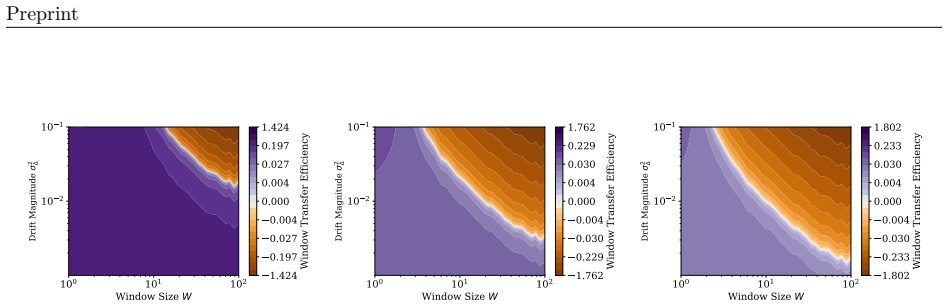
- [§5.2 / Eq. (121)] §5.2 and Eq. (121): the Window algorithm is the main constructive contribution of Predictive CL, yet W\bigstar is derived from environment and optimizer parameters (\sigma_\Delta^{2}, Tr(\Sigma_x \Sigma_\Delta), \eta, B, etc.) that a lifelong agent would not know a priori. The simulations set W to the theoretical optimum. Please discuss how W could be selected or adapted online (e.g., from recent loss trends or a small validation stream), or explicitly frame the current results as an oracle upper bound on the Predictive-CL design space. Without this, the practical advantage over JTL/ITL remains partly hypothetical outside the controlled quadratic drift model.
minor comments (6)
- [Figure 4 / Table 2] Figure 4 / Table 2: CLEAR never crosses TE=0 within the tested N range; the breakeven is only extrapolated. A short note in the caption or text that N_\infty^max lies outside the computational budget (consistent with small I) would avoid over-reading the table as a full crossing of the critical horizon.
- [§2–§3] Notation: ALEk, TE, I_k, \delta_k, and Q_n are introduced carefully, but the main text sometimes uses AJTL/AITL and sometimes JTL/ITL for the same objects. A single convention after Definition 2 would help.
- [Figure 3] Figure 3 concept map is helpful but dense; consider moving the full literature-equivalence map to the appendix and keeping a lighter version in the main text.
- [§2.4 / A.2.2] Appendix A.2.2 on warm-start ITL is important for interpreting the baseline; a one-sentence pointer in the main text near Definition 2 would prevent readers from missing that W=1 recovers warm-start ITL.
- [Throughout] Typos / polish: "the environment Growth Rate determines" (abstract-level phrasing is fine); check "computations" vs "compute" consistency; ensure all theorem numbers in the main text match the appendix (Lemma 5 vs 15, Lemma 6 vs 16).
- [§6] Related work: the connection to dynamic regret and path variation V_T (Besbes et al., 2015) is well drawn; a brief explicit comparison of Growth Rate \psi(k) to V_T in the main text (not only the appendix) would strengthen the online-learning bridge.
Circularity Check
No significant circularity: TE, Instability, and Transient Error are operational definitions whose algebraic rearrangement yields the Critical Task Duration under stated convergence hypotheses.
full rationale
The load-bearing chain is: (i) ALE as the online objective (imported from Kumar et al. 2025, whose author list has no overlap with the present paper); (ii) operational definitions TE_k := ALE_k(ITL)−ALE_k(JTL), I_k := L_k(Q^JTL_∞)−L_k(Q^ITL_∞), δ_k as average excess over stationary risk; (iii) the exact identity TE_k = −I_k + (δ_ITL−δ_JTL) obtained by writing ALE_k = L_k(Q_∞)+δ_k; (iv) Critical Task Duration N_∞^max = (Δ̄_ITL−Δ̄_JTL)/Ī by solving average TE=0 under Ī>0 and Δ̄∈o(N). None of these steps fits a fitted parameter to data and renames it a prediction, nor defines X in terms of Y while claiming an independent derivation. The quadratic closed forms (Theorems 24–25, 8) and Window W⋆ (Eq. 121) are derived from SGD moment dynamics under explicit assumptions (aligned Hessians, small η, Growth Rate/MSD), then checked on simulations and external benchmarks (CLEAR, MD5, MT10, Permuted/Shuffled CIFAR). Self-citations are absent from the premise chain; Kumar et al. is an external starting point. The paper is self-contained against external benchmarks and does not reduce its central claim by construction to its inputs.
Axiom & Free-Parameter Ledger
free parameters (4)
- learning rate η
- batch size B
- window size W⋆
- task duration N / drift magnitude σ_Δ²
axioms (5)
- domain assumption Task-wise convergence: for each task the Markov operator T_k admits a unique stationary measure Q_∞ to which Q_n converges in W_2 (Definition 12).
- domain assumption Cumulative Transient Error is sub-linear: Δ_k(A) ∈ o(N) (Lemma 16).
- ad hoc to paper Quadratic losses with simultaneously diagonalizable (aligned) Hessians and bounded spectrum (Assumptions 17, 22, 23).
- domain assumption Known task boundaries and locally stationary task-based data process (Definition 1).
- domain assumption ALE (Average Lifelong Error) is the appropriate lifelong objective under computational constraints (Kumar et al. 2025).
invented entities (6)
-
Transfer Efficiency (TE_k)
independent evidence
-
Instability (I_k)
independent evidence
-
Transient Error (δ_k)
independent evidence
-
Critical Task Duration (N_∞^max)
independent evidence
-
Predictive Continual Learning / Window algorithm
independent evidence
-
Growth Rate ψ(k) / Mean Squared Displacement m(k,W)
independent evidence
Cite this review
Pith. "Pith review of To Retain or to Adapt? Generalizing Continual Learning." pith.science (2026). https://pith.science/paper/HMFNVUB4
@misc{pith2026260705609,
  author       = {Pith},
  title        = {Pith review of: To Retain or to Adapt? Generalizing Continual Learning},
  year         = {2026},
  howpublished = {\url{https://pith.science/paper/HMFNVUB4}},
  note         = {Machine review of arXiv:2607.05609}
}
read the original abstract
The Continual Learning (CL) literature has long been driven by the goal of mitigating catastrophic forgetting. This objective rests on a pervasive, often unstated assumption: that a lifelong learner should approximate the Joint-Task Learning (JTL) solution and retain all previously acquired knowledge. We challenge this retention-centered premise, arguing that in non-stationary environments prioritizing retention can impede real-time adaptation. Shifting the focus to the Average Lifelong Error (ALE), we formalize CL as an online optimization problem governed by the interaction between environmental and learning dynamics. We introduce Transfer Efficiency as a quantitative measure of the tension between Instability, the bias inherited from conflicting past experience, and Transient Error, the optimization cost of learning new tasks from scratch. Under mild convergence conditions, holding across linear and neural network models, this decomposition yields a Critical Task Duration: a closed-form threshold beyond which historical knowledge transitions from a warm-start advantage to an optimization liability whenever retention induces a positive stationary bias. We validate these theoretical predictions on continual image classification and reinforcement learning benchmarks. Finally, by connecting continual learning to the online learning framework of predictable sequences, we show that JTL is only one instance of a broader family of objectives, and we propose a new general class of continual learning algorithms, which we call Predictive Continual Learning. Predictive CL algorithms optimize expected future performance under an explicit, dynamically updated model of future tasks. As a proof of concept, we analyze a Window algorithm that interpolates between JTL and Independent-Task Learning (ITL), outperforming both under controlled distributional drift.
Figures







Reference graph
Works this paper leans on
-
[1]
Journal of Artificial Intelligence Research , volume=
Towards continual reinforcement learning: A review and perspectives , author=. Journal of Artificial Intelligence Research , volume=
-
[2]
International Conference on Machine Learning , pages=
Minimax regret bounds for reinforcement learning , author=. International Conference on Machine Learning , pages=. 2017 , organization=
2017
-
[3]
Machine learning , volume=
Multitask learning , author=. Machine learning , volume=. 1997 , publisher=
1997
-
[4]
International Conference on Machine Learning , pages=
Characterizing implicit bias in terms of optimization geometry , author=. International Conference on Machine Learning , pages=. 2018 , organization=
2018
-
[5]
Advances in Neural Information Processing Systems , volume=
Gradient surgery for multi-task learning , author=. Advances in Neural Information Processing Systems , volume=
-
[6]
International conference on machine learning , pages=
Online multi-task learning for policy gradient methods , author=. International conference on machine learning , pages=. 2014 , organization=
2014
-
[7]
Advances in neural information processing systems , volume=
Non-stationary Markov decision processes, a worst-case approach using model-based reinforcement learning , author=. Advances in neural information processing systems , volume=
-
[8]
2020 , school=
Reinforcement learning in non-stationary environments , author=. 2020 , school=
2020
-
[9]
International Conference on Learning Representations (ICLR) , year=
The Joint Effect of Task Similarity and Overparameterization on Catastrophic Forgetting--An Analytical Model , author=. International Conference on Learning Representations (ICLR) , year=
-
[10]
arXiv preprint arXiv:2310.00137 , year=
On the Disconnect Between Theory and Practice of Overparametrized Neural Networks , author=. arXiv preprint arXiv:2310.00137 , year=
-
[11]
Advances in Neural Information Processing Systems , volume=
Continual world: A robotic benchmark for continual reinforcement learning , author=. Advances in Neural Information Processing Systems , volume=
-
[12]
Advances in Neural Information Processing Systems , volume=
Continual learning in environments with polynomial mixing times , author=. Advances in Neural Information Processing Systems , volume=
-
[13]
1994 , school =
Ring, Mark Bishop , title =. 1994 , school =
1994
-
[14]
The biology and technology of intelligent autonomous agents , pages=
Lifelong robot learning , author=. The biology and technology of intelligent autonomous agents , pages=. 1995 , publisher=
1995
-
[15]
Timothée Lesort and Vincenzo Lomonaco and Andrei Stoian and Davide Maltoni and David Filliat and Natalia Díaz-Rodríguez. Continual learning for robotics: Definition, framework, learning strategies, opportunities and challenges. Information Fusion. 2020. doi:https://doi.org/10.1016/j.inffus.2019.12.004
-
[16]
Neural Tangent Kernel: Convergence and Generalization in Neural Networks , url =
Jacot, Arthur and Gabriel, Franck and Hongler, Cl. Neural Tangent Kernel: Convergence and Generalization in Neural Networks , url =. Advances in Neural Information Processing Systems , editor =
-
[17]
International Conference on Machine Learning , pages =
Tensor Programs IV: Feature Learning in Infinite-Width Neural Networks , author =. International Conference on Machine Learning , pages =. 2021 , organization =
2021
-
[18]
Advances in Neural Information Processing Systems , volume =
Tensor Programs V: Tuning Large Neural Networks via Zero-Shot Hyperparameter Transfer , author =. Advances in Neural Information Processing Systems , volume =. 2021 , url =
2021
-
[19]
ArXiv , year=
Task Agnostic Continual Learning via Meta Learning , author=. ArXiv , year=
-
[20]
ArXiv , year=
Improving and Understanding Variational Continual Learning , author=. ArXiv , year=
-
[21]
IEEE Transactions on Pattern Analysis and Machine Intelligence , year=
Learning without forgetting , author=. IEEE Transactions on Pattern Analysis and Machine Intelligence , year=
-
[22]
ArXiv , year=
Adapting Auxiliary Losses Using Gradient Similarity , author=. ArXiv , year=
-
[23]
Neural networks , volume=
Continual lifelong learning with neural networks: A review , author=. Neural networks , volume=. 2019 , publisher=
2019
-
[24]
International Conference on Learning Representations , year=
Functional Regularisation for Continual Learning with Gaussian Processes , author=. International Conference on Learning Representations , year=
-
[25]
Machine learning , volume=
Near-optimal reinforcement learning in polynomial time , author=. Machine learning , volume=. 2002 , publisher=
2002
-
[26]
arXiv preprint arXiv:2210.07931 , year=
Sequential Learning Of Neural Networks for Prequential MDL , author=. arXiv preprint arXiv:2210.07931 , year=
-
[27]
Foundations and Trends
Introduction to online convex optimization , author=. Foundations and Trends. 2016 , publisher=
2016
-
[28]
Foundations and Trends
Introduction to multi-armed bandits , author=. Foundations and Trends. 2019 , publisher=
2019
-
[29]
Advances in minimum description length: Theory and applications , volume=
Minimum description length tutorial , author=. Advances in minimum description length: Theory and applications , volume=. 2005 , publisher=
2005
-
[30]
Measures of Complexity: Festschrift for Alexey Chervonenkis , pages=
On Martingale Extensions of Vapnik--Chervonenkis Theory with Applications to Online Learning , author=. Measures of Complexity: Festschrift for Alexey Chervonenkis , pages=. 2015 , publisher=
2015
-
[31]
Advances in Neural Information Processing Systems , volume=
Lifelong learning with non-iid tasks , author=. Advances in Neural Information Processing Systems , volume=
-
[32]
International Conference on Machine Learning , pages=
Which tasks should be learned together in multi-task learning? , author=. International Conference on Machine Learning , pages=. 2020 , organization=
2020
-
[33]
Advances in neural information processing systems , volume=
Multi-task learning as multi-objective optimization , author=. Advances in neural information processing systems , volume=
-
[34]
Foundations and Trends in Machine Learning , volume=
Continual Learning as Computationally Constrained Reinforcement Learning , author=. Foundations and Trends in Machine Learning , volume=. 2025 , publisher=
2025
-
[35]
Proceedings of the 20th international conference on machine learning (icml-03) , pages=
Online convex programming and generalized infinitesimal gradient ascent , author=. Proceedings of the 20th international conference on machine learning (icml-03) , pages=
-
[36]
arXiv preprint arXiv:1912.13213 , year=
A modern introduction to online learning , author=. arXiv preprint arXiv:1912.13213 , year=
Pith/arXiv arXiv 1912
-
[37]
2004 , publisher=
Convex optimization , author=. 2004 , publisher=
2004
-
[38]
Advances in neural information processing systems , volume=
Principles of risk minimization for learning theory , author=. Advances in neural information processing systems , volume=
-
[39]
Neural Networks , volume=
A wholistic view of continual learning with deep neural networks: Forgotten lessons and the bridge to active and open world learning , author=. Neural Networks , volume=. 2023 , publisher=
2023
-
[40]
Proceedings of the 35th International Conference on Machine Learning , pages =
Progress & Compress: A scalable framework for continual learning , author =. Proceedings of the 35th International Conference on Machine Learning , pages =. 2018 , editor =
2018
-
[41]
International Conference on Artificial Intelligence and Statistics , pages=
Nonstationary bandit learning via predictive sampling , author=. International Conference on Artificial Intelligence and Statistics , pages=. 2023 , organization=
2023
-
[42]
International Conference on Learning Representations , year=
Fortuitous forgetting in connectionist networks , author=. International Conference on Learning Representations , year=
-
[43]
Operations research , volume=
Non-stationary stochastic optimization , author=. Operations research , volume=. 2015 , publisher=
2015
-
[44]
arXiv preprint arXiv:2108.06325 , year=
Continual backprop: Stochastic gradient descent with persistent randomness , author=. arXiv preprint arXiv:2108.06325 , year=
-
[45]
Proceedings of the AAAI Conference on Artificial Intelligence , volume=
Lipschitz lifelong reinforcement learning , author=. Proceedings of the AAAI Conference on Artificial Intelligence , volume=
-
[46]
International Conference on Machine Learning , pages=
Theory on forgetting and generalization of continual learning , author=. International Conference on Machine Learning , pages=. 2023 , organization=
2023
-
[47]
Conference on Learning Theory , pages=
How catastrophic can catastrophic forgetting be in linear regression? , author=. Conference on Learning Theory , pages=. 2022 , organization=
2022
-
[48]
On Angles between Subspaces of a Finite Dimensional Inner Product Space Per
Space, Finite Dimensional Inner Product , booktitle=. On Angles between Subspaces of a Finite Dimensional Inner Product Space Per. 1983 , organization=
1983
-
[49]
Proceedings of the IEEE/CVF international conference on computer vision , pages=
Online continual learning with natural distribution shifts: An empirical study with visual data , author=. Proceedings of the IEEE/CVF international conference on computer vision , pages=
-
[50]
Advances in neural information processing systems , volume=
Gradient episodic memory for continual learning , author=. Advances in neural information processing systems , volume=
-
[51]
Proceedings of the IEEE/CVF conference on computer vision and pattern recognition , pages=
Task-free continual learning , author=. Proceedings of the IEEE/CVF conference on computer vision and pattern recognition , pages=
-
[52]
Communications of the ACM , volume=
Understanding deep learning (still) requires rethinking generalization , author=. Communications of the ACM , volume=. 2021 , publisher=
2021
-
[53]
Advances in Neural Information Processing Systems , volume=
Online structured laplace approximations for overcoming catastrophic forgetting , author=. Advances in Neural Information Processing Systems , volume=
-
[54]
Advances in neural information processing systems , volume=
Dark experience for general continual learning: a strong, simple baseline , author=. Advances in neural information processing systems , volume=
-
[55]
Proceedings of the IEEE conference on Computer Vision and Pattern Recognition , pages=
Packnet: Adding multiple tasks to a single network by iterative pruning , author=. Proceedings of the IEEE conference on Computer Vision and Pattern Recognition , pages=
-
[56]
Conference on Lifelong Learning Agents , pages=
Cora: Benchmarks, baselines, and metrics as a platform for continual reinforcement learning agents , author=. Conference on Lifelong Learning Agents , pages=. 2022 , organization=
2022
-
[57]
Local vs Global continual learning
Local vs Global continual learning , author=. arXiv preprint arXiv:2407.16611 , year=
work page internal anchor Pith review Pith/arXiv arXiv
-
[58]
Optimization and generalization of regularization-based continual learning: a loss approximation viewpoint , author=. arXiv preprint arXiv:2006.10974 , year=
work page internal anchor Pith review Pith/arXiv arXiv 2006
-
[59]
Journal of Numerical Mathematics , volume=
Angles between subspaces and their tangents , author=. Journal of Numerical Mathematics , volume=. 2013 , publisher=
2013
-
[60]
French, Robert M. , doi=. Catastrophic forgetting in connectionist networks , volume=. Trends in Cognitive Sciences , number=. 1999 , keywords=
1999
-
[61]
Catastrophic Interference in Connectionist Networks: The Sequential Learning Problem , editor =. 1989 , issn =. doi:https://doi.org/10.1016/S0079-7421(08)60536-8 , url =
-
[62]
Proceedings of the National Academy of Sciences , volume=
Overcoming catastrophic forgetting in neural networks , author=. Proceedings of the National Academy of Sciences , volume=. 2017 , publisher=
2017
-
[63]
Proceedings of the 34th International Conference on Machine Learning (ICML) , volume=
Continual learning through synaptic intelligence , author=. Proceedings of the 34th International Conference on Machine Learning (ICML) , volume=. 2017 , organization=
2017
-
[64]
Proceedings of the European Conference on Computer Vision (ECCV) , pages=
Memory Aware Synapses: Learning What (not) to Forget , author=. Proceedings of the European Conference on Computer Vision (ECCV) , pages=. 2018 , publisher=
2018
-
[65]
Advances in Neural Information Processing Systems , volume=
Experience replay for continual learning , author=. Advances in Neural Information Processing Systems , volume=
-
[66]
Nature , volume=
Human-level control through deep reinforcement learning , author=. Nature , volume=. 2015 , publisher=
2015
-
[67]
IEEE Transactions on Pattern Analysis and Machine Intelligence , volume=
A continual learning survey: Defying forgetting in classification tasks , author=. IEEE Transactions on Pattern Analysis and Machine Intelligence , volume=. 2022 , publisher=
2022
-
[68]
Advances in Neural Information Processing Systems (NeurIPS) , year=
Continual Evaluation for Lifelong Learning: Identifying the Stability Gap , author=. Advances in Neural Information Processing Systems (NeurIPS) , year=
-
[69]
2006 , publisher=
Prediction, learning, and games , author=. 2006 , publisher=
2006
-
[70]
Proceedings of the eleventh annual conference on Computational learning theory , pages=
Tracking the best regressor , author=. Proceedings of the eleventh annual conference on Computational learning theory , pages=
-
[71]
Nature Machine Intelligence , volume=
Three types of incremental learning , author=. Nature Machine Intelligence , volume=. 2022 , publisher=. doi:10.1038/s42256-022-00568-3 , url=
-
[72]
Is Multi-Task Learning an Upper Bound for Continual Learning? , year=
Wu, Zihao and Tran, Huy and Pirsiavash, Hamed and Kolouri, Soheil , booktitle=. Is Multi-Task Learning an Upper Bound for Continual Learning? , year=
-
[73]
Proceedings of the 36th International Conference on Machine Learning , pages=
Is Multi-Task Learning an Upper Bound for Continual Learning? , author=. Proceedings of the 36th International Conference on Machine Learning , pages=. 2019 , organization=
2019
-
[74]
Trends in Cognitive Sciences , volume=
Embracing Change: Continual Learning in Deep Neural Networks , author=. Trends in Cognitive Sciences , volume=. 2020 , publisher=. doi:10.1016/j.tics.2020.09.004 , url=
-
[75]
arXiv preprint arXiv:1707.06347 , year=
Proximal Policy Optimization Algorithms , author=. arXiv preprint arXiv:1707.06347 , year=
-
[76]
Proceedings of the Conference on Robot Learning (CoRL) , pages=
Meta-World: A Benchmark and Evaluation for Multi-Task and Meta Reinforcement Learning , author=. Proceedings of the Conference on Robot Learning (CoRL) , pages=. 2020 , volume=
2020
-
[77]
2018 , eprint=
Online Learning: A Comprehensive Survey , author=. 2018 , eprint=
2018
-
[78]
2013 AAAI spring symposium series , year=
Lifelong machine learning systems: Beyond learning algorithms , author=. 2013 AAAI spring symposium series , year=
2013
-
[79]
The Psychology of Learning and Motivation , volume=
Catastrophic interference in connectionist networks: the sequential learning problem , author=. The Psychology of Learning and Motivation , volume=. 1989 , publisher=
1989
-
[80]
Proceedings of the Neural Information Processing Systems Track on Datasets and Benchmarks 1 (NeurIPS Datasets and Benchmarks 2021) , year=
The CLEAR Benchmark: Continual LEArning on Real-World Imagery , author=. Proceedings of the Neural Information Processing Systems Track on Datasets and Benchmarks 1 (NeurIPS Datasets and Benchmarks 2021) , year=
2021
This paper was first reviewed by grok-4.5 on July 11, 2026.
discussion (0)
Sign in with ORCID, Apple, or X to comment. Anyone can read and Pith papers without signing in.