REVIEW 2 major objections 5 minor 35 references
A single contraction graph turns EOM-CC relaxation into reverse-mode differentiation, so excited-state forces and nonadiabatic couplings fit and run on an 8 GB consumer GPU.
Reviewed by Pith at T0; open to challenge. T0 means a machine referee read the full paper against a public rubric. the ladder, T0–T4 →
T0 review · grok-4.5
2026-07-11 04:46 UTC pith:DOMKCUV5
load-bearing objection Solid systems paper: real consumer-GPU EOM-CCSD gradients/NACMEs with strong small-scale validation and honest framing of the chromophore demo. the 2 major comments →
EOM-CC Excited-State Gradients and Nonadiabatic Couplings on a Consumer GPU from a Contraction-DAG with Laplace-Transform J/K Kernels
The pith
A machine-rendered reading of the paper's core claim, the machinery that carries it, and where it could break.
Core claim
The complete non-Hermitian EOM-CCSD excited-state gradient and interstate nonadiabatic coupling can be obtained from a single contraction DAG whose reverse-mode transpose is the relaxation, fed through an AO-direct Laplace J/K kernel that never materializes a four-index MO tensor, and that entire pipeline validates end-to-end at small scale and executes a chromophore-scale calculation of Mg-porphine within the 8 GB of a consumer GPU.
What carries the argument
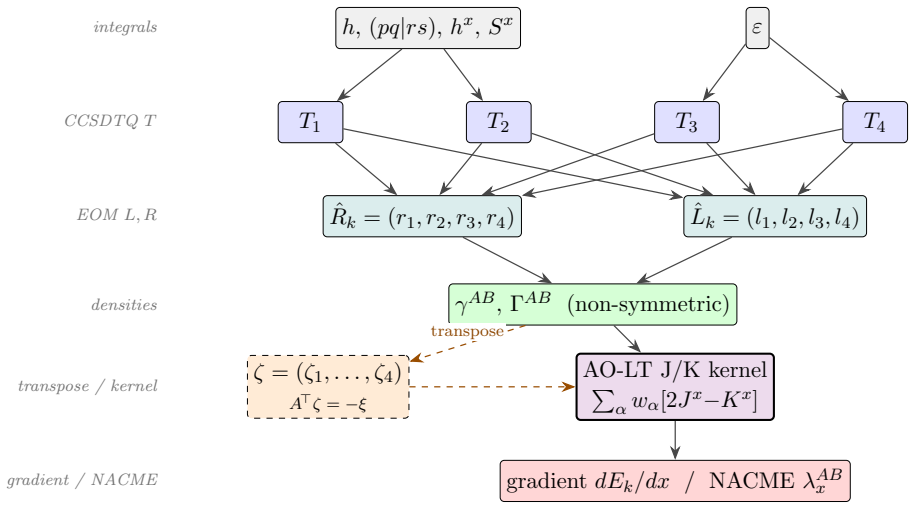
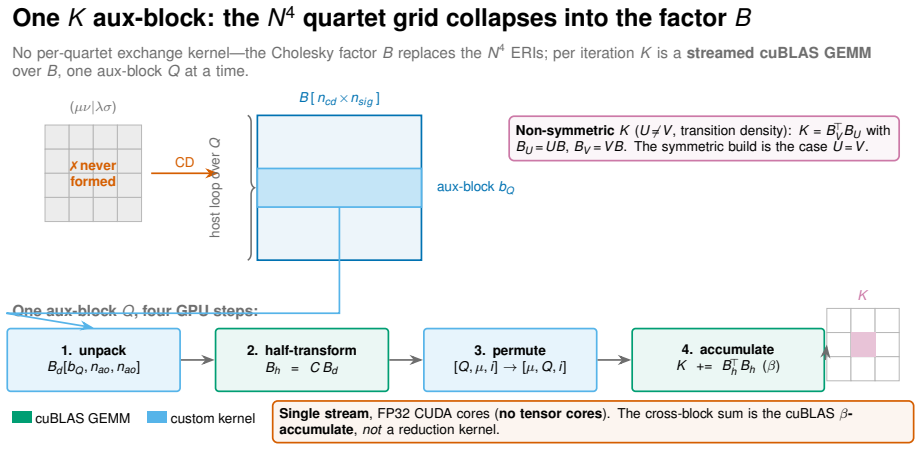
The contraction DAG whose reverse-mode transpose is the EOM-CC relaxation: every multilinear density contraction has a single adjoint rule, so one graph emits the forward densities, the amplitude-response (zeta) equations, the interstate Z-vector, and the chunked non-symmetric J/K schedule that keeps the build inside 8 GB.
Load-bearing premise
That small-scale end-to-end correctness of the same kernels, plus piece-wise checks and machine-zero translational invariance, is enough to treat the chromophore-scale Mg-porphine result as a trustworthy capability demonstration even though frozen-natural-virtual truncation leaves an uncertainty of roughly 0.01 hartree per bohr and no external large-scale oracle exists.
What would settle it
Recompute the Mg-porphine bright-Q gradient and Q–B NACME at substantially higher virtual retention (or without FNO compression on larger memory) and check whether the per-component values move by more than the stated ~0.01 Eh/a0 bound; an independent CFOUR-class cross-code comparison on a mid-sized molecule would also settle the transport of small-scale correctness.
Editorial analysis
A structured set of objections, weighed in public.
Referee Report
Summary. The manuscript presents a memory-bounded GPU implementation of EOM-CCSD excited-state analytic gradients and interstate NACMEs that fits a single 8 GB consumer GPU. The central construction is a single contraction DAG whose reverse-mode transpose supplies the non-Hermitian amplitude response (ζ / interstate Z-vector), combined with an AO-direct Laplace-transform J/K kernel made ordered and non-symmetric by transition densities (J^x(A,B)≠J^x(B,A)), so that no four-index MO tensor is formed. Small-scale end-to-end validation is extensive: finite differences across four spin multiplicities, an exact FCI identity for two electrons to <10^{-12}, spin-adapted open-shell CSF gates, a ζ=0 control, and independent Psi4 agreement on excitation energies and excited-state gradients from H2O through benzene. Kernels and the ground-state CD-RCCSD solve reach ~730 AO; with FNO virtual compression the authors execute a complete Q-state gradient and Q–B NACME of Mg-porphine (def2-SVP, 439 AO) on the card, framed explicitly as a capability demonstration bounded by ~10^{-2} Eh/a0 FNO truncation uncertainty rather than a spectroscopic result.
Significance. If the claims hold, this is a genuine systems contribution to correlated nonadiabatic dynamics: it unifies reverse-mode response for non-Hermitian EOM-CC with an AO-direct non-symmetric J/K path under a consumer-GPU memory envelope, a regime that currently requires cluster allocations. Strengths that should be credited include the multi-oracle validation stack (FD, determinant/FCI oracle, reverse-mode AD check of ξ, independent Psi4 cross-code through aromatic benzene), the explicit validated-versus-demonstrated framing, the ζ=0 load-bearing control, spin-adapted open-shell gates, and the detailed device algorithm (DAG chunking, fused ladder, arena allocator, screening-collapse fix). The combination of reverse-mode DAG transpose specialized to non-Hermitian EOM with ordered transition-density J/K on commodity hardware is a useful specialization even though the individual ingredients (AD response, Laplace AO correlation, EOM gradients/NACMEs) have mature literatures.
major comments (2)
- [Sect. 4.3, Table 6; SI S4] Sect. 4.3 and Table 6: the integrated device EOM-CCSD gradient/NACME validation uses the CD non-symmetric J/K path with exact orbital-energy denominators; the Laplace-grid resolution of Sect. 2.2 is explicitly not exercised and is only checked as an LT-MP2 energy proxy (SI S4). The title, abstract, and contribution (1) present the Laplace-transform J/K kernel as co-equal with the DAG for the memory-bounded claim. Please either (i) add a small-scale end-to-end FD (or dense-reference) gate of the excited-state gradient/NACME with the LT-AO path active, or (ii) re-scope the abstract/title/contribution language so that Laplace is clearly the memory enabler validated by proxy, not part of the end-to-end EOM gradient gate. As written, the strongest validated claim is the non-symmetric CD device path plus DAG transpose, not the full LT-AO EOM pipeline.
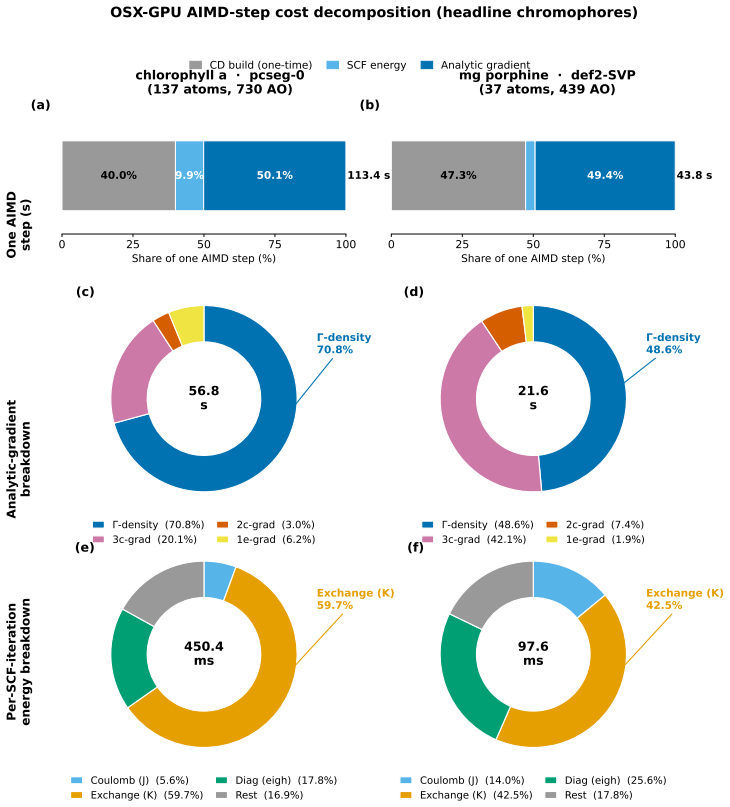
- [Abstract; Sect. 4.3; SI S10] Sect. 4.3 / SI S10: the Mg-porphine gradient and Q–B NACME are correctly labeled a capability demonstration with ~10^{-2} Eh/a0 FNO uncertainty, but the Abstract and Conclusions still lead with that chromophore run as the systems headline. Given that the FNO proxy study finds non-smooth gradient convergence and that NACME truncation is not separately convergence-tested, please keep the Abstract/Conclusions emphasis aligned with the paper’s own distinction: validated small-scale pipeline and memory-bounded kernel architecture first; chromophore execution second, with the FNO bound stated in the same sentence as the claim. This is a framing fix, not a request to drop the demo.
minor comments (5)
- [Sect. 2.1–2.4] Notation: A is used both for the EOM Jacobian (Eq. 5) and as a density argument in J^x(A,B) (Eq. 18). The text flags this once; a consistent typographic distinction (e.g. script A for the Jacobian) would reduce reader load in Sects. 2.2–2.4.
- [Table 1; Sect. 4.2] Table 1 quartet NACME rows are best-effort and not gated; the caption is clear, but a one-line pointer in the main text to the spin-adapted Table 3 resolution would help readers who stop at Table 1.
- [Sect. 4.4, Fig. 14] Fig. 14 is a surrogate-density assembly timing, not an end-to-end EOM gradient; the caption says so, but the main-text sentence that introduces it should restate that limit in one clause to avoid mis-citation.
- [Conclusions] The claim that the DAG template extends to CASPT2/DMRG etc. is carefully caveated as structural only (Conclusions). Consider moving that paragraph fully to SI or shortening it further so the validated EOM-CC scope remains the focus.
- [Data and code availability] Data availability: depositing the validation harnesses and geometries is excellent. Please state explicitly which tables/figures can be regenerated from the public stack alone versus which require the proprietary CUDA kernels (roofline, chromophore wall times).
Circularity Check
No significant circularity: reverse-mode transpose is the method, not a forced prediction; numerical claims are gated against FD, FCI, and independent Psi4.
full rationale
The load-bearing derivation is that EOM-CC amplitude response (and the interstate Z-vector) is obtained as the reverse-mode transpose of one forward density-contraction DAG, with non-symmetric AO-direct Laplace J/K builds and a two-sided Davidson. That identity is the standard reverse-mode AD Jacobian-vector product specialized to the non-Hermitian density functional F_AB; it is the implementation mechanism, not a numerical prediction that reduces to fitted inputs. Gradients and NACMEs are validated against central finite differences of the same energy, an exact full-CI determinant oracle (including bit-exact H2), a spin-adapted open-shell CSF path, and an independent Psi4 cross-code check of the excited-state gradient from H2O to benzene. The Mg-porphine chromophore run is explicitly framed as a capability demonstration with a stated FNO-truncation bound (~10^{-2} E_h/a0), piece-wise anchors, and machine-zero translational invariance—not as a spectroscopically forced result. Self-citation of the author's RECURSUM recurrence codegen is peripheral to these gates. No step reduces a claimed prediction to a fit or to an unverified self-citation chain.
Axiom & Free-Parameter Ledger
free parameters (4)
- Laplace quadrature size n_τ and minimax grid
- FNO virtual retention n'_v (e.g. 90 of 353 for Mg-porphine)
- Cholesky/screen thresholds (δ, screen_tol=0.01δ)
- FP32/FP64 mixed-precision boundary
axioms (6)
- domain assumption EOM-CC similarity-transformed non-Hermitian eigenproblem with biorthonormal left/right eigenvectors yields correct excitation energies and transition densities.
- standard math Laplace identity 1/D ≈ Σ w_α exp(-D τ_α) with factorization into one-index orbital factors allows AO-direct builds without four-index MO tensors.
- standard math Reverse-mode differentiation of the multilinear density-contraction DAG yields the amplitude-response equation A^T ζ = -ξ (relaxation = transpose).
- domain assumption Shifted Laplace reweighting 1/(D_k - ω) is valid for ω < min D_k (HOMO–LUMO-gap regime).
- domain assumption Cumulant decomposition of the two-particle transition density reduces the separable part to ordered one-particle J^x/K^x builds.
- ad hoc to paper Kernel identity: chromophore-scale kernels are the same objects validated end-to-end at small scale, so small-scale FD/Psi4 agreement transports.
invented entities (2)
-
Single contraction DAG as the EOM-CC relaxation (transpose = ζ / interstate Z-vector)
independent evidence
-
Ordered non-symmetric AO-LT J^x(A,B)≠J^x(B,A) GPU kernel for transition densities
independent evidence
read the original abstract
We present a unified, memory-bounded GPU realization of equation-of-motion coupled-cluster (EOM-CC) excited-state gradients and interstate nonadiabatic couplings (NACMEs) on a single 8\,GB consumer GPU. Both are built from one contraction directed acyclic graph: the EOM-CC relaxation is the reverse-mode transpose of the forward density build rather than a per-state re-derivation, and an atomic-orbital-direct Laplace-transform $J/K$ kernel, made non-symmetric ($J^x(A,B)\neq J^x(B,A)$) by the transition densities, resolves every energy denominator with no four-index molecular-orbital tensor; a two-sided Davidson returns both eigenvectors from one device-resident, spin-pure solve. The pipeline is \emph{validated end to end at small scale}: gradients and NACMEs match finite differences across four spin multiplicities and full configuration interaction to $<\!10^{-12}$ for two electrons, and the excited-state gradient matches the independent \textsc{Psi4} code to $\le\!4.6\times10^{-7}~E_h/a_0$ from \ce{H2O} to aromatic benzene. The kernels and the ground-state solve reach chromophores ($\le\!730$ AO) in 8\,GB, and a frozen-natural-virtual compression lets the eigensolver \emph{execute} a complete excited-state gradient and $Q$--$B$ NACME of the chlorophyll-core chromophore \ce{Mg}-porphine (def2-SVP, $439$ AO) on the card. We present that run as a \emph{capability demonstration} -- executed and translationally invariant to machine zero, but anchored only piece-wise and bounded by a direct convergence study at ${\sim}10^{-2}~E_h/a_0$ -- not a converged spectroscopic result. The validated small-scale capability and the memory-bounded implementation are the contribution.
Figures







Reference graph
Works this paper leans on
-
[1]
and Bartlett, Rodney J
Stanton, John F. and Bartlett, Rodney J. , title =. J. Chem. Phys. , year =
-
[2]
, title =
Stanton, John F. , title =. J. Chem. Phys. , year =
-
[3]
Quasidiabatic states described by coupled-cluster theory , journal =
Ichino, Takatoshi and Gauss, J. Quasidiabatic states described by coupled-cluster theory , journal =. 2009 , volume =
2009
-
[4]
Laplace transform techniques in
H. Laplace transform techniques in. J. Chem. Phys. , year =
-
[5]
and Webb, Simon P
Aikens, Christine M. and Webb, Simon P. and Bell, Robert L. and Fletcher, Graham D. and Schmidt, Michael W. and Gordon, Mark S. , title =. Theor. Chem. Acc. , year =
-
[6]
and Bouduban, Marine E
Hohenstein, Edward G. and Bouduban, Marine E. F. and Song, Chenchen and Luehr, Nathan and Ufimtsev, Ivan S. and Mart. Analytic first derivatives of complete active space self-consistent field energies on graphical processing units , journal =. 2015 , volume =
2015
-
[7]
and Parrish, Robert M
Hohenstein, Edward G. and Parrish, Robert M. and Mart. Tensor hypercontraction density fitting. J. Chem. Phys. , year =
-
[8]
Implementation of analytic gradients for
Feng, Xintian and Epifanovsky, Evgeny and Gauss, J. Implementation of analytic gradients for. J. Chem. Phys. , year =
-
[9]
, title =
Shavitt, Isaiah and Bartlett, Rodney J. , title =
-
[10]
and DePrince, III, A
Rubin, Nicholas C. and DePrince, III, A. Eugene , title =. Mol. Phys. , year =
-
[11]
and Yuwono, Stephen H
Liebenthal, Marcus D. and Yuwono, Stephen H. and Koulias, Lauren N. and Li, Run R. and Rubin, Nicholas C. and DePrince, III, A. Eugene , title =. J. Phys. Chem. A , year =
-
[12]
1979 , doi =
Pauncz, Ruben , title =. 1979 , doi =
1979
-
[13]
, title =
Warren, Jr., Henry S. , title =
-
[14]
and Lam, Monica S
Aho, Alfred V. and Lam, Monica S. and Sethi, Ravi and Ullman, Jeffrey D. , title =
-
[15]
Automated Code Engine for Graphical Processing Units: Application to the Effective Core Potential Integrals and Gradients , journal =
Song, Chenchen and Wang, Lee-Ping and Mart\'. Automated Code Engine for Graphical Processing Units: Application to the Effective Core Potential Integrals and Gradients , journal =. 2016 , volume =
2016
-
[16]
Elimination of energy denominators in
Alml. Elimination of energy denominators in. Chem. Phys. Lett. , year =
-
[17]
Principles for a direct
Alml. Principles for a direct. J. Comput. Chem. , year =
-
[18]
Takatsuka, Akio and Ten-no, Seiichiro and Hackbusch, Wolfgang , title =. J. Chem. Phys. , year =
-
[19]
Hackbusch, Wolfgang , title =. Comput. Vis. Sci. , year =
-
[20]
Grace and Fajen, O
Wang, Yuanheng and Hait, Diptarka and Johnson, K. Grace and Fajen, O. Jonathan and Zhang, Juncheng Harry and Guerrero, Rub\'en D. and Mart\'. Extending. J. Chem. Phys. , year =
-
[21]
Guerrero, Rub\'en D. , title =. arXiv:2604.18585 [cs.PL] , year =. 2604.18585 , archivePrefix =
work page internal anchor Pith review Pith/arXiv arXiv
-
[22]
and Gauss, J
Stanton, John F. and Gauss, J. Analytic energy derivatives for the equation-of-motion coupled-cluster method: Algebraic expressions, implementation, and application to the. Theor. Chim. Acta , year =
-
[23]
and Wang, Tao and Krylov, Anna I
Levchenko, Sergey V. and Wang, Tao and Krylov, Anna I. , title =. J. Chem. Phys. , year =
-
[24]
Analytic evaluation of the nonadiabatic coupling vector between excited states using equation-of-motion coupled-cluster theory , journal =
Tajti, Attila and Szalay, P. Analytic evaluation of the nonadiabatic coupling vector between excited states using equation-of-motion coupled-cluster theory , journal =. 2009 , volume =
2009
-
[25]
, title =
Faraji, Shirin and Matsika, Spiridoula and Krylov, Anna I. , title =. J. Chem. Phys. , year =
-
[26]
Communication: Non-adiabatic derivative coupling elements for the coupled cluster singles and doubles model , journal =
Kj. Communication: Non-adiabatic derivative coupling elements for the coupled cluster singles and doubles model , journal =. 2023 , volume =
2023
-
[27]
Automatic differentiation in quantum chemistry with applications to fully variational
Tamayo-Mendoza, Teresa and Kreisbeck, Christoph and Lindh, Roland and Aspuru-Guzik, Al. Automatic differentiation in quantum chemistry with applications to fully variational. ACS Cent. Sci. , year =
-
[28]
Zhang, Xing and Chan, Garnet Kin-Lic , title =. J. Chem. Phys. , year =
-
[29]
and Chan, Garnet Kin-Lic , title =
Zhang, Xing and Li, Chenghan and Ye, Hong-Zhou and Berkelbach, Timothy C. and Chan, Garnet Kin-Lic , title =. J. Chem. Phys. , year =
-
[30]
Hirata, So , title =. J. Phys. Chem. A , year =
-
[31]
Schweizer, Sabine and Doser, Bernd and Ochsenfeld, Christian , title =. J. Chem. Phys. , year =
-
[32]
Passing the one-billion limit in full configuration-interaction (
Olsen, Jeppe and J. Passing the one-billion limit in full configuration-interaction (. Chem. Phys. Lett. , year =
-
[33]
Theoretical study of the electronic spectrum of magnesium-porphyrin , journal =
Rubio, Mercedes and Roos, Bj. Theoretical study of the electronic spectrum of magnesium-porphyrin , journal =. 1999 , doi =
1999
-
[34]
Gouterman, Martin , title =. J. Mol. Spectrosc. , volume =. 1961 , doi =
1961
-
[35]
Smith, Daniel G. A. and Burns, Lori A. and Simmonett, Andrew C. and Parrish, Robert M. and others , title =. J. Chem. Phys. , volume =. 2020 , doi =
2020
discussion (0)
Sign in with ORCID, Apple, or X to comment. Anyone can read and Pith papers without signing in.