REVIEW 2 major objections 4 minor 1 cited by
Proton shell closures make neutron pairing gaps asymmetric across N=82.
Reviewed by Pith at T0; open to challenge. T0 means a machine referee read the full paper against a public rubric. the ladder, T0–T4 →
T0 review · grok-4.5
2026-07-11 04:22 UTC pith:44637WYB
load-bearing objection Solid new Sb masses plus a clean even-Z reading of OES asymmetry at Z=50 and Z=64; HFB works through mid-shell but deformation is prescribed and odd-Z remains open. the 2 major comments →
Interplay between Nuclear Shell Structure and Pairing around Doubly Magic ¹³²Sn
The pith
A machine-rendered reading of the paper's core claim, the machinery that carries it, and where it could break.
Core claim
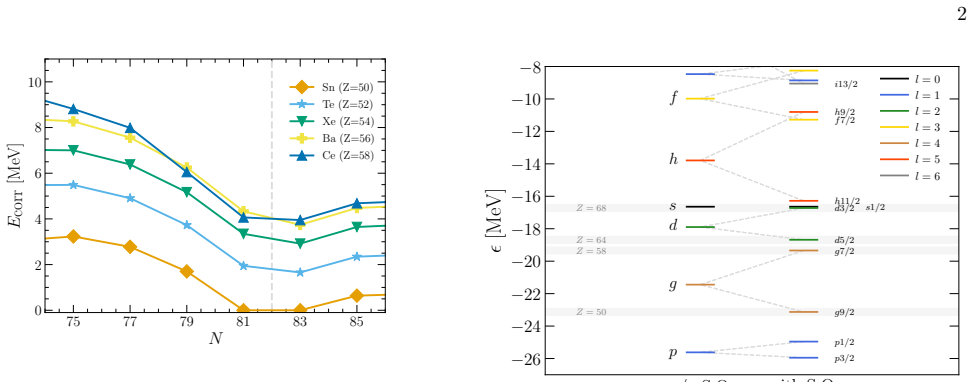
Proton shell structure enhances the asymmetry of neutron odd-even staggering across N=82: the difference between the three-point indicators Δ(3)(N=81) and Δ(3)(N=83) is largest at the proton (sub)shell closures Z=50 and Z=64, and HFB calculations attribute this to neutron pairing correlations that grow with Z and smear the N=82 closure away from those closures.
What carries the argument
The three-point odd-even staggering indicator Δ(3)(N) extracted from binding energies (or from the HFB pairing correlation energy Ecorr), which isolates the pairing contribution to the gap across the N=82 shell and thereby maps how proton shell structure modulates neutron pairing.
Load-bearing premise
The deformed HFB calculations rely on fixed, Z-independent quadrupole deformations taken from an external mass model rather than being determined self-consistently for each nucleus.
What would settle it
A self-consistent deformed HFB calculation (or an independent shell-model calculation with the same single-particle spectrum) that fails to recover the experimental rise of Δ(3)(N=83) from Z=50 to the mid-shell, or new mass measurements of more neutron-rich Sn, Sb or I isotopes that erase the reported recovery of staggering for odd-Z nuclei at N=85,86.
Editorial analysis
A structured set of objections, weighed in public.
Referee Report
Summary. The paper interprets existing mass data near 132Sn to show that proton (sub)shell structure at Z=50 and Z=64 enhances the asymmetry between neutron odd-even staggering Δ^(3)(N=81) and Δ^(3)(N=83). Original spherical and deformed HFB calculations for even-Z nuclei attribute this to neutron pairing correlations that grow with Z and smear the N=82 closure away from proton shell closures. New TITAN MR-TOF mass measurements of 137Sb (improved precision) and 138Sb (first determination) extend the analysis to odd-Z nuclei, where the shell-pairing interplay is harder to capture phenomenologically or with HFB, motivating further work.
Significance. The result, if robust, clarifies how proton shell structure modulates neutron pairing far from stability, a competition of direct relevance to nuclear structure and r-process modeling. Strengths include independent experimental masses (with calibrant checks and AME consistency for 137Sb), HFB that reproduces Sn OES and even-Z isotonic trends through Z≈60 without ad-hoc fitting to the asymmetry itself, and an explicit link between single-particle gaps (including the Z=64 subshell) and the observed OES pattern. The new 138Sb mass and the even-Z HFB success constitute concrete, falsifiable advances.
major comments (2)
- [Supplemental Material, deformed HFB; main text Fig. 1(e)] Supplemental Material (deformed HFB paragraph and Fig. 1(e) discussion): The quantitative agreement for Δ^(3)(N=83) up to Z≈60 relies on prescribed, Z-independent quadrupole deformations β2 taken as FRDM averages rather than variational minima. While the paper notes that this treatment renders E_corr-based Δ^(3) unreliable for Z>60, the main-text claim of successful deformed-HFB description should more explicitly flag this external input as a caveat, because the mid-shell success is not fully self-contained.
- [OES including odd-Z nuclei; Summary] OES including odd-Z nuclei section and Summary: The statement that both spherical and deformed HFB are inconsistent with experimental odd-Z Δ^(3)(N) is central to the motivation for future work, yet no quantitative comparison (curves, residuals, or table) is provided. Adding the corresponding HFB results (even if only in the Supplemental Material) would make the acknowledged limitation concrete and allow readers to judge its severity.
minor comments (4)
- [Fig. 1 and Phenomenological interpretation] Fig. 1(c)–(e) and related text: The vertical dashed lines marking Z=50 and Z=64 are helpful, but the near-degeneracy argument for the absence of a Z=58 subshell (≲0.7 MeV) would be clearer if the single-particle spectrum of Supplemental Fig. 2 were referenced more explicitly in the main text.
- [Experiment; Table I] Table I and Experiment section: The mass-resolving power R≈390 000 and the hyper-EMG fitting procedure are stated, but a brief note on how the 14 counts for 138Sb still yield a reliable centroid (and the assigned 68 keV uncertainty) would aid non-specialist readers.
- [Phenomenological interpretation] Eq. (1) and surrounding text: The three-point formula is standard, yet a short remark that higher-order formulas were checked and give consistent trends would preempt questions about finite-difference artifacts near shell closures.
- [References / Supplemental Material] References: Recent mass work on nearby chains (e.g., the 2025 Sn and Ce results already cited) is well covered; adding a pointer to the latest AME updates or FRDM deformation tables used for β2 would improve reproducibility.
Circularity Check
No significant circularity: experimental OES trends are independent data; HFB is a parameter-free application of the authors' prior formulation validated on Sn, not fitted to the Z-asymmetry being explained.
full rationale
The paper's central phenomenological claim (proton (sub)shell closures at Z=50 and Z=64 maximize the neutron Δ^(3)(N=81)–Δ^(3)(N=83) asymmetry) is read directly from existing AME and recent mass data; no derivation is involved. The HFB calculations that interpret the even-Z trends compute E_corr from a Woods-Saxon + pairing Hamiltonian taken from the authors' earlier formulation, then form the three-point OES of E_corr; Sn isotopic OES is used only as a post-hoc validation check that shows agreement without any ad-hoc parameters adjusted to the multi-Z asymmetry. Deformation parameters are imported as Z-independent FRDM averages rather than variationally optimized or tuned to the OES data, and the paper itself flags the resulting unreliability for Z>60. Odd-Z HFB is acknowledged to fail, so the new Sb masses serve only as experimental extension. No step reduces a claimed prediction to a fitted input or to a self-citation of the target result itself. Minor self-citation of the HFB method exists but is not load-bearing for the observed pattern.
Axiom & Free-Parameter Ledger
free parameters (3)
- Woods-Saxon depth V0(N,Z) and surface diffuseness a
- Prescribed quadrupole deformations β2(N)
- Pairing interaction strength in HFB Δij
axioms (5)
- domain assumption Three-point finite-difference formula Δ^(3)(n) measures the pairing gap contribution to binding-energy odd-even staggering.
- domain assumption Pairing correlation energy E_corr = E_HFB − E_NS is a valid proxy for the pairing part of experimental OES after slowly varying mean-field pieces cancel in Δ^(3).
- domain assumption Spherical or axially deformed Woods-Saxon plus spin-orbit potential adequately generates the single-particle spectrum near 132Sn, including a ~2–3 MeV proton gap at Z=64.
- domain assumption Odd-even (odd-odd) nuclei can be treated as one- (two-) quasiparticle HFB states with imposed number parity.
- domain assumption Proton–neutron pairing is negligible for most neutron-rich cases here because Fermi surfaces are separated by several MeV.
read the original abstract
Shell structure in finite quantum systems gives rise to sudden changes in observable properties, while pairing correlations often compete against such discontinuities. The region near the doubly magic nucleus $^{132}$Sn provides a fertile ground for testing the combined effect of shell structure and pairing. Here, we provide a novel phenomenological interpretation of existing mass data in the vicinity of the $Z=50$ and $N=82$ shell closures, which we further investigate by performing original Hartree-Fock-Bogolyubov (HFB) mean-field calculations for even-$Z$ nuclei: we find that the proton shell structure enhances an asymmetry of the neutron odd-even staggering in binding energies. We also report mass measurements of $^{137,138}$Sb, including the first experimental mass determination of $^{138}$Sb, performed using TRIUMF's Ion Trap for Atomic and Nuclear Science (TITAN). Together with existing experimental data, our results reveal an interplay between shell structure and pairing in odd-$Z$ nuclei which is more challenging to interpret phenomenologically or using HFB, thereby motivating future experimental and theoretical pairing studies in heavy neutron-rich nuclides.
Figures



Forward citations
Cited by 1 Pith paper
-
Exploring the shell structure of trapped superfluid gases
Shell structure in trapped two-component Fermi gases vanishes as interactions approach unitarity, with the interaction's effective range — not the scattering length — controlling how much shell structure survives.
Reference graph
Works this paper leans on
-
[1]
before being injected into TITAN’s radiofrequency quadrupole cooler-buncher (RFQcb) [47]. There, the ions are cooled, accumulated, and subsequently trans- ferred as an ion bunch to a multiple-reflection time-of- flight mass spectrometer (MR-TOF-MS) [48], where the mass measurements are carried out. The latter follow a TABLE I. Atomic masses of Sb isotopes...
-
[2]
M. G. Mayer, On closed shells in nuclei, Phys. Rev.74, 235 (1948)
1948
-
[3]
M. G. Mayer, On closed shells in nuclei. ii, Phys. Rev. 75, 1969 (1949)
1969
-
[4]
Haxel, J
O. Haxel, J. H. D. Jensen, and H. E. Suess, On the ”magic numbers” in nuclear structure, Phys. Rev.75, 1766 (1949)
1949
-
[5]
Brown, The nuclear shell model towards the drip lines, Progress in Particle and Nuclear Physics47, 517 (2001)
B. Brown, The nuclear shell model towards the drip lines, Progress in Particle and Nuclear Physics47, 517 (2001)
2001
-
[6]
Caurier, G
E. Caurier, G. Mart´ ınez-Pinedo, F. Nowacki, A. Poves, and A. P. Zuker, The shell model as a unified view of nuclear structure, Rev. Mod. Phys.77, 427 (2005)
2005
-
[7]
Hebeler, J
K. Hebeler, J. Holt, J. Men´ endez, and A. Schwenk, Nu- clear forces and their impact on neutron-rich nuclei and neutron-rich matter, Ann. Rev. Nucl. Part. Sci.65, 457 (2015)
2015
-
[8]
S. M. Reimann and M. Manninen, Electronic structure of quantum dots, Rev. Mod. Phys.74, 1283 (2002)
2002
-
[9]
J. P. Wilcoxon and B. L. Abrams, Synthesis, structure and properties of metal nanoclusters, Chem. Soc. Rev. 35, 1162 (2006)
2006
-
[10]
Giorgini, L
S. Giorgini, L. P. Pitaevskii, and S. Stringari, Theory of ultracold atomic fermi gases, Rev. Mod. Phys.80, 1215 (2008)
2008
-
[11]
K. H. Bennemann and J. B. Ketterson, eds.,Supercon- ductivity(Springer-Verlag, 2008)
2008
-
[12]
G. C. Strinati, P. Pieri, G. R¨ opke, P. Schuck, and M. Ur- ban, The BCS–BEC crossover: From ultra-cold fermi gases to nuclear systems, Phys. Rept.738, 1 (2018)
2018
-
[13]
D. J. Dean and M. Hjorth-Jensen, Pairing in nuclear sys- tems: from neutron stars to finite nuclei, Rev. Mod. Phys. 75, 607 (2003)
2003
-
[14]
Dobaczewski, W
J. Dobaczewski, W. Nazarewicz, T. Werner, J. Berger, C. Chinn, and J. Decharg´ e, Mean-field description of ground-state properties of drip-line nuclei: Pairing and continuum effects, Physical Review C53, 2809 (1996)
1996
-
[15]
Erler, N
J. Erler, N. Birge, M. Kortelainen, W. Nazarewicz, E. Olsen, A. M. Perhac, and M. Stoitsov, The limits of the nuclear landscape, Nature486, 509 (2012)
2012
-
[16]
Sorlin and M.-G
O. Sorlin and M.-G. Porquet, Nuclear magic numbers: New features far from stability, Progress in Particle and Nuclear Physics61, 602 (2008)
2008
-
[17]
Hakala, J
J. Hakala, J. Dobaczewski, D. Gorelov, T. Eronen, A. Jokinen, A. Kankainen, V. S. Kolhinen, M. Korte- lainen, I. D. Moore, H. Penttil¨ a, S. Rinta-Antila, J. Ris- sanen, A. Saastamoinen, V. Sonnenschein, and J. ¨Ayst¨ o, Precision mass measurements beyond 132Sn: Anoma- lous behavior of odd-even staggering of binding energies, Phys. Rev. Lett.109, 032501 (2012)
2012
-
[18]
W. J. Huang, M. Wang, F. G. Kondev, G. Audi, and S. Naimi, The AME 2020 atomic mass evaluation (I). Evaluation of input data, and adjustment procedures, Chinese Physics C45, 030002 (2021)
2020
-
[19]
Sp˘ ataru, G
A. Sp˘ ataru, G. Kripk´ o-Koncz, T. Dickel, C. Hornung, W. R. Plaß, P. Constantin, D. Amanbayev, S. Ayet San Andr´ es, D. L. Balabanski, S. Beck, J. Bergmann, H. Geissel, N. Kalantar-Nayestanaki, J. Kehat, I. Mar- dor, N. Minkov, A. Mollaebrahimi, C. Scheidenberger, M. Wasserheß, H. Wilsenach, and J. Zhao, Broadband mass measurements with the FRS ion catc...
2025
-
[20]
Kimura, M
S. Kimura, M. Wada, H. Haba, H. Ishiyama, S. Ishizawa, Y. Ito, T. Niwase, M. Rosenbusch, P. Schury, and A. Takamine, Comprehensive mass measurement study of 252Cf fission fragments with MRTOF-MS and detailed study of masses of neutron-rich Ce isotopes, Phys. Rev. C110, 045810 (2024)
2024
-
[21]
B. Liu, M. Brodeur, J. Clark, D. Ray, G. Savard, A. Valverde, D. Burdette, A. Houff, A. Mitra, G. Morgan, R. Orford, W. Porter, C. Quick, F. Rivero, K. Sharma, and L. Varriano, Precise mass measurement of the 149La-149Ce-149Pr isobaric chain, arXiv preprint arXiv 2601.09959 (2026)
-
[22]
Mollaebrahimi, C
A. Mollaebrahimi, C. Walls, T. Dickel, T. Miyagi, A. Sieverding, C. Andreoiu, J. Ash, B. Ashrafkhani, I. Belosevic, J. Bergman, C. Brown, T. Brunner, J. Car- dona, L. Egoriti, G. Gelinas, G. Gwinner, Z. Hock- enbery, J. D. Holt, A. Jacobs, S. Kakkar, B. Kootte, J. Lassen, E. M. Lykiardopoulou, S. Malbrunot- Ettenauer, G. Mart´ ınez-Pinedo, S. F. Paul, W. ...
2025
-
[23]
S. Beck, B. Kootte, I. Dedes, T. Dickel, A. A. Kwiatkowski, E. M. Lykiardopoulou, W. R. Plaß, M. P. Reiter, C. Andreoiu, J. Bergmann, T. Brunner, D. Curien, J. Dilling, J. Dudek, E. Dunling, J. Flow- erdew, A. Gaamouci, L. Graham, G. Gwinner, A. Jacobs, R. Klawitter, Y. Lan, E. Leistenschneider, N. Minkov, V. Monier, I. Mukul, S. F. Paul, C. Scheidenberge...
2021
-
[24]
A. Bohr, B. R. Mottelson, and D. Pines, Possible anal- ogy between the excitation spectra of nuclei and those of the superconducting metallic state, Phys. Rev.110, 936 (1958)
1958
-
[26]
Satu la, J
W. Satu la, J. Dobaczewski, and W. Nazarewicz, Odd- even staggering of nuclear masses: Pairing or shape ef- fect?, Physical Review Letters81, 3599 (1998)
1998
-
[27]
Duguet, P
T. Duguet, P. Bonche, P.-H. Heenen, and J. Meyer, Pairing correlations. ii. microscopic analysis of odd-even mass staggering in nuclei, Physical Review C65, 014311 (2001)
2001
-
[28]
Bender, P.-H
M. Bender, P.-H. Heenen, and P.-G. Reinhard, Self- consistent mean-field models for nuclear structure, Re- views of Modern Physics75, 121 (2003)
2003
-
[29]
D. M. Brink and R. A. Broglia,Nuclear superfluidity: pairing in finite systems(Cambridge University Press, 2005)
2005
-
[30]
A. J. Miller, K. Minamisono, A. Klose, D. Garand, C. Kujawa, J. Lantis, Y. Liu, B. Maaß, P. Mantica, W. Nazarewicz,et al., Proton superfluidity and charge radii in proton-rich calcium isotopes, Nature physics15, 7 432 (2019)
2019
-
[31]
Palkanoglou, F
G. Palkanoglou, F. K. Diakonos, and A. Gezerlis, From odd-even staggering to the pairing gap in neutron matter, Physical Review C102, 064324 (2020)
2020
-
[32]
Duguet, B
T. Duguet, B. Bally, and A. Tichai, Zero-pairing limit of hartree-fock-bogoliubov reference states, Physical Re- view C102, 054320 (2020)
2020
-
[33]
B. A. Brown, The nuclear pairing gap–how low can it go?, inJournal of Physics: Conference Series, Vol. 580 (2015) p. 012016
2015
-
[34]
Coraggio, A
L. Coraggio, A. Covello, A. Gargano, and N. Itaco, Be- havior of odd-even mass staggering around 132Sn, Phys- ical Review C88, 041304 (2013)
2013
-
[35]
Shi, X.-B
H. Shi, X.-B. Wang, G.-X. Dong, and H. Wang, Ab- normal odd-even staggering behavior around 132Sn stud- ied by density functional theory, Chinese Physics C44, 094108 (2020)
2020
-
[36]
Orlandi, S
R. Orlandi, S. Pain, S. Ahn, A. Jungclaus, K. Schmitt, D. Bardayan, W. Catford, R. Chapman, K. Chipps, J. Cizewski,et al., Neutron-hole states in 131Sn and spin- orbit splitting in neutron-rich nuclei, Physics Letters B 785, 615 (2018)
2018
-
[37]
P. Ring, P. Schuck, and M. Strayer, The nuclear many- body problem (1983)
1983
-
[38]
Gezerlis, G
A. Gezerlis, G. Bertsch, and Y. Luo, Mixed-spin pairing condensates in heavy nuclei, Physical review letters106, 252502 (2011)
2011
-
[39]
Palkanoglou, M
G. Palkanoglou, M. Stuck, and A. Gezerlis, Spin-triplet pairing in heavy nuclei is stable against deformation, Physical Review Letters134, 032501 (2025)
2025
-
[40]
Robledo and G
L. Robledo and G. Bertsch, Application of the gradient method to Hartree-Fock-Bogoliubov theory, Physical Re- view C84, 014312 (2011)
2011
-
[42]
A. A. Kwiatkowski, J. Dilling, S. Malbrunot-Ettenauer, et al., 15 years of precision mass measurements at TI- TAN, The European Physics Journal A60(2024)
2024
-
[43]
G. C. Ball, G. Hackman, and R. Kr¨ ucken, The TRIUMF- ISAC facility: two decades of discovery with rare isotope beams, Physica Scripta91, 093002 (2016)
2016
-
[44]
G. C. Ball, I. Dillmann, A. Garnsworthy, G. Gwinner, R. Kanungo, G. Morris, and C. Ruiz, The TRIUMF- ISAC facility: Recent highlights in RIB science and fu- ture prospects with ARIEL, Nuclear Physics News30, 27 (2020)
2020
-
[45]
Lassen, R
J. Lassen, R. Li, M. Mostamand, A. Gacsbaranyi, P. Kunz, C. Babcock, D. Bishop, A. Teigelh¨ ofer, F. Ames, and A. Gottberg, Developments at triumf’s laser reso- nance ionization ion source & multi-element operation, Nuclear Instruments and Methods in Physics Research Section B: Beam Interactions with Materials and Atoms 541, 137 (2023)
2023
-
[46]
Dombsky, D
M. Dombsky, D. Bishop, P. Bricault, D. Dale, A. Hurst, K. Jayamanna, R. Keitel, M. Olivo, P. Schmor, and G. Stanford, Commissioning and initial operation of a radioactive beam ion source at ISAC, Review of Scien- tific Instruments71, 978 (2000)
2000
-
[47]
Bricault, R
P. Bricault, R. Baartman, M. Dombsky, A. Hurst, C. Mark, G. Stanford, and P. Schmor, TRIUMF-ISAC target station and mass separator commissioning, Nu- clear Physics A701, 49 (2002), 5th International Con- ference on Radioactive Nuclear Beams
2002
-
[48]
Brunner, M
T. Brunner, M. J. Smith, M. Brodeur, S. Ettenauer, A. T. Gallant, V. V. Simon, A. Chaudhuri, A. Lapierre, E. Man´ e, R. Ringle,et al., TITAN’s digital RFQ ion beam cooler and buncher, operation and performance, Nuclear Instruments and Methods in Physics Research Section A: Accelerators, Spectrometers, Detectors and Associated Equipment676, 32 (2012)
2012
-
[49]
Jesch, T
C. Jesch, T. Dickel, W. R. Plaß, D. Short, S. A. S. An- dres, J. Dilling, H. Geissel, F. Greiner, J. Lang, K. G. Leach, W. Lippert, C. Scheidenberger, and M. I. Yavor, The MR-TOF-MS isobar separator for the TITAN facil- ity at TRIUMF, TCP 2014 , 175 (2017)
2014
-
[50]
Leistenschneider, M
E. Leistenschneider, M. P. Reiter, S. Ayet San Andr´ es, B. Kootte, J. D. Holt, P. Navr´ atil, C. Babcock, C. Barbi- eri, B. R. Barquest, J. Bergmann, J. Bollig, T. Brunner, E. Dunling, A. Finlay, H. Geissel, L. Graham, F. Greiner, H. Hergert, C. Hornung, C. Jesch, R. Klawitter, Y. Lan, D. Lascar, K. G. Leach, W. Lippert, J. E. McKay, S. F. Paul, A. Schwe...
2018
-
[51]
M. P. Reiter, S. A. San Andr´ es, J. Bergmann, T. Dickel, J. Dilling, A. Jacobs, A. A. Kwiatkowski, W. R. Plaß, C. Scheidenberger, D. Short,et al., Commissioning and performance of TITAN’s Multiple-Reflection Time-of- Flight Mass-Spectrometer and isobar separator, Nuclear Instruments and Methods in Physics Research Section A: Accelerators, Spectrometers, ...
2021
-
[52]
Dickel, W
T. Dickel, W. R. Plaß, W. Lippert, J. Lang, M. I. Ya- vor, H. Geissel, and C. Scheidenberger, Isobar separation in a multiple-reflection time-of-flight mass spectrometer by mass-selective re-trapping, Journal of the American Society for Mass Spectrometry28, 1079 (2017)
2017
-
[53]
S. F. Paul, emgfit - fitting of time-of-flight mass spectra with hyper-emg models (2020)
2020
-
[54]
Purushothaman, S
S. Purushothaman, S. Ayet San Andr´ es, J. Bergmann, T. Dickel, J. Ebert, H. Geissel, C. Hornung, W. Plaß, C. Rappold, C. Scheidenberger, Y. Tanaka, and M. Ya- vor, Hyper-emg: A new probability distribution func- tion composed of exponentially modified gaussian dis- tributions to analyze asymmetric peak shapes in high- resolution time-of-flight mass spect...
2017
-
[55]
Ayet San Andr´ es, C
S. Ayet San Andr´ es, C. Hornung, J. Ebert, W. R. Plaß, T. Dickel, H. Geissel, C. Scheidenberger, J. Bergmann, F. Greiner, E. Haettner, C. Jesch, W. Lippert, I. Mar- dor, I. Miskun, Z. Patyk, S. Pietri, A. Pihktelev, S. Pu- rushothaman, M. P. Reiter, A.-K. Rink, H. Weick, M. I. Yavor, S. Bagchi, V. Charviakova, P. Constantin, M. Di- wisch, A. Finlay, S. K...
2019
-
[56]
S. F. Paul, J. Bergmann, J. D. Cardona, K. A. Diet- rich, E. Dunling, Z. Hockenbery, C. Hornung, C. Izzo, 8 A. Jacobs, A. Javaji, B. Kootte, Y. Lan, E. Leistenschnei- der, E. M. Lykiardopoulou, I. Mukul, T. Murb¨ ock, W. S. Porter, R. Silwal, M. B. Smith, J. Ringuette, T. Brun- ner, T. Dickel, I. Dillmann, G. Gwinner, M. MacCormick, M. P. Reiter, H. Schat...
2021
-
[57]
Bohr and B
A. Bohr and B. R. Mottelson, Nuclear structure, vol. 1 (1969)
1969
-
[58]
Orlandi, S
R. Orlandi, S. Pain, S. Ahn, A. Jungclaus, K. Schmitt, D. Bardayan, W. Catford, R. Chapman, K. Chipps, J. Cizewski,et al., Neutron-hole states in 131sn and spin- orbit splitting in neutron-rich nuclei, Physics Letters B 785, 615 (2018)
2018
-
[59]
Palkanoglou, M
G. Palkanoglou, M. Stuck, and A. Gezerlis, Spin-triplet pairing in heavy nuclei is stable against deformation, Phys- ical Review Letters134, 032501 (2025)
2025
-
[60]
Symmetry properties of pair correlations in heavy deformed nuclei
G. Palkanoglou and A. Gezerlis, Symmetry properties of pair correlations in heavy deformed nuclei, arXiv preprint arXiv:2505.08879 (2025)
work page internal anchor Pith review Pith/arXiv arXiv 2025
-
[61]
M¨ oller, A
P. M¨ oller, A. J. Sierk, T. Ichikawa, and H. Sagawa, Nu- clear ground-state masses and deformations: Frdm (2012), Atomic Data and Nuclear Data Tables109, 1 (2016)
2012
-
[62]
W. J. Huang, M. Wang, F. G. Kondev, G. Audi, and S. Naimi, The AME 2020 atomic mass evaluation (I). Eval- uation of input data, and adjustment procedures, Chinese Physics C45, 030002 (2021)
2020
discussion (0)
Sign in with ORCID, Apple, or X to comment. Anyone can read and Pith papers without signing in.