REVIEW 4 major objections 53 references
Chunk-bounded memory with cross-chunk reconciliation and co-located storage improves agent accuracy and serving throughput together.
Reviewed by Pith at T0; open to challenge. T0 means a machine referee read the full paper against a public rubric. the ladder, T0–T4 →
T0 review · grok-4.5
2026-07-11 03:20 UTC pith:BBKYPCWB
load-bearing objection Solid agent-memory systems paper with real Pareto gains; the efficiency half is less cleanly measured than the accuracy half because auxiliary model calls are not cost-broken-out. the 4 major comments →
Akashic: A Low-Overhead LLM Inference Service with MemAttention
The pith
A machine-rendered reading of the paper's core claim, the machinery that carries it, and where it could break.
Core claim
Akashic shows that long-horizon agent memory can be both more accurate and cheaper to serve when construction is bounded to chunks, cross-chunk evidence is recovered by model-driven joint reconciliation rather than full-history rewrite, and physical layout co-locates chunks that are likely to be retrieved together. Under that design the system improves task quality and serving metrics simultaneously against whole-context, segment-level, hierarchical, and reflective memory baselines.
What carries the argument
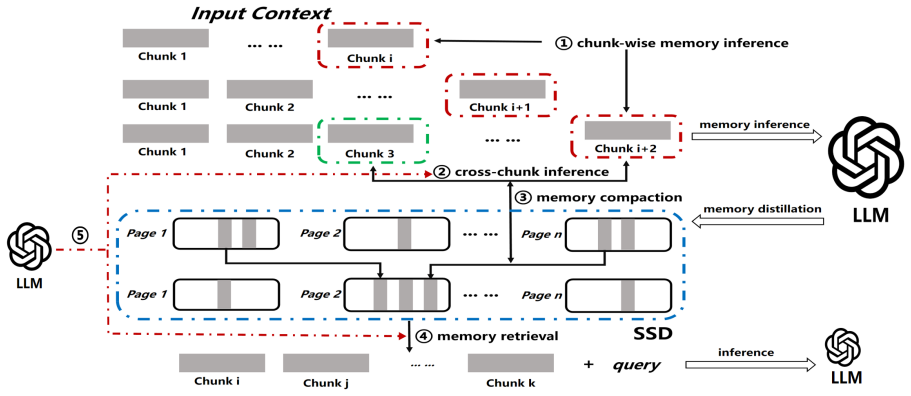
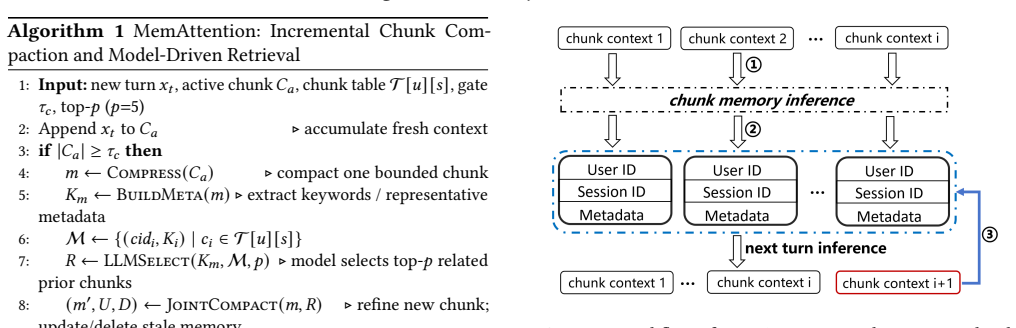
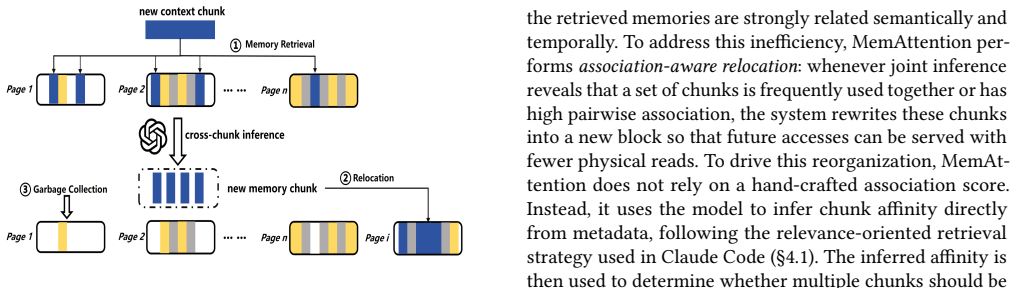
MemAttention: gate-triggered compaction of one bounded active chunk, followed by model selection of a small set of related prior chunks for joint update/delete, the same model-driven top-p selection for query-time retrieval, and an out-of-place, affinity-aware block manager that co-locates co-accessed chunks and garbage-collects high-invalid-ratio blocks.
Load-bearing premise
The design assumes that using the model itself to match chunk metadata for joint compaction, retrieval, and physical co-location is accurate and cheap enough that the extra inference and rewrite work pays for itself in quality and latency.
What would settle it
On the same four workloads and models, disable model-driven joint reconciliation and co-location (or replace them with dense-embedding matching and append-only layout) and check whether the claimed accuracy, throughput, and concurrent-rate gains over the strongest baselines disappear or reverse once extra model calls and rewrite cost are counted.
If this is right
- Agent memory need not choose between quality and serving cost: bounded chunk maintenance plus cross-chunk recovery can raise both.
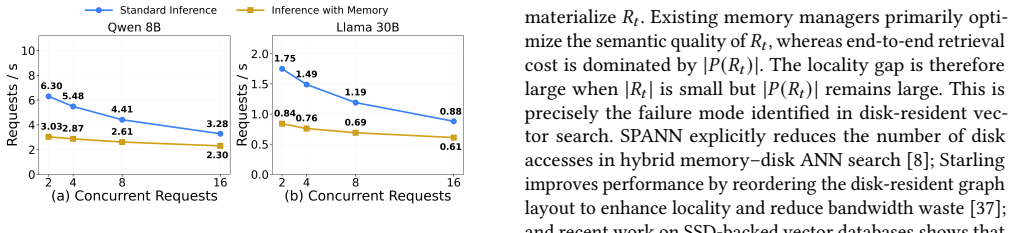
- Semantic relevance alone is insufficient for serving; co-locating co-retrieved chunks reduces blocks touched and cold retrieval latency under load.
- Fixed global summarization policies are a poor match for workloads whose information density varies across datasets and within a trajectory.
- Long-horizon serving stacks can keep the GPU decoding path unchanged and still gain by inserting memory retrieval, write-back, and layout maintenance on the control path.
Where Pith is reading between the lines
- If model-driven affinity is reliable, the same co-location idea could apply to other session-scoped stores beyond vector chunk tables, such as tool traces or multi-agent shared scratchpads.
- The locality-gap framing suggests agent-memory benchmarks should report blocks-per-request and cold retrieval latency, not only F1 or success rate.
- When context density is extremely high, the residual value of any compression may be small, so adaptive gates that skip compaction may matter as much as better summaries.
Editorial analysis
A structured set of objections, weighed in public.
Referee Report
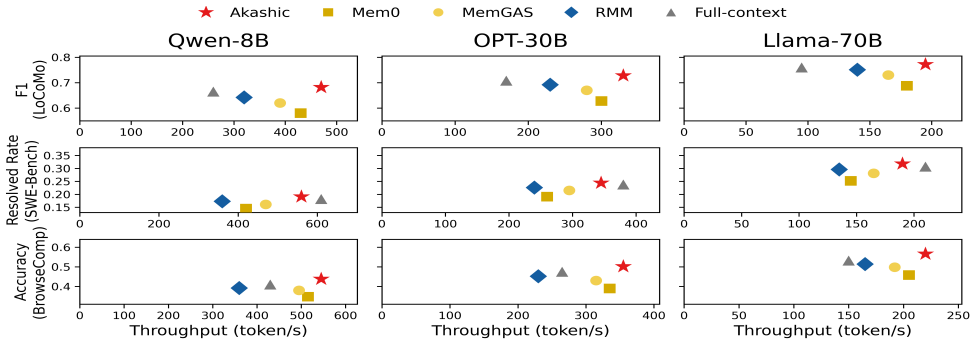
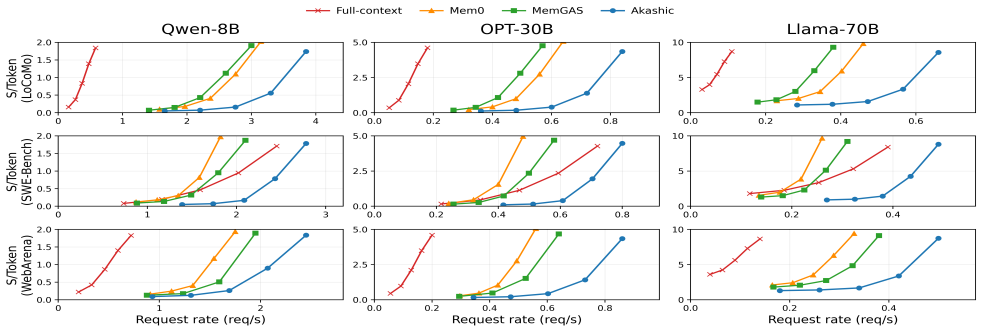
Summary. Akashic is a memory system for long-horizon LLM agent serving built around MemAttention: context is maintained as bounded chunks (default 1024 tokens), each new chunk is reconciled via model-driven cross-chunk inference with a small set of related prior chunks (top-p=5), and inference-time retrieval reuses the same model-driven metadata matching. A Memory Manager then co-locates jointly accessed chunks out-of-place and garbage-collects blocks with invalid ratio ≥0.75 to reduce retrieval I/O. Implemented as control-path extensions to vLLM, Akashic is evaluated on LoCoMo, SWE-bench, BrowseComp, and WebArena with Qwen-8B, OPT-30B, and Llama-70B against Full-context, Mem0, MemGAS, MemGPT, and RMM. The paper reports Pareto gains of up to +10.2 accuracy points, 1.21× throughput, and 1.88× sustainable concurrent request rate over the strongest prior memory baselines, plus locality and storage-amplification measurements and ablations of whole-context, no-joint, and dense-only variants.
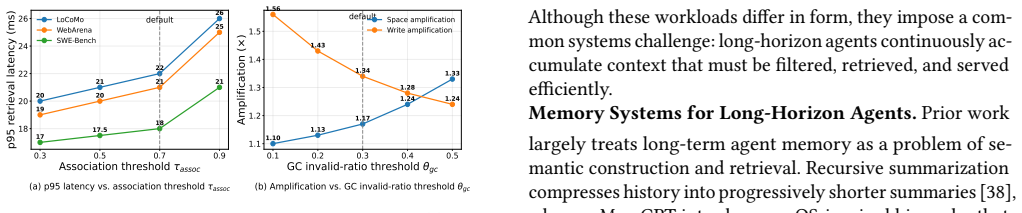
Significance. The problem is timely and well-motivated: agent workloads accumulate heterogeneous, non-uniform context, and existing memory systems either pay growing whole-history maintenance cost or fragment cross-chunk evidence, while treating storage locality as an opaque backend. The paper’s joint treatment of chunk-granular maintenance, unified model-driven relevance for reconciliation and retrieval, and affinity-aware physical placement is a coherent systems contribution. Strengths include multi-workload, multi-scale evaluation; explicit locality metrics (blocks/request, p95 retrieval latency) and space/write amplification; and sensitivity sweeps over τc, Bmem, τassoc, and θgc. If the end-to-end efficiency claims hold under full cost accounting of auxiliary model calls, the work would be a useful reference point for production agent memory stacks and for connecting agent memory to locality-aware storage design.
major comments (4)
- §4.1–4.3, Algorithms 1–2, and §5.1 leave the cost of model-driven matching under-specified relative to the efficiency half of the central claim. Every retrieval issues LLMSelect over candidate metadata; compaction uses JointCompact; relocation/GC use LLMCoLocate/LLMGroup. §5.1 further states that OPT-30B is used for relevance analysis over memory chunks, which may be a separate model from the served Qwen-8B/Llama-70B. Figures 8–9 report only aggregate tokens/s and s/token with no breakdown of GPU time or tokens spent on auxiliary matching versus main prefill/decode, and no statement whether OPT-30B latency/throughput is included in those aggregates or runs on the same H800s under the concurrency knees of Fig. 9. Because the abstract’s 1.21×/1.88× gains are end-to-end serving claims, the manuscript needs an explicit cost accounting (or a controlled experiment with matching disabled / repl
- §5.1 lists five baselines including MemGPT, but §5.2 and Figure 8 report only Full-context, Mem0, MemGAS, and RMM (legend and body text). Either MemGPT results should be added under the same protocol, or the baseline list and claims of comparison to hierarchical external memory should be revised. As written, the multi-baseline Pareto claim is incompletely supported for one of the named systems.
- §5.5 Dense-only ablation retains 97.2%–97.3% task quality and 98.7%–99.1% throughput versus full Akashic, while Whole-context hurts throughput more. This is useful, but it weakens the paper’s emphasis on model-driven semantic matching as essential to the efficiency story (§4.1, abstract). The manuscript should clarify what fraction of the reported 1.21×/1.88× gains is attributable to (i) bounded chunk maintenance alone, (ii) cross-chunk reconciliation, (iii) model-driven vs dense retrieval, and (iv) physical co-location (Fig. 10). Without that decomposition, the joint quality–efficiency narrative over-attributes gains to the more expensive model-driven path.
- The repeated claim of “hardware–software co-designed” memory placement (abstract, §1, §4.2, conclusion) overstates the contribution relative to the implementation. §4.2–4.3 describe software layout policies (out-of-place rewrite, affinity packing, GC at φ≥0.75) on commodity NVMe behind an unmodified vLLM GPU path; there is no hardware interface change, device-level scheduling, or PCIe/NVMe co-design. Reframe as software locality-aware storage management co-optimized with the memory API, or specify what is co-designed with hardware beyond using local SSD bandwidth numbers in Table 1.
Circularity Check
No significant circularity: empirical systems paper with external benchmarks and free design knobs, not a self-referential derivation.
full rationale
Akashic is an empirical LLM-serving systems paper. Its load-bearing claims are measured end-to-end quantities—task accuracy (QA F1, %Resolved, BrowseComp accuracy, WebArena success), throughput (token/s), sustainable request rate (req/s before latency knee), blocks/request, p95 retrieval latency, and space/write amplification—on external workloads (LoCoMo, SWE-bench, BrowseComp, WebArena) against independent baselines (Full-context, Mem0, MemGAS, MemGPT, RMM). These metrics are not defined by, nor algebraically forced by, the design parameters. Chunk gate τc=1024, top-p=5, φ(B)≥0.75, τassoc=0.7, and memory budget are free engineering knobs with sensitivity/ablation plots (§5.5, Figs. 11–12); the paper does not fit them to a subset of the reported accuracy/throughput numbers and then call the same numbers a prediction. MemAttention’s model-driven matching (LLMSelect / LLMCoLocate / LLMGroup) and out-of-place co-location are design mechanisms whose net benefit is tested, not derived from a uniqueness theorem or self-citation chain. The only self-reference (RedKnot [44], open-source merge plan) is implementation context and is not used to justify the Pareto claims. No equation reduces a claimed result to its own input by construction. Score 0 is the correct honest finding.
Axiom & Free-Parameter Ledger
free parameters (5)
- chunk_gate_tokens (τc) =
1024
- top_p / selection width =
5
- gc_invalid_ratio (θgc / φ threshold) =
0.75 (compaction candidate); sensitivity default 0.3
- association threshold τassoc =
0.7
- memory_budget_tokens (Bmem) =
default near 1536 in sensitivity peak
axioms (4)
- domain assumption Transformer prefill cost and middle-context degradation make full-history replay impractical for long agent trajectories.
- ad hoc to paper An LLM can perform useful semantic matching over chunk metadata keywords for both maintenance-time reconciliation and query-time retrieval without a separate dense scorer.
- ad hoc to paper Observed joint materialization of chunks at inference time is a good predictor of future co-retrieval, so out-of-place co-location reduces |P(Rt)|.
- domain assumption Out-of-place rewrite with tombstones and background compaction (LSM/log-structured style) is an acceptable storage model for session-scoped agent memory.
invented entities (2)
-
MemAttention
no independent evidence
-
Akashic Memory Manager (association-aware relocation + GC)
no independent evidence
read the original abstract
Recent LLM-based agent systems continuously accumulate context across multi-turn interactions, tool invocations, and cross-session workflows. Replaying the full history for every request quickly becomes impractical: long contexts increase prefill cost, may exceed context limits, and often bury task-relevant evidence in irrelevant content, degrading both serving efficiency and output quality. We propose Akashic, a low-overhead memory system built around MemAttention, which organizes context into bounded chunks and models semantic relationships across chunks, preserving cross-chunk evidence without repeatedly rewriting the full history. Akashic further applies hardware-software co-designed memory placement to co-locate likely co-retrieved chunks, reducing retrieval fragmentation and I/O overhead. Across four representative workloads and three model sizes, Akashic improves task accuracy by up to 10.2 points, throughput by up to 1.21x, and sustainable request rate by up to 1.88x over strong prior memory baselines.
Figures



Reference graph
Works this paper leans on
-
[1]
2024. LangChain API Reference: ConversationSummaryMem- ory.https://api.python.langchain.com/en/v0.0.354/memory/langchain. 12 memory.summary.ConversationSummaryMemory.html. Accessed 2026-03-04
work page 2024
-
[2]
LlamaIndex Documentation: Memory.https://docs.llamaindex
2026. LlamaIndex Documentation: Memory.https://docs.llamaindex. ai/en/stable/api_reference/memory/memory/. Accessed 2026-03-04
work page 2026
-
[3]
mem0: Universal Memory Layer for AI Agents (GitHub).https: //github.com/mem0ai/mem0
2026. mem0: Universal Memory Layer for AI Agents (GitHub).https: //github.com/mem0ai/mem0. Accessed 2026-03-04
work page 2026
-
[4]
Sumin An, Junyoung Sung, Wonpyo Park, Chanjun Park, and Paul Hongsuck Seo. 2025. LCIRC: A Recurrent Compression Ap- proach for Efficient Long-form Context and Query Dependent Mod- eling in LLMs. InProceedings of the 2025 Conference of the Nations of the Americas Chapter of the Association for Computational Lin- guistics: Human Language Technologies (Volum...
-
[5]
Anthropic. 2025. Claude Code: Best Practices for Agentic Coding.https: //www.anthropic.com/engineering/claude-code-best-practices. Ac- cessed 2026-03-04
work page 2025
-
[6]
Fay Chang, Jeffrey Dean, Sanjay Ghemawat, Wilson C. Hsieh, Deborah A. Wallach, Mike Burrows, Tushar Chandra, Andrew Fikes, and Robert E. Gruber. 2006. Bigtable: A Distributed Storage System for Structured Data. In7th USENIX Symposium on Operating Systems Design and Implementation (OSDI 06). 205– 218.https://www.usenix.org/conference/osdi-06/bigtable-distr...
work page 2006
-
[7]
Mark Chen, Jerry Tworek, Heewoo Jun, Qiming Yuan, Henrique Ponde de Oliveira Pinto, Jared Kaplan, Harri Edwards, Yuri Burda, Nicholas Joseph, Greg Brockman, et al. 2021. Evaluating Large Language Models Trained on Code.arXiv preprint arXiv:2107.03374(2021)
work page internal anchor Pith review Pith/arXiv arXiv 2021
-
[8]
Qi Chen, Bing Zhao, Haidong Wang, Mingqin Li, Chuanjie Liu, Zengzhong Li, Mao Yang, and Jingdong Wang. 2021. SPANN: Highly-efficient Billion-scale Approximate Nearest Neighbor Search. InAdvances in Neural Information Processing Systems, Vol. 34. 5199– 5212.https://proceedings.neurips.cc/paper_files/paper/2021/file/ 299dc35e747eb77177d9cea10a802da2-Paper.pdf
work page 2021
-
[9]
Prateek Chhikara, Dev Khant, Saket Aryan, Taranjeet Singh, and Deshraj Yadav. 2025. Mem0: Building Production-Ready AI Agents with Scalable Long-Term Memory. arXiv:2504.19413https://arxiv.org/ abs/2504.19413
work page internal anchor Pith review Pith/arXiv arXiv 2025
-
[10]
ChinaSiro. 2026. claude-code-sourcemap.https://github.com/ ChinaSiro/claude-code-sourcemap. GitHub repository; unofficial reconstruction from the public npm package and source-map analysis; accessed 2026-04-02
work page 2026
-
[11]
Karl Cobbe, Vineet Kosaraju, Mohammad Bavarian, Mark Chen, Heewoo Jun, Lukasz Kaiser, Matthias Plappert, Jerry Tworek, Jacob Hilton, Reiichiro Nakano, Christopher Hesse, and John Schulman
-
[12]
Training Verifiers to Solve Math Word Problems.arXiv preprint arXiv:2110.14168(2021)
work page internal anchor Pith review Pith/arXiv arXiv 2021
-
[13]
Tri Dao, Dan Fu, Stefano Ermon, Atri Rudra, and Christopher Ré. 2022. FlashAttention: Fast and Memory-Efficient Exact Attention with IO- Awareness.Advances in Neural Information Processing Systems35 (2022), 16344–16359
work page 2022
-
[14]
Angela Fan, Beliz Gokkaya, Mark Harman, Mitya Lyubarskiy, Shubho Sengupta, Shin Yoo, and Jie M. Zhang. 2023. Large Language Models for Software Engineering: Survey and Open Problems.arXiv preprint arXiv:2310.03533(2023)
work page internal anchor Pith review Pith/arXiv arXiv 2023
-
[15]
2022.https://github.com/features/copilot
Github. 2022.https://github.com/features/copilot
work page 2022
-
[16]
Aaron Grattafiori, Abhimanyu Dubey, Abhinav Jauhri, Aman Pandey, Abhishek Kadian, Ahmed Al-Dahle, Aiesha Letman, Anirudh Mathur, Angelica Schelten, Angela Yang, et al . 2024. The Llama 3 Herd of Models.arXiv preprint arXiv:2407.21783(2024)
work page internal anchor Pith review Pith/arXiv arXiv 2024
-
[17]
Huiqiang Jiang, Qianhui Wu, Chin-Yew Lin, Yuqing Yang, and Lili Qiu
-
[18]
LLMLingua: Compressing Prompts for Accelerated Inference of Large Language Models. InProceedings of the 2023 Conference on Em- pirical Methods in Natural Language Processing, Houda Bouamor, Juan Pino, and Kalika Bali (Eds.). Association for Computational Linguis- tics, Singapore, 13358–13376.https://doi.org/10.18653/v1/2023.emnlp- main.825
-
[19]
Jimenez, John Yang, Alexander Wettig, Shunyu Yao, Kexin Pei, Ofir Press, and Karthik R
Carlos E. Jimenez, John Yang, Alexander Wettig, Shunyu Yao, Kexin Pei, Ofir Press, and Karthik R. Narasimhan. 2024. SWE-bench: Can Language Models Resolve Real-World GitHub Issues?. InThe Twelfth In- ternational Conference on Learning Representations.https://openreview. net/forum?id=VTF8yNQM66
work page 2024
-
[20]
Gonzalez, Hao Zhang, and Ion Sto- ica
Woosuk Kwon, Zhuohan Li, Siyuan Zhuang, Ying Sheng, Lianmin Zheng, Cody Hao Yu, Joseph E. Gonzalez, Hao Zhang, and Ion Sto- ica. 2023. Efficient Memory Management for Large Language Model Serving with PagedAttention. InProceedings of the 29th Symposium on Operating Systems Principles. 611–626.https://doi.org/10.1145/ 3600006.3613165
-
[21]
Yucheng Li, Bo Dong, Frank Guerin, and Chenghua Lin. 2023. Com- pressing Context to Enhance Inference Efficiency of Large Language Models. InProceedings of the 2023 Conference on Empirical Methods in Natural Language Processing, Houda Bouamor, Juan Pino, and Ka- lika Bali (Eds.). Association for Computational Linguistics, Singapore, 6342–6353.https://doi....
-
[22]
Liu, Kevin Lin, John Hewitt, Ashwin Paranjape, Michele Bevilacqua, Fabio Petroni, and Percy Liang
Nelson F. Liu, Kevin Lin, John Hewitt, Ashwin Paranjape, Michele Bevilacqua, Fabio Petroni, and Percy Liang. 2024. Lost in the Mid- dle: How Language Models Use Long Contexts.Transactions of the Association for Computational Linguistics12 (2024), 157–173.https: //doi.org/10.1162/tacl_a_00638
-
[23]
Adyasha Maharana, Dong-Ho Lee, Sergey Tulyakov, Mohit Bansal, Francesco Barbieri, and Yuwei Fang. 2024. Evaluating Very Long- Term Conversational Memory of LLM Agents. InProceedings of the 62nd Annual Meeting of the Association for Computational Linguistics (Volume 1: Long Papers).https://aclanthology.org/2024.acl-long.747/
work page 2024
-
[24]
Patrick O’Neil, Edward Cheng, Dieter Gawlick, and Elizabeth O’Neil
-
[25]
The Log-Structured Merge-Tree (LSM-Tree).Acta Informatica 33, 4 (1996), 351–385.https://doi.org/10.1007/s002360050048
-
[26]
OpenAI. [n. d.]. OpenAI Model Docs: GPT-4.1.https://developers. openai.com/api/docs/models/gpt-4.1. Accessed 2026-03-04
work page 2026
-
[27]
OpenAI. 2025. Introducing GPT-4.1 in the API.https://openai.com/ index/gpt-4-1/. Accessed 2026-03-04
work page 2025
-
[28]
MemGPT: Towards LLMs as Operating Systems
Charles Packer, Sarah Wooders, Kevin Lin, Vivian Fang, Shishir G. Patil, Ion Stoica, and Joseph E. Gonzalez. 2023. MemGPT: Towards LLMs as Operating Systems. arXiv:2310.08560https://arxiv.org/abs/2310.08560
work page internal anchor Pith review Pith/arXiv arXiv 2023
-
[29]
Vicky Zhao, Lili Qiu, and Jianfeng Gao
Zhuoshi Pan, Qianhui Wu, Huiqiang Jiang, Xufang Luo, Hao Cheng, Dongsheng Li, Yuqing Yang, Chin-Yew Lin, H. Vicky Zhao, Lili Qiu, and Jianfeng Gao. 2025. SeCom: On Memory Construction and Retrieval for Personalized Conversational Agents. InThe Thirteenth International Conference on Learning Representations.https://openreview.net/forum? id=xKDZAW0He3
work page 2025
-
[30]
Mendel Rosenblum and John K. Ousterhout. 1992. The Design and Implementation of a Log-Structured File System.ACM Transactions on Computer Systems10, 1 (Feb. 1992), 26–52.https://doi.org/10.1145/ 146941.146943
-
[31]
SGLang Team. 2025. SGLang 0.4.6.post1.https://pypi.org/project/ sglang/0.4.6.post1/. PyPI release. Official GitHub repository:https: //github.com/sgl-project/sglang
work page 2025
-
[32]
Uri Shaham, Maor Ivgi, Avia Efrat, Jonathan Berant, and Omer Levy
-
[33]
ZeroSCROLLS: A Zero-Shot Benchmark for Long Text Under- standing. InFindings of the Association for Computational Linguistics: EMNLP.https://doi.org/10.18653/v1/2023.findings-emnlp.536
-
[34]
Joobo Shim, Jaewon Oh, Hongchan Roh, Jaeyoung Do, and Sang- Won Lee. 2025. Turbocharging Vector Databases using Modern SSDs.Proceedings of the VLDB Endowment18, 11 (2025), 4710–4722. https://doi.org/10.14778/3749646.3749724 13
-
[35]
Aditi Singh, Suhas Jayaram Subramanya, Ravishankar Krishnaswamy, and Harsha Vardhan Simhadri. 2021. FreshDiskANN: A Fast and Accurate Graph-Based ANN Index for Streaming Similarity Search. arXiv:2105.09613https://arxiv.org/abs/2105.09613
work page internal anchor Pith review Pith/arXiv arXiv 2021
-
[36]
Zhen Tan, Jun Yan, I-Hung Hsu, Rujun Han, Zifeng Wang, Long T. Le, Yiwen Song, Yanfei Chen, Hamid Palangi, George Lee, Anand Iyer, Tianlong Chen, Huan Liu, Chen-Yu Lee, and Tomas Pfister. 2025. In Prospect and Retrospect: Reflective Memory Management for Long- term Personalized Dialogue Agents. InProceedings of the 63rd Annual Meeting of the Association f...
work page 2025
-
[37]
Ashish Vaswani, Noam Shazeer, Niki Parmar, Jakob Uszkoreit, Llion Jones, Aidan N Gomez, Łukasz Kaiser, and Illia Polosukhin. 2017. At- tention Is All You Need.Advances in Neural Information Processing Systems30 (2017)
work page 2017
-
[38]
vLLM Team. 2026. vLLM (release v0.10.0).https://github.com/vllm- project/vllm/tree/releases/v0.10.0. GitHub repository, release branch releases/v0.10.0, accessed 2026-03-31
work page 2026
-
[39]
Guanzhi Wang, Yuqi Xie, Yunfan Jiang, Ajay Mandlekar, Chaowei Xiao, Yuke Zhu, Linxi Fan, and Anima Anandkumar. 2023. Voy- ager: An Open-Ended Embodied Agent with Large Language Models. arXiv:2305.16291https://arxiv.org/abs/2305.16291
work page internal anchor Pith review Pith/arXiv arXiv 2023
-
[40]
Lei Wang, Chen Ma, Xueyang Feng, Zeyu Zhang, Hao Yang, Jingsen Zhang, Zhiyuan Chen, Jiakai Tang, Xu Chen, Yankai Lin, Wayne Xin Zhao, Zhenhua Wei, and Ji-Rong Wen. 2023. A Survey on Large Language Model based Autonomous Agents. arXiv:2308.11432https: //arxiv.org/abs/2308.11432
work page internal anchor Pith review Pith/arXiv arXiv 2023
-
[41]
Mengzhao Wang, Weizhi Xu, Xiaomeng Yi, Songlin Wu, Zhangyang Peng, Xiangyu Ke, Yunjun Gao, Xiaoliang Xu, Rentong Guo, and Charles Xie. 2024. Starling: An I/O-Efficient Disk-Resident Graph Index Framework for High-Dimensional Vector Similarity Search on Data Segment.Proceedings of the ACM on Management of Data2, 1 (2024), 1–27.https://doi.org/10.1145/3639269
-
[42]
Qingyue Wang, Yanhe Fu, Yanan Cao, Shuai Wang, Zhiliang Tian, and Liang Ding. 2023. Recursively Summarizing Enables Long- Term Dialogue Memory in Large Language Models.arXiv preprint arXiv:2308.15022(2023).https://doi.org/10.48550/arXiv.2308.15022
work page internal anchor Pith review Pith/arXiv arXiv doi:10.48550/arxiv.2308.15022 2023
-
[43]
Jason Wei, Zhiqing Sun, Spencer Papay, Scott McKinney, Jeffrey Han, Isa Fulford, Hyung Won Chung, Alex Tachard Passos, William Fedus, and Amelia Glaese. 2025. BrowseComp: A Simple Yet Challenging Benchmark for Browsing Agents. arXiv:2504.12516https://arxiv.org/ abs/2504.12516
work page internal anchor Pith review Pith/arXiv arXiv 2025
-
[44]
Jason Wei, Xuezhi Wang, Dale Schuurmans, Maarten Bosma, Brian Ichter, Fei Xia, Ed Chi, Quoc Le, and Denny Zhou. 2022. Chain-of- Thought Prompting Elicits Reasoning in Large Language Models.Ad- vances in Neural Information Processing Systems35 (2022)
work page 2022
-
[45]
Derong Xu, Yi Wen, Pengyue Jia, Yingyi Zhang, Wenlin Zhang, Yichao Wang, Huifeng Guo, Ruiming Tang, Xiangyu Zhao, Enhong Chen, and Tong Xu. 2025. Towards Multi-Granularity Memory Association and Selection for Long-Term Conversational Agents. arXiv:2505.19549 https://arxiv.org/abs/2505.19549
-
[46]
Wujiang Xu, Zujie Liang, Kai Mei, Hang Gao, Juntao Tan, and Yongfeng Zhang. 2025. A-MEM: Agentic Memory for LLM Agents. arXiv:2502.12110https://arxiv.org/abs/2502.12110
work page internal anchor Pith review Pith/arXiv arXiv 2025
-
[47]
An Yang, Anfeng Li, Baosong Yang, Beichen Zhang, Binyuan Hui, Bo Zheng, Bowen Yu, Chang Gao, Chengen Huang, Chenxu Lv, et al. 2025. Qwen3 Technical Report.arXiv preprint arXiv:2505.09388(2025)
work page internal anchor Pith review Pith/arXiv arXiv 2025
-
[48]
Liu Yang, Luo ZhaoKai, Jin HuaYi, Wang ZhiYong, He RuoZhou, Wang BoYu, Chen Guanjie, and Hu. Junhao. 2026. RedKnot: Efficient Long- Context LLM Serving with Head-Aware KV Reuse and SegPagedAt- tention. arXiv:2606.06256https://arxiv.org/abs/2606.06256arXiv preprint
work page internal anchor Pith review Pith/arXiv arXiv 2026
-
[49]
Shunyu Yao, Jeffrey Zhao, Dian Yu, Nan Du, Izhak Shafran, Karthik Narasimhan, and Yuan Cao. 2023. ReAct: Synergizing Reasoning and Acting in Language Models. arXiv:2210.03629https://arxiv.org/abs/ 2210.03629
work page internal anchor Pith review Pith/arXiv arXiv 2023
-
[50]
Gyeong-In Yu, Joo Seong Jeong, Geon-Woo Kim, Soojeong Kim, and Byung-Gon Chun. 2022. Orca: A Distributed Serving System for Transformer-Based Generative Models. In16th USENIX Symposium on Operating Systems Design and Implementation (OSDI 22). 521–538. https://www.usenix.org/conference/osdi22/presentation/yu
work page 2022
-
[51]
Susan Zhang, Stephen Roller, Naman Goyal, Mikel Artetxe, Moya Chen, Shuohui Chen, Christopher Dewan, Mona Diab, Xian Li, Xi Victoria Lin, et al. 2022. OPT: Open Pre-trained Transformer Language Models. arXiv preprint arXiv:2205.01068(2022)
work page internal anchor Pith review Pith/arXiv arXiv 2022
-
[52]
Zhenyu Zhang, Runjin Chen, Shiwei Liu, Zhewei Yao, Olatunji Ruwase, Beidi Chen, Xiaoxia Wu, and Zhangyang Wang. 2024. Found in the Middle: How Language Models Use Long Contexts Better via Plug-and- Play Positional Encoding. InAdvances in Neural Information Processing Systems (NeurIPS)
work page 2024
-
[53]
Shuyan Zhou, Frank F. Xu, Hao Zhu, Xuhui Zhou, Robert Lo, Abishek Sridhar, Xianyi Cheng, Tianyue Ou, Yonatan Bisk, Daniel Fried, Uri Alon, and Graham Neubig. 2024. WebArena: A Realistic Web Environ- ment for Building Autonomous Agents. InThe Twelfth International Conference on Learning Representations.https://openreview.net/forum? id=oKn9c6ytLx 14
work page 2024
discussion (0)
Sign in with ORCID, Apple, or X to comment. Anyone can read and Pith papers without signing in.