REVIEW 3 major objections 7 minor 17 references
Closed-form radial link replaces fitted splines in elliptical classification
Reviewed by Pith at T0; open to challenge. T0 means a machine referee read the full paper against a public rubric. the ladder, T0–T4 →
T0 review · glm-5.2
2026-07-08 16:49 UTC pith:YMY7WFYJ
load-bearing objection The paper derives the Bayes radial link for elliptical classes from the generator instead of fitting it as a spline GAM, with √n-consistency and Lean-verified structural claims. The main soft spot is the gap between the proven moment regime and the empirical regime where the headline results live — but the author is honest about it. the 3 major comments →
Closed-form fractional radial links for elliptical Mahalanobis discriminant analysis
The pith
A machine-rendered reading of the paper's core claim, the machinery that carries it, and where it could break.
Core claim
The central object is the radial link phi = log g, where g is the shared radial generator of two elliptical class-conditional distributions. The paper proves three things about this object. First, the identity link (affine function) is adequate exactly under Gaussianity; any non-Gaussian elliptical family requires a non-identity link that QDA structurally cannot represent. Second, phi is identifiable from the law of the squared Mahalanobis radius via an explicit inversion (Lemma 3), making the link a known functional of observable quantities rather than a free nonparametric object to be fitted. Third, a finite fractional-power stochastic-polynomial projection of the link yields a root-n-cons
What carries the argument
Radial link phi = log g (log of the elliptical generator); fractional-power stochastic-polynomial sieve with powers p in {1, 0.5, 1.5}; identifiability via the within-class radius density f_T(t) = (omega_d/2) t^{d/2-1} g(t); two-step M-estimation with generated-regressor correction (Newey-McFadden); iterated sieve limit for Bayes-optimality; Lean 4 sorry-free formalization of the structural bridge, GAM membership, and identity-link/affine-generator dichotomy.
Load-bearing premise
The sieve approximation condition (Theorem 5) requires that the radial link phi belongs to the L^2 closure of the span of {1, t^p : p -> 0+}. This is a conditional statement: bounded powers cannot approximate faster-growing functions, and for heavy-tailed radial laws the moment problem can be indeterminate. The practical adequacy of the finite sieve with powers {1, 0.5, 1.5} on the heaviest-tailed real data is verified numerically but is not guaranteed by the theorem for all
What would settle it
Find a normalizable non-affine elliptical generator whose radial link phi lies outside the L^2(f_T)-closure of span{1, t^p : p -> 0+}, or demonstrate on a real heavy-tailed dataset that the finite sieve {1, 0.5, 1.5} systematically underperforms a fitted spline GAM by a statistically significant margin — contradicting the parity claim.
If this is right
- For any elliptical classification problem where the generator is non-Gaussian, the Bayes-optimal link can be written in closed form from the radius law rather than estimated nonparametrically, eliminating smoothing-parameter selection entirely.
- The excess-risk gap between QDA and the derived link is a structural quantity governed by two levers — covariance heterogeneity and tail-heaviness — and vanishes only at the Gaussian limit, making the advantage adaptive rather than niche.
- Replacing the sample covariance with a robust scatter estimator (e.g., Tyler's M-estimator) would extend the root-n theory to heavier-tailed regimes where fourth moments fail, without altering the link structure or identifiability argument.
- The modular separation between the scatter plug-in and the radial-link machinery suggests a general template: derive the link from the assumed family, project onto a known basis, and fit only coefficients — applicable beyond elliptical distributions to any family where the log-likelihood ratio is additive in a low-dimensional summary.
Where Pith is reading between the lines
- The simultaneous-sieve rate (m_n -> infinity with n) is left open; if the conjectured condition m_n = o(n^{1/2}) with Tikhonov regularization holds, the iterated-limit optimality would upgrade to a single-pass statement, making the method practically parameter-free rather than requiring a sieve-size choice.
- The moment-free empirical-characteristic-function route, sketched as a boundary extension, would carry the derived-link approach into the infinite-variance regime (nu <= 4), potentially covering the heaviest-tailed real series (oil, S&P 500) that currently sit outside the formal CLT scope.
- The high-dimensional regime (d >> n) failure — where the fixed fractional-power basis collapses to the identity link — suggests that a data-adaptive radius normalization or quantile-based link might recover the advantage, but this would sacrifice the closed-form character that distinguishes the method from spline-fitted alternatives.
Editorial analysis
A structured set of objections, weighed in public.
Referee Report
Summary. The paper derives the Bayes-optimal radial link for binary classification under shared-generator elliptical class-conditional distributions, showing that the log-likelihood ratio is an additive function of the two squared Mahalanobis radii with link φ = log g. The identity link (QDA) is shown to be adequate exactly under Gaussianity. The link is proven identifiable from the within-class radius law (Lemma 3), the fractional-power stochastic-polynomial plug-in estimator is proven √n-consistent and asymptotically normal (Theorem 4), and the induced classifier is proven asymptotically Bayes-optimal in an iterated sieve limit (Theorem 6). The structural claims are machine-checked in Lean 4 without sorry. Experiments compare the derived closed-form link against a reimplemented global Mahalanobis-GAM (Ghosh et al., 2025) and QDA on UCI benchmarks and six financial series, finding parity with the fitted GAM and advantages over QDA on heavy-tailed data.
Significance. The paper makes a genuine contribution by deriving, rather than fitting, the radial link for elliptical discriminant analysis and providing finite-moment estimation theory for it. The Lean 4 formalization of the structural identities (bridge, GAM membership, identity-link/affine-generator dichotomy) is a creditable strength, as is the honest delineation of the proven regime versus the empirical regime (Table 5). The reproducibility repository with gate scripts and the sorry-free Lean development are appropriate. The core estimation theory (Theorem 4) is sound within its stated scope. The main concern is the gap between the proven regime and the regime where the headline empirical results are obtained, which the paper acknowledges but does not fully resolve.
major comments (3)
- §4.3, Theorem 5: The sieve approximation condition requires φ to belong to the L²(f_T)-closure of span{1, t^p : p→0+}. The paper certifies this for the pure log target via (t^p−1)/p → log t, but the dominated-convergence envelope against f_T is not verified for the Student-t link φ(t) = −(ν+d)/2 · log(1+t/ν). For heavy-tailed Student-t (small ν), the moment conditions needed for the full basis {1, 0.5, 1.5} require ν > 6 (Assumption 1(A1)), yet Table 5 maps the strongest empirical advantages (oil, S&P 500, JPY/USD) to ν ∈ (4, 4.7), where the p=1.5 term requires E[T^3] < ∞, i.e., ν > 6, which fails. The paper states that p=1.5 is retained as 'a regularized finite-sample feature outside the formal CLT,' but the headline empirical claims (Table 4) thus sit outside the proven theory. This is the central tension: the theory is sound within its scope, but the main empirical results are in areg
- §5.2, Table 2: The table reports κ_2(t_4) = 0.95 but leaves κ_2 for t_{30}, t_8, and t_{2.5} as '—'. Since the captured fraction is the primary evidence that the fractional basis recovers the link (gate G-ELL-1/2), the missing entries weaken the gate. The paper should either fill these cells or explain why they are omitted. Additionally, the R²_lin values for t_{2.5} (0.009) suggest near-complete failure of the identity link, but no κ_m is reported to confirm the fractional basis recovers it, leaving the gate's second criterion unverifiable for the most heavy-tailed non-Gaussian example.
- Abstract and §1 (Contributions C4): The abstract states the derived link is 'decisively better' on breast_cancer with CI [+0.009, +0.021] (global) and [+0.109, +0.136] (global+local). However, Table 3 reports kunchenko−ghosh as [−0.005, +0.003] for breast_cancer, which is a statistical tie. The [+0.009, +0.021] and [+0.109, +0.136] intervals appear to be against QDA and identity respectively, not against the fitted GAM. The abstract's phrasing conflates comparators and overstates the result relative to the fitted GAM, which is the primary comparator. The abstract should clarify which comparator each interval refers to, or the claim of being 'decisively better' should be attributed to the correct comparator.
minor comments (7)
- §4.2, Assumption 1(A4): The condition that the derivative singularity ψ'_j(t) = p_j t^{p_j−1} at 0 is dominated by an integrable envelope is stated with 'd≥2 is sufficient for the powers used here,' but the argument is sketched rather than shown. A one-line verification would help.
- §4.3, Theorem 6, Eq. (4): The constants 2, 1/4, 1/2 are described as 'exact,' but the chain 2E|σ(Λ̂)−σ(Λ)| ≤ (1/2)E|Λ̂−Λ| uses the 1/4-Lipschitz property of σ. The factor of 2 in the first inequality is the standard risk bound; clarifying that these are standard constants (not novel) would avoid confusion.
- §5.4: The Mardia skewness test rejects ellipticity in all 18 cells at p < 10^{−4}, which the paper frames as a robustness result. This is honest, but the framing 'robustness to mild non-ellipticity' could be tightened — the rejection is uniform and strong, so 'mild' may understate the departure.
- §2.4: The paper cites four self-references (Zabolotnii 2026a,b,c,d). The text states that 'all identities and rates needed here are stated in the present paper,' which is appropriate, but the reader may wish to verify the captured-fraction principle against the cited preprint. Ensuring the self-contained statement is fully self-contained (not relying on the reader consulting the preprint) would strengthen this.
- §5.5(B′): The sieve-closing experiment at ν=3, n=6400 is explicitly outside the formal CLT scope (ν < 4). The paper labels it 'illustrative,' but a brief note that the monotone decrease in excess risk with m is empirical evidence for the approximation condition, not a proof of it, would help the reader.
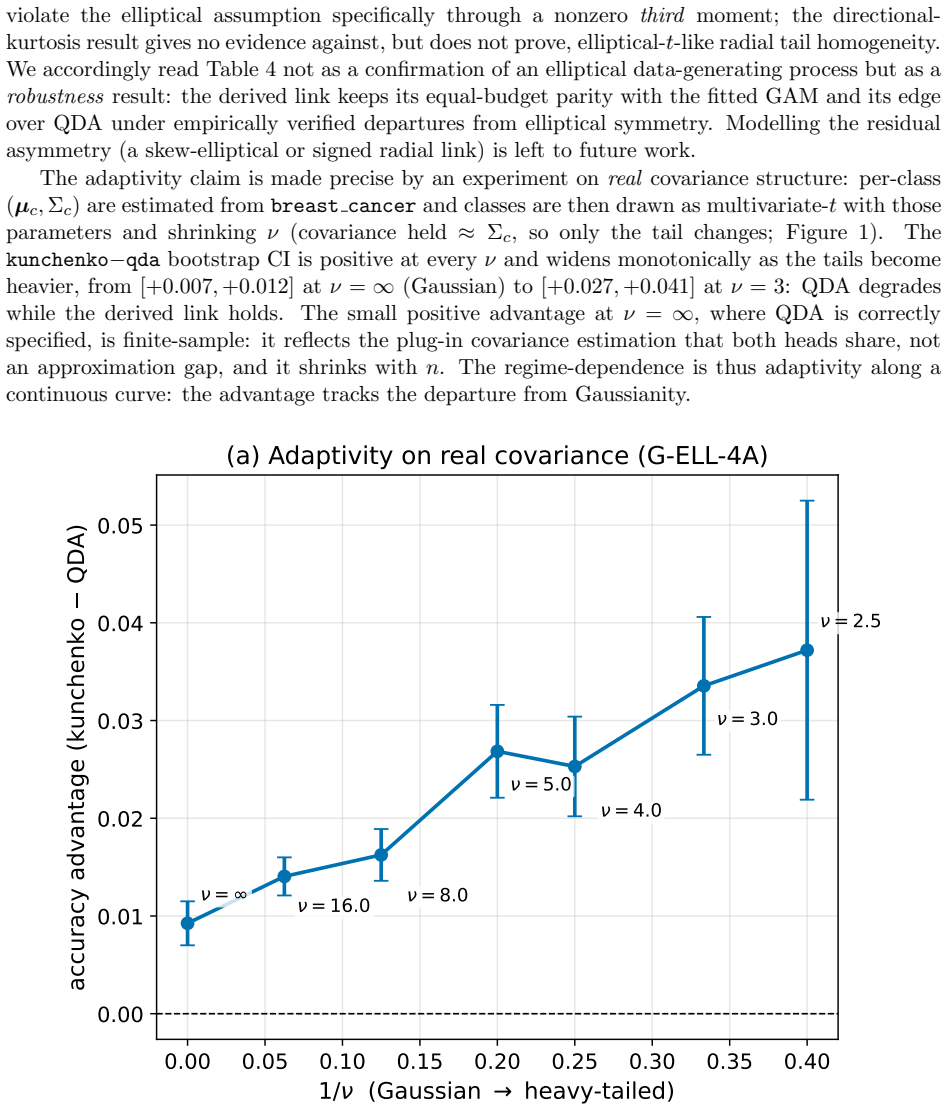
- Figure 1 caption: The x-axis label '1/ν (Gaussian → heavy-tailed)' is slightly ambiguous about direction; consider relabeling with an arrow or annotation.
- Table 3: The wine dataset is 3-class, but the paper's theory is for binary classification. The multinomial spline GAM is noted as a fixed-df fit, but a brief comment on how the binary theory extends (or does not) to the multi-class case would be helpful.
Simulated Author's Rebuttal
The referee raises three substantive points: (1) the gap between the proven regime (ν>6 for the full basis) and the empirical regime where headline results are obtained (ν∈(4,4.7)), (2) missing κ₂ entries in Table 2, and (3) conflation of comparators in the abstract. We agree with all three points and will revise accordingly. The core tension in (1) is real and already acknowledged in Table 5, but we agree the manuscript must state it more sharply and avoid any implication that the formal theory covers the headline empirical cells. For (2) and (3), we will fill the missing table entries and correct the abstract's attribution of confidence intervals to the correct comparators.
read point-by-point responses
-
Referee: §4.3, Theorem 5: The sieve approximation condition requires φ to belong to the L²(f_T)-closure of span{1, t^p : p→0+}. The paper certifies this for the pure log target via (t^p−1)/p → log t, but the dominated-convergence envelope against f_T is not verified for the Student-t link φ(t) = −(ν+d)/2 · log(1+t/ν). For heavy-tailed Student-t (small ν), the moment conditions needed for the full basis {1, 0.5, 1.5} require ν > 6 (Assumption 1(A1)), yet Table 5 maps the strongest empirical advantages (oil, S&P 500, JPY/USD) to ν ∈ (4, 4.7), where the p=1.5 term requires E[T^3] < ∞, i.e., ν > 6, which fails. The paper states that p=1.5 is retained as 'a regularized finite-sample feature outside the formal CLT,' but the headline empirical claims (Table 4) thus sit outside the proven theory. This is the central tension: the theory is sound within its scope, but the main empirical results are in areg
Authors: The referee is correct on the substance, and we accept the point. The gap between the proven regime (ν>6 for the full basis {1, 0.5, 1.5}) and the empirical regime where the headline QDA advantages appear (ν∈(4, 4.7)) is real. The paper does acknowledge this in §6 and Table 5, but the acknowledgment is not sharp enough relative to the prominence of the empirical claims in the abstract and §5.4. We will make the following revisions: (a) Add an explicit caveat sentence in the abstract noting that the strongest empirical advantages over QDA occur in a tail regime where the full-basis CLT does not apply, and that those results are empirical extensions rather than consequences of Theorem 4. (b) In §5.4, add a forward reference to Table 5 at the point where the oil, S&P 500, and JPY/USD results are introduced, making the regime boundary visible at the point of claim rather than only in the discussion. (c) Add a remark in §4.3 stating explicitly that the dominated-convergence envelope for the Student-t link φ(t) = −(ν+d)/2 · log(1+t/ν) against f_T is verified only for ν > 6 (full basis) and that below this threshold the sieve-approximation statement of Theorem 5 is not formally certified for the p=1.5 term. We note that the referee's report was truncated mid-sentence ('in areg'), but the thrust is clear and we address it as above. We also note that the sub-basis {1, 0.5} (p≤1) requires only ν>4, which covers the plug-in covariance and the p≤1 features; the p=1.5 term is the sole element outside the formal scope in the heaviest-tailed cells. The paper already states this in §6(ii) and Table 5, but we agree it must be stated more prominently and earlier. revision: partial
-
Referee: §5.2, Table 2: The table reports κ_2(t_4) = 0.95 but leaves κ_2 for t_{30}, t_8, and t_{2.5} as '—'. Since the captured fraction is the primary evidence that the fractional basis recovers the link (gate G-ELL-1/2), the missing entries weaken the gate. The paper should either fill these cells or explain why they are omitted. Additionally, the R²_lin values for t_{2.5} (0.009) suggest near-complete failure of the identity link, but no κ_m is reported to confirm the fractional basis recovers it, leaving the gate's second criterion unverifiable for the most heavy-tailed non-Gaussian example.
Authors: The referee is correct. The missing κ₂ entries in Table 2 are an omission, not a deliberate exclusion. We will fill all four cells (t_{30}, t_8, t_4, t_{2.5}) with the computed captured fractions. The t_{2.5} entry is particularly important, as the referee notes: R²_lin = 0.009 shows near-complete identity-link failure, and without a corresponding κ_m the gate's second criterion (fractional basis recovers the link) is unverifiable for the most heavy-tailed non-Gaussian example. We will compute and report κ₂(t_{2.5}) and, if the two-term basis does not achieve high captured fraction at ν=2.5, we will report κ_m for larger m so the gate is honestly assessed. We will also add a sentence explaining why the Gaussian case terminates at m=1 (the affine seed captures the link exactly), which is already noted in the text but should be explicit in the table caption. revision: yes
-
Referee: Abstract and §1 (Contributions C4): The abstract states the derived link is 'decisively better' on breast_cancer with CI [+0.009, +0.021] (global) and [+0.109, +0.136] (global+local). However, Table 3 reports kunchenko−ghosh as [−0.005, +0.003] for breast_cancer, which is a statistical tie. The [+0.009, +0.021] and [+0.109, +0.136] intervals appear to be against QDA and identity respectively, not against the fitted GAM. The abstract's phrasing conflates comparators and overstates the result relative to the fitted GAM, which is the primary comparator. The abstract should clarify which comparator each interval refers to, or the claim of being 'decisively better' should be attributed to the correct comparator.
Authors: The referee is correct. The intervals [+0.009, +0.021] and [+0.109, +0.136] in the abstract are not against the fitted GAM (ghosh); they are against QDA and the identity link respectively. Table 3 shows kunchenko−ghosh for breast_cancer as [−0.005, +0.003], which is a statistical tie. The abstract's phrasing 'decisively better on breast_cancer' immediately follows the sentence about the fitted GAM comparison, creating the impression that the intervals measure the derived link's advantage over the fitted GAM. This is a misattribution. We will revise the abstract to: (a) state explicitly that the derived link is in statistical tie with the fitted GAM on breast_cancer ([−0.005, +0.003]), (b) attribute the [+0.009, +0.021] interval to the comparison against QDA and the [+0.109, +0.136] interval to the comparison against the identity link, and (c) remove the word 'decisively' from the fitted-GAM context or reattribute it to the correct comparator. The same correction will be applied to Contribution C4 in §1, which currently uses the same conflation. We note that the abstract's claim of 'no significant loss relative to a tuned global GAM' is accurate and supported by Table 3; the error is specifically in attributing the QDA and identity-link intervals to the GAM comparison. revision: yes
Circularity Check
No significant circularity; self-citations are motivational, not load-bearing, and the derivation chain is self-contained.
full rationale
The paper's derivation chain proceeds as follows: (1) Proposition 1 is the log of the density ratio — acknowledged by the paper as 'near-definitional' and a restatement of Ghosh et al. (2025, Theorem 1). This is not circular; it is an algebraic identity. (2) Lemma 3 derives identifiability of φ from the radial density f_T via a standard change-of-variables in spherical coordinates — a genuine derivation, not a definition of φ in terms of itself. (3) Theorem 4 applies standard M-estimation theory (van der Vaart 1998) with generated-regressor corrections (Newey and McFadden 1994) to the logistic loss — standard external results, not self-cited. (4) Theorem 5 is a conditional sieve-approximation statement; the paper explicitly disclaims universality ('We do not claim universal L²(f_T)-completeness'). (5) Theorem 6 combines Theorems 4 and 5 via the standard plug-in excess-risk bound (Devroye et al. 1996) and the Lipschitz property of σ — again standard external results. The self-citations to Zabolotnii (2026c,d) are for the stochastic-polynomial apparatus and captured-fraction motivation, but the paper states explicitly: 'We use that captured-fraction view only to motivate the finite fractional-power projection; all identities and rates needed here are stated in the present paper.' The structural algebra (Propositions 1–2) is machine-checked in Lean 4 sorry-free, which per the analysis rules constitutes independent verification. The empirical claims (parity with GAM, advantage over QDA) are genuine comparisons: the derived link uses a fixed fractional-power basis while the comparator fits a data-tuned spline, both on the same radii — the prediction (parity at lower tuning cost) is not forced by construction. The skeptic's concern about the gap between the proven regime (ν > 6) and the empirical regime (ν ≈ 4–5) is a scope/correctness issue, not circularity — the paper is transparent about this gap (Table 5). The minor score of 2 reflects the self-citations to the author's own apparatus (2026c,d), which provide context but are not load-bearing for the mathematical results proven here.
Axiom & Free-Parameter Ledger
free parameters (2)
- Fractional powers p ∈ {1, 0.5, 1.5} =
Fixed set
- ℓ² ridge regularization =
Vanishing for asymptotics
axioms (4)
- domain assumption Elliptical class-conditional densities with shared radial generator g
- domain assumption Finite moments: E‖x‖⁴ < ∞ (ν > 4) for √n plug-in covariance
- ad hoc to paper Radial link φ belongs to L²(f_T) closure of span{1, t^p : p→0+}
- standard math Population risk has unique minimizer β⋆_m with nonsingular Hessian H_m
read the original abstract
We study binary classification under shared-generator elliptical class-conditional distributions. The log-likelihood ratio is an additive function of the two squared Mahalanobis radii, with radial link $\varphi=\log g$; QDA is recovered only when this link is affine. We derive the Bayes radial-link family from the within-class radius law and estimate it by a finite fractional-power stochastic-polynomial projection instead of tuning a generic spline. The link is identifiable from the radius law, the plug-in estimator is $\sqrt{n}$-consistent and asymptotically normal under finite-moment regularity conditions, and the induced classifier is asymptotically Bayes-optimal in an iterated sieve limit. The structural bridge, GAM membership, and identity-link/affine-generator dichotomy are verified in Lean 4 without unproven placeholders. Against the global Mahalanobis-GAM of Ghosh et al. (2025), reimplemented with mgcv REML splines at equal input budget, the derived link is never significantly worse on three UCI benchmarks and is decisively better on breast_cancer ($[+0.009,+0.021]$ global, $[+0.109,+0.136]$ global+local). Across six real financial series under temporal-dependence-robust validation, it is never significantly worse than the fitted GAM and is significantly better on three of five heavy-tailed series plus the light-tailed control. Relative to QDA, it improves the heaviest-tailed series (oil $[+0.024,+0.070]$, S&P 500 $[+0.038,+0.126]$, JPY/USD $[+0.009,+0.047]$) and ties elsewhere. A closed-form rate simulation corroborates the $\sqrt{n}$ rate and the predicted excess-risk dichotomy between QDA's approximation-limited floor and the derived link's vanishing excess risk. The contribution is no significant loss relative to a tuned global GAM without spline smoothing-parameter selection, plus improved accuracy over QDA where generator curvature matters.
Figures

Reference graph
Works this paper leans on
-
[1]
Journal of Multivariate Analysis 11, 368–385
On the theory of elliptically contoured distributions. Journal of Multivariate Analysis 11, 368–385. doi:10.1016/0047-259X(81)90082-8. Chen, X.,
-
[2]
A Probabilistic Theory of Pattern Recognition. Springer, New York. doi:10.1007/978-1-4612-0711-5. Fang, K.T., Kotz, S., Ng, K.W.,
-
[3]
The Canadian Journal of Statistics 18, 155–161
An efficiency result for the empirical characteristic function in stationary time-series models. The Canadian Journal of Statistics 18, 155–161. doi:10.2307/3315564. Feuerverger, A., Mureika, R.A.,
-
[4]
The Annals of Statistics , author =
The empirical characteristic function and its applications. The Annals of Statistics 5, 88–97. doi:10.1214/aos/1176343742. Fishbone, J., Mili, L.,
-
[5]
Journal of Multivariate Analysis 207, 105417
Classification using global and local Mahalanobis distances. Journal of Multivariate Analysis 207, 105417. doi:10.1016/j.jmva. 2025.105417. Ghosh, A.K., Chaudhuri, P.,
-
[6]
Scandinavian Journal of Statistics 32, 327–350
On maximum depth and related classifiers. Scandinavian Journal of Statistics 32, 327–350. doi:10.1111/j.1467-9469.2005.00423.x. H¨ ardle, W., Hall, P., Ichimura, H.,
-
[7]
The Annals of Statistics 21, 157–178
Optimal smoothing in single-index models. The Annals of Statistics 21, 157–178. doi:10.1214/aos/1176349020. Hastie, T., Tibshirani, R., Buja, A.,
-
[8]
Journal of the American Statistical Association , author =
Flexible discriminant analysis by optimal scoring. Journal of the American Statistical Association 89, 1255–1270. doi:10.1080/01621459.1994.10476866. Hastie, T.J., Tibshirani, R.J.,
-
[9]
Journal of Econometrics 58, 71–120
Semiparametric least squares (SLS) and weighted SLS estimation of single-index models. Journal of Econometrics 58, 71–120. doi:10.1016/0304-4076(93)90114-K. Kunchenko, Y.P.,
-
[10]
Journal of the American Statistical Association 107, 737–753
DD-classifier: Nonparametric classification procedure based on DD-plot. Journal of the American Statistical Association 107, 737–753. doi:10.1080/ 01621459.2012.688462. McLachlan, G.J.,
-
[11]
(Eds.), Handbook of Econometrics
Large sample estimation and hypothesis testing, in: Engle, R.F., McFadden, D.L. (Eds.), Handbook of Econometrics. Elsevier. volume 4, pp. 2111–2245. doi:10.1016/S1573-4412(05)80005-4. Ollila, E., Tyler, D.E., Koivunen, V., Poor, H.V.,
-
[12]
IEEE Transactions on Signal Processing 60, 5597–5625
Complex elliptically symmetric distri- butions: Survey, new results and applications. IEEE Transactions on Signal Processing 60, 5597–5625. doi:10.1109/TSP.2012.2212433. Pagan, A.,
-
[13]
Inter- national Economic Review 25, 221–247
Econometric issues in the analysis of regressions with generated regressors. Inter- national Economic Review 25, 221–247. doi:10.2307/2648877. Peel, D., McLachlan, G.J.,
-
[14]
Statistics and Computing 10, 339–348
Robust mixture modelling using thetdistribution. Statistics and Computing 10, 339–348. doi:10.1023/A:1008981510081. Tyler, D.E.,
-
[15]
The Annals of Statistics , author =
A distribution-free M-estimator of multivariate scatter. The Annals of Statistics 15, 234–251. doi:10.1214/aos/1176350263. van der Vaart, A.W.,
-
[16]
Asymptotic Statistics. Cambridge University Press, Cambridge. Zabolotnii, S., 2026a. Generalized stochastic approximation of the log-likelihood ratio for robust sequential change-point detection.arXiv:2605.23419. Zabolotnii, S., 2026b. Moment-free Kunchenko stochastic polynomials via empirical characteristic function.arXiv:2606.16289. Zabolotnii, S., 2026...
work page internal anchor Pith review Pith/arXiv arXiv doi:10.21203/rs.3.rs-10226291/v1
-
[17]
AI4SLT: Empirical processes in Lean 4 for formal statistical learning theory.arXiv:2602.02285. 19
work page internal anchor Pith review Pith/arXiv arXiv
discussion (0)
Sign in with ORCID, Apple, or X to comment. Anyone can read and Pith papers without signing in.